Exploring my Options

I feel like, even though I have had a fairly clear overall direction for my topic from the very beginning, I always thought that the perfect idea for a more specific research question will come to me as I learn more about the topic. 

Well, that still has not happened and I’m beginning to stress out a bit. So, this blog post is my effort to sort through my own brain and figure out what I want to work on for the next 6 months. I know, this isn’t the type of scientific, perfectly cited content expected of these blogposts, but I promise, as soon as I have figured out what topic I want to write those perfectly researched texts about, I will put all my effort into it. 

I will use this blog post to create a comprehensive list of topic ideas I have had so far, a possible research question, an overview of the topic and what possible pros and cons would be.

Documentaries and Environment/Responsible Tourism

Possible Research Questions: How can documentary film function as a form of environmental communication in the context of sustainable tourism?
In what ways can documentary storytelling influence audience perceptions of responsible tourism?
To what extent can visual media foster behavioral change toward more sustainable travel?

Overview: I would explore the overall topic of environmental documentary films, how they are structured, which storytelling tools they use and how they can shape people’s views and behaviours. Maybe I could also talk about environmental communication and sustainable tourism in general and then do a deep dive on documentaries on the topic. 
With the second research question, my focus could also maybe be more on documentary storytelling in general, and then later applying it to the topic of responsible tourism.

Methods: I would first off look for literature on the topic, exploring the state of the art as well as past research and then analyse different enivronmental documentaries amongst other forms of media on how they aim to instill a desire for change in their viewers. A qualitative analysis on actual effects of these pieces of media would also be interesting, I am however not sure how I would approach this task. 

Pros: The theoretical part of my thesis would tie nicely into and prepare me for my practical project next semester, where I could apply what I learned about environmental documentaries to my own work. 

Cons: I have not yet been very successful in finding a lot of literature on the topic, which is why I am afraid I might not be able to amass enough knowledge on the topic in order to analyse and judge the pieces of media accurately. Moreover, I do not know if analysing different pieces of media alone would be enough of a scientific method for my master’s thesis.

Entschleunigung / Slow Media = Slow Travel?

Possible Research Question: How can media design interventions based on slow media principles encourage slower, more mindful, and sustainable forms of travel?

Overview: I was intrigued by the idea of connecting the slow media and the slow travel movements, exploring how travel content promoted via slow media might encourage slower and more conscious travel alongside a more conscious media consumption. 
In a world, where everything just gets faster and faster, many have recognized a need to slow down in their lives. This desire for a more conscious and more sustainable life is the most pressing on social media, where content just keeps getting faster and shorter, and in travel, where short and frequent holidays by plane, visiting every major sightseeing or insta spot are more popular than ever. 

Methods: I would again look into current research on the topic (if there is any) and explain the issues of our fast paced world, both on social media, in the fashion or food industry and in the travel sector. I would then talk about the slow media and slow travel movements and on what principles they operate, maybe finding some examples to analyse. I could also imagine creating a survey to see what the overall opinion on our fast-paced society looks like and whether the need for slower living truly exists.
In order to connect slow media to slow travel, I might be able to analyse examples or create different versions of media to compare in the survey. 

Pros: As far as I have seen, creating the connection between slow media and slow travel has not been done too often before, meaning the thesis might have some originality to it. I also feel like the documentary I want to create would tie well into the slow media idea, even if I would not be talking about documentaries specifically in my work. 

Cons: I have struggled a bit to find literature on the topic, or on slow media in general. Moreover, I am afraid that the term and the idea of “Slow Media” are not scientifically based enough to write a whole thesis on the topic. So, the whole thesis might become a bit too abstract, straying from clear-cut scientific writing too much.

Portraying Conflict in Documentaries

Possible Research Question: How do documentary filmmakers’ audiovisual and ethical decisions shape the representation of conflicting standpoints and influence viewers’ perceptions of fairness?

Overview: For this topic I would explore the topic of conflict in documentaries and how filmmakers can assure that their final work includes enough tension and conflict without harming any of the participants. Here, ethics would also come into play and would need to be talked about in depth. Portraying contrasting ideas and viewpoints is a common occurrence in documentary films and I would like to explore the different ways this task can be approached. In the case of my documentary this conflict would be between sustainable travel and the booming tourism industry, causing overtourism. Maybe conflicts could also arise between tourists and locals affected by them. 

Methods: As with the other topics, literature research would be at the start of my thesis, exploring how storytelling can work in documentaries, which role ethics play in planning and creating a documentary film and the different ways conflict can be addressed. I would also analyse different documentaries, looking at which conflicts appear and how they are treated. 

Pros: Doing a deep dive into how conflicts can be used to tell a story and dealt with in an ethical way can be good preparation for my own documentary project next semester. Also Daniel Bauer suggested this topic to me, so I feel a bit more secure about the fact that this would be an actually feasable topic people would want to read about.

Cons: Throughout the last week I have tried to find literature on the topic of conflict in documentaries and almost every search result that came up had something to do with political conflicts or war and documentaries about that, which is not really my aim for the thesis. Like with the other topics, I am kind of afraid that I won’t be able to find a lot of scientific literature on the topic. 

Conclusion

Some small part of me was hoping that, after writing all of this down and getting it out of my head and onto paper, I would see it clearly which topic is the right one. That is not quite the case, I’m still as indecisive as ever. Nonetheless, I feel like this blog post has given me some tangible bulletpoints to orient myself at and, maybe more importantly, it has shown me apects I am still unsure about with every topic, where I can ask targeted questions to my professors. So I am hopeful that by the next blog post I will have finally made a decision!
#1 How Cinematographic Techniques Shape the Emotional Experience of the Viewer

Meine Thema für die folgenden Blogposts ist das Zusammenspiel von Kameratechniken um Figuren oder Szenen im Film greifbarer und emotionaler zu gestalten.
Als erstes werfen wir einen Blich auf die Terminologie und anschließend was Kinematografie so ausmacht.

In der Filmwissenschaft treffen Praxis und Forschung oft aufeinander. Ein gutes Beispiel dafür ist die Frage, wie Kinematografie – also Lichtsetzung, Kamerabewegung, Bildkomposition und die Wahl der Optiken – unsere Wahrnehmung eines Films prägt. Viele Regeln stammen zwar aus jahrzehntelanger künstlerischer Praxis, lassen sich heute aber zunehmend durch Erkenntnisse aus Psychologie und Neurowissenschaften erklären.

Empathie: Wie Filme Gefühle auslösen

Die moderne Empathieforschung unterscheidet drei Ebenen des Mitfühlens:

  • Emotionales Mitfühlen (Embodied Simulation) – wir spüren, was Figuren fühlen.
  • Kognitives Mitfühlen (Theory of Mind) – wir verstehen ihre Perspektive.
  • Prosoziale Motivation – wir wollen ihnen helfen. (Zaki & Ochsner, 2012)

Studien zeigen, dass filmische Mittel, etwa Einstellungsgrößen, Nähe/Distanz oder Perspektivwechsel, beeinflussen, ob das Publikum eher emotional eintaucht oder intellektuell mitdenkt.

Kinematografie als Gestaltung von Raum

Ein zentrales Anliegen professioneller Kinematografie ist die Erzeugung von Tiefe und räumlicher Wahrnehmung. Denn obwohl Film eine dreidimensionale Welt auf eine zweidimensionale Fläche projiziert, entsteht im Kopf des Publikums dennoch ein überzeugendes Raumgefühl. Deshalb ist es wichtig die Dreidimensionalität zu bewahren und sogar noch zu verstärken.

Kameraleute versuchen dies seit über 100 Jahren. Gewisse Regeln werden von Generation zu Generation weitergegeben, ohne Erklärung warum diese Regeln entwicklet wurden oder warum diese existieren. Wenn man sich diese Regeln genauer ansieht, erkennt man dass diese aktiv daran beteiligt sind größere Tiefe in Bildern zu schaffen:

  • Vorder, -Mittel, Hintergrund: 3 dimensionales Bild durch Komposition
  • Chiaroscuro / Checkerboard Lighting: Hell-Dunkel-Kontraste verstärken Tiefenwirkung.
  • Gegenlicht und Konturenlicht: helfen dem Gehirn, Vorder- und Hintergrund zu trennen.
  • Pools of Light: Lichtinseln definieren unterschiedliche Raumebenen.
  • Lighting in Layers: Lichtschichten schaffen Orientierung im Bild.
  • Short Lighting / Far-Side Key: Erhöht die räumliche Präsenz.

Diese Methoden bedienen sogenannte monokulare Tiefenhinweise, also visuelle Signale, die unser Gehirn nutzt, um aus einem flachen Bild eine dreidimensionale Szene zu rekonstruieren.

Warum Tiefe so entscheidend ist

Kinematografie erzeugt nicht nur ästhetisch ansprechende Bilder – sie nutzt unbewusste Wahrnehmungsprozesse, um das Publikum im Raum einer Geschichte zu verankern. Tiefenwirkung schafft Orientierung, Glaubwürdigkeit und emotionale Bindung.

Deshalb hat sich die Erzeugung räumlicher Tiefe über Jahrzehnte hinweg fast zu einer eigenen Kunstform entwickelt und bleibt bis heute ein zentrales Werkzeug, um Zuschauer*innen in die Welt eines Films hineinzuziehen. Jetzt stellt sich die frage warum es zu einer Obsession geworden ist, Tiefe zu erzeugen?

Neuere neurowissenschaftliche Forschung weist darauf hin, dass die Wahrnehmung von Raum und die Entstehung emotionaler Empathie enger miteinander verbunden sein könnten, als bisher angenommen. Eine zentrale Rolle spielt dabei die Amygdala. Studien mit Menschen und Primaten zeigen, dass die Amygdala nicht nur emotionale Bedeutung bewertet, sondern diese Bedeutung auch mit räumlichen Informationen verknüpft. Dadurch reagiert das Gehirn schneller und intensiver auf räumlich klar verortete Reize, insbesondere wenn diese als emotional bedeutsam gelten.

Realer Raum besitzt Tiefe, und wir nehmen ihn wahr, indem wir alle verfügbaren Tiefenhinweise nutzen. Wenn Bewegtbilder diese Tiefe durch kinematografische Techniken verstärken und ein intensiviertes Gefühl von Räumlichkeit erzeugen, können sie wie ein supernormaler Stimulus wirken und die dargestellte Realität für die Zuschauerinnen und Zuschauer noch kraftvoller oder gesteigerter erscheinen lassen. (Ramachandran & Hirstein, 1999)

Literatur

Lotman, E. (2016). Exploring the ways cinematography affects viewers’ perceived empathy towards onscreen characters. Baltic Screen Media Review, 4(1). https://doi.org/10.1515/bsmr-2017-0005

Ramachandran, V. S., & Hirstein, W. (1999). The science of art: A neurological theory of aesthetic experience. Journal of Consciousness Studies, 6(6–7), 15–51.

Zaki, J., & Ochsner, K. N. (2012). The neuroscience of empathy: Progress, pitfalls and promise. Nature Neuroscience, 15(5), 675–680.

#3 Understanding Aesthetic Variables

The paper “Abstract Shape Aesthetics: Contour, Complexity, Motion, and Individual Variability” (Soranzo et al., 2024) as mentioned in the previous blogpost, breaks aesthetics down into three key variables: contour, complexity, and movement. These variables help researchers understand how we respond to very simple, abstract shapes that carry no specific meaning for us. What I do like about this kind of approach is that there is a separation between aesthetics into its different parts. The focus will now lie on what these different variables mean but also how the study measured them and what these results say about the foundation of visual preference.

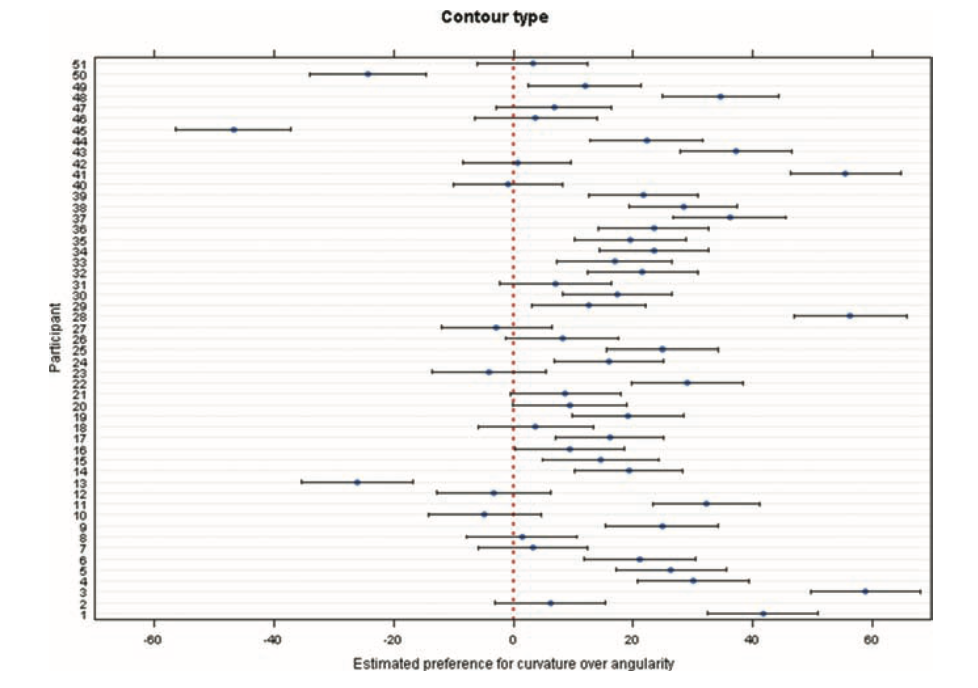
One of the first variables is contour. Where the shape edges, curved versus angular. In our daily life, we tend to already associate curved things with softness, smoothness, or safety, and angular things with sharpness or tension. The study confirms this pattern: participants preferred curved shapes over angular ones. This matches earlier research mentioned in the paper, which also found a strong preference for curved contours. The exact reason remains debated. Some theories suggest angular shapes trigger avoidance responses because they can signal danger. Others propose that curved shapes feel more natural to us, connecting to shapes we encounter in the environment.

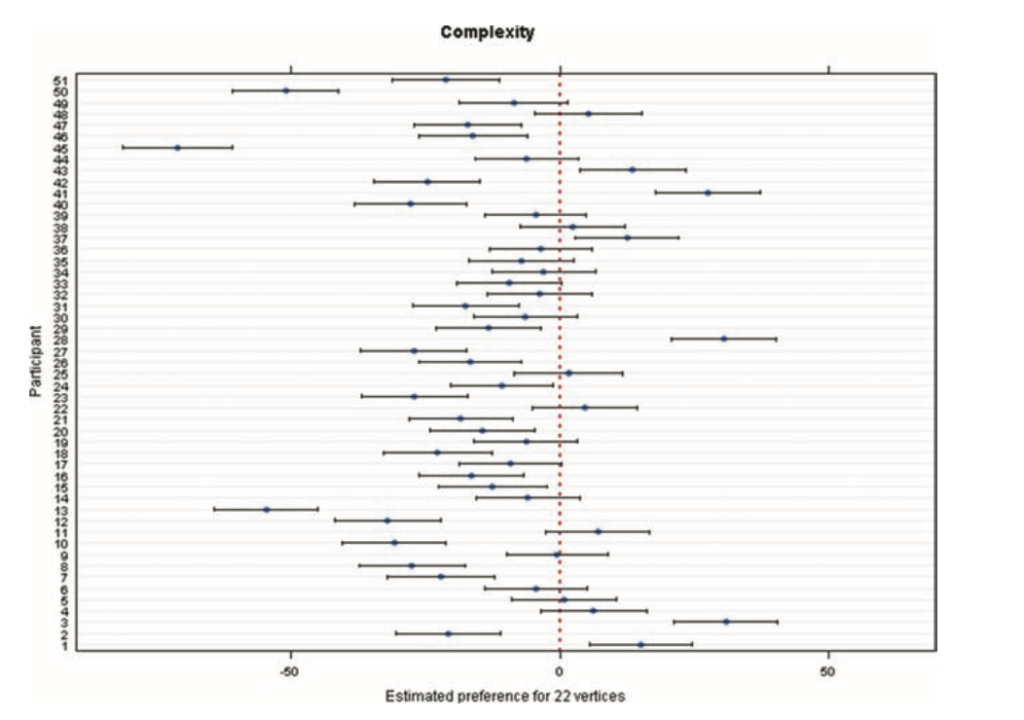
The second variable, complexity, turned out to be more surprising. The study defines complexity through the number of vertices: six for simple shapes, 22 for complex ones. Complexity is already a controversial topic in aesthetic research. Some theories argue that complexity increases interest, while others suggest simplicity is more appealing because it requires less cognitive effort. In this study, participants clearly preferred simpler shapes. The authors describe this as an effect of simplicity. However, they also acknowledge that previous studies have found more mixed or even opposite patterns, depending on how complexity was defined from the beginning. This suggests complexity is not a single variable but a cluster of different visual features. For example, the paper “Visual Complexity: A Review” (Donderi, 2006) highlights that visual complexity which has been studied across many domains. It looks at how judgments of complexity relate to multiple factors such as amount of detail, predictability, symmetry, and perceptual load. One of Donderi’s key points in his work is that our perception of complexity is very tightly linked to its predictability. Images or shapes that have a more clear and regular pattern, like symmetrical shapes, often feel less complex. On the other hand, unpredictable shapes or compositions feel more complex to us because our visual system cannot easily understand or “compress” them into simple rules. This claim is also supported by the idea that our brain constantly tries to reduce incoming information into simple structures. However, when that is not possible, we perceive it as complex.

The third variable, movement, examined whether rotation or expansion would change how people rated the shapes. The interesting part is that movement did not affect aesthetic ratings. There were also no individual differences. This stands in contrast to contour and complexity, where people varied a lot. But for movement, the participants agreed that it didn’t have a special effect on them. This might mean movement simply does not influence aesthetic judgments for this type of shape. Or it might mean that the study design removed all the expressive value that movement normally carries. My main takeaway is that movement is not a universal aesthetic enhancer. When a shape is abstract and meaningless, adding rotation or expansion does not automatically make it more beautiful. Aesthetic impact depends on context and on the meaning we attach to motion.

Overall the reseach shows that aesthetic judgment are shaped by basic visual features like contour, complexity and movement. Even if movement does not play such a major role for abstract shapes. Simplicity, predictability and visual structure do have a great influence on beauty more that it might have been expected. 

Bibliography

Donderi, D. C. (2006). Visual Complexity: A Review. Psychological Bulletin132(1), 73–97.

Soranzo, A., Bertacchini, F., & Bertamini, M. (2024). Abstract Shape Aesthetics: Contour, Complexity, Motion, and Individual Variability. Art & Perception12(3), 240–263. https://doi.org/10.1163/22134913-bja10057

#2 What Abstract Shapes Teach Us

When we talk about aesthetics, most people immediately think of art, design, or familiar objects. Things that we recognize and know. Things that carry memories and meaning. That’s why it feels almost strange to learn that an entire field of research focuses on the opposite: abstract, meaningless shapes. No symbolism and. No cultural context. 

In Abstract Shape Aesthetics: Contour, Complexity, Motion, and Individual Variability (Soranzo et al., 2024), the authors highlight why such stripped-down stimuli are so powerful. They write that studying shapes “devoid of meaning or familiarity” helps us understand how visual perception can work and how we experience art on a basic level. To me, this hints at something fundamental, that we might not need cultural knowledge to experience beauty. Some aesthetic responses might be built into how our visual system works.

Abstract Shapes as a Window Into “Raw” Perception

Abstract shapes let researches look at how we react to visuals before meaning steps in. For example, the moment we recognize a face, an animal, or a symbol, our brains automatically activate memories, emotions, and cultural knowledge. That’s also why psychologists often try to remove context, to find out what features alone can trigger an aesthetic preference.

This study took that idea and looked at it more closely. The researchers used abstract, meaningless shapes presented on a computer screen, ensuring that nothing could be interpreted as a known object. This creates a laboratory-like condition: a clean space where only visual properties matter.

And even when shapes have no meaning they can still influence us: 

  • Curves often feel soft, friendly, or organic
  • Angles can feel sharp, dynamic, or even threatening
  • Simple shapes can feel calm or elegant
  • Complex shapes can feel chaotic or energetic
  • Motion — expansion, rotation — can feel looming, playful, or mechanical

We respond emotionally to form long before meaning steps in.

A Long Tradition: Fechner and the Quest to Measure Aesthetics

What I find fascinating is this very modern study can be connected to something very old. Already in 1876, Gustav Fechner believed that aesthetics could be studied scientifically and that the best way to do this was through neutral stimuli. Here the authors explicitly link their work to Fechner’s idea that studies of beauty should start with simple, context-free shapes.

This does leave me torn. On one hand, it’s exciting to think that beauty isn’t purely subjective. On the other hand, I love the messy, emotional, culturally shaped side of aesthetics. Beauty is not only “perception”; it’s also memory, narrative, and identity.

New Insights: Individual Differences Matter

One of the most interesting results becomes visible when looking at individuals instead of a whole group of averages. The overall trends were very clear: 

  • People preferred curved over angular shapes
  • Simple over complex shapes
  • And within this experiment movement didn’t create a strong preference 

But when researches looked at each individual the results changed. Especially when contour type and complexity interacted the preferences varied a lot from person to person. This reminds us that even the most basic perceptual preferences are not universal. Even before meaning enters the picture, humans differ.

The study shows that many of our aesthetic responses may be deeply rooted in the visual system itself. Abstract shapes make these foundations visible. But for me, abstract shapes standing alone are not fully satisfying. They reveal mechanisms, not emotions. Perception, not meaning. Preference, not experience. However what I can take away form this is that abstract shapes help us understand how we process beauty, but only context explains why something truly touches us.

Bibliography:

Soranzo, A., Bertacchini, F., & Bertamini, M. (2024). Abstract Shape Aesthetics: Contour, Complexity, Motion, and Individual Variability. Art & Perception12(3), 240–263. https://doi.org/10.1163/22134913-bja10057

Die Rolle des Lichts im Sakralraum

Gespräch mit D. Bauer

Im Rahmen des Kurses Design and Research 3 fand ein gemeinsames Reflexionsgespräch mit D. Bauer statt. Bauer verfügt über umfassende Erfahrung im Bereich medialer Gestaltung und Produktionsprozesse. Während einer intensiven halbstündigen Sitzung bot er uns die Gelegenheit, die eigenen Masterarbeitskonzepte kritisch zu beleuchten und inhaltliche Schwerpunkte zu präzisieren.

Für mich war dieses Gespräch besonders wertvoll, da ich mich bis dahin schwer tat, den theoretischen Kern meiner Masterarbeit klar zu fassen. Mein ursprünglicher Ansatz beschäftigte sich mit der Frage, wie der kulturelle oder religiöse Raum die Wahrnehmung eines Videomappings beeinflusst, insbesondere in Kirchen oder Kapellen. Obwohl mich das Thema von Beginn an faszinierte, war es in seiner formulierten Form noch relativ breit und theoretisch schwer greifbar.

Licht als zentrales Medium im sakralen Raum

D. Bauer reagierte positiv auf meinen Ansatz und riet mir, ihn nicht aufzugeben, sondern konzeptionell zu schärfen. Seine wichtigste Empfehlung bestand darin, das Thema stärker auf den Begriff Licht zu fokussieren. Dieser Hinweis eröffnete eine neue Perspektive:

  • Kirchen sind seit Jahrhunderten lichttheologisch und lichtarchitektonisch aufgeladen.
  • Licht besitzt in sakralen Kontexten eine symbolische, atmosphärische und spirituelle Funktion.
  • Architektur und Lichtführung sind in Kirchen untrennbar miteinander verbunden.
  • Videomapping ist letztlich geformtes und gelenktes Licht, das eine räumliche Bedeutung erzeugt.

Damit ergibt sich eine klarere Forschungsfrage:

Welche Rolle spielte und spielt Licht im sakralen Raum – und wie verhält sich künstliches Licht (Videomapping, Projektion) im Vergleich zu historischem, natürlichem oder spirituellem Licht?

Bauer betonte, dass diese Fragestellung sowohl kulturgeschichtlich anschlussfähig sei als auch eine solide Verbindung zum praktischen Teil meiner Arbeit ermögliche.

Überfrachtung vs. Reduktion

Im Gespräch schilderte ich Bauer eine persönliche Erfahrung: Bei einer Videomapping-Ausstellung in Wien empfand ich die Inszenierung in einer katholischen Kirche als ästhetisch überladen. Kirchen besitzen bereits eine sehr dichte visuelle Struktur – Skulpturen, Fresken, Altäre, Ornamente. Das Hinzufügen intensiver Farben und schnell wechselnder Bilder wirkte künstlich und störend.

Sakrale Räume sind keine neutralen Projektionsflächen. Vielmehr besitzen sie eine jahrhundertelange ikonografische und atmosphärische Tradition.

Daraus ergab sich für mich eine wichtige Erkenntnis:

Videomapping im sakralen Raum muss nicht laut und farbintensiv sein. Es kann auch als reduziertes Lichtmapping funktionieren – etwa mit weißem Licht, das architektonische Elemente subtil hervorhebt.

Damit wird Projektion zu einer Art zeitgenössischer Lichtliturgie, die bestehende Architektur kommentiert statt überlagert.

Die Andräkirche Graz – ein potenzieller Ausstellungsort

© dibk.at

Besonders wichtig war Bauers Hinweis auf die Andräkirche in Graz. Diese Kirche ist bekannt für ihre experimentelle Offenheit gegenüber zeitgenössischer Kunst. Über Jahre hinweg war Hermann Glettler, heute Bischof von Tirol, dort tätig. Er prägte die Andräkirche maßgeblich, indem er sie ab 1999 zu einem Ort machte, an dem moderne Kunst, performative Formate, mediale Installationen und liturgischer Raum miteinander in Dialog treten.

Glettler vertritt die Auffassung, dass Kirchenräume nicht museal erstarren dürfen, sondern als lebendige kulturelle Räume fungieren sollen. Er öffnete St. Andrä bewusst für Projekte, die Grenzen verschieben – darunter Lichtkunst, politische Kunst, interdisziplinäre Performances und mediale Interventionen.

Für meine Masterarbeit eröffnet dies eine äußerst spannende Möglichkeit:

Warum die Andräkirche ideal wäre

  • Sie verbindet sakrale Tradition mit zeitgenössischer Experimentierfreude.
  • Sie ist architektonisch reich und atmosphärisch intensiv.
  • Es existiert dort eine bereits etablierte künstlerische Infrastruktur.
  • Der Raum ist kulturgeschichtlich bedeutungsvoll und zugleich medienkunstfreundlich.
  • Sie wäre ein realer Kontext, um die Rolle von künstlichem Licht im religiösen Raum zu untersuchen.

Die Andräkirche könnte damit ein Ort für meinen praktischen Masterarbeits-Teil werden.

Literaturrecherche und theoretische Grundlage

Seit dem Gespräch habe ich begonnen, systematisch Literatur zum Thema Licht im sakralen Kontext, Atmosphäre, architektonische Lichtführung und Wahrnehmung zu sammeln. Dabei sind mehrere Quellen besonders relevant für die theoretische Fundierung meiner Masterarbeit.

Folgende Bücher habe ich während meiner bisherigen Recherche gefunden und sie könnten einen wesentlichen Beitrag zum theoretischen Teil meiner Arbeit liefern:

Baukunst aus Raum und Licht: Sakrale Räume in der Architektur der Moderne (Zahner 2012).
Diese Publikation untersucht, wie moderne sakrale Architektur Licht als konstitutives Gestaltungselement einsetzt. Besonders relevant ist die Verbindung zwischen spiritueller Bedeutung und architektonischer Lichtdramaturgie.

Architektur und Atmosphäre von Gernot Böhme (2013).
Böhmes Konzept der Atmosphäre bietet eine theoretische Grundlage, um zu analysieren, wie Licht Stimmung, Raumwirkung und Wahrnehmung erzeugt. Für die Untersuchung sakraler Räume ist dieses Werk theoretisch zentral und methodisch richtungsweisend.

The Design of Lighting von Peter Tregenza und David Loe (1998).
Dieses Buch liefert einen technisch fundierten, gestalterischen und wahrnehmungspsychologischen Überblick über Lichtgestaltung. Besonders wertvoll ist seine praxisorientierte Herangehensweise, die sich gut auf Projektionstechnik, Videomapping und architektonische Lichtführung übertragen lässt.

Licht–Räume: Die Kunst architektonischer Beleuchtung (Zumtobel Staff 1998).
Diese Publikation analysiert Lichtführung anhand realer Architekturprojekte und verbindet technische Erkenntnisse mit ästhetischen Überlegungen. Gerade für die Frage nach der Funktion künstlichen Lichts im sakralen Raum ist sie von großer Bedeutung.

Farbe und Licht: Symbolik bei Aleksandr Blok von Johanne Peters (1981).
Obwohl literaturwissenschaftlich orientiert, bietet dieses Werk eine tiefgehende Analyse der symbolischen Bedeutung von Licht. Es eignet sich daher für theoretische Querverweise und unterstützt die Untersuchung von Licht als kulturellem Bedeutungsträger.

Diese Literatur bildet gemeinsam ein solides Fundament, um die Rolle des Lichts sowohl historisch, ästhetisch als auch atmosphärisch zu verstehen – und um künstliches Licht (Mapping, Projektion, Weißlichtintervention) differenziert in den Kontext sakraler Räume einzuordnen.

Bildnachweise (Chicago Style)

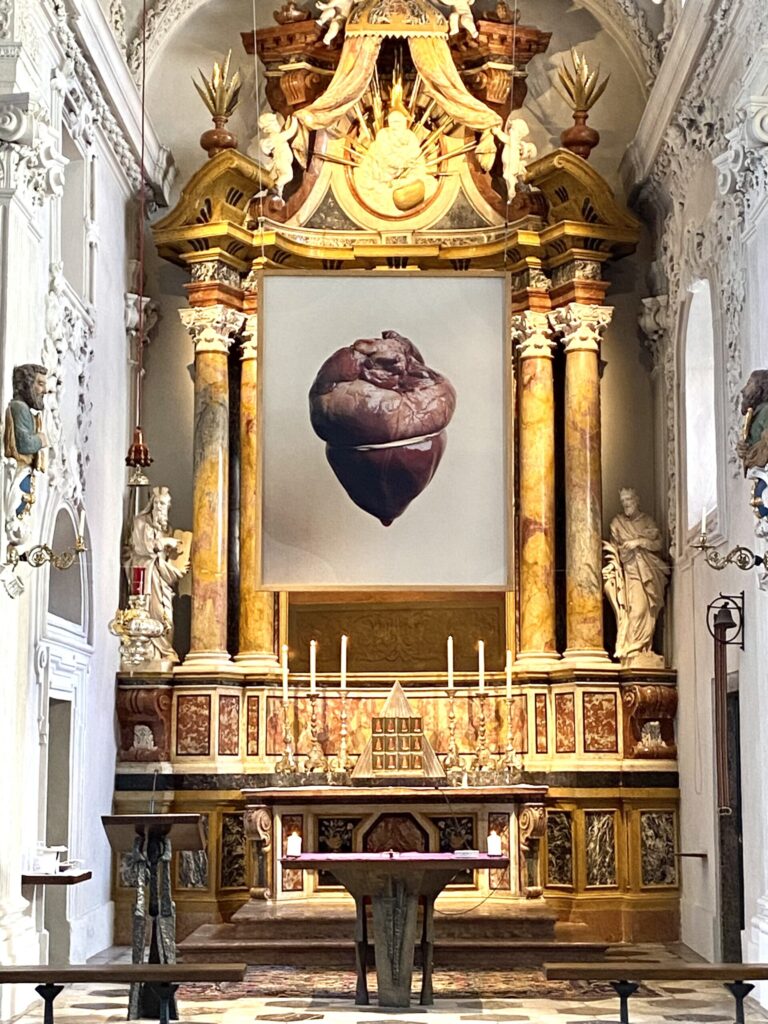
Bild 1 – Herz-Installation im Altarraum

Bildquelle: Kath.ch. 2023. „Bischof Glettler zu Herz im Altarraum: Im Lärm ging eigentliches Thema fast unter.“
© Kath.ch / Diözese Innsbruck / Fotograf: unbekannt.
Accessed February 2025.
https://www.kath.ch/newsd/bischof-glettler-zu-herz-im-altarraum-im-laerm-ging-eigentliches-thema-fast-unter/

Literaturverzeichnis (Chicago Author–Date)

Stadt Graz. 2020. Kirche St. Andrä – Kunst am Bau.
Accessed February 2025. https://www.graz.at/cms/beitrag/10271682/7776088

Kath.ch. 2023. „Bischof Glettler zu Herz im Altarraum: Im Lärm ging eigentliches Thema fast unter.“
Accessed February 2025.
https://www.kath.ch/newsd/bischof-glettler-zu-herz-im-altarraum-im-laerm-ging-eigentliches-thema-fast-unter/

Böhme, Gernot. 2013. Architektur und Atmosphäre. München: Fink.

Peters, Johanne. 1981. Farbe und Licht: Symbolik bei Aleksandr Blok. Frankfurt am Main: PH02.
https://directory.doabooks.org

Tregenza, Peter, und David Loe. 1998. The Design of Lighting. London: Spon Press.

Zahner, Walter, Hrsg. 2012. Baukunst aus Raum und Licht: Sakrale Räume in der Architektur der Moderne. Lindenberg: Kunstverlag Fink.Zumtobel Staff. 1998. Licht–Räume: Die Kunst architektonischer Beleuchtung. Dornbirn: Zumtobel Staff.


Hinweis zur Verwendung von KI-Tools

Zur sprachlichen Optimierung und für Verbesserungsvorschläge hinsichtlich Rechtschreibung, Grammatik und Ausdruck wurde ein KI-gestütztes Schreibwerkzeug (ChatGPT, OpenAI, 2025) verwendet.

Seeking Conflict Ethically

In this blog post, I will be analyzing the article Dramatic Conflict in Documentary How to Build it Safely? published in 2023 and written by Andrei Tache-Codreanu (Tache-Codreanu, 2023, pp. 473–478). The text talks about how in order for a documentary film to be compelling and catching, as all films and stories, it needs to have a conflict consisting of a protagonist and opposing antagonistic forces, working against the protagonist (Tache-Codreanu, 2023, p. 473).

In documentaries however, seeking this type of conflict might create ethical dilemmas as the subjects being filmed and observed are real-life people with real problems, for whom the experience of being put onto a screen might be (re-)traumatizing.
Tache-Codreanu describes how, many times, talking to a camera can lead participants to reveal far more than they had intended initially intended, making them very vulnerable. Documentary filmmakers need not lose sight of that when chasing their perfect story (Tache-Codreanu, 2023, pp. 474–475).

In chapter 2 of his article Tache-Codreanu describes the parallels documentaries bear to psychoanalysis in the way that patients or, in the case of a documentary, participants wish to have an opportunity to have their story heard by someone empathetic and respectful, who will ideally help them understand it better by having someone reflect the story back to them in a broken down and simplified way. The main difference between the two would be that documentary filmmakers do not have the participant’s healing process as their highest aim, it might just be a lucky side effect of their main goal: creating a captivating and interesting piece of media. This discrepancy between participants feeling like they will achieve some healing or closure by revealing some potentially traumatic information and the filmmaker possibly only aiming at getting an intriguing story, whatever it takes, might lead to an exploitation of the participant’s trauma when filmmakers push too hard. This is why Tache-Codreanu describes that, like in psychoanalysis, conversations in documentaries should be able to flow freely without being forced (Tache-Codreanu, 2023, p. 475).

Nonetheless, even when the interview situation itself is pleasant and freeing for the participants, Tache-Codreanu talks about how seeing themselves in the finished product can lead to anxiety if the participants do not recognize their doppelganger on the screen. This separation between their perceived self and what the editing process and style of the documentation have made of them can cause a great deal of pain and trauma for the film’s subjects. This is why Tache-Codreanu making participant’s also feel included in the rest of the creative process, giving them a certain amount of control over the version of themselves they are going to show the world. This collaborative approach can look like explaining the different steps of the filmmaking process, including the film team and equipment, making the participants feel as a part of the team, but can also go so far as to ask creative input from them for how they want the documentary to look and feel like. This inclusion would help people feel not as test subjects to be studied under a microscope, but as active participants and proud part of the production, thus aiding in making them feel more comfortable with the results, even if deeply traumatic topics are treated. One method by Rosenthal, which Tache-Codreanu described is having a sort of warm-up phase before the actual interview starts where he just talks to the participant, maybe having a cup of tea and introducing the crew as well as the equipment and process, before the actual interview begins (Tache-Codreanu, 2023, pp. 476–477).

Tache-Codreanu concludes that in order to create meaningful and ethical documentaries that still tell captivating stories about real people, it is never a good idea to force answers out of the participants or edit the footage in a way that makes it seem more enticing, but less real. He says that truly moving stories come from a collaboration between filmmaker and film subjects where there are mutual trust and openness. Creating a safe space is the best method for getting honest and raw stories and letting participants have a say in the finished product assures a harmonious and ethical collaboration. Documentary filmmakers are wholly dependent on the stories they are told, so it is of utmost importance to treat those who tell these stories with care and respect (Tache-Codreanu, 2023, pp. 477–478).

Source:

Tache-Codreanu, A. (2023). Dramatic Conflict in Documentary How to Build it Safely?

IMPULS 1 Arkestra of Light – Lifted

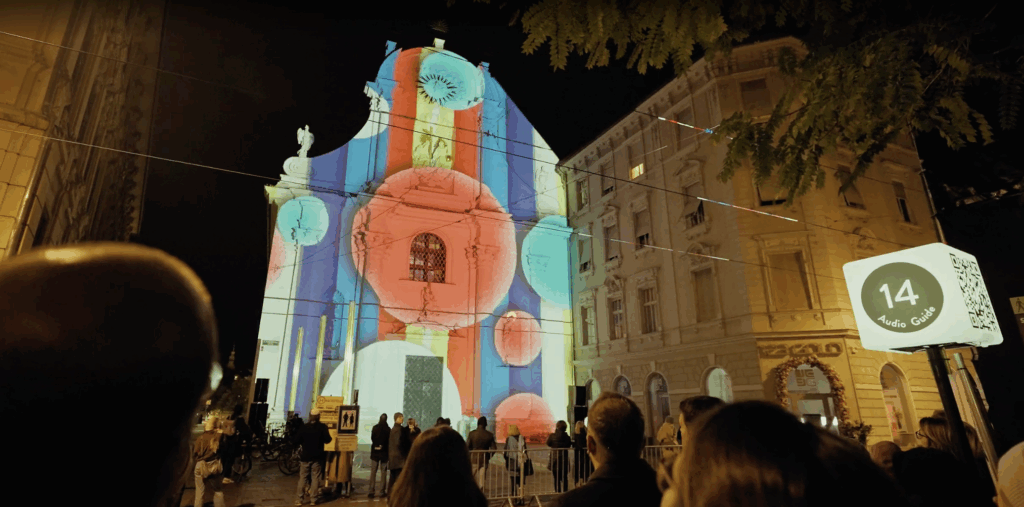
Bei dem besuch des diesjährigen Klanglichts ist mir vorallem die Installation  „Arkestra of Light – Lifted“ ins Auge gefallen da diese thematisch sehr gut zu meinem möglichen master thema passen könnte. Die Installation war eine großformatige Licht- und Klangprojektion des Kollektivs OchoReSotto. Sie wurde direkt auf die Fassade der Dreifaltigkeitskirche am Karmeliterplatz projiziert, die gewählte location hat viel angeboten mit ihren Säulen, Rundungen und der geschwungenen oberen Form.  Was mir als Erstes aufgefallen ist, war die kräftige Farbwahl. Die Farben waren intensiv, aber trotzdem angenehm, und die Formen dazu eher simpel gehalten, was das Ganze nicht überladen hat, dies hat sich aber auch im verlaufe der animation verändert und angepasst. Ich fand besonders spannend, wie diese Formen zueinander animiert wurden, manchmal schnell, energetisch, dann wieder ruhiger, fast rhythmisch, so als würde die Fassade kurz durchatmen. Auch die Mischung aus 2D- und 3D-Elementen war schön subtil eingesetzt und hat der Projektion eine gewisse Tiefe gegeben, ohne dass es zu technisch wirkt.

Etwas was mich überrascht hat, war, dass die Architektur der Kirche selbst für meinen Geschmack nur teilweise genutzt wurde. Ich hatte das Gefühl, dass besonders die Säulen ein bisschen einbezogen wurden, aber die Türen, die Rundungen oben oder die spezifische Form der Fassade hätten viel mehr Potenzial geboten. Es wirkte eher so, als diene die Kirche als Fläche – aber nicht wirklich als Teil der Erzählung. Das fand ich etwas schade, weil genau das Zusammenspiel zwischen Animation und Raum oft das Spannendste an Projektionen ist. Trotzdem hat die Installation für mich gut funktioniert, weil die Animationen selbst sehr stimmig waren. 

Die wechselnden Bewegungen und Farben erzeugten ein Gefühl, das ständig in Veränderung war, teils mehr  Input auf einmal, fast ein bisschen überwältigend, dann wieder Momente, in denen sich die Formen zusammenziehen und eine gewisse Ruhe reinbringen. Dieses Wechselspiel hat mich irgendwie reingezogen, ohne dass ich die ganze Zeit analysiert habe, was da passiert. Für meine eigene inspiration werde ich hiervon definitiv den Umgang mit simplen aber auch teils eher Abstrakten Formen mitnehmen. Klare, einfache Elemente, die durch die Animation an Ausdruck gewinnen. Dazu die Farbwahl, die stark, aber nicht überladen ist, und der Mix aus 2D und 3D, der dem Ganzen Tiefe gibt. Auch wenn ich mir gewünscht hätte, dass die Architektur der Dreifaltigkeitskirche noch stärker in die visuelle Story eingebunden wird, war „Arkestra of Light – Lifted“ für mich ein schönes Beispiel dafür, wie Licht, Klang und Rhythmus ein Gefühl erzeugen können, das nicht unbedingt logisch ist, aber emotional wirkt.

IMPULS 3 – Ausstellung: “Junge Grafik Schweiz!” In Zürich

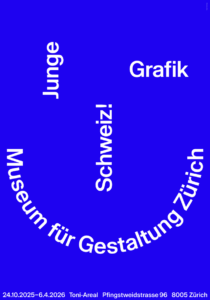
Ausstellung: Junge Grafik Schweiz! In Zürich
https://museum-gestaltung.ch/de/ausstellung/junge-grafik-schweiz

Quelle: https://museum-gestaltung.ch/de/guide-junge-grafik-schweiz

Die Ausstellung „Junge Grafik Schweiz!“ zeigt, wie die neue Generation von Designer:innen – so Mitte 20 bis Mitte 30 – gerade die Schweizer Grafikszene aufmischt. Die Schweiz hat ja eine ziemlich beeindruckende Grafiktradition, deshalb ist es umso spannender zu sehen, wie die jungen Designer:innen arbeiten.

Worum ging es in der Ausstellung

Die Ausstellung „Junge Grafik Schweiz!“ zeigt einen kleinen Einblick in die neue Generation von schweizer Designer:innen – Menschen im Alter von Mitte 20 bis Mitte 30.

Die Schweiz hat ja eine richtig starke Grafiktradition, und genau darauf bauen viele der jungen Gestalter:innen auf: Sie nehmen „das klassische Erbe“ als Basis, brechen es aber auf, mischen es neu und reagieren auf das, was sich heute in Medien, Gesellschaft und Technik verändert. Ich finde es ist die perfekt Mischung aus „Lernen und Profi werden, in dem wie es traditionell und etabliert funktioniert“ und daraufhin dann „Neues entdecken”. Das ist manchmal auch das, was mir bei vielen anderen Designern fehlt: Man kann erst “Aufbrechen und neu denken”, wenn man weiß was “das Alte” ist und was es so gut macht. System verstehen bevor man es rethinked, quasi.

Gezeigt wird in der Ausstellung ganz viel unterschiedliche visueller Gestaltung – von sehr experimentell bis super präzise. 

Ein großes Thema ist der Mix aus analog und digital:
Einerseits bieten neue Technologien und KI immer mehr Tools, andererseits wird gerade das „Menschliche“, das Materialhafte und das „bewusste Zulassen von Zufällen“ wieder wichtiger… Ich fand es super inspirierend und motivierend zu sehen wie hier damit umgegangen wurde und auch zu sehen wie “gute Art-Direction” KI Einsatz zu einem nützlichen Tool macht, anstatt Angst davor zu bekommen ersetzt zu werden.

Viele Designer:innen arbeiten kollaborativ und interdisziplinär und es gab für alle unseres kleinen Besucher:innen-Teams etwas darin zu entdecken, dass sie begeistert hat 🙂

WAS ist der IMPULS

Eher, was nicht?

  1. Ich konnte einiges für mich als Motion Designerin mitnehmen, denn wenn die Ausstellung eines nicht war, dann war es unbewegt. So viele spannende Aufarbeitungen der Projekte, so viel Animation (IN 2D AAAAH!) Ansätze in Richtung  Motion Identity, Creative Coding, versuch. Showreels – sehr viel spannendes!
  2. Für Tanja und mich als Studio-to-be gab es sehr viel inspirierendes und motivierendes für die eigene Arbeitsweise und es war super spannend zu sehen wohin es noch einer Gründung so gehen kann und wie spannend alles werden kann, wenn man sich den Raum dafür gibt.

    Gestalter:innen/Büros in der Ausstellung, zum Nach-googeln und Inspiriert werden:
    Unstated
    Data-Orbit
    Dirtygraphik
    Giliane Cachin
    Jana Sofie Liebe
    Office Ben Ganz
    Onari Projects
    Outline Online
    Pauline Mayor & Loïc Volkart
    Post Action
    Studio 11×1
    Tristesse
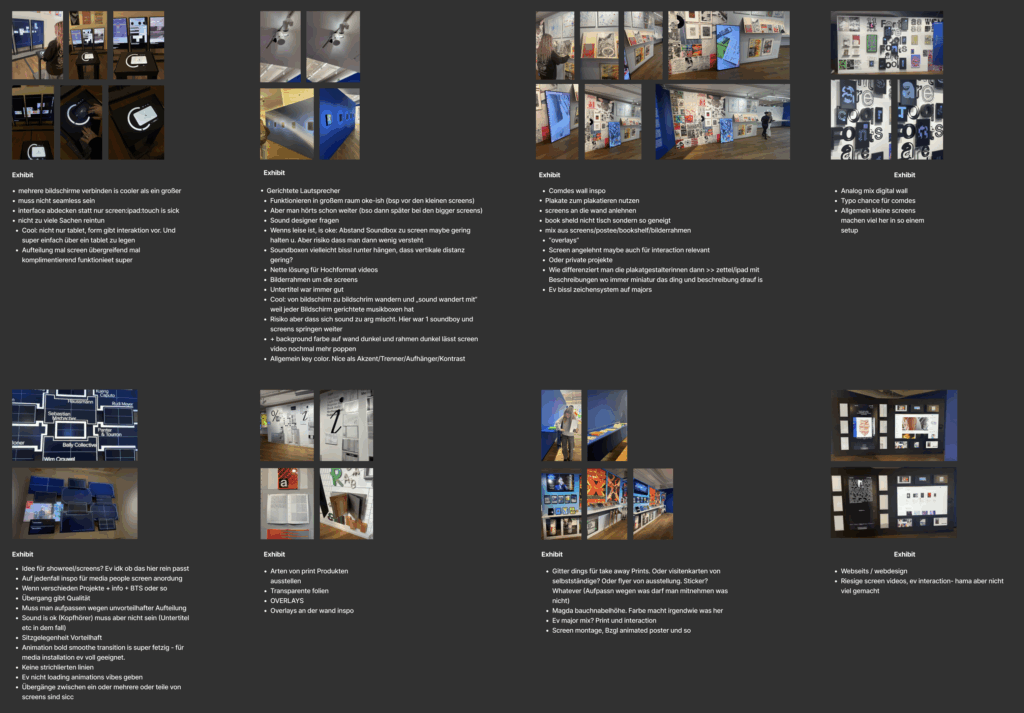
  3. Auch für unsere Ausstellung im ESC konnten wir einiges mitnehmen, speziell in Bezug auf Ausstellungsgestaltung und Aufbereitung der Arbeiten! Eine Mini summary davon hier:


Mein Personal-Favorite war die Aufarbeitung verschiedener Interviews und Videos in einen “irgendwie coolen und spannenden Loop” Siehe unten.

Das Setup selbst macht die Installation schon doppelt so spannendnund die Art wie im loop mit den verschiedenen Bildschirmen, dem daraus entstehendem Grid usw spielt fand ich super spannend,a uch für unsere Exhibition!
Es geht um verschiedene Designer:innen und Studios die zu einem Thema Interviewed werden.
Mit der Transition kündigen sie an, wer noch in diesem Loop vorkommt und führen dann immer zu einem Studio. Es gibt den sonst relativ unspektakulär gestalteten (wenn auch informativen) Interviews Spannung und gestalterische Qualität. Im Übergang wird auch kurz erklärt wer nun sprechen wird bevor sich das Video aufbaut. Jeweils in einer Ecke läuft dann das Interview, während sich auf einem kleinen Screen daneben der Untertitel abspielt.
Zwar ist es dann vielleicht etwas viel Schnickschnack darum herum, aber vor allem das Setup mit den Bildschirmen, der Übergänge, das Placement etc. macht’s sehr spannend für mich als Grid-obsessed Motion Designerin!
Ich fand es schön zu sehen wie Animation und Motion Graphics so zu einem ziemlich relevanten Teil des Schnittes werden – mehr als nur Title Sequenz und Abspann!


Viele der Showreels in der Ausstellung waren auch hochformatig und mit viel Motiooon gelöst

Das war’s soweit – mehr Fotos und Videos will ich dann auch nicht in die WordPress-Datenbank hier jagen – am besten man schaut selbst vorbei (und besucht dabei auch unsere liebe Kata in Zürich!) 😉

LINKS
https://museum-gestaltung.ch/de/ausstellung/junge-grafik-schweiz
Onari Projects https://onariprojects.ch/
Outline Online https://www.outline-online.com/
Dirtygraphik https://dirtygraphik.ch/
Giliane Cachin https://gilianecachin.ch/stempel-diplom

Critical review of “Microbiophonic Emergences” by Adomas Palekas (Master’s Thesis, Institute of Sonology, 2024)

Adomas Palekas’s master’s thesis, entitled Microbiophonic Emergences, could be described as an interdisciplinary mixture of artistic reflection, philosophical speculation, and experimental sound practice. Combining ecological thought and artistic research, the text examines the relationship between sound, life, and perception. Drawing upon the Gaia hypothesis and Goethean science, the author advances a more sensitive and ethical mode of listening wherein the boundaries between the art and scientific observation are dissolved.

Overall, the presentation of the work is considerate and visually well-structured, though it significantly deviates from academic conventions. A clearly defined research question, hypothesis, or structured methodology is lacking. Instead, the text comes across as a long essay on listening, nature, and non-human agency. Its first half is dedicated to theoretical reflections on sound as a living force, while the second half introduces a series of artistic experiments and installations entitled Kwass Fermenter, Microbial Music I–III (On Bread, Compost and Haze, Aerials), Rehydration, Infection, Spectrum of Mutations: Myosin III and Kwassic Motion. According to the author, these works constitute a coherent artistic ecosystem in which microorganisms and sonic feedback interact.

More conceptually, this framing of sonification as bi-directional means that sound should not just be generated from biological data but is also to be sent back into the system and used to affect it. Conceptually, this approach seeks to transform sonification into a dialogue rather than a representation. This claim of originality, however, feels somewhat overstated: bi-directional or feedback-based sonification has been explored conceptually and practically by many artists and researchers before him, mostly within the frames of bio-art and ecological sound practices. Palekas himself mentions only one precedent when, in fact, there exists a wide range of comparable works dealing with translating biological activity into sound and then re-introducing it into the same system. His treatment of the topic is therefore limited and without deep contextual awareness, giving the impression of a rediscovery of ideas that are well conceptualized in the discipline.

The artistic independence of the thesis and a strong, personal vision are explicit. Palekas’s voice is consistent; his writing also reflects genuine curiosity and sensitivity. But it is this very independence that alienates his research from the broader academic and artistic discourse. One misses the dialogue with other practitioners or with theoretical perspectives, except for the few philosophical sources mentioned above. The limited literature review weakens the credibility of his theoretical framework and makes it difficult to situate the work within contemporary sound studies or bio-art research.

The structuring of the thesis is much closer to a philosophical narrative than to a scientific report. The chapters are more intuitively than logically connected. Because explicit methodological framing is absent, the reader has to reconstruct the logic of the experiments from poetic descriptions. For example, the sonification tests with fermentation are told in narrative terms, sometimes mentioning sensors, mappings, and feedback without providing detailed diagrams, lists of parameters, or reproducible data.

From a communicational point of view, the thesis is well-written and easy to read. Palekas’s prose is expressive and reflective; his philosophical passages are a pleasure to read. At the same time, this lyricism too often supplants analytical clarity. The experimental results remain fuzzy; the measurements are given “by ear,” not through numerical analysis, and the reader cannot tell whether the effects observed are significant or only subjective impressions.

In scope and depth, the thesis is ambitious but uneven. It tries to combine philosophy, biology, and sound art, but the practical documentation remains superficial. The experiments are deficient in calibration and control conditions, as well as in quantitative evidence. The author himself recognizes that fermentation is hardly predictable and thus difficult to reproduce. But this admission only underlines the fragility of his conclusions. Without a presentation of clear data or even replicable protocols, the whole project remains conceptual rather than empirical.

Partial accuracy and attention to detail: the author provides some information about equipment and process – for example, relative calibration among the CO₂ sensors, use of Arduino, Pure Data, but no consistent system is provided for reporting values, frequencies, and time spans. References made to appendices and videos are incomplete, and none of the referred sound recordings and codes are available. The result is that the project cannot be scientifically evaluated or reproduced.

The section on literature review reflects selectivity: In situating his thought within broader ecological and philosophical frameworks, Palekas barely engages the rich corpus of research on bio-sonification, microbial sensing, and feedback sound systems. The lack of these sources increases the effect of isolation: the thesis feels self-contained rather than in conversation with a field.

This gap between theory and documentation is where the quality of the artifact is questioned. The installations and performances he describes conceptually are incompletely and poorly documented. It is not clear if the works were created for this thesis or collated from previous projects. Without recordings, schematics, or step-by-step documentation available, one cannot evaluate any artistic or technical outcomes. Put differently, Microbiophonic Emergences is a strong artistic and philosophical statement, but it is only a partially successful academic thesis. Its conceptual strength comes from the ethical rethinking of listening, the poetic vision of sound as life, and the attempt to dissolve the hierarchy between observer and observed.

The work unfortunately lacks in methodological rigor, detailed evidence, and sufficient contextual grounding. While Palekas seeks to establish a dialogue between humans and microbes, the outcome is just speculative and remains unverified. This invention of bi-directional sonification is not really new; moreover, the thesis overlooks the numerous past projects that have already elaborated on a similar feedback relationship between sound and living systems. Overall, the work is successful as a reflective, imaginative exploration of sound and ecology but fails as a systematically researched academic document. While the work evokes curiosity and wonder, it requires far stronger methodological and contextual grounding to meet the standards of a master’s thesis.

IMPULS 2 – CREATIVE NIGHT GRAZ 2025 – Besuch bei “Unter Freiem Himmel”, Thema: Character Animation

Intro für Kontext:
Am 10.10 fand die CREATIVE NIGHT GRAZ 2025 statt und ich konnte dem Studio Unter freiem Himmel einen Besuch abstatten. Neben vielen Themen rund um Studio Gründung und Co bin ich dabei auch auf eine kleine Erkenntnis zum Thema Character-Animation gekommen

INSIGHTS Character Animation:

Im Studio haben wir natürlich auch viel über die Projekte gesprochen, die meisten (oder alle?) davon auch hier zu finden https://www.unterfreiemhimmel.net/projekte/

Da sind viele spannende Dinge dabei und vor allem in den Hauseigenen Showreels toben sie sich stilistisch und Thematische richtig aus.
Ich bin mit vier Befürchtungen in das Studio gestartet:
– Es wird zu viel Frame-by-Frame Animation angefragt
– Es wird zu viel 3D-Animation angefragt
– Es wird NICHTS angefragt weil die Branche stirbt (Thema KI)
– oder aber dass ALLES voller 2D-Character-Rigs sein wird. 

Keine meiner Ängste hat sich 100% bestätigt, außer wahrscheinlich letztere.

Und darum soll es gehen. Denn in dem langen Gespräch mit Michael und Gernot vor Ort konnte ich einige spannende Dinge mitnehmen.

Zwischen all den Erklär- und Werbefilmen zu den wohl UNTERSCHIEDLICHSTEN Themen hat mich eines nicht in Ruhe gelassen: „Muss ich wirklich ÜBERALL 2D-Character Animation machen? Ist es das, was Kund:innen wollen?“


Als Motion Designerin die vor allem auf Typografie und Motion Graphics „ohne Augen, Hände und Co.“ steht wäre das nämlich eher schlecht.

Im Gespräch mit Michael hat sich dann auch raushören lassen, dass ich damit nicht ganz alleine bin. Immer und überall wird ein Maskottchen, ein Charakter oder Sonstiges durch das Bild geschickt – Hauptsache irgendjemand geht „full body“ durchs Bild – super, ganzes Character Rig und holprigen Walk-Cycle.

Dabei sieht das doch selten WIRKLICH gut und sinnvoll aus.

Aber warum immer dieser Wunsch nach einem Character?
Vielleicht liegt es daran, dass es genau das Bild von Animation ist, das Kund:innen haben. Oder, dass sie sich andere Visualisierungen nicht vorstellen können? Oder liegt es daran dass es tatsächlich nur mit Charakter gut funktioniert? (I doubt it (und Michael does too) – oft sieht’s ja auch eher Bescheiden aus. Nicht bei Unter freiem Himmel natürlich, aber allgemein)


Natürlich lässt sich da viel Bezug zum Thema Wahrnehmung schaffen, den Personifikationen funktionieren ja nicht grundlos so gut (und es gibt ja auch viele Positiv-Bespiele). Aber haben wir das nicht langsam satt? Schauen wir uns sowas wirklich noch gerne an?

Im Gespräch mit Daniel Bauer konnte ich gut an das Gespräch mit Michael anknüpfen: Es gibt bestimmt einiges an geschichtlichen Beispielen für den „Rise of Character Animation“, denn in so ziemlich jedem großen Unternehmen, von Raiffeisenbank bist SBudget“ Lassen sich Maskottchen und Co finden – Selbst zum Thema Atomstrom?! Aber all diese Dinge sind heute weg – nicht mehr das Hauptgesicht der jeweiligen Marke. Warum ist das so? Haben wir Maskottchen satt? Sind sie nicht professionell genug? Hat sich die Wahrnehmung in diesem Sinne verändert?  Ist es etwas „The Fall of Character Animation“, den wir hier erleben?

Ist das nicht GENAU MEINE CHANCE um dahingehen zu recherchieren und so andere Wege, Erzählstrukturen und Stile zu finden, um die Visionen potenzieller Kund:innen zu unterstreichen?

Die Motivation ist hoch! Deshalb danke nochmal, Michael, für das lange Gespräch, all die Infos, Tipps, Motivationen und INSPIRATIONEN. Und auch Danke an Daniel Bauer, der das Thema mit den richtigen Buzzwords greifbarer gemacht hat!

LINKS:
https://www.unterfreiemhimmel.net/projekte/netformic/
https://www.cis.at/event/creative-night-graz-2025/
https://www.unterfreiemhimmel.net/