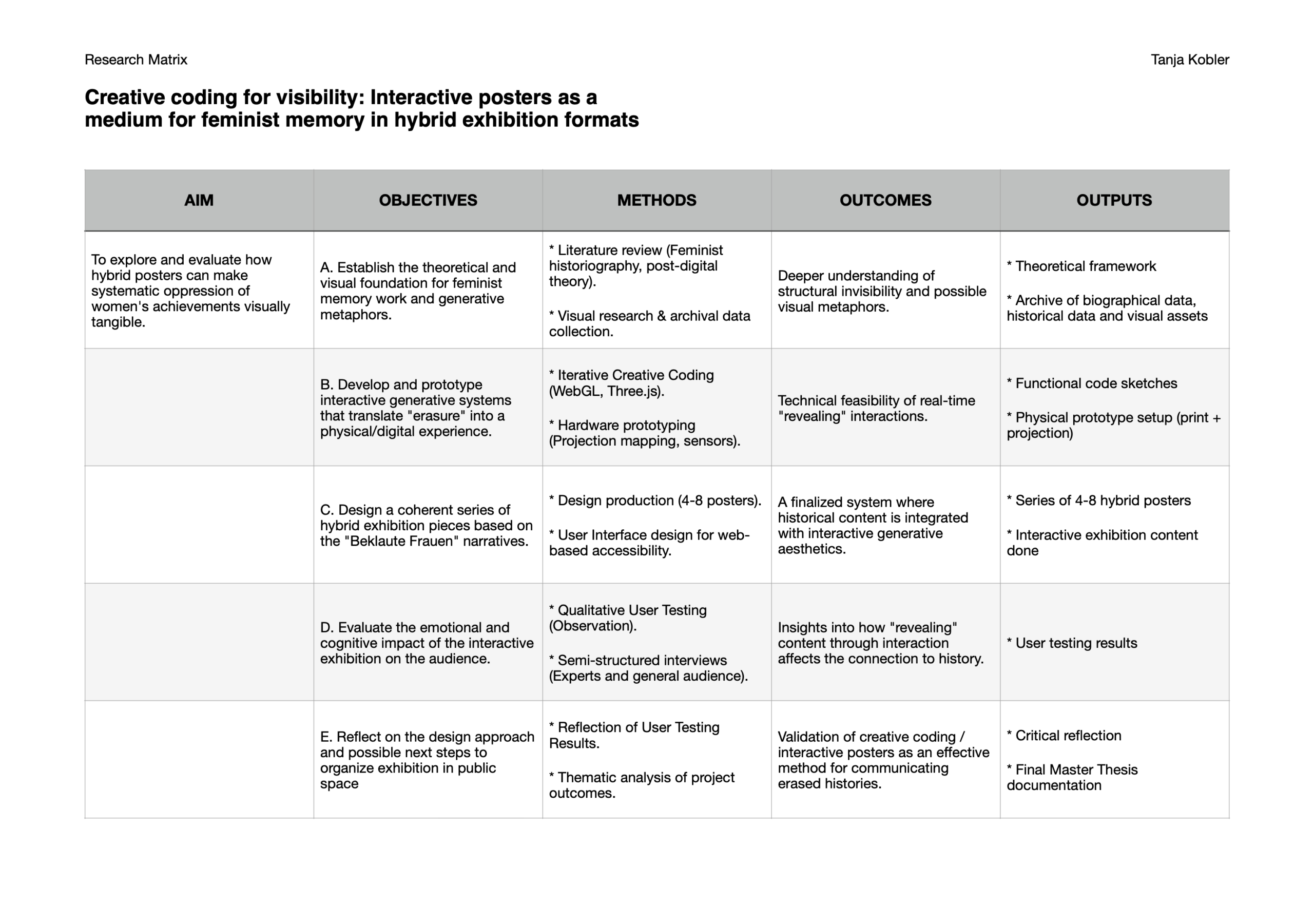
Research Matrix
Thesis Topic:
Motion as Communication: Using Micro-Interactions to Help Drivers Understand Automation Mode Changes
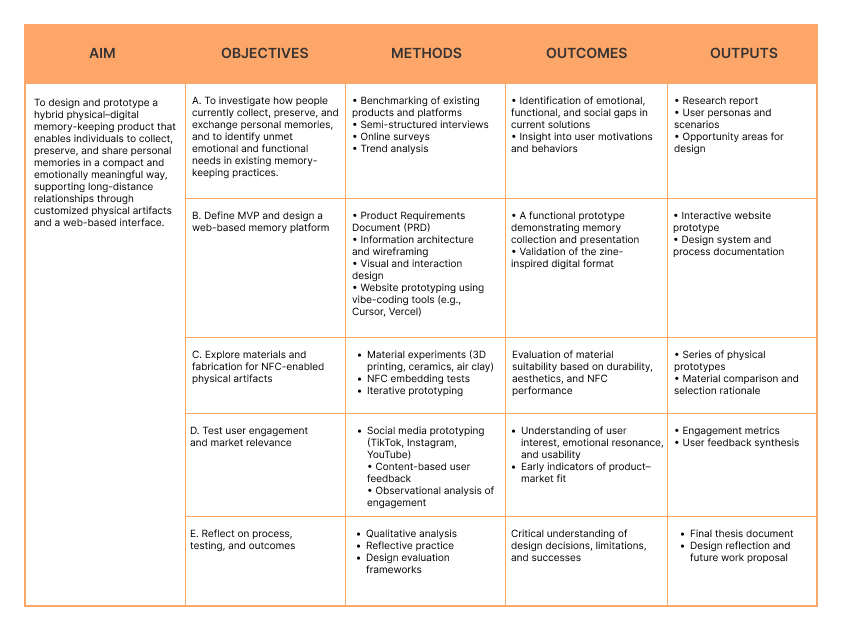
| Aims | Objectives | Methods | Outcomes | Outputs |
|---|---|---|---|---|
| Understand how drivers currently get confused about automation modes and handovers. | Clarify the problem space of mode confusion and existing HMI strategies for communicating mode and takeover. | Targeted literature review on mode confusion, takeover studies, and automation HMI guidelines. | Clear picture of where current interfaces fail (e.g., unclear state, weak anticipation, bad timing of alerts). | Short problem framing section with diagrams of current HMI patterns and failure modes. |
| Find out what existing research already says about effective feedback and motion in high‑load, time‑critical interfaces. | Collect and organize evidence on which feedback types and motion patterns improve comprehension and reaction time. | Systematic search, screening, and evidence mapping across automotive, aviation, medical, and UI/motion research. | Evidence maps showing which strategies (static, motion, multimodal) work, where, and how strongly they’re supported. | Evidence tables and visual maps you can include in the thesis (and reuse in slides). |
| Translate that evidence into concrete motion patterns and parameters for automation mode changes. | Define a compact motion framework for entering automation, exiting automation, and escalating takeover requests. | Research‑through‑design: sketching, storyboard flows, prototyping micro‑interactions (e.g., in Figma) guided by the evidence. | A small, coherent set of motion patterns with rationale tied back to specific studies and theories. | Motion specs (timing, easing, behavior) plus prototype screens showing mode transitions and alerts. |
| Turn those patterns into reusable motion tokens and a design guide that teams could plug into a design system. | Define motion tokens (durations, easing curves, escalation patterns) and describe how to use them in an automotive HMI. | Synthesis + systems thinking: abstracting patterns into tokens, writing guidelines, and mapping them into a component library structure. | A motion “layer” that can sit inside a design system for vehicle HMIs (or similar products). | Motion token set, usage guidelines, and an example component library (e.g., Figma pages or documented components). |
| Reflect on how this changes the way we think about motion in safety‑critical interaction design. | Position motion as a functional communication tool (not just delight) and highlight gaps for future empirical work. | Critical discussion that connects your framework back to theory (cognitive load, attention, mode confusion) and identifies missing research. | Clear articulation of what we know, what we can recommend with confidence, and what still needs live testing. | Discussion + conclusion chapters that wrap up the framework, its limits, and next steps (including ideas for future simulator studies). |
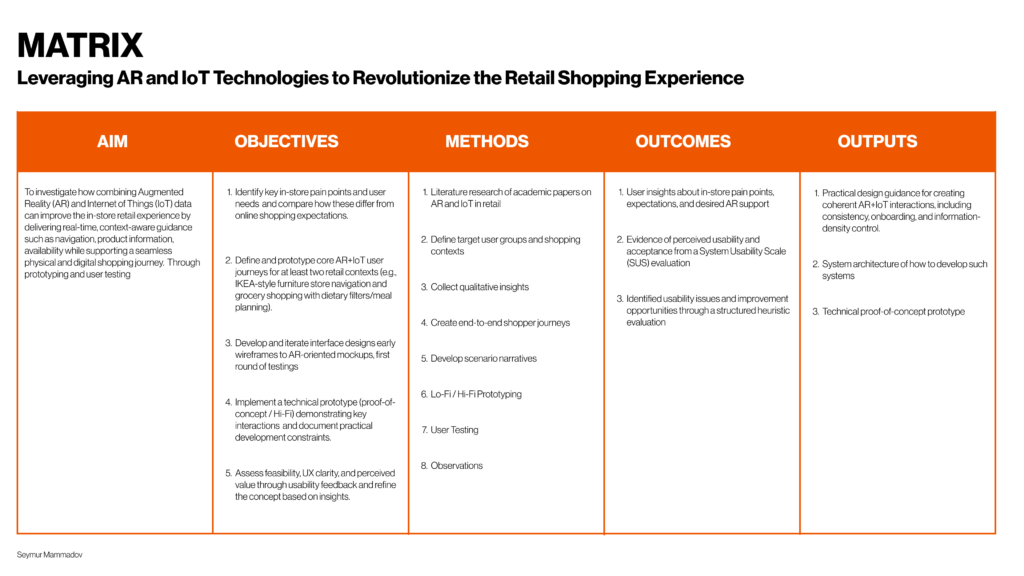
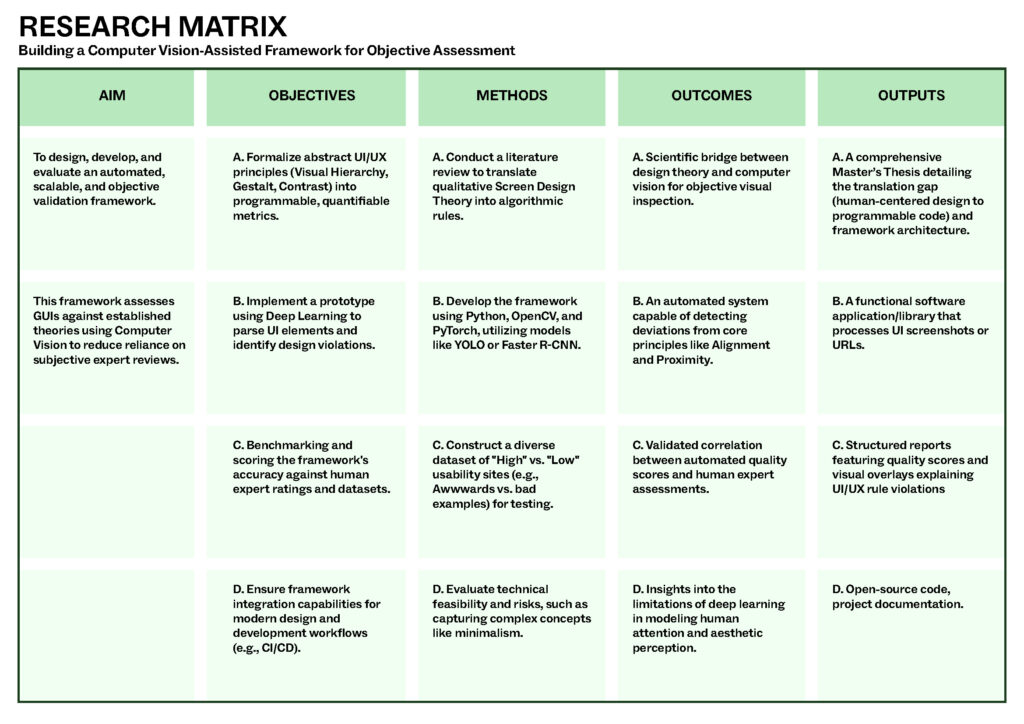
Validating a User Interface (UI) has traditionally been a bottleneck. While we can easily automate functional tests to see if a button works, determining if that button is aesthetically correct or follows established design principles has always required a human expert. My current research aims to enhance the speed of human expertise by developing a Computer Vision-Assisted UI Validation Framework.
The primary goal is to design, develop, and evaluate a framework that uses Computer Vision (CV) to objectively assess User Interfaces based on established UI/UX theories. It specifically targets the current problem where UI validation is too resource-intensive and subjective.
Translate Theory: Convert abstract principles like Visual Hierarchy, Gestalt Principles (Proximity/Similarity), and Color Theory into quantifiable metrics.
Build Prototype: Create a tool that can Parse elements (buttons, text), Evaluate them against rules, and Score the results.
Integration: Ensure the framework can be used within existing development workflows, such as CI/CD tools.
Research through Design: A four-phase approach involving literature review, dataset construction, implementation, and evaluation.
Technical Stack: Utilizing Python with libraries like OpenCV and PyTorch, specifically employing deep learning models like YOLO for object detection.
Data Sourcing: Building a dataset from award-winning sites (e.g., Awwwards) to compare against “bad” design examples.
Objective Validation: An enhancement for subjective human observation to a scalable, automated visual inspection mechanism.
Correlation Findings: Determining the extent to which automated scores can successfully mirror human expert assessments.
Technical Insights: Identifying risks regarding whether high-level concepts like “minimalism” can be truly captured by algorithms.
The Workpiece: A software application or library that takes a URL or screenshot and generates a structured report.
Visual Overlays: Heatmaps or overlays on the UI that point out exactly where rules (like alignment or contrast) are violated.
Master’s Thesis: A formal document covering the translation gap between UX and Computer Vision.
Lange habe ich überlegt welches Buch ich mir für meine restlichen drei Blogposts (exkl. Fazit) genauer anschauen soll. Mit “Painting with Light”, “Motion Picture and Video Lighting” und “Lighting for Cinematography” habe ich die wichtigsten Quellen aus meiner Literaturliste nämlich bereits zu Hause. Nach kurzem Überfliegen ebenjener bin ich aber zum Entschluss gekommen, dass sich für diese eine letzte Woche, in der alle Blogposts entstehen müssen, eigentlich nur eines davon eignet: Painting for Light. Denn schon beim Überfliegen habe ich festgestellt, dass gerade “Lighting for Cinematography” eine unfassbar geile und nie versiegende Quelle kinematographischen Wissens ist, und noch dazu unfassbar Hands-On erklärt. Auch “Motion Picture and Video Lighting”, hat auf gut 150 Seiten sehr praktische Ansätze, auch wenn es im Rest eher um die technischen Komponenten wie Stromspannungen oder Lichtwellen geht. Einzig “Painting with Light”, das Standardwerk, das man unbedingt gelesen haben muss (zumindest wenn man die schlauen Leute im Internet fragt) ist da eher theoretisch. Außerdem kann es auch gar nicht die aktuelle Praxis auf einem modernen Set widerspiegeln, da der Autor eine digitale Kamera oder LED-Lampe nie mit eigenen Augen gesehen hat. Deshalb habe ich mir zur Aufgabe gemacht, die zeitlosen, die klassischen Theorien aus diesem Standardwerk zu extrahieren und in den nächsten drei Blogposts wiederzugeben. Das hilft mir im späteren Verlauf bei meiner Masterarbeit vor allem dabei, mich nicht ständig nur auf einige wenige Quellen zu berufen.
Für diesen Blogposts habe ich mir seine Grundsätze, seine “Theory of Illumination” angesehen, die ich, für das, dass sie vor gut 70 Jahren entstanden ist, unfassbar eindrucksvoll finde.
Alton startet seine Theory of Illumination damit, die Kamera richtig zu platzieren, da erst dann überhaupt eine Ausleuchtung Sinn macht. Schon er hat damals erkannt (und er spricht im Text mehrmals über den gerade laufenden oder endenden zweiten Weltkrieg), dass es im Film darum geht eine dreidimensionale Welt auf eine zweidimensionale Leinwand zu bringen, das Hauptproblem auf das eigentlich immer wieder referenziert wird, wenn es darum geht, warum gute Beleuchtung wichtig ist. Er erklärt die Kamerapositionierung für maximalen Effekt aber etwas anders, als ich es von den meisten modernen Quellen gehört habe. Statt Vordergrund- und Hintergrund-Separation als Hauptelement zu nennen, um ein Objekt im Raum wirken zu lassen, ist für Alton der Kamerawinkel entscheidend. Sein Grundsatz: “(…) it is imperative that we photograph everything from an angle from which most surfaces of the subject are visible to the camera.”1 Er erklärt dies mit einem Würfel, der in der totalen Frontansicht überhaupt nicht aussieht wie ein Würfel, sondern wie ein Quadrat, da weder die seitlichen Wände noch die Tiefe nach hinten zu sehen ist. Bewegt man die Kamera zur Seite, bekommt man eine Seitenwand des Würfels aufs Bild, und bewegt man sie nach oben auch noch die Decke. So sieht man gleichzeitig drei Seiten des Würfels und damit das Maximum. Wenn ich an viele Shot-Analysen und Kritiken zurückdenke, die ich mir in der Vergangenheit angesehen habe, so wurde diese Grundlage zwar nie so kommuniziert, war aber eigentlich immer präsent.2
Hat man den richtigen Winkel erst einmal gefunden geht es ans Leuchten. Auch wenn Alton es noch nicht so nennt, ist das was er dabei beschreibt, das klassische Finden einer “Motivation” fürs Licht: “Suppose for instance, that the light source is a reading lamp. By use of a small testlight we determine the position from which the light will properly illuminate the scene, and yet will appear as if coming from the reading lamp.”3 Als nächsten Schritt, um den dreidimensionalen Effekt zu verstärken, empfiehlt er die Implementierung von einem Filllight, das verhindert, dass alle Sichtbaren Seiten des Objekts gleich hell sind. Zuletzt spielt das Verhältnis zwischen Vordergrung und Hintergrund noch eine entscheidende Rolle: “The illusion of depth can be enhanced by the separation of the two; that is, if the foreground is dark, the background should be light, or vice versa.”4 Alton schließt das Kapitel mit einem Satz, den ich wohl zu 99,9 Prozent auch so in meiner Masterarbeit zitieren werde. Quasi einer Checkliste, was für ihn 1945 eine perfekte Beleuchtung ausmacht. “The combination of a foreground, having visible as many surfaces of the object as possible, each surface having a different brightness, and a background of a different tone, makes a picture perfect.”5 All das macht bis heute Sinn und wurde nur umformuliert aber nie verändert.6
P.S.: Falls ihr euch fragt was ich da vom zweiten Weltkrieg und alten Theorien daherrede, wenn das Buch doch von 2013 ist, hier die Antwort ohne wirklich gefragt worden zu sein: Das Buch erschien eigentlich 1949, wurde dann aber immer wieder neu aufgelegt, zuletzt 2013. Alton ist aber schon 1996 verstorben, die einzigen Änderungen bei den Neuauflagen waren immer die Vorwörter oder Ähnliches, nicht aber der Inhalt.

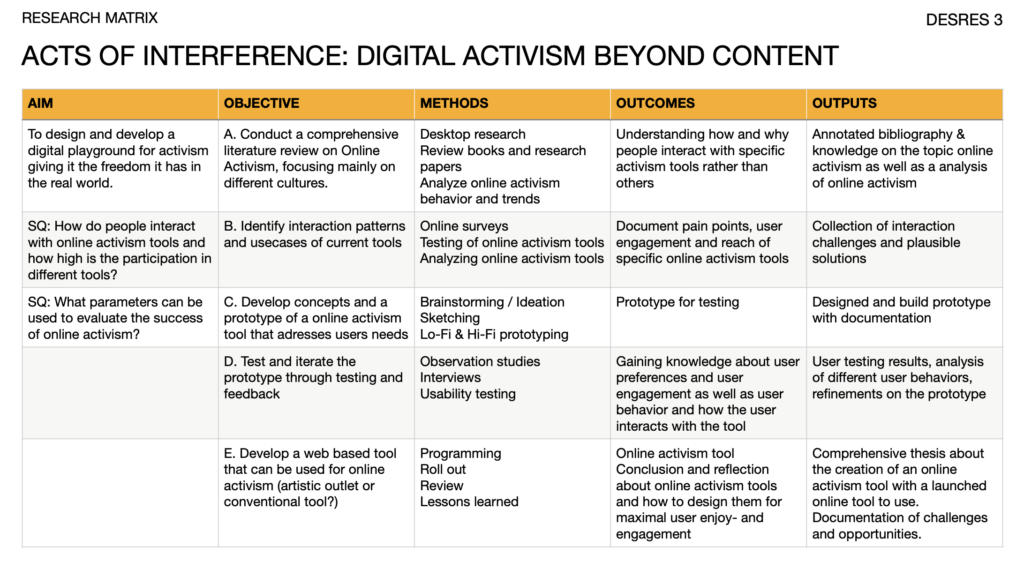
ACTS OF INTERFERENCE: DIGITAL ACTIVISM BEYOND CONTENT