#03 Are we living in an epidemic of loneliness?

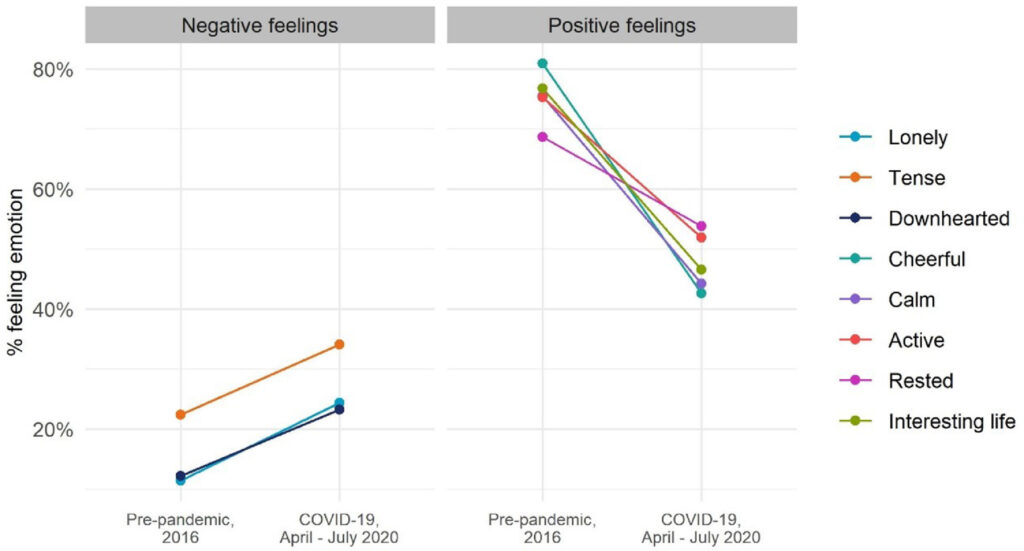
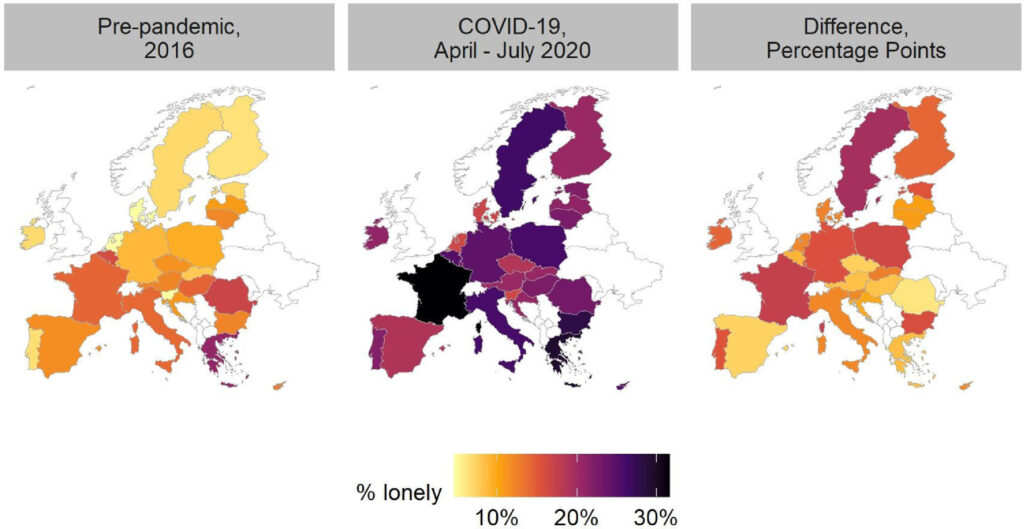
The heightened risk of loneliness during the COVID-19 pandemic has brought increased attention to the issue, leading to loneliness and social isolation being recognized as serious public health concerns.A study conducted by the IFO Institute and the European Commission reveals that in 2016, 12 % of people in the European Union frequently experienced the feeling of loneliness. During the initial months of lockdown, this figure increased to 25%. 2

Source: Loneliness in Europe before and during the COVID-19 pandemic 2

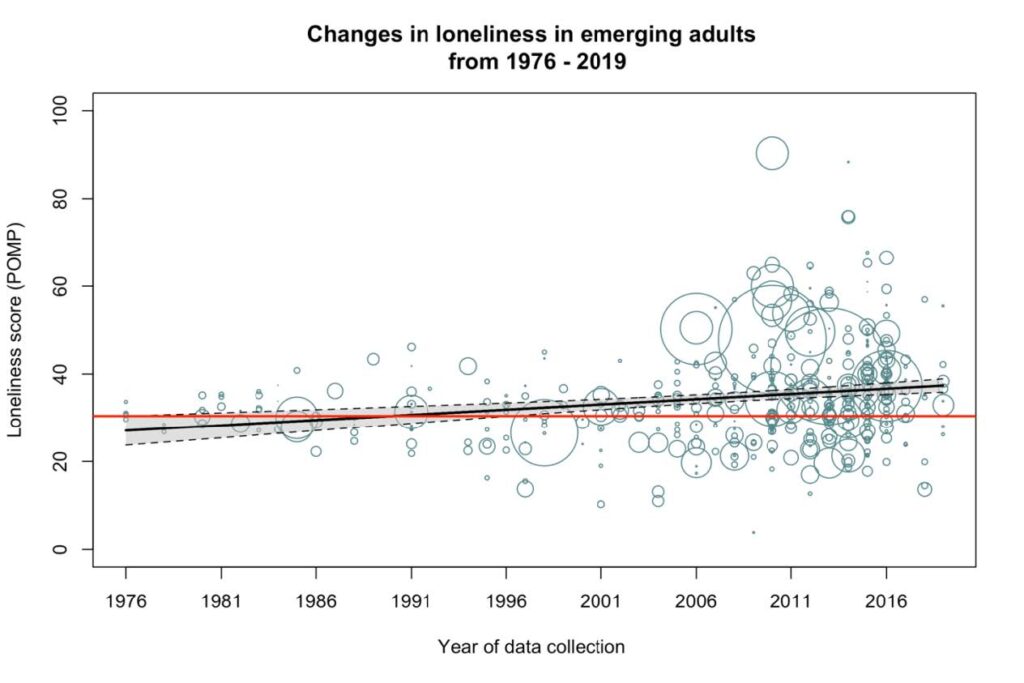
Some researchers even claim that we are living in an epidemic of loneliness right now. However, loneliness is not a modern-day phenomenon. A study by the American Psychological Association analyzed 345 studies comprising 437 independent samples, with a total of 124,855 young adults completing the UCLA Loneliness Scale between 1976 and 2019. Over these 43 years, the study revealed a gradual increase in loneliness. Even though there was constant increase in loneliness, talking about an epidemic of loneliness might be exaggerated. 3

Source: Is Loneliness in Emerging Adults Increasing Over Time? A Preregistered Cross-Temporal Meta-Analysis and Systematic Review 3

Who is at highest risk for loneliness?

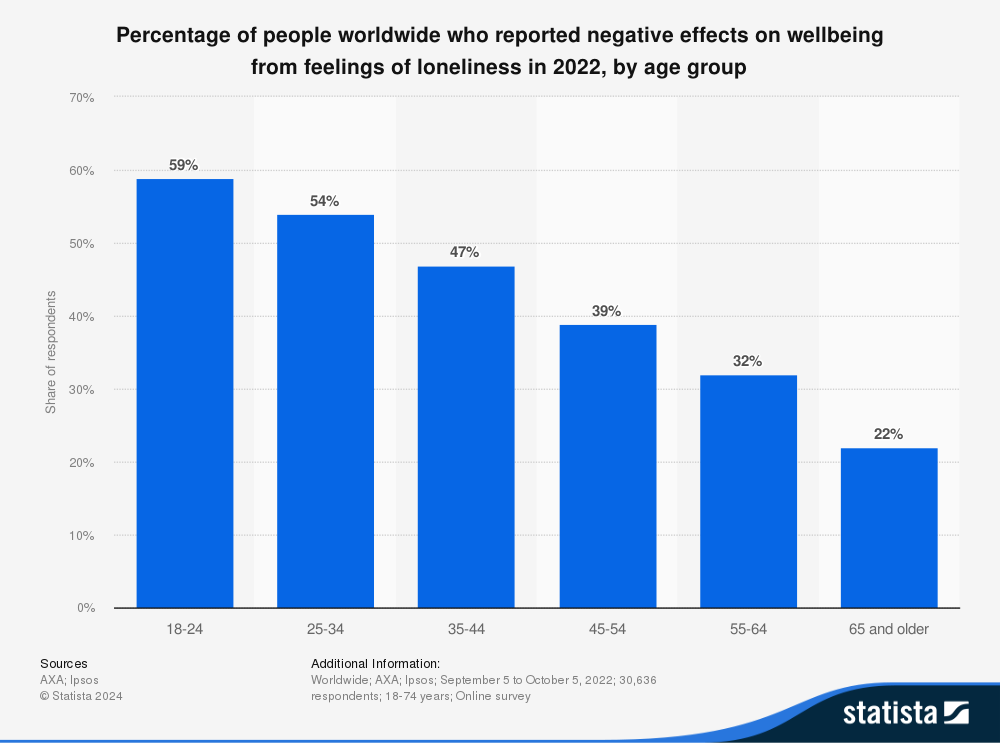
Age is a frequently studied aspect in connection with loneliness. For a long time, the focus was on older people, as they have a particularly high risk of being affected by loneliness. However more recent studied showed that there is a u-shaped relationship between age and loneliness, because also young people are highly affected by loneliness these days. 4

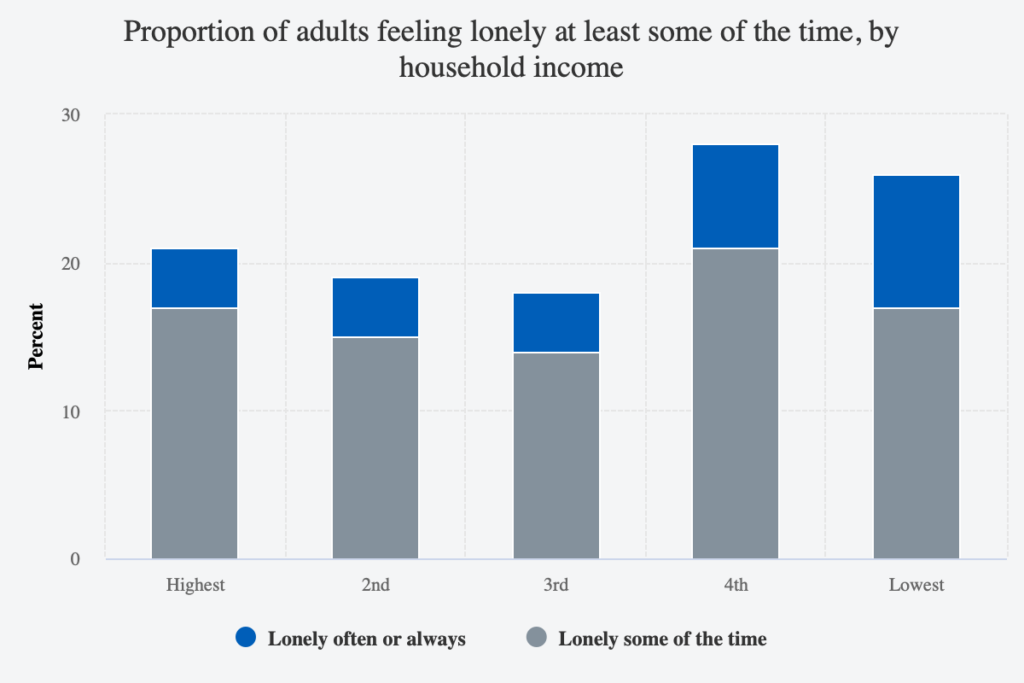
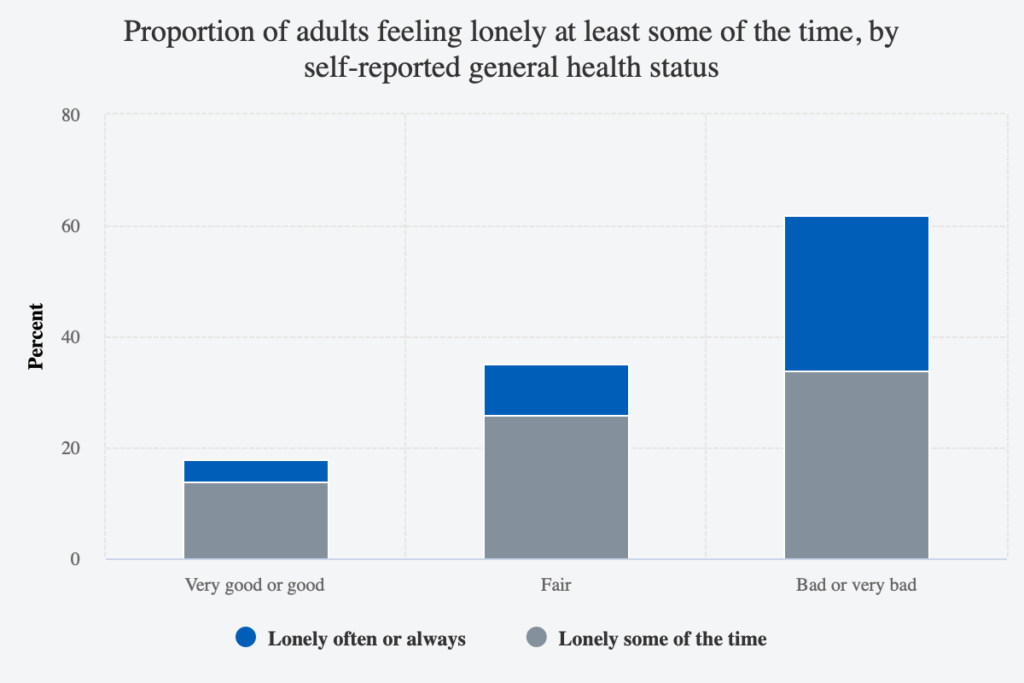
Examining socio-economic factors such as income, health, and living conditions, several studies indicate that individuals with lower income levels are more likely to experience loneliness. Similarly, those who report poor health tend to feel lonelier compared to individuals with good health. Furthermore, research shows that individuals living alone are more likely to experience loneliness. 2 5  

Source: Health Survey for England 2021: Loneliness and Wellbeing 5

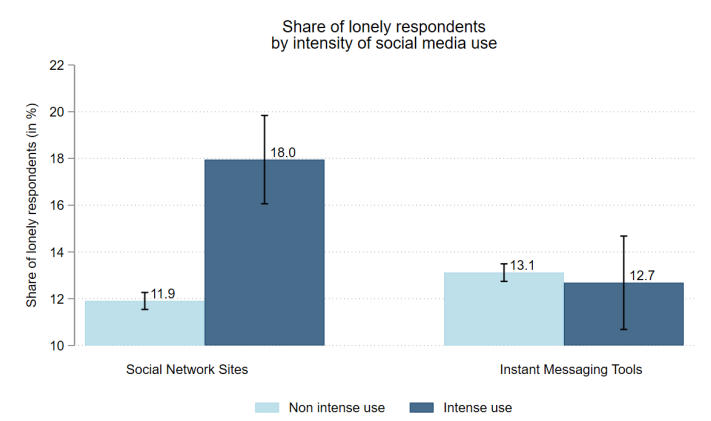
Additionally, technology, particularly social media, has a significant impact on our relationships and social interactions. Even though we are more connected than ever, people tend to feel more lonely nowadays. Excessive social media use (in the study from the European commission excessive means two or more hours per day on social media) can contribute to feelings of loneliness, a fear of missing out, and a lack of meaningful social connection. 6 7

Source: EU Loneliness Survey, 2022 6

Since several studies show the negative impact of loneliness on health and its growing significance in public health, several governments and institutions — such as the government of United Kingdom and Japan, the Ministry of Health in the Netherlands, and the European Commission — are developing strategies to combat loneliness. 

The next blog post explains which impact loneliness has on our health.


Sources

[1] JRC, „Loneliness and social connectedness: insights from a new EU-wide survey“, 2023.

[2] J. Baarck, B. D’Hombres und G. Tintori, „Loneliness in Europe before and during the COVID-19 pandemic“, Health Policy, Bd. 126, Nr. 11, S. 1124–1129, Sep. 2022, doi: 10.1016/j.healthpol.2022.09.002.

[3] S. Buecker u. a., „Is Loneliness in Emerging Adults Increasing Over Time? A Preregistered Cross-Temporal Meta-Analysis and Systematic Review“, journal-article, 2021. doi: 10.1037/bul0000332.

[4] S. V. Schnepf, B. D’Hombres und C. Mauri, Hrsg., Loneliness in Europe. 2024. doi: 10.1007/978-3-031-66582-0.

[5] NHS Digital, Health Survey for England 2021: Loneliness and Wellbeing. Available: https://digital.nhs.uk/data-and-information/publications/statistical/health-survey-for-england/2021-part-2/loneliness-and-wellbeing. Accessed: Jan. 7, 2025.

[6] B. Dhombres, M. Kovacic, S. V. Schnepf, and Z. Blaskó, Loneliness and social media use in the European Union, European Commission, 2024, JRC135806.

[7] V. H. Murthy, „Our Epidemic of Loneliness and Isolation: The U.S. Surgeon General’s Advisory on the Healing Effects of Social Connection and Community“, 2023. [Online]. Verfügbar unter: https://www.hhs.gov/sites/default/files/surgeon-general-social-connection-advisory.pdf

Exploring already existing Climbing Boards in Bouldering: MoonBoard, Tension Board, Kilter Board, and More

Climbing boards have revolutionized the way climbers train, offering a dynamic and systematic way to build strength, technique, and endurance. Popularized by their versatility and community-driven route setting, boards like the MoonBoard, Tension Board, and Kilter Board have become staples in bouldering gyms worldwide. In this blog post, we’ll explore the key types of climbing boards, their pros and cons, and their costs to help gym owners and climbers alike make informed decisions.


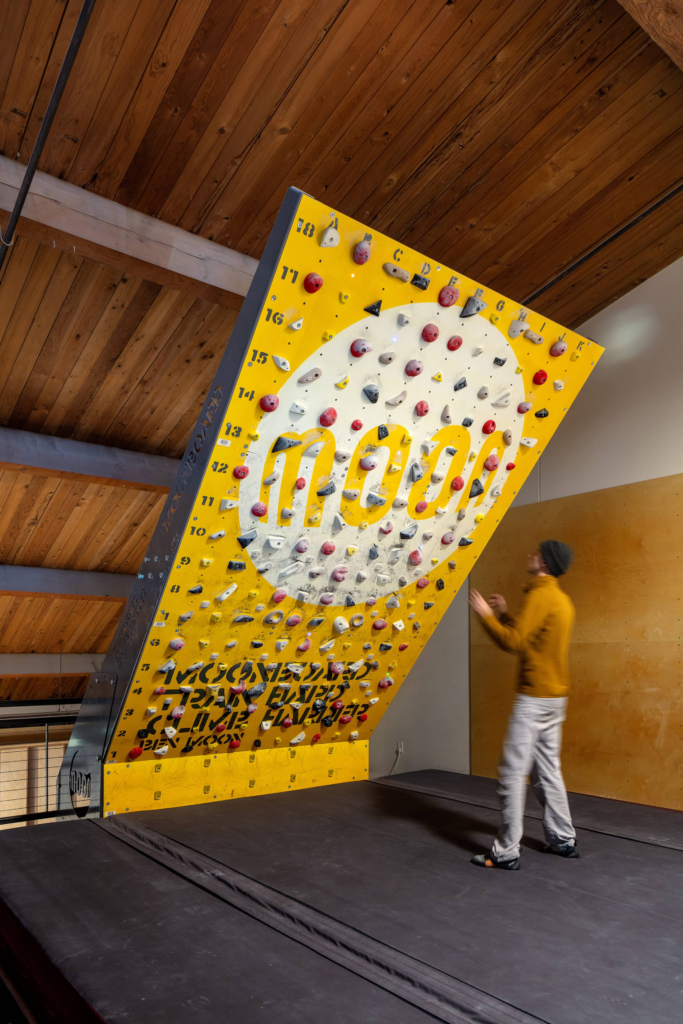
1. MoonBoard

The MoonBoard is one of the most iconic training boards in the climbing world. It consists of a standardized 40-degree overhang wall, equipped with LED lights and holds arranged in a universal layout.

Pros:

  • Huge database of user-generated problems accessible via a mobile app.
  • Compact and space-efficient design.
  • Excellent for building power and finger strength.

Cons:

  • Extremely challenging for beginners due to the steep angle and sharp holds.
  • Limited hold variety compared to other boards.

Average Cost for Gyms:

  • Installation costs range from $5,000 to $10,000, depending on the wall size and LED integration.

2. Tension Board

Designed with wooden holds, the Tension Board offers a skin-friendly training experience and precise, uniform holds.

Pros:

  • Skin-friendly holds, ideal for long training sessions.
  • Provides a wide range of hold types and angles.
  • Compatible with adjustable wall angles.

Cons:

  • Wooden holds can feel slippery, especially for those used to resin holds.
  • Smaller problem database compared to the MoonBoard.

Average Cost for Gyms:

  • Prices typically range from $6,000 to $12,000, depending on the setup and adjustable wall features.

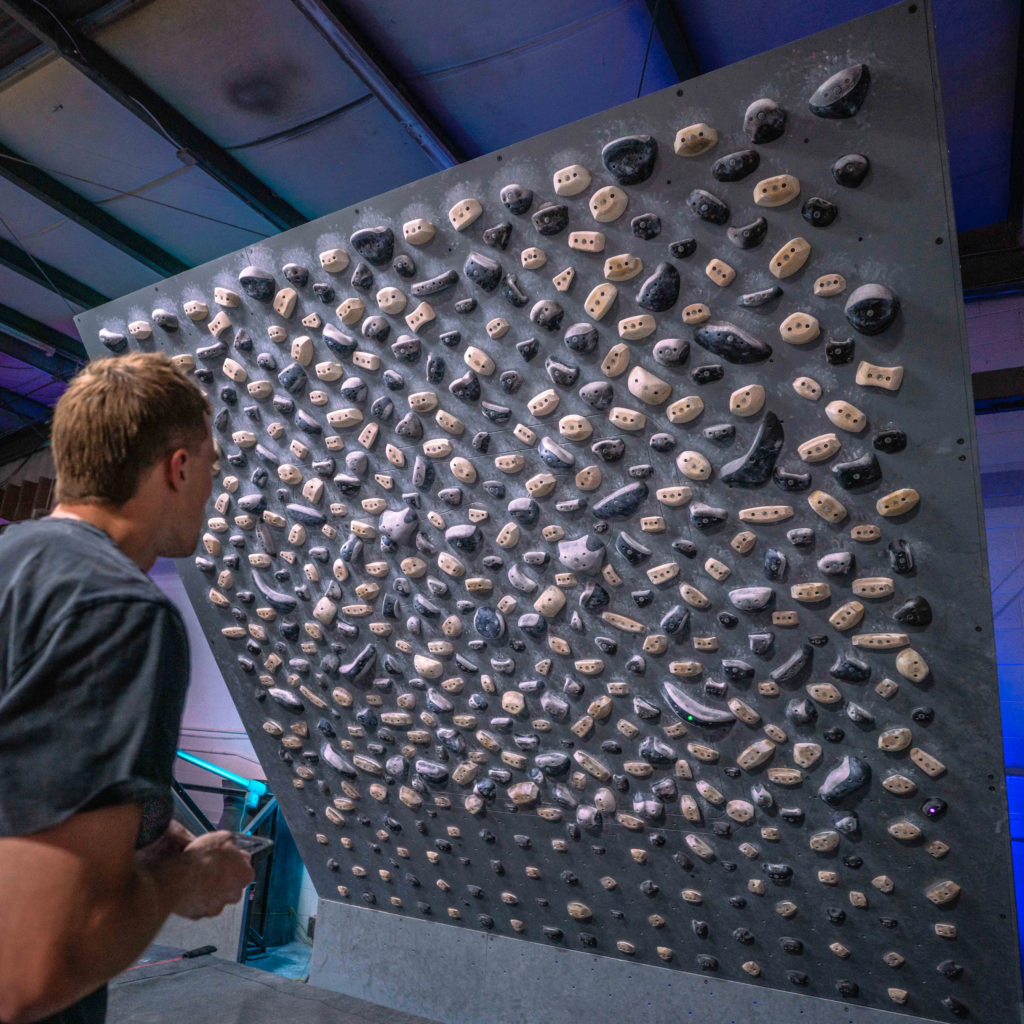
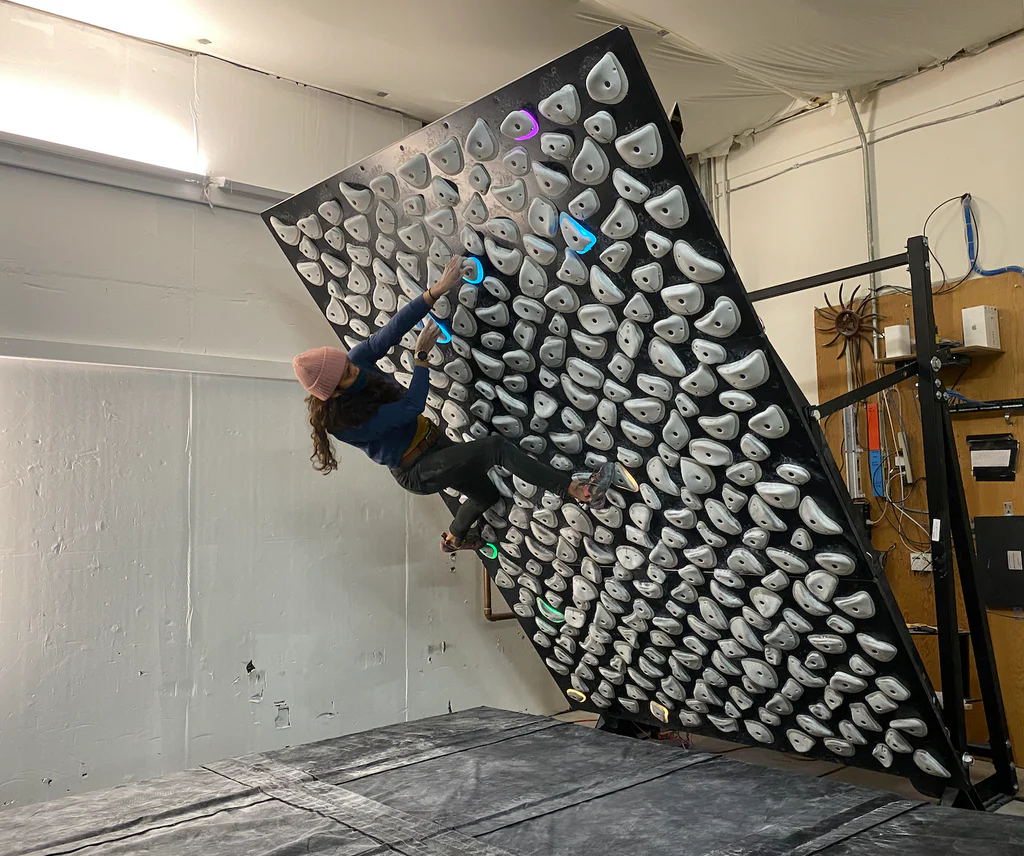
3. Kilter Board

The Kilter Board is known for its customizable lighting system and extensive hold variety, catering to climbers of all levels.

Pros:

  • Adjustable angles, accommodating climbers from beginners to experts.
  • Wide variety of holds, including jugs, crimps, and slopers.
  • Bright LED system enhances usability in low-light settings.

Cons:

  • High initial cost compared to other boards.
  • Requires significant space for installation.

Average Cost for Gyms:

  • Expect to pay $10,000 to $20,000, depending on the size and features.


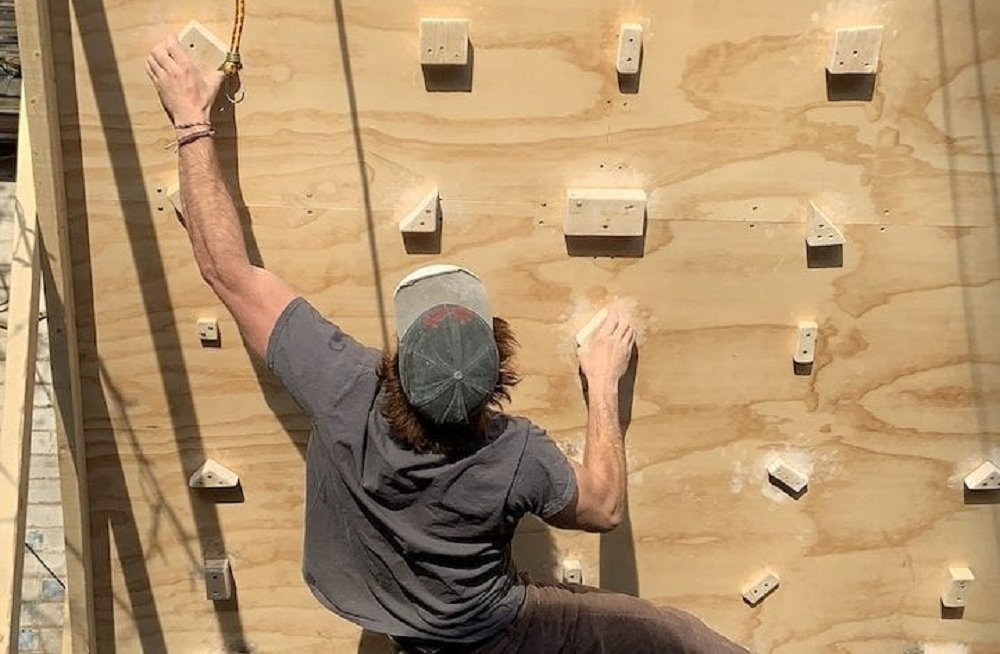
4. Homegrown or DIY Boards

For gyms with tighter budgets, a DIY climbing board offers flexibility and significant cost savings. These boards can be customized to match specific needs.

Pros:

  • Fully customizable hold layouts and wall angles.
  • Inexpensive compared to commercial systems.

Cons:

  • Lack of LED integration and standardized routes.
  • Time-consuming to build and maintain.

Average Cost for Gyms:

  • Costs can vary widely but often fall between $1,000 and $3,000.

How Smaller Gyms Can Benefit from Affordable Boards

Gyms with limited budgets can leverage DIY solutions or simpler systems like the Grassroots Board to provide valuable training options without breaking the bank. Investing in a functional but cost-effective setup allows gyms to cater to intermediate and advanced climbers while saving on upfront costs. Additionally, these gyms can engage their communities by hosting route-setting events or creating unique challenges tailored to their audience.

By prioritizing creativity and community involvement, gyms can provide excellent training opportunities without relying on high-end systems, ensuring climbers of all levels continue to thrive.


Conclusion

Climbing boards are an invaluable tool for bouldering gyms, enhancing training and fostering a sense of community. While premium boards like the Kilter Board and MoonBoard offer cutting-edge features, more affordable options like the Grassroots Board or DIY setups ensure accessibility for gyms of all sizes. By carefully considering their needs and budget, gyms can select the right board to meet their goals, inspiring climbers and maximizing their investment.

The Importance of Early Warning Systems

Early warning systems are critical tools for identifying and analyzing weather and climate-related risks. These systems aim to protect lives, livelihoods, and assets by enabling early actions in response to potential hazards. With climate change intensifying the frequency and severity of natural disasters, EWS are more necessary than ever. 

Issuing warnings within 24 hours can significantly reduce the damage caused by extreme events. (30%) Despite the growing number of disasters, only half of the world’s countries currently have access to multi-hazard early warning systems. 

Warning systems are composed of four essential elements:
– disaster risk knowledge
– detection and forecasting
– communication of warnings
-preparedness and response capabilities.

These components must work together, involving communities and organizations at risk, to effectively minimize the impacts of extreme weather and non-weather-related hazards, such as earthquakes and disease outbreaks. 

By advancing early warning systems, we can better prepare for the challenges posed by climate change, reducing harm and enhancing resilience. 

To get a better overlook which kind of early warning systems there are i started my research on that.

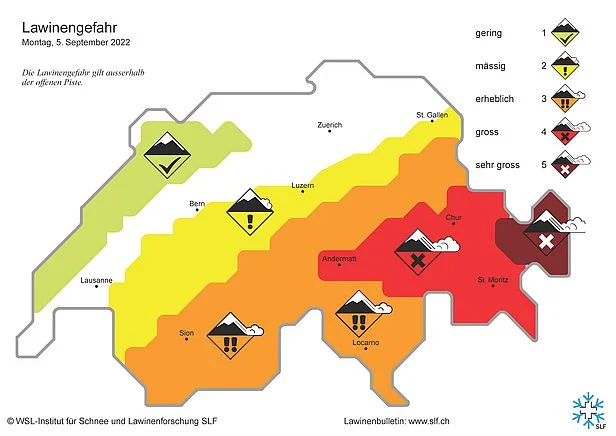
Swiss: WSL-Institut für Schnee-und Lawinenforschung SLF

The page on the Swiss Institute for Snow and Avalanche Research (SLF) website provides information about their research and services related to snow, avalanches, and mountain ecosystems. Visitors can find insights on current avalanche warnings, snow conditions, ongoing projects, and publications. The site also offers educational resources and tools for professionals and the public to enhance safety and understanding of mountainous environments.

The website from Swiss Institute for Snow and Avalanche Research appears updated and clean but finding the right path seems tricky sometimes.

Link: https://www.slf.ch/de/naturgefahren/lawinen/

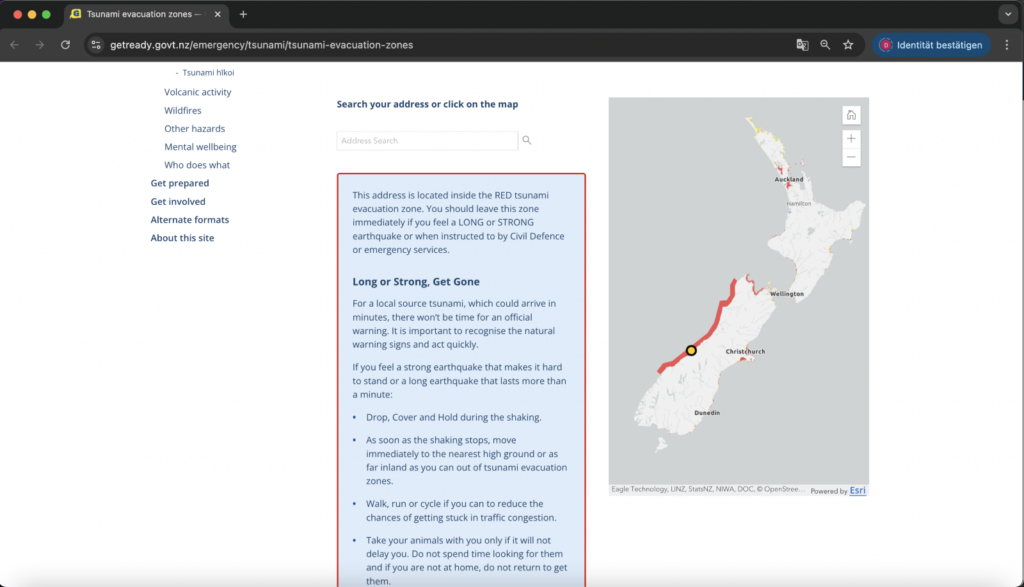
New Zealand: NEMA 

The National Emergency Management Agency website provides comprehensive resources on disaster preparedness and management in New Zealand. Visitors can find information on emergency alerts, guidelines, like video tutorials, for responding to various natural hazards like earthquakes and tsunamis, and resources for community engagement and education. The site also details strategies for disaster resilience, emergency response planning, and legislative frameworks. Additionally, it offers insights into civil defense sector operations, public education programs, and training opportunities. 

You can search if your location is in a Tsunami evacuation zones but doesn’t provide information about current tsunami warnings.   

The design of the National Emergency Management Agency’s website is definitely not the newest one. But it is user-friendly and straightforward, focusing on easy navigation and accessibility.  

Link: https://www.civildefence.govt.nz/ 

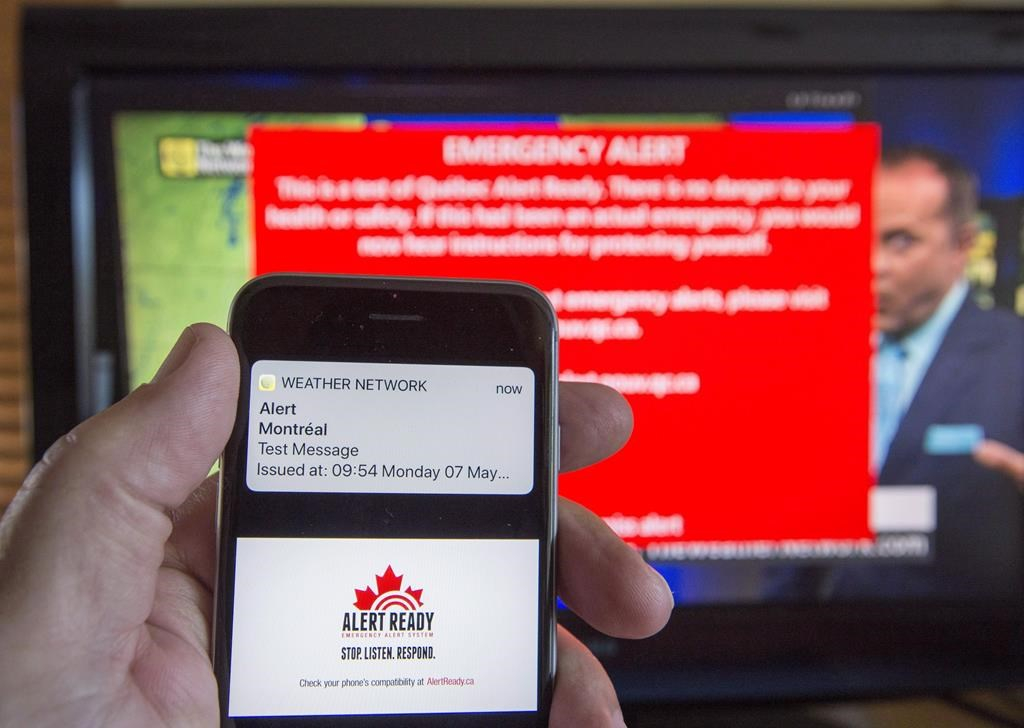
Canada: the National Public Alerting System  

Public Safety Canada’s website provides information about the National Public Alerting System (NPAS), known as Alert Ready. It explains how the system works to deliver emergency alerts to Canadians through various channels, including TV, radio, and mobile devices, during life-threatening situations. The page also includes details on the types of emergencies covered, how the alerts are issued, and guidance on receiving them. 

Although the website of the Public Safety Canada’s National Public Alerting System is being updated regularly, the design appears somewhat outdated. It lacks modern design elements such as responsive layouts, dynamic visuals, and interactive features that are now standard in contemporary web design. The visual hierarchy is minimal, and the aesthetic could benefit from an update to improve user engagement and accessibility. While functional, the site’s design might not fully meet current user expectations for an intuitive and visually appealing experience. 

Link: https://www.publicsafety.gc.ca/index-en.aspx 

The search for warning systems turned out to be tedious. There are a few websites that offer some information but are not very exciting from a design perspective. Basically, it can be said that acoustic signals (sirens) or visual warning lights are usually used in emergency situations. In order to reach people directly, such systems rely on contact via direct messages.


Research
https://wmo.int/topics/early-warning-system#:~:text=All%20early%20warning%20systems%20aim,assets%20of%20people%20at%20risk.&text=The%20damage%20caused%20by%20a,is%20issued%20within%2024%20hours.&text=About%2030%25%20of%20the%20global,covered%20by%20early%20warning%20systems.

https://www.civildefence.govt.nz/ 

https://www.publicsafety.gc.ca/index-en.aspx 

https://www.slf.ch/de/naturgefahren/lawinen/

The Journey of Documenting – Research and Preparation

Once you have found your “why” and “what” of your documentary you will have to figure out the “how”. What information do you need to tell the story you want to tell and how do you want to tell it?

Research
While nobody expects you to become the leading expert on the subject of your documentary, it is important to learn as much as you possibly can about it. Not only will it allow you to focus on the right things with your documentary and maybe change directions in the process, it is also necessary in order to be able to properly communicate with your subjects and to ask the right questions during interviews.
Being knowledgeable about your topic is also essential when pitching your idea to possible funders. No broadcasting company will support you if they feel like your documentary might only superficially treat the topic of interest (Glynne, 2007).
Through research you can begin to plan out your film and start thinking about how exactly you want to tell the story and what your storyboard and shortlist will look like (MasterClass, 2021).

Researching for a documentary film often starts with archival research. You will look through various archives, collecting anything that could relate to your topic of choice. You might find old photos and videos, newspaper articles, paintings or sketches, letters and diaries, any official documents, newsreels and unaired footage. All of this can either help you get a better understanding of the subject or event you are researching or can even be used in your documentary (MasterClass, 2021).
Another important part of your research will be finding the right people for your documentary, whether that be experts on the topic or citizens directly affected by social injustices or witnesses to certain events. Here you have to find a balance between finding people suited for the specific idea you have in mind and the ones audiences will want to watch and listen to. You might find experts or witnesses perfect for the job, but if they are not able to convey their expertise or charisma on film, you might have to rethink your options (Glynne, 2007).

In the article “Learn About Documentary Filmmaking: How to Research a Documentary Film With Tips and Advice From Ken Burns” on the website “MasterClass”, filmmaker Ken Burns is cited giving a few pieces of advice for researching your documentary. He states for example that when it comes to archival research you should always collect way more than you think you’ll need, at least 40 times as much. This way you can choose from all the possible directions your film might head into. Burns also advised to treat research like a detective following a lead, you have to dig deep and look in places that might not be obvious to get the best results. Last but not least he states that you have to be persistent, because you never know when you will find that perfect piece that will complete your story (MasterClass, 2021).

Further Developing your Idea
Another important factor that might greatly influence your research is the style of your documentary. How do you want to approach the topic you have chosen and which style will be best suited to convey the intended message? Sometimes this questions will be very easy and intuitive to answer, other times you might have to dig a bit deeper and get a bit further in your research before you know (Glynne, 2007).

The following are some of the different types of documentaries you might choose from:

  1. Observational
    This documentary style has its origin in the “cinéma vérité” movement and is defined by the fact that filmmakers neither comment nor intervene in what they document. In this type of documentary film there are no actors re-enacting the scenes after the fact, events are recorded as they are happening with as little manipulation and influence as possible (Glynne, 2007).
    A famous example of an observational documentary, also called “direct cinema” is the film “Titicut Follies” (1967) by Frederick Wiseman showing the abysmal treatment of inmates in a facility for mentally ill criminals called “the Bridgewater State Hospital for the Criminally Insane”. The conditions shown in the facility were so bad with inmates’ hygiene being neglected and guards mistreating them, that the state of Massachusetts banned the film from being shown until the ban was lifted in 1991 (Titicut Follies – Wikipedia, 2025).
  2. Authored
    Opposed to observational documentary, authored documentaries are highly subjective and often either include the filmmaker themself or are about the filmmaker’s life (Glynne, 2007).
    Some example of this style of documentary are “Fahrenheit 9/11” (2004) by Michael Moore where he himself talks about and comments, among other things, on the presidency of George W. Bush, the Iraq War and the media’s role in it (Fahrenheit 9/11 – Wikipedia, 2025) and “Supersize Me” (2004) by Morgan Spurlock, where Spurlock even went one step further and did the self-experiment of allegedly only eating food from McDonald’s for 30 days (Super Size Me – Wikipedia, 2024).
  3. Archive-based
    These documentaries are specifically planned around archive materials. Many historical documentaries fall under this category as it is impossible to create new authentic footage, thus many rely on archived documents, images and videos. One thing filmmakers should avoid is creating archive-based documentaries of current characters just because they don’t have access to them (Glynne, 2007). An example of an archive-based documentary is the documentary series “The Power of Nightmares” (2004) by Adam Curtis which compares the rise of the neoconservative movement in the US to the rise of the radical Islam. The documentaries consist mostly of archive footage underlined by narration of Curtis himself (The Power of Nightmares – Wikipedia, 2025).
  4. Reconstructed, Re-enactment and Drama-Documentary
    These types of documentaries recreate an actual event due to the lack of footage or because it was too far in the past. In this genre of documentary, the lines between documentaries and fictional films often get blurred leading to so-called “factions” or “docudramas” (Glynne, 2007). An example of this style would be various true-crime series or any other pieces that use a dramatised style to tell ‘true’ stories like “The Secretary who stole $4 Million” (2005) by the BBC, a drama documentary about a secretary who stole huge amounts of money from her boss and spent it all on her lavish lifestyle (Davis, 2005).
  5. Animation
    Sometimes filmmakers choose to not go for life-action footage at all in their documentaries or at leat not only. They might use the voices of real characters but animate their story, making it easier to deal with sensitive subjects without burdening the subjects or viewers (Glynne, 2007). One example Glynne mentioned was his own series of short, animated documentations called “Animated Minds” (2003), where real testimonies on different social and psychological topics are visualised through animations (Glynne, 2003).

Conclusion
Thorough research is the backbone of every documentary and will not only help you work out your storyline and the content of your film in the best way possible, but also allow you to communicate confidently with experts and potential funders. One important aspect to think about before starting to plan out your documentary is what style would be best suited for the topic you chose.

Literature

Possible Examples from Asia

As previously with African events, in the next step I would like to examine major events from the Asian region and find out whether they also have a design history as a basis that can be investigated further.

Possible Events for Asia:

1. Asian Football Championship (AFC Asian Cup)

2. Asian Games

3. Asian Art Biennale (Bangladesh)

4. Diwali and similiar festival events

5. Harbin International Ice and Snow Sculpture Festival (China)

6. Tokyo Game Show (Japan)

7. Lunar New Year Festivals

8. Gwangju Biennale (South Korea)

9. Shanghai Fashion Week (China)

10. Holi Festivals (India)

11. Pusan International Film Festival (South Korea)

12. Lantern Festivals (China, Taiwan, South Korea)

13. Cherry Blossom Festivals (Japan, South Korea)


The next step will be about getting to know more about these events and if they could help to examine the interactions between social trends and the design language.

The Journey of Documenting – The Idea

Introduction into the series
In preparation for creating my own documentary film at the end of my master’s, I’ve set out to find somewhat of a step-by-step guide on what it takes to succeed in this endeavour. During my research I found one book that promises to provide just that, called “Documentaries …and how to make them” (Glynne, 2007) by Andy Glynne. In the book Glynne leads (future) documentary filmmakers through the whole process, offering his own expertise and experience as well as that of various other renowned filmmakers such as Alma Har’el, Kim Longinotto, Marc Isaacs and many more. My idea for the next couple of blog entries is to create a more easily digestible and accessible collection of the information provided in the book, I can come back to during the process of creating my documentary. I will also try to find and add more information from other sources where I find it necessary, but I will mostly be basing my texts on the content provided within the book.

Part 1 – The Idea behind the Documentary

Finding your “Why”
Maybe even more important than finding out what your documentary should be about is the question of why you want to create it in the first place. Being able to answer this question passionately and with personal conviction will not only help you convince others of your idea but will also get you through the inevitable rough patches in the journey to creating your documentary. Being certain of your “why” will ensure you don’t lose your focus and drive when things might get hard (Solberg, 2024).

The reasoning for creating a documentary film can be very different depending on the person. Sometimes ideas for documentaries arise from deeply personal topics and issues, sometimes the films are used to raise or create social awareness of certain problems. Many filmmakers even chase the ultimate goal of changing the world with their creations. Although one could argue that documentaries themselves won’t change anything, their ability to instil the desire for change in their viewers make them incredibly powerful.
Some examples of when documentaries actually affected real change are the two films; “The Dying Rooms” (1995) by Kate Blewett and Brian Woods, and “A Complaint of Rape” (1982) by Roger Graef. “The Dying Rooms” shone a light on the tragic dark side of China’s one-child policy, where children were deliberately left to die because no-one wanted them. The outrage created by the film led, amongst other things, to the creation of a charity to improve the lives of orphaned and abandoned Chinese children (Whewell, 2025).
The other film Glynne mentioned, “A Complaint of Rape” was part of a documentary series on the police in the UK and showed, how rape victims are treated poorly during questioning and how police officers did not believe the women at all. After its publication on BBC, the video caused worldwide outrage and has led to a thorough reexamination of the procedures in place up until that point (BBC, 2021).


Both of these examples show how documentaries can have a real-world impact on social and political issues. However, there are also plenty of other reasons for creating a documentary film. While many filmmakers do have a political interest in mind or want to uncover social injustice, others that were cited in Glynne’s book stated that the reason they got into documentaries at all was just being nosy and liking to ask questions about other people’s lives (Glynne, 2007).
Whatever your reason might be, it is important to make sure your aim is clear enough to be able to inspire others to fund your project or watch the finished product, and also to be able to continually inspire yourself to keep going.

Finding Ideas
Whether your idea comes to you through something you already know or something you want to learn more about, something that enrages or excites you, a person our group of people you find particularly interesting or even a personal story from your own life or that of someone close to you, the most important thing you need is passion.
However, being passionate alone is not enough. You also have to check, whether your idea will actually make a good documentary. You need to ask yourself, whether there is a story behind it. Does it have an arc to it? Is there a clear goal and obstacles that have to be overcome in order to achieve it? Will your audience be intrigued enough to keep watching (Solberg, 2024)?
If you use characters in your documentary to tell the story you’ll also have to ask yourself whether they are interesting enough for the camera, what your relationship to them is and whether you have clearly and openly communicated your plans for the documentary with them.
Another important question to ask yourself early on is whether the story you have in mind is actually one that can best be told visually, so do you already have images in mind that will convey your idea?
But after all, even the best idea about the most captivating story is worth nothing if you do not have the possibility to actually create the documentary. So you have to ask yourself whether you even have the access needed for your project. Do the people you plan to tell a story about even want to be filmed? Is it save for them to be exposed like that?
Last but definitely not least, you have to ask yourself questions about the future of the documentary you want to create. Will it be commercially successful? Will audiences want to watch it and will broadcasting companies want to fund it? Has it been done before or are you the first one?
All of these questions and many more, you’ll have to ask yourself before you can turn your ideas into projects. Doing so will also help you dive deeper into the topic and familiarise yourself with it.

While there are countless different types and topics of documentaries, there are some general themes one usually better avoids when coming up with ideas. You should never try creating a documentary about experiences that you don’t know yourself and that cannot be directly viewed.
And although many filmmakers draw from personal experiences when looking for ideas, it is never a good idea to create a project about an ongoing, unresolved personal problem that might hold you back. Filmmakers should also avoid giving moral advice and preaching about a topic within their documentaries, cover problems which already have a solution or try to deal with issues they’re not able to fully grasp or understand (Glynne, 2007).

Conclusion
To sum up what is important in the process of finding the idea for a documentary, you always have to keep in mind, what it is you’re aiming at with your work. You should choose a topic that can inspire you as well as your audience and sponsors. Make sure your idea has a strong enough core, an intriguing storyline and the potential to make a visually interesting film before moving on to the next stages of your documentary.

Literature

The Power of Storytelling in Sustainable Graphic Design

Sustainability Through Narratives

Storytelling has long been a cornerstone of effective communication, and its relevance in sustainable graphic design cannot be overstated. With compelling narratives, designers can amplify their impact, engaging audiences emotionally and intellectually while promoting eco-conscious values. This post explores how storytelling transforms sustainable design into a persuasive tool that drives change.

Why Storytelling Matters in Sustainability

  1. Emotional Connection
    A well-told story resonates with audiences, creating empathy and engagement. When Patagonia tells the story of how their recycled materials protect fragile ecosystems, they make sustainability relatable and inspiring. As Dougherty (Green Graphic Design, 2008) points out, connecting values to visuals strengthens the bond between a brand and its audience.
  2. Simplifying Complex Topics
    Sustainability involves intricate concepts like carbon footprints, lifecycle assessments, and supply chain impacts. Storytelling simplifies these ideas, making them accessible. For example, an infographic that visually narrates the journey of recycled packaging materials illustrates the process for consumers.
  3. Driving Behavioral Change
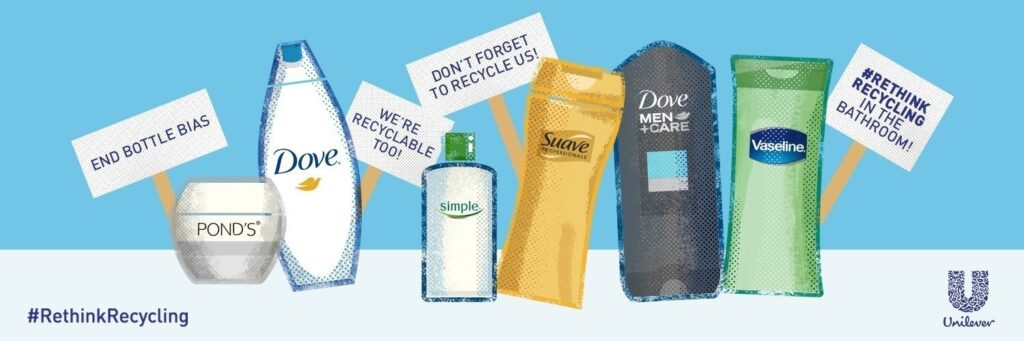
    Stories motivate action. A case study shared in Packaging Sustainability (Jedlicka, 2011) describes how Unilever’s storytelling campaigns led to increased consumer recycling rates. By illustrating the consequences of inaction and the benefits of eco-friendly choices, designers can inspire lasting change.
Unilever’s storytelling campaigns

Techniques for Effective Storytelling in Design

  1. Authenticity
    Stories must align with the brand’s values and practices. Authenticity builds trust, ensuring audiences believe in the message being conveyed.
    • Example: A small local print shop might share the story of their shift to FSC-certified paper, emphasizing their commitment to sustainability.
  2. Visualization
    Effective design uses visuals to tell stories that words alone cannot. Infographics, animations, and process illustrations bring narratives to life.
    • Example: A packaging design that incorporates before-and-after imagery to show the environmental benefits of switching materials.
  3. Human-Centric Narratives
    Stories are most impactful when they focus on real people, whether they’re the consumers benefiting from sustainable choices or the workers involved in eco-friendly production.
    • Example: Highlighting the artisans crafting biodegradable packaging as part of a fair-trade initiative.
  4. Call-to-Action (CTA)
    Every story should end with a clear CTA that invites the audience to contribute to sustainability.
    • Example: “Choose eco-friendly products today to make a difference tomorrow.”

Challenges in Using Storytelling for Sustainability

While storytelling is powerful, it must overcome certain hurdles:

  • Greenwashing Risks: Misrepresenting sustainability efforts can backfire, damaging trust. Transparency is crucial.
  • Audience Fatigue: Repeated messaging can lead to a loss of sensitivity. Keeping stories fresh and innovative is essential.
  • Balancing Creativity and Clarity: Stories must be creative yet straightforward enough to resonate with diverse audiences.

By addressing these challenges, designers can use storytelling as a transformative tool for sustainability advocacy.

References

  • Dougherty, B. (2008). Green graphic design. Allworth Press.
  • Jedlicka, W. (2011). Packaging sustainability: Tools, systems, and strategies for innovative package design. Wiley.
  • McDonough, W., & Braungart, M. (2002). Cradle to cradle: Remaking the way we make things. North Point Press.

Sound Design Basics und der Effekt auf Animation & Motion Graphics

„Ich will doch animieren, nicht Sounddesigner“
Sofern es kein Profession im Stummfilm werden soll gilt es auch als Animator:in ein basic Know-How von Sound-Design zu haben. Nicht nur weil Film ohne Ton ein wenig langweilig wäre, sondern auch weil sich durch das Sounddesign ganz neue Dimensionen in deiner Animation eröffnen können.
Das Sounddesign setzt emotionale Akzente, definiert den Charakter der Animation und verstärken die erzählerische Wirkung. Im weiteren erwecken Sprecher:innen ihre Charaktere durch ihre Stimme zum Leben. (Vgl. Connolly 2024)

Sounddesign alleine erzählt uns nicht die ganze Geschichte, aber es versetzt uns mitten in die Geschichte hinein! Es ist der immersive Faktor, der es ermöglicht, eine Animation wirklich zum Leben zu erwecken. (Vgl. Marques o.D.)

Gutes Sounddesign setzt sich aus verschiedenen Arten von Sounds zusammen.
Ambiente Sounds: Geräusche der Umwelt die Informationen über die Umgebung in der die Animationen stattfinden beinhalten, beispielsweise das Geräusch des Windes, das Singen der Vögel. (Vgl. Marques o.D.)  Tipp: Auch leere Räume machen ein Geräusch, beispielsweise Lüftungen.
Foley: Foleys werden verwendet um das Gezeigte zu vertonen, also Schritte auf dem Boden, beispielsweise.
Soundeffekte: Die Soundeffekte sind all die andere Geräusche, die Aktionen oder Elemente verstärken, sei es ein abstrakter Swoosh oder auch ein Knurren.
– Voice Over: Eine Stimme, welche die Geschichte/den Inhalt erzählt und so Informationen liefern.
Musik: Sanfte– oder auch laute – Musik im Hintergrund setzt die Atmosphäre den Ton des Videos (Vgl. Marques o.D.)

Stimmung und Atmosphäre schaffen
Das Sounddesign einer Animation ist essenziell, um die gewünschte Atmosphäre der Animation zu erzeugen. Durch die gezielte Auswahl von Sounds und Musik können Zuschauer:innen in die verschiedenste Szenarien transportiert werden – egal ob eine belebte Großstadt, ein ruhiger Wald oder futuristische Motion Graphics. (Vgl. Connolly 2024)

Erzählerische Tiefe durch Audio
Gut und strategisch verwendete Audioelemente treiben die Handlung voran und sorgen einerseits für Realismus, aber auch für Kontinuität. Die Kombination von Ton und visuellen Elementen sorgt für ein nahtloses Erzählerlebnis, das die Zuschauer:innen fesselt. (Vgl. Dupre 2023)  Was ohne Ton wie eine unpassende Pause oder zu langsam wirkt bekommt mit dem Sounddesign eine erzählerische, neue Ebene und wirkt plötzlich ideal! Über auditiven Input können außerdem Off-Screen-Ereignisse angedeutet werden oder die räumlichen Beziehungen klargestellt werden. 

Emotionale Tiefe durch Klanglandschaften
Die von Sounddesignern entworfenen Klanglandschaften verleihen Charakteren und Szenen mehr emotionale Tiefe, spiegeln den Zustand von Figuren wider und machen sie für das Publikum greifbarer. So wird die Zuschauerbindung intensiviert. Schon subtile Harmonien oder dramatische Klänge verstärken die gewünschte emotionale Reaktion – egal ob Spannung, Freude, Angst oder Melancholie. (Vgl. Dupre 2023)

Charakterentwicklung durch Stimmen und Emotionale Ausdruckskraft
Zwar ist es immer ein Kampf, vor allem im Rahmen des Studiums, gute Sprecher:innen für Projekte zu finden, nichtsdestotrotz habe ich oft das Gefühl dass die Animation mit eben diesen „Steht oder fällt“. Als Beispiel möchte ich später dann auch meine Bachelorarbeit „Lost sein. Verloren in der Quarterlife Crisis“ herbeiziehen.
Durch Tonlage, Intonation und Sprachmuster formen Sprecher:innen die Identität ihrer Figuren. (Vgl. Connolly 2024) Auch in Erkläranimationen trägt die verwendete Stimme zur Wahrnehmung des gezeigtem bei. Man soll der Stimme zuhören wollen.
Zusätzlich können durch spezielle Sprachstile oder einzigartige stimmliche Nuancen beispielsweise humorvolle Momente betont werden. (Vgl. Dupre 2023)

Die Sprecher:innen müssen eine Bandbreite an Emotionen vermitteln können und schaffen damit eine emotionale Verbindung zum Publikum. Wie Dupre beschreibt, erfordert dies ein herausragendes Verständnis für Timing, Intonation und Rhythmus, damit die Darbietung glaubwürdig und dynamisch wirkt. (Vgl. Dupre 2023)


Die Bedeutung von Voice-over und Sprecherstimmen

Arbeitet man mit Motion Graphics und Animationen zählen auch Erklärvideos zu klassischen Projekten. Ein gutes Voice-Over ist entscheidend für den Erfolg eines Erklärvideos, denn es fungiert als unsichtbare:r Erzähler:in und ergänzt so die visuelle Botschaft, erklärt komplexe Inhalte und schafft eine emotionale Verbindung zu den Zuschauer:innen.
Doch nicht jede Stimme erfüllt diese Aufgabe gleichermaßen gut, weshalb die Auswahl der richtigen Stimme den Unterschied zwischen einem gelungenen Video und einem nicht ganz perfektem ausmacht. (Vgl. Nisha 2024)
Eine gute Stimme vermittelt nicht nur Informationen, sondern bringt auch Emotionen und Glaubwürdigkeit mit in das Video, während ein monotones Voice-over die Inhalte langweilig erscheinen lassen kann. Es tragen sowohl der Klang, die Betonung und auch die Sprachmelodiedazu bei, die Zuschauer:innen emotional abzuholen.(Vgl. Nisha 2024)

Die passende Stimme spiegelt auch die Persönlichkeit der Marke wieder: Ein eher spielerischer Ton kann ein jüngeres Publikum ansprechen, während ein eleganter und professioneller Stil Seriosität ausstrahlt. Hier ist es also besonders wichtig die Markenidentität, die Botschaften und die Zielgruppe zu bedenken. (Vgl. Nisha 2024)


Technisches
Die technische Umsetzung des Sounddesigns ist entscheidend, um Animationen Tiefe und Realitätsnähe zu verleihen. Hochwertige Mikrofone und eine passende Umgebungen sind essenziell für klare Tonaufnahmen. (Vgl. Connolly 2024)
Es macht daher durchaus Sinn in hochwertige Audio-Files und Aufnahmegeräte zu investieren oder eben gleich einen Pro für’s Sounddesign heranzuziehen.
Mischen und Mastern sorgt für ein ausgewogenes Klangbild, in dem Dialoge, Effekte und Musik harmonisch miteinander funktionieren. Die finale Abmischung balanciert alle Audiospuren, kontrolliert den Dynamikumfang des Sounds und sorgt durch Equalizing für Klarheit und harmonische Balance. (Vgl. Dupre 2023)

Abstrakte Animationen und die präzise Synchronisation von Bewegungen und Klangereignissen.

In der Fallstudie von Gerald Moshammer (Vgl. Moshammer 2023) wird unter anderem die Synchronisation von Bewegungen und Klangereignissen thematisiert.

Kleine, subtile Bewegungen, die genau auf die Dynamik und den Rhythmus der Musik abgestimmt sind, erzeugen eine starke emotionale Resonanz.  Beispiele sind das leichte Zittern einer Linie, das den Vibrato eines Instruments visualisiert, oder sanfte Farbwechsel. (Vgl. Moshammer 2023) Bei Motion Graphics oder anderen Videos die rhythmisch sind und mit Musik unterlegt werden macht es deshalb oft auch Sinn, die Musik als Leitlinie für das Timing in der Animation zu verwenden.

Vermeiden sollte man unsynchronisierte Bewegungen oder visuelle Elemente, vorallem wenn diese nicht mit der zu visualisierenden Musik übereinstimmen. Auch zu viele visuelle Reize, wie übermäßige Bewegungen oder Farben, zu Überladung und Überlagerungen führen (Vgl. Moshammer 2023) – das ist auch im Sounddesign zu vermeiden.

Fazit und Erkenntnisse aus meiner Bachelorarbeit: 

Im Rahmen meiner Bachelorarbeit habe ich die Gefühlswelt junger Erwachsener in der Quarterlife Crisis in einen Animationsfilm verarbeitet. Es wurde intensiv daran gearbeitet und das Ergebnis ist durchaus in Ordnung, nichtsdestotrotz bekomme ich jedes Mal Gänsehaut (negativ), wenn ich das Sound-Design dazu höre. Davon abgesehen dass die Animation ohnehin zu lang geworden ist, war die Aufnahme der Texte nicht gut und die Sprecherstimmen nicht unterschiedlich genug. Die gesamte Informations-Ebene der Voiceovers – dem inneren und dem tatsächlichen Monolog – ging verloren. Gegen Ende kommen weitere Stimmen hinzu und das Sounddesign wurde mit guten Songs und Sounds hinterlegt und plötzlich gewann auch die Animation an Qualität. Was heißt das für mich? Ich weiß jetzt dass Sound einer etwas wackeligen Animation viel stärke geben kann, oder eine „ganz okay wirkende Animation“ in den Boden drücken kann. Deshalb > Sich gut überlegen was die Sound-Ebene der animation mitgeben soll/wird + Gute Beziehungen zu Sound-Designer:innen wahren!

Quellen: 

Dupre 2023
Dupré, Gwénaëlle (2023): Sound Design in Animation. Definition, Process & Challenges. In: CG Wire, https://blog.cg-wire.com/sound-design-in-animation-definition-process-challenges/(zuletzt aufgerufen am 06.01.2025)

Connolly 2024
Connolly, Michelle (15.05.2024):Sound Design in Animation: Crafting Immersive Experiences for Your Audience. In: Educational Voice, https://educationalvoice.co.uk/sound-design-in-animation/ (zuletzt aufgerufen am 06.01.2025)

Nisha 2024
Nisha (30.05.2024): Explainer Video Voiceover: Elevating Your Message with the Right Tone. In: mypromovideos, https://mypromovideos.com/blog/explainer-video-voice-over/ (zuletzt aufgerufen am 06.01.2025)

Moshammer 2023

Moshammer, Gerald  (2023): Abstract animation, emergent audiovisual motion and micro-expression. A case study of analogue music tracking with Robert Schumann’s Forest Scenes in AudioVisualizer. In: ResearchGate,https://www.researchgate.net/publication/373684415_Abstract_animation_emergent_audiovisual_motion_and_micro-expression_A_case_study_of_analogue_music_tracking_with_Robert_Schumann’s_Forest_Scenes_in_AudioVisualizer (zuletzt aufgerufen am 06.01.2025)

Marques o.D.

Marques, Raff (o.D.): Why and How to Incorporate Custom Sound Design into Your Next Animation Project. In: Mowe, https://mowe.studio/animation-sound-design-effects-music-motion-graphics/(zuletzt aufgerufen am 06.01.2025)

Disclaimer: 

This text was proofread for punctuation, grammar and spelling errors with the help of ChatGPT 4o. The content of the text remains unaffected.
Morphing als narratives und ästhetisches Werkzeug

Was ist Morphing – Definition:

Morphing nennt man einen visuellen Effekt, bei dem Ein Objekt (beispielsweise im Film) nahtlos in ein anders übergeht. (vgl. Wikipedia 2024). Ein Morph kann ziemlich auffällig oder auch sehr subtil sein. Ein auffälliger Morph wäre beispielsweise die Transformation einer Person in eine andere oder etwa sogar in ein Tier. Eine weniger sichtbare und subtilere Transformation ist jene von einem Schauspieler zu seinem Stuntman oder Stundwoman. (vgl. Nuke o.D.) Diese Transformationen werden heute häufig angewendet und sind durch CGI relativ gängig geworden.
Auch im Sound-Design und in der Musikproduktion nutzt man Morphing, beispielsweise um Stimmen oder Tonspuren zu verändern (vgl. Wikipedia 2024).

In meinem Blog war es bisher selten der Fall dass wir über die Geschichte von etwas gesprochen haben. Hier bietet sich und sie chance über Animations-Geschichte in einer kleinen Nische zu sprechen, was wir uns natürlich nicht entgehen lassen wollen.

Früheste Techniken der Transformation:
Schon vor der digitalen Technik gab es verschiedene Methoden, welche die Transformationen von Bildern ermöglichten:

  1. Tabula Scalata: Noch nicht wirklich Film und Animation, aber bereits seit dem 16.Jh ist diese Technik in der Malerei bekannt. Die Malerei funktioniert indem zwei Bilder auf einer gewellten Oberfläche dargestellt werden und dadurch jeweils nur aus einem bestimmten Winkel sichtbar sind. Ein primitiver Morphing-Effekt tritt dann auf, wenn man zwischen beiden Bildern steht (vgl. Wikipedia 2024).
  2. Mechanische Transformationen: Nach der Malerei wurden Morphings auch im Schattenspiel verwendet. Händisch wie auch mechanisch, beispielsweise um 1790 vom französische Schattenspieler François Dominique Séraphin (Gesicht einer jungen Frau in das einer Hexe) (vgl. Wikipedia 2024).
  3. Matched Dissolves: Im 19. Jahrhundert gab es Techniken, bei denen zwei Bilder miteinander verschmolzen wurden, beispielsweise indem sie die Landschaften von Tag zu Nacht oder von Sommer zu Winter verwandelten. (vgl. Wikipedia 2024).

Aber wann kam das alles so wirklich in die Gänge?
Die ersten digitalen Morphing-Effekte tauchten in den 1980er Jahren auf, als Computergraphiktechniken genutzt werden konnten.

  1. Frühe digitale Beispiele: 1986 entwickelte die Firma Omnibus einen digitalen Morphing-Effekt für einen Werbespot, in dem sie eine Flasche Waschmittel in die Form der Vereinigten Staaten verwandelten. (vgl. Wikipedia 2024).
  2. Bekannte Anwendungsbeispiele kamen dann wenig später, wie Musikvideo-Clipx zu Michael Jacksons “Black or White” oder Filme wie Terminator 2: Judgment Day (vgl. Wikipedia 2024).
  3. Software und kommerzielle Nutzung: In den 1990er Jahren erschienen Programme wie “Elastic Reality”, die es ermöglichten, Morphing-Effekte in Filmen und Musikvideos zu erzeugen. Diese Technologie gewann 1996 zwei Oscars für ihre technischen Verdienste.
    (vgl. Wikipedia 2024).

Gegenwart und moderne Anwendungen:

Heute gibt es schon jedemenge Morphing-Algorithmen, die sich immernoch weiter entwickeln und besonders seit dem Aufkommen von AI in der Bild- und Videogestaltung können nun schon einige Programme automatisch morphen, wenn die ausreichend ähnlich sind. Oft sind die Morphings in Filmen und Videos für das ungeschulte Auge garnicht mehr sichtbar. (vgl. Wikipedia 2024).

Morphings werden genutzt um Zeitlupeneffekte zu erzeugen (bsp Bullet Time) und auch als standardisierte Übergangstechnik zwischen verschiedenen Szenen in Fernsehshows werden Morphings eingesetzt, auch wenn die Inhalte der beiden Bilder völlig unterschiedlich sind. Das funktioniert indem der Algorithmus, korrespondierende Punkte zwischen den Bildern sucht und das eine in den anderen verzerrt, während sie sich überblenden. (vgl. Wikipedia 2024)

Ein noch extra zu erwähnender Einsatzbereich von Morphing-Effekten ist die Gestaltung von Fonts, denn durch Morphing-Technologie, die als Interpolation oder Multiple-Master-Technik bezeichnet wird. So können Designer:innen eine Zwischenform zwischen zwei Schriftschnitten entwickeln lassen, indem beispielsweise eine halbfette Schrift durch das morphen einer fetten und einer normalen Schrift entsteht. (vgl. Wikipedia 2024).

Morphing vs. Tweening vs. …

Wer Morphing kennt hat manchmal auch schon von Tweening gehört – ist das das selbe? Die Begriffe werden oft austauschbar verwendet, beschreiben aber unterschiedliche Prozesse. Während es beim Tweening mehr um Animation und das Hinzufügen von Bewegung geht, ist Morphing eine Technik der Filmindustrie zur Erstellung von Special Effects. (Vgl Adobe o.D.)

Morphing: Eine VFX-Technik zur nahtlosen Transformation eines Objektes in ein anderes

Tweening: Ein Animationseffekt, bei dem – automatisch – Bilder zwischen Keyframes eingefügt werden, um den Eindruck von Bewegung zu erwecken. Beispielsweise zwischen Key-Posen.

Reißschwenk: Reißschwenkt ist eine Übergangsart, mit der zwei Aufnahmen zu einer zusammengeführt werden indem sie schnell bewegt werden, was auch einer Art Morph gleichen könnte.

(Vgl Adobe o.D.)

Morphing-Arten:


– Morphing mit maximaler Geschwindigkeit:
Hier macht man sich im Morph eine kleine Hilfe – die Verzerrung – zu nutze. Diese Art von Morphing sieht man oft in Kinofilmen, denn Objekte werden gemorpht, während sie in einer schnellen Bewegung sind. Durch die Verzerrung der Geschwindigkeit fallen kleinere Inkonsistenzen weniger auf. (Vgl. Adobe o.D.) Ein beispiel aus Motion Graphics wäre es auch, dass ein Objekt zum Beispiel rotiert, während es morphed (z.B. ein Quadrat in einen Kreis)

– Direktes Morphing: Bei einfacheren Morphings kann über die Form gemorphed werden, z. B. um eine handgezeichnete Form in eine andere Form umzuwandeln. Mithilfe von Form-Tweens kann man dann Frame für Frame (oder mithilfe der Funktion) ein Quadrat in einen animierten Kreis verformen. (Vgl. Adobe o.D.)

– 3D-Morphing: In 3D-Programmen wird Morphing genutzt um Verformungen zwischen verschiedenen Bewegungen zu modellieren. Die verschiedenen Bewegungen oder Posen werden durch ein „Ziel“, eine Key Pose, definiert und der rest wird durch die Algorithmen gemorphed. (Vgl. Adobe o.D.)

Was steckt dahinter – Die Technik

Beim Morphing geht ein Bild in ein anderes über

Im ersten Schritt ist ein Ausgangs- und Zielbild zu wählen und so das Konzept festzulegen.
Im zweiten Schritt 2. werden die wichtigsten Merkmale definieren. Es muss beispielsweise die Form des Originalobjekts muss exakt vermessen und abgebildet werden, um dann auf Basis dieser Werte ein möglichst gutes Morphing-Ziel zu finden – also ein entsprechende Modelle erstellen oder eine Aufnahmen suchen. Im letzten Schritt werden dann die genauen Punkte zugeordnet. Mithilfe von Spezial-Software werden wie relevantesten Punkte im Original- und im Zielobjekt analysiert und in weiterer Folge lassen sich so die wichtigen Bereiche aufeinander abstimmen – z. B. die Augen. Im letzten Schritt werden die Pixel des Originalobjekts durch Einfügen von Zwischenbildern zu den Pixel des neuen Objekts umgeformt. (Vgl. Adobe o.D.)

Zur genauen Anwendung gibt es unzählige Tutorials online 🙂

Quelle

Nuke o.D.
Nuke (o.D.): Morphing. In: Foundry,https://learn.foundry.com/nuke/content/comp_environment/warping/morphing.html#:~:text=An%20example%20of%20a%20noticeable,a%20much%20more%20subtle%20morph.

Wikipedia 2024
Wikipedia. Die freie Enzyklopädie (18.11.2024), s.v. Morphing, https://en.wikipedia.org/wiki/Morphing (zuletzt aufgerufen am 06.01.2025)

Adobe o.D.

Adobe (o.D): Morphing: Was ist das und wie funktioniert der Effekt?. In: Adobe/Animation/Discover, https://www.adobe.com/de/creativecloud/animation/discover/morphing-in-animation.html (zuletzt aufgerufen am 06.01.2025)

Disclaimer: 

This text was proofread for punctuation, grammar and spelling errors with the help of ChatGPT 4o. The content of the text remains unaffected.
Rethinking Digital Spaces

As technology becomes an inseparable part of our daily lives, it plays a crucial role in shaping how we interact with the world—and each other. But how often do we stop to consider the gender biases embedded in our digital experiences? From voice assistants and algorithmic recommendations to UI/UX design, technology is far from neutral. In fact, it often reinforces binary gender norms, intentionally or not.

How do we experience Gender in tech?

Genderless design in technology refers to the deliberate effort to remove unnecessary gender markers from digital products, services, and interfaces. It’s about creating experiences that don’t assume or reinforce traditional gender roles, allowing users to engage with technology on their own terms. But the challenge is that many of our current digital systems are built on deeply ingrained assumptions about gender.

One of the most well-documented areas of gender bias in technology is voice AI. Digital assistants like Siri, Alexa, and Google Assistant overwhelmingly use female voices, reflecting long-standing social expectations that women should be helpful, accommodating, and nurturing. Studies suggest that users perceive female voices as warmer and more approachable, whereas male voices are often associated with authority and expertise. But this creates an imbalance—when AI assistants are predominantly voiced by women, it perpetuates stereotypes about servitude and obedience. Conversely, when virtual assistants designed for finance or technical support use male voices, it reinforces the idea that men are more knowledgeable in those areas.

To counter this, projects like Q: The World’s First Genderless Voice aim to challenge binary assumptions. Q was developed through extensive research, blending the vocal characteristics of multiple speakers to create a tone that exists between traditional male and female registers. The goal is not just to provide an alternative but to provoke a discussion about why gendered voices are the default in the first place. (Source: Q Voice Project)

Moving Beyond Gendered Aesthetics

We can see the topic of Gender in visual communication in many design choices, from color palettes to iconography, again. For example, fintech apps targeting men often use dark themes, sharp typography, and high-contrast elements, signaling power and control. Meanwhile, apps marketed toward women may employ soft pastels, rounded typography, and nurturing language, reinforcing ideas of emotional sensitivity and caretaking. This is particularly evident in the health and wellness industry, where apps for period tracking, fertility, and general well-being overwhelmingly adopt a “feminine” aesthetic. While there is nothing wrong with this, it assumes that all users of these apps identify with traditional femininity. A more inclusive approach would involve providing customization options so users can shape the interface to fit their own preferences.

A great example of genderless UI is Google’s Material Design, which emphasizes functionality and adaptability over aesthetic assumptions. By focusing on clarity, accessibility, and modular components, Material Design enables brands to create interfaces that work across diverse user identities. (Source: Google Material Design)

Challenges and the Future of Tech Design

Despite growing awareness, there are still barriers to achieving true gender neutrality in tech. One major challenge is bias in AI and machine learning. Many algorithms are trained on datasets that reflect historical gender disparities, meaning they inherit and amplify those biases. Facial recognition systems, for instance, have been criticized for being less accurate in identifying non-binary or gender-nonconforming individuals (Read more about this in the following Blog Post!).

Ultimately, genderless design in technology is about challenging default assumptions. Rather than asking, “How do we make this product appealing to men or women?” the question should be, “How do we make this product useful and welcoming for everyone?” Technology shapes the way we navigate the world, and by designing without unnecessary gender markers, we create experiences that empower individuals to engage with digital spaces on their own terms.