Impulse #8 – Trust the process, I guess?

This final impulse isn’t really about one single event but more about my next steps and some reminders for myself, that hopefully help me shape my thesis, since I am kind of lost at the moment.

Instead of moving forward with my thesis I find myself circling, questioning and mostly doubting my current direction. It feels uncomfortable, but maybe this phase is necessary for the whole process, since everyone always says “the journey is the reward”. Up until now I tried to define what my thesis should be, what the outcome should look like and what form it should take, and how can I justify or measure it. I realized the more and harder I tried to answer all of these questions the more pressured I felt. Also, I realized that defining the workpiece kind of in the beginning, blocked me even more because I felt like I already defined a way and I can’t move away from it. Rationally, I know that I can always change the direction, but somehow, I still feel stuck at the moment.

Since I am not 100% happy with my current direction, my next step is a step back. I think I need to go back to a more open and exploratory phase. The process doesn’t need to be linear, and I want to allow myself to also move sidewards not only forwards. I want to explore different topics, topics that I truly care about. But I want to explore them without immediately trying to turn them into a solution asking myself if this would be a good thesis. I want to ask myself more open questions: What excites me? What makes me curious? What topics do I come back to? I think this next phase should be less about creating and more about researching through reading, watching, observing and experimenting and see what resonates with me. I want to spend time writing down thoughts, questions, references or any ideas that come to my mind, without the pressure of turning it into a concept right away.

I need to remind myself that I don’t need to have all the answers right away. For someone who loves to have a clear goal and all the steps that lead me to reach this goal, this feels very unnatural and hard, but maybe this is exactly what I need right now. I need to trust the process and accept uncertainty as part of it. Additionally, going back doesn’t mean going back to zero. The impulses from the past weeks aren’t wasted, they formed a good foundation I can build on if I want to. Now that I finished all my courses, I finally have more time and mental space to really take a step back and sit with some ideas longer, sketch, reflect and finding out what I really want to do. Maybe I just need to narrow down my current idea or maybe I need to go into a completely different direction, but anyways I think my goal right now is to be curious, to explore, to ask questions instead of searching for the perfect thesis.

AI was used to check spelling and grammar.
Installing a PiHole (Homelabbing_3) – Impulse #6

In my last homelabbing post, I talked about getting my server set up with Docker and hosting my first applications. A logical next step on my list was to tackle network-wide ad-blocking. As I hinted before, the time finally came to set up a PiHole. I was excited to improve my own network but also to get my hands on a piece of open-source software that is widely loved.

For those unfamiliar, PiHole works differently than an add blocking browser extension. Instead of scanning websites for ad-like code, it operates as a DNS sinkhole. In simple terms, when any device on your network tries to contact a server known for serving ads, the PiHole intercepts that request and sends back an empty response, so the ad never even loads. The biggest advantage? It works for everything on your network, your laptop, your phone, and even your Smart TV, where ad-blockers are often non-existent.

The setup process itself was a great hands-on experience. I used a tiny Raspberry Pi Zero that I got from my brother for christmas, flashed the operating system to an SD card, enabled SSH for remote access, and plugged it into my router. From there, running the single install command and watching it work its magic was incredibly satisfying. A few configuration changes on my router to direct all DNS traffic through the Pi, and it was up and running, protecting me from ads. ;D

Impact for my Masters Thesis

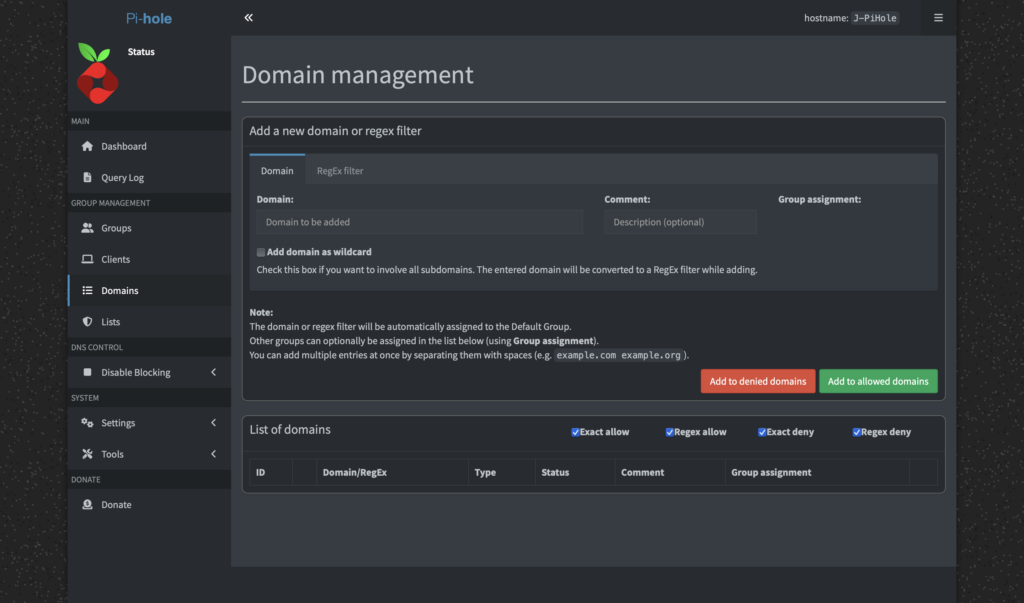
This is where this little project became a huge impulse for my thesis. While exploring the PiHole’s web dashboard, I stumbled upon a perfect, real-world UX issue. To block a domain, you add it to a blocklist. To allow one, you add it to an “allow list.” On the dashboard, the button to add a domain to the allow list is green.

As a designer, green signifies a positive action, like adding something while red signals a negative action, like deleting something. More than once, I found myself accidentally clicking the green “Allow” button when my actual intention was to block a domain. It’s a classic UX problem where the visual signifier conflicts with the user’s intent. For a developer, a green button for “allow” might make perfect sense, it’s the “good” list. But for a user managing blocklists, it creates confusion.

This was a firsthand example of a barrier a designer could help lower. I immediately thought, “This is open source, I should be able to fix this!” I wanted to change the button color, maybe add an icon, or just improve the layout. But then I hit another wall: the documentation on how to change interface elements wasn’t straightforward for a non-developer. I literally had no idea, where to start.

This entire experience perfectly encapsulates the core of my thesis. It’s not just about finding UX issues, but about the entire process: identifying a problem, understanding the contribution workflow, and finding the right documentation. My simple home lab project has given me a tangible case study, a real problem to solve, and a clear path to explore for my “Designer’s Guide to Open Source.” It’s the first step in moving from theory to a real, practical contribution.

Accompanying Links

Pi-hole official website – https://pi-hole.net/

Raspberry Pi Zero – https://www.raspberrypi.com/products/raspberry-pi-zero/

Ai was used to formulate this blogpost (Gemini + WisprFlow)

Impulse #7 – Talk, Talk, Talk

As written in my last blog post, unfortunately I feel kind of lost and stuck about my master’s thesis at the moment. However, this week I had three different talks about my master thesis, which helped me a bit to gather my thoughts.

My struggles right now

The main topic of my thesis is the impact of productivity and perfection pressure on creative work nowadays. The reasons why I am unsure about the topic are that [a] creativity is a very broad and sometimes hard-to-grasp topic, [b] there are already quite a lot of theses about creativity, and it might be hard to create a strong and unique selling point and [c] I am worried about whether there is a scientific way to really measure creativity. Especially in my case where I want people to interact with the creative webspace and then reflect on their emotional response afterwards and this feels rather vague right now. To prove or disapprove a thesis it is of course important to be able to measure something.

In addition, there is also the realization that I don’t want to create something only digital.

Final Crit with Horst Hörtner

Horst Hörtner is expert in human computer interaction and managing director of the Ars Electronica Futurelab which is known as one of the most important institutions in interaction design on the edges of digital media, design, art, science, industry, society.

The talk was not just about the master thesis itself, but in general about us, our projects and skills and where we want to head in the future. I told him about my master’s thesis idea and about the struggles I am currently facing. He also agreed that in my case only building something digital, which should help creatives in a time of creative blocks, might not be the best solution. We talked a bit more about my general research interests, such as mental health, social issues, feminism and tangible interfaces. He said this is already a good starting point and even though I feel unsure about my thesis right now they resonate with my current topic.

He gave me the advice to deeply dive into topics I am genuinely interested in and to think about what visions I have for my future self, this will help me find a clearer direction. Additionally, he said that, even though he knows it is hard, it is important to engage with the theme, see where the research leads me, and then, in the best-case scenario, a workpiece will emerge from this process.

Final Crit with Martin Kaltenbrunner

Mr. Kaltenbrunner is professor at the Institute of Media Studies / Interface Culture at the University of Art and Design in Linz, head of the Tangible Music Lab, expert in human computer interaction and co-inventor of the Reactivision framework.

Mr. Kaltenbrunner gave me valuable feedback on both my approach and the overall direction of my thesis. I explained my idea of creating a digital, interactive playground as a counter act to productivity culture in creative environments. The webspace intended to support creatives during times of creative blocks. He pointed out that, despite the playful intention, it still would function as a tool designed to increase productivity, since its goal is to generate more creativity. To be honest I never thought about it this way, but he was right. This underlying logic contradicts with what I actually want to explore and question in my thesis.

He told me about the exhibition Unuselessness – The Useful Useless they did at University of Arts and Design Linz. The exhibition explored the contradiction between art and usefulness and the growing expectation that art, design and technology always must be useful or efficient. While researching for the exhibition, they came across Chindogu – the Japanese art of “useless inventions”. He advised me to read up on this topic and narrow down my topic as it currently seems a bit too broad.

https://www.kunstuni-linz.at/archiv/detail/unuselessness-the-useful-useless

Talk with Ursula Lagger

Yesterday I also had a conversation with Ursula Lagger about my master’s thesis and my exposé. She advised me to create a pro-and-contra list if I feel unsure about my topic and to write down everything that comes to my mind about it. When I told her that I might want to explore different topics, she encouraged me to think about the graduation itself and what I want to present to my family, something I feel proud and happy about it, as this might help me to find a topic I truly want to write about.

These three conversations all gave me different perspectives, insights and impulses to move forward. Even though it feels frustrating to realize that I might need/want to rethink or even start over, the conversations felt encouraging.

AI was used to check spelling and grammar.

Impulse #6 – Overlays Exhibition

It’s crazy that our Overlays Exhibition has already been over since Tuesday, but since then I’ve had some time to review the whole process and the exhibition itself.

I was part of the speaker team, so in addition to planning and implementing my own projects that were exhibited as well as the Portfolio Machine, we also had to coordinate the entire exhibition itself and keep track of the organization. That was often not easy and involved a lot of stress and long nights. But I think the effort and stress paid off, because it was a successful exhibition with a lot of positive feedback. I learned so much about teamwork, project management and exhibition design, and I am sure this will help me in my future career. During this whole process I also realized that organizing exhibitions is something I really enjoy. However, most importunately this whole exhibition and its process gave me some new impulses and directions for what I want to do in my master’s thesis.

I was part of three projects that were exhibited: The Poisonous Twin (game), BÖRG (interactive projection mapping) and the Portfolio Machine. Looking back at these projects, I realized all of them had a strong haptic interface and where not just another only screen-based experience. And I think this is the main reason why I enjoyed working on them so much. I’m a crafty person and I like to work with my hands and that is exactly what we did in all of these three projects: from cutting, painting, building a mountain out of Styrofoam and then cover it with papier-mâché, building little mushrooms out of fimo, soldering, printing cd covers to 3D-printing our cd player for the Portfolio Machine. The combination of working analog and digital is what I enjoy the most, especially in a time where we are staring at our screens too much anyways. And I think not every idea needs to live exclusively on one.

My initial idea for my master’s thesis was to create a digital webspace/creative playground for low-pressure and non-goal-oriented creativity. However, after experiencing my projects in a physical exhibition, I realized that creating just another webspace/digital environment might not be exactly what I want to do. Or at least it should not be the only part of my workpiece. I am interested in finding a way to combine digital and analog elements for my project, because I think it is quite nice to hold something physical in your hands after working on a project for such long time.

Even though this might take me back few steps in my thesis process, it is important to me to rethink my workpiece and approach. Right now, I feel kind of unhappy and unsure about my idea and project. And I guess already starting with this feeling might not be the best starting point for my master’s thesis. My next step is a step back; to brainstorm again about the direction of my thesis. I think it is necessary now because I want to be excited and confident about my master’s thesis.

AI was used to check spelling and grammar.
IMPULSE #7 – A Talk & A Book

After defining my thesis topic as Narrative UX & Interactive Web Storytelling, I wanted to engage more directly with designers who explicitly connect storytelling and design. One impulse that felt especially relevant was watching Ellen Lupton’s talk Storytelling and Visual Design. After the talk, I spent a few hours browsing through her book Design is Storytelling, skimming through it and reading the parts that drew me in the most.

The Talk: Storytelling and Visual Design

What stayed with me most from Lupton’s talk was her idea of the journey as the interface. She described interfaces as narrative paths, using the example of a weight loss app. The user is on one long journey toward a goal, while within that journey there are many smaller daily journeys, such as logging progress or receiving feedback. Each interaction becomes a small narrative moment within a larger story.

Lupton also explained how even very small design elements can tell stories. Interface icons, transitions, and micro-interactions function as short narrative cues that guide users and shape expectations. Another key idea was her explanation of mazes versus labyrinths. A maze is designed to confuse, while a labyrinth has one guided path. She used IKEA as an example of a labyrinth: a long, structured journey where the visitor moves through different stages and succeeds at the end (often rewarded with a hot dog). This made me think about how well-designed interfaces should guide users through information rather than overwhelm them.

The Book: Design is Storytelling

The book expands on many of the ideas introduced in the talk and frames storytelling as a practical design tool rather than something purely narrative or fictional. Lupton argues that all design communicates a message, whether it is political, social, or cultural, and that storytelling provides a structure for how those messages are experienced. Instead of focusing on linear stories, she presents storytelling as a way of shaping meaning through interaction, sequencing, and context.

A key part of the book is Lupton’s framework of Action, Emotion, and Sensation, which she uses to describe how people move through designed experiences. Action focuses on paths and decisions, similar to the idea of users navigating a guided journey. Emotion centers on empathy and human-centered design methods, such as personas and experiences, while Sensation looks at how users perceive and react to visual and interactive cues. Together, these layers helped me better understand how narrative structure and interaction design overlap.

Another idea that stood out was her explanation of how storytelling adds value by providing context. Lupton uses examples like coffee culture to show how experience can transform a simple product into something more meaningful. This made it clear that storytelling in design is often subtle and embedded in atmosphere, flow, and expectations rather than explicitly told. For my thesis, this reinforced the idea that Narrative UX is less about telling a story to users and more about guiding them through one in a way that feels intentional and coherent.

Why This Was an Impulse for My Research

This impulse helped me clarify how storytelling principles apply directly to interaction design. Lupton’s talk introduced the idea of interfaces as guided journeys, while her book provided language and structure for thinking about narrative in design. For my thesis on Narrative UX & Interactive Web Storytelling, this reinforced the idea that interfaces do not simply present content, but guide users through experiences. Seeing design as a form of storytelling helped me think more intentionally about how users move through digital spaces and how meaning is constructed through interaction.

Stuff Worth Clicking A.K.A. Accompanying Links

Disclaimer: This blog post was written with the help of AI for better grammar and correct spelling.

Impulse #8 Design, Ethics and a lot more to think about

Over the past days and weeks, I had the opportunity to talk with several people whose perspectives strongly influenced the direction of my master’s thesis: Anika Kronberger, Martin Kaltenbrunner, Ursula Lagger, and expecially Horst Hörtner.
Although these conversations were very different in tone and focus, one shared insight gradually became clear: my thesis is not primarily about design decisions or visual outcomes. At its core, it is about ethics.

During my talk with Horst Hörtner, one sentence in particular stayed with me:


“Freedom is not the absence of rules, but the absence of oppression.”


This statement fundamentally changed how I think about my project. Until then, I often approached freedom in digital spaces as something that emerges when rules are removed. However, this idea reframes freedom as something more complex. Rules can exist without limiting freedom, as long as they are not oppressive. This immediately raised deeper questions for my thesis: Who defines these rules? Who enforces them? And can systems designed by humans ever truly be neutral?

Through further discussions with Anika Kronberger and Martin Kaltenbrunner, these questions became even more concrete. We talked about interfaces not just as tools, but as systems that structure behavior. Every interface sets boundaries, even when it appears open or playful. This led to an important doubt: Is a website really the right medium for my project?
While a website is accessible and familiar, it might already carry too many expectations and conventions. Other possibilities came up, such as a browser add-on, a plugin for Google Maps or Google Earth, or interventions that sit closer to existing infrastructures. These alternatives could make rules and control more visible, rather than hiding them behind a neutral-looking interface.

My conversation with Ursula Lagger further reinforced this shift in thinking. We discussed the responsibility of designers and how design decisions always reflect certain values, even when they are framed as purely functional or technical. This made me realize that my artefact should not aim to provide answers or solutions, but rather to expose tensions: freedom versus control, participation versus regulation, action versus permission.

At this stage, I am not fully certain what form my final artefact will take, and I am learning to accept this uncertainty as part of the process. What is clear, however, is that I need to engage more deeply with ethical questions. I want to talk to more people, especially from different backgrounds, to better understand how morality, power, and responsibility intersect with design. Broadening this perspective feels necessary before committing to a specific medium or implementation.

Right now, my outlook is open but focused. I know that my thesis will deal with freedom under rules and with the role design plays in shaping what is allowed, visible, or possible. This shift from form to ethics feels challenging, but also motivating. I am excited to see where these conversations will lead next — and I am genuinely stoked to continue this journey.

Impulse #7 Etoy: Interaction as Cultural Action

While researching digital activism and intervention for my master’s thesis in Interaction Design, I came across the work of etoy, an international art collective founded in the mid-1990s. Although their work predates many of today’s debates around digital activism, platform power, and interface control, it feels surprisingly relevant to current discussions in interaction design.

etoy became widely known during the so-called Toywar in the late 1990s, a legal and cultural conflict between the art collective and the toy company Toys “R” Us over the domain name etoy.com. What makes this event important is not only the legal outcome, but the way etoy treated the internet as a contested cultural space rather than a neutral technical infrastructure. Their actions were not about usability, efficiency, or communication, but about intervention, appropriation, and visibility.

From an interaction design perspective, etoy’s work challenges the idea that digital systems are primarily tools to be optimized. Instead, they used corporate language, branding, and online infrastructures as material for cultural action. By adopting the structure of a corporation and exaggerating it to an absurd degree, etoy exposed how power, ownership, and control operate in digital environments. Interaction here was not about completing tasks, but about participating in a situation.

This approach strongly connects to the core ideas of my future master’s thesis. My project investigates digital activism not as content production, such as posting messages or sharing information, but as action through visual intervention. Similar to etoy’s practice, the focus is not on what is said, but on what is done. In both cases, meaning emerges through interaction rather than explanation.

Another important aspect of etoy’s work is its ritualistic character. Projects such as Mission Eternity treated digital space as a place for symbolic action and repeated participation. These projects were not efficient, clear, or goal-oriented. Instead, they created moments of reflection and engagement that resisted traditional design logic. This idea directly informs my own approach, which aims to design an artefact where users intervene visually without guidance, ranking, or optimization.

etoy’s work also highlights a key issue in contemporary interface design: the illusion of neutrality. Many digital interfaces present themselves as neutral and objective, while silently enforcing certain behaviors and values. By intervening in these systems, etoy made these hidden structures visible. This resonates with my thesis, which treats interface intervention as a way to expose control, authorship, and power relations embedded in design.

In this sense, etoy can be understood as an early example of interaction as cultural practice. Their projects demonstrate that digital systems can be used not only to communicate or function, but also to resist, disrupt, and question. For my master’s thesis, etoy serves less as an aesthetic reference and more as a conceptual precedent. Their work supports the idea that interaction design can operate beyond usability and become a medium for activism, ritual, and cultural expression.

Impulse #6 Cultural Bias, Moral Choice, and the Role of Interfaces

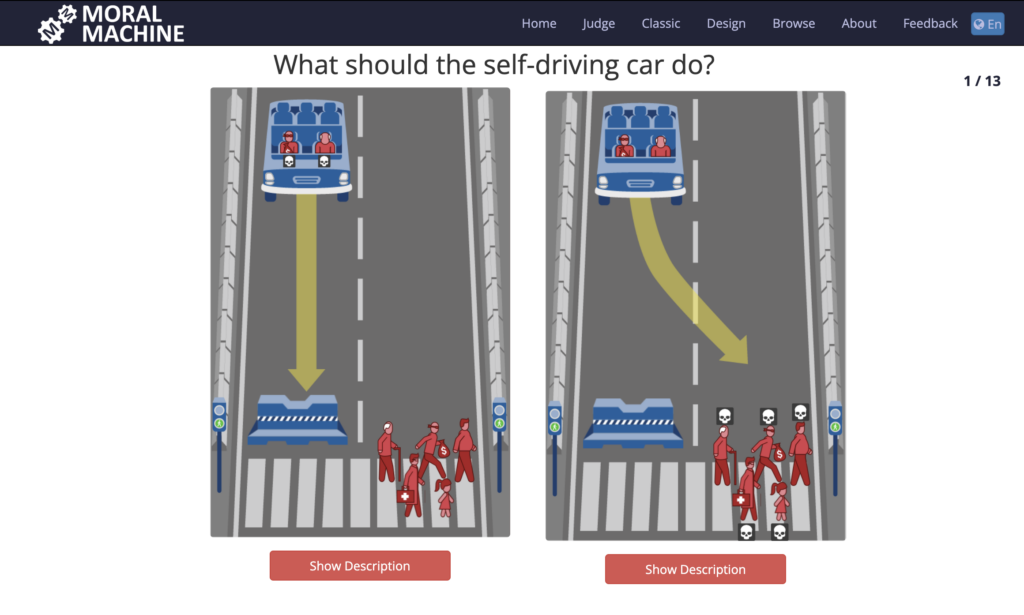
One project that strongly influenced my thinking during my master’s thesis is Moral Machine, an online experiment developed by researchers at the MIT Media Lab. The Moral Machine explores how people from different cultural backgrounds make ethical decisions when faced with unavoidable harm, using the example of self-driving cars. Users are asked to choose between different fatal outcomes, such as whether a car should save passengers or pedestrians, children or elderly people, humans or animals.

What makes the Moral Machine particularly interesting from an interaction design perspective is not only its topic, but the way it maps moral decisions to cultural patterns. By collecting millions of decisions worldwide, the project revealed that moral judgments are not universal. Instead, they are deeply influenced by cultural, social, and regional contexts. For example, some cultures tend to value the protection of the young more strongly, while others prioritize law-abiding behavior or social roles.

This approach highlights an important issue in interaction design: interfaces are never neutral. Even when they appear objective or technical, they embed values, assumptions, and worldviews. In the case of the Moral Machine, the interface becomes a space where users actively project their cultural norms and moral beliefs onto a system. The design does not tell users what is right or wrong; it forces them to act and take responsibility for a choice.

This idea strongly connects to my master’s thesis, which explores digital activism as a form of action rather than communication. While the Moral Machine focuses on ethical decision-making, my project investigates visual intervention and digital appropriation as cultural practices. However, both approaches share a key concern: how interaction reveals underlying values and power structures.

In my thesis project, users intervene visually in interface representations without explanation, ranking, or optimization. Similar to the Moral Machine, the focus is not on reaching a “correct” outcome, but on exposing differences in behavior, emotion, and intention. Where the Moral Machine maps moral choices across cultures, my project highlights how people express critique, resistance, or frustration through visual interference. In both cases, the system acts as a framework that makes invisible attitudes visible.

Another important parallel lies in the rejection of efficiency as the main goal. The Moral Machine does not optimize for usability comfort; instead, it creates discomfort by forcing users to confront difficult decisions. Likewise, my project deliberately avoids smooth interaction and clear guidance. This friction is intentional. It opens space for reflection and turns interaction into a cultural act rather than a task.

Ultimately, the Moral Machine demonstrates how interaction design can function as a research tool for understanding society. It shows that digital systems can capture complexity, conflict, and difference without simplifying them into single solutions. This perspective strongly supports my thesis: that interaction design has the potential to go beyond usability and become a medium for cultural expression, ethical questioning, and activist practice.

#8 IMPULS: Inhalt “Beklaute Frauen”

Für meinen letzten Blogpost möchte ich nochmal einen Schritt zurückgehen und über das Buch sprechen, das eigentlich der Auslöser für das ganze Projekt war: Beklaute Frauen von Leonie Schöler. Nicht als wissenschaftliche Rezension, sondern eher als persönlicher Blick darauf, warum mich dieses Buch so beschäftigt – und auch wohin das inhaltlich führen könnte in der Ausstellung.

Was mich beim Lesen sofort gepackt hat: Das Buch liest sich nicht wie ein trockenes Geschichtsbuch, sondern eher wie eine Sammlung von Stories, die man eigentlich hätte kennen müssen. Frauen, die geforscht, erfunden, geschrieben, gerechnet oder gestaltet haben – und deren Leistungen entweder komplett vergessen wurden oder später ganz selbstverständlich Männern zugeschrieben wurden. Nicht, weil irgendwer „aus Versehen“ ihren Namen vergessen hat, sondern weil das System so funktioniert hat (und teilweise noch immer funktioniert).

Was mir beim Lesen relativ schnell klar geworden ist: Beklaute Frauen ist kein Buch über „einzelne vergessene Genies“, sondern vor allem ein Buch über Strukturen. Es geht weniger darum, möglichst viele individuelle Heldinnengeschichten nachzuerzählen, sondern darum zu zeigen, wie systematisch Geschichte gemacht, verzerrt und weitergegeben wird. Die Kapitel sind thematisch aufgebaut und drehen sich um gesellschaftliche Bewegungen, Machtverhältnisse und Mechanismen – zum Beispiel darum, wer als Bürger:in gilt, wie Ehe als ökonomisches Abhängigkeitsverhältnis funktioniert, warum künstlerische oder wissenschaftliche Arbeit von Frauen strukturell unsichtbar gemacht wird oder wie Erinnerungskultur ganz konkret Politik ist. Einzelne Biografien tauchen immer wieder auf, aber eher als Beispiele innerhalb eines größeren Systems, nicht als Hauptfiguren im klassischen Sinn. Genau diese Mischung finde ich extrem stark: Persönliche Geschichten machen die Strukturen greifbar, aber der Fokus bleibt darauf, dass es nicht um „Ausnahmen“ geht, sondern um wiederkehrende Muster.

Hier sehe ich auch die Verbindung zu meiner Ausstellungsidee. Das Buch könnte man in einer modularen Übersetzung aufarbeiten: einzelne, fokussierte Momente die in Summe das System wiedergeben.

Wenn ich an 4–8 Poster denke, könnte jedes davon ein eigenes Kapitel oder Motiv aufgreifen, vielleicht direkt aufs Buch referenziert, oder auch mit Beispielen außerhalb dieser Literatur – nicht als Nacherzählung, sondern als visuelle Interpretation. Hier ein paar erste Ideen:

– Ein Poster könnte sich mit dem Thema Zuschreibung beschäftigen: Ein Porträt, das sich immer wieder verändert, Namen verliert, überschrieben wird. Vielleicht taucht der Name der Frau nur kurz auf, wird wieder verdrängt, fragmentiert, überlagert.

– Ein anderes könnte sich mit dem Matilda-Effekt beschäftigen: Mehrere Ebenen von Text oder Bild, die übereinander liegen, wobei die „offizielle“ Geschichte zuerst sichtbar ist – und die eigentliche Urheberin erst durch Interaktion freigelegt werden kann.

– Ein Kapitel über frühe Programmiererinnen oder Rechnerinnen ließe sich super über Zahlen, Raster, Algorithmen übersetzen: Ein scheinbar neutrales System, das aber gezielt Informationen ausblendet oder überschreibt.

– Auch spannend finde ich die Idee, Berufsbilder zu visualisieren, die historisch weiblich waren und später männlich „geworden“ sind. Das könnte ein Poster sein, das langsam seine visuelle Sprache wechselt: Farben, Typo, Bildwelt kippen, ohne dass sich der Inhalt ändert.

Ein weiterer Punkt, den ich stark finde, ist, dass viele Geschichten im Buch keinen klaren Abschluss haben. Die Frauen werden nicht plötzlich rehabilitiert. Oft bleibt ein Gefühl von Frust, Ungerechtigkeit oder Leerstelle. Auch das will ich nicht glattbügeln. Interaktion heißt für mich hier nicht „Problem lösen“, sondern sich mit der Störung auseinandersetzen. Vielleicht lässt sich manches Poster nie ganz „freiräumen“. Vielleicht bleibt immer ein Rest Rauschen, ein Fleck, ein fehlender Teil. Solange es bewusst wirkt, kann man die Betrachter auch nicht mit einem positiven Gefühl rausgehen lassen.

Für mich könnte Beklaute Frauen deshalb auch weniger ein konkretes inhaltliches Regelwerk als ein Denkanstoß. Das Buch gibt mir Themen und Muster, aber die Übersetzung mit noch mehr Literatur gespickt, in Bilder, Bewegung und Interaktion ist meine eigene Arbeit. Das Buch ist vielleicht eher der Startpunkt, aber nicht das Endprodukt.

IMPULSE #6 – Board Games

This impulse was not based on a single event, but on several moments over the past months. I played a lot of board games with friends, and some of them stood out more than others. Not because they were the most complex or competitive, but because I genuinely enjoyed the worlds and stories behind them.

While playing, I started to notice that many board games create narrative experiences in subtle ways. Even without explicit storylines, they invite players into specific settings, roles, and situations. This made me realize that board games can be understood as interactive storytelling formats, which connects surprisingly well to my thesis topic on narrative UX and interactive storytelling.

The following games are the ones I played most recently and enjoyed the most.

Catan

In Catan, players arrive on an island and gradually build settlements, cities, and trade routes. There is no written story, yet the game creates a clear sense of exploration and development. Each round feels like a small chapter in the process of colonizing and shaping a new world. What I liked most about Catan is that the story is not told directly, but emerges through interaction. Every decision (where to build, whom to trade with, how to expand) contributes to a unique narrative. This is similar to Narrative UX, where users do not just receive a story but actively shape it through their actions.

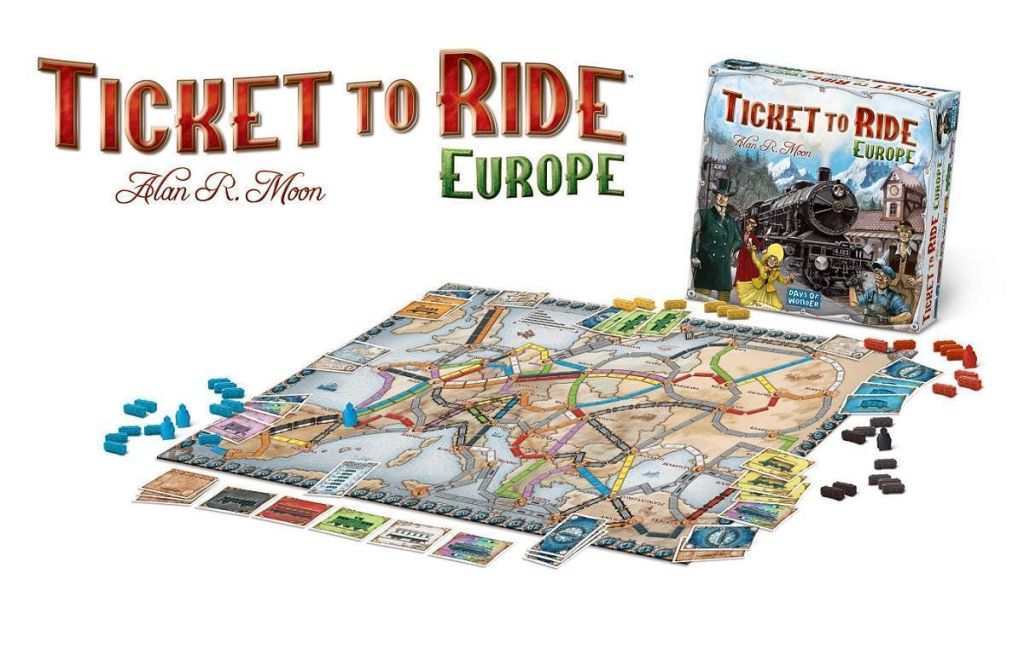
Ticket to Ride: Europe

This game creates a narrative through movement and geography. By building train routes across European cities, players experience a journey rather than a static game board. The visual design of the map, the cities, and the routes makes it easy to imagine travel, connection, and progress. I enjoyed how the game subtly encourages storytelling through its structure. The routes feel like personal travel stories, even though they are based on strategic choices. This connects to interactive web storytelling, where navigation and structure influence how users experience a narrative.

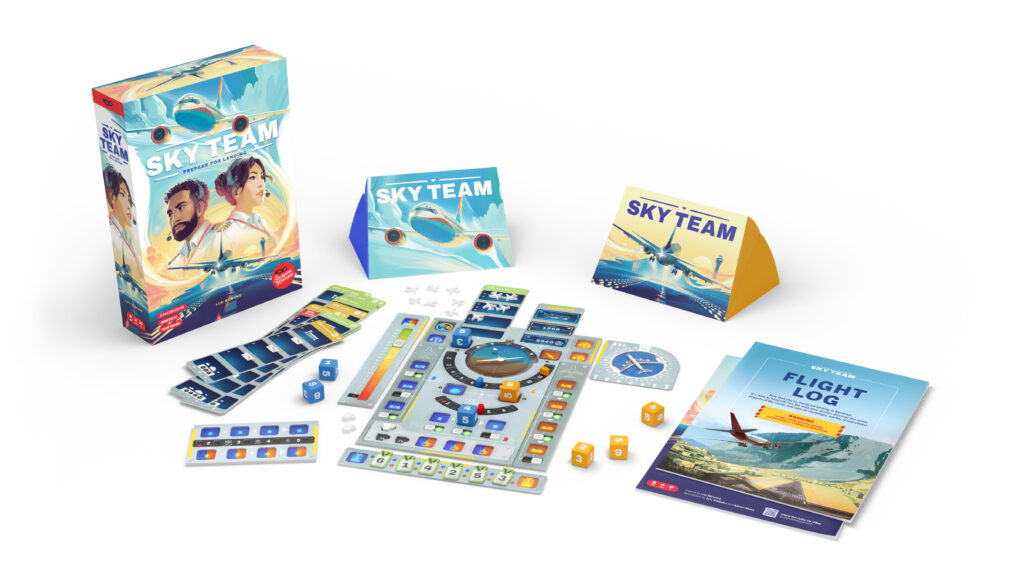
Sky Team

Sky Team is a cooperative game in which two players work together as pilots to land an airplane. Compared to the other games, the narrative here is more direct and intense. Every move feels meaningful because it affects the outcome of the landing. What fascinated me was how the story emerges from tension and collaboration rather than from text or visuals alone. The game shows how constraints and roles can create strong narrative experiences. This is similar to interactive design, where users often experience stories through tasks, challenges, and decisions rather than through traditional storytelling formats.

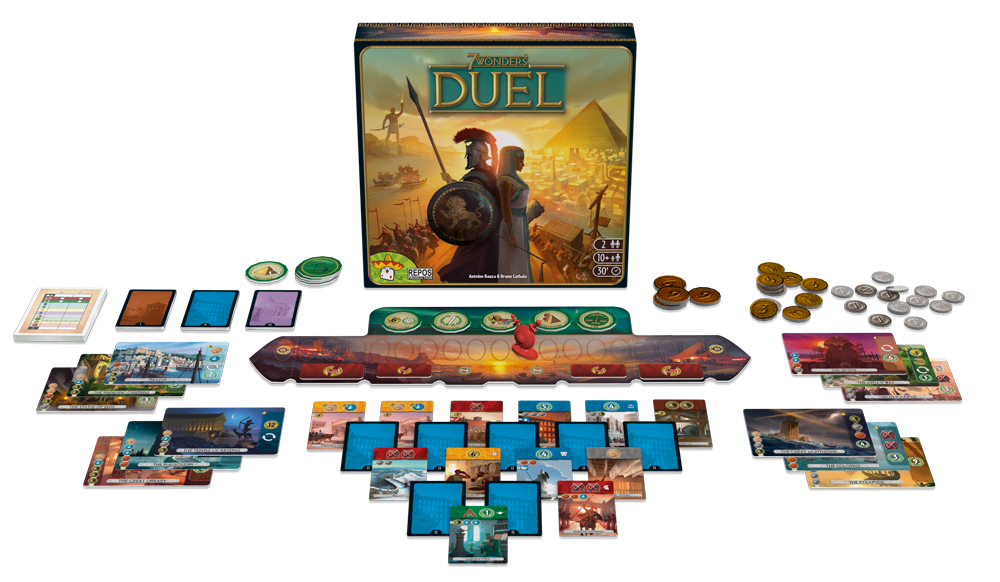
7 Wonders Duel (with Pantheon Expansion)

In 7 Wonders Duel, players build civilizations, construct wonders, and compete across different historical and cultural dimensions. With the Pantheon expansion, mythological elements add another layer of meaning and atmosphere. I liked how the game creates a sense of historical progression and symbolic depth without explicitly telling a story. Over time, each player’s civilization develops its own narrative through strategic choices. This reflects how interactive narratives often unfold gradually, shaped by user decisions rather than predefined plots.

Why This Was an Impulse for My Research

Playing these board games made me realize that storytelling does not always need words, scripts, or linear narratives. Instead, it can emerge from systems, rules, and interactions. The stories I experienced were not written beforehand; they were created through play.

For my thesis, this impulse is important because it shows that Narrative UX can exist beyond digital media. Board games function as analog examples of interactive storytelling, where users co-create meaning through interaction. This perspective helps me think differently about how stories can be designed in web experiences, not as fixed narratives, but as frameworks that invite participation. In this sense, board games became more than just entertainment. They offered insights into how interaction can generate storytelling, which directly relates to my research.

Stuff Worth Clicking A.K.A. Accompanying Links

Disclaimer: This blog post was written with the help of AI for better grammar and correct spelling.