One project that strongly influenced my thinking during my master’s thesis is Moral Machine, an online experiment developed by researchers at the MIT Media Lab. The Moral Machine explores how people from different cultural backgrounds make ethical decisions when faced with unavoidable harm, using the example of self-driving cars. Users are asked to choose between different fatal outcomes, such as whether a car should save passengers or pedestrians, children or elderly people, humans or animals.
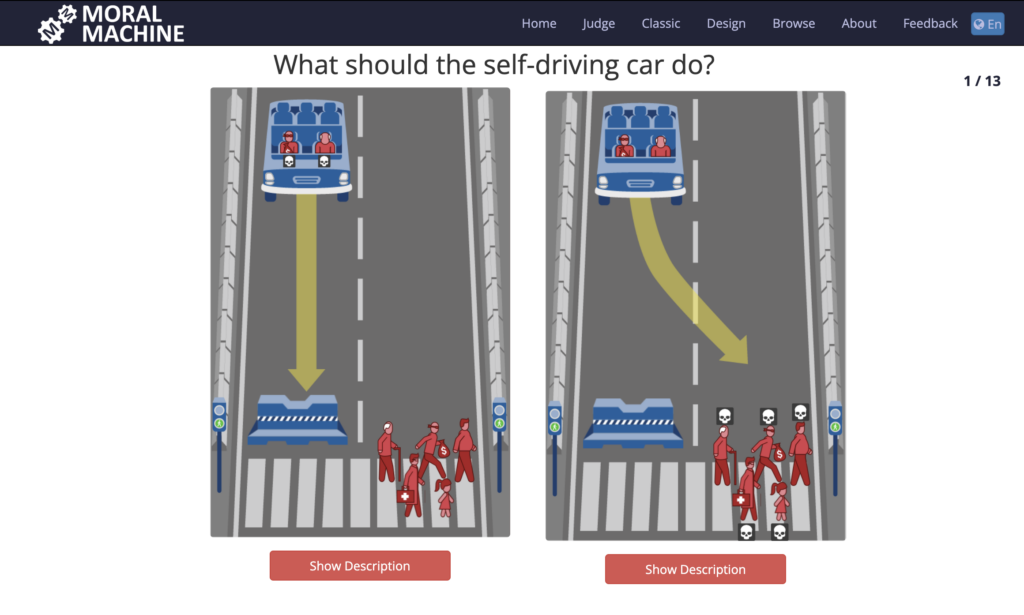
What makes the Moral Machine particularly interesting from an interaction design perspective is not only its topic, but the way it maps moral decisions to cultural patterns. By collecting millions of decisions worldwide, the project revealed that moral judgments are not universal. Instead, they are deeply influenced by cultural, social, and regional contexts. For example, some cultures tend to value the protection of the young more strongly, while others prioritize law-abiding behavior or social roles.
This approach highlights an important issue in interaction design: interfaces are never neutral. Even when they appear objective or technical, they embed values, assumptions, and worldviews. In the case of the Moral Machine, the interface becomes a space where users actively project their cultural norms and moral beliefs onto a system. The design does not tell users what is right or wrong; it forces them to act and take responsibility for a choice.
This idea strongly connects to my master’s thesis, which explores digital activism as a form of action rather than communication. While the Moral Machine focuses on ethical decision-making, my project investigates visual intervention and digital appropriation as cultural practices. However, both approaches share a key concern: how interaction reveals underlying values and power structures.
In my thesis project, users intervene visually in interface representations without explanation, ranking, or optimization. Similar to the Moral Machine, the focus is not on reaching a “correct” outcome, but on exposing differences in behavior, emotion, and intention. Where the Moral Machine maps moral choices across cultures, my project highlights how people express critique, resistance, or frustration through visual interference. In both cases, the system acts as a framework that makes invisible attitudes visible.
Another important parallel lies in the rejection of efficiency as the main goal. The Moral Machine does not optimize for usability comfort; instead, it creates discomfort by forcing users to confront difficult decisions. Likewise, my project deliberately avoids smooth interaction and clear guidance. This friction is intentional. It opens space for reflection and turns interaction into a cultural act rather than a task.
Ultimately, the Moral Machine demonstrates how interaction design can function as a research tool for understanding society. It shows that digital systems can capture complexity, conflict, and difference without simplifying them into single solutions. This perspective strongly supports my thesis: that interaction design has the potential to go beyond usability and become a medium for cultural expression, ethical questioning, and activist practice.
