3.1 Reflection & IMPULSE #1

Reflection on the last two semesters
This semester, my focus in Design & Research will be on the pre-research phase of my master’s thesis. During the first semester, I identified the broader research area as the combination of analog and digital technologies. In the second semester, I explored microcontrollers and hands-on prototyping more deeply.

For this semester, I am still interested in the fusion of analog and digital elements, as well as prototyping with microcontrollers. However, there is still one key factor that is missing: a purpose. For this reason, I will roughly use the framework “5Ws and 1H” (What, Who, Why, Where, When, How) as a loose structure to help me define the direction of my thesis more precisely.

Some of the topics I want to explore include:

  • Play & Playfulness, sense of adventure,
  • Gamification, serious games, video games, board games, toys or toy-like
  • Education, learning, inclusivity
  • Memory, nostalgia, archiving, pop culture
  • Tangibility, systems, collections,
  • Microcontrollers, Building, Prototyping

For each impulse, I will use the 5Ws and 1H framework to organize my thoughts and clarify what kind of design direction or insight it offers.

So, for my first impulse, I watched 3 talks about Play, and here are my thoughts about them:

Talk #1: The Role of Play in the Development of Social and Emotional Competence by Peter Gray
In his talk, Peter Gray argues that free, self-directed play is essential for children’s emotional and social development. Drawing from research on hunter-gatherer societies, he shows how children in these communities were trusted and allowed to explore freely, learning vital skills such as empathy, cooperation, and self-regulation through play. In contrast, modern societies often limit children’s autonomy through structured activities and constant supervision, reducing opportunities for natural learning and independence.

My Reflection:
This makes me think about how I could use ideas from hunter-gatherer play, like freedom, choice, cooperation, and learning through challenge, in design. For example, when creating games, interactive experiences, or educational tools, one could consider how users can make their own choices, how activities can encourage working together instead of competing, and how challenges can help people learn and grow in a safe way. Rather than dictating a single path or outcome, the design could invite open-ended exploration where discovery happens naturally through action. That sense of self-direction becomes a key principle for how I want to design, shaping interactions that give users autonomy, space to experiment, and the freedom to define their own experiences, much like the unstructured play of hunter-gatherer communities.

Talk #2: Creating Inclusive Environments with Play by Gary Ware
In this talk, Gary Ware explores how play can build safe, authentic, and inclusive environments in workplaces and collaborative groups. He began his talk with a playful exercise, showing how shared experiences can quickly create connection and trust. Ware emphasized that people often divide their “home self” and “work self,” which prevents genuine belonging: trying to fit in is not the same as belonging. He highlighted how play encourages vulnerability, creativity, and collaboration, ultimately fostering psychological safety and empathy.

My Reflection:
This made me think about how play could inspire designs that foster inclusion and trust. Could an interactive system help people feel accepted and comfortable being themselves? Activities like improv, drawing, or dancing already create natural connections, and I wonder how technology might extend that same sense of shared joy and safety into everyday interactions.Thinking this way helps me see where playful design could have real impact: in shared spaces like classrooms, workplaces, or public areas. These could become places of playful connection, where design cultivates belonging through interaction.

Talk #3: The Power of Play to Heal and Connect by Amy Work
Amy Work explains that play is a child’s natural language, a way to express feelings before words are available. While adults communicate through conversation, children process their inner world through play. Quoting Gary Landreth, “Play is the language of children, and toys are their words,” she highlights how play helps children express emotions, face fears, and make sense of their experiences in a safe, symbolic way. Parents who join in that play build stronger emotional bonds and open lines of communication. Work encourages adults to observe and name emotions during play, helping children develop emotional literacy, while letting them lead and set the pace.

My Reflection:
This talk reminded me that play isn’t just about learning, but also a form of emotional communication. It made me wonder how interaction design might support non-verbal expression, how people could externalize feelings or memories through playful, tangible engagement. Seen this way, play becomes a bridge between inner and outer worlds. That perspective also hints at who my designs might serve: people who communicate or process emotions differently like children, neurodivergent users, or anyone drawn to expression beyond words.

AI was used for corrections, better wording, and enhancements.
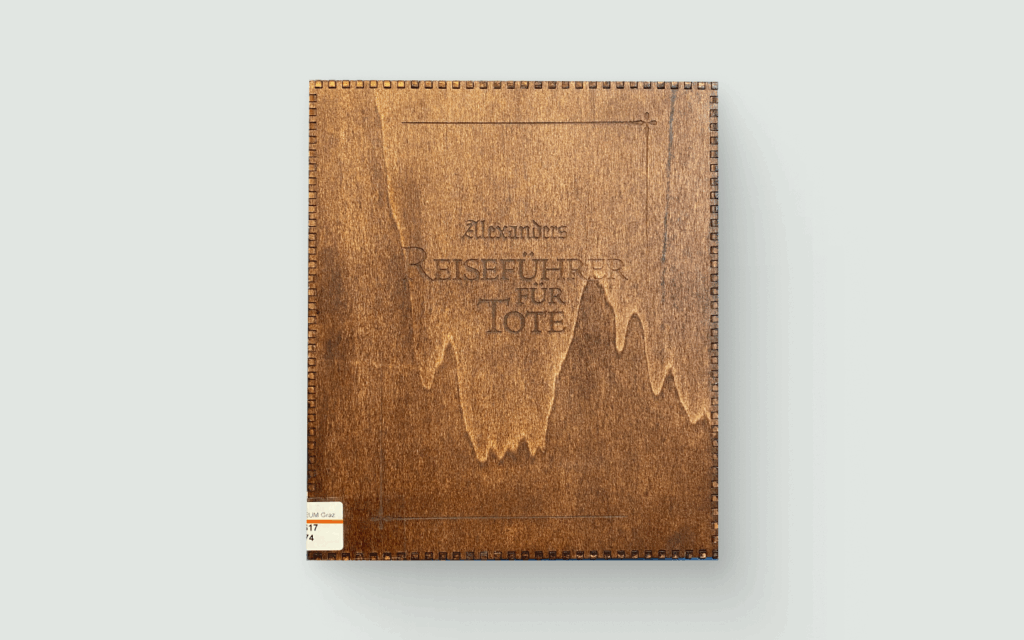
Alexander’s Travel Guide for the Dead — A Journey Beyond Life

What happens after we die? It’s one of humanity’s oldest and most haunting questions. Phillipp Alexander’s “Reiseführer für Tote” (Travel Guide for the Dead) takes this universal fear and curiosity and turns it into something unexpected — a travel guide for the afterlife.

At first glance, the concept sounds absurdly fascinating: a Lonely Planet–style guide that helps you navigate heaven, hell, or reincarnation. But beneath the quirky premise lies a deeper intention — to make people reflect on death, religion, and what might await us after our final journey.

Exploring Death Through Design

Alexander’s goal is simple yet ambitious: to make people think more openly about the afterlife and perhaps ease the fear of dying. Rather than preaching or philosophizing, he invites readers to explore the topic — like travelers flipping through a guidebook before an adventure.

It’s an unusual approach, blending two very different worlds:

  • Religion, with its strict rules, moral frameworks, and promises of eternal destinations.
  • Travel guides, which celebrate freedom, curiosity, and self-directed discovery.

By merging these opposites, Alexander creates a tension that’s both intriguing and thought-provoking — though not without its flaws.

The project unfolds in two main parts:

  1. An overview of different religions and their interpretations of the afterlife — from heaven and hell to reincarnation and spiritual rebirth.
  2. A more subjective “expert analysis” of travel guides, where the author himself becomes the self-declared guide through these spiritual landscapes.

While the first section is well-researched and informative, the second feels more like a personal reflection than a structured analysis. There’s no clear conclusion — instead, it reads as an open-ended exploration rather than a destination reached.

Aesthetic and Presentation

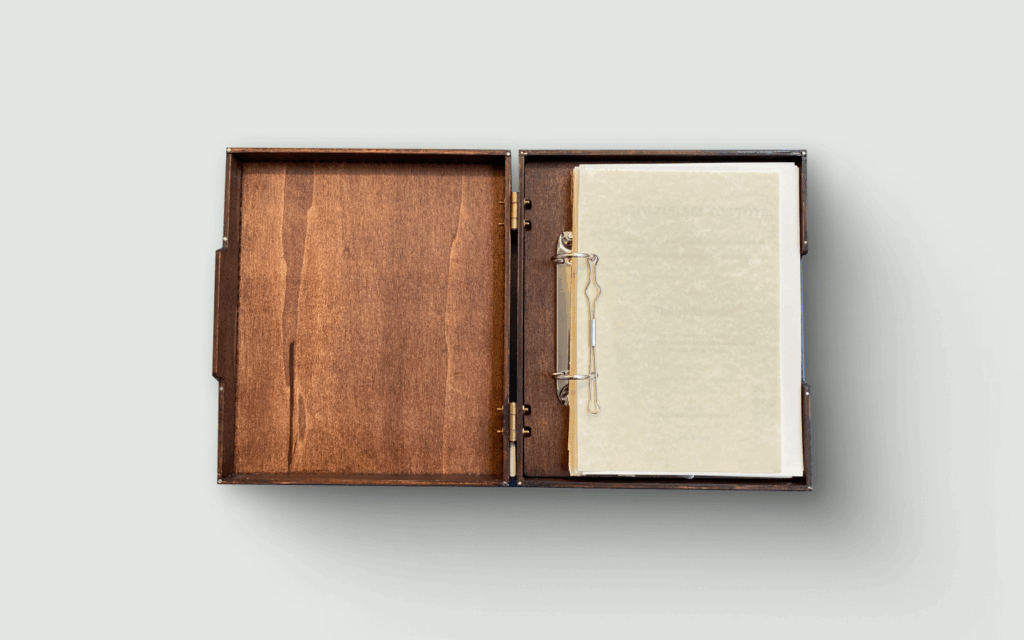
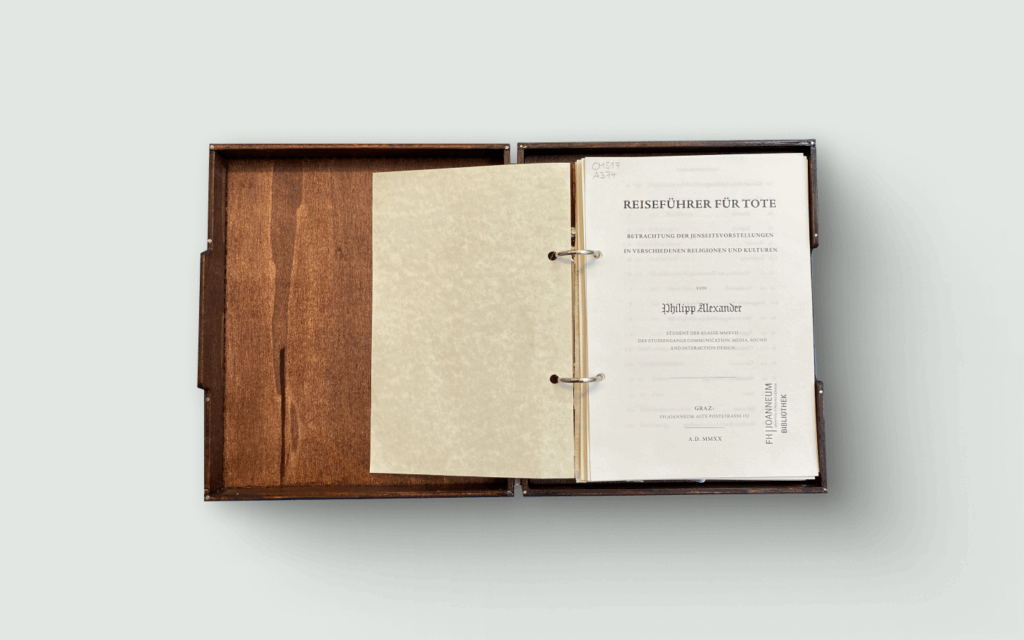
If there’s one thing that immediately captivates, it’s the presentation. The work comes encased in a beautiful wooden box, filled with bone-white paper — an eerily fitting design choice for a guide to the afterlife. The craftsmanship feels intentional and authentic, setting the right tone from the moment you open it.

However, the physical design, while visually striking, makes it somewhat uncomfortable to handle and read. The box, though conceptually clever, turns into a clumsy reading experience — a reminder that sometimes, aesthetics and usability don’t always align.

Originality and Design Relevance

Conceptually, “Alexander’s Travel Guide for the Dead” is fun, unique, and original. It stands out as a playful yet critical commentary on how we think about death and belief.

That said, the connection to design as a discipline feels weak. The piece is more of a philosophical or cultural exploration than a true contribution to design research or methodology. It’s a creative idea, executed beautifully, but it doesn’t quite push the boundaries of design thinking.

Final Thoughts

Overall, I’d rate the project a 3 out of 5. It’s a professional, well-executed piece with strong visuals and a memorable concept. However, the topic itself feels relatively easy, and the design implications are limited.

The biggest issue? The metaphor doesn’t entirely hold up. A travel guide suggests freedom, options, and agency — things that the afterlife, especially through religious frameworks, doesn’t really offer. In that sense, the piece feels more like a “religion guide for the living” than a genuine travel guide for the dead.

Still, it’s a creative and thought-provoking exploration — one that might not give you answers, but will definitely make you think twice about what lies beyond.

#Task III: Masterarbeit Evaluation

Titel: Development and Evaluation of a User Interface Concept for an Industrial Wind Turbine Diagnosis Application
Studiengang: Software Engineering and Management, TU Graz
Umfang: ca. 145 Seiten + Anhang
Artefakt: Interaktiver UI/UX-Prototyp für ein modellbasiertes Diagnosesystem im Bereich Windturbinenwartung

1. Einleitung und Überblick

Die Masterarbeit befasst sich mit der Entwicklung und Evaluierung eines User-Interface-Konzepts für ein industrielles Diagnosesystem auf Basis modellbasierter Fehlererkennung. Die Arbeit vereint theoretische Grundlagen zu Model-Based Diagnosis (MBD) mit einem nutzerzentrierten Designprozess und abschließender Usability-Evaluation. Als Artefakt wurde ein klickbarer Prototyp erstellt, der in ein reales Industrieumfeld (Uptime Engineering GmbH) eingebettet ist.

Die Arbeit ist klar strukturiert, professionell gesetzt (offensichtlich in LaTeX erstellt), mit sauberem Inhaltsverzeichnis, aktiven PDF-Verlinkungen und formal korrekter Quellenangabe. Der Aufbau folgt einem nachvollziehbaren Schema (Theorie, Related Work, Methodik, Artefakt, Evaluation, Fazit).

2. Bewertung nach CMS-Kriterien

Overall Presentation Quality

Die Arbeit wirkt insgesamt sehr professionell aufbereitet: einheitliche Typografie, konsequente Kapitelstruktur, klare Tabellen- und Abbildungsbeschriftungen. Die grafische Qualität der eingebetteten Abbildungen ist jedoch uneinheitlich – einige Screenshots wirken unscharf oder ohne klares visuelles Raster. Stellenweise wirken Kapitel sehr textlastig, ohne grafische Auflockerung oder Zwischenfazits, was es etwas anstrengend zu Lesen macht.

Degree of Innovation

Das Thema ist solide gewählt, jedoch nicht mega innovativ. Die Forschungslücke („Usability im Kontext von MBD-Systemen“) wird erkannt und adressiert, allerdings basiert der Beitrag auf der Anwendung bekannter Methoden (Usability-Testing, Iterative UX-Designprozesse). Daraus schließe ich, dass man garnicht das Rad neu erfinden muss für ein Masterarbeit.

Independence

Die Arbeit zeigt erkennbar Eigenleistung, insbesondere im Bereich der Nutzerstudien, Prototypentwicklung und Ableitung von Anforderungen. Gleichzeitig ist jedoch die enge Bindung an den Industriepartner sichtbar. Teilweise wirkt der Text wie ein Projektbericht über ein Firmentool, weniger wie eine freie wissenschaftliche Untersuchung. Darauf schließe ich, dass die Masterarbeit im Rahmen eine Anstellung gemacht worden sein könnte.

Organization and Structure

Sehr klare Gliederung, logisch aufgebaut. Einige Kapitel sind jedoch krass umfangreich – z. B. enthält Related Work fast 30 Seiten, während Conclusions and Future Work vergleichsweise knapp ausfallen. Es wirkt als wäre Related Work für sehr ausgereizt worden, um den Gesamtumfang zu erweitern, weil es in meiner Ansicht einfacher ist über bestehendes zu schreiben als eigene innovative Gedanken für z.B. Conclusions zu finden.

Communication (Stil, Lesbarkeit, Sprache)

Der Schreibstil ist präzise und gut lesbar, ohne unnötige Komplexität. Fachbegriffe werden korrekt eingeführt. Allerdings enthält der Text einige wiederholende Passagen, die Inhalte aus früheren Kapiteln nochmals zusammenfassen. Auch wird an mehreren Stellen Grundlagenwissen ausführlicher erklärt als für eine Masterarbeit im Software-Engineering notwendig wäre – insbesondere im Abschnitt über AI-Methoden.

Scope

Der Umfang der Arbeit ist angemessen. Die praktische Komponente (der Prototyp) wird ausführlich beschrieben und evaluiert. Allerdings liegt der Schwerpunkt deutlich stärker auf UX als auf UI oder systemtechnischen Aspekten. Themen wie visuelle Gestaltung, Farbsysteme, Typografie oder Accessibility werden kaum wissenschaftlich reflektiert, obwohl sie für ein UI-Projekt relevant wären.

Accuracy and Attention to Detail

Formale Qualität ist hoch: ich konnte kein Tippfehler erkennen, konsistente Formatierung, umfangreiche Abbildungsbeschriftungen. Auffällig ist jedoch, dass methodische Details teilweise nur oberflächlich erläutert werden, etwa:

  • keine genaue Beschreibung des Usability-Test-Designs
  • Ergebnisse werden gut erzählt, aber kaum im Projekt ausgeführt.

Literature

Das Literaturverzeichnis ist umfangreich und wirkt für mich formal korrekt. Auffällig ist aber der hohe Anteil älterer Publikationen (>10 Jahre), besonders zu UX und UI, besonders weil diese Felder schnelllebig sind. Moderne Arbeiten zu Design Patterns, HCI-Guidelines oder aktuellen UI-Frameworks fehlen. Eine stärkere Einbindung aktueller Quellen (z. B. Nielsen-Norman, Material Design, usw) hätte die theoretische Basis gestärkt.

3. Bewertung des Artefakts

Der Prototyp erfüllt seinen funktionalen Zweck und ist nachvollziehbar dokumentiert. Die UX-Methodik ist klar beschrieben, der iterative Designprozess gut begründet und mit Usability-Evaluation abgesichert. Ich finde auch die klare Trennung von „General Interface“ und „Wind Turbine Interface“ ganz gut.

Kritisch fällt jedoch die visuelle und gestalterische Qualität des Prototyps auf:

Das Interface wirkt optisch veraltet und erfüllt moderne UI-Gestaltungsstandards (Typografie, visuelle Hierarchie, Farbkonzept) nur eingeschränkt – auch unter Berücksichtigung, dass die Arbeit 2018 publiziert wurde. Die Gestaltung erinnert eher an technische Tools der 2000er als an zeitgemäße Industrial UI/UX. Designentscheidungen werden funktional begründet, aber nicht gestalterisch reflektiert (keine Design Guidelines oder Style Systems). Ich finde zu einer runden Masterarbeit hätte UI schon auch noch dazu gehört.

4. Gesamtbewertung – Stärken & Schwächen

Stärken der Masterarbeit

  • Klare und logisch nachvollziehbare Struktur, wirkt professionell
  • Formal hochwertig gestaltet (LaTeX, sauber verlinkte Quellen, einheitliche Formatierung)
  • Solide methodische Vorgehensweise im UX-Prozess (iterativ, testbasiert, mit Stakeholder-Einbindung)
  • Reale Anwendungssituation mit Industriepartner, Praxisrelevanz
  • Gute und verständliche Sprache
  • Umfangreiche Literaturbasis, konsequent und formal zitiert
  • Detaillierte Dokumentation des Prototypings und der Usability-Evaluation
  • Nachvollziehbarer Forschungsbezug

Schwächen der Masterarbeit

  • Visuelles bzw. gestalterisches Niveau des UI-Artefakts eher schwach und nicht zeitgemäß
  • Nicht super innovativ: Keine neue Theorie oder Methode, eher Anwenden von UX Prinzipien 
  • Enge Bindung an Industriepartner, kann auch einschränkend wirken
  • Unbalancierter Textumfang: Related Work sehr lang, Conclusion vergleichsweise kurz
  • Teilweise Wiederholungen im Text und zu ausführliche Darstellung bekannter Grundlagen
  • Literaturquellen überwiegend älter, moderne UX/UI-Forschung kaum berücksichtigt

Fazit

Die Arbeit ist meiner Ansicht nach insgesamt eine gut strukturierte, wissenschaftlich sauber ausgeführte Masterarbeit mit hohem praktischem Anteil. Sie zeigt besonders im Bereich UX-Methodik und Usability-Evaluation ihre Stärke. Schwächen liegen vor allem in der gestalterischen Qualität des Artefakts sowie der fehlenden Auseinandersetzung mit Innovationen im UX/UI Bereich vor. Der wissenschaftliche Beitrag liegt weniger in einer theoretischen Neuerung, sondern in der systematischen Anwendung bestehender UX-Methoden. Ich hatte immer die Befürchtung, dass eine Masterarbeit eine super innovative Leistung sein muss. Eigentlich finde ich das sehr beruhigend.

Link: https://repository.tugraz.at/publications/9ybyz-xjd17

#12 Vertigo

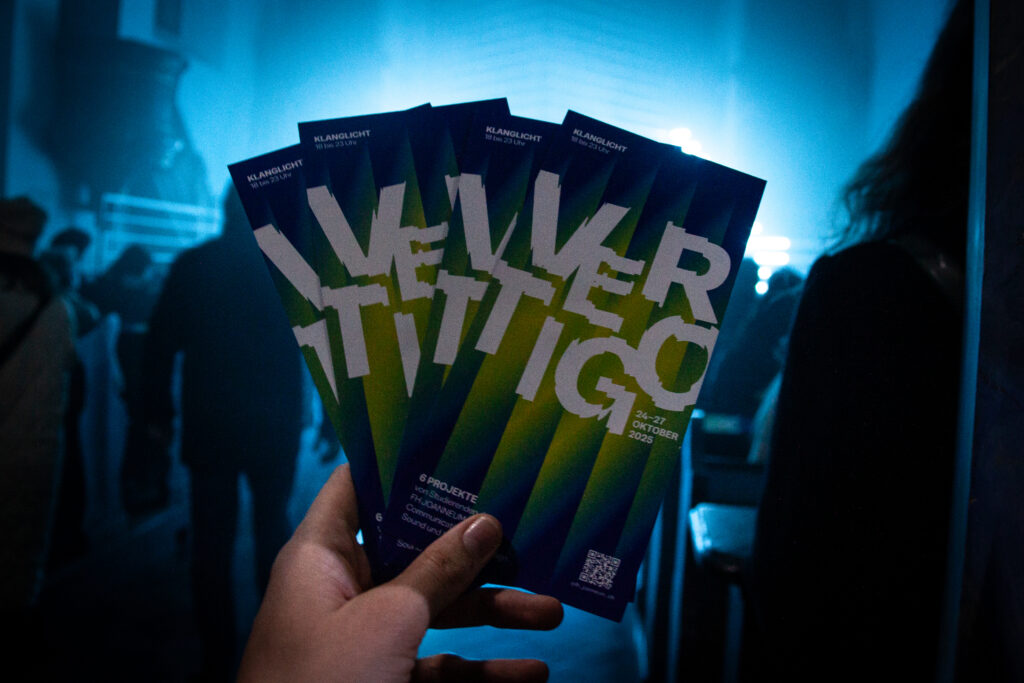
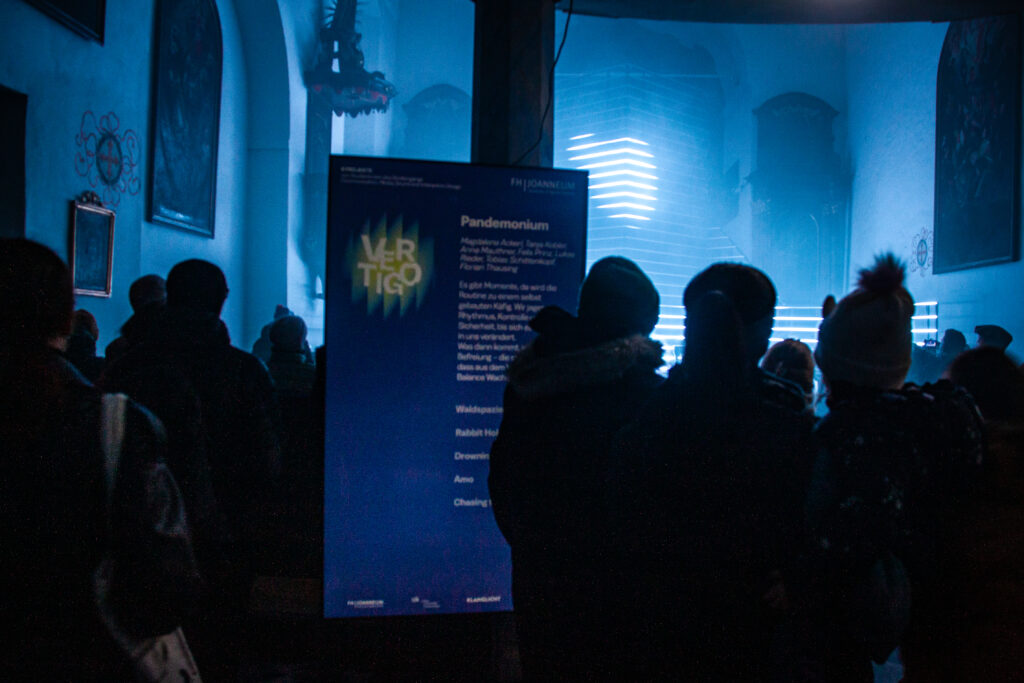
When I look back at Vertigo, the project that took place as part of the Klanglicht Festival in Graz, I don’t just remember the long working days and tight deadlines, but I remember the feeling of being part of something real. Together with a Elisabeth Seiler, I had the opportunity to develop the corporate identity for Vertigo, the sound and visual project by Media, Sound and Interactiondesign realized inside the St. Antonius Church.

Real project – real deadlines

The special thing at this project was, that it wasn’t a classroom simulation. It was part of Klanglicht, a real festival with real deadlines and an actual audience. And perfectly suited as portfolio work. We were responsible for everything related to visual communication like:

  • Branding and logo design
  • Posters, flyers, and stickers
  • Wayfinding banner for the exhibition space
  • Screen animations for digital displays (in collaboration)
  • and social media content to promote the event.

The scope was huge and challenging but also incredibly valuable. It was very imporant that the design not just look “good”, but also work: it had to be recognizable, consistent, and evoke the right atmosphere while fitting into the overall Klanglicht visual world.

Atmosphere and concept

The theme Vertigo – meaning dizziness, disorientation, the play with perception and space – was something we wanted to make tangible through our design. We tried to translate this feeling visually: through sharp forms, splinter effect, and imbalances in composition. The effect, as well as the bright colors used, should also visualize the students’ project.

When we finally saw the finished exhibition in the St. Antonius Church, it was fascinating to experience how sound, light, space, and design all came together. Each installation had its own language, yet everything was connected through the shared theme.

Our Work Phase

At the beginning, we actually started with a completely different concept than the one we eventually realized. Our first idea was to work with 3D particles, animate them, and use the resulting visuals as the basis for our posters. However, it quickly became clear that the time we had was far too short for that approach. Both technically and conceptually, we just weren’t making enough progress. Looking back, I’m actually glad we decided to let that idea go, because the concept that followed fit the project so much better and felt much more authentic to both of us.

We began experimenting with splinter effects in After Effects, testing out countless colors and shapes until we found a visual language that captured the feeling of Vertigo. From there, we created the brandmark using the same visual effect and animated it to form the foundation of our entire corporate design.

Once that core was established, we moved on to the layout for posters and flyers, which had top priority. In between, we had several feedback sessions, where we refined details and adjusted compositions. After receiving final approval, everything had to move fast – printing deadlines were approaching and we only had a few days left. At the same time, we worked on banners, wayfinding elements, and animated content for social media. Toward the end, we also designed the screen visuals, which were later animated by Roman.

Finally came the setup phase. We painted the poster stands ourselves, which turned out to be a lot more work than expected, and spent the day before the festival installing everything around the church. Seeing all the printed materials in place and how they transformed the space into an exhibition atmosphere was incredibly rewarding. It was the moment when all our work finally came to life.

What I took away from this project

Even though Vertigo isn’t directly related to my planned master’s thesis, this project was very important to me. Working on it showed me how crucial a well-thought-out concept is, one that is backed by a clear idea and attitude. Working on a real project was challenging, but also extremely educational. We had to react quickly, find solutions, and still remain consistent in our design. An experience that gave me a lot of confidence.

Since I probably want to use animations in my master’s thesis, Vertigo was particularly valuable in this regard. We worked intensively with After Effects, and I was able to learn a lot, technical know-how, but also a better understanding of how movement can enhance mood and meaning. This knowledge will be enormously helpful for my future project work.

This project was a step toward professional practice, and at the same time, a creative experience that helped me grow as a designer. The process was intense and sometimes stressful, as we had very little time and the communication channels were often quite spontaneous and unstructured. Nevertheless, it was an incredibly rewarding experience, and we’re genuinely proud of the final result.

Task III: Proseminar Master’s Thesis

Creating the Photographic Film Look:
Intricacies and Misconceptions of Film vs Digital

Author: Niklas Maximillian Dostal
Year: 2024

Overall presentation quality 9/10

The presentation quality of this thesis has surprised me by how much the author researched about the industry of cinematography and tried to look through every crevice to find material that supported his theory and practice, which resulted in a meticulous and astounding presentation of every perspective cited and all the contentions that has been written.

Degree of innovation 8/10

Coming from a photography and filmmaking enthusiasts as myself, I can testify that this thesis is a collection of perspectives and technicalities both from the digital and film realms that were collected attentively, although, the author explored and delved into the eternal question of Digital vs Film which is a subject that is explored and talked about by many people around the globe and still to this day sparks differences of narratives and opinions that sometimes lead to heated debates, however, the thesis still has a significant contribution to the field.

Independence 9/10

There is a unique aspect to this thesis which is that one of the main challenges of the topic that was discussed and detailed in the theory and narratives part was converted into practice in the later stage, which gives an originality to the overall work.

Organization and structure 9/10

The thesis was clear and concise and gave an inside look of the technological shifts in Cinema as well as the perspectives on Film vs Digital, even a beginner can get a decent idea about the subject given the simplicity of how the author presented everything, he presented the narratives logically from both ends inserting screenshots from different films along with citations from well respected cinematographers and filmmakers, finalized by his on the field work, incorporating both technics using the digital to shoot and Davinci Resolve to create the film look in post-production.

Communication 9/10

The human factor in writing and presenting every chapter gave the thesis an organic and realistic approach to the subject, which goes hand in hand with the whole ethos of the work which made the delivery effective to both professionals, connoisseurs and beginners.

Scope 9/10

I believe that the length of the thesis is balanced, not too short to make it shallow and not too long to make it redundant. In terms of depth, it has enough depth both theoretically and practically and when the author delved deep into understanding film explaining all the nuances of Grain, Colours, Halations etc.. he kept it relevant and summarized it well at the end.

Accuracy and attention to detail 8/10

The linguistic and vocabulary aspects of the thesis are above average and were used correctly in accordance with the content of every chapter.

Literature 10/10

The quality of materials used was good enough, from screenshots to illustrations and they were always relevant to what it discussed and cited along with the appropriate description and all the sources at the end.

Proseminar Task III: Evaluation of a Master’s Thesis

Author: Francesca Fusco
Title: Child-AI Creativity Support Tools: A Co-Design Study with Children
Year of Publication: 2024
University: University of Illinois at Chicago
Degree: Master of Science in Computer Science
Source: Politecnico di Torino Webthesis Libraries

Introduction

I chose this master’s thesis because I want to write my own research about e-learning for children supported by AI. I am interested in how technology can make learning more creative and personal. This thesis explores how children imagine and design tools that help them be creative together with AI. I think this is very relevant for my topic because understanding how children think about AI can help design learning environments that feel natural and supportive, not intimidating or overly technical.

Overall Presentation Quality

The thesis has a clear and professional structure, moving from theory to practical work and ending with strong reflections. It includes a summary, visuals, tables, and a conceptual model that helps readers understand the findings. The documentation of the design sessions is detailed and transparent. However, some chapters, especially the methods, are very long and could be shorter without losing clarity. Overall, the presentation is high-quality and shows strong academic effort.

Degree of Innovation

This thesis is innovative because it looks at how children co-design AI creativity tools, rather than just testing finished products. It introduces new ideas like “negotiation,” “division of work,” and “input methods” between children and AI partners. This is an original contribution to the field of child–computer interaction. However, the innovation is mostly conceptual, since no working prototype or long-term study was developed. The results are valuable but more theoretical than practical.

Independence

The author demonstrates strong independence in planning, conducting, and analyzing the co-design study. She clearly took initiative in organizing sessions and interpreting the data. The writing shows personal understanding and critical thinking. While she collaborated with a research team, her own contribution and perspective are visible throughout. Some sections could show even more of her individual interpretation rather than describing the process step by step, but overall, the independence level is very good.

Organization and Structure

The structure of the thesis is logical and easy to follow. Each part connects to the research questions, and the tables and diagrams support understanding. However, the transitions between chapters are sometimes abrupt, and the text could benefit from short summaries after each section. The structure fits academic expectations and shows a clear flow from research context to findings, even if it feels slightly overloaded with details in some places.

Communication

The author communicates her ideas clearly and uses suitable academic language. The introduction and discussion are well written and make the research questions easy to follow, though some sentences are quite long. Visuals and diagrams support understanding, but I didn’t really like the overall design and layout. The typography and images look very technical and plain, which is typical for a computer science thesis but feels a bit dry. In our study program, visual presentation is more important, so this difference stood out. Still, the communication is clear and consistent, even if the visual design could be more engaging.

Scope

The scope of the study is suitable for a master’s thesis. The author worked with seven children aged 8–13 over several co-design sessions. The amount of data is large and well analyzed. Still, the thesis focuses mainly on creativity and interaction, not directly on learning outcomes. For my own work about e-learning, I would like to see more about how such AI systems can support children’s actual learning progress. Nevertheless, the scope fits the research goal and provides deep insights.

Accuracy and Attention to Detail

The thesis is carefully written and well formatted. Figures and tables are clear and correctly referenced. The text is free from major language or spelling errors. Some sentences could be shorter and more precise, but the overall accuracy and attention to detail are strong. It is clear that the author invested significant time in ensuring the quality and correctness of the work.

Literature

The literature review is comprehensive and well organized. The author includes recent studies from child–computer interaction, AI in education, and creativity research. The sources are relevant and academic. Some references could be updated with even newer works on generative AI tools, but the overall literature base is strong and supports the study’s goals effectively.

Overall Assessment

This master’s thesis offers an original and thoughtful look at how children imagine working with AI in creative storytelling, showing a good understanding of their perspectives. Its strengths are a clear structure, detailed documentation, good visuals, and a meaningful contribution to child–AI design. Weaknesses include being mostly conceptual, sometimes repetitive, and having chapter transitions that could be smoother. Still, it provides useful ideas for future research on AI-supported learning, showing that AI should help, not replace, children’s creativity. Overall, I would rate this thesis as good (2) for its originality, depth, and professional presentation.

Disclaimer: This blog post was written with the help of AI (ChatGPT) for better structure and phrasing.

Proseminar TASK III: Evaluation of Master’s Thesis

Author: Lisa Fresser / Tina Schart 
Title: User Interface Design of a Smartphone Application for Early Detection and Reduction of Risk Factors for Dementia as Part of an EU Study 
Year of publication: 2022 

Why I chose this master thesis: The idea for my own master thesis is also focused on creating an app for preventive health measures with gamification elements. This thesis intrigued me because it explores a very similar concept, but with a more specific focus on early detection and reduction of dementia risk factors. Additionally, the project was developed in collaboration with other health institutions, which adds to a practical, real-world dimension that I find inspiring and relevant to my own work. 
 

–> How is the artifact documented in the thesis? 

The main outcome of the project, referred to as the artifact, was the concept and design of the LETHE app. The thesis documents the artifact thoroughly by presenting the design process, wireframes, user interface concepts, and interactive prototypes. It also includes detailed explanations of the design decisions, user scenarios, and feedback from workshops, making it easy to understand how the app was developed and why certain design choices were made. 

–> Where and how can it be accessed? 
As it was mentioned in the Master thesis, the app had launched in 2022, and should had be ongoing till 2024. But after some google search I discovered that the project was prolonged and still on the developing mode. Unfortunately, I couldn’t find the app in the App-store nor in the Play Market, suggesting that it’s still on the developing stage and the thesis itself is promary source to review the concept and design of the app 
 

–> Do the theoretical arguments and the practical implementation align? 
Yes, the theoretical foundation of the project aligns well with the practical implementation. The design decisions and interface solutions clearly reflect the research on user needs, early detection of dementia risk factors, and UX principles. The artifact demonstrates a consistent connection between theory and practice throughout the development process. 

–> Is the documentation clear and comprehensible? 
Yes, the thesis is well-structured and comprehensible. Each stage of the design process is clearly documented, supported by visual materials such as wireframes and mockups. The logical flow of the thesis allows readers to understand the development process step by step, even if they are not experts in UX or healthcare applications. 

–> Does the quality of the work piece meet the standards expected of a master’s thesis? 
Yes, the work meets the standards expected of a master’s thesis. The artifact shows a high level of competence, and the thesis demonstrates methodological rigor, originality, and attention to detail. 

Overall presentation quality: 10/10 
The thesis is very well-presented, with a clear structure and logical progression. The outcome, the design of the LETHE app, is impressive and professionally documented. 
 
Degree of innovation: 8/10 
The project focuses on detecting and reducing risk factors for dementia. While the idea is not entirely new, it is valuable and well-executed. The potential impact is significant; if the app reaches a larger user base than the initial 160 users mentioned, it could make a meaningful contribution to the healthcare field. 

Independence: 9/10 
The students demonstrated strong independence throughout the project. They showed high organization from diving into history of gamification and how to apply it (Octalysis Framework) to handling ideation and testing workshops with potential users and support of medical workers like Helena Untersteiner from the department of Neurology at the AKH. I believe that collaboration with health and high-academic institutes provided students with the source-information from real patients and as a result led to the best structure of the app rather if it would be handled in normal-environment 

Organization and structure: 10/10 
The thesis is highly organized, following all steps of the design thinking process. Each section is logically connected, making it easy to follow the progression from research to final design. 

Communication: 8/10 
The thesis communicated ideas clearly, though at times the documentation could have been more concise. Some images were repetitive or could have been simplified, but overall, the presentation was effective. 
I like how they mentioned the problems they faced throughout the testing part and how it helped them to concentrate on fulfilling the content part of the app 
 
Scope: 10/10 
The length and depth of the thesis are appropriate given the seriousness and complexity of the topic. The project provides sufficient detail without overwhelming the reader. 
 

Accuracy and attention to detail: 10/10 
The thesis demonstrated a high level of precision and formal accuracy. The language and terminology were consistent throughout. However, from a UX designer’s perspective, I would suggest adding an option to increase the typography size, considering that the target users were primarily people aged 60 and above. 
 

Literature: 8/10 
The thesis cites reliable sources, including Statista and WHO data. However, UX-related research could have been strengthened by referencing more specialized sources, such as the Nielsen Norman Group or Baymard Institute, rather than LinkedIn or Medium posts. 


Conclusion: 
Overall, I’m impressed by the quality and scale of the project. I saved some gamification articles they used that might help me in the future. And for sure this thesis inspired me to consider reaching out to health organizations for potential collaboration opportunities. 

Evaluation Masters Thesis – Task 3

The Masters Thesis „Exploring Slow Technology in the Home“ by Martin Krogh from from the Interaction Design Program at Malmö University (2015) is a new approach to interaction design in the context of (smart) technology in homes. The work is divided into two parts consisting of a first theoretical research, ending with research questions and a methodological chapter and a second practical part including field work, design making, user testing, reflections and a conclusion.

Overall presentation quality
Besides very few and minor formatting issues the thesis is is laid-out nicely with a clear, logical and comprehensible structure. Text is nicely supported with sketches and images especially in the practical part.

Degree of innovation
The thesis generally explores an under-researched and relatively new topic that hasn’t been studied much. Therefor it raises interesting new questions and aims to explore them in a playful, curious way while considering the little research and prevailing ideas that do exist in the field. It even introduces a semi-new methodology of slow provotyping. Although nothing entirely new is discovered or innovated, the design experiments that are conducted are very thought-provoking and offer a new perspective on current design approaches.

Independence
The underlying motivation for the thesis clearly has a strong tie to the authors own life and personal experience. Besides a literature research to better understand the current state of research on the topic ideas, interviews experiments and user-testings were entirely unique to the thesis and conducted by the author himself.

Structure and Organization
The thesis follows a very clear and logical structure which is especially well done considering how messy an explorative a design process such as this one can be. Dividing the work into two parts (theoretical and practical) makes it easy to follow the thought-process and understand how the ideas and findings came to be.

Communication
The writing is personal and engaging as well as academic and professional, which makes for an informative read, which at the same time doesn’t feel boring or dry. The visual documentation perfectly supports the practical part and makes the experimental ideas and somewhat abstract concepts understandable. I feel like even someone who isn’t well-versed in the design world could follow the thought-process of the experiments.

Scope
The scope of the masters thesis seems appropriate and well balanced in terms of research and practical experiments. Creating three prototypes is quite a lot, which makes up for the fact that there is no „final Product“. Given that this is an experimental project that aimed to explore, rather than develop, this fits the scope and fulfills the goal of the thesis.

Accuracy and attention to detail
The language is easy to understand, mostly correct, conscience, clear and scientifically accurate. The experiments are nicely described and supported with photos and sketches. As already mentioned the structure is logical and detailed but not repetitive.

Literature
The thesis uses a good amount and range of literature aas well as own research and seems to be cited fairly correctly with clickable links which make deeper research more easy.

Overall I really enjoyed reading this thesis. It was interesting as well as informative and really nicely thought out. Especially considering that this is an under explored field the theoretical research felt thorough and gave a good understanding of the current state of research. Also considering this was written in 2015 it is quite impressive how well the situation and development of future smart technology was assessed. It also had a clear goal leading through the thesis despite being explorative and experimental.

A Review of the Thesis: Influence and Ethical Impact of Design of Technology on User Behavior

Author: Veronika Langner
Title: Influence and ethical impact of design of technology on user behavior
Year: 2023
University: Technische Hochschule Ingolstadt
Course of Study: User Experience Design
Link to Thesis: https://opus4.kobv.de/opus4-haw/frontdoor/deliver/index/docId/4046/file/I001659320Thesis.pdf

This thesis digs into how things like button color, shape, or placement in apps actually push people’s decisions, often without us even realizing it. Veronika covers nudging, persuasive tech, and all those design tricks, but she’s always asking, “Is this ethical?” She doesn’t just talk about theory. She runs a pretty solid user study with over 100 people to see which designs actually change user choices. That mix of research and practice made this stand out for me.

Presentation quality
Everything is laid out clearly. The graphics actually help explain things, and there is no clutter. The flow is sensible and it never feels lost or repetitive. You can tell care went into making sure it is easy to navigate.

Degree of innovation & independence
What I really like is her focus on the subtle stuff, how tiny UI tweaks can majorly affect behavior. She did not lean on old templates but set up her own experiments and followed them through confidently. Most studies ignore how much control users actually have over what they share or do, but she doesn’t. I do wish there was more about people outside “typical users,” especially those who might care more about tracking or privacy.

Organization and structure
No surprises here. It is logical and clear, each section building on the last. It goes from theory and research straight into the actual user study and then loops back to why these findings matter for designers.

Communication
The writing is straightforward, not clogged up with jargon. She makes complex ideas easy to get, like she is talking with you and not just writing for academics.

Scope
She goes deep enough on every topic layer without straying too far. There could be more about how these ideas play out with stricter privacy laws or in different countries, but for what she sets out to do, she delivers.

Accuracy and attention to detail
Her charts, stats, and references are solid. There is a careful approach to both the experiment and the write-up. You can trust what is there.

Literature
She brings in the big names in design and behavioral science alongside new studies. It is not just a list. The sources work with her points instead of standing alone.

Personal reflection
What really pulled me in was how this connects to my own thesis, which is about how we help users actually manage their digital footprints better. It is so easy to forget the power design has in quietly guiding what data people share and whether they feel in control or not. Reading this reminded me of the importance of designing for agency, showing people where their data goes, making privacy choices obvious and accessible, and resisting those sneaky nudges that favor the company over the user. For my own research, this thesis is a reminder to keep checking every screen and every pathway I design and keep asking, “Does this help people actually manage and understand their digital trail, or am I adding to the confusion?”

Disclaimer:
This review was shaped with AI (Perplexity) to help me capture my thoughts and structure them clearly.