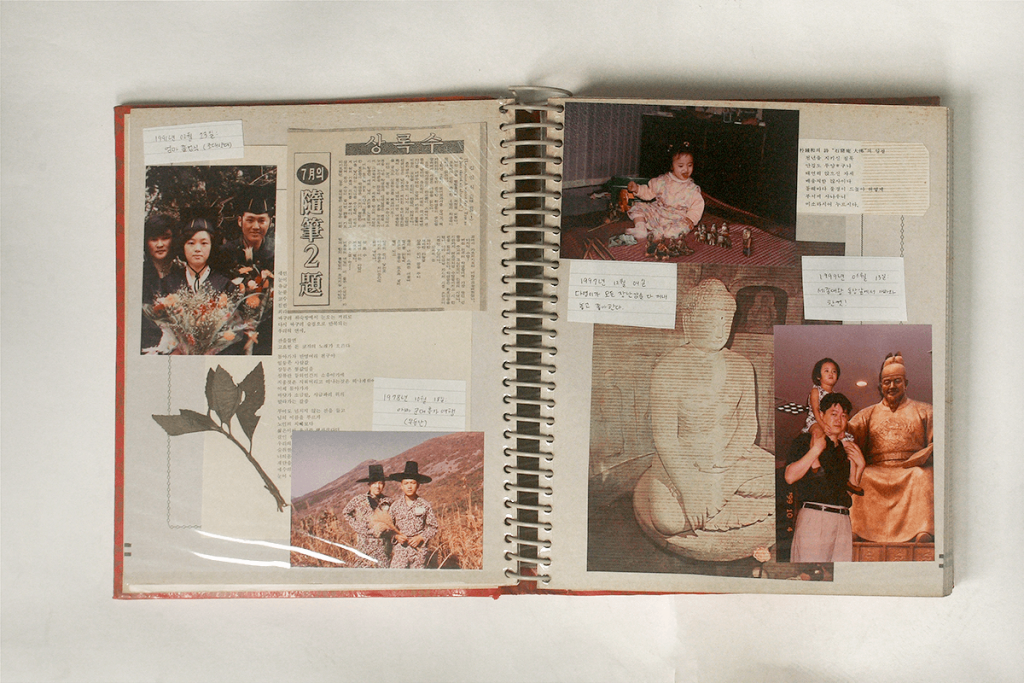
Impulse #6 – Electric Cinema: On Atmosphere and Attention

Last week, I went to the Electric Cinema in Notting Hill to watch Notting Hill. Which, on paper, sounds almost ridiculous. Watching a romcom I’ve already seen, in the exact neighbourhood where it’s set, didn’t feel like something that would count as “research.” It wasn’t a lecture, it wasn’t a book, and it definitely wasn’t productive in the traditional academic sense.

But it stayed with me.

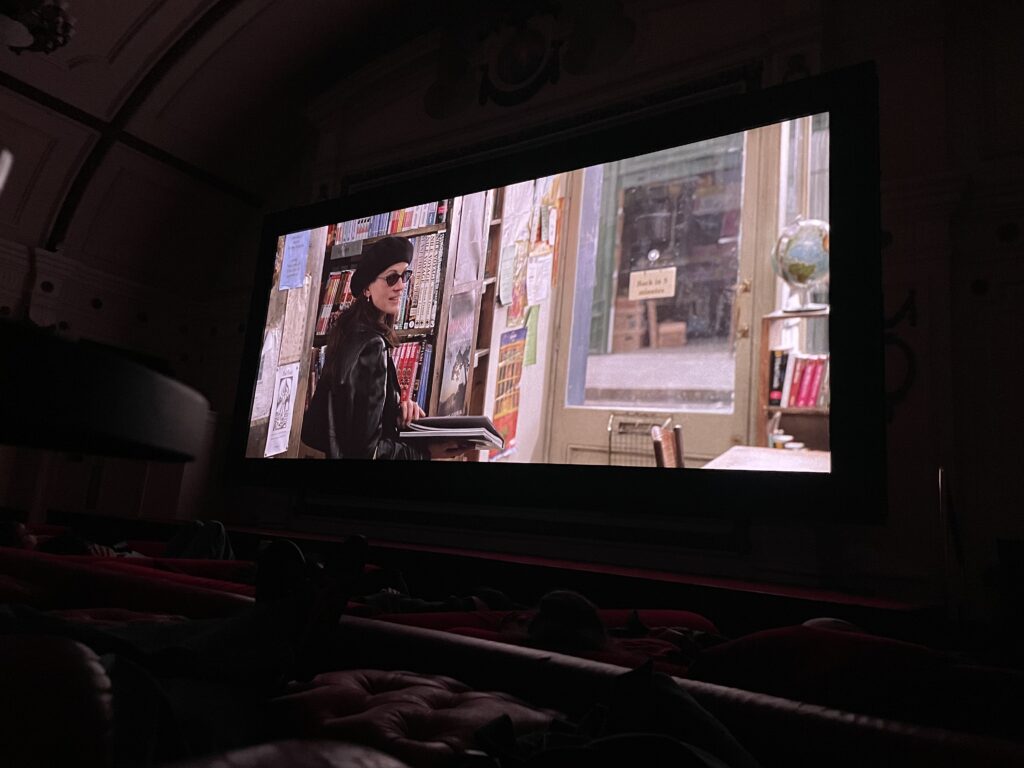
I think what made it special wasn’t the film itself, but the atmosphere of the cinema. The Electric Cinema is one of the oldest cinemas in London, and it feels very different from watching something at home or on a laptop. You sit in these soft seats, there are small lamps next to you, people eat burgers and fries. It sounds like a small detail, but it made me realise how rarely I watch something with my full attention. No phone, no distractions, no multitasking. Just sitting there and watching.

I’ve loved Notting Hill for years, but I honestly can’t remember the last time I experienced a film like that by not just watching it, but really being present with it. The atmosphere allowed me to focus differently. It made me think about how much our surroundings shape the way we experience things.

What was also interesting was the contrast between the inside and outside. Notting Hill, especially around Portobello Road, feels very chaotic. It’s full of tourists, noise, and constant movement. But inside the cinema, there was this quiet fictional version of the same place. For two hours, you leave the real Notting Hill and enter a constructed one. And even though you know it’s fiction, it still feels real in its own way.

This made me think about my thesis and my interest in chaos. Outside, there is uncontrolled chaos, random, overwhelming, and hard to fully process. Inside the cinema, there is a different kind of structure. Everything is intentional. The story, the timing, the emotions are carefully directed. It’s not necessarily less real, but it’s organised in a way that allows you to engage with it more deeply.

I think working on a thesis is not only about reading books or sitting in libraries. It’s also about paying attention to experiences and noticing how context changes perception. The same film can feel completely different depending on where and how you watch it.

This visit reminded me that atmosphere, environment, and attention all play a role in how meaning is created. And maybe part of my research is learning to notice these moments more consciously.

Links:
https://www.electriccinema.co.uk/history/electric-cinema-portobello-history
https://www.imdb.com/de/title/tt0125439/

Thesis Research 10: Kann Design Schweigeräume öffnen?

Neben dem Thema Wut beschäftigt mich zunehmend ein anderes Feld, das ebenso existenziell ist und gleichzeitig gesellschaftlich auffallend leise behandelt wird: Tod und Abschied. Ich finde dieses Thema besonders interessant, weil es in gewisser Weise ein Tabuthema ist, obwohl es das Alltäglichste überhaupt ist. Jeden Tag sterben Menschen. Jeden Tag werden Menschen geboren. Jede Person wird im Laufe ihres Lebens unweigerlich mit dem Tod konfrontiert, sei es durch den Verlust von Angehörigen, Freundinnen oder Freunden, oder irgendwann durch den Gedanken an den eigenen Tod. Und trotzdem fällt es uns schwer, darüber zu sprechen.

Aus eigener Erfahrung weiß ich, wie irritierend diese Schweigsamkeit sein kann. Als ich selbst einen Verlust erlebt habe, hat mich weniger die Trauer anderer irritiert als ihre Unsicherheit. Die Stummheit. Das Ausweichen. Das Gefühl, dass niemand weiß, wie man das Thema ansprechen darf. Diese Sprachlosigkeit hat mich gestört. Nicht, weil ich perfekte Worte erwartet hätte, sondern weil ich gemerkt habe, wie sehr das Thema Tod aus dem öffentlichen Gespräch ausgeschlossen ist.

Natürlich ist Trauer schmerzhaft. Natürlich ist Abschied schwer. Aber warum fällt es uns so schwer, darüber offen zu sprechen, wenn es doch eine Erfahrung ist, die jede und jeder teilt.

Vielleicht liegt genau darin ein Kern des Problems. Der Tod ist real, aber er wird aus dem öffentlichen Raum verdrängt. Er findet im Privaten statt. In Krankenhäusern, Hospizen, Familien. Und wenn er eintritt, fehlt vielen die Sprache.

Ein Satz von Chimamanda Ngozi Adichie begleitet mich in diesem Zusammenhang besonders:
„Trauer ist das Glück, geliebt zu haben.“

Dieser Gedanke verschiebt den Blick auf Trauer radikal. Trauer ist hier nicht nur Schmerz, sondern Ausdruck von Verbundenheit. Auch die Aussage von Eva Maria Thümling, „Trauer und Glück können koexistieren“, öffnet einen ähnlichen Raum. Trauer wird nicht als reiner Ausnahmezustand verstanden, sondern als Teil des Lebens, als etwas, das neben anderen Gefühlen existieren darf.

Im Podcast 50 über 50 spricht Stephanie Hielscher mit Leonie Jung über Tod, Verlust und Endlichkeit. Schon in der Einleitung wird deutlich, dass Tod und Trauer Themen sind, die uns ein Leben lang begleiten, über die aber kaum gesprochen wird. Ähnlich offen spricht Guido Maria Kretschmer im Format Deep und Deutlich über den Verlust seiner Eltern. Auch Joëlle berichtet dort sehr ehrlich über den Tod ihrer beiden Mütter. Diese Gespräche zeigen, dass Offenheit möglich ist. Dass Sprache entlasten kann. Dass das Teilen von Erfahrungen Verbindung schafft.

Und genau hier formt sich für mich ein weiterer Gedanke. Vielleicht geht es weniger darum, den Tod neu zu interpretieren, sondern ihn schlicht auszusprechen. Nicht symbolisch. Nicht metaphorisch. Sondern klar. Der Tod ist real.

Dieser Satz wirkt auf den ersten Blick banal. Und gerade darin liegt seine Kraft. Vielleicht tun wir gesellschaftlich oft so, als wäre er es nicht. Als könnte Schweigen ihn kleiner machen. Als würde Unsichtbarkeit ihn weniger endgültig erscheinen lassen. Doch er ist real. Jeden Tag. Für irgendjemanden.

Wenn Gestaltung, wie Friedrich von Borries schreibt, politisch ist, weil sie „in die Welt interveniert“ (von Borries, Weltentwerfen. Eine politische Designtheorie, 2024, S. 30), und wenn „alles, was gestaltet ist, entwirft und unterwirft“ (ebd., S. 9f.), dann wäre eine gestalterische Arbeit mit dieser klaren Setzung bereits ein Eingriff. Eine Intervention gegen die gesellschaftliche Stummheit. Keine Provokation im Sinne eines Schocks, sondern eine ruhige, konsequente Benennung.

Mich interessiert weniger, den Tod selbst darzustellen, als die Sprachlosigkeit rund um ihn zu thematisieren. Das Unbehagen. Die Unsicherheit. Die Angst, etwas Falsches zu sagen. Und gleichzeitig die Sehnsucht nach Austausch. Vielleicht geht es darum, Räume zu schaffen, in denen Menschen nicht perfekt reagieren müssen, sondern ehrlich.

Wut und Trauer haben für mich weiterhin eine Parallele. Beide sind starke, existenzielle Emotionen. Beide werden gesellschaftlich häufig privatisiert. Beide verlangen Raum. Beide sind zutiefst menschlich.

Im Moment weiß ich noch nicht, ob Tod und Abschied mein finales Thema sein werden. Aber ich merke sehr deutlich, dass mich der Gedanke nicht loslässt, Gestaltung als Einladung zum Gespräch zu denken. Vielleicht geht es weniger um ein einzelnes Thema, sondern um die Frage, wie Design Schweigeräume öffnen kann.

Links:
https://www.fischerverlage.de/buch/chimamanda-ngozi-adichie-trauer-ist-das-glueck-geliebt-zu-haben-9783596710164
https://www.instagram.com/p/DUplWGMDNfE/?img_index=8
https://open.spotify.com/episode/6WNHnZOAcZ9OKdnUU1Qljv
https://www.ardmediathek.de/video/deep-und-deutlich/der-verlust-meiner-eltern-oder-guido-maria-kretschmer-im-talk/ndr/Y3JpZDovL25kci5kZS8zYjY0NGQ0Ni02NzIyLTQxZTQtYWQ2Yy02NDAwMWQxOTExNGM
https://www.ardmediathek.de/video/deep-und-deutlich/ich-habe-zwei-mal-meine-mutter-verloren-oder-joelle-im-talk/ndr/Y3JpZDovL25kci5kZS9mMzkwMzE2NC1mYzRiLTRhMmQtYmZhZC0xZWE2MTdiMWQ5MmE

Impulse #5 – The Uses of Disorder by Richard Sennett

https://www.paulstewartdesign.co.uk/the-uses-of-disorder

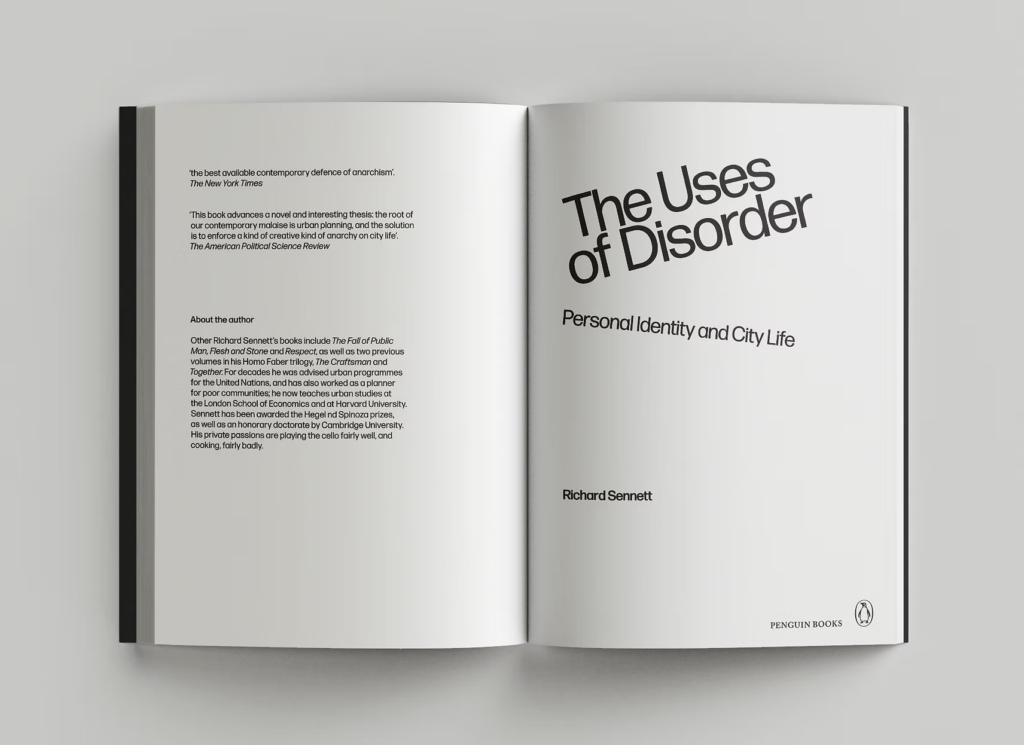
Lately I’ve been reading The Uses of Disorder by Richard Sennett, and even though I’m not finished yet, I already know it’s going to be important for how I shape my thesis. Mostly because my topic keeps circling around CHAOS not chaos as “everything is broken,” but chaos as something productive, alive, even necessary. And Sennett basically walks straight into that uncomfortable zone and says: maybe the problem isn’t disorder. Maybe the problem is how obsessed we are with getting rid of it.

The book was written as a critique of this dream of the perfectly planned, perfectly ordered city, the kind of place where everything is smooth and controlled and “safe,” but in a way that also flattens life. Sennett argues that overly ordered communities can become stagnant, because order can turn into avoidance: avoidance of difference, avoidance of conflict, avoidance of anything that might force you to grow.

What I find interesting is that he doesn’t talk about disorder like it’s a cute aesthetic. He’s not romanticising mess. He’s talking about it as something that can actually do work on a person. Like friction. Like a training ground. His point (at least how I’m understanding it so far) is that development doesn’t come from living in a bubble. It comes from being confronted with complexity, with other people, other values or other realities you can’t control.

One of the ideas that keeps sticking in my head is his critique of “purified” communities. Spaces built around sameness, where everything feels predictable. The way he frames it, these environments aren’t neutral. They’re a choice. And they’re often a choice made possible by privilege: if you have enough resources, you can design your life to avoid discomfort. You can separate yourself from anything messy. You can curate your surroundings until you barely have to deal with surprise.

And then I keep thinking… what does that mean for design?

Because design can easily become part of that “purifying” impulse. Even in the nicest, most well-intentioned way. We design systems to reduce uncertainty. We design environments to be seamless. We design experiences that remove friction. And sometimes that’s good but sometimes it feels like we’re also designing out the parts where people actually change.

Reading Sennett makes me ask: When does “making things easier” turn into making things less real? When does smoothing everything out become a way of avoiding growth?

This is where it starts connecting to my own obsession with chaos. Not because I want everything to be chaotic. But because I’m starting to see chaos as a condition for meaning. Like: if everything is too controlled, everything becomes the same. You stop noticing. You stop feeling. You stop having those moments where something interrupts you and you have to re-orient yourself.

Also, maybe this is the biggest thing the book is giving me right now: permission to not immediately “solve” chaos. To not treat disorder as a design failure. To treat it as information. As something you can work with instead of against.

I’m still in the middle of the book, so I don’t want to pretend I’m summarising it perfectly. But I can already tell it’s reshaping the way I think about cities, communities, and creative practice and honestly, it’s making me more suspicious of anything that looks too organized.

Links:
https://www.paulstewartdesign.co.uk/the-uses-of-disorder
https://www.versobooks.com/en-gb/products/2810-the-uses-of-disorder?srsltid=AfmBOoqcJ_Up1gbzIwcqjeYxPyC983siGmJnnOm5moLjHgr6Zbzdk7O0

Research #9 The “Drive to Survive” Effect

We can’t talk about modern motorsport without talking about the “Drive to Survive” effect. The Netflix Series didn’t just bring in more fans but it also changed the demographic of the fans. For the first time, we have a massive, young, and increasingly female audience that cares as much about the drama, the personalities, and the vibe as they do about the technical specs.

#27 – Platform as Context

After being inspired by Paulus Goerden again (and again), I finally did something I should have done much earlier: I stopped only saving posts and started looking at his Instagram account as a whole system. Not just what he posts, but how he builds meaning around everyday installations through format, repetition and framing.

I already wrote a deeper version of this as an Impulse blogpost, but I wanted to keep a short version here as well because it connects directly to my own thesis process.
What I noticed is that his account is not simply documentation. It’s structured. He repeats a few formats over and over again, and that is exactly why it works so well. The most obvious one is the classic: showing a found everyday installation. But then he expands it with other layers: reconstruction (miniature versions), street interviews, and meta-posts where he includes hate comments or reactions from followers. The installations stay anonymous, but the context around them keeps changing.

This is important for my thesis because it proves something I keep coming back to: the object itself is rarely the main point. The frame is. On Instagram, the frame can be a caption, a voiceover, a title, a hate comment screenshot, or a conversation with a stranger. And suddenly the same pile of boxes becomes either trash, minimalism, or a joke — depending on what kind of frame is offered.

For me, the biggest takeaway is that I shouldn’t think of my work as “just photos” either. The documentation, the text, the exhibition space, the order of images, the titles, even the reactions from other people, all of that is part of the final communication.
Paulus’ work is a good reminder that everyday installations don’t need a museum to become readable. But they do need a structure. And building that structure is basically communication design.

Impulse #4 – Workshop @UAL

Recently, we had a workshop at the University of the Arts London with Ella, the Course Leader of the MA Design for Social Innovation and Sustainable Futures at London College of Communication. The workshop is part of a larger task for this semester: creating a future newspaper set in the year 2046. Each of us has to develop our own project that exists within this imagined future, while also working with a local community. It sounds simple at first, but the question behind it feels much bigger: how will the future look, and how do we position ourselves within it as designers?
I’ve noticed that thinking about the future makes me slightly uncomfortable. The future feels abstract, uncertain, and difficult to hold onto. I realised that I often find more comfort in looking at the past, in personal stories, cultural references, and existing memories. At first, I thought this might be a limitation. But Ella’s talk shifted my perspective.
One thing she said that stayed with me was: “Joy is radical.” In a time where so much of the future is discussed through crisis, climate change, political instability and uncertainty, choosing to focus on joy can itself become a form of resistance. It made me realise that future-oriented design doesn’t always have to come from fear or urgency. It can also come from care and hope.

Ella showed us several projects from her students, and one in particular stayed with me. It was created by an international student from South Korea, who asked the question: What if South Korea had never been colonised? She explored this question through deeply personal and visual methods. She rearranged photographs in her grandmother’s home, imagining how her family might have dressed or lived under different historical conditions. Through this process, she connected speculative thinking about the future with reflections on the past. What I found especially interesting was how this exploration eventually led her to something completely different: kimchi and sustainability. She created her own kimchi brand, using food waste from restaurants to imagine more sustainable production systems. I was fascinated by how a thesis that began with history and identity could evolve into something so tangible.

Decolonizing Sadaejuui in Korean History Through Speculative Letter from the Future – Rebecca Ghim

This project also reassured me on a personal level. It showed me that working with the past doesn’t mean you’re stuck there. The past can become a tool to imagine alternative futures. As someone who is interested in cultural memory and my own background, this approach felt very close to how I want to work.

Another moment during the workshop that stayed with me was when one of my classmates presented her idea that chocolate might no longer exist in the future due to climate change and resource scarcity. One suggestion I particularly loved was the idea to make people write letters and give them chocolate-flavoured stamps, allowing people to value it while we still have it.

Links:
https://read.followingthefootprints.com/p/the-check-out-20-theferm
https://madsisf.myblog.arts.ac.uk/2020/06/11/rebecca/
https://www.arts.ac.uk/colleges/london-college-of-communication/people/ella-britton

IMPULSE #6 — Paulus Goerden (Street Interview)

(Online Activity – watching and analysing a street interview format, 1+ hour)

For this impulse I focused on one specific format Paulus Goerden uses frequently: street interviews. Instead of analysing his account as a whole, I watched one reel closely and treated it like a small case study. The reel is titled “Zitate aus der Kunstgeschichte auf der Straße 🥰” and shows Paulus approaching a passerby and asking her directly why people choose to ignore a specific everyday installation.

This reel is interesting because it makes something visible that is usually invisible in my research: the moment of interpretation. When I photograph everyday installations, I capture the result, an arrangement that already exists. But I rarely capture the social process around it. Paulus does. In this reel, the installation is not only shown as an object in space. It becomes a trigger for conversation, disagreement, humor and negotiation.

The structure of the interaction is simple. Paulus starts by asking for permission and then asks a clear question: why does nobody pay attention to this “construction”? The woman answers honestly and pragmatically: she does not see it as an art object. For her, the reason is contextual. She assumes it is related to moving boxes and the fact that people constantly move in and out. This answer is extremely valuable for my thesis because it shows how strongly interpretation depends on everyday logic. She does not analyse form, she analyses function.

Paulus then follows up with an important question: what would need to be different for her to perceive it as an artwork? This question is basically a direct version of my thesis topic. It forces the viewer to articulate their own internal criteria. And what happens next is even more interesting: Paulus tries to connect the installation to art history. He mentions minimalism, simple forms, colors, stacked shapes. In other words, he tries to re-frame the everyday installation using a cultural reference.

The moment another passerby joins and jokes about the address label (“the artist left his signature”) is also important. It shows how quickly people switch between seriousness and humor when confronted with ambiguous objects. It also shows how social interaction itself becomes part of the framing. Suddenly, the installation is not only “boxes.” It is a shared moment between strangers.

What I find most relevant is that the reel demonstrates how easily the interpretation can shift once a label is introduced. Paulus calls it “Alltagsinstallation,” and the woman responds: “ja gut, ist in Ordnung,” and laughs. The conversation ends politely, and everyone moves on. But something has changed: the object has been temporarily upgraded. Not because it physically changed, but because a word was introduced. A name was given. A concept was offered.

This connects directly to my thesis question: what does it take for art to communicate without a frame? In this reel, the frame is not a gallery. The frame is Paulus himself. The frame is language. The frame is art history. And the frame is the social permission to talk about an object as if it matters.

The reel also shows something else: people are not necessarily unwilling to engage. They simply need a trigger. Without the trigger, they walk past. With the trigger, they participate. This supports the idea that everyday installations can communicate but they do not automatically do so. Communication happens when attention is activated.

For my own work, this impulse gives me a concrete method idea: I could incorporate short interviews or spontaneous reactions into my research, even if I do not want to become a street interviewer myself. The reel proves that audience perception is not abstract. It can be observed in real time. It can be recorded. And it can become part of the thesis material, not only as anecdotal evidence but as a structured research method.

Overall, this impulse helped me see that “framing” is not only spatial (museum vs street). Framing can also happen through conversation. A single question can function like a museum label. A single reference to minimalism can function like a curatorial statement. And a single shared laugh can turn an ignored pile of boxes into a temporary artwork.

Transcript (based on the reel)

Paulus: Darf ich Sie kurz was fragen? Ich frag mich, wieso hier jeder an dieser spannenden Konstruktion vorbeigeht und warum das keine Beachtung findet?
Woman: Weil ich das jetzt nicht als Kunstobjekt ansehe.
Paulus: Was fehlt Ihnen denn dafür, dass es als Kunstobjekt wahrgenommen werden kann?
Woman: Es hat einfach damit zu tun, dass hier die ganze Zeit neue Leute einziehen und ich denke, dass die Kartons von denen sind.
Paulus: Ja, aber das ist eine spannende Form, oder? Es hat sehr viel vom Minimalismus in der Kunstgeschichte. Die einfachen Formen, die Farben, das Aufeinandergestapelte.
Man (Passant): Der Künstler hat sich da verewigt.
Paulus: Der Künstler hat sich da verewigt?
Man: Ja, die Adresse steht drauf. (points with finger on the adress written on it)
(everyone laughs)
Paulus: Ich nenn das Alltagsinstallation.
Woman: Ja gut, ist in Ordnung. (laughs) Dann kann man’s angucken.
(they laugh and say goodbye)

Links
https://www.instagram.com/reel/DUdMrLLDFJD/?igsh=ZHE3bWZmZmJqbmdp
https://www.instagram.com/reel/DUoFC48DBPT/?igsh=MW93eXdwNHViZ3oxdw==
https://www.instagram.com/paulusgoerden?igsh=eTl5d2Z0b3dmOGY=

AI Disclaimer
This blog post was written with the assistance of AI.
Thesis Research 09: Wut gestalten zwischen Irritation und Verantwortung

Im weiteren Verlauf meiner Recherche bin ich auf einen Artikel bei Design Made in Germany gestoßen, der sich ebenfalls mit Wut als gestalterischem Ausgangspunkt beschäftigt. Die dort vorgestellte Diplomarbeit „Wut – Eine Collage“ nähert sich dem Thema mit einem klaren Anliegen. Trauernde finden Mitleid und Trost in der Gesellschaft und jemanden, der mitlacht, findet man schnell. Doch wer wütend ist, wird oft mit seinem Gefühl allein gelassen. Aus dieser Beobachtung heraus entsteht der Anspruch, Wut nicht als rein negative Emotion zu betrachten, sondern ihre Energie konstruktiv und kreativ nutzbar zu machen.

Dieser Gedanke erinnert mich erneut an das Interview im Podcast Hotel Matze mit Caroline Wahl, in dem sie sagt: „Ich finde Wut und Zorn schöne Emotionen, weil Menschen, die wütend und zornig sind und dann das sagen und laut sind, die sind danach befreit und die sind ehrlich. Die lassen was Ehrliches raus. Deswegen bin ich für Wut.“

Gerade diese Perspektive macht deutlich, dass Wut nicht nur destruktiv gedacht werden muss, sondern auch als ehrliche, klärende Kraft verstanden werden kann. In der Diplomarbeit „Wut – Eine Collage“ scheint ein ähnlicher Gedanke mitzuschwingen. Wut wird nicht beruhigt, sondern ernst genommen. Nicht erklärt, sondern sichtbar gemacht.

Besonders interessant finde ich die bewusste Entscheidung der Gestalterin, sich nicht anzumaßen, Wut pauschal zu erklären oder Schritt-für-Schritt-Anleitungen anzubieten. Stattdessen werden Menschen aus unterschiedlichen gesellschaftlichen und beruflichen Kontexten vorgestellt, die jeweils ihren eigenen Umgang mit Wut gefunden haben. Wut erscheint hier nicht als einheitliches Gefühl, sondern als individuelles, vielschichtiges Phänomen.

Gestalterisch wird diese Haltung konsequent umgesetzt. Die zugrunde liegende Prämisse lautet, dass zwischen Geschmack, der mit Auslese und Geduld einhergeht, und Wut, die impulsiv und erbarmungslos ist, keine Verbindung besteht. Eine klassische, minimalistische Gestaltung wäre demnach unangebracht. Stattdessen wird Irritation bewusst eingesetzt. Gestaltungsregeln werden über Bord geworfen, visuelle Mittel wie Wingdings-Symbole oder alte Stockfotografien greifen Aspekte wie Tunnelblick oder Aggression auf. Auch das physische Trennen von Themen durch ausgerissene Seiten wird als Ausdruck von Wut verstanden.

Diese Arbeit beeindruckt mich, weil sie radikal versucht, Form und Emotion zusammenzuführen. Gleichzeitig wirft sie für mich neue Fragen auf. Ist das bewusste Brechen von Regeln automatisch ein Ausdruck von Wut. Oder entsteht hier eine neue Ästhetik, die zwar auf Wut verweist, sie aber gleichzeitig in ein gestalterisches System überführt.

In meinen bisherigen Researches habe ich mich gefragt, ob Wut gestaltet werden kann, ohne ästhetisiert zu werden. Auch hier bleibt die Spannung bestehen. „Wut – Eine Collage“ entscheidet sich bewusst gegen Minimalismus und für Irritation. Doch Irritation ist ebenfalls ein gestalterisches Mittel. Sie ist geplant, konzipiert, gerahmt. Selbst wenn Regeln gebrochen werden, geschieht dies innerhalb eines bewussten Konzepts.

Das führt mich zurück zu meinem Gedanken aus Thesis Research 08: Aus Wut wird Gestaltung. In der vorgestellten Arbeit wird deutlich, dass Wut nicht nur dargestellt, sondern zum Motor des Entwurfs gemacht wird. Gleichzeitig bleibt Gestaltung ein Eingriff. Sie wählt Mittel, setzt Grenzen und definiert Erscheinungsformen.

Hier wird auch Friedrich von Borries’ Gedanke erneut relevant, dass alles, was gestaltet ist, entwirft und unterwirft. Auch eine Gestaltung, die sich gegen Konventionen richtet, interveniert in die Wahrnehmung. Sie entwirft eine bestimmte Sicht auf Wut und schließt andere aus.

Was ich aus diesem Beispiel mitnehme, ist weniger die konkrete Ästhetik als die Haltung dahinter. Wut wird nicht pathologisiert, sondern ernst genommen. Sie wird nicht beruhigt, sondern als Energie verstanden. Gleichzeitig wird sie nicht vereinnahmt, sondern geöffnet. Der Leser entscheidet selbst, wie er sie erlebt und was er daraus macht.

Vielleicht liegt genau hier ein wichtiger Punkt für meine eigene Arbeit. Wenn ich mich weiter mit Wut beschäftige, dann nicht im Sinne einer festen Form, sondern als offenes System. Nicht als Anleitung, sondern als Angebot. Nicht als Stil, sondern als Prozess.

Thesis Research 09 zeigt mir, dass eine Arbeit zum Thema Wut möglich ist. Gleichzeitig macht sie deutlich, wie sensibel der Umgang mit dieser Emotion sein muss. Zwischen Provokation und Ernsthaftigkeit. Zwischen Irritation und Verantwortung. Zwischen Ausdruck und Gestaltung.

Links:
https://www.designmadeingermany.de/#68012
https://www.youtube.com/watch?v=_zbqX7USL9g
https://res.cloudinary.com/suhrkamp/images/q_auto/v1742120777/38677/weltentwerfen_9783518127346_leseprobe.pdf

IMPULSE #5 — Paulus Goerden (Structured Content Log)

(Online Activity – Instagram Research, 1+ hour)

In my previous impulse blogpost (IMPULSE #4) I analysed Paulus Goerden’s Instagram account and described the recurring categories I noticed: documentation, reconstruction, meta-content, personal presence, and event-related posts. While writing that, I realised something: it might be just as interesting to show how I got to those observations.

So for this impulse, I focused on the method. I documented his recent posts in a structured way, using a simple logging system (date, caption, format, and what is shown). The goal was not interpretation, but to create a clear dataset that makes the account analysable beyond personal inspiration.

I started with a raw version (Version 1), writing down everything that caught my attention. Afterwards I translated the same content into a more structured overview (Version 2) with ChatGPT, so patterns like format choices, recurring elements and communication strategies become easier to compare.

Version 1 Raw log (my original note structure)

  • 18.01. 4 Rahmen in meiner Garagenecke (Bilder): Verschiedene Bilder von Rahmen in seiner Garage, die unterschiedlich angeordnet sind, mit eingeblendeten Hate-Kommentaren („Alter was du rauchst will ich haben…“) [META]
  • 16.01. So viel kann ich dir sagen💫🤍🪄 (Video): Paulus ist im Bild, kuratiert Objekte auf einem Stuhl, dazu Screenshot eines Hate-Kommentars („Such dir ne Arbeit Paulus…“) und sein Text „POV: meine Arbeit“ [META]
  • 13.01. 4 Rahmen in meiner Garagenecke (Video): Er erklärt die Rahmen-Serie und spricht über Wahrnehmung („ab wann nehmen wir solch eine Konstruktion überhaupt wahr“) [EI]
  • 14.01. Ihr seid ja krass… (Text/DM Post): Er zeigt DMs und eine lange Liste von Titelvorschlägen, die seine Follower*innen für ein Motiv vorgeschlagen haben [META]
  • 29.01. Kunstunterricht: Ja (Bild): Screenshot einer Nachricht einer Lehrerin, die seine Alltagsinstallationen im Unterricht verwendet (Schüler*innen gehen raus und suchen selbst) [META]
  • 30.12. Was soll das bringen / nichts (Bild): Foto von seinem Notizbuch, in dem er „Was soll das bringen“ mehrfach als Text verarbeitet (Kommentar wird zum Werk) [META]
  • 12.02.2026 Lesung? (Video): Er zeigt das Notizbuch und erklärt es im Zusammenhang mit dem Hate-Kommentar „Was soll das bringen?“ [META]
  • 12.02.2026 Ein Versuch es einzufangen (Video): Er zeigt seine analoge Mini-Version einer Alltagsinstallation und erklärt die Idee dahinter [MINI]
  • 05.02. Der Mut kommt unterwegs (Bild): „Pappe, Acryl, Klebstoff, Bleistift“, Maße 29 x 20 x 10 cm; analoge Interpretation einer Installation vom Görlitzer Bahnhof [MINI]
  • 07.02.2026 Zitate aus der Kunstgeschichte auf der Straße 🥰 (Video): Paulus spricht Passant*innen an und fragt, warum sie an der Konstruktion vorbeigehen; Gespräch über „Kunstobjekt“, Umzugskartons, Minimalismus, und ein witziger Kommentar über die Adresse als „Signatur“ [STREET]
  • 03.02. Gucken wir uns mal eine Show auf der Fashion Week an (Video): Er beobachtet unscheinbare Momente bei einer Show, beschreibt Schattenfiguren, Kameras, Präsenz und Blickrichtungen [EVENT]
  • 02.02. BFW 🪄🩶 Schön wars! (Bilder): Mehrere Fotos von der Berlin Fashion Week [EVENT]
  • 01.02. Letzter Tag, Berlin Fashion Week 🤍 (Bild): Recap-Post, shoutouts, Shows, Foto von ihm + Freundin [EVENT]
  • 27.01. Atelier 26.01.2026 (Bild): A4 Zeichnung, Buntstift auf Papier [STUDIO]
  • 21.01. Kommentar, Pfusch, Toilette verstopft… (Bilder): Carousel mit verschiedenen Fotos (Alltag, Objekte, auch Selfies), dazu Text „Alles wie immer“ [PERS]
  • 12.01. Gitter, 2026 (Bild): Metall/Plastik, 50 x 40 cm; Foto eines Metallgitters an der Wand [STUDIO]
  • 11.01. In den letzten Tagen habe ich begonnen… (Bild): Er beschreibt, dass er Situationen festhält und wieder an den Ort projiziert, an dem sie entstanden sind (Konfrontation mit dem eigenen Abbild) [STUDIO]
  • 03.01. 💫💫 (Bild): Foto von ihm und einer Freundin [PERS]
  • 28.12. Schmunzelnd durch die Ausstellung… Feldmann (Video): Paulus geht durch eine Ausstellung und kommentiert Beobachtungen [EVENT]
  • 09.02.2026 Zeit (Bild): Foto eines gemalten Bildes plus eingeblendeter Hate-Kommentar („Hab gestern eine Bierflasche auf meinen Toaster gestellt… verkaufe es für 20.000€“) [META]

Version 2 — Structured table (same content, clearer overview)

Codes (for category):
EI = Everyday Installation / found moment
MINI = miniature / analogue reconstruction
STREET = street interview / public reaction
META = hate comments / discourse / DMs
EVENT = fashion week / museum / external event
STUDIO = atelier / personal production
PERS = personal / selfie / friend post

DateCaptionFormatCodeComment screenshotTalks/voiceoverWhat is shown (short)
12.02.2026Lesung?VideoMETAYesYesNotebook shown + explanation connected to hate comment “Was soll das bringen?”
12.02.2026Ein Versuch es einzufangenVideoMININoYesAnalogue miniature reconstruction shown and explained
09.02.2026ZeitImageMETAYesNoPainting + hate comment overlay (toaster/bottle joke)
07.02.2026Zitate aus der Kunstgeschichte auf der Straße 🥰VideoSTREETNoYesStreet interview about why the installation is ignored
05.02.2026Der Mut kommt unterwegsImageMININoNoAnalogue object with materials + dimensions
03.02.2026Gucken wir uns mal eine Show auf der Fashion Week anVideoEVENTNoYesObserves unnoticed moments at Fashion Week
02.02.2026BFW 🪄🩶Schön wars!ImagesEVENTNoNoMultiple Fashion Week photos
01.02.2026Letzter Tag, Berlin Fashion Week 🤍ImageEVENTNoNoFashion Week recap + shoutouts
29.01.2026Kunstunterricht: JaImageMETANoNoScreenshot of DM from teacher using his content in class
27.01.2026Atelier 26.01.2026ImageSTUDIONoNoDrawing documentation (A4, colored pencil)
21.01.2026Kommentar, Pfusch, Toilette verstopft…ImagesPERSNoNoMixed carousel: daily life + objects + selfies
18.01.20264 Rahmen in meiner GarageneckeImagesMETAYesNoFrames arranged differently + hate comment overlay
16.01.2026So viel kann ich dir sagen💫🤍🪄VideoMETAYesYesHe curates objects, includes hate comment screenshot
14.01.2026Ihr seid ja krass… (Titelvorschläge)Text-based postMETANoNoFollowers’ DM title suggestions
13.01.20264 Rahmen in meiner GarageneckeVideoEINoYesExplains the frame arrangement + perception
12.01.2026Gitter, 2026ImageSTUDIONoNoArtwork documentation: metal/plastic grid + size
11.01.2026In den letzten Tagen habe ich begonnen…ImageSTUDIONoNoProjection back onto the original place
03.01.2026💫💫ImagePERSNoNoPhoto with a friend
30.12.2025Was soll das bringen / nichtsImageMETANoNoNotebook work repeating hate comment as text
28.12.2025Schmunzelnd durch die Ausstellung… FeldmannVideoEVENTNoYesMuseum visit + commentary

Quick Observations (without interpretation)

  • Recent posts are a mix of video and image, with video used mainly when explanation or interaction is involved.
  • Comment screenshots are used frequently as a recurring visual element.
  • There is a clear pattern of alternating between:
    • documentation of “works”
    • public reaction
    • personal/event content
  • Many posts include titles, dimensions, and materials, which makes found moments look like official artworks.

Impact on my research

This structured log is useful for my thesis because it turns inspiration into something measurable. Instead of only reacting emotionally to Paulus Goerden’s work, I can now identify the communication tools he uses: format choices, framing through language, audience involvement, and the consistent use of context. This helps me develop my own documentation strategy and makes it easier to compare different ways of presenting everyday installations.

Links

https://www.instagram.com/paulusgoerden?igsh=eTl5d2Z0b3dmOGY=
https://www.instagram.com/reel/DUoFC48DBPT/?igsh=MW93eXdwNHViZ3oxdw==
https://www.instagram.com/reel/DUdMrLLDFJD/?igsh=ZHE3bWZmZmJqbmdp

AI Disclaimer
This blog post was written with the assistance of AI.
IMPULSE #4 — Paulus Goerden (Instagram Analysis)

(Online Activity – Instagram Research, 1+ hour)

For this impulse I did something I’ve been meaning to do for a long time: I stopped casually consuming Paulus Goerden’s content and instead looked at his Instagram account as a system. I have been inspired by him repeatedly throughout the last semesters, but mostly in a quick way, saving a post here, rewatching a reel there and moving on. This time I wanted to understand why it works so well and what exactly he is doing in terms of communication.

Paulus Goerden’s account functions like an ongoing format: a mixture of art practice, observation, performance and public mediation. The topic is often the same (everyday installations, who would have thought :P) but the way he presents them shifts between several repeating categories. This is interesting for my thesis because my research is also about framing: what makes people notice something and what makes something feel like “art” instead of “random objects.” On his account, the frame is constantly changing and he actively uses Instagram as a tool to shape interpretation.

capturing everyday installations

The first major category is the most obvious one: capturing everyday installations. Sometimes this happens through photography, sometimes through video, but the focus is always on moments that already exist in public space. The objects are not created by him. They are found. What makes them his work is the act of noticing, naming, and documenting them. This is directly connected to my own approach, but Paulus’ account shows how far you can push this without turning it into a simple “look what I found” archive.

reconstruction

The second category, which is the one that influenced me the most recently, is reconstruction. In the reel “Ein Versuch es einzufangen,” he shows an analogue miniature version of a found everyday installation and explains it. This approach adds a second layer to documentation: instead of only translating the installation into an image, he translates it into an object. That shift is important, because it makes the act of observing visible. It is not just about capturing a moment. It is about re-building it, re-seeing it, and showing that the installation has structure and intention even if it originally had none. This connects strongly to my own idea of building miniature reconstructions for my exhibition.

meta-content

A third category is what I would describe as meta-content. Paulus frequently includes hate comments, misunderstandings, or audience reactions in his posts. He doesn’t hide the fact that many people think his work is “stupid” or “not art.” Instead, he uses that reaction as material. This is a communication strategy. It shows that his account is not only about presenting finished work, but also about making the discourse around it visible. The hate comments become part of the frame. And that is exactly what my thesis is concerned with: the question of legitimacy, authorship, and context. His posts show that meaning does not only come from the object, but from the conversation around the object.

personal presence

The fourth category is his personal presence. He often appears in his videos, speaks directly or shows behind-the-scenes moments. This makes the account feel less like a distant art project and more like a person building a practice in public. This is relevant because it shows how strongly “the artist” still functions as a framing device. Even though the installations are anonymous and found, Paulus’ presence creates continuity. It makes the audience trust the project. It also makes the topic accessible to people who might not normally engage with contemporary art.

Other

Finally, Paulus also posts content that is not directly connected to everyday installations — for example, his Fashion Week posts. At first glance, these seem unrelated. But they actually reveal something important: his attention is consistent. Even in a highly curated environment like Fashion Week, he searches for small unnoticed moments, shadow figures, awkward compositions, and accidental visual situations. This suggests that his practice is not only about street installations. It is about a way of seeing. And that is exactly what I’m trying to research as well: how perception can be trained and how attention can be redirected toward things that normally remain invisible.

Overall, the most important insight from this impulse is that Paulus Goerden’s Instagram is not just documentation. It is a communication design tool. It uses repetition, format, humor, conflict, and storytelling to guide interpretation. His work proves that the frame does not have to be a museum. The frame can be a feed. And in some ways, Instagram might be an even stronger framing device than a gallery wall, because it creates constant context: captions, comments, reactions, and the rhythm of posting.

For my thesis, this impulse is useful in two ways. First, it gives me inspiration for how to expand my own documentation beyond “just photography.” Second, it shows how important it is to think about the platform and the narrative structure around the work. Even if my final outcome becomes an exhibition or a book, the logic stays the same: framing is never neutral, and meaning is always negotiated.

Links
https://www.instagram.com/reel/DUoFC48DBPT/?igsh=MW93eXdwNHViZ3oxdw==
https://www.instagram.com/p/DUOMXJcDPt0/?igsh=MW1ldGZqa2R2cXc1ag==
https://www.instagram.com/p/DTptXdhDBAA/?igsh=dG84OTVoeHpnNjM0

AI Disclaimer
This blog post was written with the assistance of AI.