#30 – damn this is number 30

The next months are going to be a bit intense, so I’m trying to get ahead of the chaos before it starts. 

A big part of what makes this semester feel different is that I have two parallel realities to manage: my thesis work, and the fact that I’ll be in Valencia for a a few months. Which is exciting, but also slightly terrifying, because I know myself. Procrastination and thesis don’t go well with one another. So instead of pretending I will magically become a perfectly disciplined person, I’m trying to build a structure that is realistic. I have to have a plan now, so at least one thing is out of the way and I can directly start into the thesis.

My main goal for the next months is to keep moving forward in small steps. I don’t need huge breakthroughs every week. I need consistency. The thesis is not one big moment. It’s a chain of small decisions: collecting, selecting, writing, revising and polishing.

Right now my plan is to split my thesis work into three tracks that can run simultaneously:

The first track is research. This is where I read, collect sources and build the language around my topic. I already noticed that reading becomes easier once I have the right keywords and once I stop forcing my topic into one discipline. I want to keep doing this continuously, because it’s the part that will support everything else later when I start writing.

The second track is practical work. That means taking photographs, documenting everyday installations, and experimenting with reconstructions. The miniature idea especially feels like something I want to push further, because it connects the observational part of my thesis with a more designed outcome. I want to keep producing while I research, so I don’t end up with a thesis that is only theoretical.

The third track is final format planning. Even if I don’t decide the exact outcome yet, I want to start thinking in systems: how the archive will become a narrative, how an exhibition could work, how a book could work and what kind of structure makes sense for my material. This is also where Valencia might become interesting, because being in a different city could change what I notice and could expand my archive beyond one location.

To make this plan actually work, I’m also setting myself a few small rules. Routines that I can realistically keep:

  • I want at least 3 focused thesis sessions per week (even if they are short).
  • I want one day where I only do practical work (photography, collecting, building miniatures).
  • I want one day where I only work on writing (even if it’s messy writing).
  • I want to keep my archive clean while collecting, so I don’t have to sort everything later.

If I manage to stick to this structure, I think the thesis will stay manageable while living abroad.

The real challenge of this semester: not coming up with even more ideas but turning them into a finished thesis.
#29 – Ethics?

The more I archive my everyday installation photographs, the louder this question gets: what are the ethics of this whole project?

Because the truth is: I’m photographing situations that do not belong to me. These installations are anonymous, often accidental and usually created by someone who never planned for them to be seen as “art.” Sometimes they might even be functional: moving boxes, stored materials, temporary fixes, or objects left behind for a reason.

And the moment I photograph them, I shift their meaning. I turn them into an image. I turn them into something that can be shared, archived and potentially exhibited. 

So I started setting a few rules for myself.

The first one is simple: I avoid photographing people. If someone is clearly visible, the image becomes street photography, and that’s not what my thesis is about. It also creates privacy issues that I don’t want to build my project on.

The second rule is about intervention: I never move objects. Even if an arrangement looks “almost perfect,” I don’t want to complete it. My role is observer, not curator of the street. Otherwise the work would become staging and I would lose the whole point of researching found installations.

The third rule is about sensitivity. Some installations feel open and neutral. Others feel personal. If an object includes names, private belongings or something that feels emotionally loaded, I might still document it for myself, but I probably wouldn’t include it in a public exhibition. Not everything that is visually interesting should automatically become content.

What I like about this ethical question is that it connects directly to the core of my thesis: framing. Because the ethical dilemma is basically proof that framing is powerful. An installation changes the moment it is documented. It changes again the moment it is shared. And it changes again if it enters a curated context like a book or exhibition.

So instead of ignoring the ethics, I want to include it as part of my research. It is not a side issue. It is a sign that meaning is not neutral, and that the act of noticing already carries responsibility.

#28 – building an archive

At this point I’m collecting more photographs than I can process. Which sounds like a good problem to have, but it becomes messy very quickly. A camera roll full of “interesting moments” is not research yet. It only turns into research once the material becomes searchable, comparable, and usable for decisions.

So this week I started building a proper archive system for my everyday installation photographs.

Right now, my main goal is clarity. I need to be able to find images again without relying on memory. I also want to be able to see patterns: what types of installations I notice most, which materials repeat, and how the city keeps producing similar accidental compositions.

My structure:

Each installation gets a folder name that includes date + city + a short description. Inside that folder I keep the raw photo(s), plus one selected version I consider “final” for now.

On top of that, I started tagging my images with a few recurring categories. 

For example:

  • Beverages (coffee/beer)
  • cardboard
  • repair
  • furniture
  • temporary construction
  • staged?

This immediately made my collection feel less like a random moodboard and more like a research archive. Because once the images are tagged, I can compare them across time and location. I can see how often certain object types appear. And I can start asking better questions: Why do I notice these moments? What do they have in common visually? What kind of “order” keeps showing up?

The archive also helps me with selection. Instead of choosing images based on mood, I can choose them based on criteria. I can group them. I can build sequences. And I can start thinking about the final format (book, exhibition) in a more structured way.

I’m realising that archiving is not a boring side-task. It’s actually part of the design work. The archive is the foundation for everything I will do later: writing, analysis and the final output.

IMPULSE #8 — Perfect Days

(Media Activity — watching and reflecting on a film, 1+ hour)

For this impulse a friend recommended me a movie to watch. So I followed his suggestion and watched Perfect Days (2023) by Wim Wenders. It is not a film about art, nor design. But while watching it, I realised that it connects to my thesis topic almost perfectly: attention.

The film follows a man living in Tokyo who works as a toilet cleaner. His days are repetitive and quiet. He wakes up, goes to work, eats, reads, takes photos and repeats. At first glance, nothing “special” happens. And that is why it became such a strong impulse for me.

One of the core questions in my thesis is: why do we ignore most of what is around us? And what makes certain everyday situations suddenly feel meaningful? In my research, this often happens through accidental installations in public space, arrangements of objects that appear without intention, without authorship, and without explanation. In Perfect Days, the same mechanism is explored, but through storytelling instead of photography.

The main character is someone who notices. Not in a dramatic way and not with a big artistic gesture. He notices small things because he is present. Light through leaves, reflections, textures, routines, tiny shifts in the city. The film shows that attention is not a talent, it is a practice.

The film suggests it is all about what you choose: the city is full of moments all the time. You just have to choose to start looking.

Another thing the film made clear is that meaning does not always come from interpretation. Sometimes meaning comes from repetition. The film repeats similar scenes over and over again and slowly, they become loaded. Not because the scenes change a lot, but because the viewer becomes more sensitive. This is similar to what happens in my archive. A single photograph might feel like a joke. But when many similar situations are collected, patterns start to appear. The work becomes less about one funny moment and more about a visual culture.

What I also found relevant is the way the film treats public space. It does not romanticise the city, but it also doesn’t treat it as anonymous. Public space becomes a place of small encounters, invisible labour, and unspoken rules. This connects directly to my thesis, because everyday installations often exist in the gaps of those rules: between private and public, between order and disorder, between function and accident.

The biggest insight from this impulse is that my thesis is about attention as a design question. Who is allowed to slow down? Who is allowed to look? And what happens when we treat the ordinary as something worth noticing?

Perfect Days feels like the opposite of Instagram. It is slow, quiet and almost stubbornly unoptimized. But that is exactly why it matters. It reminded me that the work I’m doing is not only about documenting “cool finds.” It is about training perception. And about making space for a different way of seeing.

Links
https://www.imdb.com/title/tt27503384/
https://en.wikipedia.org/wiki/Perfect_Days
https://www.rottentomatoes.com/m/perfect_days

AI Disclaimer
This blog post was written with the assistance of AI.

IMPULSE #7 — a Test

(Offline Activity – mini experiment with 3 participants, 1 hour)

For this impulse I wanted to test something that sits at the center of my thesis: framing. I keep writing about how context changes meaning, and how the same everyday installation can be read as trash, as suspicious, or as art depending on how it is presented. But instead of staying in theory, I decided to test it with a small experiment.

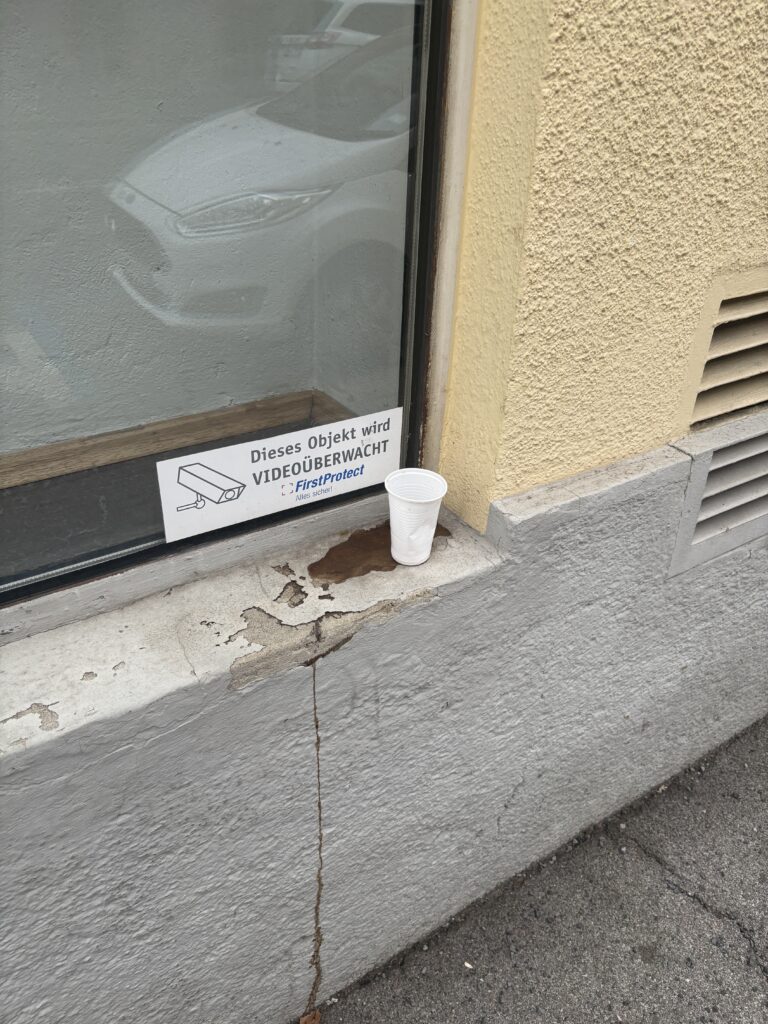
I used one photograph from my archive, taken in Graz (Geidorf) on 03.12.2025. The image shows a very simple scene: a white plastic cup placed on a window ledge. Under the window there is a sign that reads: “Dieses Objekt wird VIDEOÜBERWACHT.” The cup itself looks casual, like someone just left it there after drinking. At the same time, the surveillance sign makes the situation feel strangely tense. It turns a completely ordinary object into something that suddenly feels “watched,” important.

I then showed this image to three different people. All three participants were non-design friends, which was important for me because I wanted reactions that are not trained through art or design education.

The setup: I showed everyone the exact same photograph in three different framings.

Version A: the image without any title or context.
Version B: the image with an artsy title (Surveillance Cup, 2026).
Version C: the image with additional context (date, location, and the label “found everyday installation”).

I asked each participant the same questions:

  1. What do you think this is?
  2. Would you describe it as art? Why or why not?
  3. What do you think is happening here?
  4. Does the title or context change your interpretation?
  5. Would you stop and look at this in real life?

Across all three participants, the first reaction was surprisingly similar: they tried to explain the scene through logic. The cup was interpreted as “someone’s trash,” “a coffee left behind,” or simply “a random thing on a ledge.”

But even in Version A, the sign already triggered something. All three people mentioned the surveillance text immediately. Without me asking, they started wondering why the sign was there, and why it was placed so close to the cup. The cup became suspicious because of the context around it.

Once I introduced Version B (the title), the reactions shifted. The participants stopped treating the cup as a practical object and started reading the scene as a message. One person said it feels like “a joke about how seriously we take surveillance, even when there’s nothing to protect.” The title didn’t fully convince them that it is art but it did change the way they looked at the image. They started searching for details.

Version C created another shift. When I added the location and the label “found everyday installation,” the participants became more open to the idea that the scene could be something worth noticing. Interestingly, the added context didn’t make the scene feel more emotional. It turned the image from a random situation into something documented on purpose.

What became very clear is that framing does not only change the final judgment (art or not). It changes the entire viewing process. In Version A, the image was scanned quickly. In Version B and C, the participants looked longer and started analysing: the stain under the cup, the typography of the sign, the relationship between object and text, and the strange contrast between cheap plastic and official surveillance language.

This experiment was useful because it produced direct evidence for something I’ve been circling around for months: meaning does not sit inside the object. Meaning happens between the object and the viewer. And even minimal framing can push interpretation in completely different directions.

For my thesis, this confirms that everyday installations can communicate — but they do not automatically do so. Communication begins when attention is activated. Sometimes all it takes is a title. Sometimes all it takes is one sentence. Sometimes it takes a whole institutional frame.

As a next step, I want to repeat this experiment with more images from my archive and compare which types of everyday installations react most strongly to framing.

Links
https://www.britannica.com/topic/framing
https://www.britannica.com/science/semiotics
https://www.britannica.com/science/Gestalt-psychology

AI Disclaimer
This blog post was written with the assistance of AI.

#27 – Platform as Context

After being inspired by Paulus Goerden again (and again), I finally did something I should have done much earlier: I stopped only saving posts and started looking at his Instagram account as a whole system. Not just what he posts, but how he builds meaning around everyday installations through format, repetition and framing.

I already wrote a deeper version of this as an Impulse blogpost, but I wanted to keep a short version here as well because it connects directly to my own thesis process.
What I noticed is that his account is not simply documentation. It’s structured. He repeats a few formats over and over again, and that is exactly why it works so well. The most obvious one is the classic: showing a found everyday installation. But then he expands it with other layers: reconstruction (miniature versions), street interviews, and meta-posts where he includes hate comments or reactions from followers. The installations stay anonymous, but the context around them keeps changing.

This is important for my thesis because it proves something I keep coming back to: the object itself is rarely the main point. The frame is. On Instagram, the frame can be a caption, a voiceover, a title, a hate comment screenshot, or a conversation with a stranger. And suddenly the same pile of boxes becomes either trash, minimalism, or a joke — depending on what kind of frame is offered.

For me, the biggest takeaway is that I shouldn’t think of my work as “just photos” either. The documentation, the text, the exhibition space, the order of images, the titles, even the reactions from other people, all of that is part of the final communication.
Paulus’ work is a good reminder that everyday installations don’t need a museum to become readable. But they do need a structure. And building that structure is basically communication design.

IMPULSE #6 — Paulus Goerden (Street Interview)

(Online Activity – watching and analysing a street interview format, 1+ hour)

For this impulse I focused on one specific format Paulus Goerden uses frequently: street interviews. Instead of analysing his account as a whole, I watched one reel closely and treated it like a small case study. The reel is titled “Zitate aus der Kunstgeschichte auf der Straße 🥰” and shows Paulus approaching a passerby and asking her directly why people choose to ignore a specific everyday installation.

This reel is interesting because it makes something visible that is usually invisible in my research: the moment of interpretation. When I photograph everyday installations, I capture the result, an arrangement that already exists. But I rarely capture the social process around it. Paulus does. In this reel, the installation is not only shown as an object in space. It becomes a trigger for conversation, disagreement, humor and negotiation.

The structure of the interaction is simple. Paulus starts by asking for permission and then asks a clear question: why does nobody pay attention to this “construction”? The woman answers honestly and pragmatically: she does not see it as an art object. For her, the reason is contextual. She assumes it is related to moving boxes and the fact that people constantly move in and out. This answer is extremely valuable for my thesis because it shows how strongly interpretation depends on everyday logic. She does not analyse form, she analyses function.

Paulus then follows up with an important question: what would need to be different for her to perceive it as an artwork? This question is basically a direct version of my thesis topic. It forces the viewer to articulate their own internal criteria. And what happens next is even more interesting: Paulus tries to connect the installation to art history. He mentions minimalism, simple forms, colors, stacked shapes. In other words, he tries to re-frame the everyday installation using a cultural reference.

The moment another passerby joins and jokes about the address label (“the artist left his signature”) is also important. It shows how quickly people switch between seriousness and humor when confronted with ambiguous objects. It also shows how social interaction itself becomes part of the framing. Suddenly, the installation is not only “boxes.” It is a shared moment between strangers.

What I find most relevant is that the reel demonstrates how easily the interpretation can shift once a label is introduced. Paulus calls it “Alltagsinstallation,” and the woman responds: “ja gut, ist in Ordnung,” and laughs. The conversation ends politely, and everyone moves on. But something has changed: the object has been temporarily upgraded. Not because it physically changed, but because a word was introduced. A name was given. A concept was offered.

This connects directly to my thesis question: what does it take for art to communicate without a frame? In this reel, the frame is not a gallery. The frame is Paulus himself. The frame is language. The frame is art history. And the frame is the social permission to talk about an object as if it matters.

The reel also shows something else: people are not necessarily unwilling to engage. They simply need a trigger. Without the trigger, they walk past. With the trigger, they participate. This supports the idea that everyday installations can communicate but they do not automatically do so. Communication happens when attention is activated.

For my own work, this impulse gives me a concrete method idea: I could incorporate short interviews or spontaneous reactions into my research, even if I do not want to become a street interviewer myself. The reel proves that audience perception is not abstract. It can be observed in real time. It can be recorded. And it can become part of the thesis material, not only as anecdotal evidence but as a structured research method.

Overall, this impulse helped me see that “framing” is not only spatial (museum vs street). Framing can also happen through conversation. A single question can function like a museum label. A single reference to minimalism can function like a curatorial statement. And a single shared laugh can turn an ignored pile of boxes into a temporary artwork.

Transcript (based on the reel)

Paulus: Darf ich Sie kurz was fragen? Ich frag mich, wieso hier jeder an dieser spannenden Konstruktion vorbeigeht und warum das keine Beachtung findet?
Woman: Weil ich das jetzt nicht als Kunstobjekt ansehe.
Paulus: Was fehlt Ihnen denn dafür, dass es als Kunstobjekt wahrgenommen werden kann?
Woman: Es hat einfach damit zu tun, dass hier die ganze Zeit neue Leute einziehen und ich denke, dass die Kartons von denen sind.
Paulus: Ja, aber das ist eine spannende Form, oder? Es hat sehr viel vom Minimalismus in der Kunstgeschichte. Die einfachen Formen, die Farben, das Aufeinandergestapelte.
Man (Passant): Der Künstler hat sich da verewigt.
Paulus: Der Künstler hat sich da verewigt?
Man: Ja, die Adresse steht drauf. (points with finger on the adress written on it)
(everyone laughs)
Paulus: Ich nenn das Alltagsinstallation.
Woman: Ja gut, ist in Ordnung. (laughs) Dann kann man’s angucken.
(they laugh and say goodbye)

Links
https://www.instagram.com/reel/DUdMrLLDFJD/?igsh=ZHE3bWZmZmJqbmdp
https://www.instagram.com/reel/DUoFC48DBPT/?igsh=MW93eXdwNHViZ3oxdw==
https://www.instagram.com/paulusgoerden?igsh=eTl5d2Z0b3dmOGY=

AI Disclaimer
This blog post was written with the assistance of AI.

IMPULSE #5 — Paulus Goerden (Structured Content Log)

(Online Activity – Instagram Research, 1+ hour)

In my previous impulse blogpost (IMPULSE #4) I analysed Paulus Goerden’s Instagram account and described the recurring categories I noticed: documentation, reconstruction, meta-content, personal presence, and event-related posts. While writing that, I realised something: it might be just as interesting to show how I got to those observations.

So for this impulse, I focused on the method. I documented his recent posts in a structured way, using a simple logging system (date, caption, format, and what is shown). The goal was not interpretation, but to create a clear dataset that makes the account analysable beyond personal inspiration.

I started with a raw version (Version 1), writing down everything that caught my attention. Afterwards I translated the same content into a more structured overview (Version 2) with ChatGPT, so patterns like format choices, recurring elements and communication strategies become easier to compare.

Version 1 Raw log (my original note structure)

  • 18.01. 4 Rahmen in meiner Garagenecke (Bilder): Verschiedene Bilder von Rahmen in seiner Garage, die unterschiedlich angeordnet sind, mit eingeblendeten Hate-Kommentaren („Alter was du rauchst will ich haben…“) [META]
  • 16.01. So viel kann ich dir sagen💫🤍🪄 (Video): Paulus ist im Bild, kuratiert Objekte auf einem Stuhl, dazu Screenshot eines Hate-Kommentars („Such dir ne Arbeit Paulus…“) und sein Text „POV: meine Arbeit“ [META]
  • 13.01. 4 Rahmen in meiner Garagenecke (Video): Er erklärt die Rahmen-Serie und spricht über Wahrnehmung („ab wann nehmen wir solch eine Konstruktion überhaupt wahr“) [EI]
  • 14.01. Ihr seid ja krass… (Text/DM Post): Er zeigt DMs und eine lange Liste von Titelvorschlägen, die seine Follower*innen für ein Motiv vorgeschlagen haben [META]
  • 29.01. Kunstunterricht: Ja (Bild): Screenshot einer Nachricht einer Lehrerin, die seine Alltagsinstallationen im Unterricht verwendet (Schüler*innen gehen raus und suchen selbst) [META]
  • 30.12. Was soll das bringen / nichts (Bild): Foto von seinem Notizbuch, in dem er „Was soll das bringen“ mehrfach als Text verarbeitet (Kommentar wird zum Werk) [META]
  • 12.02.2026 Lesung? (Video): Er zeigt das Notizbuch und erklärt es im Zusammenhang mit dem Hate-Kommentar „Was soll das bringen?“ [META]
  • 12.02.2026 Ein Versuch es einzufangen (Video): Er zeigt seine analoge Mini-Version einer Alltagsinstallation und erklärt die Idee dahinter [MINI]
  • 05.02. Der Mut kommt unterwegs (Bild): „Pappe, Acryl, Klebstoff, Bleistift“, Maße 29 x 20 x 10 cm; analoge Interpretation einer Installation vom Görlitzer Bahnhof [MINI]
  • 07.02.2026 Zitate aus der Kunstgeschichte auf der Straße 🥰 (Video): Paulus spricht Passant*innen an und fragt, warum sie an der Konstruktion vorbeigehen; Gespräch über „Kunstobjekt“, Umzugskartons, Minimalismus, und ein witziger Kommentar über die Adresse als „Signatur“ [STREET]
  • 03.02. Gucken wir uns mal eine Show auf der Fashion Week an (Video): Er beobachtet unscheinbare Momente bei einer Show, beschreibt Schattenfiguren, Kameras, Präsenz und Blickrichtungen [EVENT]
  • 02.02. BFW 🪄🩶 Schön wars! (Bilder): Mehrere Fotos von der Berlin Fashion Week [EVENT]
  • 01.02. Letzter Tag, Berlin Fashion Week 🤍 (Bild): Recap-Post, shoutouts, Shows, Foto von ihm + Freundin [EVENT]
  • 27.01. Atelier 26.01.2026 (Bild): A4 Zeichnung, Buntstift auf Papier [STUDIO]
  • 21.01. Kommentar, Pfusch, Toilette verstopft… (Bilder): Carousel mit verschiedenen Fotos (Alltag, Objekte, auch Selfies), dazu Text „Alles wie immer“ [PERS]
  • 12.01. Gitter, 2026 (Bild): Metall/Plastik, 50 x 40 cm; Foto eines Metallgitters an der Wand [STUDIO]
  • 11.01. In den letzten Tagen habe ich begonnen… (Bild): Er beschreibt, dass er Situationen festhält und wieder an den Ort projiziert, an dem sie entstanden sind (Konfrontation mit dem eigenen Abbild) [STUDIO]
  • 03.01. 💫💫 (Bild): Foto von ihm und einer Freundin [PERS]
  • 28.12. Schmunzelnd durch die Ausstellung… Feldmann (Video): Paulus geht durch eine Ausstellung und kommentiert Beobachtungen [EVENT]
  • 09.02.2026 Zeit (Bild): Foto eines gemalten Bildes plus eingeblendeter Hate-Kommentar („Hab gestern eine Bierflasche auf meinen Toaster gestellt… verkaufe es für 20.000€“) [META]

Version 2 — Structured table (same content, clearer overview)

Codes (for category):
EI = Everyday Installation / found moment
MINI = miniature / analogue reconstruction
STREET = street interview / public reaction
META = hate comments / discourse / DMs
EVENT = fashion week / museum / external event
STUDIO = atelier / personal production
PERS = personal / selfie / friend post

DateCaptionFormatCodeComment screenshotTalks/voiceoverWhat is shown (short)
12.02.2026Lesung?VideoMETAYesYesNotebook shown + explanation connected to hate comment “Was soll das bringen?”
12.02.2026Ein Versuch es einzufangenVideoMININoYesAnalogue miniature reconstruction shown and explained
09.02.2026ZeitImageMETAYesNoPainting + hate comment overlay (toaster/bottle joke)
07.02.2026Zitate aus der Kunstgeschichte auf der Straße 🥰VideoSTREETNoYesStreet interview about why the installation is ignored
05.02.2026Der Mut kommt unterwegsImageMININoNoAnalogue object with materials + dimensions
03.02.2026Gucken wir uns mal eine Show auf der Fashion Week anVideoEVENTNoYesObserves unnoticed moments at Fashion Week
02.02.2026BFW 🪄🩶Schön wars!ImagesEVENTNoNoMultiple Fashion Week photos
01.02.2026Letzter Tag, Berlin Fashion Week 🤍ImageEVENTNoNoFashion Week recap + shoutouts
29.01.2026Kunstunterricht: JaImageMETANoNoScreenshot of DM from teacher using his content in class
27.01.2026Atelier 26.01.2026ImageSTUDIONoNoDrawing documentation (A4, colored pencil)
21.01.2026Kommentar, Pfusch, Toilette verstopft…ImagesPERSNoNoMixed carousel: daily life + objects + selfies
18.01.20264 Rahmen in meiner GarageneckeImagesMETAYesNoFrames arranged differently + hate comment overlay
16.01.2026So viel kann ich dir sagen💫🤍🪄VideoMETAYesYesHe curates objects, includes hate comment screenshot
14.01.2026Ihr seid ja krass… (Titelvorschläge)Text-based postMETANoNoFollowers’ DM title suggestions
13.01.20264 Rahmen in meiner GarageneckeVideoEINoYesExplains the frame arrangement + perception
12.01.2026Gitter, 2026ImageSTUDIONoNoArtwork documentation: metal/plastic grid + size
11.01.2026In den letzten Tagen habe ich begonnen…ImageSTUDIONoNoProjection back onto the original place
03.01.2026💫💫ImagePERSNoNoPhoto with a friend
30.12.2025Was soll das bringen / nichtsImageMETANoNoNotebook work repeating hate comment as text
28.12.2025Schmunzelnd durch die Ausstellung… FeldmannVideoEVENTNoYesMuseum visit + commentary

Quick Observations (without interpretation)

  • Recent posts are a mix of video and image, with video used mainly when explanation or interaction is involved.
  • Comment screenshots are used frequently as a recurring visual element.
  • There is a clear pattern of alternating between:
    • documentation of “works”
    • public reaction
    • personal/event content
  • Many posts include titles, dimensions, and materials, which makes found moments look like official artworks.

Impact on my research

This structured log is useful for my thesis because it turns inspiration into something measurable. Instead of only reacting emotionally to Paulus Goerden’s work, I can now identify the communication tools he uses: format choices, framing through language, audience involvement, and the consistent use of context. This helps me develop my own documentation strategy and makes it easier to compare different ways of presenting everyday installations.

Links

https://www.instagram.com/paulusgoerden?igsh=eTl5d2Z0b3dmOGY=
https://www.instagram.com/reel/DUoFC48DBPT/?igsh=MW93eXdwNHViZ3oxdw==
https://www.instagram.com/reel/DUdMrLLDFJD/?igsh=ZHE3bWZmZmJqbmdp

AI Disclaimer
This blog post was written with the assistance of AI.

IMPULSE #4 — Paulus Goerden (Instagram Analysis)

(Online Activity – Instagram Research, 1+ hour)

For this impulse I did something I’ve been meaning to do for a long time: I stopped casually consuming Paulus Goerden’s content and instead looked at his Instagram account as a system. I have been inspired by him repeatedly throughout the last semesters, but mostly in a quick way, saving a post here, rewatching a reel there and moving on. This time I wanted to understand why it works so well and what exactly he is doing in terms of communication.

Paulus Goerden’s account functions like an ongoing format: a mixture of art practice, observation, performance and public mediation. The topic is often the same (everyday installations, who would have thought :P) but the way he presents them shifts between several repeating categories. This is interesting for my thesis because my research is also about framing: what makes people notice something and what makes something feel like “art” instead of “random objects.” On his account, the frame is constantly changing and he actively uses Instagram as a tool to shape interpretation.

capturing everyday installations

The first major category is the most obvious one: capturing everyday installations. Sometimes this happens through photography, sometimes through video, but the focus is always on moments that already exist in public space. The objects are not created by him. They are found. What makes them his work is the act of noticing, naming, and documenting them. This is directly connected to my own approach, but Paulus’ account shows how far you can push this without turning it into a simple “look what I found” archive.

reconstruction

The second category, which is the one that influenced me the most recently, is reconstruction. In the reel “Ein Versuch es einzufangen,” he shows an analogue miniature version of a found everyday installation and explains it. This approach adds a second layer to documentation: instead of only translating the installation into an image, he translates it into an object. That shift is important, because it makes the act of observing visible. It is not just about capturing a moment. It is about re-building it, re-seeing it, and showing that the installation has structure and intention even if it originally had none. This connects strongly to my own idea of building miniature reconstructions for my exhibition.

meta-content

A third category is what I would describe as meta-content. Paulus frequently includes hate comments, misunderstandings, or audience reactions in his posts. He doesn’t hide the fact that many people think his work is “stupid” or “not art.” Instead, he uses that reaction as material. This is a communication strategy. It shows that his account is not only about presenting finished work, but also about making the discourse around it visible. The hate comments become part of the frame. And that is exactly what my thesis is concerned with: the question of legitimacy, authorship, and context. His posts show that meaning does not only come from the object, but from the conversation around the object.

personal presence

The fourth category is his personal presence. He often appears in his videos, speaks directly or shows behind-the-scenes moments. This makes the account feel less like a distant art project and more like a person building a practice in public. This is relevant because it shows how strongly “the artist” still functions as a framing device. Even though the installations are anonymous and found, Paulus’ presence creates continuity. It makes the audience trust the project. It also makes the topic accessible to people who might not normally engage with contemporary art.

Other

Finally, Paulus also posts content that is not directly connected to everyday installations — for example, his Fashion Week posts. At first glance, these seem unrelated. But they actually reveal something important: his attention is consistent. Even in a highly curated environment like Fashion Week, he searches for small unnoticed moments, shadow figures, awkward compositions, and accidental visual situations. This suggests that his practice is not only about street installations. It is about a way of seeing. And that is exactly what I’m trying to research as well: how perception can be trained and how attention can be redirected toward things that normally remain invisible.

Overall, the most important insight from this impulse is that Paulus Goerden’s Instagram is not just documentation. It is a communication design tool. It uses repetition, format, humor, conflict, and storytelling to guide interpretation. His work proves that the frame does not have to be a museum. The frame can be a feed. And in some ways, Instagram might be an even stronger framing device than a gallery wall, because it creates constant context: captions, comments, reactions, and the rhythm of posting.

For my thesis, this impulse is useful in two ways. First, it gives me inspiration for how to expand my own documentation beyond “just photography.” Second, it shows how important it is to think about the platform and the narrative structure around the work. Even if my final outcome becomes an exhibition or a book, the logic stays the same: framing is never neutral, and meaning is always negotiated.

Links
https://www.instagram.com/reel/DUoFC48DBPT/?igsh=MW93eXdwNHViZ3oxdw==
https://www.instagram.com/p/DUOMXJcDPt0/?igsh=MW1ldGZqa2R2cXc1ag==
https://www.instagram.com/p/DTptXdhDBAA/?igsh=dG84OTVoeHpnNjM0

AI Disclaimer
This blog post was written with the assistance of AI.

IMPULSE #3 — Active Walk Through Graz

(1-hour walk, everyday installations)

For this impulse, I simply walked. One hour. Just my phone, my eyes and an open mind.

If CoSA showed me how exaggerated framing works, and the Schlossberg Museum showed me how subtle framing still guides behaviour, then this walk through Graz showed me to be present.

The Walk (Duration: 1 hour and 15 minutes)

I started on Mariahilferstraße, wandered across the Murinsel, continued toward Lendplatz, went into side streets, crossed Annenstraße and slowly moved toward Grieskai. 

It’s strange: when you intentionally look for accidental meaning, the world starts to reveal tiny compositions everywhere. Some poetic, some funny, some tragic, some boring, some confusing.

Here are a few moments I captured:

1) The Fallen Cone

Near Lendplatz a single orange traffic cone lay sideways, slightly dented. It looked almost theatrical.

If this were in a museum, it would be part of an installation about urban chaos.
Outside, it’s just a cone.

But what changed?
Only the frame.

This made me think: maybe objects communicate consistently, it’s just our interpretive mode that switches.

2) The Empty Coffee Cup on a Windowsill

Not a trash bin. Not a table. A windowsill.
Someone had placed it there deliberately or absentmindedly.

And suddenly it became a story.

  • Was someone waiting for a friend?
  • Did they forget it?
  • Did they mark the spot like some urban ritual?

The funniest part: if I placed a cup there myself, it would be “an intervention.”
But because someone else did it accidentally, it becomes “everyday installation.”

The line between art and non-art grows thinner the more I walk.

3) The Three Cigarette Butts Forming a Triangle

This one wasn’t poetic but a bit bizarre.
Three cigarette butts arranged almost perfectly into a triangle like some secret smoker geometry.

I didn’t touch anything. I didn’t rearrange them. But the order was uncanny.

Is it art?
Is it coincidence?
Does it matter?

Maybe communication happens the moment the viewer cares enough to interpret.

What This Walk Taught Me About My Thesis

My question “What does it take for art to communicate without a frame?” felt different after this walk.
More layered.
More complicated.
But in a good way.

Here’s what I realized:

1. The frame isn’t always physical — sometimes it’s mental.

If I walk with the mindset of “I’m looking for art,” the world becomes an exhibition.

If I walk without that mindset, everything becomes background noise.

Which means:
Maybe art communicates without a frame only when the viewer is aware enough to see it.

2. Everyday installations rely on the viewer, not the maker.

In museums, meaning is served to you.
On the street, meaning must be harvested.

That difference is huge.

Street installations don’t explain themselves.
They don’t try.
They don’t guide you.
They don’t ask to be understood.

Meaning only appears when someone stops, looks, interprets.

3. Art without a frame might require more effort

A frame protects.
A frame contextualizes.
A frame tells you:
“Look here, this matters.”

Without that, all you have is noise unless you tune yourself to see the signal.

Walking through Graz felt like tuning myself.

And maybe that’s the heart of my MA:
To understand not only how art communicates without a frame, but how people learn to see without being told to.

Why This Walk was important

This walk felt like practicing perception.

And perception might be the key to answering my thesis question.
If I want to understand how to communicate without a frame, I need to understand the conditions that make a viewer receptive.

This walk was the first step in that direction.

Links
https://www.graz.at
https://www.murinsel.at
https://www.graztourismus.at

AI Disclaimer

This blog post was written with the assistance of AI.