One thing the fashion world understands better than the sports world is Desire. Most sports teams want to sell as much merch as possible to as many people as possible. In the end, that’s mass produced stuff that also feels cheap. Lifestyle and more exclusive brands do the opposite: they make less than people want.
RESEARCH #4 – Developing a Personal Research Process
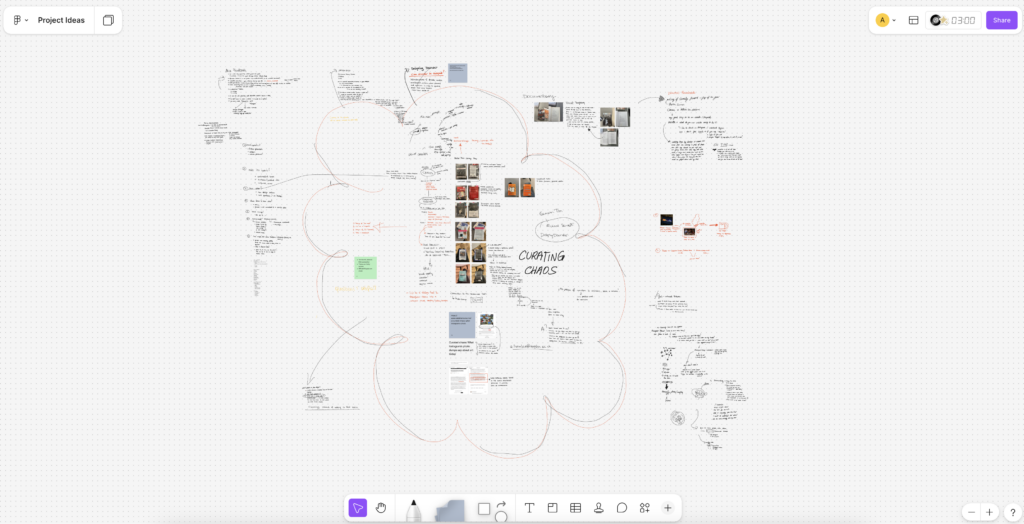
One of the first concrete steps I took in my research process was creating a Figma file to collect references. Instead of using traditional academic tools, I began documenting books, images, and thoughts visually. Whenever I found a book in the library that interested me, I took photos of the front and back cover and placed them into this file.
This method might feel informal and unstructured for some. I mean, it did not follow conventional academic standards, and people might question whether it is the “right” way to approach research. However, I realised that this visual system allowed me to engage with my research in a more intuitive way.
Seeing the books as images, alongside my own notes and reflections, made the research feel more tangible. It allowed me to see relationships between different sources more clearly. Instead of existing as isolated texts, the books became part of a larger visual landscape of ideas.
What surprised me most was how naturally patterns began to emerge. Even when I selected books based on intuition rather than relevance, many of them explored similar themes. Questions about perception, environment, attention, and meaning appeared repeatedly.
Over time, the Figma file became much more than just a collection of books. It started to include everything that influenced my thinking. I wrote down things that were said during lectures at Kingston, notes from the workshop at UAL, and reflections on documentaries I watched, even when they were not directly related to my thesis. I added feedback I received from my lecturers, ideas my friends shared with me in conversations, and even things my dad said that stayed with me afterwards. Sometimes it was just a sentence, a question, or a song title that captured a certain feeling or direction.
This made me realise that research does not only happen in structured academic settings. It happens constantly, through conversations, experiences, and observations. The Figma file became a space where all of these fragments could exist next to each other. It allowed me to take these moments seriously and recognise them as part of the research process. (I love it)
This process helped me understand that research does not have to follow a rigid structure from the beginning. Developing a personal system made the process more accessible and engaging. It also made me more confident in trusting my own way of working. Looking at the file now, I don’t see a finished structure, but a growing archive of my thinking. What initially felt random and unorganised slowly began to form connections.
Research #11 Editorial Design x Motorsport
When you go to a the F1 Race at the Red Bull Ring, you usually get a special version of the Red Bulletin —a booklet filled with all of the Red Bull Content, ads, (Red Bull) driver infos, and maybe some more information. And while Red Bull is generally doing a good job, it’s designed to be used for a few hours and then thrown in the bin.
RESEARCH #3 – On Starting
Closely connected to avoidance was procrastination. Even when I had time to work on my thesis, I often found it difficult to begin. The act of starting felt much harder than the work itself. I would sit down with the intention to work on it, but quickly find myself distracted by smaller tasks or well… MY PHONE.
What I noticed was that the anticipation of working on the thesis created more stress than the actual process of doing it. Once I started reading, collecting references, or writing down thoughts, it didn’t feel as overwhelming as I had imagined. But reaching that point required overcoming a mental barrier.
I think part of this came from the expectations I associated with the thesis. It felt like something that needed to be meaningful and well-developed from the beginning. This created pressure to make the “right” decisions early on. As a result, I hesitated to make any decisions at all.
This made me realise how much procrastination is connected to uncertainty. It is easier to delay something than to confront the possibility of making mistakes or choosing the wrong direction.
What helped me move forward was shifting my perspective. Instead of seeing the thesis as a single large task, I began breaking it down into smaller actions. Taking photos of books, writing short reflections, or organising references became manageable entry points. These actions did not require immediate clarity, but they allowed the process to begin. Clarity does not appear before the process begins, but emerges through the process itself. Understanding this helped me approach my research more realistically. Instead of waiting for the perfect moment, I learned to value small, consistent steps.
RESEARCH #2 – Avoiding the Thesis
For a large part of the semester, I avoided thinking about my thesis. I was busy with other university projects, workshops, and deadlines, and it was easy to focus on tasks that had clear expectations and immediate outcomes. These projects gave me structure. I knew what to do, how to do it, and when it needed to be finished. The thesis, in contrast, felt abstract and undefined. There was no immediate urgency, no fixed form, and no clear starting point.
Because of this, I kept postponing it. I told myself that I would start once I had more time, or once other projects were finished. I convinced myself that I needed the right moment to begin, even though that moment never really arrived.
Looking back, I realise this is a pattern I have experienced before. When something feels important but uncertain, I tend to avoid it. Not because I am not interested, but because the openness of it feels overwhelming. The thesis carried a different kind of weight compared to other projects. It felt more permanent, more personal, and more significant. This made it harder to approach.
At the same time, I now understand that avoidance did not mean the thesis was absent from my thinking. Even when I wasn’t actively working on it, I was still encountering ideas that influenced it. Lectures, conversations, exhibitions, and books all became part of my research indirectly. I just didn’t recognise it as such at the time.
Avoidance created the illusion that I was delaying the process, but in reality, the process was already happening in the background. My interests were forming gradually, even without conscious effort.
Reflecting on this made me realise that research is not a purely linear or controlled process. It includes phases of uncertainty, hesitation and distance. These phases are not necessarily unproductive. They allow ideas to develop more naturally, without forcing premature decisions.
Recognising my avoidance was an important turning point. It made me more aware of the emotional and psychological dimensions of research. The difficulty was not only about finding a topic, but about allowing myself to engage with something that didn’t yet have clear boundaries. Understanding this helped me approach my thesis with more patience.
RESEARCH #1 – Feeling Lost
At the beginning of the semester, I felt completely lost when thinking about my thesis. Not in the sense that I had no interests, but almost the opposite. I had too many ideas, too many directions, and none of them felt stable enough to commit to. Every time I thought I had found something, I would question it again. It felt like everything was possible, which strangely made it harder to begin.
Looking back, I realise that I expected myself to start with clarity. I thought I needed to know exactly what my thesis would be about before allowing myself to explore it. But this expectation made it difficult to move forward. Instead of helping me, it made me feel stuck.
During lectures, workshops, and conversations, I saw how open the process actually is. There is no single correct starting point. Research is not about immediately knowing, but about gradually finding direction through exposure and reflection.
What I understand now is that feeling lost was not a failure of the process, but the beginning of it. It forced me to question my assumptions and stay open. Instead of following a predefined path, I had to start paying attention to what genuinely interested me.
This uncertainty also made me more aware of the themes that kept reappearing in my thinking, such as chaos, attention, atmosphere, and meaning. At the time, these ideas felt random but over time I started seeing relationships between them.
This phase taught me that not knowing is not something to avoid, but something to work with. It creates space for ideas to develop more naturally, without forcing them too early into fixed forms.
Impulse #8 – Getting Lost in the Library
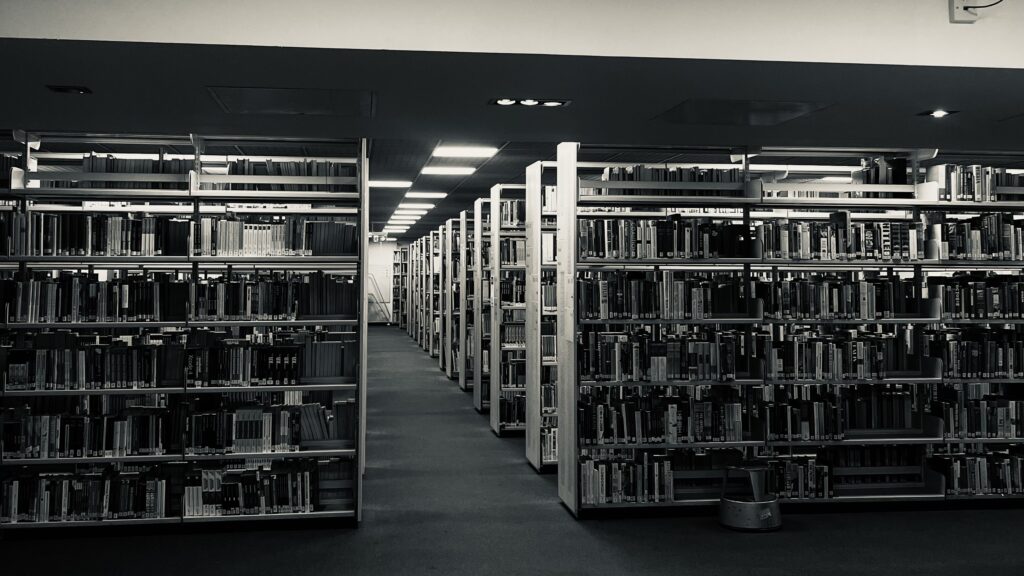
Throughout this research phase, I’ve spent a lot of time in libraries. Especially since coming to Kingston, visiting the library has become a regular part of my routine. This might be because of how big and comfortable the Kingston University library is, or simply because I feel motivated to make the most of my time here and use the facilities available to me. But I’ve noticed that the library has become more than just a place to work. It has become part of my research process itself.
I’ve always loved spending time in libraries and bookshops. As cheesy as it sounds, it really feels like entering a different world. There is something about being surrounded by books that makes knowledge feel physical and accessible. It creates a kind of quiet focus that is very different from being online. Even though I would argue that my social media feed is quite educational and inspiring, it doesn’t create the same depth of attention. Scrolling feels fast while being in a library feels slower and more intentional.
What became especially important during this phase was how I started collecting literature. Instead of using a structured or academic system, I began simply taking photos of the front and back of books that interested me and placing them into a Figma file. It’s probably the most unprofessional way of collecting literature for a thesis. But visually seeing the book covers alongside my thoughts made the process more engaging and personal. It didn’t feel like a boring literature research, it felt like building my own archive.
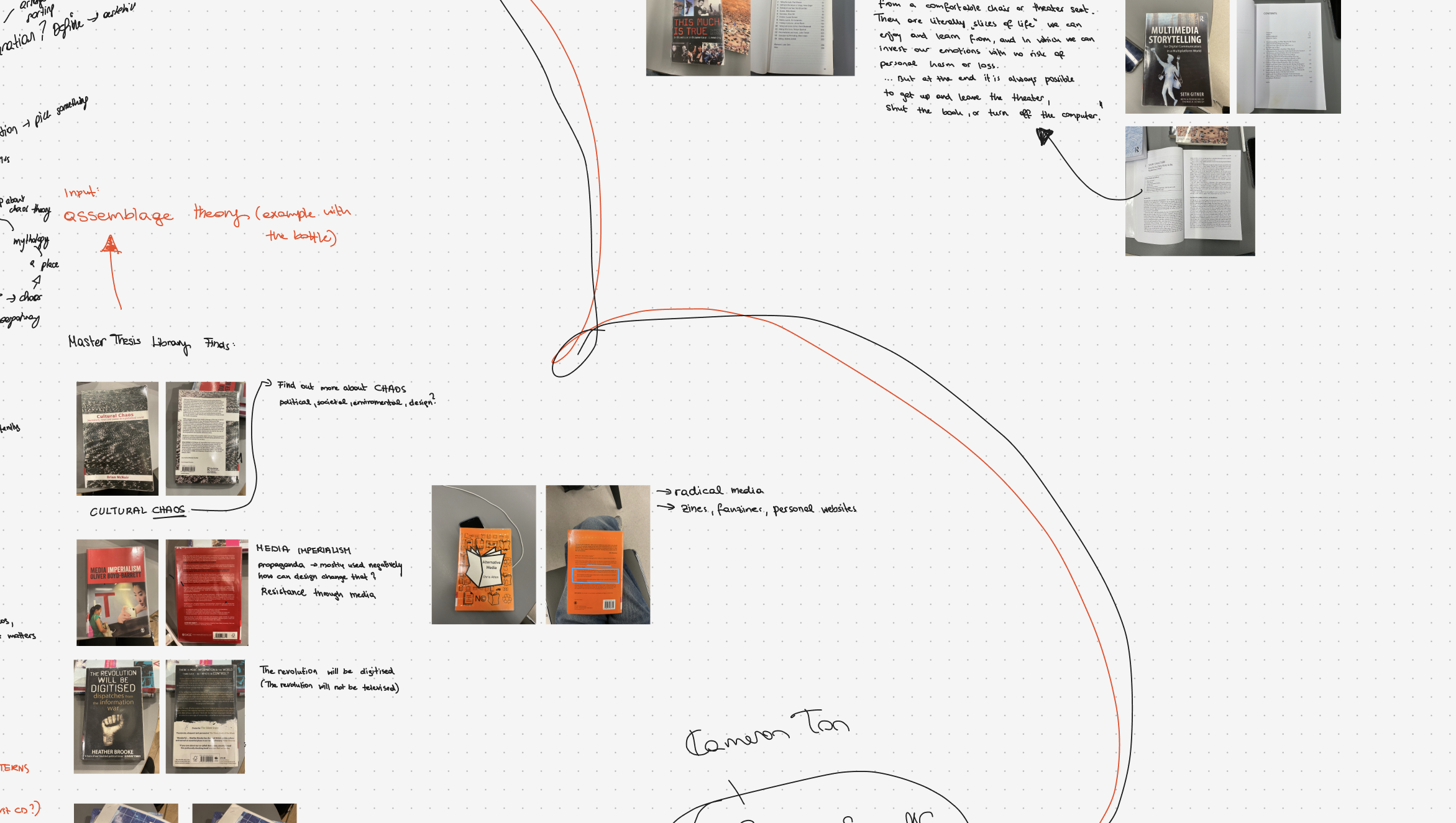
I didn’t even limit myself to design-related books. Most of my visits were to a different Kingston campus library and ended up in sections like psychology, politics, and cultural studies. I picked books purely based on intuition picking titles, colours, or topics that caught my attention, without worrying whether they were directly relevant to my thesis.
What surprised me was that even though these choices felt random, connections began to appear. Many of the books, in different ways, touched on similar themes: how people understand the world, how environments shape behaviour, how meaning is constructed, and how individuals exist within larger systems.
This experience also changed how I think about chaos in relation to research. At first, my approach felt disorganised. I wasn’t following a clear structure, and my collection of books came from different disciplines without an obvious order. But over time, patterns began to emerge. What initially felt like chaos started to form its own internal logic.
This impulse has influenced my research by helping me trust a more intuitive approach. Instead of forcing my thesis into a fixed direction too early, I’ve allowed myself to collect fragments, ideas, and references from different fields, wishing there was more time to just focus on this process. But unfortunately this phase of searching for a topic has to come to an end soon…
Impulse #7 – ReThinking Podcast: The Truth About the Attention Crisis
For this impulse, I listened to the podcast ReThinking: The Truth About the Attention Crisis from the WorkLife with Adam Grant series, featuring historian Daniel Immerwahr. I kept thinking about it afterwards, especially because attention has slowly become an important part of how I understand my own research process.
I’ve often caught myself believing that my attention span is getting worse. It’s easy to blame phones, social media, or the constant availability of information. There is always something new to look at, something else to click on, and it becomes harder to stay with one thought for a longer period of time. I noticed this not only when working, but also when watching films, reading, or even visiting museums. My attention feels fragmented, constantly moving.
What interested me about this podcast was that it questioned this idea of the “attention crisis.” Instead of treating it as something entirely new, it suggested that people have worried about attention disappearing for a long time. This made me realise that attention is not just a personal ability that we either have or don’t have. It is something that is shaped by the environment we are in.
This connects strongly to experiences I’ve had recently. For example, as I mentioned in my previous blog entry: when I visited the Electric Cinema, I was able to watch a film with full attention, without distractions. The space itself allowed for that kind of focus. In contrast, when I visited the National Gallery, the large quantity of paintings made it harder to fully engage with individual works. It wasn’t because the paintings lacked meaning, but because my capacity to process them reached a limit.
This made me realise that attention is closely connected to structure and chaos. When there is too much information, everything starts to blur together. Nothing stands out anymore. But when there is enough space, attention can settle.
This idea feels very relevant to my thesis, where I am interested in chaos and how meaning is created within it. Chaos is not necessarily negative, but it can become overwhelming when there is no structure to navigate it. At the same time, too much structure can remove the unexpected moments that make things feel alive. Attention seems to exist somewhere in between these two states. It needs enough openness to allow discovery, but enough direction to allow focus.
The podcast made me reflect on attention not as something I need to “fix,” but as something that responds to context. It shifted my perspective from blaming myself for being distracted to observing the conditions that shape how I focus. This also changes how I think about creative direction. Directing attention is not about forcing control, but about creating environments where attention can naturally emerge.
For my research, this impulse reinforces the importance of atmosphere, structure, and context. It makes me more aware that meaning is not only created through content, but through how that content is experienced. Attention is not just an individual act, but something that is designed and influenced by the systems around us.
Links:
https://www.ted.com/podcasts/worklife
https://history.northwestern.edu/people/faculty/core-faculty/daniel-immerwahr.html
Research #10 Materiality in Design
Materiality is about weight-to-strength ratios. In FS, ee use carbon fiber because it’s light and stiff. We use aluminum because it can handle the stress of the suspension. But in the world of branding, materiality is about tactile emotion.
Thesis Research 11: Zusammenfassung
Wenn ich auf meine bisherigen Research-Blogposts zurückblicke, sehe ich keine lineare Entwicklung, sondern ein Feld aus Gedanken, Impulsen, Begegnungen und Fragen. Ich habe mich mit politischer Gestaltung beschäftigt, mit Typografie, mit Lesbarkeit und Macht, mit Raum, Wahrnehmung und Intervention. Ich habe über Wut nachgedacht, über Haltung, über Perspektive. Und zuletzt intensiv über Tod, Trauer und Sprachlosigkeit. Nicht jedes Thema war gleich stark. Nicht jede Idee war gleich tragfähig. Aber jede hat etwas freigelegt.
Von Anfang an war mir klar, dass meine Masterarbeit politisch sein soll. Nicht im parteipolitischen Sinne, sondern im Sinne einer Haltung. Friedrich von Borries schreibt in Weltentwerfen. Eine politische Designtheorie, dass Design politisch ist, weil es in die Welt interveniert (vgl. von Borries, 2024, S. 30), und dass alles, was gestaltet ist, entwirft und unterwirft (vgl. ebd., S. 9f.). Dieser Gedanke hat sich wie ein roter Faden durch meine Research-Phase gezogen. Gestaltung ist nie neutral. Sie schafft Realitäten, rahmt Wahrnehmung und positioniert sich zu bestehenden Ordnungen.
In den letzten Blogposts haben sich zwei Themen besonders verdichtet: Wut und Tod. Zwei scheinbar unterschiedliche Felder, die sich jedoch in einem Punkt berühren. Beide sind starke, existenzielle Erfahrungen. Beide werden gesellschaftlich oft verdrängt, privatisiert oder normiert. Beide erzeugen Sprachlosigkeit.
Beim Thema Wut ging es um die Frage, ob Gestaltung Emotion darstellen oder aus Emotion entstehen kann. Ob „aus Wut Gestaltung wird“ und was das für eine gestalterische Haltung bedeutet. Beim Thema Tod und Abschied ging es weniger um Ausdruck als um Schweigen. Um die irritierende Erfahrung, dass etwas so Alltägliches wie Sterben gesellschaftlich kaum besprochen wird. Aus persönlicher Erfahrung weiß ich, wie merkwürdig diese Stummheit sein kann und das sie isoliert.
Der Satz „Der Tod ist real“ ist aus dieser Auseinandersetzung entstanden. Er wirkt banal und gleichzeitig radikal. Vielleicht weil er eine Tatsache ausspricht, die wir kollektiv oft umgehen.
Wenn ich meine Research-Beiträge insgesamt betrachte, wird deutlich, dass es mir weniger um einzelne Themen geht als um eine übergeordnete Frage: Wie kann Gestaltung Räume öffnen. Für Emotion. Für Perspektive. Für Gespräch. Für das, was gesellschaftlich schwer sagbar ist.
Wut, Tod, Lesbarkeit, politische Haltung sind Themen, welche um Sichtbarkeit und Zugang kreisen. Um Macht. Um das Verhältnis zwischen Gestaltung und Wirklichkeit.
Für den nächsten Schritt bedeutet das für mich vor allem eines: Zuspitzung. Ich muss entscheiden, ob ich mich thematisch fokussiere, etwa auf Tod und Sprachlosigkeit oder ob ich eine übergeordnete Fragestellung entwickle, die existenzielle Emotionen als Ausgangspunkt nimmt. Parallel dazu möchte ich beginnen, praktisch zu denken. Erste Gespräche führen. Stimmen sammeln. Formale Experimente wagen. Testen, wie sich Offenheit, Nähe oder Konfrontation gestalterisch anfühlen.
Die bisherige Research-Phase war kein Finden einer Antwort beziehungweise eines finalen Themas, sondern ein Schärfen meiner Haltung und Ideen. Die Kirmes im Kopf ist etwas weniger durcheinander, weil ich nun einige Themenansätze herausgearbeitet habe, die ich gerne weiter verfolgen möchte.