03.05.: Weitere Überlegungen zur “korrekten” Belichtung

Während ich im letzten Blog-Post schon näher darauf eingegangen bin, warum Lichtmesser, egal welcher Art, ein essenzielles Tool für professionelles Filmmaking sind, möchte ich deren Einsatzgebiete in diesem Blog-Post noch etwas ausführen. Jetzt da klar ist was Belichtungsmesser sind und wie sie eingesetzt werden, kommt ja erst die wahre Kunst ins Spiel, nämlich das Bild mit Licht zu kreieren.

Hierzu schlägt Christopher Chomyn von der ASC vor, das sogenannte “Zone System” anzuwenden. Dazu wird das Bild in verschiedene Helligkeitsbereiche, also “Zonen” eingeteilt. Jede dieser Zonen repräsentiert dabei einen Stop an Licht, hat die Kamera mit der man Arbeit also zum Beispiel 14 Stops an Dynamic Range, würde man das resultierende Bild in 14 Zonen unterteilen, wovon die unterste schwarz und die oberste weiß ist.1 Diese Herangehensweise, habe ich so noch nie gehört (zumindest als “Zonen System”), ähnelt dabei aber sehr vielen anderen Ansätzen. So ist im Grunde False Color ja auch nichts anderes, als ein Tool, das einem das Bild in genau solche Zonen unterteilt, auch wenn False Color dabei ja das IRE System verwendet und somit quasi unabhängig von der Dynamic Range des jeweiligen Sensors mit jeder Kamera funktioniert. Auch hat mich die Herangehensweise an jene vom Wandering DP erinnert, dieser spricht ja eigentlich immer nur davon, dass er in jedem Shot die maximale Anzahl von Kontrastunterschieden haben will, also wenn man das Bild von links nach rechts liest, so viele Abwechslungen zwischen hell und dunkel wie möglich. Im Grunde ist das Zonen-System hier nichts anderes, da es diese Kontrastunterschiede nur noch einmal herausstreicht.

Bleibt man bei dieser Herangehensweise, so sind für die Feststellung der Zonen natürlich vor allem Lichtmesser interessant, die das von der Szene reflektierte Licht (und damit ja quasi direkt die jeweilige Zone) ermitteln. Der Umgang mit diesen, so Chomyn, ist zwar etwas umständlich, hat man ihn aber einmal verstanden, auch irgendwo logisch. Im Grunde kann man modernen Lichtmessern die Parameter seiner Kamera einfach sagen, also jene die sich zwischen den Shots im Normalfall nie verändern, nämlich den Shutterspeed und die ISO-Empfindlichkeit. Beim Messen hält man den Lichtmesser dann in Richtung der gewünschten Stelle und dieser Spuckt einen Blendenwert aus, nämlich jenen Blendenwert, den man benutzen müsste, um diese Stelle genau als middle grey darzustellen, ganz egal ob dieser Bereich nun wirklich grau ist oder nicht. Heißt auf Deutsch: Der gemessene F-Stop muss erst interpretiert werden, um damit arbeiten zu können. Misst man etwa eine weiße Wand, und möchte, dass diese auch als weiße Wand im Film wiedergegeben wird, müsste man den gemessenen Wert um 3-4 Stops erhöhen um vom Messwert (Mittelgrau) auf den gewünschten (Weiß) zu kommen, und so weiter.2 Dies erfordert natürlich auch genaue Kenntnis über die eigene Kamera und ihre dynamic range. Hat man diese Erfahrungen jedoch gemacht und das System gemeistert, gibt es wohl kaum einen genaueren Weg um das Bild genau so zu bauen, wie es einem beliebt.

Eine weitere Überlegung bei der Belichtung ist aber auch eine gewollte Über- oder Unterbelichtung, vor allem das allseits bekannte ETTR. Zu diesem hat Chomyn aber auch interessante Überlegungen angestellt, auf die ich wohl erst durch eigene Fehler selbst gekommen wäre. Im Grunde geht es bei ETTR ja um nichts anderes, als so hell wie möglich zu belichten, ohne die Highlights zu klippen, um das gesamte Bild über den noise-floor der Kamera zu bringen und später dann in der Helligkeit anzupassen. Grundsätzlich ist das nichts schlechtes, es kann aber auch zu Problemen führen. Denn viel schlimmer als starker Noise im Bild, so Chomyn, ist verschieden starker Noise in aufeinanderfolgenden Shots. Und gerade bei ETTR könnte dies auftreten. Etwa wenn man eine Szene filmt, in der jemand zuerst in einem düsteren Raum sitzt, bis ein andere Person zum Beispiel die Rollo hinaufzieht. Im ersten, düsteren Shot, würde man extrem überbelichten, um die Schatten komplett hinaufzubekommen, weil man ja auch keine hellen Stellen im Bild hat, die potenziell klippen könnten. Behält man diese Belichtung bei, wenn die Rollo hinaufgeht, würde aber natürlich alles sofort ausbrennen, daher müsste man für den zweiten Shot die Belichtung dahingehend anpassen, dass auch die neue Lichtquelle von draußen nicht clipped. Das würde natürlich eine viel dunklere Belichtung für den Innenraum, und daher viel mehr Noise bedeuten. Vermutlich sogar einen so großen Unterschied, dass es völlig amateurhaft aussieht. Chomyn empfiehlt daher ETTR in ausgewählten Sequenzen einzusetzen, in denen es möglich ist, aber nicht immer anzuwenden.3
  1. Vgl. Chomyn, Christopher: Measuring Light. In: Mullen, Merritt David (Hrsg.) und Hummel, Rob (Hrsg.): American Cinematographer Manual. Eleventh Edition. Los Angeles: The ASC Press 2023. S. 89-91. ↩︎
  2. Vgl. Ebda. S. 96-98. ↩︎
  3. Vgl. Ebda. S. 100-102. ↩︎

Impulse No1: Take-away: WUC Vortrag zu „Political Design“

Der Talk über „Political Design“ beim World Usability Congress war für mich ein sehr spannender, weil er etwas angesprochen hat, das im UX/UI und Design Business immer zu beachten ist und zwar, dass Design nie in einem luftleeren Raum, sondern immer in einem Netz aus Unternehmenskultur, Menschen, Egos und politischen Dynamiken entsteht. Obwohl man immer versucht sich im Studium oder in Projekten auf „best practices“ und Designprinzipien zu konzentrieren, merkt man irgendwann unumgänglich, dass die Realität viel komplexer ist.

Im Vortrag wurde Political Design als ein Prozess beschrieben, in dem UX Professionals nicht nur Interfaces gestalten, sondern auch lernen müssen, mit organisationalen Spannungen umzugehen. Nicht, weil sie wollen, sondern weil sie müssen!! Die Grundidee befasst sich damit, dass Design immer mit Neugier, Spieltrieb und Leidenschaft beginnt. Aber je weiter wir in echten Projekten vorstoßen, desto mehr stoßen wir an Grenzen, die nichts mehr mit Figma oder heuristischen Evaluationen zu tun haben, sondern mit Menschen, Macht und Kommunikation.

Ein Satz, der besonders betont wurde ist:

„No tension. No extension.“

Ohne Reibung und Konflikt keine Weiterentwicklung. Ohne Konflikte keine Innovation. Das klingt im ersten Moment sehr intuitiv und sinnvoll für mich und das ist es im Endeffekt auch. Viele der spannendsten Projekte, wurde erzählt, entstehen genau da, wo unterschiedliche Perspektiven aufeinanderprallen. Marketing will X, Engineering will Y, das Management will alles gleichzeitig und Nutzer*innen wollen etwas ganz anderes. In dieser Spannung entsteht oft der Raum für kreative Lösungen.

Was ich besonders gut fand war, dass der Vortrag klar gemacht hat, dass Political Design nicht bedeutet, sich „politisch”, im Sinne von manipulativ oder strategisch zu verhalten. Vielmehr geht es um Soft Skills wie: klar zu kommunizieren, zuzuhören und das Gefühl zu geben gehört zu werden. Es geht darum zu verstehen wie und warum die Menschen um uns herum ihre Entscheidugnen treffen.

Im Grunde wurde betont, dass UX nicht nur ein sehr technischer, sondern ein zutiefst zwischenmenschlicher Beruf ist. Wir designen nicht nur für Menschen, sondern auch mit Menschen und diese Menschen haben ihre eigenen Prioritäten, Ängste, Ziele und Blind Spots. Ein Design Prozess der das mitbedenkt ist weitaus effektiver und liefert bessere Ergebnisse.

Als Impuls nehme ich für mich mit, dass ich in meiner eigenen Arbeit noch stärker darauf achten möchte WIE ich kommuniziere und woran Ideen wirklich scheitern. Political Design nehme ich für mich weniger als ein Framework, sondern mehr als eine Haltung auf. Eine die neugierig auf Menschen zugeht und sich nicht nur auf das perfekte Interface beschränkt.

IMPULSE.04 // Designing for Safety in Healthcare

In this talk Dr. Avi Mehra an IBM associate partner shared valuable insights on the critical intersection of design and clinical safety in digital health. Avi and his college Flora, a design director at IBM discuss how to create safer healthcare solutions through thoughtful collaboration and user-centered design principles.

The presentation begins with a personal story from the speaker’s early days in an intensive care unit, highlighting a serious patient safety incident caused by miscommunication and outdated information. This story set the stage for the central theme: safety must always be at the forefront of healthcare design. The speakers emphasized that digital health technologies hold immense potential to improve patient experiences but can also introduce significant risks if not carefully managed.

Flora then introduced four key principles for designing with safety in mind:

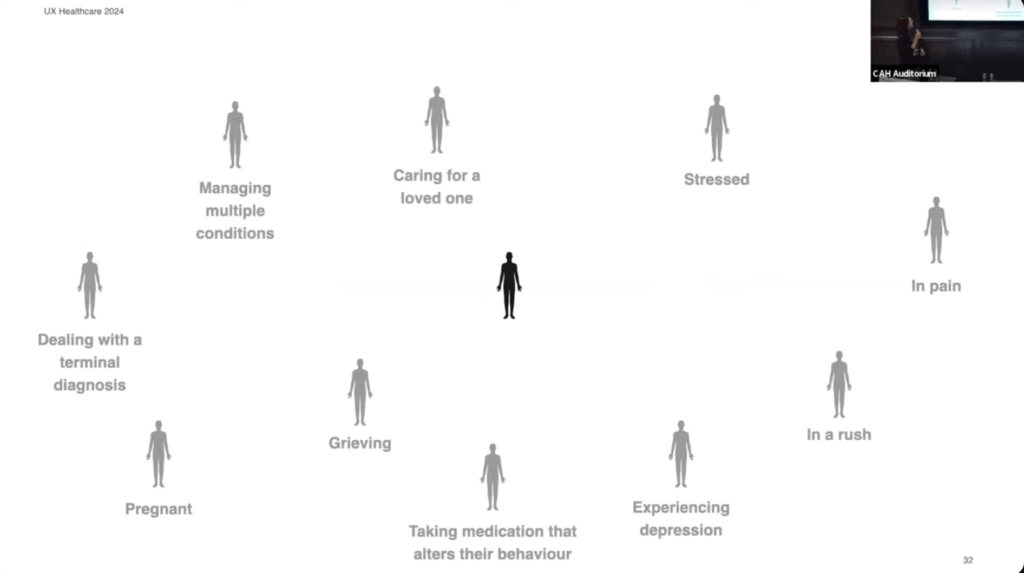
  1. Design for the edges of the population: Focus on users with complex needs, not just the average user.
  2. Recognize the risks: Understand the serious consequences of missteps in healthcare delivery.
  3. Account for various care settings: Design for the entire patient journey, including home care and telemedicine.
  4. Support adoption from the start: Ensure that new solutions seamlessly integrate into existing workflows and do not overwhelm users.
Screenshot from the presentation

I really appreciate Flora’s perspective on designing for the edges of the population. She highlights that individuals often face multiple challenges simultaneously, rather than just one. This is something I was not considering yet and is something I want to keep in mind as I develop my personas.

Link to video: https://www.youtube.com/watch?v=g9ku7Xane6w

AI was used to rephrase my thoughts.

IMPULSE №4

AI and coding

If I got one euro every time someone said AI in the last two years, I could probably pay my rent for a year. Jokes aside, AI really did change everything. It gives regular people access to tools that used to require a full team. For designers, this is huge. We can finally bring weird ideas to life without begging a developer to “just help a tiny bit.”

I’ve worked with developers for years and always admired how they manage to build complicated systems from scratch. Now we can do a chunk of that work ourselves. You still need to know basic logic, but the heavy lifting can be handled by AI. So why not experiment a little, build something fun, and keep the creative spark alive?

For the last months I’ve been watching designers and devs use different AI coding tools. I’m inspired, but also a bit lost, because these tools aren’t perfect yet. You have to juggle between them. So I wrote down simple notes based on talks, videos, and tests. Here’s the short version.

1. v0 by Vercel – the most capable, but very generic.

Pros
• Builds complex logic fast.
• Follows instructions well.
• Code and previews load quickly.

Cons
• First drafts look chaotic with strange animations.
• Designs often feel bland when you ask for something subtle.
• Struggles with basic layout alignment.
• Preview wasn’t mirrored like a real camera app.

2. Lovable – the best visuals and overall experience, but misses logic sometimes.

Pros
• Cleanest and most modern UI.
• Shows a plan before coding, which feels reassuring.
• Adds creative touches on its own.
• Sound effects were nice once fixed.

Cons
• Ignored some specific instructions at first.
• Needed reminders to add live filter previews.

3. Bolt.new -friendly interface, but broke completely in the test.

Pros
• Shows every step it’s doing.
• Chat feels natural and clear.

Cons
• Tried to use the phone camera, which caused flashing screens and overheating.
• Couldn’t fix the bug through prompts. Prototype failed.

4. Google AI Studio (Gemini) – the weakest tool in both design and function.

Pros
• Eventually used a clean grid.
• Basic photo strip feature worked after a full restart.

Cons
• Ugly old-school Material Design look.
• First attempt failed with an error.
• Interface feels overwhelming.
• Didn’t generate real filters, only simple color changes.

5. Figma Make Designs (Beta)– the most creative, but still too buggy.

Pros
• Fun and expressive design style.
• Added extra features like frames and cute filters.
• Sounds worked immediately.

Cons
• Images didn’t load at first.
• Camera only worked after “publishing.”
• Buttons were placed randomly.
• No preview of filters until asked

AI still isn’t perfect for coding, but it’s already strong enough to help designers build real prototypes with logic, visuals, and sound. It feels like a new creative playground. I’ll definitely try to vibe-code some mini project in the next months

IMPULSE №3

As an international student, and someone who’s constantly watching friends juggle life across countries, I keep coming back to one question: Why is it so hard to stay connected?

There isn’t just one reason. We’re all busy: classes, work, deadlines, life. It’s normal that it gets harder to keep up. Most families can still talk over dinner and stay in sync.
But what about people who live thousands of kilometers apart?
That’s where it gets complicated. Schedules rarely match, time zones pull people even further apart, and honestly, it’s no surprise that so many long-distance relationships fade after a few months.

Trying to understand this better, I went back to the basics: What actually makes a human connection strong?
Maybe if I answered that, the “how do we keep it?” part would make more sense.

While wandering through YouTube, I found a talk called “The hidden truth about human connection” by Dan Foxx. He basically put into words something most of us already feel deep down but rarely say out loud.

His main message was that we struggle to connect because our ego gets in the way.
We’re stuck in our own perspective instead of actually caring about the other person. Real connection comes when we shift from “What do I get out of this?” to “How can I care for this person?” That’s when relationships deepen.

Listening to him helped me see why connection feels harder today, especially across distance:

1. We treat connection like something we can postpone.
When life gets intense, it’s easy to think, “We’ll catch up later.” But relationships don’t maintain themselves. Without intention, they slowly fade.

2. Technology simulates connection but doesn’t fully deliver it.
Sending reels, emojis, or brief texts feels like staying in touch, but it doesn’t provide the presence or emotional depth we actually crave. Digital contact is convenient… but often shallow.

So how do we preserve connection even from far away?

1.Lead with empathy.
Ask real questions. Listen with care. Make space for someone else’s feelings, not just your own.

2. Be consistent, even in small ways.
Things like a voice message, a short video call, a thoughtful note matter when done with full attention. Presence beats frequency.

3. Choose depth over constant chatter.
One meaningful conversation will strengthen a connection more than a month of random memes and “how was your day?” messages.

Takeaways
Human connection is essential. It’s one of the things that makes life feel meaningful. Dan Foxx’s talk reminded me that distance isn’t the real enemy, disconnection is. And disconnection happens when we stop showing up with honesty, empathy, and intention. This talk felt like the starting point of a bigger exploration for me. I’ll might go deeper into the topic of human connection in my next posts.

I used ChatGPT to check the spelling and grammar of this text

LS Impulse #3 Demokratie, heast!

By now, we have all been to this exhibition probably, but I wanted to mention it for my research as well since I went there a couple of times already and I think the exhibition is presented in a really nice way on different levels: It is visually appealing, interactive and has a good size to not be overflowed with information or feeling like there is something missing.

The exhibition focuses on one central question: How do we want to shape our society in the future? It highlights that democracy sometimes feels very static and abstract, but  it is something we practice every day, in big political institutions like the townhall, but also in very immediate contexts: workplaces, schools, families, and communities. The exhibition combines historical material about democratisation in Graz with current debates around participation, civil rights, social responsibility, and the fragility of democratic systems. What I found particularly meaningful is the idea that democracy is in constant movement. It requires reflection, dialogue, and sometimes the willingness to question our own assumptions.

The exhibition uses varied media to create this sense of movement and participation. The spaces are visually designed to invite curiosity rather than lecture the visitor. Instead of overwhelming explanations, each room opens a small question, theme, or personal story. The interactivity is also woven into the exhibition in a subtle but effective way through sticky dots, opinion walls, small surveys, and participatory prompts. Visitors are encouraged to position themselves, literally and metaphorically, and to see how diverse or fragmented collective opinions can be. It becomes clear that democracy is not only about “being loud” but also about observing and understanding how different perspectives coexist.

From a communication design perspective, this was one of the strongest aspects. The way the exhibition was structured felt democratic in itself: open, accessible, and balanced between information and personal engagement. The visual design was friendly and non-intimidating, with a tone that felt approachable but not superficial. This made it possible to deal with political content without creating emotional overload or polarization, something that is difficult to achieve in contemporary political communication, which tends to be highly charged or simplified. Also, when I spoke to the curator she also mentioned that they got criticized for putting in their own political views even though they tried to be as neutral as possible. This also reminded me that anything (regarding design in this case) can be unpolitical and I will always send some kind of message.

The exhibition also made me think about how communication design can contribute to democratic processes. Visual tools, spatial cues, and interactive elements can help people express opinions, reflect on their biases, or understand complex issues. The use of stickers, participatory questions, and tangible interaction points reminded me how design can facilitate dialogue rather than merely transmit information. In my own work regarding activism, protest, or subtle feminist interventions these ideas feel very relevant. Designing spaces for conversation rather than statements might be the wording and also a direction worth exploring.

How is this an impulse for my potential master’s topic?

This exhibition made me reflect again on the relationship between design and participation. A possible direction for my future research could involve exploring how communication design can create environments for democratic engagement in public space,  activist contexts, or through gamified interaction. It also connects to some of my earlier ideas around subtle protest and spatial behaviour: how can design help people understand power structures through experience rather than explanation?

Alternatively, this impulse could be relevant for my interest in globalisation and the communication of complex systems. Democracies depend on clarity, accessibility, and inclusivity; and design plays a huge role in how accessible political knowledge or decision-making feels.

In the context of my developing research identity, Demokratie, heast! serves as a reminder that design is never neutral. It mediates understanding, shapes participation, and creates frameworks for dialogue. Maybe my master project can explore how communication design can act as a facilitator of reflection and collective thinking through visuals, spatial, interactive and emotional design.

Links:

https://www.grazmuseum.at/ausstellung/demokratie-heast/

IMPULSE #4 – TED Talks

For my last blogpost in November, and with the deadline suddenly very close, I decided not to overthink what activity to choose. Instead, I made myself a TED Talk evening, letting myself wander, research, and explore until I found talks that could spark something meaningful. And surprisingly, I found a lot. Five talks, all circling around creativity, identity, and what it means to navigate the design world with many interests at once.

The art of being yourself by Caroline McHugh

McHugh talks about identity as something you grow into, not something you force. Her reminder that we spend too much time comparing ourselves to others felt painfully accurate. Comparison is constant in design. This talk made me reflect on how designers form their identities in a field that almost encourages fragmentation. It helped me see that having many interests doesn’t weaken identity, it shapes it. Identity in a multidisciplinary industry isn’t about choosing one path, it’s about understanding your own mix.

The power of creative constraints by Brandon Rodriguez

Rodriguez argues that constraints aren’t the boundaries of creativity, but the foundation of it. Drawing from engineering and scientific history, he shows how many major discoveries were made by accident and how those “mistakes” revealed new constraints that pushed innovation even further. In science, limits don’t shut creativity down, they activate it. And the same is true in design. As someone who often feels overwhelmed by endless possibilities, this talk reminded me that constraints, whether tools, time, or even my own abilities, can actually guide ideas instead of restricting them.

Embrace the Shake by Phil Hansen

In art school, Phil Hansen developed a hand tremor that made his signature pointillist drawings impossible. He felt lost, like his entire creative identity had collapsed, until a neurologist told him something simple: embrace the limitation. That shift changed everything. Instead of fighting the shake, Hansen used it, exploring new materials, motions, and techniques. His story shows that creativity doesn’t vanish when a skill becomes shaky; it evolves. And for generalist designers pressured to “excel” at everything, this is a powerful reminder: working with our limitations, not against them, can open up completely new creative paths.

Where good ideas come from by Steven Johnson

People often credit their ideas to individual “Eureka!” moments. But Johnson shows that history tells a different story. He takes us on a fascinating tour, from the “liquid networks” of London’s coffee houses to Charles Darwin’s long, slow hunch, all the way to today’s high-velocity web. Creativity, he explains, emerges from the slow collision of many influences rather than sudden inspiration. Again, an impulse connected to exploring multiple interests, showing that a broad mix of experiences can be the fertile ground where ideas grow and intersect.

How to build your creative confidence by David Kelley

Is your school or workplace divided into creatives versus practical people? Kelley challenges this notion, emphasizing that creativity isn’t reserved for a chosen few. Drawing from his legendary design career and personal experiences, he shares how confidence to create comes from taking small risks repeatedly. Throughout my life, my biggest obstacle has been people discouraging my ideas, but I am learning that I have to ignore them to succeed. Kelley’s message resonates deeply for anyone navigating multiple roles or interests: creativity grows when you trust yourself and keep experimenting, even in the face of doubt.

In the past, watching TED Talks often felt like a task (assigned by teachers or professors), something to check off a list. This evening, however, it was entirely different. I watched out of genuine curiosity, letting myself be inspired, challenged, and surprised. Sometimes, the most valuable insights come when we follow our own impulses and let ideas find us.

Disclaimer: This blog post was written with the help of AI for better grammar and correct spelling.

IMPULSE №2

Designing for complex UI with Vitaly Friedman

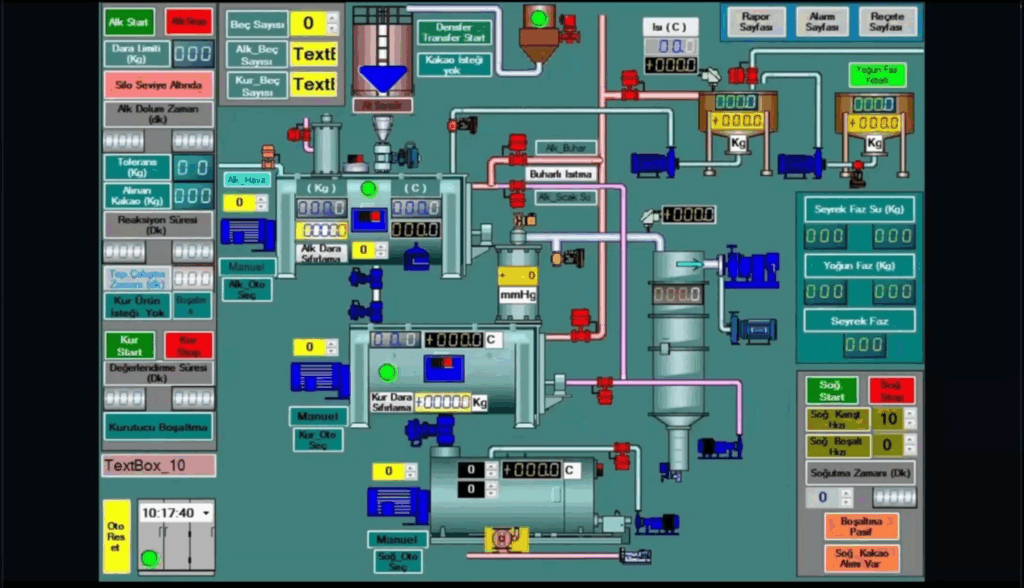
A while ago I worked on a CMS system for an online shop. It was a dense platform with many connections between features. Our Lead Designer created the main structure and I took care of the Design System and new components. The work was very analytical. No banners. No decorative visuals. Every color and spacing value followed strict rules. I handled hundreds of input fields, tables, filters and other parts that needed to stay consistent.

When I started thinking about my master’s thesis last year, one idea was a gamified platform for patients and doctors. Healthcare is known for high complexity and heavy cognitive load. Even though I had worked with CMS systems and dashboards, enterprise UX was still new to me. This is why I became interested in the work of Vitaly Friedman. He speaks often about complex interfaces. I watched his talk for the UX Healthcare community called Designing the complex UI. It helped me understand how to plan such projects and how to measure if a design works.

In the talk he explained common problems in healthcare and enterprise systems. They often hold too much data. They contain many layers. They have strict dependencies between features. These systems overwhelm users fast if design is not careful.

His first point was about deciding what matters most inside the product and for it he uses Task Performance Indicators. These metrics show how fast and how successfully users finish important tasks. They help designers move away from guessing.

His second point was about choosing the right user groups. He suggests three user segments. Then he suggests finding 30-40 to participants for testing, cause half of them will likely drop out so a larger pool matters.

Then he talked about creating tasks for each segment. Each user gets ten to twelve short tasks. Every task needs one clear correct answer. Descriptions should stay under thirty words so users understand them without stress.

And when the design is on the production, track these metrics regularly – every 6 to 12 months depending on the speed of the team. This shows if design choices are helping or making things worse. He also suggests bringing the same eighteen participants back when possible. This keeps the comparison fair.

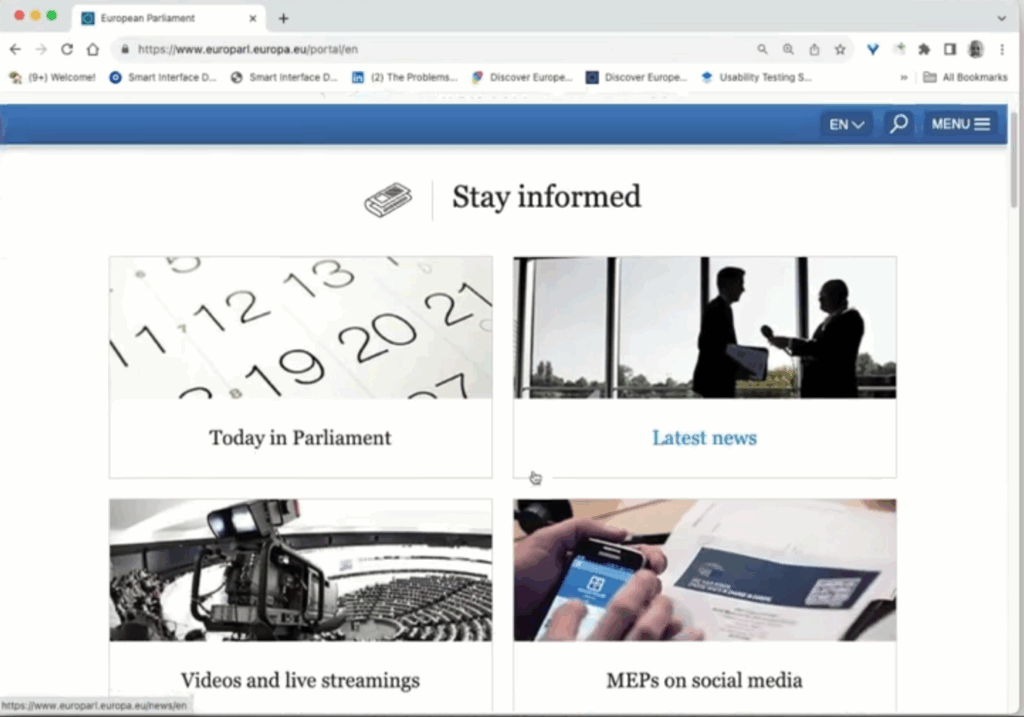
He showed the EU Parliament website as an example of a heavy and well structured system. It supports twenty languages and multiple search engines and several CMS platforms, still it feels simple for the user.

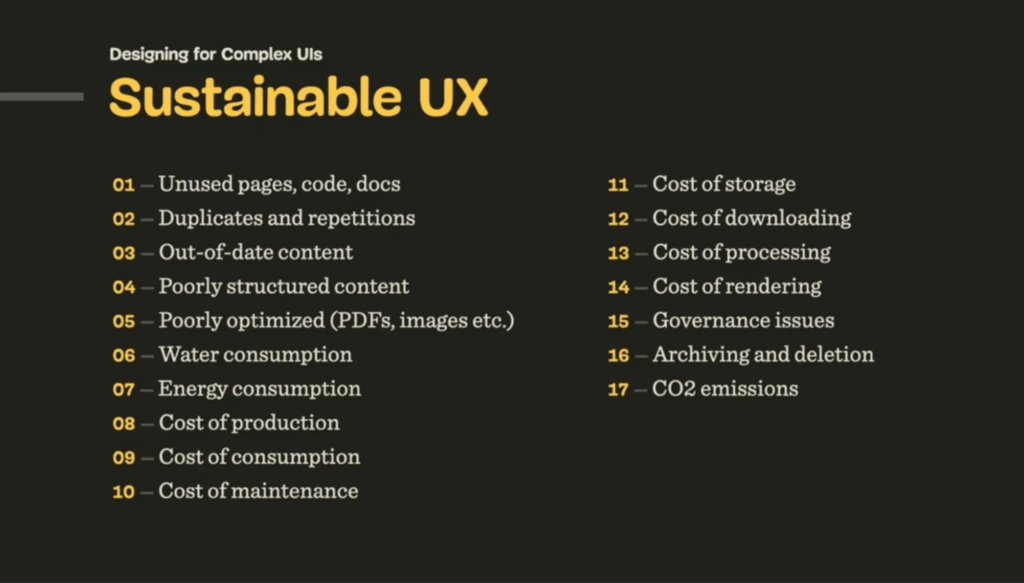
At the end he mentioned sustainable design. It is often viewed as a topic for developers and project managers. Designers still need to stay aware of it. Sustainable UX keeps systems efficient and reduces waste. It is easy to forget about it when we focus only on usability.

This talk helped me understand how large systems work and what to pay attention to when planning my thesis topic.

I used ChatGPT to check the spelling and grammar of this text

Impulse #3: Nadieh Bremer, WebExpo 2025

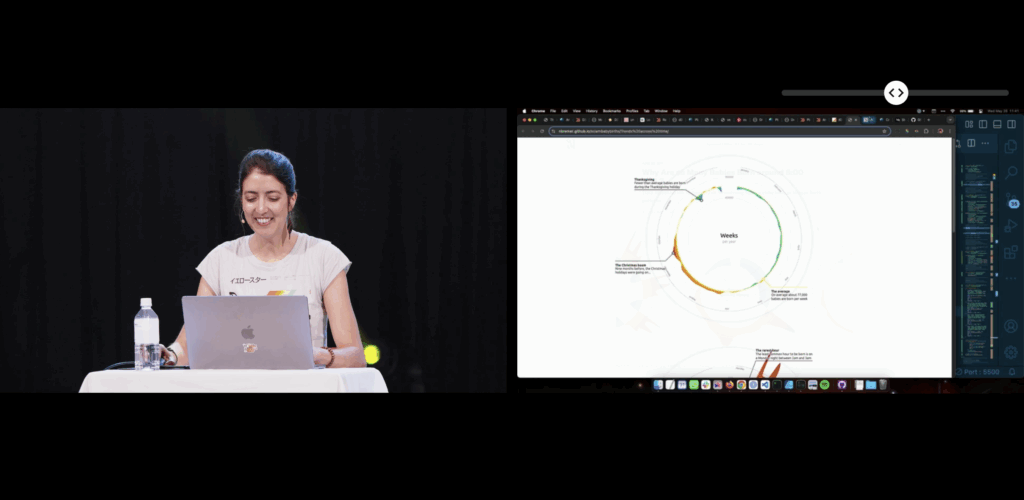
This blogpost will be a reflection inspired by Nadieh Bremers’ WebExpo 2025 talk Creating an effective & beautiful data visualisation from scratch with d3.js. Bremer demonstrates how visual interfaces can be designed to convey information clearly and emotionally. She outlines a design process that begins with understanding the data’s story and ends with polishing details such as visual hierarchy, color, and interaction. Her approach emphasizes that visuals should not only communicate facts but also evoke engagement and a sense of discovery. I rewatched the digital documentation of her talk to recap the content of her presentation.

Bremer presents visualization as a communication medium, where design choices directly impact user comprehension and emotional experience. Clarity reduces frustration, while appealing design increases motivation to explore. This perspective positions data visualization as a critical component of user experience, not merely a decorative or aesthetic layer.

Learning about new technologies for data visualization

When I encountered Nadieh Bremers work, I was already familiar with data visualization, but mostly through print media and a little experience with Processing. Designing layouts for magazines or static posters taught me how much data visuals can influence perception and guide a narrative. Around that time we went to WebExpo, I got into JS coding but wasn’t aware of the posibilities to use it for data visualization. Her projects demonstrated what I had been missing in print -> interactivity and adaptivity.

Why adaptive data visualization matters for a good user experience

During my deeper dive into adaptive data visualization literature, I explored a research paper focusing on real-time decision support in complex systems. It argues that static dashboards are no longer enough to support organizations facing rapidly changing data environments. Instead, visualizations must adapt to:

  • Incoming data streams
  • User interactions
  • Context shifts
  • Multivariate complexity

Adaptive systems combine machine learning, real-time processing, and flexible visualization layers to support faster and more informed decision-making. This means that the visualization is not just displaying data, it is interpreting and reacting to it. The paper specifically highlights D3.js as one of the technologies capable of creating these highly flexible and dynamic interfaces. Unlike pre-built dashboards, D3 allows developers to adapt interactions, transitions, and representations directly to user needs and situational changes.

In my earlier blog posts I wrote about affective computing. Combining the gained knowled I came to a conclusion: If a system can visually adapt based not only on the dataset, but also on the emotional state of the user, could generate a better user experience?

Sources:

https://slideslive.com/39043157/creating-an-effective-beautiful-data-visualisation-from-scratch

https://www.researchgate.net/publication/387471439_ADAPTIVE_DATA_VISUALIZATION_TECHNIQUES_FOR_REAL-TIME_DECISION_SUPPORT_IN_COMPLEX_SYSTEMS

IMPULSE.03 // Innovations in healthcare

Yesterday I listend to the episode Innovating healthcare by the Service Design Podcast. It features Brian Desplinter and Jurgen De Klerck who are collaborating at AZ Groningen, a hospital in Belgium, about healthcare innovation, with a focus on the use of 5G technology for advancements.

They mention that co-creation of solutions for challenges across hospitals and industries are vital for innovations. In health care the potential of messing something up is extremely risky. Especially in highly stressful environments like the hospital.

Something that was super interesting to me was that Brian was asked to shadow medical departments. Over the course of a year he watched the daily activities of the doctors and nurses in different departments to see where there were problems and to come up with new ideas. I’m curious to find out if this innovation center of the hospital in Belgium is comparable to anything here in Austria.

The challenges in healthcare are evident worldwide due to the eldering society which leads to the shortage of staff. This calls for innovative ideas to make processes in health care more efficient. The guests on the podcast mention that innovation is not only about technology. Its how you integrate the technology into the system.

Nowadays the demands and standards from patients are much higher than 10 years ago. People want to have seamless experiences but innovation is slower in healthcare because the bureaucracy that is tied to healthcare is always a problem.

The podcast touches on the use of VR in healthcare, such as in speech and aggresion therapy, highlighting the potential for creating optimal, controlled environments. The future of healthcare, they suggest, will likely be heavily influenced by wearable and on-demand technology.

Looking at the current state and future of healthcare, the speakers articulate the need for a more preventative approach, maintaining health rather than treating disease. They believe the way forward lies in closer collaboration between service designers, healthcare professionals, and patients.

The episode ends with Jurgen stating that people interested should send him a message and he can give them insights of their work of the hospital over a coffee. I’m kind of intrigued to see if he can stand up to this offer. Maybe I will travel to Belgium soon…

Link to the episode: https://open.spotify.com/episode/6Te3pgrvYndt1KEr0l7BlV?si=c55b231243e94747

No AI was used to create this blog post.