#7 Der Ikaurs Komplex

Der Ikarus-Komplex der Filmgeschichte: Der Mythos des totalen Kinos

In der Geschichtsschreibung der Technik dominiert zumeist ein materialistischer Determinismus: Man geht davon aus, dass wissenschaftliche Durchbrüche und ökonomische Rahmenbedingungen die notwendige Basis bilden, auf der kulturelle Ausdrucksformen wie das Kino erst erwachsen können. Doch André Bazin, der geistige Vater der Nouvelle Vague, unterzieht in seinem essenziellen Text „Der Mythos vom totalen Kino“ genau diese Annahme einer radikalen Revision. Er postuliert eine paradoxe Umkehrung der Verhältnisse zwischen der ökonomisch-technischen Evolution und der schöpferischen Imagination der Pioniere.

Die Umkehrung der Kausalität: Geist über Materie

Bazin meint, dass die Entstehung des Films, entgegen marxistischen Deutungsmustern, wie sie etwa Georges Sadoul vertrat, nicht zwangsläufig aus der industriellen Infrastruktur des 19. Jahrhunderts hervorging. Vielmehr scheint die historische Kausalität auf dem Kopf zu stehen: Die grundlegenden technischen Entdeckungen waren für Bazin lediglich „glückliche Zufälle“, die weit weniger ins Gewicht fielen als die vorgefassten, fast schon im „Himmel“ schwebenden Ideen der Erfinder.

Das Kino, so Bazin, ist ein idealistisches Phänomen. Die Vision einer totalen Repräsentation der Realität existierte in den Köpfen der Forscher bereits in vollendeter Form, lange bevor die chemischen und mechanischen Mittel zu ihrer Realisierung bereitstanden. Was die Frühgeschichte des Films prägt, ist daher weniger die Unterstützung der Phantasie durch die Technik, sondern vielmehr der „hartnäckige Widerstand der Materie gegen die Idee“.

Die „Monomanen“ und der Widerstand der Technik

Ein zentrales Argument Bazins ist die Charakterisierung der Gründerväter des Kinos. Er unterscheidet strikt zwischen dem echten Wissenschaftler (Savant) und dem besessenen Erfinder. Während ein Wissenschaftler wie Marey lediglich an der Analyse von Bewegung interessiert war, also daran, die Zeit anzuhalten, statt sie zu rekonstruieren, waren Männer wie Muybridge, Niepce, Leroy oder Lumière in erster Linie „Monomanen einer fixen Idee“.

  • Muybridge und das Unmögliche: Bereits zwischen 1877 und 1880 realisierte Muybridge dank der Finanzierung eines Pferdeliebhabers komplexe Versuchsreihen, obwohl ihm zwei der drei technologischen Grundvoraussetzungen (die trockene Emulsion und die flexible Basis) noch gar nicht zur Verfügung standen. Er erzwang das Resultat mit nassen Kollodiumplatten auf Glas – ein technischer Anachronismus im Dienste einer Vision.
  • Der Bastler als Prophet: Selbst Thomas Edison wird von Bazin nicht als Wissenschaftler, sondern als „do-it-yourself man of genius“ beschrieben. Diese Pioniere waren keine kühlen Kalkulatoren der Industrie, sondern Visionäre, die eher bereit waren, wie der Töpfer Bernard Palissy ihr Mobiliar zu verbrennen, um für wenige Sekunden ein zitterndes Bild zu erzeugen.

Der Mythos vom totalen Kino: Das Ziel ist die totale Illusion

Der Kern von Bazins These liegt im Begriff des integralen Realismus. Der leitende Mythos, der die Erfindung des Kinos befeuerte, war die Sehnsucht nach einer Rekonstruktion der Welt nach ihrem eigenen Ebenbild – eine Wiedergabe, die unbeschwert ist von der interpretativen Freiheit des Künstlers oder der Unumkehrbarkeit der verstreichenden Zeit.

Daraus ergeben sich weitreichende Konsequenzen für unser Verständnis der Filmgeschichte:

  1. Der Stummfilm als Mangelzustand: Es wäre absurd, den Stummfilm als einen Zustand ursprünglicher Vollkommenheit zu betrachten, den man später durch Ton und Farbe korrumpiert hätte. In der Vorstellung der Erfinder war das Kino von Beginn an mit Sound, Farbe und räumlicher Tiefe (Stereoskopie) konzipiert.
  2. Die Verspätung der Apparaturen: Da die optischen Prinzipien (wie die Netzhautträgheit) bereits seit der Antike bekannt waren, ist die späte Erfindung des Kinos nicht wissenschaftlich, sondern nur psychologisch zu erklären. Die Menschheit wartete darauf, dass die Chemie (die Fotografie) einen Weg fand, das Bild automatisch zu fixieren, bevor sie sich der Synthese der Bewegung widmete.
  3. Ein unendlicher Prozess: Da das Ziel eine vollkommene, identische Kopie der Natur ist, kommt Bazin zu dem provokanten Schluss: „Das Kino ist noch nicht erfunden!“ Jede neue technologische Stufe ist lediglich ein weiterer Schritt zur Realisierung des ursprünglichen Mythos.

Das Kino als metaphysisches Streben

Indem Bazin das Kino als ein Produkt der Imagination definiert, das seiner technischen Realisierung vorausging, enthebt er das Medium einer rein funktionalen Technikgeschichte. Er vergleicht das Streben nach dem Kino mit dem Ikarus-Mythos: So wie der Traum vom Fliegen seit Urzeiten in der menschlichen Seele wohnte und lediglich auf den Verbrennungsmotor wartete, so wartete der Traum vom totalen Realismus auf die chemische und mechanische Industrierevolution des 19. Jahrhunderts.

Das Kino ist somit nicht das Kind der Wissenschaft, sondern das Kind eines metaphysischen Bedürfnisses nach Realität. Damit lässt sich auch rückwirkend sagen, dass die Technik niemals ein Hinderniss war das Kino weiterzuentwicklen. Wichtiger sind Ideen, Gefühle und Emotionen um uns den Filmrealismus näher zu bringen. Natürlich kommen mit neueren Technologien (AI, etc.) auch neuere Möglichkeiten und neue Stile die sich ins Kino einbringen. Dies ist aber nicht anders als wie als Beispiel genannt, der Verbrennungsmotor um fliegen zu können.

Quellen:

  • Bazin, A. (1967). What is cinema? 1. Univ. of Calif. Press.

03.10.: Fazit und Ausblick

Ich finde, ohne mich selbst zu viel loben zu wollen, dass sich über diese 17 Blogposts wirklich viel Getan hat. Von einem gänzlich neuen Thema zu einer klaren Idee, mit vorliegender Literatur, die eigentlich nur mehr darauf wartet von mir verschlungen und wiedergegeben zu werden.

Mittlerweile bin ich gut in Zypern angekommen, und ich würde behaupten ich habe mich nicht so schlecht in die Erasmus-Experience eingelebt, wenn man das so sagen kann. Jetzt wird es aber Zeit wirklich ins Tun zu kommen, um am Ende nicht den ganzen schönen Sommer hier auf Zypern vorm Laptop verbringen zu müssen, sondern stattdessen jetzt die harte Arbeit zu leisten. Mit der “ASC-Bibel” und “Painting with Light” habe ich im Zuge dieser Blogposts bereits zwei meiner insgesamt sechs Bücher, die ich als “Basisliteratur” für die Masterarbeit verwenden möchte, inhaliert und zusammengefasst. Die anderen vier liegen bereits neben mir hier am Schreibtisch und warten auf einen Tag, an dem die örtliche Erasmus-Organisation mich nicht unverschämt mit Freibier auf ihren Frat-Parties ködert – aber dieser wird kommen, ich glaube fest daran!

Zusätzlich habe ich mir gerade in Hinblick auf die Finale Einreichung des Exposé noch genauere Gedanken über meine Vorgehensweise bei der Filmanalyse gemacht. Auch wenn der erste Schritt das Zusammenfassen der Literatur sein wird, glaube ich braucht ein gutes Exposé vor allem viel Weitblick. Außerdem lässt es sich dann, finde ich zumindest, viel leichter arbeiten. Dafür habe ich mir bereits zwei E-Books zugelegt – Bücher in meine zypriotische Wohnung zu bestellen war mir dann irgendwie zu umständlich. Einerseits die fünfte Ausgabe von “Film- und Fernsehanalyse” von Knut Hickethier und die dreizehnte von “Film Art: An Introduction” von Bordwell, Thompson und Smith. Meiner Recherche zufolge ist das jeweils das deutsche und internationale Standardwerk zur Filmanalyse. Auch wenn darin natürlich viel mehr behandelt wird, hindert mich das ja nicht daran nur die Kapitel “Zur Analyse des Visuellen” beziehungsweise “The Shot: Mis en scene” zu verwenden, um nicht den Rahmen zu sprengen und mich wirklich auf das was ich behandeln möchte, nämlich die Analyse der Lichtsetzung, zu fokussieren.

Auch das sind bereits zusammen über 100 Seiten aus denen sich gut eine individuelle Matrix bauen lassen sollte, die wissenschaftlich fundiert ist und mithilfe derer ich dann Film für Film abarbeiten kann.

Damit (glaube ich jetzt zumindest) habe ich einen ziemlich guten Fahrplan für die nächsten Woche und Monate, den ich jetzt eigentlich nur mehr umsetzen muss. Das freut mich persönlich besonders, da ich eigentlich nicht wirklich der vorplanende Typus bin und deshalb im Moment des Verfassens dieser Zeilen selbst ein bisschen überrascht von mir selbst bin.

Zusammenfassend kann man also sagen, dass mir diese Blogreihe tatsächlich auf meinem Weg zum Status Quo geholfen hat, da sie mich gezwungen hat, mich früh genug mit der Suche meiner Literatur und mit der Literatur selbst auseinanderzusetzen, sodass ich jetzt bereits wirklich an einem guten Punkt bin, von dem aus ich in Ruhe arbeiten kann. Sofern mich das Wetter in Zypern eben lässt 😉

In diesem Sinne, wünsche ich allen Lesern dieser Zeilen einen schönen und hoffentlich stressfreien Masterarbeitssommer!

Blümel out.

Impuls 8: O´Sullivans Breakdown von “Oppenheimer”

Ich habe schon in ein paar Impulsen für diese Blogserie Filme analysiert und versucht herzuleiten wie und warum die Filmemacher bestimmte Entscheidungen getroffen haben. Schon damals war mir klar, möchte ich ähnliche Analysen auch in meiner Masterarbeit machen (und das möchte ich ja) brauche ich dafür eine zumindest strukturiertere (am besten aber sogar wissenschaftlich genormte) Herangehensweise, sodass meine Ergebnisse einerseits einheitlich zwischen den Filmen, aber auch für Dritte nach außen hin nachvollziehbar sind. Spätestens im Gespräch mit Ursula Lagger wurde diese Vermutung bestätigt, woraufhin ich im letzten Impuls dieser Blogserie einmal kurz nachsehen wollte, wie der Wandering DP seine Filmanalysen (beziehungsweise Breakdowns) so aufzieht. Dafür habe ich mir seinen Patreon Breakdown zum Film Oppenheimer angesehen.

Herangehensweise

O´Sullivan sucht sich im Vorfeld ungefähr 10 bis 15 Szenen aus dem Film heraus, die er in (in diesem Fall) 30 Minuten durchbespricht. Dabei geht er voll allem auf drei Dinge ein: Blocking, also wo stehen die Charaktere im Raum und in welchem Verhältnis zueinander, Kameraposition, also auf welche Seite der line of action befinden wir uns und warum, und Lichtsetzung, also woher kommt das Licht, welche Qualität hat es und warum.

Dies macht er aber ohne echten Leitfaden, also nicht genormt wie bei einer Masterarbeit, dass er Shot für Shot den selben Katalog abarbeitet. Stattdessen konzentriert er sich mehr auf das, was seiner Meinung nach am wichtigsten in dem Shot ist, also warum sind wir beispielsweise hier auf der rechten Seite und nicht auf der linken. Dies erklärt er dann mit allen Vor- und Nachteilen.

Ich denke, dass ich hiervon semi viel für meine Masterarbeit mitnehmen kann. Das worauf er achtet, ist definitiv auch genau das, worauf ich mich in meinen Analysen konzentrieren will. Keine Analyse der Handlung, der Charaktere, oder Ähnlichem, sondern eine Analyse all derer Faktoren, die bestimmen wie das Bild am Ende aussieht, nicht was darin passiert. Dafür brauche ich aber eine striktere Herangehensweise und klare Regeln, um meine Arbeit auf ein wissenschaftliches Niveau zu bringen.

TR #8 The AIDS Crisis and Queer Representation in the Balkans

The AIDS crisis shaped queer communities globally, but in the Balkans it overlapped with war, sanctions, and political chaos.

Healthcare systems were collapsing. Information was limited. Stigma was intense.

Photography from this period sometimes carries that weight. You see fragility. Hospital visits. Activist posters. Intimate portraits that feel almost like quiet memorials.

But you also see solidarity.

Friends caring for each other. Community meetings. Protest signs demanding visibility and support.

The camera becomes both witness and activist.

AIDS photography isn’t just about illness. It’s about care networks. About refusing to let people disappear quietly.

In a region already overwhelmed by conflict, queer suffering could easily be ignored. But these images insist on attention.

They ask us to look — and not look away.

#9 The Role of the Audience within an Installation

In installation art, the physical presence of the viewer is not optional but it is essential. Ilya Kabakov famously stated that “the main actor in the total installation is the viewer; they are the center toward which everything is directed.” This focus on the viewer, however, often leads to a paradox: instead of being placed at a privileged point, the viewer is physically decentered. There is no single, ideal position from which the work can be fully understood. Meaning emerges only through movement within the space (Bishop, 2005). Another key aspect of installation art is duration. While a painting often suggests an instant or timeless moment, an installation requires time. The viewer must walk through it, pause, return, and explore. In this sense, installation art shares qualities with theater or film, yet differs in one crucial way: the visitor remains autonomous. They choose their own path, pace, and length of engagement (Zhihan Ren, 2025).

Contemporary museums increasingly respond to these demands with dynamic exhibition design. Static white walls are replaced by flexible and mobile elements that can adapt to movement and interaction. A notable example is the exhibition Homo Ludens where visitors were able to change the spatial setup themselves using mobile devices. Architecture becomes a “living” part of the experience, something that reacts and evolves through human presence.

Technological developments have further expanded these possibilities. Hereby immersive exhibitions today often use:

  • High-resolution projection mapping, allowing images to be projected precisely onto irregular surfaces such as columns or curved walls, making architecture appear fluid or unstable (Johnson, 2025a)
  • Spatial sound systems, with multiple speakers creating soundscapes that move around the visitor and envelop them acoustically (Johnson, 2025a)
  • Haptic feedback, such as vibrating floors or handheld controllers, which add a tactile layer to perception (Johnson, 2025a)

These technologies are not meant as pure spectacle. Their goal is to intensify emotional and sensory engagement and to encourage visitors to reflect on their own perception and their relationship to the surrounding world.

Richard Serra and Time as Matter

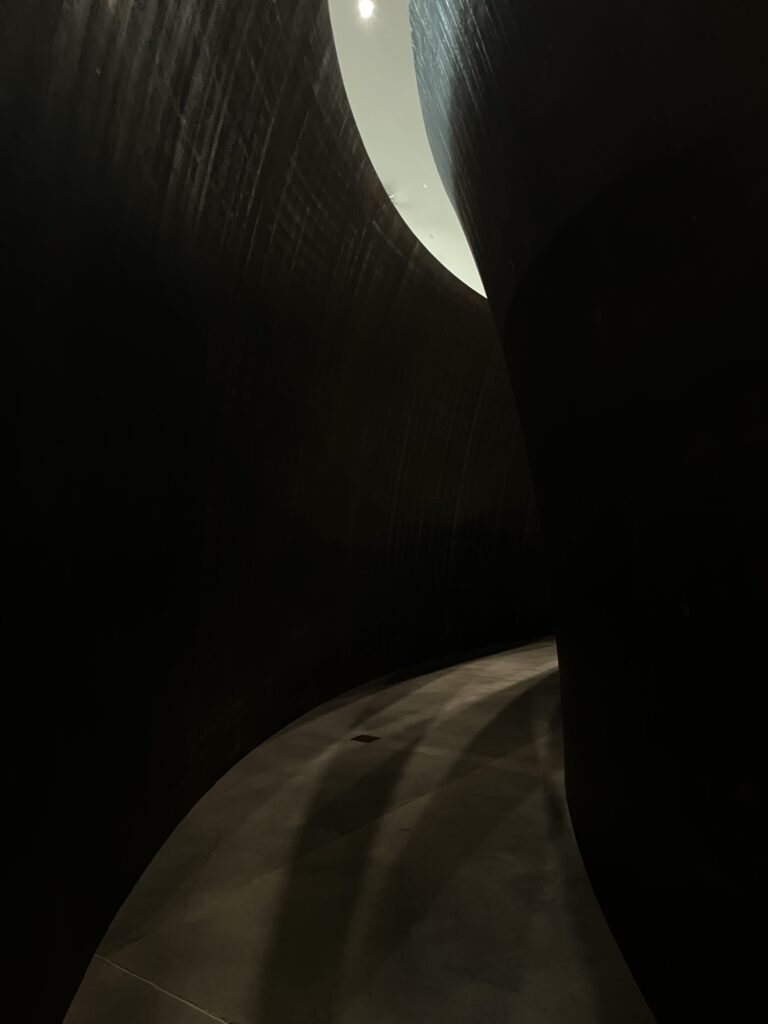
Richard Serra’s monumental installation The Matter of Time (2005) in the Guggenheim Museum Bilbao is one of the most radical explorations of space, time, and bodily experience. Installed in the 130-meter-long, column-free gallery, the work consists of eight massive Cor-Ten steel sculptures that activate the entire space (Johnson, 2025b).

Rather than presenting individual objects, Serra creates an environment that unfolds through movement. The viewer becomes the subject, and meaning is produced through walking.

  • Physical disorientation: The tilted and curved steel walls create a constant sense of imbalance. Scale and orientation shift continuously, challenging spatial perception.
  • Proprioceptive awareness: Moving through narrow passages makes visitors more aware of their own bodies, their breathing, rhythm, and physical limits. The acoustics of the steel amplify footsteps and ambient sounds, intensifying feelings of isolation or compression.
  • Time as material: The title emphasizes that time itself is sculptural. Each form leads to the next, subtly altering the visitor’s orientation in relation to the museum architecture.

Serra’s approach is influenced by his study of Japanese Zen gardens, which he understood as spatial fields that can only be experienced through movement. In Bilbao, Frank Gehry’s architecture functions as a resonant shell around the sculptures, creating a quiet, almost meditative space where perception slows down.

Olafur Eliasson and Perceiving Perception

Olafur Eliasson places the viewer at the absolute center of his work. His installations often function as tools that invite visitors to step back and reflect on their own actions and sensory processes. Eliasson frequently works with natural elements such as light, fog, water, and ice to heighten sensory awareness. Blurring subject and object: In Your Imploded View (2001), a polished aluminum sphere reflects the surrounding space but distorts it so strongly that viewers see themselves from unfamiliar perspectives. The artwork no longer dominates; instead, a dialogue emerges between observer and object (Malone, 2007).

  • Individual experience: Eliasson’s frequent use of the word “Your” in his titles emphasizes that meaning is personal and shaped by memory, expectation, and physical position.
  • Collective awareness: At the same time, these highly subjective experiences make visitors aware of others sharing the space. Being surrounded by fog or light creates temporary communities and encourages reflection on social responsibility.

A clear example is Beauty, where a rainbow appears through light and fine mist. The rainbow is only visible from a specific angle and exists solely in the act of seeing. Here, the viewer does not just observe the image but actively produces it through their position in space.

Installation art shifts the focus away from the artwork as an isolated object and toward experience as a process. Movement, time, and bodily presence are not secondary effects but core components of meaning. Whether through massive steel structures or fragile light phenomena, these works demand active participation and awareness. Rather than offering clear messages, they create situations in which perception itself becomes unstable, and it is precisely within this instability that reflection begins.

Bibliography

Bishop, C. (2005). Installation Art. Tate Publishing. https://www.scribd.com/document/463827422/Installation-Art-Claire-Bishop-pdf

Johnson, F. (2025a, September). Immersive Art Museum: A Deep Dive into Digital Experiences, Future Trends, and Visitor Engagement. Wonderful Museums. https://www.wonderfulmuseums.com/museum/immersive-art-museum/

Johnson, F. (2025b, November). Richard Serra Guggenheim Museum Bilbao: Exploring the Monumental Steel Sculptures Within Frank Gehry’s Architectural Masterpiece. Wonderful Museums. https://www.wonderfulmuseums.com/museum/richard-serra-guggenheim-museum-bilbao/

Malone, M. (2007, December). Ólafur Eliasson, Your Imploded View, 2001. Mildred Lane Kemper Art Museum. https://www.kemperartmuseum.wustl.edu/learn/learning-resources/eliasson-olafur-your-imploded-view-2001/type/essays

Zhihan Ren. (2025). When the Black Box Meets the White Cube: Spatial Shifts and Postdramatic Aesthetics in Performance Art. ResearchGate. https://www.researchgate.net/publication/392611552_When_the_black_box_meets_the_white_cube_spatial_shifts_and_postdramatic_aesthetics_in_performance_art

Conclusion – Reflections on Immersive Music Production

This project set out to explore how immersive audio formats can be used as an integral part of music production rather than as an additional or purely technical layer. Over the course of the project, it became clear that working in 3D audio fundamentally affects compositional, arrangement-related, and production decisions. Spatial considerations do not emerge only at the mixing stage, but influence songwriting, recording strategies, and performance choices from an early point onward.

A central insight of the project is that spatial width and motion are most effective when used deliberately and in contrast. Excessive or constant spatial expansion can reduce musical impact, whereas controlled changes in spatial density and focus can significantly enhance the perceived energy of specific song sections. In this context, immersive audio proved particularly valuable for shaping structural contrasts, clarifying arrangements, and reducing perceptual masking through spatial distribution rather than aggressive spectral processing.

From a technical perspective, the comparative use of Ambisonics and Dolby Atmos workflows provided valuable insights into different production philosophies. Ambisonics offered a flexible and performance-efficient environment for exploratory spatial work, while Dolby Atmos proved especially practical for structured production workflows and distribution on current streaming platforms. Neither approach emerged as universally superior; instead, their strengths depended on artistic intent, playback context, and production requirements.

Overall, the project demonstrates that immersive audio can serve as a meaningful compositional and narrative tool in contemporary music production—provided that spatial decisions remain grounded in musical intention and listener perception. Rather than treating 3D audio as a novelty, this work argues for its thoughtful integration as an expressive dimension that supports, rather than overshadows, the music itself.

Acknowledgements

I would like to sincerely thank Alois Sontacchi for his continuous support throughout this project. Our discussions were consistently insightful and inspiring, not only in relation to this work, but also beyond its immediate scope. A special thanks also goes to Benjamin Pohler, who was always available for short (or longer) conversations and quick exchanges of ideas.

Workflow Comparison: Ambisonics vs. Dolby Atmos

Based on practical experience gained throughout the project, both workflows revealed distinct strengths and limitations that influenced artistic decisions, technical handling, and playback outcomes.

One noticeable difference concerned vertical spatial resolution. In the Ambisonics workflow, access to a continuous vertical sound field allowed for more flexible and coherent vertical movements. In contrast, a Dolby Atmos setup, as used in this project, did not include a top center speaker. This limitation became particularly apparent in sections where vertical motion played a structural or emotional role, such as moments where sound elements were intended to move upwards. During playback in the Cube, this difference was emphasized further, as the upper loudspeaker layer consists of five speakers that could not be addressed using the chosen Dolby Atmos configuration.

Despite this limitation, the Dolby Atmos workflow proved to be highly efficient and reliable. The integration of the Dolby Atmos Renderer directly into Cubase and Nuendo allowed for seamless monitoring across different loudspeaker layouts, as well as quick evaluation of stereo downmixes and binaural renders. This level of integration significantly simplified workflow management and made it easy to check translation across formats within a familiar DAW environment.

In comparison, working with Ambisonics in Reaper was considerably more performance efficient. Even with large sessions consisting of 120 to 150 tracks, CPU usage remained comparatively low. The IEM Plugin Suite offered a powerful and intuitive toolset for spatial encoding and decoding, reverberation, and sound design tools, enabling many creative possibilities with minimal system load. This made Ambisonics particularly suitable for exploratory work and complex spatial experimentation.

Another key difference lay in signal organization and processing philosophy. The Ambisonics workflow encouraged early grouping and encoding strategies. The Dolby Atmos workflow, on the other hand, offered greater flexibility for multichannel summing and corrective processing at the subgroup level, particularly through the use of multichannel-capable plugins. While both approaches were effective, they led to different working habits and influenced how spatial and tonal decisions were made during mixing.

From a distribution perspective, the Dolby Atmos workflow proved to be more practical. At the time of writing, immersive music releases on major streaming platforms require delivery in the ADM format. Working directly within a Dolby Atmos environment allows for a straightforward ADM export that aligns with current industry standards for music distribution. This made the Dolby-based workflow particularly suitable for release-oriented productions, whereas Ambisonics workflows typically require additional conversion steps before meeting platform-specific delivery requirements.

Overall, neither workflow proved universally superior. Instead, each approach offered specific advantages depending on artistic intent, technical requirements, and playback context. The comparative use of both workflows throughout the project contributed significantly to a deeper understanding of immersive music production practices.

Practical Limitations and Session Transfer Issues

Although not directly related to the spatial workflows themselves, practical challenges arose during the transfer of sessions to the production studio system. Due to compatibility issues between different versions of the FabFilter plugins (notably Pro-Q 3 and Pro-Q 4), session interchange became unexpectedly time-consuming.

Sessions created with older plugin versions could not be opened using newer versions, and vice versa. Attempts to work around this limitation, such as using user presets, were unsuccessful, requiring all equalization settings to be recreated manually. This significantly increased preparation time and highlighted an often-overlooked aspect of production workflows: plugin version compatibility across different systems.

EAR Production Suite Experiments

As part of the ongoing series on spatial mixing approaches in practice, this post focuses on experimental tests conducted with the EAR Production Suite (EPS). These experiments were carried out at a late stage of the project and aimed to explore alternative ADM-based playback and conversion workflows.

EAR Production Suite Experiments

In parallel, experiments were conducted using the EAR Production Suite (EPS). These tests took place during the weekend prior to the final presentation, which significantly limited the available time for extended troubleshooting and deeper investigation.

The EAR Production Suite is a set of VST plugins developed by BBC R&D and IRT under the EBU, designed to enable immersive audio production using the Audio Definition Model (ADM). It allows for importing, exporting, and monitoring ADM content for various loudspeaker configurations based on ITU-R BS.2051, using the ITU ADM Renderer. The suite is primarily optimized for Reaper and serves as a reference implementation for ADM-based workflows[1].

Using the EAR Production Suite, I tested alternative playback and conversion approaches, including rendering ADM content into Ambisonics formats. However, during these tests, unexpected behavior occurred, such as excessive spatial spread and routing inconsistencies. Resolving these issues would have required more extensive investigation and testing.

Due to limited working time in the Cube and the need for a fail-safe playback solution, I ultimately decided against further experimentation with the EAR Production Suite in this context. Instead, the fully channel-based rendering approach, as mentioned before, was chosen for all listening examples used in the presentation.


[1] “EAR Production Suite,” accessed February 6, 2026, https://ear-production-suite.ebu.io//.

Dolby Atmos – Workflow Comparison and Technical Reflection

Continuing the series on spatial mixing approaches in practice, this post focuses on the Dolby Atmos workflow I used for Alter Me and Caught In Dreams, and on the practical steps taken to prepare ADM exports and playback in the IEM Cube.

For the Dolby Atmos productions, I decided to work in Cubase and Nuendo, as the Dolby Atmos Renderer is already fully integrated into both environments. This allowed for a streamlined workflow without the need for external rendering tools[1].

After completing the stereo mixes of Alter Me and Caught In Dreams to an advanced stage, the sessions were converted into Dolby Atmos projects. Cubase provides an automated conversion process in which all existing tracks are initially routed into a standard bed configuration.

For my workflow, I used the standard bed primarily for reverberation. I also used an Ambisonics bus with the Room Encoder and the FDN Reverb as a reverb send. Since the standard bed in Dolby Atmos is limited to a maximum configuration of 7.1.2, I deliberately avoided placing direct sound sources in this bed. Instead, I created a so-called object bed. In this setup, 11 objects were placed at the exact positions of the loudspeakers (used in the production studio), which in my case was the 7.1.4 configuration at the IEM production studio.

Routing signals into this object bed allowed me to address individual loudspeakers, provided that the loudspeaker positions were correctly defined. While this spatial correspondence was largely accurate in the production studio, minor deviations remained due to differences between the virtual speaker layout and the physical setup (higher elevated top speakers for example).

Subgroup structure and processing

In addition to object-based routing, extensive use of subgroups was made. Instrument groups such as drums, guitars, and vocals were routed into dedicated multichannel buses. For example, the drum signals were routed into a 7.1.4 drum bus, allowing for internal panning decisions as well as group-based processing.

Within these subgroup buses, summing and tonal shaping were carried out using multichannel-capable plugins, primarily from the FabFilter suite. Compared to the Ambisonics workflow, this approach provided greater flexibility for summing and corrective processing at the group level, while the overall structural logic of the routing remained similar.

Signals involving pronounced movement or spatial automation were routed directly to objects. In cases where a sound source only changed position briefly within a song, the track was often routed into the object bed and automated using the track’s multipanner rather than being continuously treated as a Dolby Atmos object.

LFE handling

The Low Frequency Effects (LFE) channel was deliberately not used in this workflow. Although the LFE channel is definitely part of standard Dolby Atmos workflow, it is often not used in music production. By excluding the LFE channel, the separation between the standard bed and the object bed remained clear, as any signal intended to address the LFE channel must be routed in the bed. This decision helped maintain a clean and predictable routing structure.

Export and playback preparation for IEM CUBE

At the end of the production process, an ADM file was rendered directly from Cubase. For playback preparation in the Cube, several approaches were tested with the goal of ensuring a stable and reliable setup for the final presentation of this project.

The ADM file was imported into Nuendo and up-rendered to a 9.1.6 configuration. At the time of production, I was not aware that the production studio system (their Nuendo version) also supported a 9.1.6 setup. In retrospect, creating the object bed directly in 9.1.6 would have been the more precise solution.

The up-rendered 9.1.6 mix was then exported as a channel-based 16-channel WAV file. This file was routed manually and directly to the corresponding loudspeakers in the Cube, ensuring full control over playback and eliminating potential uncertainties related to rendering or decoding behavior.


References:

[1] “Getting Started in Dolby Atmos with Steinberg Cubase and Nuendo,” accessed February 8, 2026, https://professionalsupport.dolby.com/s/article/Getting-Started-in-Dolby-Atmos-with-Steinberg-Cubase-and-Nuendo?language=en_US.

Ambisonics – Workflow Comparison and Technical Reflection

Ambisonics Workflow

When it came to mixing in 3D audio, I decided to begin my first immersive mixing experiments using Ambisonics in Reaper rather than Dolby Atmos. This decision was mainly influenced by the IEM Plugin Suite, which provides intuitive and flexible tools for Ambisonics mixing and made the initial entry into 3D audio more accessible.

I chose to work with fifth-order Ambisonics for this project to achieve a more accurate and immersive rendering of diffuseness, spaciousness, and spatial depth. While first-order Ambisonics might seem sufficient due to the even nature of diffuse sound fields, in practice, their low spatial resolution leads to high directional correlation during playback, which significantly impairs the perception of these spatial qualities. Higher-order Ambisonics, in contrast, improves the mapping of uncorrelated signals and preserves spatial impressions much more effectively. Psychoacoustic research has shown that an Ambisonic order of three or higher is required to perceptually preserve decorrelation between neighboring loudspeakers, which is crucial for rendering depth and diffuseness. Fifth-order Ambisonics further enhances this, particularly outside the sweet spot, providing a more consistent spatial experience across a larger listening area. As demonstrated in the IEM CUBE, a fifth-order system allows nearly the entire horizontal listening plane—in this case, a 12 × 10 m concert space—to become a valid and perceptually plausible playback zone. [1]

Thus, fifth-order Ambisonics is not only a practical choice for immersive production in larger spaces, but it also strikes an effective balance between spatial resolution, technological complexity, and perceptual benefit [2].

I also had the opportunity to experience this myself during a small listening test we conducted with Matthias Frank. We listened to first-, third-, and fifth-order Ambisonics in a blind comparison and were asked to rate certain spatial parameters like spatial depth or localization. The first order was quite easy to identify due to its limited spatial resolution. However, distinguishing between third- and fifth-order Ambisonics proved to be much more challenging, as the differences were often subtle and less immediately perceptible.

After that, I started with setting up the routing, which was one of the most underestimated parts of this project. Similar to a traditional stereo production, I created a structure of groups and subgroups, but adapted it for Ambisonics. For example, in the drum section, encoding happens at the main drum group via the IEM Multi Encoder. All individual channels are routed into that group, allowing me to process them using conventional stereo plugins before spatializing them — saving both CPU resources and maintaining flexibility in the early mixing stages.

Within the drum routing, I created subgroups for kick, snare, overheads and the “Droom”, allowing for finer control and processing. When dealing with coherent signals, such as double-tracked guitars, I first routed both signals (panned hard L & hard R) into a stereo group to conserve CPU power by processing them together. This group is then routed into a master guitar group that handles Ambisonics encoding. Since the L and R signals remain separated, they can still be treated independently in the encoder and placed individually in the 3D field.

I followed the same approach with vocals, organizing them into groups before routing them into the Multi Encoder. For specific adlibs, I used the Granular Encoder to create glitchy, scattered spatial effects.

To add a sense of depth and immersion to the vocals, I used a small amount of FDN Reverb for diffuse reverberation and the Room Encoder for early reflections — all plugins from the IEM Suite.

Finding this optimal signal flow took considerable time and experimentation. It was a major learning process to understand how to best structure a large session for Ambisonics.


References

[1] Franz Zotter and Matthias Frank, Ambisonics: A Practical 3D Audio Theory for Recording, Studio Production, Sound Reinforcement, and Virtual Reality, Springer Topics in Signal Processing (Springer International Publishing, 2019), 19:18–20, https://doi.org/10.1007/978-3-030-17207-7.

[2] Zotter and Frank, Ambisonics, 19:18–20.