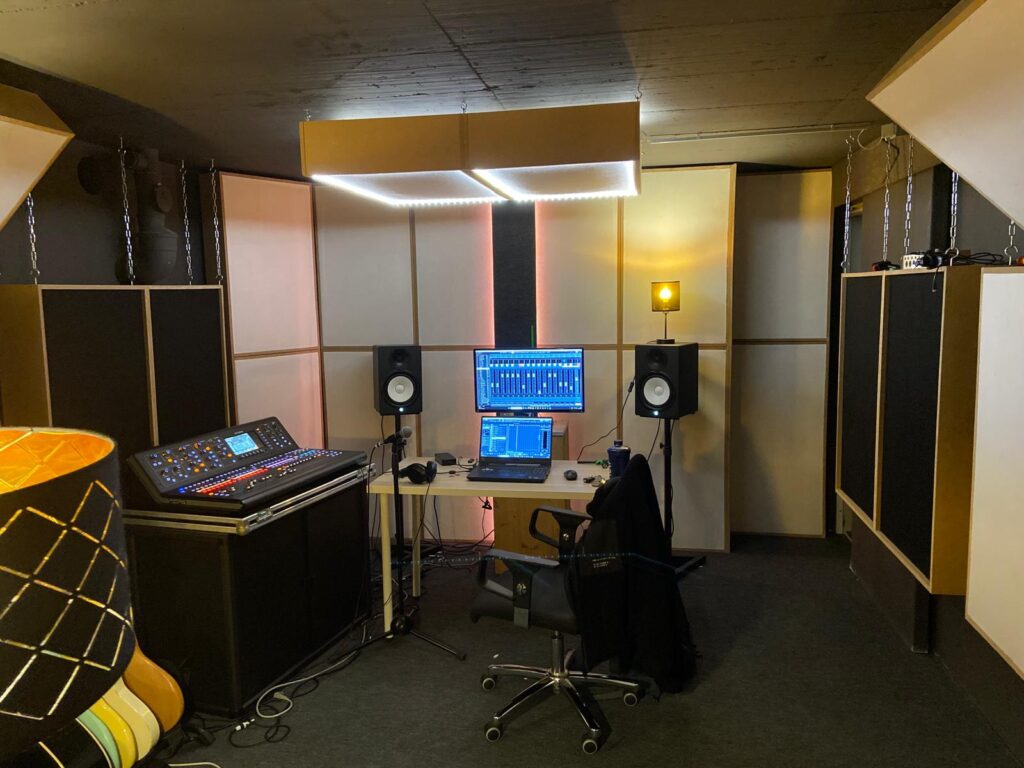
Ambisonics – Workflow Comparison and Technical Reflection

Ambisonics Workflow

When it came to mixing in 3D audio, I decided to begin my first immersive mixing experiments using Ambisonics in Reaper rather than Dolby Atmos. This decision was mainly influenced by the IEM Plugin Suite, which provides intuitive and flexible tools for Ambisonics mixing and made the initial entry into 3D audio more accessible.

I chose to work with fifth-order Ambisonics for this project to achieve a more accurate and immersive rendering of diffuseness, spaciousness, and spatial depth. While first-order Ambisonics might seem sufficient due to the even nature of diffuse sound fields, in practice, their low spatial resolution leads to high directional correlation during playback, which significantly impairs the perception of these spatial qualities. Higher-order Ambisonics, in contrast, improves the mapping of uncorrelated signals and preserves spatial impressions much more effectively. Psychoacoustic research has shown that an Ambisonic order of three or higher is required to perceptually preserve decorrelation between neighboring loudspeakers, which is crucial for rendering depth and diffuseness. Fifth-order Ambisonics further enhances this, particularly outside the sweet spot, providing a more consistent spatial experience across a larger listening area. As demonstrated in the IEM CUBE, a fifth-order system allows nearly the entire horizontal listening plane—in this case, a 12 × 10 m concert space—to become a valid and perceptually plausible playback zone. [1]

Thus, fifth-order Ambisonics is not only a practical choice for immersive production in larger spaces, but it also strikes an effective balance between spatial resolution, technological complexity, and perceptual benefit [2].

I also had the opportunity to experience this myself during a small listening test we conducted with Matthias Frank. We listened to first-, third-, and fifth-order Ambisonics in a blind comparison and were asked to rate certain spatial parameters like spatial depth or localization. The first order was quite easy to identify due to its limited spatial resolution. However, distinguishing between third- and fifth-order Ambisonics proved to be much more challenging, as the differences were often subtle and less immediately perceptible.

After that, I started with setting up the routing, which was one of the most underestimated parts of this project. Similar to a traditional stereo production, I created a structure of groups and subgroups, but adapted it for Ambisonics. For example, in the drum section, encoding happens at the main drum group via the IEM Multi Encoder. All individual channels are routed into that group, allowing me to process them using conventional stereo plugins before spatializing them — saving both CPU resources and maintaining flexibility in the early mixing stages.

Within the drum routing, I created subgroups for kick, snare, overheads and the “Droom”, allowing for finer control and processing. When dealing with coherent signals, such as double-tracked guitars, I first routed both signals (panned hard L & hard R) into a stereo group to conserve CPU power by processing them together. This group is then routed into a master guitar group that handles Ambisonics encoding. Since the L and R signals remain separated, they can still be treated independently in the encoder and placed individually in the 3D field.

I followed the same approach with vocals, organizing them into groups before routing them into the Multi Encoder. For specific adlibs, I used the Granular Encoder to create glitchy, scattered spatial effects.

To add a sense of depth and immersion to the vocals, I used a small amount of FDN Reverb for diffuse reverberation and the Room Encoder for early reflections — all plugins from the IEM Suite.

Finding this optimal signal flow took considerable time and experimentation. It was a major learning process to understand how to best structure a large session for Ambisonics.


References

[1] Franz Zotter and Matthias Frank, Ambisonics: A Practical 3D Audio Theory for Recording, Studio Production, Sound Reinforcement, and Virtual Reality, Springer Topics in Signal Processing (Springer International Publishing, 2019), 19:18–20, https://doi.org/10.1007/978-3-030-17207-7.

[2] Zotter and Frank, Ambisonics, 19:18–20.
Workflow Comparison and Technical Reflection

As part of the ongoing series on spatial mixing approaches in practice, this post shifts the focus from artistic decisions to a technical reflection on the workflows used throughout the project. The following sections outline how different immersive production approaches influenced working methods, creative flexibility, and playback outcomes.

Workflow Overview

This chapter outlines the different production and mixing workflows used throughout the project. While all recordings were carried out using the same studio environment and similar recording setups, two distinct immersive audio workflows were applied during the course of the project.

The first workflow is based on Ambisonics and reflects my initial approach to immersive music production. This workflow was primarily explored during the production of Standby and served as an entry point into working beyond stereo formats.

As the project progressed, a second workflow based on Dolby Atmos was introduced and applied to the subsequent tracks Alter Me and Caught In Dreams. This shift allowed for a comparative evaluation of both approaches in terms of practical handling, artistic possibilities, and production implications.

All projects had about 120–150 individual tracks. Recording was carried out using Cubase and Reaper, depending on the session requirements. Ambisonics mixing was performed in Reaper, while Dolby Atmos productions were realized using Cubase 15 and Nuendo 13. The following blog entries describe both workflows separately, focusing on their respective structures and characteristics.

Motion and Vertical Movement as Structural Tools – Spatial Mixing Approaches in Practice

Continuing the series on spatial mixing approaches in practice, this post focuses on two spatial strategies applied in Caught In Dreams that intentionally challenge listener perception. Both examples explore motion and verticality as expressive devices and examine their role as structural and narrative tools within immersive music production.

Motion as Creative Risk

An experimental spatial decision was made during a two-bar drum fill preceding the second chorus. In this section, the drum signal is rotated around the listener. This moment coincides with the lyric “turning nights into nightmares” and was intended to briefly destabilize the listening perspective.

This decision was approached deliberately as a creative risk. While the movement can be perceived as engaging and expressive, it also raises questions regarding distraction and musical focus. The example was included to provoke reflection on how much spatial motion is appropriate within groove-based music and where the boundary between expressive effect and overuse may lie.

Vertical Movement as Formal Break

A further spatial strategy occurs during a short bridge following the second chorus. This section represents a moment of realization, expressed in the lyrics “I woke up and realized it was just a dream.” At this point, multiple elements—including ride cymbals, guitars, and vocals—are shifted upward in the vertical dimension.

This vertical movement functions as a formal break rather than a continuous effect. After this section, the mix collapses back toward a more frontal and dry presentation, reintroducing a mono-oriented guitar similar to the intro. The contrast emphasizes the narrative shift and prepares the listener for the final section of the song.

The spatial strategies discussed above were realized using two different immersive audio workflows. The following blog posts provides a comparative reflection on these workflows and their implications for music production and playback.

Reduced Masking Through Spatial Placement – Spatial Mixing Approaches in Practice

Caught In Dreams

As part of the ongoing series on spatial mixing approaches in practice, this post shifts the focus from Alter Me to the second track discussed in detail: Caught In Dreams. The following sections outline the song’s emotional context and a key spatial mixing strategy applied during its production.

Song Context and Emotional Arc

Caught In Dreams addresses the realization that certain dreams and ideals can become dangerous illusions. The song reflects a gradual loss of grounding driven by the desire for more, leading to a feeling of being trapped within one’s own expectations. While the track maintains a dreamy and indie-inspired character, it also aims to confront the listener with the consequences of losing balance and perspective.

Reduced Masking Through Spatial Placement

A central advantage of immersive mixing in Caught In Dreams lies in the increased spatial capacity compared to stereo production. By distributing sound sources across multiple loudspeakers rather than concentrating them within a left–right panorama, significantly more space is available. This spatial separation reduces the need for aggressive EQing and helps to minimize masking between competing elements.

As a result, overlapping frequency ranges—for example in the low-mid region—become less problematic, as spatial separation supports perceptual differentiation between sources.

The use of a dedicated center speaker further contributes to this effect. Unlike a phantom center, which relies on equal energy from the left and right channels, a discrete center channel allows the lead vocal to be placed alone in one speaker. This reinforces intelligibility and reduces interference with other centrally positioned elements.

A direct comparison between the stereo vocal mix and the immersive version demonstrates that the 3D mix achieves a more open vocal sound with reduced masking, not primarily through equalization, but through spatial distribution. This example highlights how immersive audio can create mix clarity by reallocating elements in space rather than by removing frequency content.

Vocal Arrangement and Spatial Density – Spatial Mixing Approaches in Practice

As part of the ongoing series on spatial mixing approaches in practice, this post continues the analysis of Alter Me. After examining spatial width and impact, the focus now shifts to vocal arrangement and spatial density as key compositional tools in immersive mixing.

Vocal Arrangement and Spatial Density

Vocal production played a central role in my spatial productions and mixes. The lead vocal remains dry and clearly localized in the center channel, providing a stable perceptual anchor throughout the song. Reverberation and delay are routed to the other channels.

In the verses, vocal processing is kept relatively restrained, using slapback delay and reduced reverb to maintain focus. In the chorus, longer delay throws and increased reverberation are introduced to enhance perceived size.

Backing vocals are treated as a spatial and structural element rather than as additional layers only. In the verses, they are reduced in number, less widely distributed, and processed with minimal reverb. In the chorus, backing vocals become more numerous, more saturated, spatially wider, and more reverberant. This increase in spatial density contributes significantly to the perceived size of the chorus while maintaining a clearly localized lead vocal.

Spatial Width and Impact – Spatial Mixing Approaches in Practice

The following blog posts focus on selected spatial mixing approaches applied in practice during the production of this EP. Rather than providing complete production breakdowns, the emphasis lies on specific spatial decisions that were consciously made to support musical structure, narrative development, and listener perception.

The series begins with Alter Me and examines how spatial width, focus, and contrast were used as compositional tools within an immersive mixing context. Subsequent posts will expand on these ideas by exploring additional spatial strategies applied in other tracks of the project.

Alter Me – Spatial Mixing Decisions

Song Context and Narrative Function

Alter Me is conceived as a dialog with one’s own addiction. The song portrays addiction as an internal voice that initially appears supportive and reassuring, but gradually reveals its manipulative and destructive nature. As the song progresses, this internal conflict becomes more explicit, culminating in an emotional outburst during the chorus.

The spatial design of the track was used to support this narrative by differentiating between internal and external perspectives and by reinforcing contrasts between sections.

Spatial Width and Impact

The introduction of Alter Me consists of a single guitar, a snare roll, and several sustained E-bow layers. These E-bow sounds are spatially distributed and move around the listener, creating a highly immersive and enveloping sound field. The intention was to represent the intrusive and surrounding nature of the “addiction voice” before the band enters.

When the full band enters, the spatial strategy changes noticeably. Drums, bass, and guitars are deliberately focused toward the front, and the overall spatial width is reduced. During production, it became clear that an extremely wide and immersive intro can reduce the perceived impact of the band entry. By slightly narrowing the spatial image before the entry, the contrast between intro and chorus is increased, resulting in a stronger sense of impact and energy.

This observation was particularly noticeable during studio monitoring and binaural listening. Interestingly, playback in the Cube emphasized different aspects of this contrast, highlighting how playback environments can influence spatial perception.

Additionally, spatial width is further enhanced by adding multiple, largely uncorrelated signals. Different performances, variations in timing, timbre, and spatial position contribute to a wider and more complex spatial image.

Second Drum Recording Session and Experimental Room Microphone Approaches

After the first drum recording session laid the foundation for Standby, a second session was planned with a stronger focus on experimentation and refinement.

In total, two major drum recording sessions were conducted during the project. The first session, which formed the basis for Standby, has already been described in previous blog entries. The second session took place in September 2025 and involved significantly more preparation time, setup complexity, and experimental testing.


This second session was characterized by an increased focus on exploration and critical listening. Considerable time was spent finding suitable microphone positions and evaluating their sound, resulting in a much more intensive and hands-on recording process.

Experimental Room Microphone Approaches

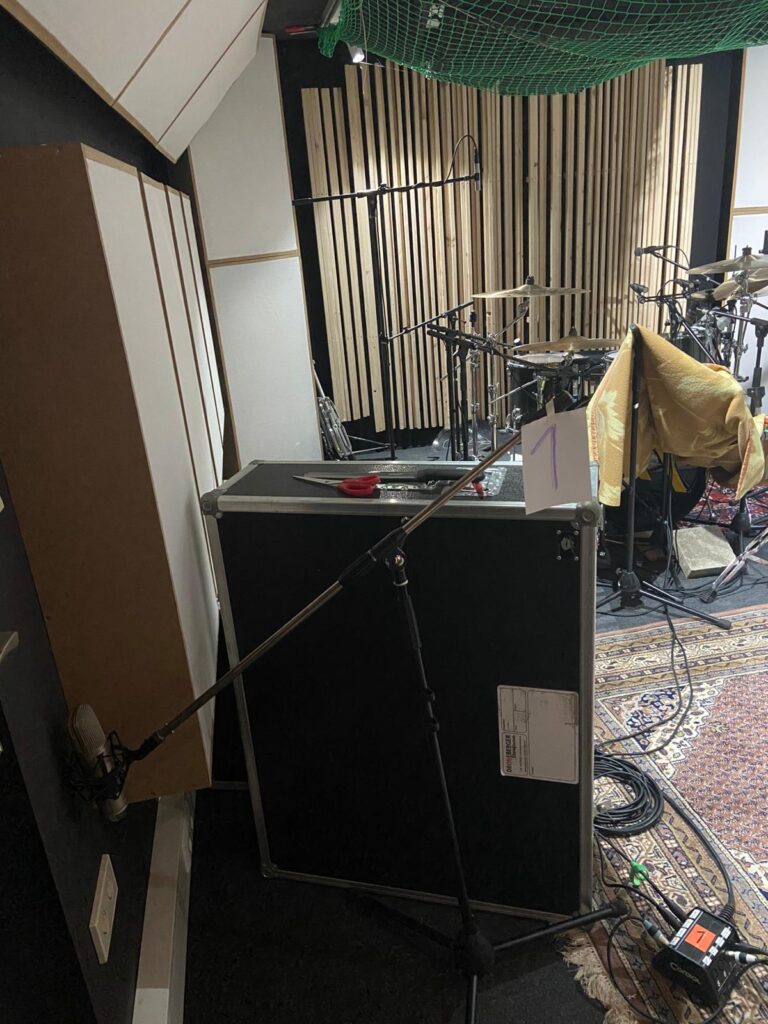
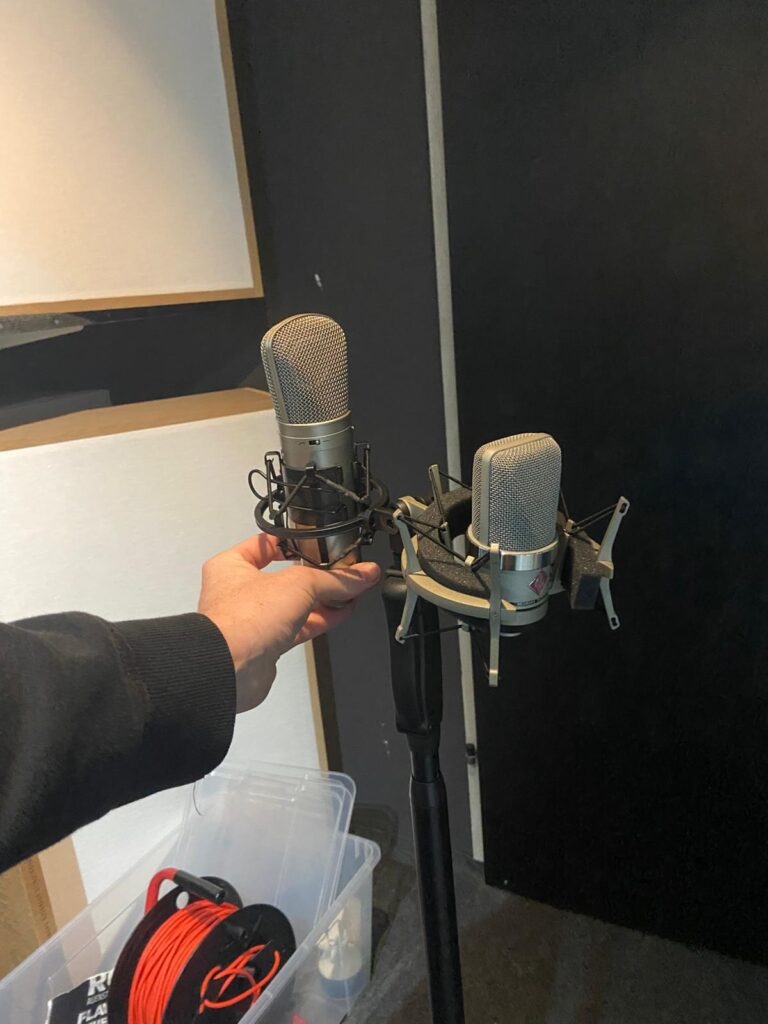
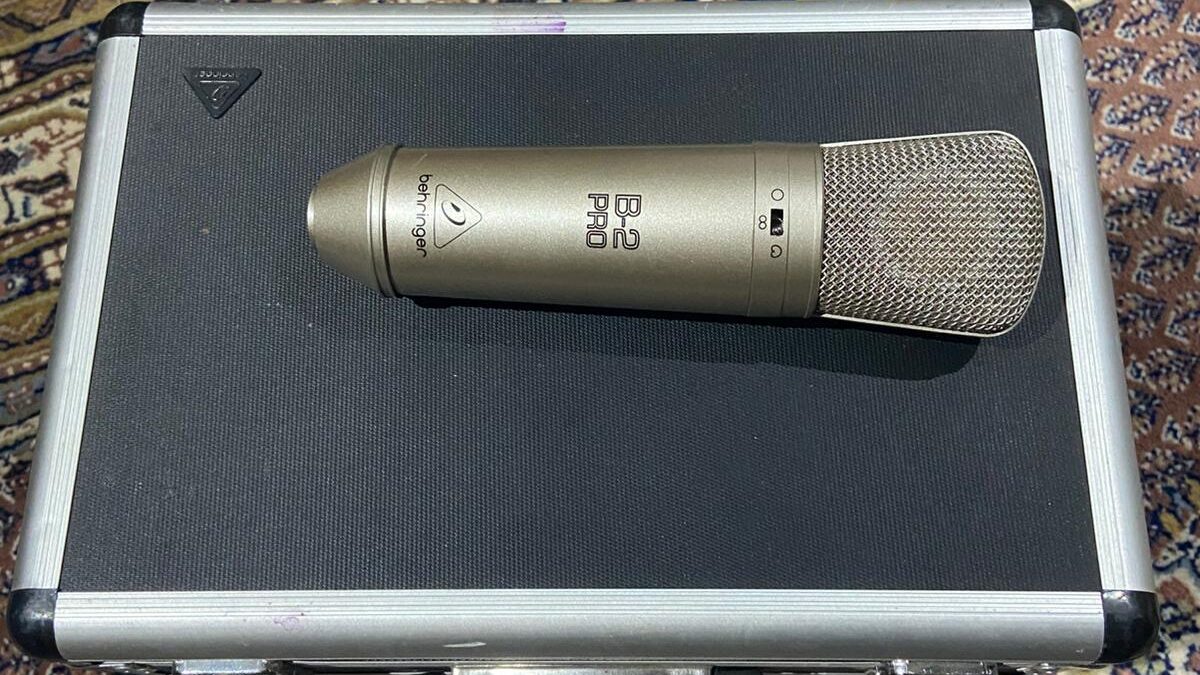
During the second recording session, a wide range of unconventional room microphone techniques were tested. For this purpose, several older Behringer B2 large-diaphragm condenser microphones were used, which I was able to borrow from a friend for the session.

Various microphone constellations were explored, often with the intention of minimizing direct sound capture and emphasizing early reflections and reverberant components instead.

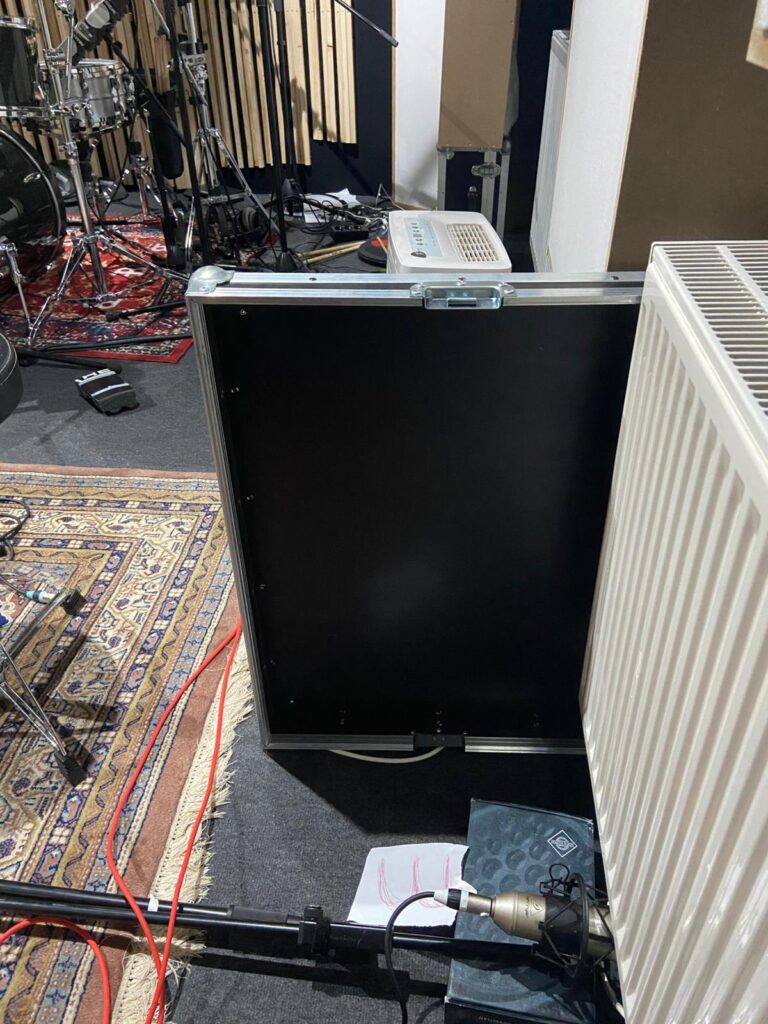
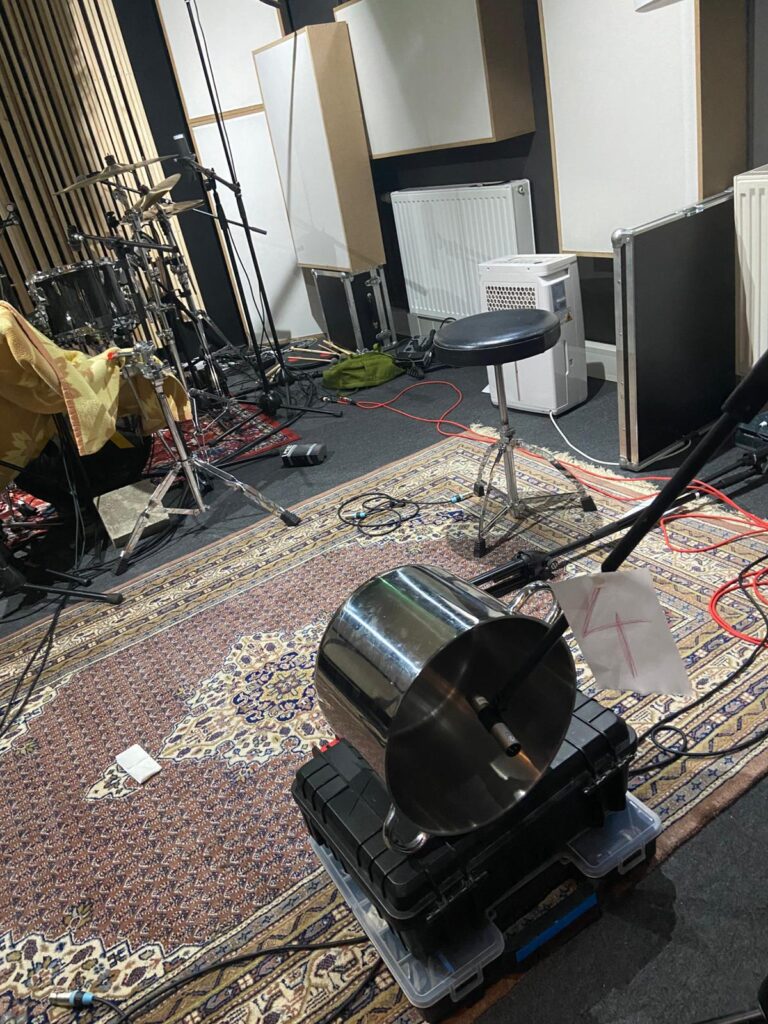
Due to the limited room size, achieving a clean separation between direct sound and room response proved challenging. Nevertheless, multiple strategies were tested, including shielding direct sound and placing microphones in acoustically reactive positions. Additional experiments were conducted by capturing resonant objects within the room, such as a large metal pot or a radiator, in order to introduce controlled resonances—through postproduction, the so-called “dirt”—into the drum sound.

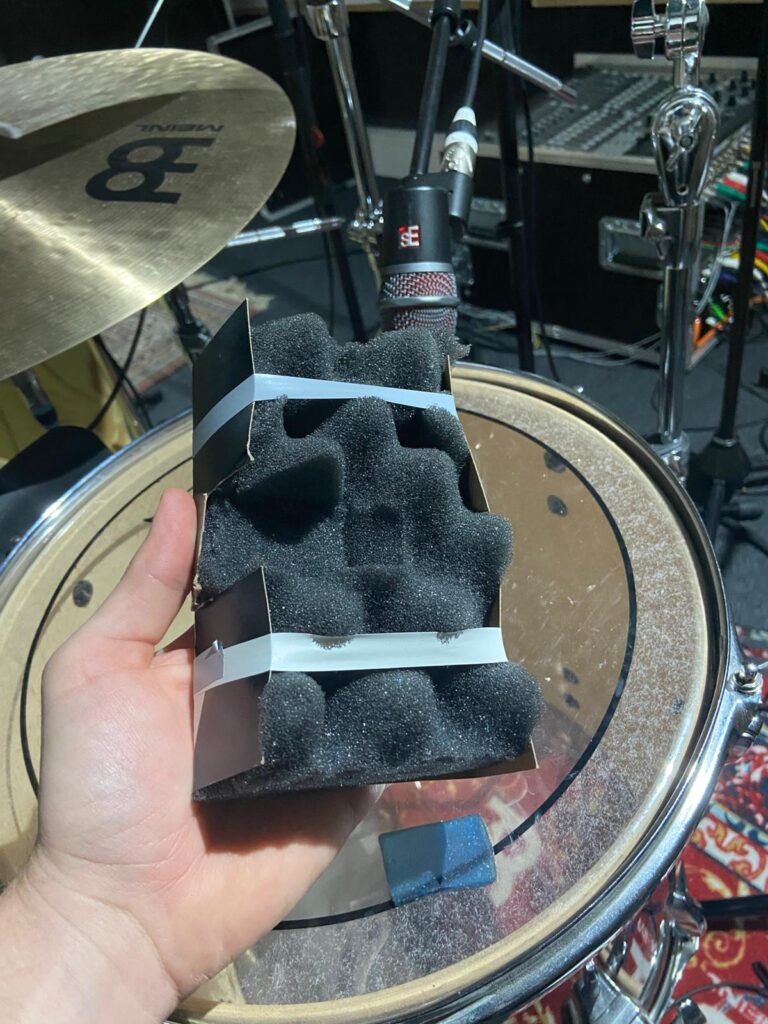
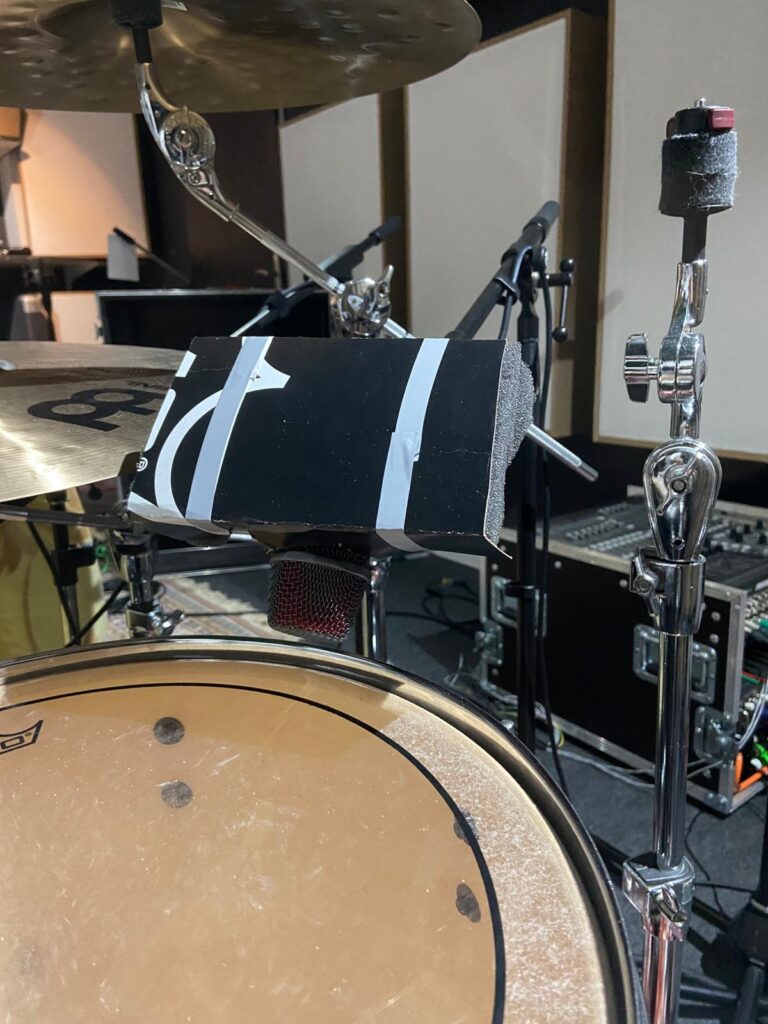
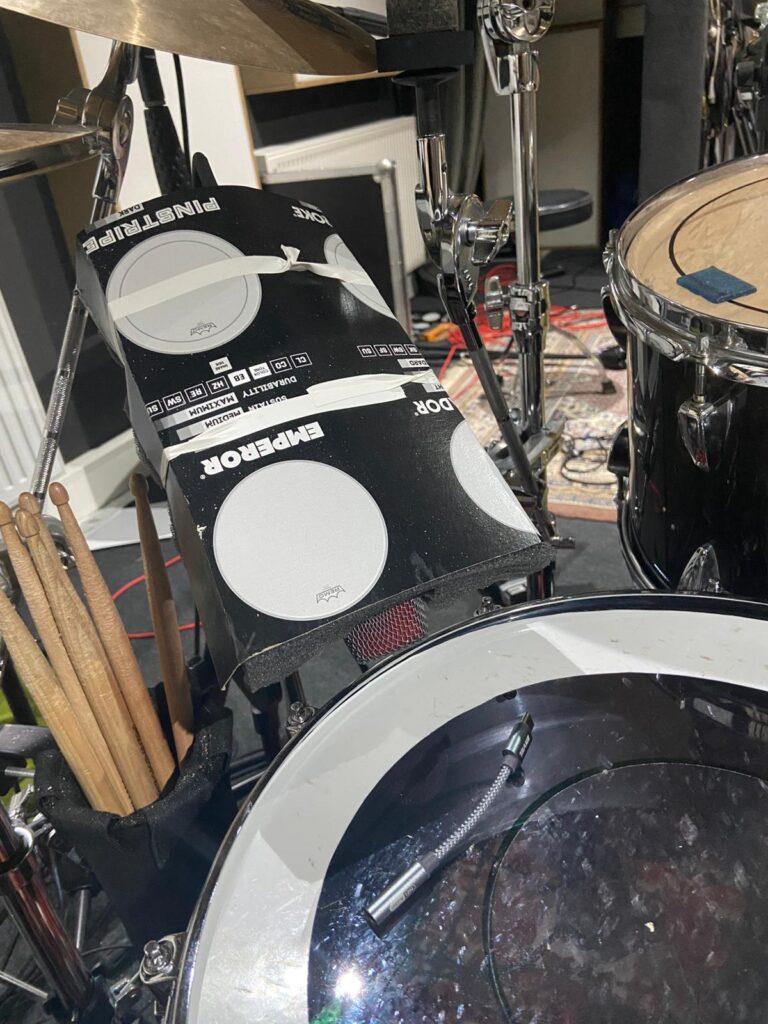
We also built temporary drum shields to reduce cymbal bleed, particularly for the snare and tom microphones.

Evaluation and Consequences

In practice, many of these experimental approaches resulted in signals that were perceived as overly diffuse or lacking clarity. Even after phase alignment and corrective processing, the room microphones often introduced a smeared or unstable drum image. Within an immersive context, this effect was further amplified, as spatial placement of these signals tended to pull the perceived drum position away from a stable frontal image.

As a result, the use of room microphones was significantly reduced. The most effective and reliable solution proved to be the “Droom” microphone setup (A/B stereo placement) positioned directly in front of the drum kit. This configuration provided a coherent spatial impression of the room while maintaining a clear and stable drum image. The “Droom” signal was spatially distributed behind the listener to increase envelopment and, in some cases, dynamically automated—for example, becoming more prominent during choruses. This technique proved highly successful and is considered a valuable approach for future productions.

The refined recording strategies directly influenced the production of the following tracks Alter Me and Caught In Dreams.

Refining Recording and Production Strategies

After completing the first recording, production and mixing phase, my interest in increasing our production quality got higher. I especially wanted to gain more knowledge in the field of mixing and recording — particularly drum recording.

Having “caught the bug” during the initial sessions, I became increasingly curious about unconventional approaches to capturing drum sound, especially in the context of immersive music production. Influences from producers and engineers such as Moses Schneider and Hans-Martin Buff encouraged me to further explore alternative recording strategies and to actively test the potential of non-standard microphone placements.

All other instruments and tracks were recorded using the same approaches already described in the previous production phase.

I will document the following recordings in the next blog posts.

Impuls 7: “The Framework” von Patrick O´Sullivan

Für meinen siebenten Impuls möchte ich endlich einmal etwas über die schier endlosen Weisheiten des WanderingDP mit euch teilen. Seit einigen Monaten schaue ich nun seine Pay-per-View Videos und bin nämlich echt schwer davon beeindruckt, wie genau und praktisch er auf Dinge eingeht. Als erstes möchte ich daher sein “Framework” zusammenfassen, das ist eine sechsteilige Videoserie, in denen er quasi die wichtigsten Aspekte moderner Kameraarbeit erklärt.

1. Upstage Lighting

Als ersten Punkt führt er hier sogenanntes Upstage Lighting ein. Dabei geht es im Grunde darum, wenn möglich, Kamera und Key auf unterschiedliche Seiten der Line of Action zu legen. Das führt automatisch dazu, dass die Kamera immer auf der Schattenseite des Subjekts ist und bietet daher einfach maximalen Kontrast. Laut O´Sullivan kreiert diese eine Sache bereits automatisch 80% eines kontrastreichen Looks.1

2. Der Point-of-Control

Seine Vorgehensweise beim Einleuchten einer Szene ist dabei quasi zu einhundert Prozent vom sogenannten Point-of-Control abhängig, also dem Licht in einer Szene, das man nicht oder nur sehr schwer kontrollieren kann. Draußen ist das klassischerweise die Sonne oder der Himmel an sich, aber auch Reflektionen oder heiße Spots im Hintergrund sind möglich. Drinnen liegt der Point-of-Control eigentlich fast immer in den Fenstern oder manchmal auch im ambient light. Das erste was ich also gemacht habe, wenn ich die Schauspieler im Raum platziert und den Frame gesetzt habe, ist ich suche diese Punkt und belichte dann für genau diesen, sodass mir eben der Himmel, das Fenster, die Spiegelung etc. nicht ausbrennt, sondern dass dieser Punkt genau richtig belichtet ist, da ich ihn ja nicht kontrollieren kann. Erst dann versuche ich die Szene mit dem restlichen mir verfügbaren Licht zu balancen.2

3. The Lighting Triad

Unter der Lighting Triad versteht O´Sullivan quasi seine Art des klassischen Dreipunktlichts. Damit beginnt er die Szene quasi wirklich zu leuchten, nachdem er zuerst den Frame gesetzt und auf den Point-of-Control belichtet hat. Die Triade besteht dabei aus dem Key (auf der gegenüberliegenden Seite der line of action von der Kamera), einer Menge negative fill statt klassischem fill light (auf der selben Seite wie der Kamera) und einem Kicker, ebenfalls auf der Kameraseite. Der große Unterschied zum klassischen Dreipunktlicht ist also, dass er auf der Fill-Seite immer versucht maximal viel Licht durch neg wegzunehmen, statt mit Lampen hinzuzufügen. Dies führt zu maximaler Kontrolle und maximalem Kontrast.3

4. Room Tone

Bei Room Tone geht is im Grunde um das Level der Umgebung, des Hintergrunds oder auch Ambientes. Heißt: Schon alle Lichter, die wir schon gesetzte haben bzw. die schon da sind: das Key, Kicker, die Fenster etc. beleuchten automatisch ja nicht nur das Subjekt, sondern die ganze Szene. Dabei muss man aber sichergehen, dass zum Beispiel der Hintergrund auch genug Licht abbekommt, gerade wenn er zum Beispiel weit weg vom Subjekt ist, weil es mitten im Raum steht. Denn während wir beim Point-of-Control extra auf diesen Belichten um sicherzugehen, dass er nicht clipped, möchten wir natürlich auch nicht, dass der Hintergrund zu dunkel ist und absäuft. Was O´Sullivan also macht ist, er bringt eine vierte Lichtquelle (Triad +1) ins Spiel, die so groß und so stark diffused wie möglich ist. Zum Beispiel eine große overhead Softbox, deren einziger Sinn ist, dem gesamten Raum eine schattenlose durchgängige Illumination zu geben, um zu verhindern, dass einzelne Elemente zu dunkel sind und Strukturen erkennbar bleiben. Ist der Room Tone bereits schon zu stark, stopped er in der Kamera beispielsweise durch ND oder Blende runter, und verstärkt die Kraft von Key und Kicker, bis das Verhältnis zwischen Vorder- und Hintergrund passt.4

5. The L of the Room

Eigentlich hätte dieses Kapitel wohl ganz an den Anfang gehört, denn beim L of the Room definiert O´Sullivan seine Vorgehensweise, wenn er aufs Set oder beim Recce auf die Location kommt. Dort sollte nämlich geklärt werden, wohin man die Subjekte der Szene stellt/setzt und von wo die Kamera das ganze filmt. Das L des Raums hilft dabei, genau diesen optimalen Spot zu finden, nämlich den, der am meisten Tiefe im Bild erzeugt. Für maximale Tiefe ist einmal eines klar, das Subjekt sollte nie direkt vor einer Wand stehen, da das im Grunde das flachste Bild ergeben würde, stattdessen sind die Ecken des Raumes immer besser geeignet. Und die beste Ecke findet man, indem man sich die zwei angrenzenden Wände einer Ecke immer als L vorstellt, da bei rechteckigen Räumen ja eine immer länger sein wird als die andere. Die perfekte Ecke ist dabei jene, in der die lange Seite des L´s die Wand mit den Fenstern ist und die kurze Seite keine Fenster hat. Diese Ecke macht es am einfachsten Tiefe zu erzeugen und gleichzeitig Upstage Lighting (von draußen durchs Fenster) zu praktizieren und ist damit vielleicht nicht der einzige, aber der einfachste Ort für ein gutes Bild.5

6. Salt and Pepper

Als wirklich letzten Schritt, bevor auf Rec gedrückt wird versucht O´Sullivan dann noch die letzten 1-2% aus dem Bild rauszuholen, deshalb die Analogie zu Salz und Pfeffer. Im Grunde, und das ist ja nicht nur sein Grundsatz, geht es ihm dabei so viele Iterationen zwischen Hell und Dunkel wie möglich zu schaffen – also so viel Kontrast wie möglich. Dafür arbeitet er in den letzten Minuten, wenn Subjekt, Kamera, Key, Roomtone usw bereits stehen, noch daran irgendwo kleine Highlights zu platzieren um das Bild interessanter zu machen. Also zum Beispiel noch einmal Licht von draußen durch ein Fenster zu bringen und auf die Wand fallen zu lassen, oder mit einem Spotlight Mount so etwas noch einmal zu imitieren. Auch die letzte Ausrichtung, also dass die Kamera noch einmal einen Grad nach links oder rechts geht, damit sich Schatten und Lichter in Hinter- und Vordergrund nicht überlappen, sondern abwechseln, zählt noch in diese letzten Steps.6

Fazit

Ich finde O´Sullivan ist eine wahnsinnig gute Ressource für gut und praktikabel vermitteltes Wissen. Ich weiß nicht inwiefern seine Videos geeignet als Quellen für die Masterarbeit sein können, gerade jene Inhalte hinter der Paywall, die ja dann nur schwer von Prüfer oder Begutachter nachvollziehbar sind. Falls nicht, werde ich versuchen ähnliche Theorien in publizierter Literatur zu finden. Fürs Verständnis sind seine Ansätze aber einfach unersetzbar.

  1. http://wanderingdp.com/2344780_frame_23_/ ↩︎
  2. http://wanderingdp.com/149813_basdfkei_framework_2/ ↩︎
  3. http://wanderingdp.com/adskjadfn_214313257_framework_3/ ↩︎
  4. http://wanderingdp.com/bsasdjk_2345_framework_4/ ↩︎
  5. http://wanderingdp.com/sdkjdeewiud_14535_framework_5/ ↩︎
  6. http://wanderingdp.com/sdllwekhjht_4377892_framework_6/ ↩︎

QR Codes and AR in Retail

Simple Technologies with Big Impact

Augmented Reality (AR) in retail is often presented as complex and expensive. However, effective AR solutions do not always require advanced hardware or fully immersive systems. One of the most realistic and accessible approaches is the use of QR codes and image-based recognition to connect physical retail spaces with digital content.

This blog post explores how simple AR entry points can have a strong impact on customer comfort, decision-making, and user experience.

What “Low-Cost AR” Means in Retail Design

In this context, low-cost AR refers to systems that do not require special devices such as AR glasses or smart mirrors. Customers can use their own smartphones, which lowers both technical and financial barriers.

Low-cost AR solutions include:

  • QR codes placed in the store
  • image recognition based on existing visuals
  • web-based AR instead of custom apps

This approach follows early AR research, which defines AR as a technology that adds digital information to the real world, not replaces it (Augmented Reality).

Store Concept: Section-Based QR Codes That Support Physical Movement

The core idea behind this concept is to support physical shopping, not replace it.

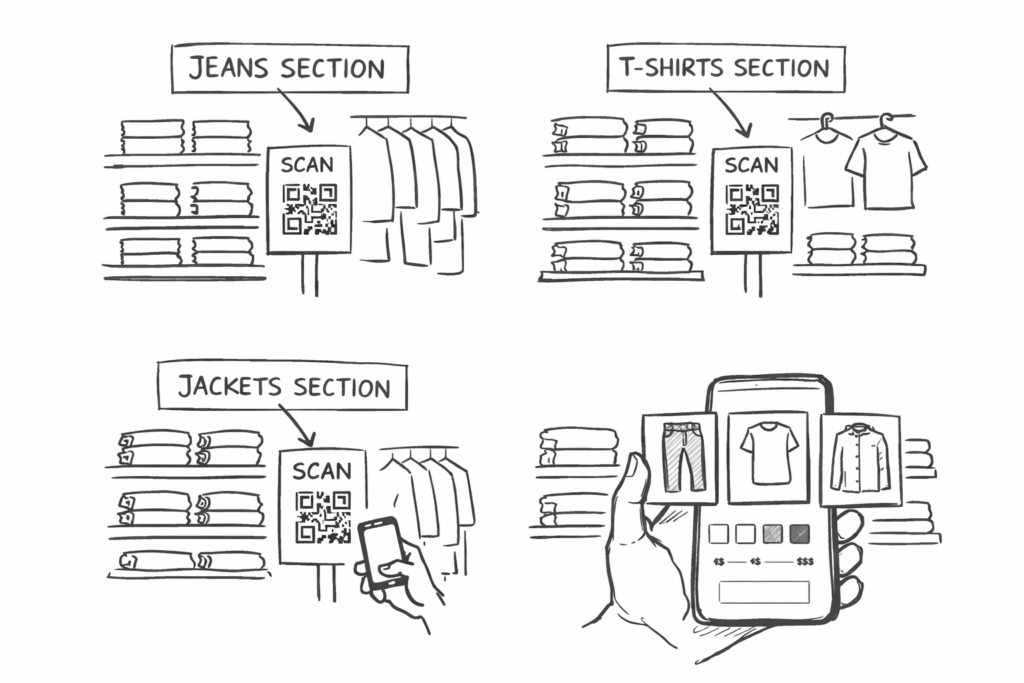
Instead of attaching QR codes to every single product, QR code stickers are placed by store sections, for example:

  • one QR code for the jeans section
  • one QR code for the T-shirt section
  • one QR code for the jacket section

This design choice encourages customers to walk through the store, browse physically, and stay engaged with the space.

After scanning the QR code, the customer would see:

  • images of all available items in that section
  • simple filters (size, color, cut, price range)
  • visual previews instead of long text

This keeps the store experience active while adding a calm digital support layer.

Beyond QR Codes: Adaptive AR Using Image Recognition

Importantly, this system does not need to rely only on QR codes.

Based on older blogpost we realized that computer vision and image recognition, modern applications are already able to:

  • recognize images or objects through the camera
  • match them with stored visual databases
  • “remember” or identify visual patterns

This means that instead of scanning a QR code, a customer could:

  • point the camera at a section sign, poster, or product image
  • let the system recognize the image
  • automatically open the related digital content

Research presented in Computer Vision shows that image recognition systems can reliably identify visual features and link them to stored information. These methods are already used in retail apps, museums, and navigation systems.

From a design perspective, this makes the system adaptive:

  • QR codes can be used as a clear entry point
  • image recognition can work as a more seamless alternative
  • both systems can coexist

This flexibility allows designers to choose the level of visibility and interaction that best fits the store atmosphere.

Reducing Cognitive Load with Structured Visual Information

Cognitive load means the amount of mental effort required to process information and make decisions. Presenting information only when it is needed helps reduce extraneous cognitive load and prevents users from feeling overwhelmed.

Retail environments can easily overwhelm customers through:

  • visual clutter
  • too many options
  • unclear organization

Research summarized in The Cambridge Handbook of Multimedia Learning shows that users process information better when it is:

  • structured
  • optional
  • visually supported

Section-based AR helps reduce cognitive load by:

  • grouping items logically
  • showing only relevant products
  • allowing filtering instead of searching

This supports clearer and calmer decision-making.

Why This Approach Matters for Retail Design

This QR- and image-based AR concept is effective because it is:

  • low-cost – no special hardware required
  • adaptive – QR codes and image recognition can be combined
  • inclusive – supports different user personalities
  • emotionally supportive – reduces pressure and overstimulation

As discussed in Digital Consumer Management, modern retail success depends on understanding how digital tools affect emotions, comfort, and consumer confidence, not only efficiency.

Conclusion

QR codes and image recognition show that meaningful AR in retail does not require complex systems. By placing digital entry points at the section level and allowing customers to filter and explore visually, retailers can support autonomy while preserving the physical shopping experience.

According to multimedia learning theory, users process information more effectively when content is presented in a structured and segmented manner rather than all at once.

In this approach, AR becomes a quiet, adaptive assistant that respects emotional comfort, cognitive limits, and personal space.

Sources

  • Norman, D. A. (2004). Emotional Design: Why We Love (or Hate) Everyday Things. Basic Books.
  • Mayer, R. E. (Ed.). (2005). The Cambridge Handbook of Multimedia Learning. Cambridge University Press.
  • Mogaji, E. (2024). Digital Consumer Management: Understanding and Managing Consumer Engagement in the Digital Environment. Routledge.

Disclosure (as requested):
In the development of this blogpost, AI (ChatGPT) was used as a supportive writing and structuring tool. I provided the conceptual content, research direction, theoretical preferences, and methodological decisions, while the AI assisted in translating it to English, refining the wording, organising the material and generating coherent academic formulations based on my input. The AI did not produce research or arguments but helped transform my ideas into a clear and well-structured text draft.