Simple Technologies with Big Impact
Augmented Reality (AR) in retail is often presented as complex and expensive. However, effective AR solutions do not always require advanced hardware or fully immersive systems. One of the most realistic and accessible approaches is the use of QR codes and image-based recognition to connect physical retail spaces with digital content.
This blog post explores how simple AR entry points can have a strong impact on customer comfort, decision-making, and user experience.
What “Low-Cost AR” Means in Retail Design
In this context, low-cost AR refers to systems that do not require special devices such as AR glasses or smart mirrors. Customers can use their own smartphones, which lowers both technical and financial barriers.
Low-cost AR solutions include:
- QR codes placed in the store
- image recognition based on existing visuals
- web-based AR instead of custom apps
This approach follows early AR research, which defines AR as a technology that adds digital information to the real world, not replaces it (Augmented Reality).
Store Concept: Section-Based QR Codes That Support Physical Movement
The core idea behind this concept is to support physical shopping, not replace it.
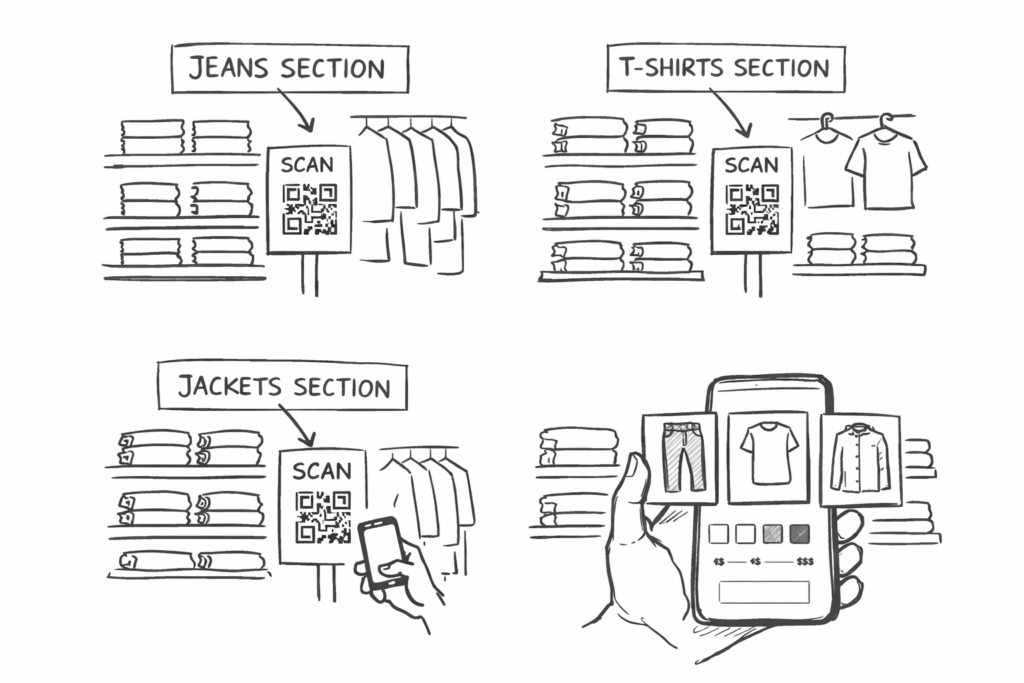
Instead of attaching QR codes to every single product, QR code stickers are placed by store sections, for example:
- one QR code for the jeans section
- one QR code for the T-shirt section
- one QR code for the jacket section
This design choice encourages customers to walk through the store, browse physically, and stay engaged with the space.
After scanning the QR code, the customer would see:
- images of all available items in that section
- simple filters (size, color, cut, price range)
- visual previews instead of long text
This keeps the store experience active while adding a calm digital support layer.
Beyond QR Codes: Adaptive AR Using Image Recognition
Importantly, this system does not need to rely only on QR codes.
Based on older blogpost we realized that computer vision and image recognition, modern applications are already able to:
- recognize images or objects through the camera
- match them with stored visual databases
- “remember” or identify visual patterns
This means that instead of scanning a QR code, a customer could:
- point the camera at a section sign, poster, or product image
- let the system recognize the image
- automatically open the related digital content
Research presented in Computer Vision shows that image recognition systems can reliably identify visual features and link them to stored information. These methods are already used in retail apps, museums, and navigation systems.
From a design perspective, this makes the system adaptive:
- QR codes can be used as a clear entry point
- image recognition can work as a more seamless alternative
- both systems can coexist
This flexibility allows designers to choose the level of visibility and interaction that best fits the store atmosphere.
Reducing Cognitive Load with Structured Visual Information
Cognitive load means the amount of mental effort required to process information and make decisions. Presenting information only when it is needed helps reduce extraneous cognitive load and prevents users from feeling overwhelmed.
Retail environments can easily overwhelm customers through:
- visual clutter
- too many options
- unclear organization
Research summarized in The Cambridge Handbook of Multimedia Learning shows that users process information better when it is:
- structured
- optional
- visually supported
Section-based AR helps reduce cognitive load by:
- grouping items logically
- showing only relevant products
- allowing filtering instead of searching
This supports clearer and calmer decision-making.
Why This Approach Matters for Retail Design
This QR- and image-based AR concept is effective because it is:
- low-cost – no special hardware required
- adaptive – QR codes and image recognition can be combined
- inclusive – supports different user personalities
- emotionally supportive – reduces pressure and overstimulation
As discussed in Digital Consumer Management, modern retail success depends on understanding how digital tools affect emotions, comfort, and consumer confidence, not only efficiency.
Conclusion
QR codes and image recognition show that meaningful AR in retail does not require complex systems. By placing digital entry points at the section level and allowing customers to filter and explore visually, retailers can support autonomy while preserving the physical shopping experience.
According to multimedia learning theory, users process information more effectively when content is presented in a structured and segmented manner rather than all at once.
In this approach, AR becomes a quiet, adaptive assistant that respects emotional comfort, cognitive limits, and personal space.
Sources
- Norman, D. A. (2004). Emotional Design: Why We Love (or Hate) Everyday Things. Basic Books.
- Mayer, R. E. (Ed.). (2005). The Cambridge Handbook of Multimedia Learning. Cambridge University Press.
- Mogaji, E. (2024). Digital Consumer Management: Understanding and Managing Consumer Engagement in the Digital Environment. Routledge.
Disclosure (as requested):
In the development of this blogpost, AI (ChatGPT) was used as a supportive writing and structuring tool. I provided the conceptual content, research direction, theoretical preferences, and methodological decisions, while the AI assisted in translating it to English, refining the wording, organising the material and generating coherent academic formulations based on my input. The AI did not produce research or arguments but helped transform my ideas into a clear and well-structured text draft.
