Impulse #5 – Talk with Birgit

Before the break I met with Birgit to talk about my master’s thesis. I had a rough idea what I want to do for my thesis since end of November, but nothing really concrete yet. To be honest I also had some doubts about the topic every other day if this is really what I want to do. I thought a lot about the topic and the project, brainstormed, researched but somehow, I circled around the same project ideas over and over again. While this is probably a normal part of the process, I still felt stuck. So, the meeting with Birgit came at a very good time for me, since I wanted to move forward with my idea and get more concrete.

One thing that felt quite clear to me already was the general direction for my thesis. I want to design something that embraces low-pressure creativity, fun, a bit of uselessness, and something whimsical. I feel like we are missing all of these sometimes during our everyday life as creatives. I see this as a counter to the productivity- and hustle-culture we are currently live in. It feels like everything needs to be useful, perfect and efficient. With my thesis I want to explore the opposite: creating a space where people can simply enjoy the act of creating without goals, pressure and expectations.

However, my intention felt clear, I struggle with what the creative space/playground could be. What should be on the website? What do people do there? How does it look like? After pitching her my idea she gave me a historical context I didn’t think of yet. She told me about a the time where the internet was full of so-called “useless” or one-purpose websites, especially during the time of Flash websites. These sites didn’t try to solve a problem or be efficient; they simply existed for fun, surprise and a little confuse.

One example she showed me was the, back in the days very famous, Hamster Dance Website (http://www.hamsterdance.org/hamsterdance/). The website doesn’t really do any useful it is basically just a loop of animations of a hamster with music (unfortunately the sound somehow doesn’t work, but the version Birgit showed me had sound). There is no goal, it doesn’t lead to anything and there is no productivity value and yet it is very joyful and funny. This reminded me that the internet hasn’t always been about optimization, metrics and productivity. It was playful, strange and delightfully pointless. So, I am going to take a deeper look at the history of websites and what was already out there.

Another aspect Birgit told me I should consider is the time factor. She suggested that the webspace or the content of it should not be available all the time. Instead of it being constantly available, it should be available only temporarily, for example 24 hours, before disappearing or changing into something else. That is the same concept as BeReal follows, people can take a snapshot of what they are doing now, once every 24 hours. This limitation creates presence and urgency, but without the pressure to be perfect. This temporal aspect could reinforce the idea of low-pressure creativity: you show up, you play, you create and then it’s gone. You create just in the moment, there is no way to iterate, optimize or monetize.

Even though I still don’t have an exact idea of what the webspace should be like, the talk with Birgit gave me new insights and impulses for the next steps.

AI was used to check spelling and grammar and better clarity.
IMPULSE #4: World Usability Congress 2025

Spending two days at the World Usability Congress in Graz made me focus on UX aspect of my thesis. The talks I followed were mostly about UX KPIs, usability testing and accessibility, and I kept translating everything into my own topic: AR and IoT in retail. Instead of just thinking about how my future system could look, I started to think in a much more concrete way about how to measure it, test it and make sure it works for real people, not only in prototypes.

KPIs – Learning To Define What “Better” Means

One of the clearest lessons was how seriously UX teams treat KPIs. In my notes I wrote that valuable improvements are often only 10 to 15 percent per quarter, and that this is already considered success. That sounds small, but the important part is that these improvements are defined and measured. The typical UX KPIs that kept coming up were conversion rate, task completion time, System Usability Scale score, Net Promoter Score and error rate.

For my thesis this means I cannot just write “AR wayfinding will improve the shopping experience”. I need to specify what that improvement looks like. For example: people find a product faster, they ask staff for help less often, they feel more confident about their choices. The practical action I took from the congress is: for each feature I design, I will write down one or two concrete metrics and how I would measure them in a real store test. That turns my concepts into something that can be evaluated instead of just admired.

Accessibility As A Built In Check, Not An Extra

The accessibility track was also directly relevant. In my notes I wrote down a “quick checklist” that one speaker shared: check page layout and content, contrast and colours, zoom, alerts and error messages, images and icons, videos, no flashing animation and audio only content. It is simple, but exactly because it is simple it is realistic to apply often.

For my AR and IoT ideas, this becomes a routine step. Whenever I sketch a screen or overlay, I can quickly run through that checklist. Also thinking how my work could also have an impact on the accessibility for the end users. Are colours readable on top of a busy store background. Can text be enlarged. Is there a non visual way to access key information. Combined with talks about accessibility on a corporate level and inclusive design for neurodivergent people, it pushed me to treat accessibility as a default requirement. The concrete action is to document accessibility considerations in my thesis for every main feature, instead of adding a separate chapter at the end.

What I Take Back Into My Thesis

After World Usability Congress, my AR and IoT retail project feels less like a collection of futuristic ideas and more like something that could be developed and tested step by step. The congress gave me three practical habits. First, always define UX KPIs before I design a solution, so “better” is not vague. Second, run an accessibility quick check on every main screen or interaction and think about different types of users from the start.

This fits nicely with my other blog reflections. The museum visit gave me ideas about where AR and IoT could be applied. The festival made me think about wayfinding and smart environments. World Usability Congress added the missing layer: methods to prove that these ideas actually help people and do not silently exclude anyone.

Links
Official conference homepage
World Usability Congress – Home World Usability Congress

2025 agenda with talks and speakers
World Usability Congress 2025 – Agenda World Usability Congress
AI Disclaimer
This blog post was polished with the assistance of AI.

IMPULSE #3: Meta Connect 2025 AR Moving From Headsets To Everyday Life

Watching Meta Connect 2025 felt like seeing my thesis topic walk on stage. The focus was not on big VR helmets anymore but on glasses that look close to normal and are meant to be worn in everyday life. The main highlight was the new Meta Ray-Ban Display, a pair of smart glasses with a small full color display in one lens and a lot of AI power built in. They are controlled with a neural wristband that reads tiny finger movements, so you can click or scroll with almost invisible gestures.

When starting this topic I have theorized how technology going to look and have had my hopes and assumptions. A few years ago AR meant heavy hardware that you would never wear into a supermarket or furniture store. Now the vision is a pair of sunglasses that weigh about as much as regular glasses, can show simple overlays in your field of view and are designed to be worn on the street, in a shop or on the couch. The technology is still expensive and early, but watching the keynote made it very clear that the direction is: smaller, lighter, more normal looking, and more tightly connected with AI.

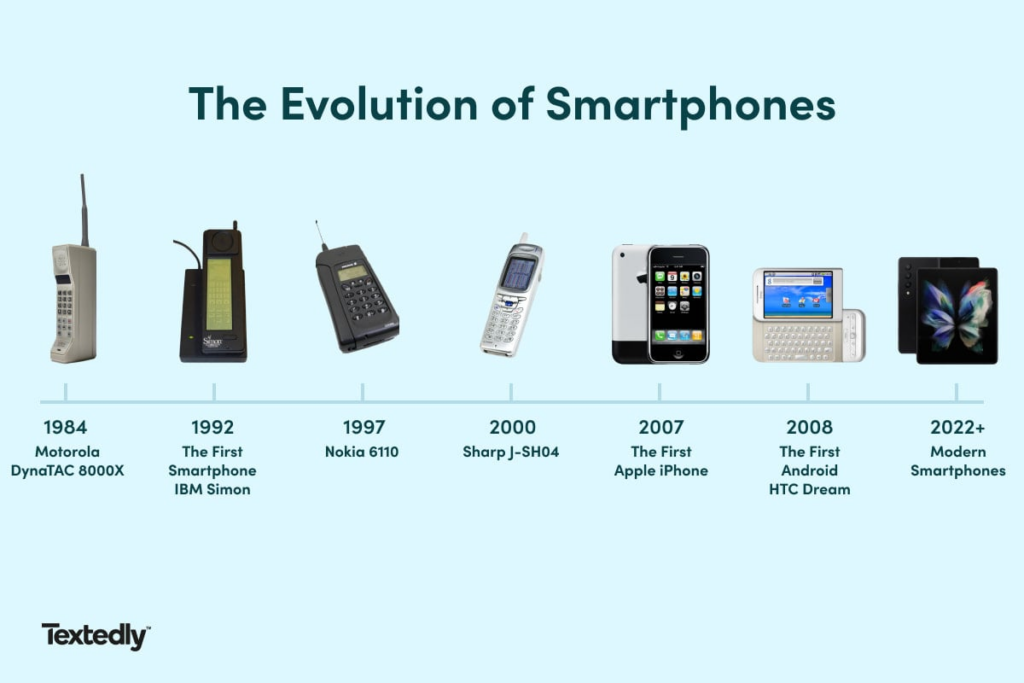
It could be compared to evolution of the phones and technology in general how our everyday devices moved from being heavy and bulky to light and portable and also with having speculations such as it’s not needed we can come to vision that everyday said we do not need phones because we have laptops but technology advances and we find new ways where we interact with the world.

What I Learned About AR From The Event

The first learning is about form factor. The Ray-Ban Display does not try to turn your whole field of view into a digital world. It uses a compact display area to show only what is necessary: navigation hints, messages, short answers from Meta AI or the title of a song that is playing. Instead of replacing reality, it adds a thin layer on top of it.

The second learning is about interaction. The neural wristband is a good reminder that people do not want to wave their arms in public to control AR. In real environments like a festival, a museum or a supermarket, subtle gestures or simple taps are much more realistic.

The third learning is the merge of AI and AR. The glasses are clearly designed as AI first devices. They can answer questions, translate speech, caption what you hear and see, and then present this information visually inside the lens.

Technology Getting Smaller And More Accessible

Another strong theme in Meta Connect is how quickly the hardware is trying to become socially acceptable. Earlier devices were clearly gadgets. These glasses try to be fashion first, tech second. They look like familiar Ray-Ban frames instead of a prototype. The same is true for battery life and comfort. The promise is that you can wear them for several hours without feeling like you are in a lab experiment.

Why Meta Connect Matters For My Thesis

Meta Connect 2025 confirmed that my scenarios for AR in retail are not just science fiction. The building blocks are emerging in real products: lightweight glasses, AI assistants, subtle input methods and simple overlays instead of full virtual worlds. For my master’s thesis this is both motivating and grounding. It tells me that the interesting design work is no longer about asking if AR will be possible in stores, but about shaping how it should behave so that it actually helps people shop, learn and navigate without stealing the spotlight.

Technology should become smaller, calmer and closer to everyday objects, so it can quietly support what people already want to do in physical spaces. Not to replace those spaces, but to make moving through them a little clearer, smarter and more human.

Links

Official Meta recap of the Connect 2025 keynote (Ray-Ban Display, Neural Band etc.)
Meta Connect 2025 – AI Glasses And Ray-Ban Display Meta

Meta product page for Ray-Ban Meta smart glasses (for specs and positioning)
Ray-Ban Meta Smart Glasses – Meta Meta

General info / news listing around Meta smart glasses and AI wearables
Meta – Newsroom / Ray-Ban Meta Announcements

AI Disclaimer
This blog post was polished with the assistance of AI.

IMPULSE #2: A Night of Techno Losing Yourself And Finding Your Way Experience

The night I saw Charlotte de Witte at Signal Festival was pure overload. Heavy bass, dense crowd, strobing lights, smoke, multiple bars and stages, lockers, queues, a constant flow of people in every direction. As an experience it was amazing, I am a designer and one thing I love to do and always do is to see how I can optimize the whole event and how I can apply it to my thesis because I am also a workaholic.

Observations: Immersion Versus Orientation

One of my strongest observations was how different immersion and orientation felt. Immersion was perfect. When I was in front of the main stage, I did not need any interface. The sound and visuals were enough. Orientation was a different story. Moving away from the stage meant guessing, especially if you got drunk a bit. Where is the nearest bar that is not overcrowded. Which corridor leads to the toilets. How do I get back to my locker without opening the venue map again and again. The more time passed, the more people were intoxicated, and the weaker everyone’s internal navigation became.

At some point I lost my friends in the crowd and we had the usual routine: messages that did not go through, vague descriptions like “I am near the left bar” that are useless in a dark hall, and the classic feeling of spending twenty minutes trying to reconnect. When you are sober this is still slightly annoying. Once you are drunk, it becomes hard work.

Understanding: How AR And IoT Could Be A Soft Safety Net

This is where I started to imagine an IoT based guidance system with AR as the interface. Where IoT beacons or other positioning technology could be distributed across the venue. Every bar, locker zone, toilet block and entrance could have its own tiny digital footprint. If visitors opt in, AR glasses could use this network to understand three basic things in real time: where they are, where their friends are, and where key services are located.

In practice, that could look very simple. An AR arrow could hover in my view and gently lead me to my locker, even if I barely remember which area I used. A small indicator could show me which direction my friends are in and roughly how far and also notify in case my friends need help as sometimes you can face safety issues other people approaching and annoying. If I want a drink, the system could show the nearest bar plus tell where I can go to smoke. If there is an emergency or I need to leave quickly, the AR layer could highlight the closest safe exit instead of forcing me to rely on my memory in a confused state.

Main Concept: Festivals As Prototypes For Smart Guidance

The main concept that came out of Signal Festival for me is the idea of a soft, ambient guidance system built on AR and IoT. The festival does not need more screens. It needs invisible structure that supports people at the right moment. A network of small, low power devices in the space can give the system awareness of positions and states. Which will elevate user experience nd AR then becomes a thin, context aware layer on top of that awareness. It answers very simple questions: where am I, where is what I need, and how do I get back.

This is closely related to my retail research. A music festival is like an extreme version of a shopping mall. Both are large, noisy, crowded environments where people try to reach specific goals while managing limited energy and attention. If a guidance system can help a drunk visitor find the right bar, locker or friend in a dark venue, it can certainly help a tired shopper find the right aisle or click and collect point in a busy store.

Links
Event page for Signal Festival Weekend 2 at Pyramide
Signal Festival – PYRAMIDE TAKEOVER WE2 (O-Klub) O-Klub

Techno event listing with headliners and description
Signal Festival Pyramide WE2 – Event Overview technomusicworld.com

Local article about Signal Festival in the glass pyramid
Signal Festival in der Pyramide Vösendorf – Heute.at

AI Disclaimer
This blog post was polished with the assistance of AI.

IMPULSE #1 Kunsthistorisches Museum Wien: Analog Space, Digital Ideas

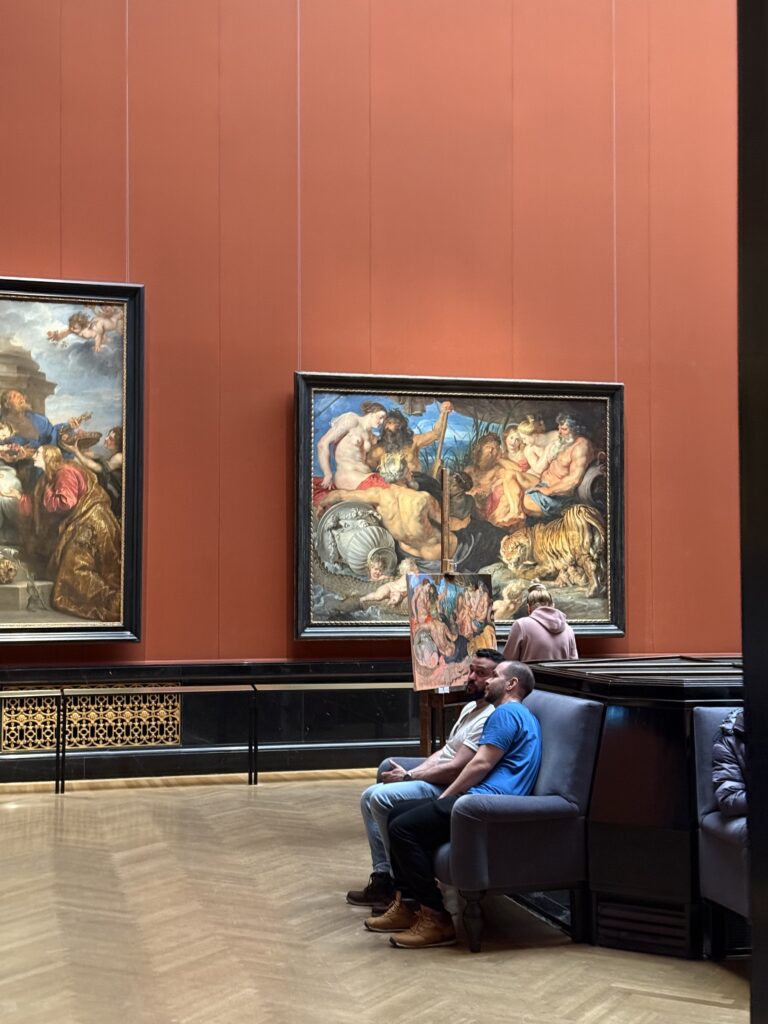
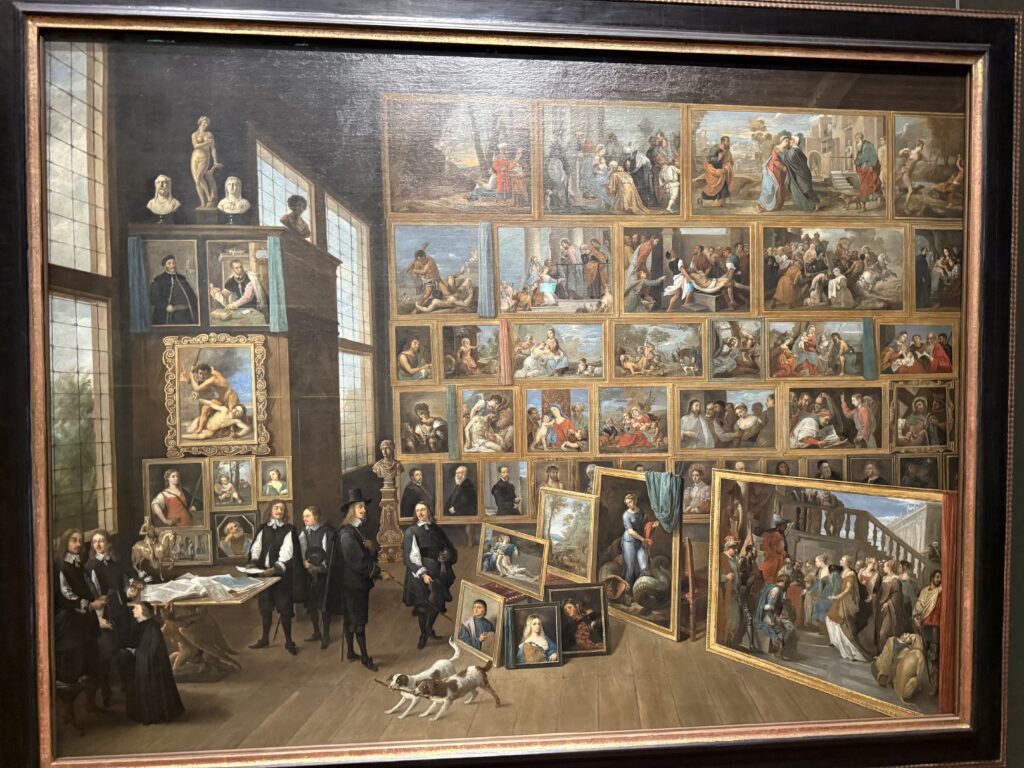
Visiting the Kunsthistorisches Museum Wien felt almost the opposite of my thesis topic. It’s a very “analog” space: heavy architecture, old masters, quiet rooms, and almost no visible technology. Apart from the optional audio guide device, there are no screens, no projections, no interactive installations. You move from room to room, read the small wall texts and simply look.

That contrast is exactly what made the visit so valuable for me as an interaction design student. I wasn’t impressed by high-tech features. I was impressed by how much potential there is for technology to quietly support the experience without taking attention away from the art itself. The museum became a kind of mental sandbox where I could imagine how AR and IoT might be implemented in a very delicate context: history, culture, and learning.

Observations: A Classical Museum with a Small Digital Layer

My main observation was how traditional the user journey still is. You enter, pick a wing, and mostly navigate by room numbers, map and intuition. The only digital touchpoint I used was the handheld audio guide. Even that already shows the basics of what I work with in my thesis: an extra information layer on top of the physical space. You enter a painting number, press play, and suddenly you get context, story and meaning instead of just title, date and artist.

But the interaction is linear and passive. You always get the same story, no matter who you are, how much you already know, or what caught your eye. There is no way for the system to “notice” that you are fascinated by one detail and want to go deeper, or that you are in a hurry and only want a short summary. It made me see very clearly where today’s museum tech stops and where AR and IoT could start.

Understanding: Technology Should Support the Artwork, Not Compete with It

Standing in front of paintings, I tried to imagine AR in the room. The danger is obvious: if we fill the space with too many digital elements, the painting becomes a background for the interface. That’s exactly what I do not want, and it connects strongly to my thesis: technology must serve the human and the content, not distract from it.

So my understanding is that any AR or IoT system in a museum like this would have to be extremely calm, subtle and respectful. The artwork stays the main actor. AR is just a transparent layer that appears only when the visitor asks for it. IoT devices like small beacons near the frame could be completely invisible, only there to let the system know where you are and what you’re looking at. The goal is not to “modernise” the museum for its own sake, but to deepen the connection between visitor and artwork.

Main Concept: A Future AR & IoT Guidance Layer for Museums

The main concept that came out of this visit is to treat the museum as a potential case study for the same principles I explore in smart retail: guided navigation, contextual information, and personalised journeys, all powered by AR and IoT.

I imagined wearing AR glasses instead of holding an audio guide. When I look at a painting for more than a few seconds, a small icon could appear next to it in my field of view. If I confirm, the system overlays very minimal hints: a highlight around a specific detail, a short caption, or the option to see a brief animation explaining the story behind the scene. If I want more, I can dig deeper maybe see a reconstruction of how the painting originally looked, or how it was restored. If I don’t, nothing changes; I just keep looking with my own eyes.

The same system could also redesign the wayfinding experience. Instead of a fixed predefined tour, AR could show me a route that matches my interests and time: “Show me five highlights from the Renaissance in 45 minutes,” or “Guide me only to works that relate to mythology.” IoT sensors in rooms could provide live information about crowding, so the path avoids the most packed galleries and keeps the experience more relaxed.

What mattered most for me in this museum visit was not what technology was already installed, but the mental exercise of placing my thesis ideas into this setting. It helped me see that the principles I am developing for AR and IoT could have wider use case from the intended one and give a perspective for a retail subtle guidance, context-aware information, and respect for the physical environment also make sense in a cultural space.

Links

Official museum site
Kunsthistorisches Museum Wien – Official Website KHM.at

Visitor overview and highlights in English
Kunsthistorisches Museum – Overview & Highlights (visitingvienna.com) Visiting Vienna

Background and history of the building
Kunsthistorisches Museum Wien – Wikipedia

AI Disclaimer
This blog post was polished with the assistance of AI.

IMPULSE #4: Lunch with Prof. Baumann (with some good Kebap!)

This impulse is a bit different from the others because it is not a book or a talk, but a lunch meeting with Prof. Konrad Baumann that helped me put much sharper edges around my thesis idea. The conversation was essentially my first “real” check-in with someone I would like to supervise my thesis, and it forced me to articulate my motivations and what I actually want to achieve with “effective ethical design” and digital footprints. Instead of staying in my own head, I had to explain why this topic matters to me and where I see it sitting inside UX practice and the wider industry. That alone made this meeting feel like an important impulse.

We started by reconnecting threads from a previous class discussion, where we had talked about our interests in the UX field and the kinds of industry problems we care about. For me, those questions brought back the same themes: ethical design, dark patterns, privacy, and how users are often left in the dark about their data trails. This lunch was like a continuation of that exercise, but one-on-one and more honest. Saying my thesis topic out loud and contextualising it in front of someone with experience in this area made my intentions feel more “real”, and it also exposed where my thinking was still a bit vague or too broad.

I really liked how he brought up concrete cases and pointed me toward resources, including earlier advice I had heard about noyb (Neuerungen bei Datenschutzfällen), a privacy organisation that regularly takes companies to court over data protection violations. These cases are basically “real-life stories” of where digital products and services crossed lines in how they handled user data. That was a helpful reminder that my thesis is not just theoretical; it sits in a landscape where regulators, NGOs, and companies are already fighting over what is acceptable, from tracking to dark patterns to consent models.

Afterwards, Prof. Baumann shared an interesting ORF article that discusses current tensions and developments around privacy and digital rights in Austria and Europe. Even without quoting it directly, the article makes it clear how much is at stake: from weak enforcement to high-profile cases against platforms and tech companies, it shows that “privacy by design” is not just a slogan but something that either happens in concrete interfaces or does not. For my thesis, this is a useful anchor, because it links my academic work to a living context of laws being tested, companies being challenged, and users being affected.

What I take from this impulse is both emotional and structural. Emotionally, it reassures me that I am not chasing a “nice sounding topic” but something that sits at the intersection of UX, law, and real harms users are experiencing. Structurally, it pushes me to frame my thesis more clearly around a few core questions: How can interaction design make digital footprints visible and manageable in everyday interfaces? How can ethical constraints and legal requirements be translated into practical patterns instead of abstract guidelines? And how can designers avoid repeating the kinds of behaviours that end up in complaints, lawsuits, or investigative articles about privacy abuses?

For my next steps, this meeting gives me three concrete moves. First, to keep mapping real cases (like those collected by noyb and highlighted in media coverage) as examples of what “unethical design” looks like in practice, and why better interaction patterns are needed. Second, to use those cases as boundary markers when I prototype: if a pattern smells like something that has already led to a complaint or enforcement, it is a red flag. Third, to stay in close conversation with Prof. Baumann as a supervisor, so that my thesis stays grounded in both design practice and the evolving legal and ethical landscape.

Link to the ORF article Prof. Baumann shared (in German), which anchors this impulse in current debates about privacy and data protection:
https://orf.at/stories/3410746/

For broader context on enforcement and complaints concerning privacy violations in Europe, especially involving companies like Clearview AI, this overview from Reuters and noyb helps show how data misuse is being challenged at a legal level:
https://www.reuters.com/sustainability/society-equity/clearview-ai-faces-criminal-complaint-austria-suspected-privacy-violations
https://noyb.eu/en/criminal-complaint-against-facial-recognition-company-clearview-ai

Finally, this Austrian consumer-focused article on dark patterns and manipulative web design provides a very concrete list of deceptive practices and explains how new regulations like the Digital Services Act aim to limit them, which connects directly back to my thesis interest in ethical interfaces and user autonomy:
https://www.konsumentenfragen.at/konsumentenfragen/Kommunikation_und_Medien/Kommunikation_und_Medien_1/Vorsicht-vor-Dark-Patterns-im-Internet.html

Disclaimer: This blog post was developed with AI assistance (Perplexity) to help with structuring and phrasing my reflections.

IMPULSE #2: Design Patterns for AI Interfaces

With more tools adopting AI — generative text, code assistants, smart search, content creation — there’s a rush to “add AI” to every product. Without good UI/UX, many of these additions end up confusing or frustrating users. The patterns from this talk offer a more sustainable, user-centric approach to AI integration. As a UI UX designer working with a product team trying to explore AI features, these insights help avoid common pitfalls during research and practice.

The traditional chatbot (a blank text box, open prompt) is often insufficient; it places too much burden on the user to guess what to ask for, how to phrase it, what input format works. Instead, AI UIs should provide structure — templates, guided inputs, preset actions — that shape user intent and make the AI’s capabilities and limitations clear.

Structured Input & Output UX

  • Input UX: Rather than free-form prompts, designers can use structured templates, presets, or guided flows so users don’t need to “guess” how to phrase their request. This improves usability and broadens the accessibility of AI tools to non-expert users.
  • Output UX: AI responses — often long, verbose, or ambiguous — should be presented in a digestible way. Use of rich formatting (e.g. collapsible reasoning traces, style lenses, ranking, color-coding) helps users find value quickly.

Why These Patterns Matter and What They Solve

Lowering friction and cognitive load: Many people don’t know how to “talk to AI.” Structured inputs/templates reduce the intimidation and guesswork.

Making AI more reliable and trustworthy: By clarifying what AI can (and can’t) do, and giving users control (via refinements, options, transparency), designers can avoid “hallucinations,” miscommunication, and user frustration.

Delivering value quickly and predictably: Well-designed AI interfaces help users get useful results with minimal effort — increasing adoption and satisfaction.

Supporting diverse user types: Not everyone is a “power user.” Good patterns make AI accessible to novices while still serving experienced users.

First results from AI often need tuning. Good AI interfaces let users refine — through follow-up prompts, filter buttons, adjustment sliders (e.g. “temperature” or style), or iterative flows — to get closer to what they need. This is more powerful than expecting a single perfect answer.

Rather than isolating AI in a separate “assistant” screen, embed AI features where they feel natural: side-panels, overlays, inline suggestions, context-aware widgets — wherever they support the user’s task flow. This makes AI feel like a seamless extension, not a tacked-on add-on.

Disclaimer: AI was used to fix any grammatical mistakes and for better phrasing.

Design Patterns For AI Interfaces — Smashing Magazine

Design Patterns for AI Interfaces by Vitaly Friedman

IMPULSE #1: Creating an effective & beautiful data visualisation from scratch

It is amazing to me personally that this talk was almost entirely about introducing one
of the most underrated coding language in data viz, D3.js, which is a lang that should
be a staple in every team that wants to create bespoke charts and design beautiful yet
functional dashboards from scratch and proudly enough my master’s thesis main topic
is about a SaaS that has a dashboard that will be created entirely by the unpopular D3.js.

I was and will be involved in designing all the components needed for the dashboard and also in the appropriate research to find out how to develop those components on a web app level which is was done later by a fellow full stack developer.

What is the talk about

  • The talk shows how to build a unique, effective — and “beautiful” — data visualization from nothing but a blank browser window, using D3.js.
  • The goal isn’t simply to produce a standard chart, but to think creatively and intentionally — using “out-of-the-box thinking” and code — combining design sense with technical implementation.

Nadieh’s background: she trained in astronomy, worked in data science, but found her passion in data visualization. Over time she developed a distinct style of data-driven “data art” rather than generic graphs.

Data → Story → Visual

A recurring theme: good visualizations start with a story — or a question — not just with data. You ask: what insight or narrative do you want to reveal? That shapes how you approach the data and what kind of visual you will build.

Nadieh emphasizes that often the best question emerges after a bit of data exploration — so the “question” evolves.

Before designing, you have to understand what the data actually contains: its type (quantitative, categorical, etc.), structure, quirks, what’s important — and who will be reading the visualization. This affects choices like chart type, level of detail, labels, readability.

Not all charts fit all data: pick a visual representation that expresses clearly what you want to communicate — trends, distributions, comparisons, relationships, etc. Sometimes that means abandoning “standard” charts in favor of more creative or custom visuals.

Because people are visual, design elements matter. But they must serve the data, not overshadow it. Use color thoughtfully (e.g., for differentiation, accessibility), maintain consistent palettes, use spacing, hierarchy, alignments to make it easy to read.

Nadieh’s own work often uses vibrant palettes and custom design touches — she argues that if you’re building by hand (e.g., using D3 + SVG), you can push beyond default library charts to create something truly expressive yet still accurate.

Why This Talk Stands Out

This talk offers something beyond standard data-viz best-practices or template-driven dashboards: it’s about treating data visualisation as a creative process, a blend of design, storytelling, and coding.

Seeing the creation from an empty browser to a full chart helps demystify the building process — it shows that you don’t need heavy software or prebuilt templates to produce something expressive and meaningful. You just need data, a clear purpose, and willingness to think visually + code.. This talk is inspiring to me on many levels because my research is based on creating meaningful data visualizations rather than just “reports” or “dashboards”

Disclaimer: AI was used to fix any grammatical mistakes and for better phrasing.

https://slideslive.com/39043157/creating-an-effective-beautiful-data-visualisation-from-scratch?ref=folder-188701

https://www.geeksforgeeks.org/data-visualization/6-tips-for-creating-effective-data-visualizations

https://pixelpioneers.co/blog/designing-data-visualisations-an-interview-with-nadieh-bremer?utm_source=chatgpt.com

First literature Research – Impulse #4

The last three blogposts where all about my intentions and the reasons for picking open source as the topic of my masters thesis, this one is about first steps, I took in researching about open source and how this influenced the next steps, I want to make.

During the “Proseminar Master Thesis” course, we were tasked, to gather some sources we could use for our thesis in the future. Two books and an article. Skimming through those texts really changed my view on open source. Especially the impact of UX work on open source projects interested me.

1. Working in Public

Reading Working in Public felt like having someone open a curtain. I always knew open source was built by volunteers, but the book made me understand just how much work, coordination, and emotional labor goes into maintaining a project. I was especially struck by the part that explained how most projects start small and private, and how everything changes once people begin to use them.
The sections on hidden costs and funding were honestly eye opening. Until now, I never really questioned how open-source creators manage to keep projects alive despite having almost no resources. This book made me more aware of why people burn out, why documentation suffers, and why newcomers have such a hard time finding their place.

2. Producing Open Source Software

Where Working in Public explained what is going on, Producing Open Source Software finally gave me how. This book was far more structured, and honestly much easier to navigate. For the first time, I read concrete advice on where design can fit into an OSS workflow, especially the points about improving documentation, lowering the “activation energy,” and funding dedicated UX roles.
The most influential part for me was the idea that newcomers should write beginner tutorials. That simple thought made me reflect on my own homelabbing struggles: of course the docs feel hard, because they’re written by experts.
This shifted my thinking from “What UX problem should I research?” to “Maybe the onboarding experience of designers in OSS is the problem.”

3. Untold Stories

The third text, Untold Stories, finally backed many of my assumptions with research. UX professionals do help OSS projects. Their contributions are valuable. And still, hardly any of them participate.
The paper helped me understand why: the culture, the tools, the developer-first mindset.
What surprised me most was how differently UX people write issue reports: more factual, more user-centered, more structured. It made me think that maybe designers don’t need to force themselves into OSS spaces—they just need to show the value of this way of communicating.
It also strengthened my idea that UX needs its own “space” within OSS—something that current platforms don’t provide.

Accompanying Links

Link to the book “Working in Public” (sadly no free download): https://press.stripe.com/working-in-public

Link to the book “Producing Open Source Software”, which is free to download: https://www.producingoss.com

Link to the article “Untold Stories”: https://dl.acm.org/doi/10.1145/3706599.3720063

Ai was used to formulate this blogpost (ChatGPT)

Impulse #4: The Role of Playtesting in Game Development

Understanding Users before Building a Game

Game development today involves more than programming and visual design. The process has expanded to prioritize player experience, usability, and comfort. As a result, user research and structured game testing have become established parts of development rather than optional additions. Developers collect information about potential players’ expectations, preferred interaction styles, and prior gaming experience. These findings help define the core direction of the project, informing mechanics, interface design, and accessibility considerations.

The Role of Continuous Playtesting

Playtesting follows throughout production. During testing, participants play the game while developers evaluate how easy it is to understand controls, complete objectives, and maintain engagement. Feedback may take the form of performance metrics, interviews, or surveys. Insights gathered from testing lead to adjustments in difficulty, interface structure, pacing, and overall design. By repeating this cycle of testing and refinement, developers aim to reduce friction and improve player satisfaction prior to release.

VR as a Special Design Challenge

Virtual reality development highlights the importance of this approach. In VR environments, issues such as motion sickness, spatial confusion, and physical fatigue can occur if design choices are not aligned with human perception and comfort. Prototypes are therefore tested early, often using basic shapes or limited interaction, to observe how players move, react, and navigate. These observations allow developers to refine interactions before expanding the experience. The overall purpose of these processes is to ensure that the final product functions as intended when experienced by diverse players. Testing with real users helps identify challenges that may not be visible to designers or engineers working closely with the system.

Source: https://www.interaction-design.org/literature/article/how-to-understand-user-needs-in-virtual-reality?srsltid=AfmBOopOKeH_8sjLighvBVX2mjNCNtP7S0dj0D1mwOKBO1bDZp9lVcOC

UX Quality in Video Games

As I learned more about UX design and testing, I began to view video games very differently. Instead of only enjoying them as a player, I now pay close attention to how mechanics are introduced, how controls feel, and how smoothly the experience guides me from one action to the next. I’ve noticed how a well-designed game teaches its systems without overwhelming the player, while a poorly designed one creates confusion or frustration through unclear feedback or awkward navigation. My own play experiences have become a source of learning — I can sense when a game’s UX supports my immersion, and equally when it breaks it. Understanding the development behind these decisions has made me appreciate how much careful thought goes into balancing challenge, flow, and usability. Games have essentially become case studies, helping me recognize what makes an interaction feel right, and inspiring ideas for how those same UX principles can be applied in design work beyond gaming.

Source: https://uxplanet.org/how-video-games-can-develop-your-ux-design-skills-e209368330ac