During one of our design research classes, I had the opportunity to interview someone in connection with my research topic digital try-ons and the future of virtual fashion experiences. The conversation turned out to be more insightful than I expected.
One simple, but great question they asked was: “What if I want the oversized look?”
It made me pause. In the current world of online shopping and AR filters, we often focus on how a garment fits but not how someone wants it to fit. Sometimes the goal isn’t to see if a shirt hugs your waist, but how it hangs off your shoulders. This led to an even deeper point:
“What if I just want to see how it looks on my body—oversized or not?”
That moment made me wonder: are digital fashion tools really reflecting our bodies—or just a generic mannequin?
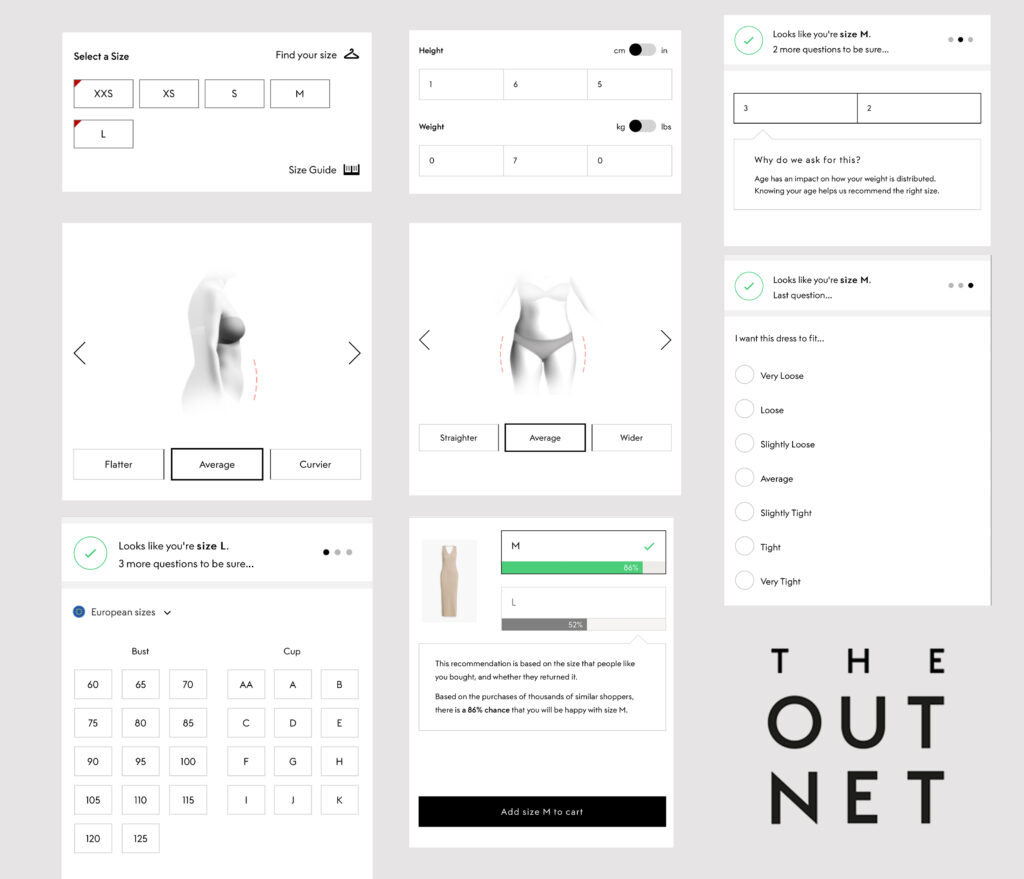
Later, while browsing an outlet’s website, I came across something interesting: a quiz feature that helps users determine their body type. It made me think—what if this same input could be used to generate a personalized 3D body model? Not just a one-size-fits-all avatar, but a real approximation of how clothes might fall on your unique shape.
Imagine this:
You answer a few questions in a body type quiz just like in OUTNET
The system generates a simplified 3D model based on your input.
You can try on clothes virtually—with options to toggle fits like oversized, slim, or relaxed.
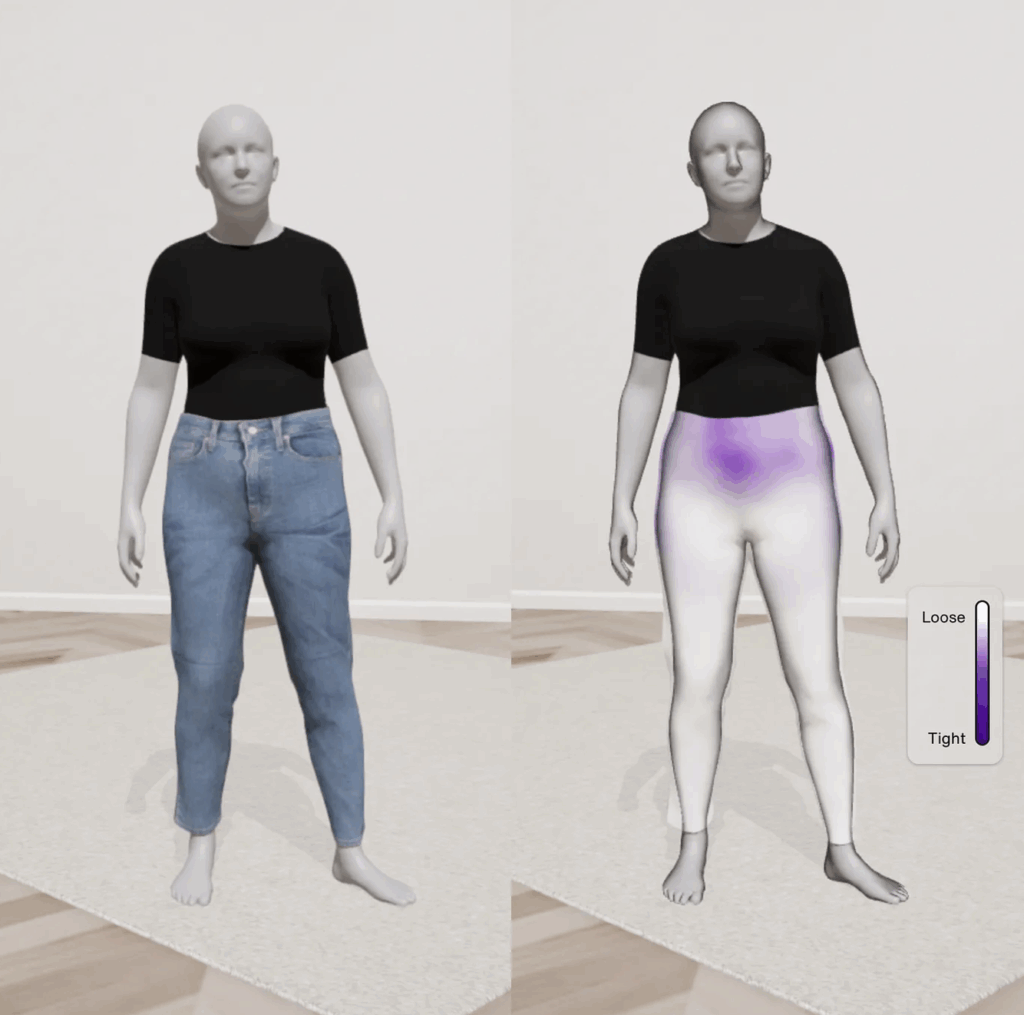
It sounds futuristic—but maybe not that far off. I already found something really really close to the thing I was searching for and it is Zalando’s virtual fitting rooms allow users to adjust the fit of an item on their avatar (tight vs. loose). its pilot version but still coming soon…
From Body Scan to Personalized Avatar
Zalando’s Size & Fit team is leveraging body measurement technology to create tailored 3D avatars—beyond generic mannequins, these avatars reflect real proportions, helping users visualize how clothes will look and feel
Dynamic Fit Visualization
They’re experimenting with dynamic poses sitting, stretching, walking—to better showcase how an item behaves in real life. To communicate fit, they’ve used color-coded overlays to highlight tight or loose areas, recognizing that fit is style-dependent and context matters
The Path to Trust & Sustainability
Zalando aims to reduce size-related returns, contributing to more sustainable shopping. By prioritizin accuracy, positivity, and inclusivity, and involving real customers in testing, their virtual fitting room has already reached tens of thousands of early users
I’ll share some visuals from the outlet site below that sparked this idea. Let me know what you think—could this be the next step in personalized AR try-ons?
While doing some research ,I randomly came across Luma AI and I was instantly impressed. The quality of the 3D scans it can produce from just a phone blew my mind. I had already worked with Adobe Aero before, so the idea naturally came to me: What if we combined the power of Luma AI with Aero?
Especially in the context of resale, this could open up exciting new possibilities for creating immersive, trustworthy product experiences.
Technologies LumaAI requires as an input a set of object photos or a video of an object and then cuts the video into frames as input for the NeRF algorithm {2} . NeRF is an algorithm in the field of computer vision and 3D imaging. It is used to reconstruct a 3D spatial model from 2D photographs taken from different angles. NeRF algorithm uses a neural network to build a ray field (radiance field) for 3D space. This ray field describes the probability of each point in 3D space emitting a ray of light in all directions and the color of that ray. It will first receive the cropped data set from the video that we pass in, and then use a neural network to build a radiance field for the 3D space. This ray field describes the probability of each point in 3D space emitting a ray of light in all directions and the color of that ray. A neural network consists of two parts: an encoding part and a decoding part. The encoder converts the 3D coordinates and the direction of view at a point in 3D space into a corresponding vector. This helps the model learn the relationship between the points in the 3D space and the corresponding 2D image . In addition to leveraging A-Frame for AR development, we will enhance our project by integrating LumaAI’s modeling capabilities. It will first receive the cropped data set from the video that we pass in, and then use a neural network to build a radiance field for the 3D space. This ray field describes the probability of each point in 3D space emitting a ray of light in all directions and the color of that ray. A neural network consists of two parts: an encoding part and a decoding part. With the integration of LumaAI, we can expedite the creation of 3D models for our augmented reality applications. This enables us to enrich the user experience by incorporating lifelike virtual objects seamlessly into the real environment. Whether it’s furniture, prod- ucts, glasses, clothe or architectural elements, LumaAI empowers us to generate
How LumaAI and Aero Enhance the Shopping Experience
LumaAI leverages an advanced technique called Neural Radiance Fields (NeRF), transforming simple 2D photos or video clips of furniture into highly detailed, interactive 3D models. Aero, on the other hand, enables users to create immersive AR experiences with intuitive, drag-and-drop simplicity.
Rotation and Zoom: Customers can easily rotate furniture models, viewing them from all angles.
Spatial Placement: Using their smartphone cameras, users can visualize exactly how the piece fits and looks in their own space.
Real-Time Interaction: Adjustments such as changing positions or orientations of furniture happen smoothly and realistically.
Overview of Augmented Reality / Virtual Reality Virtual reality (VR) is a technology that simulates a computer-generated three-dimensional image or environment, allowing the user to interact with it in such a way that it looks realistic or physical. To do this, users use special electronic devices such as helmets with screens or gloves with sensors to interact
AR has been applied in many mobile applications, especially in the areas of learning support, content comprehension, memory protection, and motivational learning .
Currently, various agencies, companies, and universities are actively promoting research and application of augmented reality technology.. They collaborate with Chiet Giang University, the Optics Department of the Beijing Institute of Technology , Microsoft , Google [1], and others.
System Workflow: LumaAI / Aero
LumaAI Process:
Capture: Users take a short video or series of images.
Upload: The video is uploaded for processing.
Processing: Employs NeRF to generate dynamic 3D models.
Interaction: Users interact via AR-enabled apps.
Aero Process:
Import: Users import existing 3D models.
Design: Utilize Aero’s intuitive tools to design interactive AR experiences.
Publish: Deploy instantly viewable AR scenes.
Benefits of Implementing AR (LumaAI & Aero)
Enhanced Customer Experience: Accurate and immersive visualizations boost shopper confidence.
Reduced Product Returns: Clear visualization decreases returns due to mismatched expectations.
Market Differentiation: Retailers adopting AR set themselves apart with unique, interactive shopping experiences.
Key Insights & Challenges
While AR significantly enhances customer interactions, there are some considerations:
Technical Precision: Accurate face and object recognition can still be challenging, affecting user experience.
Accessibility: Advanced AR functionalities may not yet be globally available, often restricted to specific regions.
Conclusion: A Vision for the Future
The use of AR in furniture shopping, as exemplified by LumaAI and Aero, is not merely innovative—it’s transformative. With these systems, we’re moving toward a retail environment where physical showrooms merge seamlessly with digital convenience. As technology advances and becomes universally accessible, AR-driven shopping will become the new standard, providing customers unparalleled confidence and satisfaction in their online purchases.
I wanted to see how far augmented-reality shopping has come, but most headline tools—Google’s new try-on, several US-only apps, etc.—still won’t load here in Austria. Even a VPN plus a “US” Google account failed. So I chose the two options that do work right now:
Amazon Try-On (Eyewear)
Maybelline Virtual Make-Up Studio
Challenge #1: Geo-Locks Everywhere
The biggest frustration wasn’t the tech itself; it was access. Many advanced AR experiences are geo-fenced to the United States. Until platforms open globally—or at least EU-wide—Austrian shoppers will stay few steps behind.
Amazon Try-On: Hunting for AR-Ready Frames
Discovery pain: Only a fraction of Amazon’s glasses catalogue supports AR, and you don’t know which ones until you click. A small “AR available” badge on product tiles would save so much time.
Pro: I tried transparent frames, sunglasses, and standard optical models. Tracking stayed stable even as I turned my head, and sizing felt believable.
User experience: Simple tap, allow camera, instant preview. Exactly what a first-time user hopes for.
Excitement factor: I could genuinely picture ordering frames this way once the selection grows. It was also easy to scroll through the color and shape options.
What I would love to see: I would love to see the more authentic and rare items on the list for the testing with Virtual reality.
Face-shape hiccups: Foundations and contour products sometimes floated off-axis or didn’t appear at all, even in good lighting. ( as you can see in the provided video ) which I think is a huge problem and can get the first time user sceptic about virtual try ons.
Lip colour success: Lipstick shades mapped accurately and updated in real time as I moved.
Nice touch: You can switch to a preset model if you’d rather not show your own face. (On the model, every product looked flawless—highlighting that face-tracking, not shade range, is the bigger hurdle.)
Before/after slider: Handy for subtle products, though the differences were occasionally too subtle to notice.
Personal “Aha” Moments
Note-taking vs. flow: Detailed note-taking kills the vibe. One bullet per thought was more than enough.
In-store “Deja vu”: Even when I’m standing in front of a real mirror in a shop, I still pull out my phone, switch to selfie mode, and check how glasses or blush look on-screen. Do you see my point? AR simply lets me do the same thing anywhere at home, at uni, on the tram without the struggle to get to a store. I am keep wondering when it all be updated enough and accurate enough does this one little glance in a real/physical mirror worth it? does it worth going to the store and take your time? why not just stay at home and try them on?
Final Thoughts
Trying on glasses through Amazon felt more professional and kinda ready to improve more and more and reach prime time, while Maybelline showed promise but needs better face recognition for anything beyond lipstick. Overall, the sessions were fun and clearly for me the future of product discovery.
I’ve also recorded a short demo video of both try-ons I hope you enjoy watching it as much as I enjoyed testing!
The big question: when these tools finally work as smoothly worldwide as they do in the US, will I still bother queuing at a cosmetics counter or will my camera remain my dressing room?
Note: This post was corrected for grammar and clarity with the support of ChatGPT (OpenAI).
Designing Reality: How Adobe Aero is Changing AR for Creatives.
In this world where digital encounters draw ever closer to the tangible, augmented reality (AR) is not a futureistic idea any more. And it’s interactive, immersive, and extremely creative. Amid the multitude of platforms emerging to the occasion, Adobe Aero is a game changer, a piece of software that gives designers, artists and storytellers the ability to bring to life their visions literally in the 3D space.
But what’s that makes Adobe Aero so special? What are designers so excited about it? Let’s examine what Aero is, why it is that important, and how it is changing our creative process.
What is Adobe Aero?
Adobe Aero is a strong app for AR authoring and viewing by Adobe as a member of its Creative Cloud suit. It enables creators to design and share interactive augmented reality experiences without having to write any code at all. That’s right. No unity, no unreal engine, no need of developer background. Simply creativity and iPad (or iPhone) and Aero. Users are also able to import 3D models, animations, and assets from Adobe tools such as Photoshop, Illustrator or Substance 3D, and layer them into real world environments using the mobile camera. Whether you want animated characters to walk on your kitchen table or build immersive product demonstrations or interactive stories responding to touch & movement. You can do all this in augmented space with Aero.
Key Features That Make It Shine
1.Intuitive Drag-and-Drop Interface
Adobe aero is user friendly. I used it for my personal business logo and it worked perfectly. Its interface lives up to the feel of many other creative tools from Adobe, making it easy for long-term users. You just drag 3D assets from our library into your scene, adjust their position, size and apply inbuilt behaviors such as bounce, rotate or fade to animate them.
2.Interactivity Without Coding
The ability to create interactive experiences, thanks to simple triggers and actions, is one of Aero’s best features. For instance, if one taps on a digital object it can cause it to spin, tumble, or produce a sound. This degree of interactivity brings AR to life and becomes attractive without necessitating technical know-how.
3.Cross-Tool Integration
Aero works with other Adobe tools without glitches. How about using layered PSD file for digital pop-up book? Done. Want an original 3D logo to create in Illustrator or Substance? Just import it. Aero is a creature of a creative ecosystem. you can do animation as well such as spin, move and all.
4.Real-Time Preview and Sharing
Content creators are able to view their experiences in real time on mobile via links or QR codes. This is extremely important for client presentations, education and using in social networks.
Empowering a New Era of Creativity.
Traditionally, the creation of AR experiences entailed an intricate process of development environments, use of coding languages or collaboration with engineers. Adobe Aero manages to turn that model on its head by allowing designers to be able to independently prototype, build, and share augmented experiences.
This democratization of AR design is important because it moves creative power into a lot more hands, artists, creatives, educators, marketers even students can now create in AR without having to wait on a dev team, or a big budget.
Picture yourself, as a fashion designer, presenting a virtual runway anywhere on the street or a curator at a museum making tales of the gallery walls into an animated story that reacts to the movement of visitors. Aero is making that sort of magic possible.
Use Cases: From Art to Commerce
Adobe Aero is already used in many industries:
Art & Exhibitions: Digital artists are utilizing Aero to place animated artwork over real world environments. This is in particular strong for public installations, street art or immersive galleries.
Marketing & Retail: Brands can develop product demos where customers can imagine furniture in their homes, or play with 3D packaging prior to purchase.
Education: Teachers and students are also applying Aero to interactive learning – picture an AR history lesson in which the ruins of Rome appear under your desk or science project that uses 3D models of molecules.
Storytelling & Publishing: Authors and content producers are creating AR-enhanced books and zines; transforming pages from a single sense into multisensory adventures.
AR as a Creative Standard
AR is no gimmick or trend. It’s becoming a new norm for digital communication and design. Given the increasing popularity of headsets such as Apple Vision Pro and the Meta Quest, high quality AR content will be in much higher demand. Adobe Aero is contributing to preparing creatives for that future by making available to them tools that they can import immediately. The way we learn also matters for those who aim to stay ahead of the curve learning Aero isn’t just a fun experiment, it’s a smart investment in future ready skills.
Final Thoughts
Adobe Aero is proof that AR does not have to be complex to be powerful. Thanks to a bit of imagination and a smart device, author-savants are now in a position to design immersive and interactive worlds that immerse and excite. Whether a designer bursting at the seams to enrich your toolbox, a marketer yearning for fresh paths to your audience or an artist keenly watching the frontiers of digital representation, Aero is the starting point for your next big idea in Augmented Reality.
References
Adobe, 2023. Adobe Aero: Create interactive augmented reality experiences without coding. [online] Available at: https://www.adobe.com/products/aero.html [Accessed 9 May 2025].
Parsons, T., 2023. Augmented reality for designers: How Adobe Aero is changing the creative landscape. Creative Bloq. Available at: https://www.creativebloq.com/features/adobe-aero-ar [Accessed 9 May 2025].
The Futur, 2023. Augmented Reality Design with Adobe Aero – What You Need to Know. YouTube. Available at: https://www.youtube.com/watch?v=czdMwCnxRRA [Accessed 9 May 2025].
Grammar and structure were refined with the help of ChatGPT.
Since people are tired of the usual online ads, an essential shift is happening. AR is now used for more than fun effects, as it supports marketing that relies on presence, relevance and people’s connection. The future of AR marketing is focused on changing the way brands interact with the physical world instead of only adding digital elements to it.
Here, I discuss the next important things happening in AR marketing such as ambient AR and campaigns affected by emotions, as well as real-time personalization.
1. Background Marketing: Ambient AR consists of Interactive Elements
Ambient AR refers to information or objects that appear in the physical environment around someone, depending on their location, the time or even the mood they display. With ambient AR, you can receive information or experiences without having to aim your device at anything or use the camera.
Just think that as you walk into a store, your AR glasses will highlight items that mean most to you based on your past and present interests. Perhaps it’s a public sculpture that tells a relevant story from the brand as you walk by. Marr (2019) stated that the next important shift in marketing will be hidden tools that make it more convenient for people without demanding attention.
They believe that these campaigns will be integrated into our lives, helping us rather than causing disruptions.
2. Emotionally Responsive AR: Marketing That Feels
With today’s technology, marketers have more ways to sense when customers are not happy or satisfied and can respond.
Marketing is being transformed by the way AR blends with affective computing which is able to gauge feeling from a person’s face or other signs. When AR is used, brands are able to react instantly to what a user is feeling.
A fashion retailer can use AR mirrors to determine if a customer is upset or happy and react appropriately. If a person seems tense, a skincare brand may guide them through visualisations to help relax. Since the brand responds so quickly, marketing shifts from promotion to sympathy.
Kotler, Kartajaya and Setiawan (2021) state in their book that the upcoming trend in marketing calls for machines and humans to work together. Emotion-aware AR prepares to do just that.
3. AR Spaces That Last: Digital Twins Are Increasing
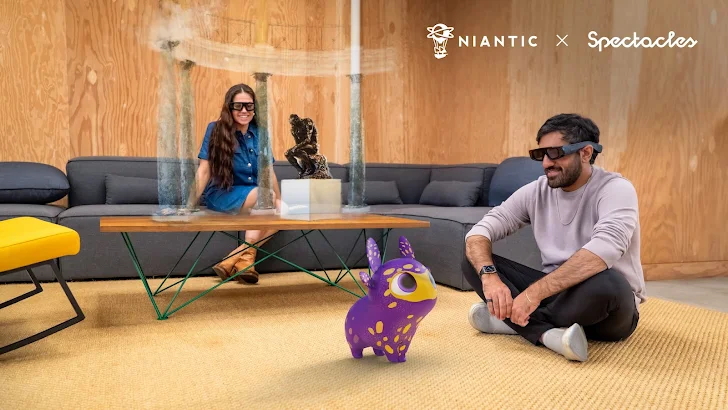
Businesses are beginning to design AR spaces that mirror actual places and keep updating with the real world. Thanks to Niantic and Snap’s platforms, companies are able to set up multi-user AR areas where clients interact with various things such as products, over a period of time.
Envisage a sneaker brand where you could use AR to access its virtual flagship store, join drop events, meet others in real time and share your brand avatar. They shouldn’t be mistaken for simple campaigns; they’re meant to last.
Craig mentioned before that with AR, we will experience more lasting environments that matter for a period of time.
4. Hyper-Personalisation Through AI and Spatial Data
AI allows brands to examine AR data to personalise their offerings for every individual. Based on someone’s interactions and tastes, a tourism company could develop an AR walk in real time. A fitness company could advise you on appropriate exercises based on your schedule when you enter a gym. ( which is already can used as an app)
Pires and Stanton (2015) explain that real-time flexibility is crucial in today’s marketing which incremental AR provides with accuracy.
5. Storytelling for the Sustainable Use of the Environment
Many consumers hope that brands can be more transparent and environmentally friendly. AR lets you present eco-information by visualising the process behind a product on its packaging or in stores.
For example, Rothy’s has introduced AR experiences that explain how used plastic bottles are made into shoes. When customers perform a scan, the sustainability statements are immediately visible.
Deloitte highlights that AR creates transparency, turning regular CSR efforts into experiences that engage consumers.
6. WebAR and 5G are helping to get rid of the barriers.
Over the past few years, using AR in marketing was restricted due to the requirement for users to download an app and the lack of enough bandwidth. However, WebAR enables AR to be accessed via web browsers and with the introduction of 5G, these problems are no more.
Nowadays, brands can design interactive campaigns using a link or QR code. Because it takes little effort to log in, the platform will attract more users, encourage them to spend more time there and reach a wider audience. When Starbucks switched to WebAR for their seasonal offers, they reported a 62% increase in the way customers engaged with the campaigns.
In Conclusion: From Something New to Something Essential
The best part about AR in marketing now is its potential, rather than what it is today. Today, AR is more than a clever tool or a trend; it is expected to be the main form of brand communication. There will be a shift in AR marketing from advertising to offering experiences so realistic that people barely notice it.
It is evident that the brands that succeed in being less visible, yet present, will guide the future market.
Reference List (Harvard Style)
Craig, A.B. (2013) Understanding Augmented Reality: Concepts and Applications. Waltham, MA: Morgan Kaufmann.
Deloitte. (2024) Augmented Reality: The new front line of digital marketing. Available at: https://www2.deloitte.com
Kotler, P., Kartajaya, H. and Setiawan, I. (2021) Marketing 5.0: Technology for Humanity. Hoboken, NJ: Wiley.
Marr, B. (2019) Tech Trends in Practice: The 25 Technologies That Are Driving the 4th Industrial Revolution. Hoboken, NJ: Wiley.
Pires, G.D. and Stanton, J. (2015) Interactive and Dynamic Marketing. London: Routledge.
Scholz, J. and Smith, A.N. (2022) Immersive Marketing: How Technology is Shaping the Future of Customer Experience. London: Routledge.
For me shopping online always been easier than in shops. But unfortunately even now for me classical methods of shopping more often involve the use of general size definitions and style groups that may not in the best possible way for the specific needs of each customer. This is where AR comes in, because it allows brands to provide the customers with fashion suggestions that are more relevant by taking into consideration the customer’s body type, favorite articles of clothing, and even previous orders. AR technology allows customers to use their cameras or in-store screens to see how the clothes will look like on them in the near real time.
Zeekit’ app
Zeekit’ app (purchased by Walmart) suggests body metrics. With these technologies combined with the use of machine developing,learning algorithms, brands can now suggest styles that would fit the customers’ body shape much more effectively, making this a very personalized experience for the customer . Besides, AR can also identify colors ( pattern to match ) , the time of the year, and other preferences of the customers to give recommendations that are not limited to resizing, but also to the style and the current trends on the market.
Moreover, all these large accounts for(encoded) data such as social media habits and personal shopping histories can be checked and analyzed to provide the best styling. Customers, therefore, did not have a simple choice between what was so wishes on a rack or a website but got to choose from what is decided on the basis of customers’ individual characteristics. Such a level of customization is capable of minimizing returns and level of dissatisfaction among customers, and at the same time promoting customer loyalty and brand uptake.
Custom-Tailored Virtual Outfits: The Role of AI and AR
Among all the features that AR and AI bring to the fashion industry, the most striking one is the personalized virtual clothing try-on for customers. AI can know their individual style preferences from different sites (outlet, yoox and more) or what they have been searching for in the past and what they like sharing on social media. Together with AR this technology creates perfect experience for fashion consumers.
For example, Amazon and H&M contain AR options in the applications of smart phones through which customers can design clothes and virtually try them on. Exclusively, artificial intelligence algorithms operate in the background, making the appropriate recommendation based on a customer’s past selections ,which is already now new technique with regard to clothing. With these data points, AI brings not only fashion relevance, but much more skin to skin experience (Hoffman and Zhao, 2022, p.56).
AR increases the overall diversity within fashion domain as well as the reach of the industry. Specific types of clothing can be suggested to any consumer based on their shape, size, or physical possibilities. So AI algorithms consider each individual’s body shape in order to give them suggestions that they feel alright about themselves. This strengthens the talk of how technology is closing all the gaps in the fashion world, making shopping on individuality a reality across the world.
The Future of Hyper Personalized Shopping Experience
AR hop and AI technologies are not standing still, and so the next stage of personalized shopping may not be far away.
AI can anticipate suitable clothing based on the weather forecast for the week, important events that might be scheduled for the week or even changes in the social media trends.
AI weather fashion combines data from several weather APPs, behavioral analytics, and intelligent recommendation offer real-time clothing suggestions. When these systems detect a cold front in your area, for example, they can highlight cozy knits, boots, or scarves in your app or feed.
Glance can be as your adviser from now one. Glance use contextual knowledge with the help of artificial intelligence (AI) to provide customized outfit suggestions based on location, preferences, and the current weather.
Furthermore, as more appealing wearable AR devices get introduced to the market, the rationale of the digital and physical world’s shopping differences evaporates. Augmented reality on wearables such as glasses may act as a tool whereby the customers are able to engage with the items of clothing in a different way. These customers could ‘place’ entire wardrobes with accessories in a store while observing the assortment, or they could ‘purchasing from their living rooms, and at once look and feel the garments (Johnson, 2024). Consumers’ physical and digital experiences, known as ‘Phygital’, are held to reinvent the consumer-brand touchpoints.
Hyper-Personalization is also going to hit sustainability by the end of shopping. Thus, AI and AR help with the more precise clothing recommendations, and this approach decreases returns, which cause waste. Virtual showrooms also eliminate the extra requirements of clothes in stock, making the production line cater to the consumers’ market better (Evans, 2023).
Conclusion
The combination of AI and AR in fashion is here. This means that despite body type, style and trends, people can be given recommendations on what season’s fashionable for them and where to find it as it has become possible for fashion and tech to amalgamate thus changing the retail landscape.
Evans, L., 2023. Sustainable Fashion and Technology: The Role of AR and AI in Reducing Waste. Fashion Technology Review, 14(2), pp.30-41.
Hoffman, J. and Zhao, Y., 2022. Virtual Try-Ons: How AI and AR are Revolutionizing the Shopping Experience. Retail Science Quarterly, 9(4), pp.67-82.
Huang, W. and Liao, Z., 2023. Personalized Fashion with AR: Body Types and Style Preferences in the Digital Age. International Journal of Fashion Studies, 7(3), pp.112-126.
Johnson, M., 2024. The Phygital Future: How Wearable AR Will Transform Shopping. Retail Tech Today, 15(1), pp.54-63.
Virtual fashion has experienced explosive growth because virtual reality (VR) worlds now allow people to express their personal style. Developing VR clothing presents an adventurous creative path for your gaming avatar meetups and digital socializing purposes. Virtual fashion dream translation requires what level of difficulty to execute? Let’s break it down.
As a starting point we need to grasp basic principles of virtual reality clothing
The digital garments of VR are virtual garments which attach to digital avatars. VR clothing design happens through software which enables the production of virtual fabrics alongside textural effects plus motion attributes. VR clothing bypasses traditional fashion limitations through its ability to design unconventional designs with no physical boundaries. Designers obtain full creative freedom because they can experiment with no boundaries.
Virtual fashion design needs proper attention to form elements as well as avatar compatibility and natural movement in addition to technical execution. Inadequate design of clothing products may cause items to penetrate the user’s body structure or create abnormal movements thus interrupting their VR experience.
Essential Tools You’ll Need:
3D Design Software: Programs like Blender, Marvelous Designer, or Clo3D are popular for creating realistic clothing simulations. These platforms provide flexibility in shaping garments and adding details.
Texturing Tools: Substance Painter and Photoshop help add colors, patterns, and textures, enhancing the garment’s realism.
Rendering and Animation Tools: Software like Unity and Unreal Engine allows you to animate the clothing, simulate realistic physics, and visualize it in a VR setting.
VR Platforms: Platforms like Decentraland, Roblox, or Meta Horizon Worlds provide spaces to showcase and sell your designs.
The Learning Curve
VR clothing creation poses distinctive challenges especially to new users who start this process. Substantial creative design along with technical abilities create the productive basis of this process. Learning 3D modeling and UV mapping alongside rigging mechanics for avatar garment attachment and creating textures which resemble reality proves difficult until one gains sufficient practice.
For Beginners: The initial learning curve might feel steep, particularly when learning to navigate 3D design software. However, countless online resources, tutorials, and communities can help guide you through the process.
For Intermediate Designers: If you have experience in graphic design or fashion design, the skills transfer well. Marvelous Designer, for instance, simulates real-world fabric behavior, making it intuitive for those with garment construction knowledge.
For Advanced Users: Professionals can experiment with complex materials, intricate textures, and dynamic simulations to push the boundaries of VR fashion.
Pro Tip: Start with simple projects like t-shirts or jackets to understand the basics before advancing to elaborate designs.
Designing Your First VR Garment
Typically design processes require these sequential phases:
Begin by creating sketches or digital representations of clothing designs during conceptualization. Next evaluate how the design will function and react against the avatar’s body structure.
The base shape creation happens through the use of software such as Blender. Virtual fabric simulation on avatar models works best through the tool known as Marvelous Designer.
Texturing provides the method of applying colorful designs with patterns to finalize the visual creation process. By using Substance Painter users can produce realistic material textures.
Through rigging enable your garment to link up with avatar skeletons then it will follow their motions naturally.
Virtual testing enables designers to position their creations through VR for required modifications.
Experimentation and Creativity
Virtual reality fashion allows creators to transcend physical limitations by developing designs that challenge classical dynamics of physics. Virtual fashion designers craft their designs through excellent ideas such as responsive garments which alter with user movements and through outfits made of glowing dresses or fluid metallic materials. You gain full creative freedom to design nonrealistic concepts and futuristic designs without boundaries.
The virtual fashion marketplaces of several platforms make their appearance to users. Developing a personal commitment to digital fashion allows you to turn your designs into income through digital fashion items as well as NFTs and game skins.
Creative Ideas to Try:
Gravity-defying capes
Interactive garments that change color
Transparent holographic outfits
Cyberpunk-inspired metallic suits
Challenges You Might Face
The liberating element of virtual fashion brings both strength and obstacles to users. Some common difficulties include:
Proper avatar compatibility and rigging procedures prove to be technical problems during the process.
The large file size of VR clothing creates management problems which impacts system loading speed and operational performance.
Clients may have to dedicate time and professional skill to reach precise fabric simulation results.
Continuous practice together with persistence enables major improvements in most cases. Designers who work in communities often share their procedures along with offering support to other members.
Conclusion: Is It Easy or Hard?
The process of making VR clothing becomes easier after acquiring experience and learning how to design with the right tools matched to your creative ambitions. The technical complexity initiall Beginning simple projects and increasing practical work and trying diverse styles helps both new and experienced users develop their skill level and confidence.
VR fashion provides unlimited opportunities where personal designers can build their creativity toward establishing a virtual presence including the market. All expert fashion designers began their journey at the beginner level thus becoming experts by starting first.
Fashion designers encounter multiple hurdles while developing virtual reality apparel which results in significant challenges during the design process.
New technology in Virtual Reality fashion completely changes our approach to wearing clothes. The fashion world uses virtual reality garments along with virtual avatars to let users express their creativity through sustainable fashion options. The creation of digital clothes involves numerous technical obstacles because of the characteristics of the virtual world. VR fashion developers encounter numerous significant difficulties during their work to create virtual reality clothing.
1. Achieving Realistic Fabric Simulation
The movement dynamics of VR clothing depend on simulated fabric behavior because digital fabrics lack natural attributes of physical textiles. Designers need to duplicate the exact textures and movements of all materials including flowing silk alongside rigid leather. becoming realistic demands scientific mastery regarding material behavior along with high-capacity processing systems. VR designs fail unless simulation programming is precisely accurate since it affects the way virtual characters move through their garments.
2. Balancing Aesthetics and Performance
Duplicating intricate fabric patterns together with high-end textures requires processing equipment with great power intensity. Softwares featuring photorealistic clothing offer better immersion yet they put excessive strain on computing devices. Developing VR content requires developers to strike an ideal stability point that maintains performance speed while showing visually pleasing graphics. The preservation of frame rates through texture simplification or polygon number reduction leads to lowered realistic detail in the virtual environment.
3. Avatar Customization and Fit
Physically produced clothing adjusts to accommodate people of all body sizes as well as shapes. The capability to customize in virtual reality systems remains challenging at present. Programmers develop adjustable clothing systems which handle various sizes of virtual characters through automation. Such systems face technical issues which result in improper clothing conformance and garments that expand abnormally.
4. Physics-Driven Collisions and Clipping
VR fashion faces a major difficulty because clothing frequently intersects with both the avatar and other garments in ways that are known as “clipping.” The detection tools that developers embed in their systems stop clothing from interchanging yet they still have difficulty making interactions between objects work flawlessly particularly when characters execute intricate moves. When collisions are inadequately managed in VR programs they destroy users’ immersion and negatively affect their virtual reality experience.
5. Style Limitations and Creative Constraints
Design capabilities within VR exist without border while the system places specific design constraints on users. The designers have to simplify complex elements which display marginal realism during rendering and animation processes. Processing user interactions such as fabric manipulation becomes difficult within virtual environments because it demands specialized equipment.
6. Sustainability vs. Commercial Viability
Virtual reality fashion has environmental benefits because it cuts out the need for conventional fashion products created from real resources. The development process for high-quality digital garments requires extensive resources to create and demands a team of specialized workers to maintain it. Profitability and sustainable practices exist in constant opposition to each other.
Final Thoughts
To make VR clothing you need both technological ability and creative thinking skills. The multiple challenges of creating VR clothing have started to decrease since real-time rendering and adaptive garment technology combined with AI-driven physics continue to progress. Designer opportunities within the metaverse will expand proportionally to the growth of this virtual realm enabling them to transform virtual fashion limitations.
The initial step towards participating in digital outfit development requires comprehension of these challenges for designers, developers, and fashion enthusiasts alike.
Unfortunately, I wasn’t able to attend the last day of Pixel Vienna, but I watched the recorded session on YouTube. Based on that, I wanted to share my thoughts and insights in this blog post.
A Look Back at the Event Watching the video, I could feel the enthusiasm and energy from both the panelists and the audience, even thought it was right after the party . The discussions were insightful, and the topics explored—especially diversity and representation in animation—felt incredibly relevant to today’s creative industries.
The Panel & Key Discussions The panel shows experienced professionals from the worlds of video game design, animation, and production, each bringing their unique perspectives on character design and storytelling. One of the most impactful moments was the discussion about how animated characters influence us from a young age, shaping our views on identity, diversity, and representation.
Hearng the panelists reflect on characters that inspired them while growing up reminded me how much media influences our perception of the world. They also highlighted the importance of avoiding stereotypes in character design, ensuring representation is authentic and meaningful rather than just symbolic.
The Role of Storytelling in Diversity A key takeaway from the discussion was that diversity in animation shouldn’t just focus on end results but on real, multi-dimensional characters. We need to do more research and actually talk with people who has more experience or even lived the life of the character. A well-developed character is not just defined by their background but by their experiences, relationships, and growth. The conversation also touched on how studios like Pixar have teams dedicated to accurate and respectful representation, something that should become an industry standard.
The Future of Representation in Animation One of the most exciting aspects of the discussion was looking at the next generation of artists and storytellers. The panelists were optimistic that upcoming creators are pushing for greater inclusivity in animation and gaming, breaking traditional molds, and telling stories that better reflect today’s world.
Final Thoughts Even though I wasn’t there in person, watching the final day of Pixel Vienna online still left a lasting impression on me. It showed how animation is not just about entertainment, but a powerful tool for storytelling and change. The discussions made me think about he animations i have watched and how relevant and accurate they are. and how we, as designers, can contribute to more inclusive and meaningful narratives.
If you missed it, no worries I highly recommend watching the recordings on YouTube — Enjoy!
The global field of fashion that for a long time has been accredited for its talented and innovative designers is now in the hot seat concerning environmental problems. Within the current phase of global supply chain integration, high rates of consumption and waste, the sector is looking for ways to help sustain the environment. Of all the spectacular innovations that are expected to advance sustainable living, augmented reality (AR) proves to be a versatile force in the pursuit of sustainability. AR solves many of the current problems related to fashion such as hesitation of physical samples and returns, optimization of the design process, and helping a consumer make a sustainable decision.
AR and Sustainable Fashion: Reducing Physical Samples and Returns
One of the major ways through which AR is helping to fast fashion and sustainability is by designing and eliminating the need for samples and returns. This practice poses a great challenge to conventional fashion design and manufacturing activities where numerous sample garments are made in the design process. These samples, usually made from precious metals, are sometimes thrown away after use, thus becoming a waste (Pal & Gander, 2018). However, AR offers potential for designers and manufacturers to develop samples that could be tested, visualized and redesigned from the digital world. It also means that physical prototypes are no longer required during the first phases of development and the number of resources needed is cut down considerably. Besides the savings on physical samples, AR is also beginning to speak to the increasing issue of product returns. The major issue facing it is the high rate of returned products due to size and fitting problems in an e-commerce niche. This is especially the case since most consumers buy different sizes of the same type of clothes with the aim of returning the ill-fitting ones. This results in a high rate of shipping emission, a high rate in packaging wastes and in most instances customers return the products. AR technologies, including virtual try-on assistance enable a consumer to evaluate how clothes will look on them and check if they fit before purchasing them reducing chances of returning the item (Kim & Forsythe, 2008). Gucci and ASOS among other companies are already applying the use of AR to let buyers do the dressing virtually thus encouraging responsible consumption (Schneider, 2020).
Virtual Prototyping and Minimizing Waste in Design
It is very important to note that virtual prototyping, which is a core concept in the use of augmented reality, reduces wastage greatly in the design and manufacturing cycle. Formerly, fashion designers had to make a sample of a garment and make changes, if necessary, with the help of physical models; this process was called sample making and mostly resulted in wasted material, and if there were changes needed even a mere A4 piece of paper was used – scraps were thrown away after that. AR enables fashion designers to build virtual models that enable them to practice various designs, material, and texture before having to make actual materials (Song & Ashdown, 2015). When applied to design, it allows for precise imaginative genuinely of how certain design will drape, fit and look like without physically making it. This goes a long way in decreasing the trial and error that is usually time wastage. Moreover, such prototypes can be presented to a number of teams and other stakeholders for evaluation, or put for approval, all this without having to physically build any artifact. It also helps to cut time wastage while also saving the environment through the following explanations: Furthermore, there is an advantage for the brands, as they are able to minimize overproduction through use of virtual prototyping services. The problem that we find severely affecting the fashion industry is overproduction, which leads to leftover products that are worthlessly disposed of or burned. There is nothing like testing market receptiveness toward digital garments through AR before investing a lot of production and resources. It reduces the chances of having excess inventory which is addition to creating a burden on the environment through dispose of (Choi & Kim, 2021).
Educating Consumers about Sustainable Fashion Choices
Apart from its application in the design and manufacturing processes, AR offers possibilities in informing consumers about environmentally friendly fashion. One greatest challenge that faces the fashion industry is that it has no fashion transparency which does not enable a consumer to know the extent of the fashion item they are buying was environmentally friendly. AR can fill this gap as it offers immediate information on the sustainability of the garments. For instance, the application of augmented reality in consumer products enables individuals to point the camera of their phone at a piece of clothing and get further details on fabrics used in the product, the environmental impact of the product, and the production standard of the manufacturers (Jung & Lee, 2020). Despite this, this increased transparency can help the consumer make more conscious decisions to shift towards better brands and that include environmentally friendly products. It can also lead to increased understanding of the life cycle of the clothes from production to when it is discarded and effective practices such as up cycling, recycling, and buying from sustainable fashion production lines. Some brands are using AR to help consumers learn more about products and services and there are already many popular brands that use this technology. For example, Stella McCartney has added AR technology in its stores where people are given information about the company’s policies on sustainability and how each product helps the environment. Likewise, there is an AR app called Good on You that offers consumers augmented reality-based assessment of fashion brands depending on the sustainable measures they take (Niinimäki et al., 2020).
Challenges and the Future of AR in Sustainable Fashion
However, the study aims to show that even though AR is a great tool of marketing sustainability in fashion it is not without complications. The integration of AR technology obviously involves a considerable investment in both infrastructure and knowledge. Newer brands can be a little slow in adapting to the use of AR tools because of the costs that are usually incurred. Also, the ability of providers to convey AR to the broad consumer base will also depend on the readiness of accessible, user-friendly, and equipment-free platforms. Nevertheless, getting to that point and giving AR the opportunity to change the fashion industry for good is possible. In the future, with the advancement in technological devices, it is expected that AR will reduce in cost by making more brands to incorporate it in sustainable strategies. AR could even help to design more circular fashion systems in the future where the buyer gets to know how much the products opposite them will contribute to the environment from production to extinction.
Conclusion
Therefore, augmented reality becomes the key finding as a strategy towards sustainability within the fashion sector in this research. From elimination of need of a physical sample, minimizing return of the product they have no use for, helping developers design products without having to manufacture a large number of prototypes, and enlightening the consumer on the correct option to pick in a bid to save the environment, AR has made the following ways of cutting out waste and conserving resources possible. Shifts in AR technology is also expected to grow in support of sustainable fashioning for brands and consumers will experience enhanced ways of making sustainable choices. The fashion industry, which is so far noted for most of the environmental issues, is standing on the brink of a technological revolution that has the potential of wedding fashion and creativity with sustainability.
References
Choi, T.M. and Kim, H.M., 2021. Environmental sustainability of the fashion supply chain: A circular economy approach. Resources, Conservation and Recycling, 168, p.105291.
Jung, J. and Lee, J., 2020. Customer engagement in augmented reality shopping: The mediating role of immersion, shopping enjoyment, and perceived value. Journal of Retailing and Consumer Services, 53, p.101987.
Kim, J. and Forsythe, S., 2008. Adoption of virtual try-on technology for online apparel shopping. Journal of Interactive Marketing, 22(2), pp.45-59.
Niinimäki, K., Peters, G., Dahlbo, H., Perry, P., Rissanen, T. and Gwilt, A., 2020. The environmental price of fast fashion. Nature Reviews Earth & Environment, 1(4), pp.189-200.
Pal, R. and Gander, J., 2018. Modelling environmental value: An examination of sustainable business models within the fashion industry. Journal of Cleaner Production, 184, pp.251-263.
Schneider, J., 2020. Virtual fashion: How brands are embracing digital clothing in a sustainable future. Vogue Business.
Song, H.K. and Ashdown, S.P., 2015. Development of automated custom sizing of apparel using scanned body measurements. Textile Research Journal, 85(12), pp.1269-1280.