For my third genre experiment, I’m turning to a world far removed from the digital softness of Lofi or the neon modernity of Electronic: Classical music. With its deep roots in tradition, formality, and historical prestige, Classical offers a completely different aesthetic and cultural frame through which to reimagine the visual storytelling of K-Pop.
Why Classic?
Classical music carries with it an air of refinement, structure, and cultural gravitas. It conjures visuals of orchestras, velvet-draped theaters, marble columns, tailored tuxedos, and gilded instruments. The aesthetic is steeped in a historical Eurocentric idea of “high culture,” and with that, comes a set of visual norms that are both highly gendered and heavily codified: men in suits or waistcoats, women in flowing gowns, all within a restrained palette of blacks, whites, and muted golds.
Introducing a K-Pop boy group into this visual world invites a fascinating tension. K-Pop thrives on the new, the now, the visually explosive. Classical is about heritage, structure, and restraint. What does it mean to place a contemporary idol into this visual lineage?
This genre is about elegance, legacy, and form. It will be fascinating to see how K-Pop’s emotional expressiveness and stylized gender play navigate these older aesthetic structures.
I’ll begin working on this classical transformation, developing visual motifs and styling cues that channel classical beauty through the K-Pop view.
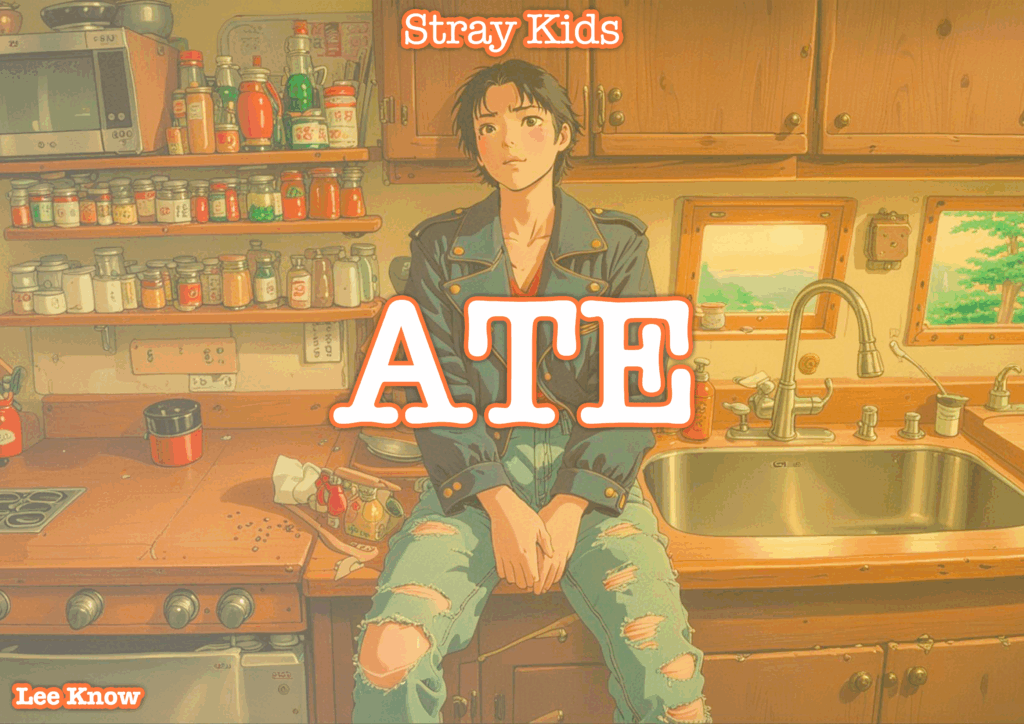
Lofi branding centers on emotional intimacy and authenticity. Often associated with lo-fi beats “to study/relax to,” its visual identity is nostalgic, cozy, and DIY-leaning, built around soft color palettes, analog textures, and handmade or illustrated elements. Branding in this genre prioritizes mood over spectacle, creating a sense of comfort and emotional presence. The visuals are often embedded in soft clothing, unfiltered moments, and solitary, reflective settings.
Evalution
The Lofi genre experiment was both intriguing and challenging, and while it worked out better than I expected, it also showed some key limitations in translating this aesthetic to a K-Pop world.
Lofi’s visual language is inherently quiet, nostalgic, and non-specific. It thrives on mood over identity, often relying on soft colors, hand-drawn illustrations, and ambient, faceless environments. This creates a calming, intimate atmosphere, but it also makes it difficult to embed strong, recognizable personalities into the visual branding. In trying to reimagine a K-Pop group within this framework, I found it hard to represent the individual members in a way that felt distinctive or character-driven. They risked blending into the aesthetic rather than shaping it.
There’s potential here, especially for a special album concept or side project, where the goal might be to evoke a specific feeling or moment rather than highlight the group’s full image. A cartoonish or illustrated approach could work well in that case, perhaps offering a stylized version of the members that fits within Lofi’s softness without erasing their identities entirely. But as a main concept or long-term branding strategy, Lofi feels too generalized. The aesthetic tends to overpower the artists themselves, making it hard to maintain the strong visual-personality connection that’s central to K-Pop.
That said, I was surprised by how well the emotional tone and mood alignment worked. K-Pop often explores vulnerability and intimacy through ballads or softer concepts, and the Lofi styling did manage to evoke a similar atmosphere. It’s not that it failed, it simply doesn’t allow for the kind of individual expression that fans expect from a K-Pop group.
In the end, this experiment highlighted the importance of balance: how much can an aesthetic speak before it silences the artist? And how do you design within a genre that’s more about feeling than face?
Next, I’ll make a 180 twist, and going to experiment with the Classical genre.
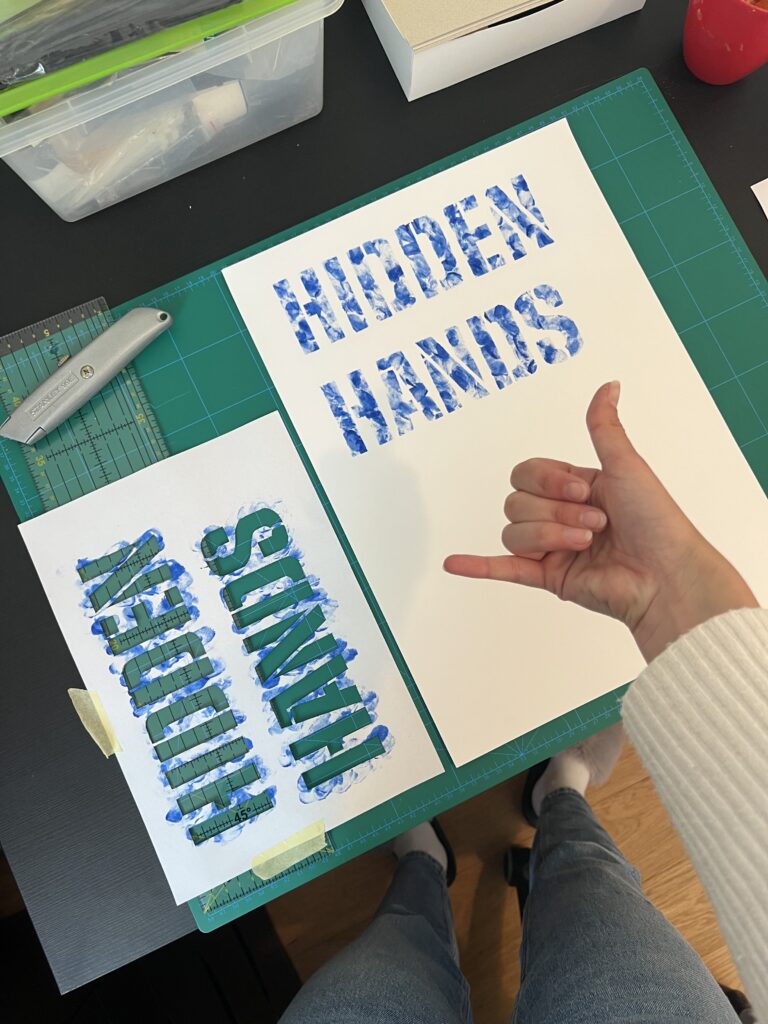
Inspired by our visit at the “Lo Siento” studio and their stencil branding concept, I want to dive deeper into the possibilities of analogue work with stencils.
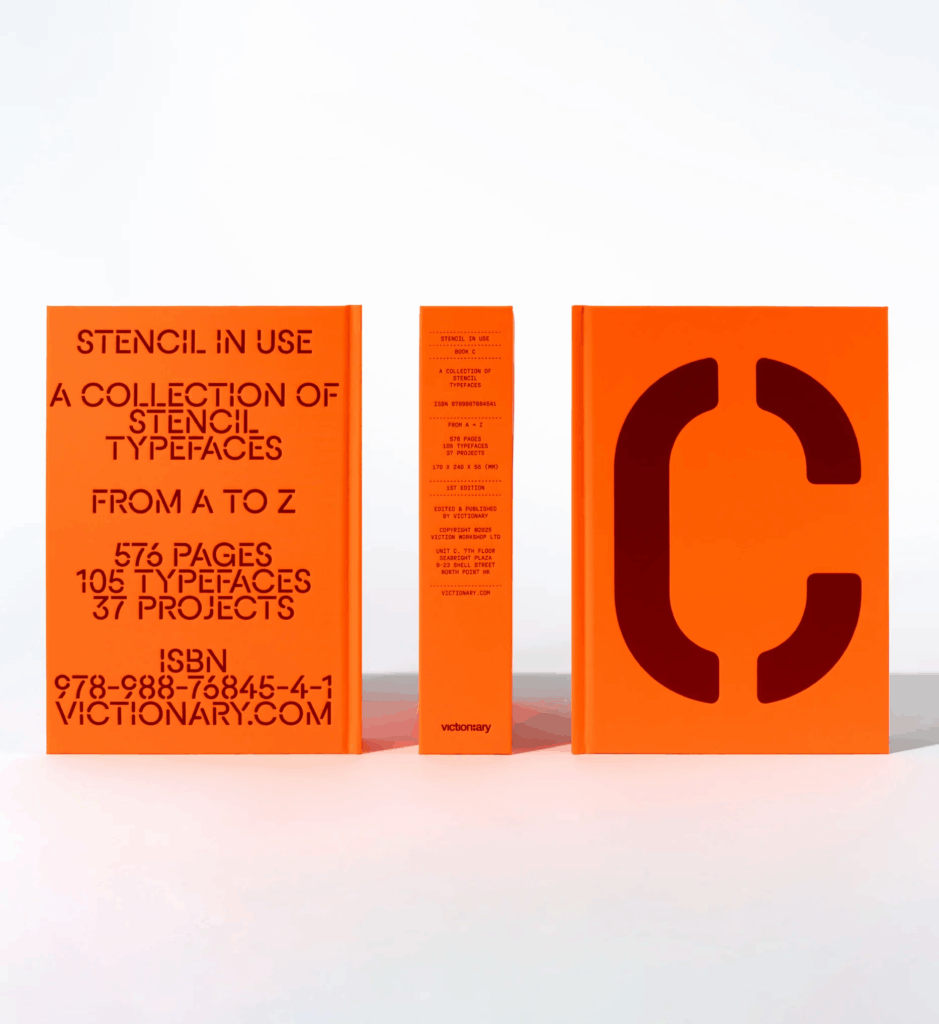
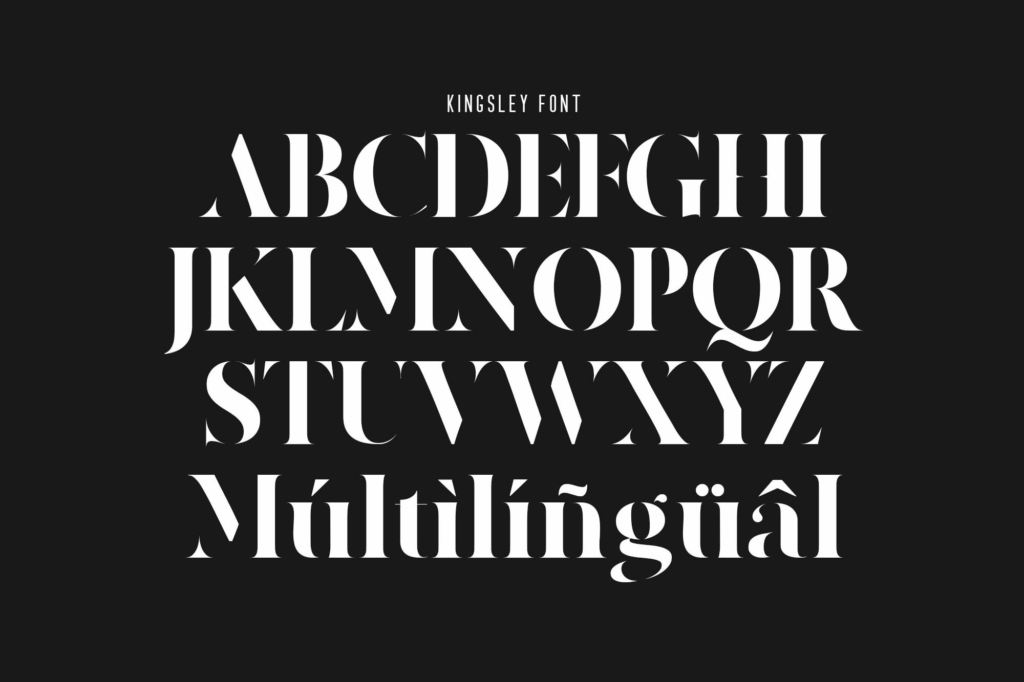
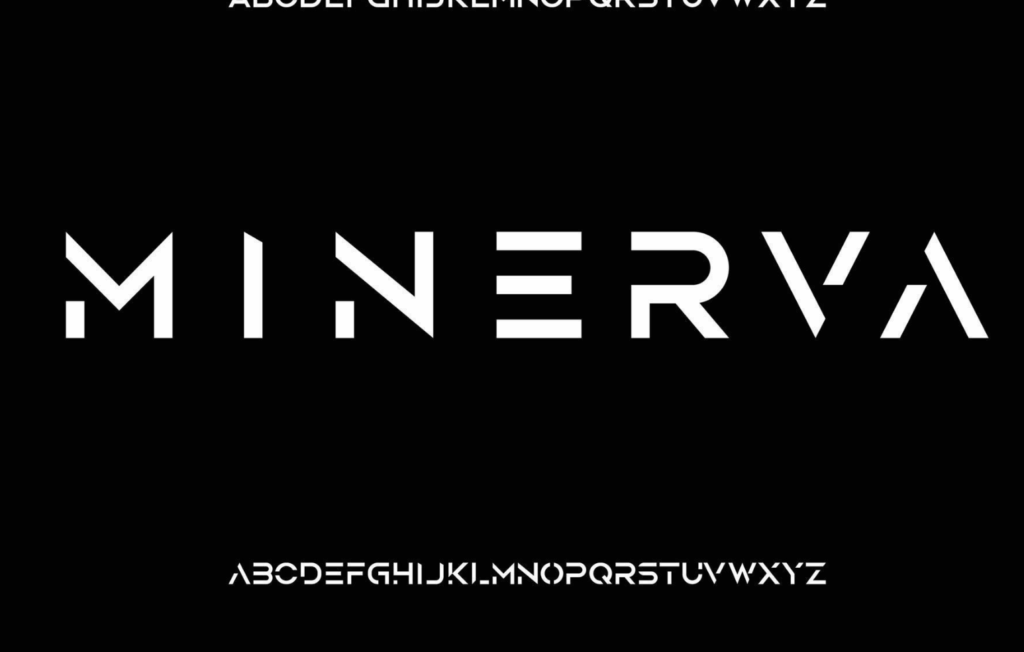
When I think about stencil fonts, what first comes to my mind is either cheap graffiti or oldschool military / aviation sprayed on airplanes, runways or industrial machinery and maintenance toolboxes. Nothing too elegant, more heavy duty style. But can I challenge this perception and create something new?
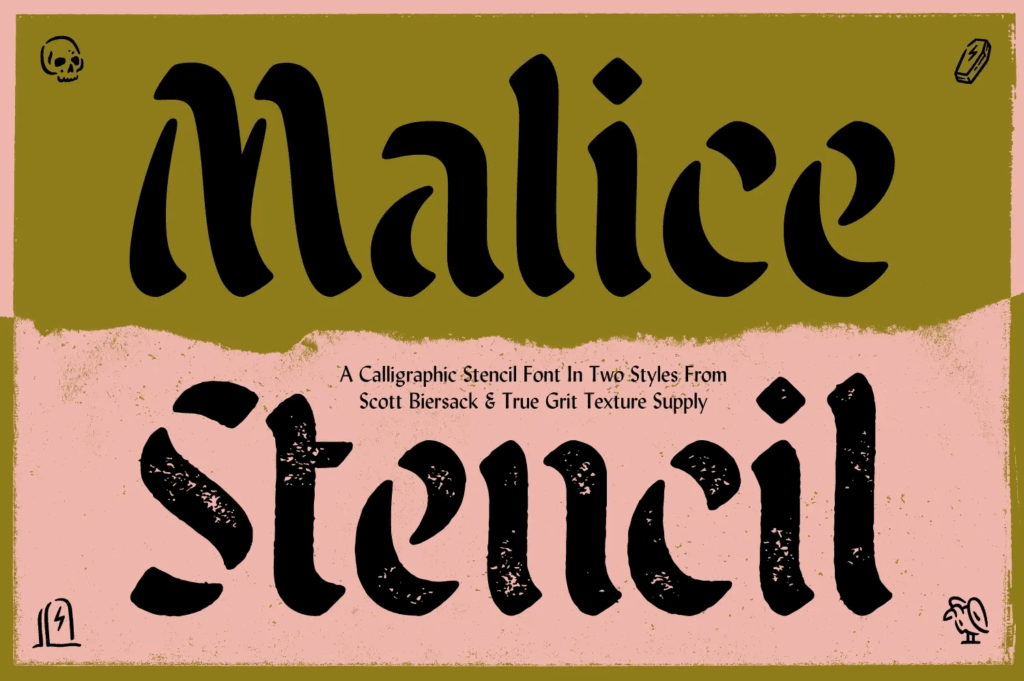
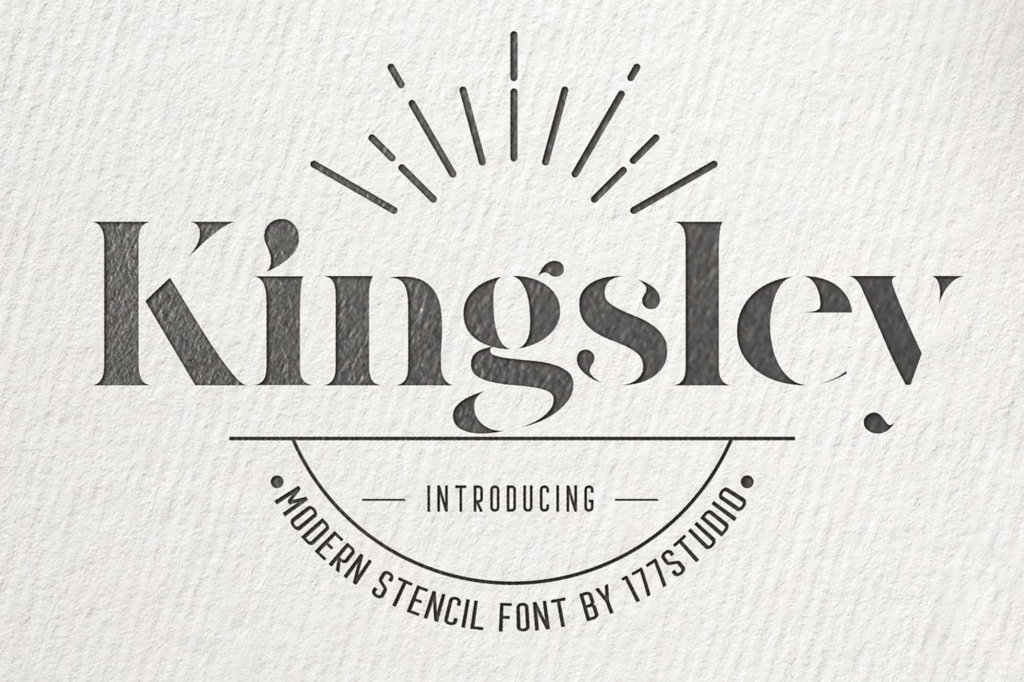
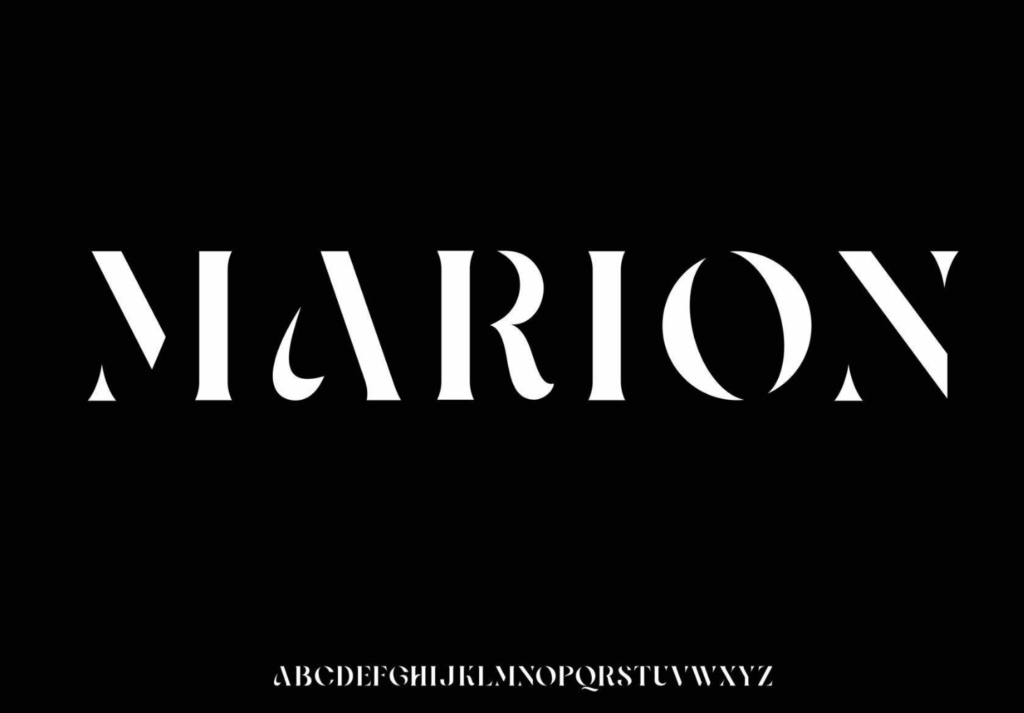
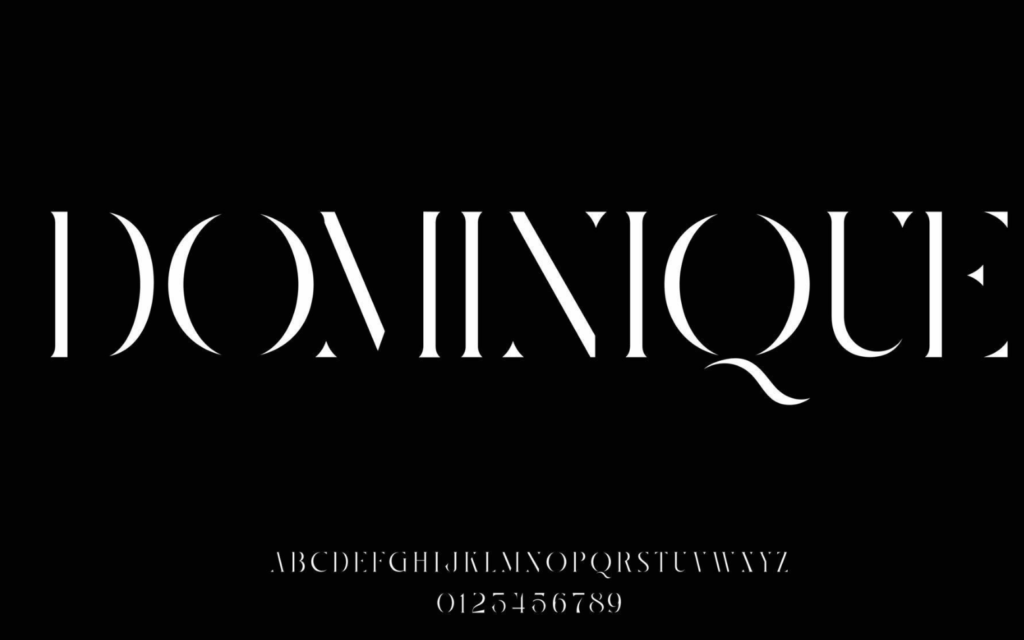
During my research I quickly found new resources that opened my mind:
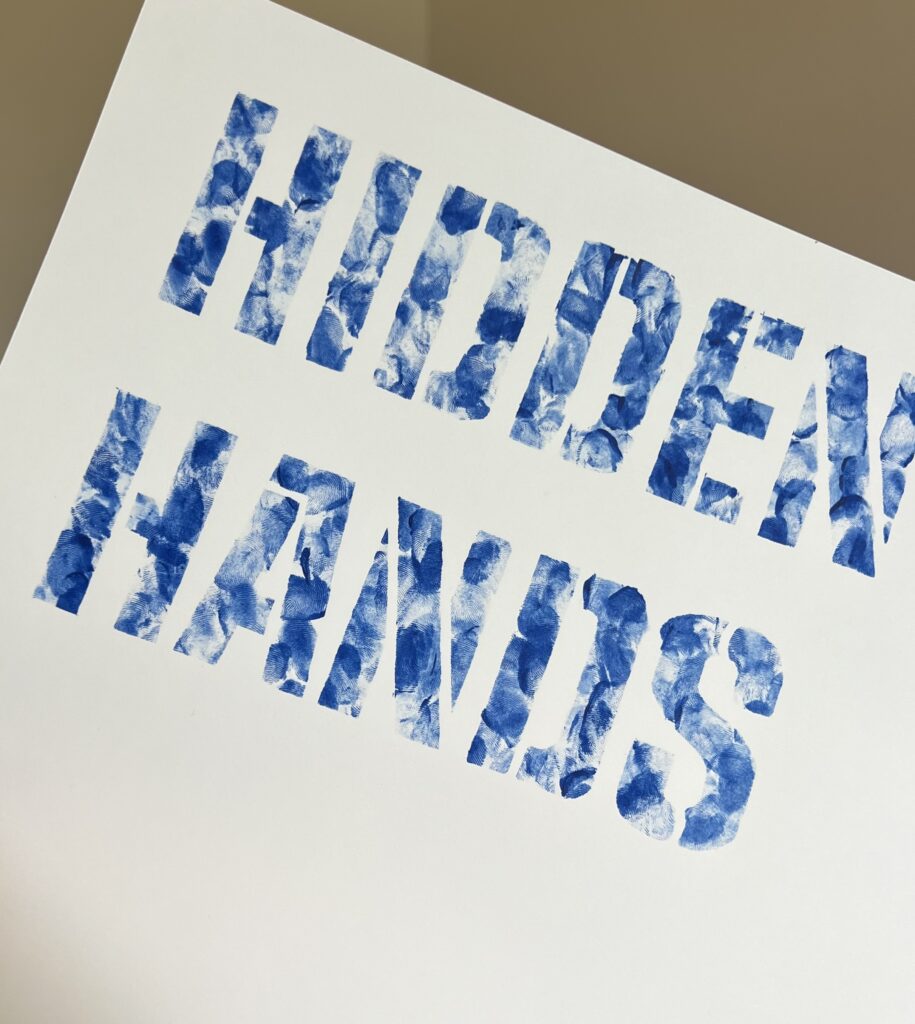
For me this experiment was less about the stencil typography itself, but more about the mixed media aspect of it. Which materials can be used to fill or paint the letters?
Here some brainstorming:
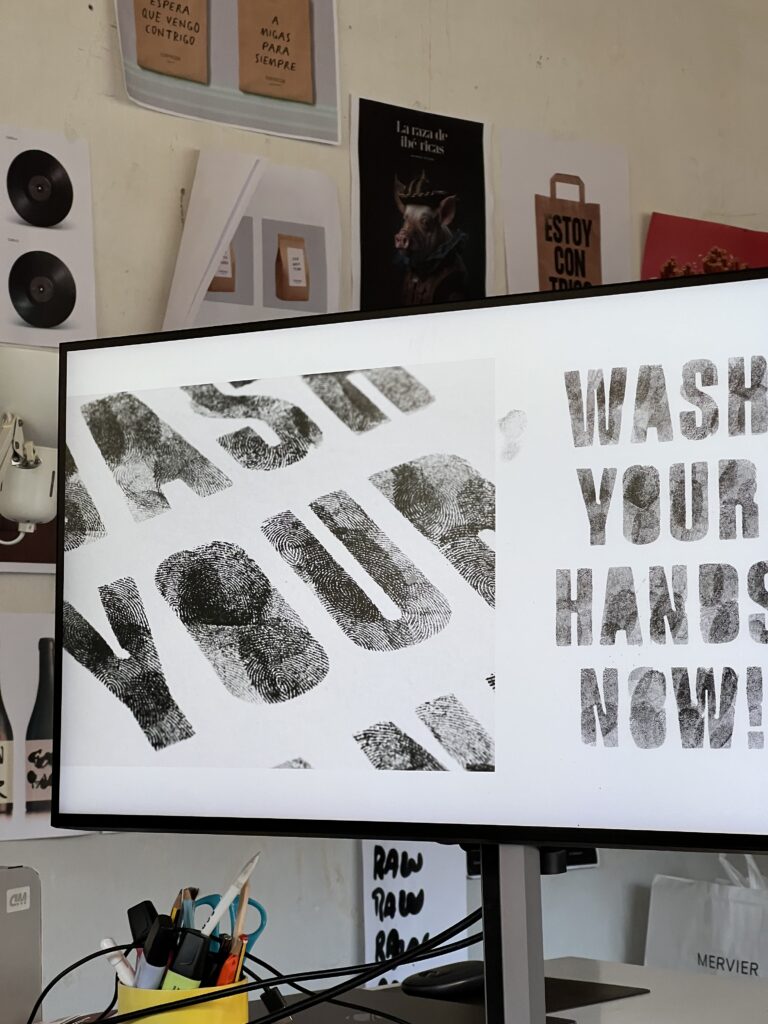
Fingerprints
Earth
Sand
Spraypaint
Pen scribble
Acrylic paint
It’s interesting to see how different the readability and elegance is within these 4 examples I picked.
The Experiment
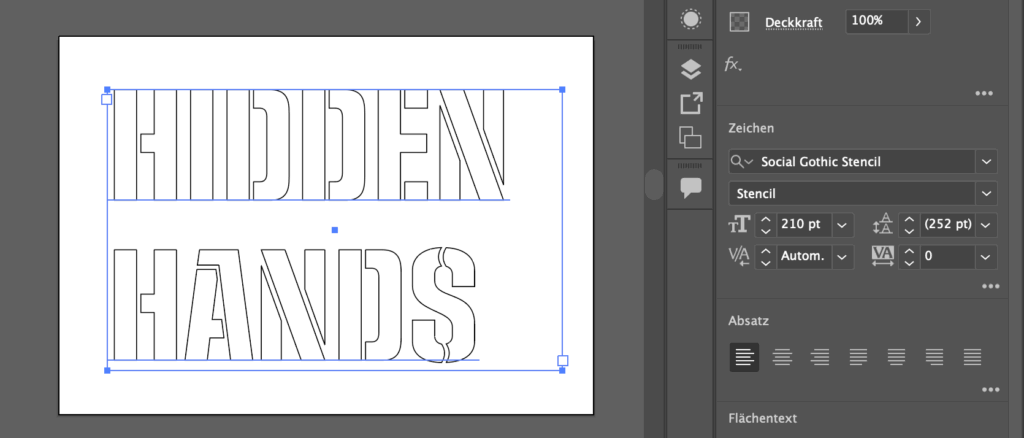
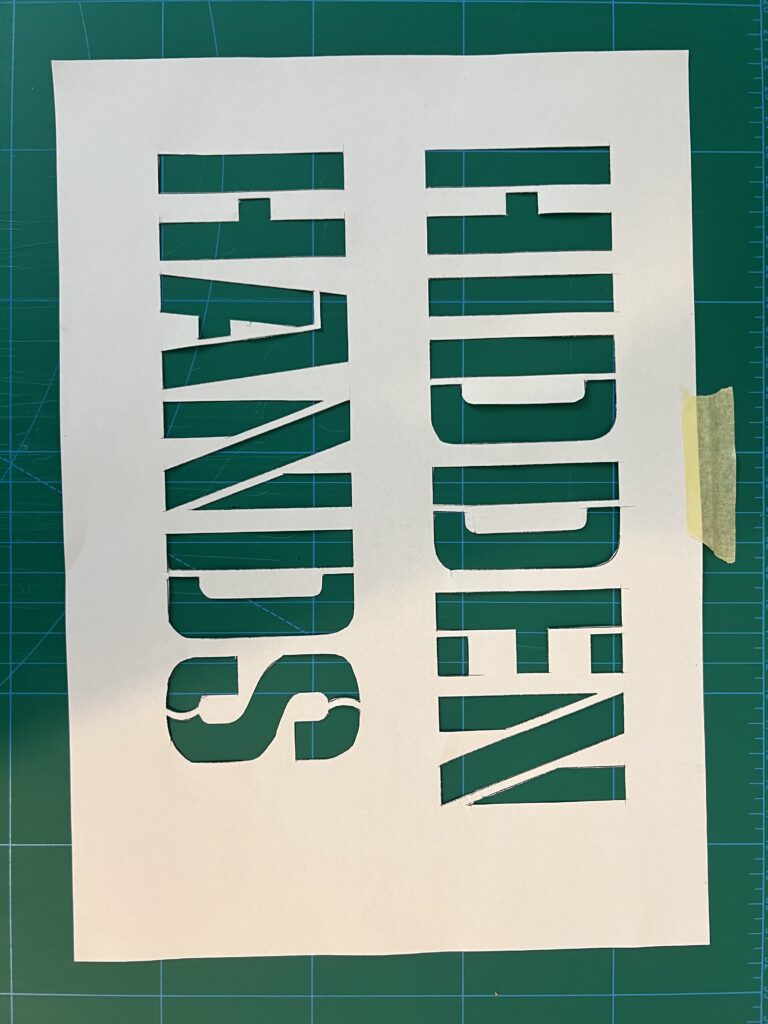
I chose to print out a stencil font called “Social Gothic Stencil” on a sheet of A4 paper and to cut it out with a carpet knife to create my own stencil with the two words “Hidden Hands”.
For further experiments and a leaner production process I would like to use washable plastic and the lasercutter in the FabLab to skip the manual cutting.
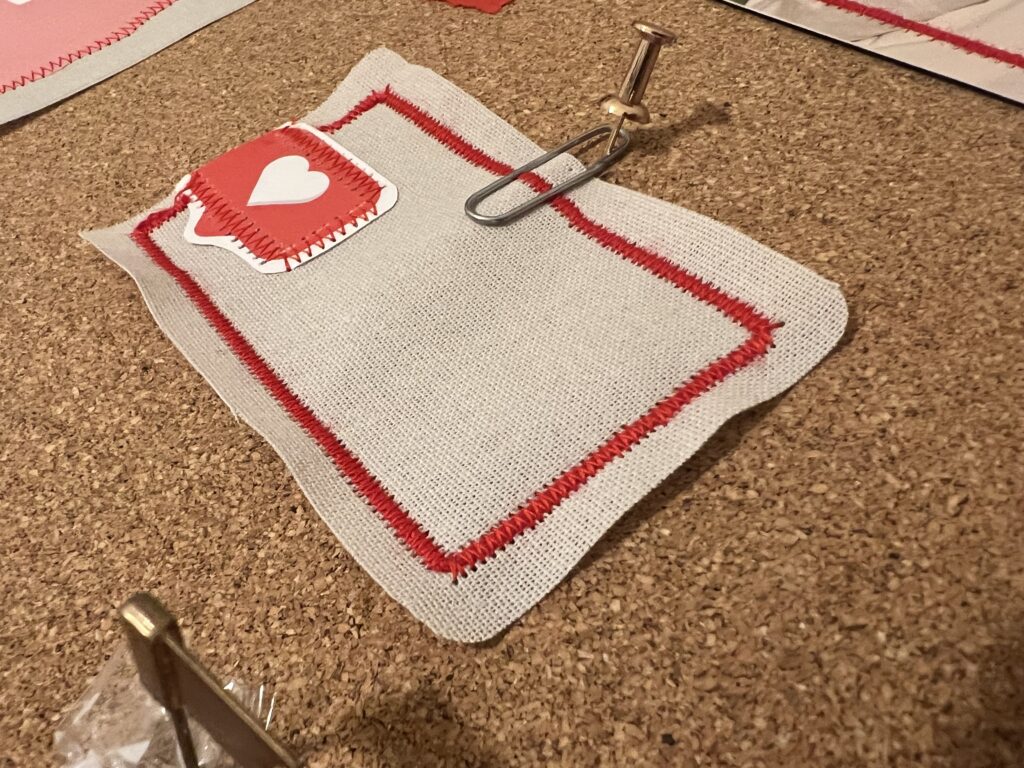
With this experiment I wanted to explore how wool thread transforms the visual and tactile qualities of sewn designs, compared to conventional embroidery floss or thread.
Focus Areas:
Texture: Observe how wool’s fuzziness and thickness catch light differently or distort stitch regularity.
Tension & Structure: Document how wool behaves in tight vs. loose stitching; whether it puckers or lifts the fabric.
Emotional Qualities: Reflect on how it shifts the “feel” of the piece — rustic, raw, cozy?
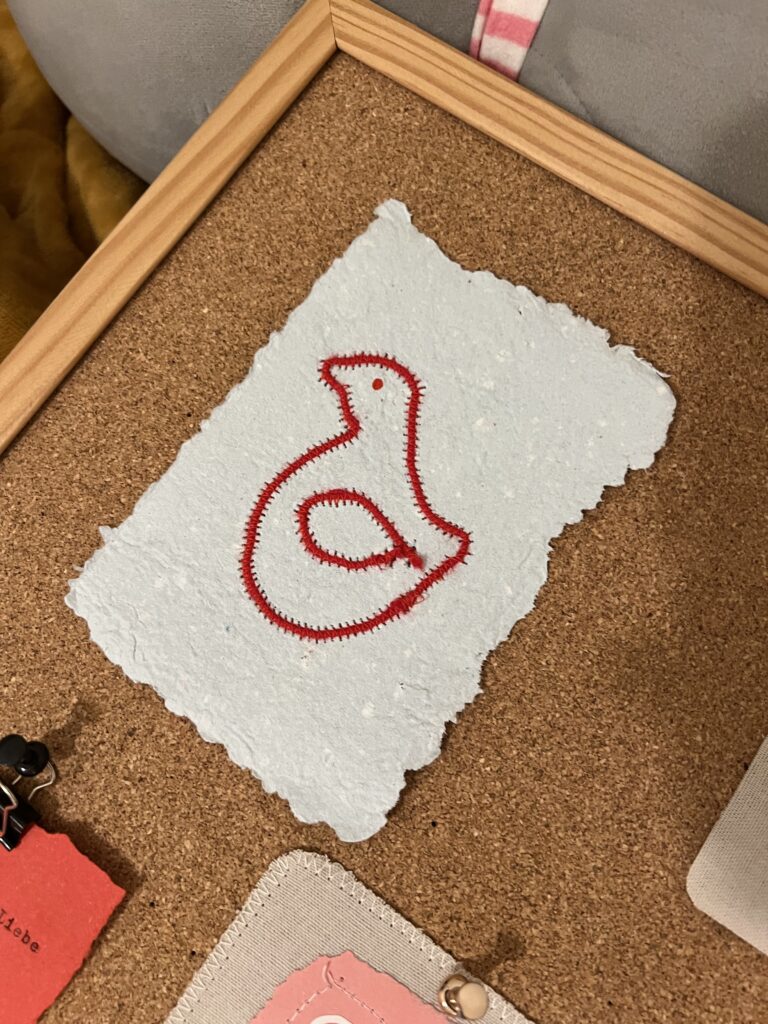
Then in the second attempt I switched fabric for a more unconventional surfaces like my self made paper. I would also like to try cotton, linen, felt, or even further variations to explore are various colors and weights of the thread itself.
Conceptual Layer
Next my objective is to contextualize my material experiments with narrative, metaphor, or thematic exploration.
Questions to Guide:
What does wool evoke culturally or emotionally? (Warmth, heritage, craft, softness)
How does working on fragile/ephemeral materials (like handmade paper) with bold threads challenge permanence?
Can you use your material explorations to tell stories of tension, repair, fragility, or transformation?
Installation or Presentation Format
I consider displaying my studies as:
A sample book with swatches and notes.
A wall installation mapping progression and material dialogue.
A photographic series focusing on material interactions.
Process-based documentation (videos of stitching, sound of thread on fabric) to amplify the tactile experience.
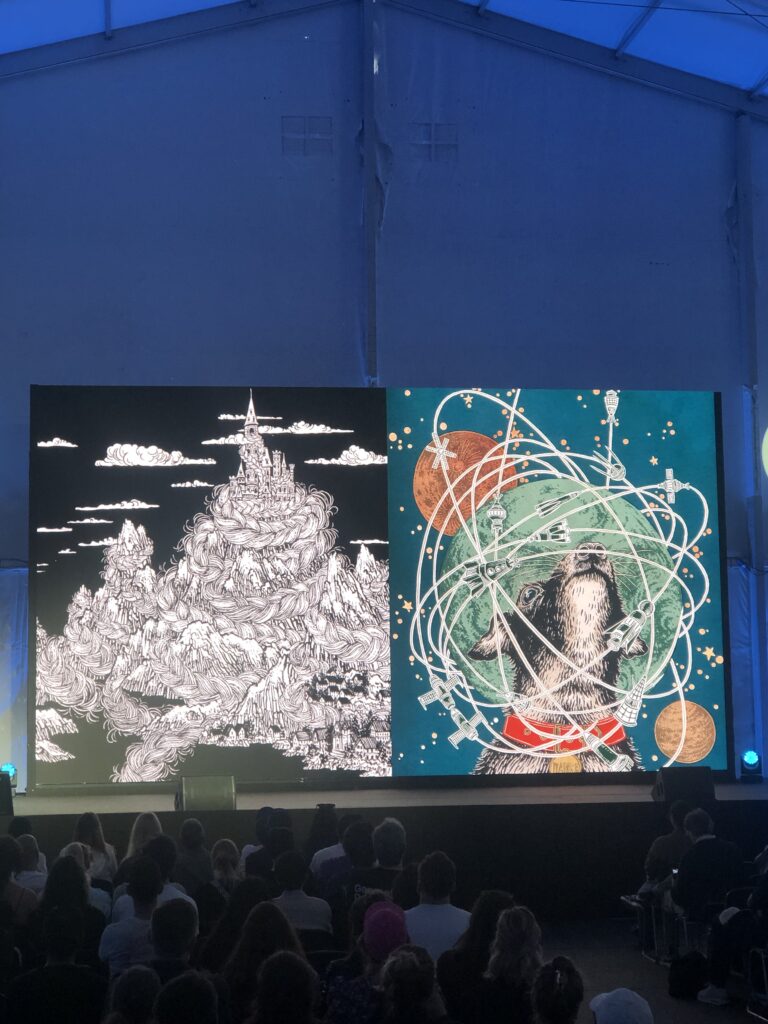
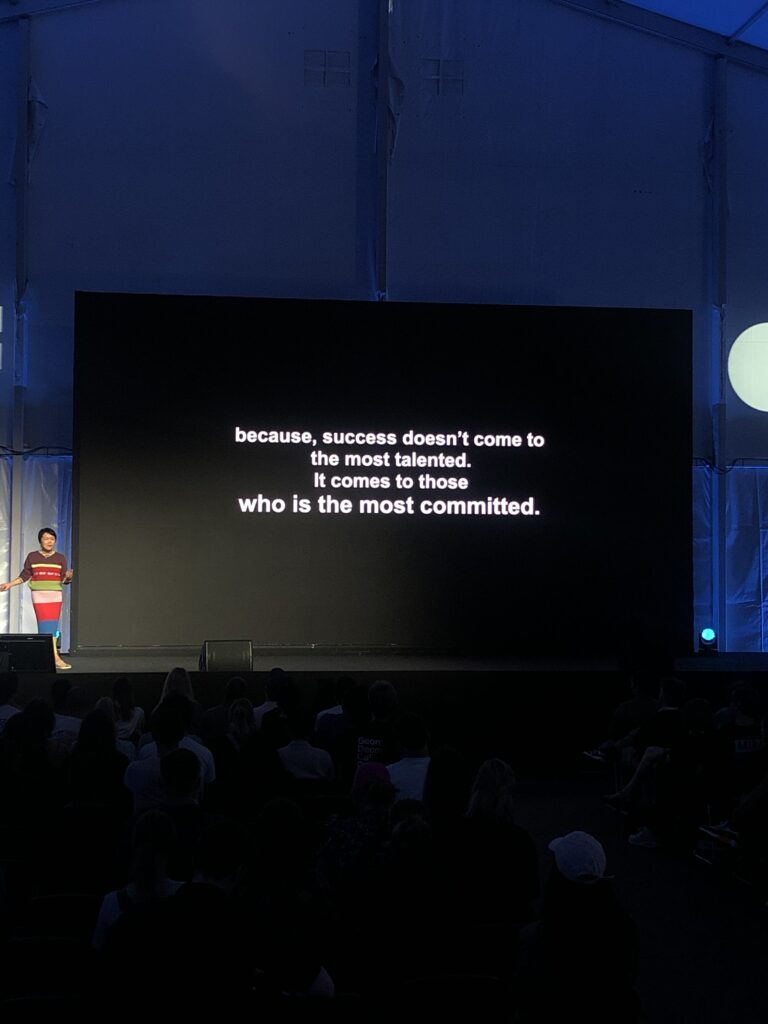
Yuko Shimizu at OFFF Barcelona At the OFFF Festival in Barcelona, one talk in particular left a lasting impression on me: Yuko Shimizu’s. Her thoughts on artistic integrity, staying true to yourself, and finding your own path deeply inspired me. Since these are the same questions I explore in my blog, I wanted to summarize and reflect on her talk here.
Who is Yuko Shimizu? Yuko Shimizu (not to be confused with the Hello Kitty designer of the same name) was born in Tokyo in 1965 and now lives in New York. She works for clients such as The New Yorker, TIME, and DC Comics. It wasn’t until her mid-thirties that she left a career in PR to study illustration at the School of Visual Arts in New York – a bold and life-changing decision. Her style is powerful and culturally layered, blending influences from traditional Japanese Ukiyo-e and Western comics.
The Talk: Honest, Motivating, and to the Point Yuko’s talk wasn’t about putting on a show, it was an open, thoughtful conversation about doubt, decisions, and creative mindset.
“You don’t need to change how you draw – you need to learn to embrace it.” Her message: accept your style instead of chasing trends.
Original or Pop Star?
“Don’t judge but decide who you want to be: original or pop star?” Do you want commercial success, or do you want to follow your own unique path? Both are valid but the choice should be intentional. And when you say yes to a project, give it your all.
“Don’t create for imaginary clients.” Yuko warns against designing based on imagined expectations. Often, we create with a voice in our head saying, “Would a client like this?” – which isn’t necessarily wrong, but it can limit creative freedom. Some of the most powerful work happens when there are no constraints, no brief, no paycheck, just pure artistic expression.
Focus Over Talent
“It doesn’t matter when you are not talented – clear focus matters.” Talent isn’t everything. What matters more is clarity, perseverance, and passion. Doubt is normal. The important thing is to keep going. “To say: ‘In the past I was so bad’ means that you got better.” Looking back and seeing growth is a sign of progress and that’s a great feeling.
Why Illustration?
“Illustration comes when photos don’t work.” Illustration can express what photography can’t – emotions, concepts, imagination. That’s why the medium matters. Even in a world full of new technologies, illustration has a future, because it’s honest, personal, and human.
My Conclusion Yuko Shimizu reminded me what truly matters: finding and owning your unique style. Not working for likes or money, but for meaning. And the two most important things: never give up and it’s never too late to start over.
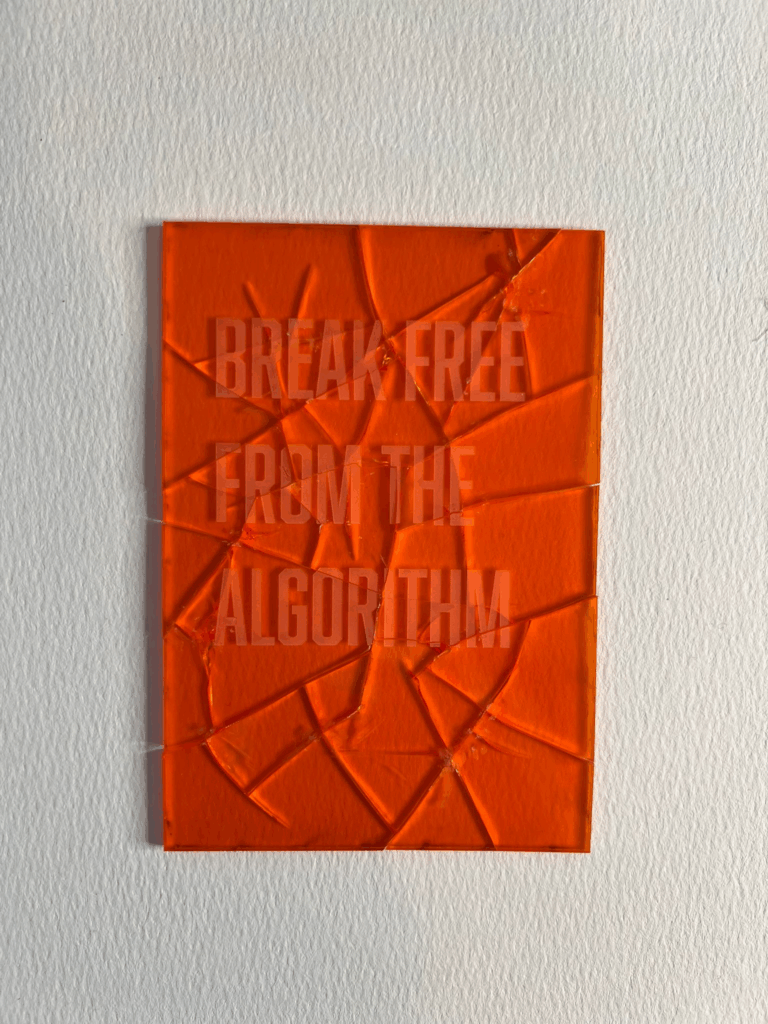
I aimed to further developed my material knowledge with this experiment. So I tried out whatever acrylic glass was in the left over bin at the Fablab. There was some orange, milkglass green, and transparent acrylic laying around.
I was surprised with how clean the edges can be cut and how well the engraving worked on the orange sample. The green was not my favorite outcome.
In the next step I experimented with the porosity of the acrylic compared to the actual glass from experiment #4.1.
See further development at experiment #11 at a digital level by creative post production.
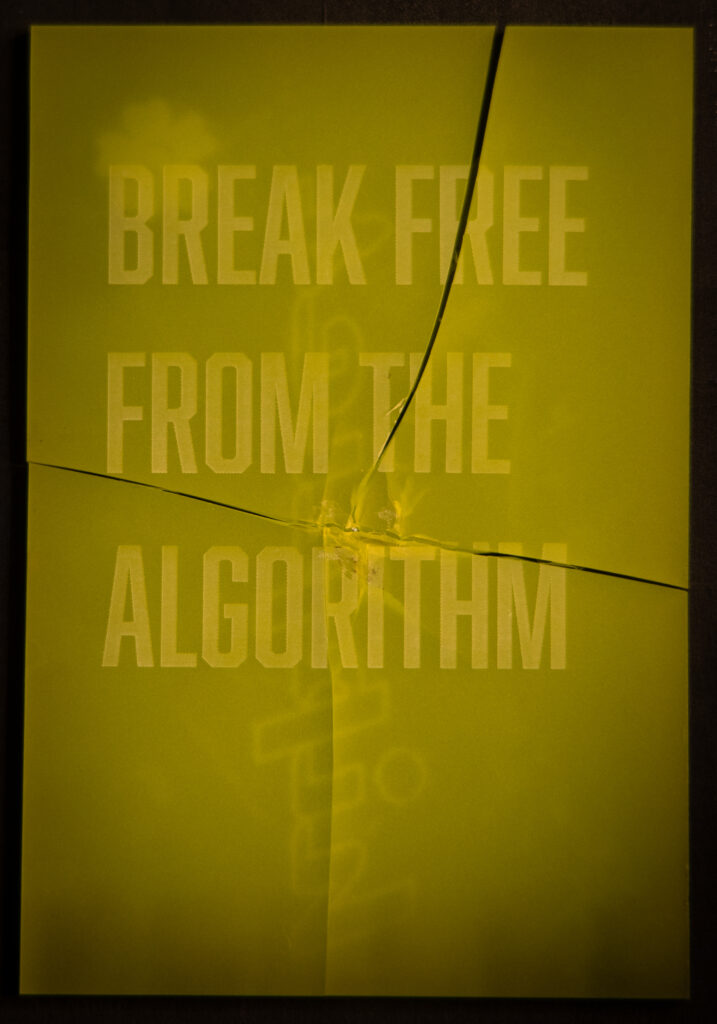
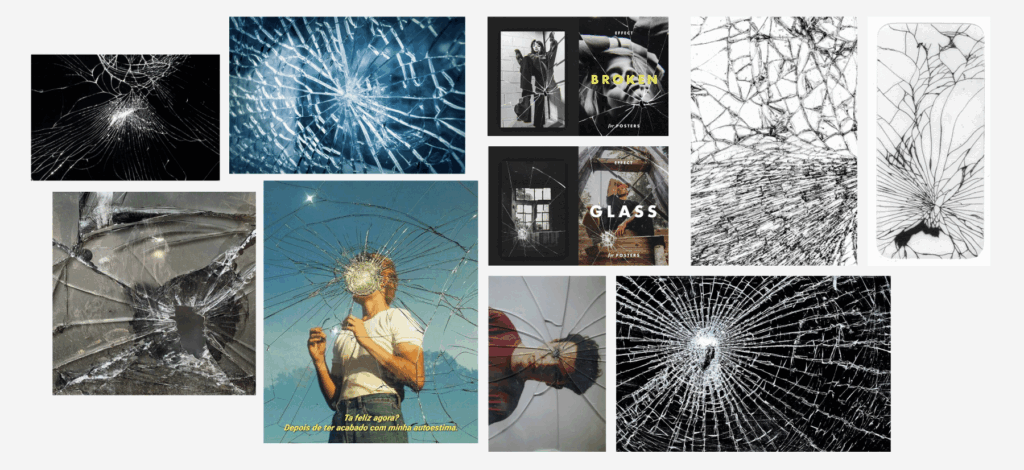
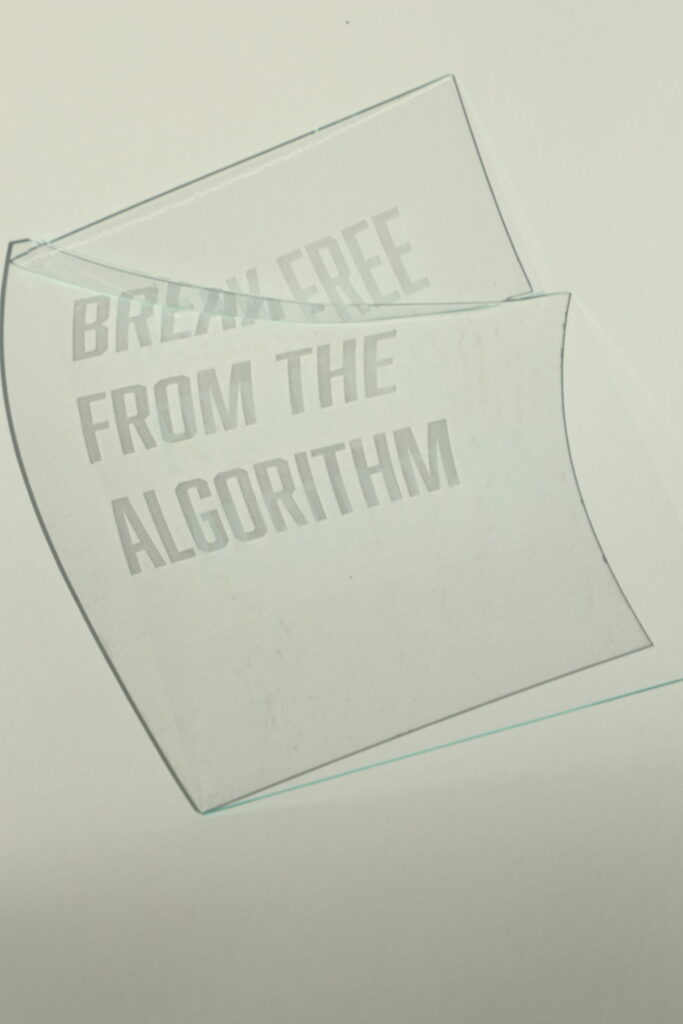
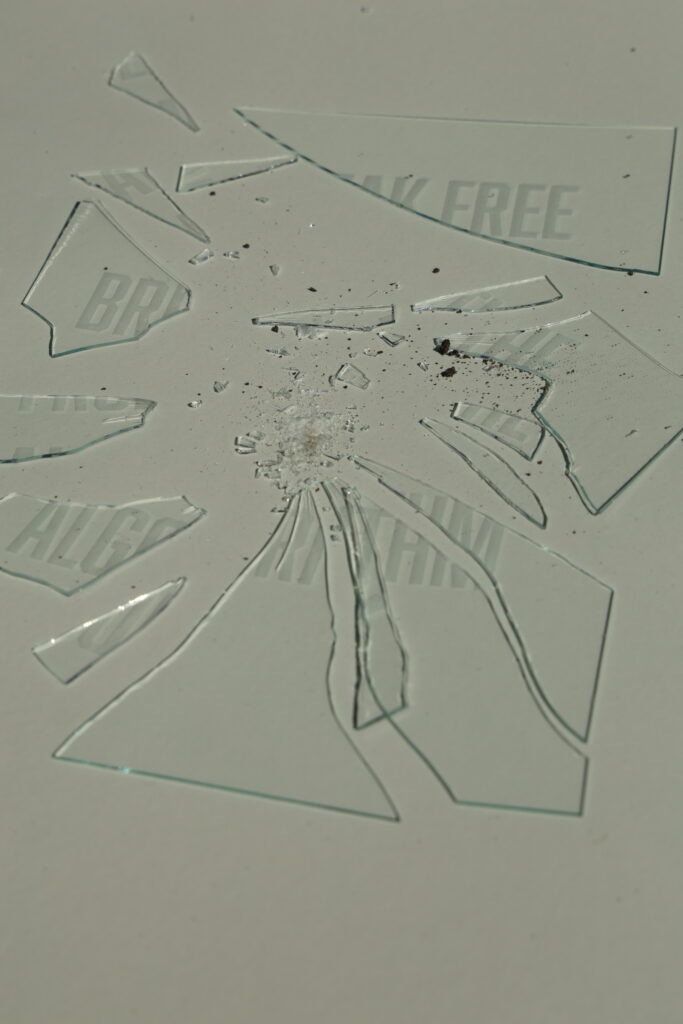
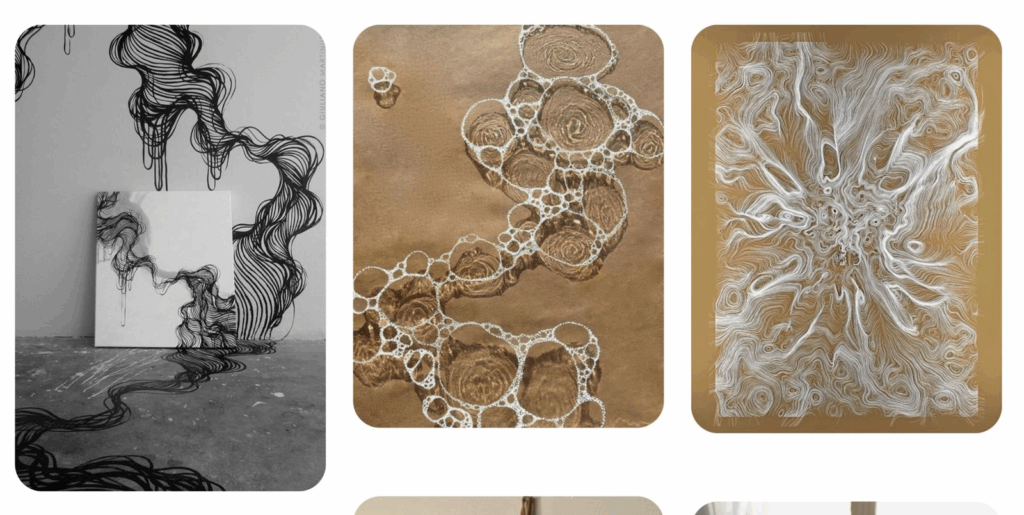
Before I started my project I created a moodboard for inspiration and conceptual direction. My central theme, “Break free from the algorithm,” emerged from a desire to challenge uniformity and celebrate irregularity, fluidity, and organic expression, qualities often lost in algorithm-driven platforms like Instagram and Pinterest.
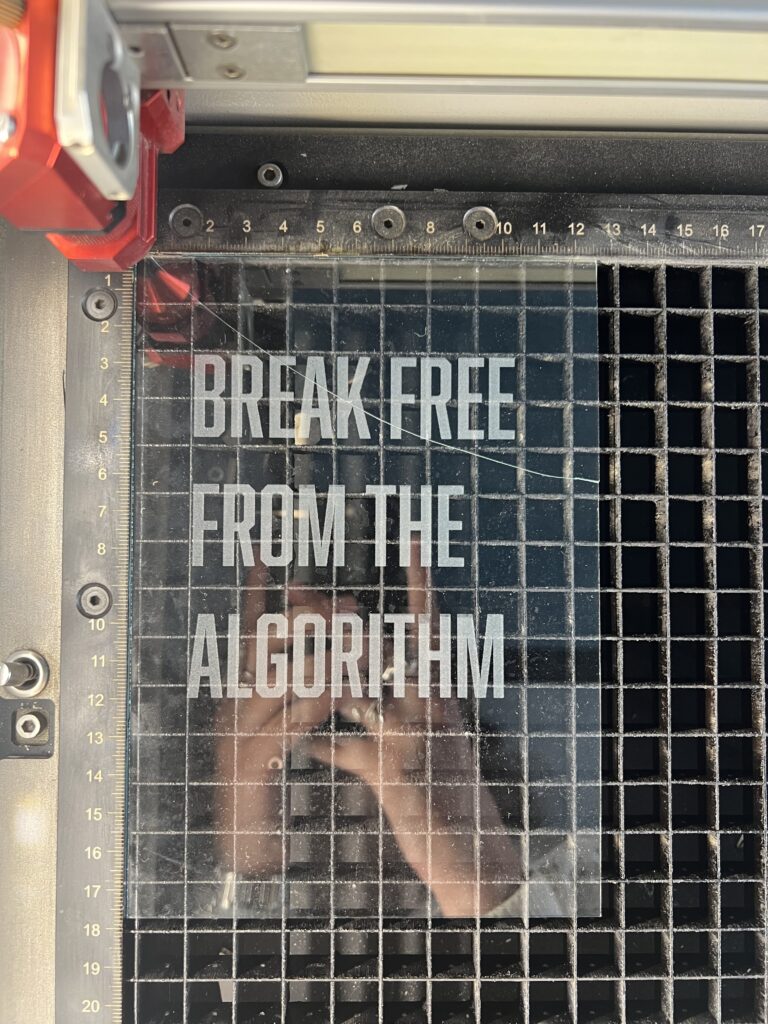
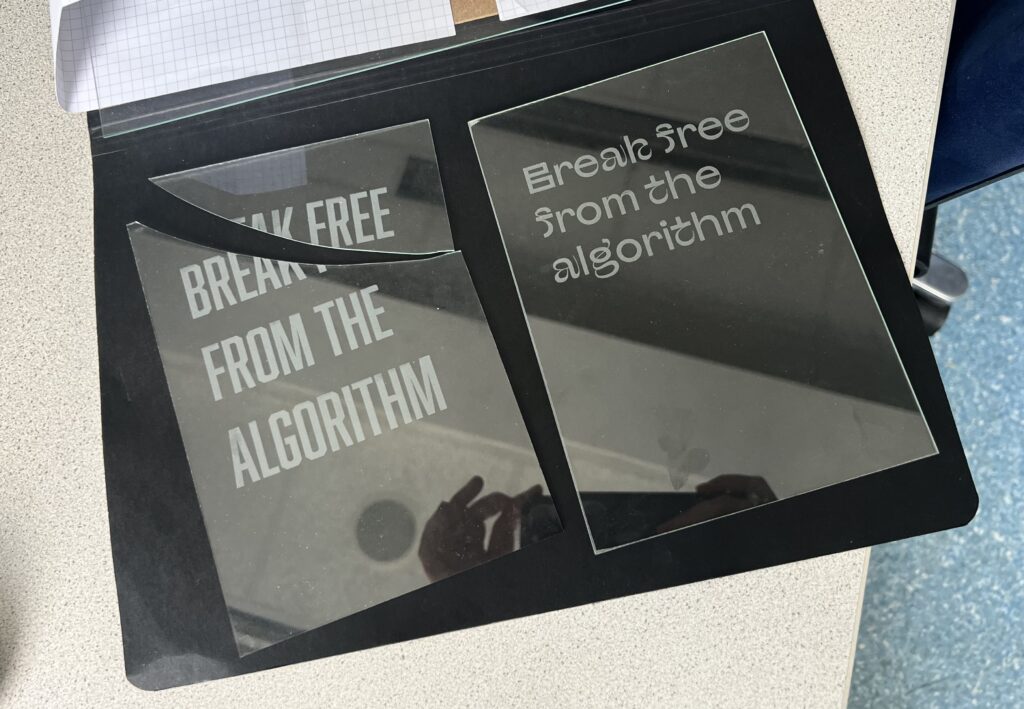
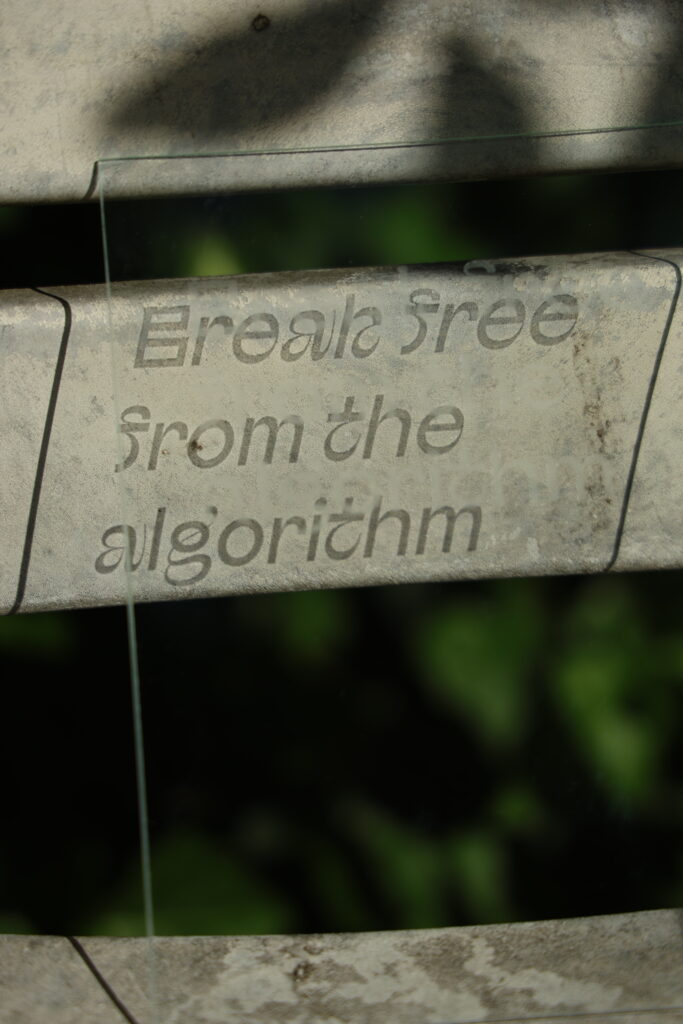
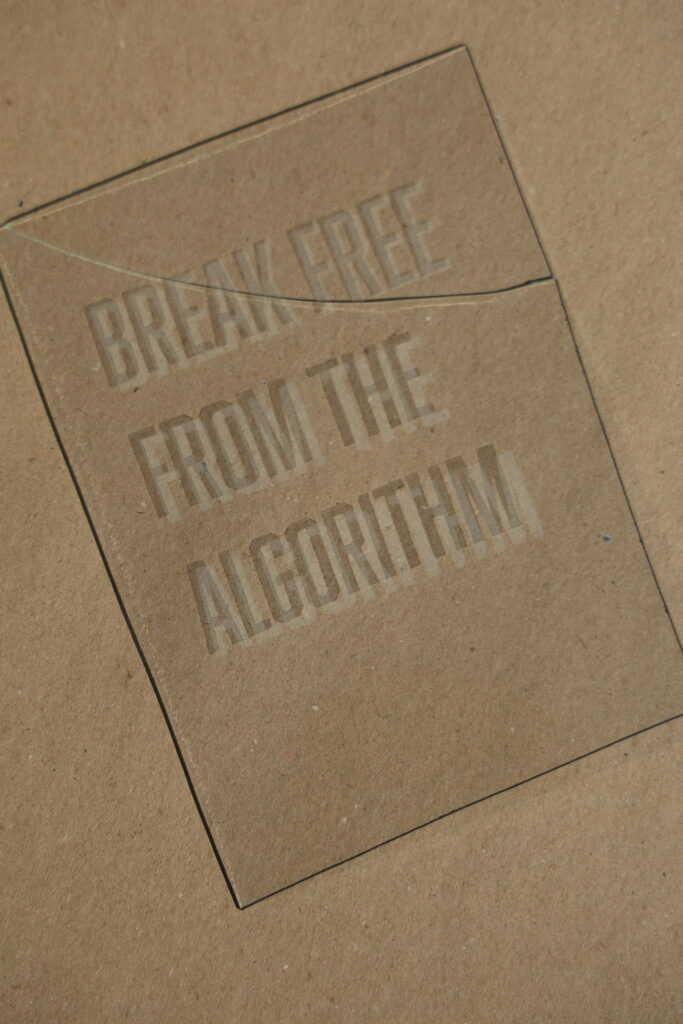
The outcome from the lasercutter in the FabLab: “Break free from the algorithm”
I tested two different typefaces and varied the thickness of the glass, noting how each combination affected legibility, shadow, and the interaction of light through the etching. The glass I took from picture frames that I had left over from making paper.
Photography
I’m now planning to scale up the format and move beyond text-based work. The next phase involves engraving a larger sheet of glass with an abstract, artistic pattern inspired by organic shapes, particularly those resembling water flow or liquid movement. I created a new vision board to guide this stage, filled with references from fluid illustrations, topographic lines, marbling, and ink-in-water photography.
The goal of this development is to explore how non-linear, natural forms can be embedded into the rigidity of glass—a material often associated with fragility but also permanence. The juxtaposition of algorithmic precision (via laser cutting) and organic chaos (via fluid-inspired design) is the core of this visual concept.
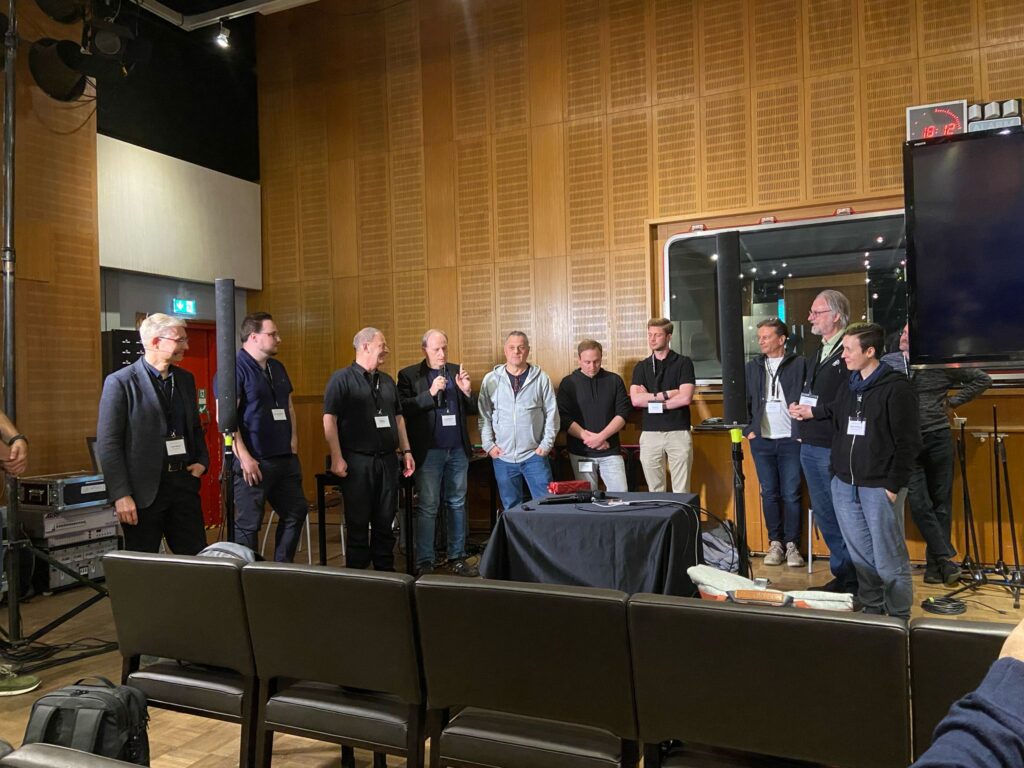
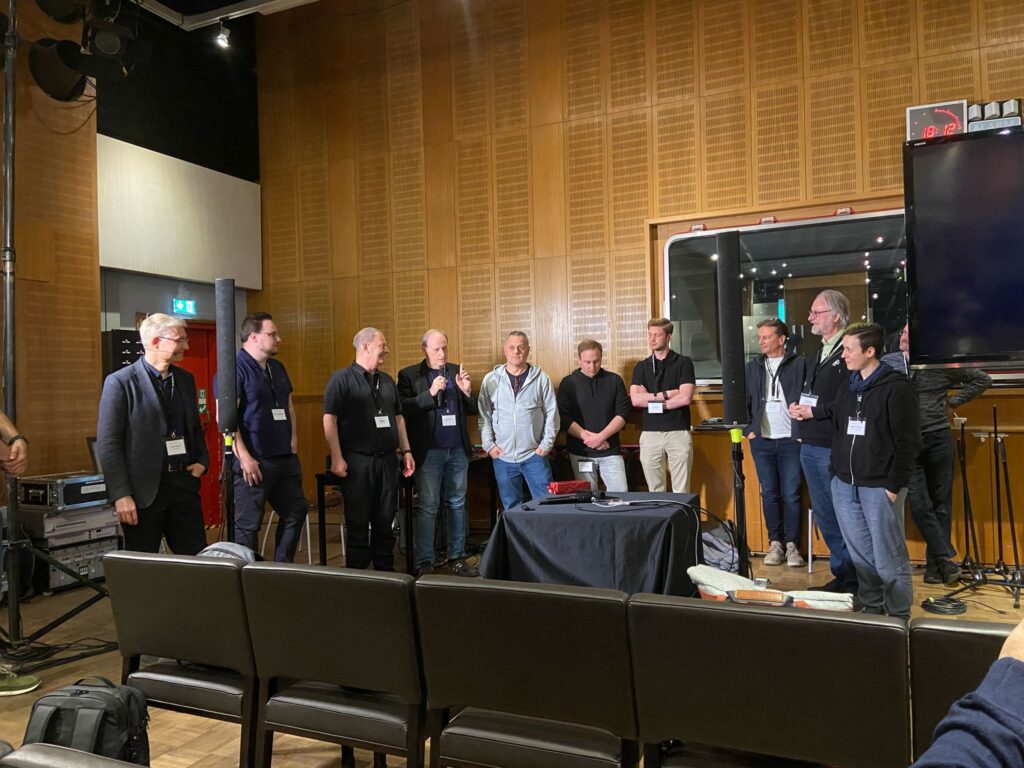
At the end of april, i had the opportunity to attend and participate in Lasse Nipkow’s 3D audio seminar. This seminar was held at the ORF Funkhaus in vienna and many important guests from the industry were invited. At the end of the last day of the seminar, all speakers were asked to talk briefly about the future of 3D audio. These were the most important findings of this discussion:
“Who’s Gonna Pay for This?” – Dietz Tinhof
Dietz Tinhof tackled the uncomfortable question of financing 3D audio head-on. He stressed that creators and innovators in the field rarely see financial returns for their work, while platforms and labels profit. “We’re at the forefront of a development where others will reap the rewards, not us,” he said, pointing out the lack of rights or credits for audio engineers compared to other creative roles like cinematographers. He called for collective action to demand recognition and fair compensation, arguing that immersive audio’s artistic and technical value should translate into tangible benefits for its creators. “Ton wächst nicht auf Bäumen—it’s our labor, our ideas. We can’t keep giving it away for free.”
Lasse Nipkow proposed in this context that we should focus on 3D audio in luxury settings (e.g., spas, luxury hotels).
Tom Ammermann continued by emphasizing the need for better binaural mixes, noting significant room for improvement. He highlighted the growing role of 3D audio in live installations and households, urging producers to prioritize quality to shift perceptions from “it wasn’t bad” to genuine enthusiasm. He envisioned 3D audio becoming “the new stereo” if the industry collectively pushes for higher standards.
Michael A. Bühlmann added that while technical formats like mono, stereo, or 3D are packaging, the artistic vision must remain uncompromised. Roger Baltensperger stressed the importance of mastering workflows and quality control, advocating for the same rigor applied to stereo to unlock 3D’s full potential.
Sebastian Oeynhausen (Pan Acoustics) thanked the community for its welcoming atmosphere and noted the divergence between home and industrial applications, urging manufacturers to develop specialized hardware. He also praised tools like Graves 3D for animating audio objects in DAWs.
Katharina Pollack, representing the scientific angle, underscored the importance of foundational research and artistic-technical synergy. She predicted a binaural-dominated future, citing widespread headphone use and innovative applications like Dreamwaves’ navigation systems for the visually impaired.
Karlheinz Brandenburg reflected on 25 years of binaural and speaker-based audio, celebrating its resurgence but cautioning that home-listening standards (e.g., proper headphones for spatial audio) are still evolving. He dismissed the idea that standard headphones or YouTube could deliver true spatial experiences.
“Good Content Survives Mono Underwater”
Florian Camerer blended humor and skepticism, toasting to “mono beer, stereo schnitzel, and immersive fever dreams.” But his real focus was broadcast’s inertia. While public broadcasters like ORF led the 5.1 revolution, immersive audio remains stuck in limbo. “Everyone’s waiting for someone else to jump first—the BBC, the French, the Germans.” He criticized recycled debates over basics like center channels and LFE, calling it “déjà vu from the 5.1 era.” Yet he ended on optimism: immersive audio, unlike 5.1, might survive because of its artistic potential.
Benedikt Ernst, the youngest in the room, brought a hopeful counterpoint. With “youthful recklessness,” he argued that engaging more creatives could unlock both artistic and economic potential. “If we get artists on board—not just as passive recipients but as active participants—the content will improve, and the money might follow.” He acknowledged the uphill battle but emphasized the need to bridge the gap between technical possibilities and creative buy-in.
Lenni Damann grounded the discussion in reality, citing Spotify’s influence as a make-or-break factor. “Labels ask: Why invest in 3D if our artists have 3 million monthly listeners on Spotify but only 95,000 on Apple Music?” He hinted at industry rumors about Spotify’s potential spatial-audio rollout, which could tip the scales. “If the biggest platform pushes it, suddenly the ‘why’ becomes obvious.”
Closing Words: “The Battle for Quality and Perception”
Dietz Tinhof circled back to dual challenges: production and perception. On one side, clients treat 3D as a marketing afterthought, demanding “stems-based pricing” that sacrifices quality. On the other, end-users hear compressed, downgraded versions of meticulously crafted mixes. “We’re stuck between clients who say we’re not making money and listeners who say we don’t hear the difference.” His rallying cry? Fight for immersive audio as its own art form—not just “stereo with extra steps.” Tom Ammermann and Michael Bühlmann echoed this, sharing stories of artists who dismissed 3D until they experienced it firsthand. The takeaway: Education, advocacy, and unflinching quality are the keys to 3D’s future.
Lasse Nipkow closed with a nod to collaboration, inviting attendees to the next Tonmeistertagung. The room’s consensus was clear: 3D audio’s potential is undeniable, but realizing it demands creativity, persistence, and a fair share for those building it.
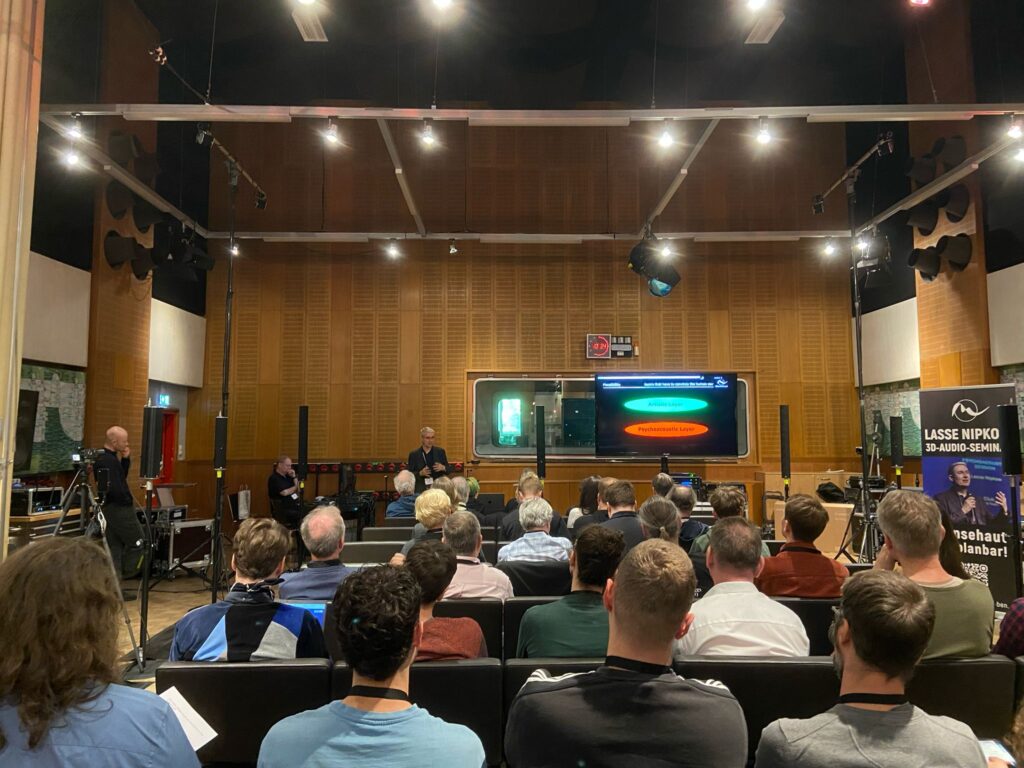
In late April 2025, I had the exciting opportunity to attend the 3D Audio Seminar by Lasse Nipkow, held in cooperation with the VDT (Verband Deutscher Tonmeister) under the motto “Goosebumps can be planned!”. The seminar took place on April 29–30, 2025, at the ORF RadioKulturhaus in Vienna and brought together audio professionals, creatives, and technical experts with one clear goal: to create impressive 3D audio content for audiences.
The event was not only aimed at sound designers, studios, and educational institutions, but also at planners and representatives from concert halls, museums, hotels, and other service sectors. Its core mission was to bridge the gap between the technical and creative aspects of 3D audio, offering a deep dive into both psychoacoustic principles and practical implementation.
The program covered a wide spectrum:
Psychoacoustic Foundations – understanding how humans perceive sound emotionally and using this knowledge to shape immersive experiences.
Technology and Practice – showcasing tools and workflows for producing and presenting high-quality 3D audio.
3D Listening Experiences – offering real-world examples and demonstrations in a finely tuned acoustic environment to highlight the full potential of spatial sound.
An exhibition area run by the event’s partner companies also accompanied the seminar, offering product showcases and networking opportunities during breaks and the evening reception.
Day 1: Setup and Technical Exploration
Although I initially registered as a participant, Lasse reached out beforehand and asked if I would be interested in joining the setup crew for the event. I immediately agreed—this was a chance I couldn’t pass up.
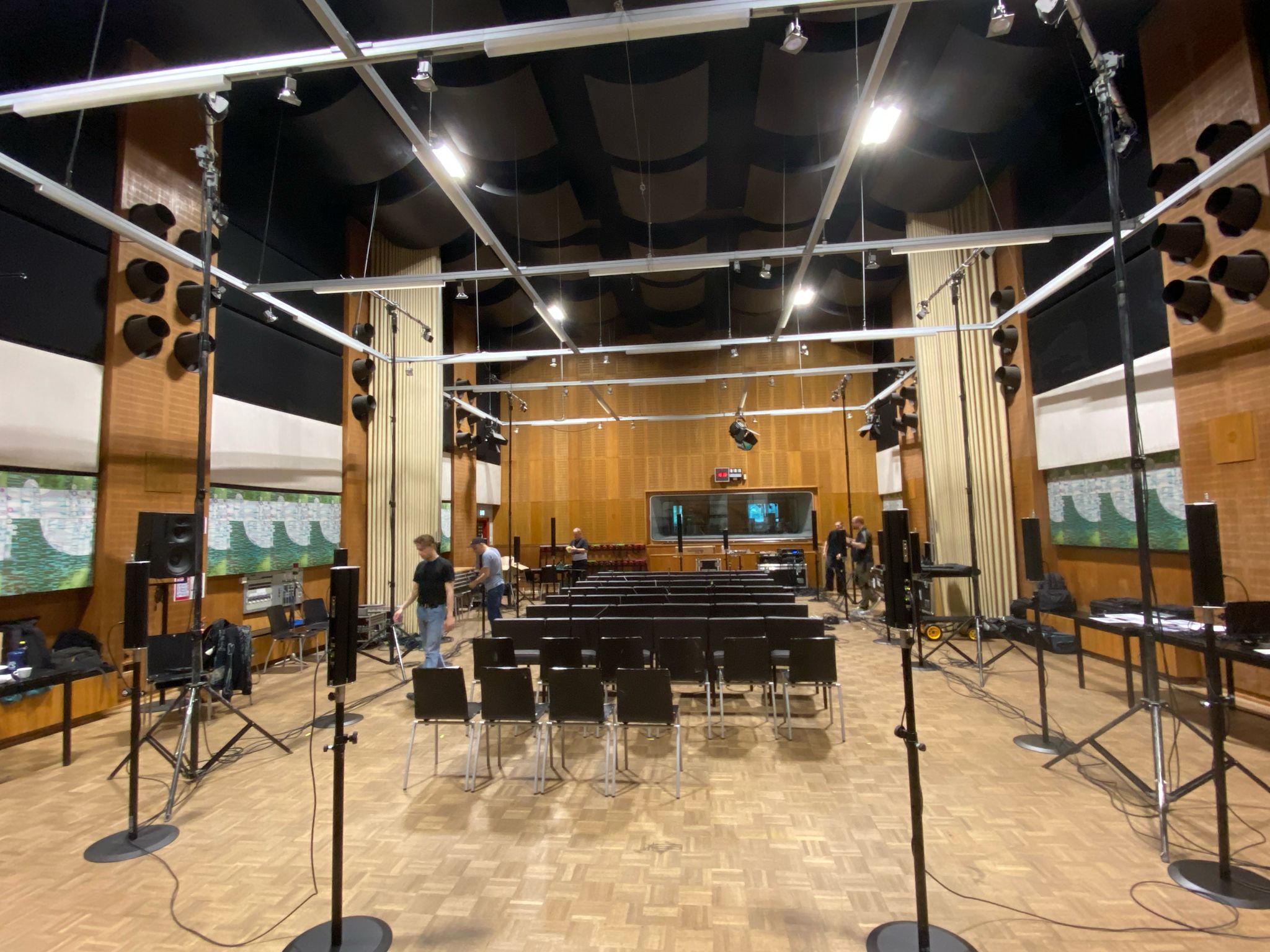
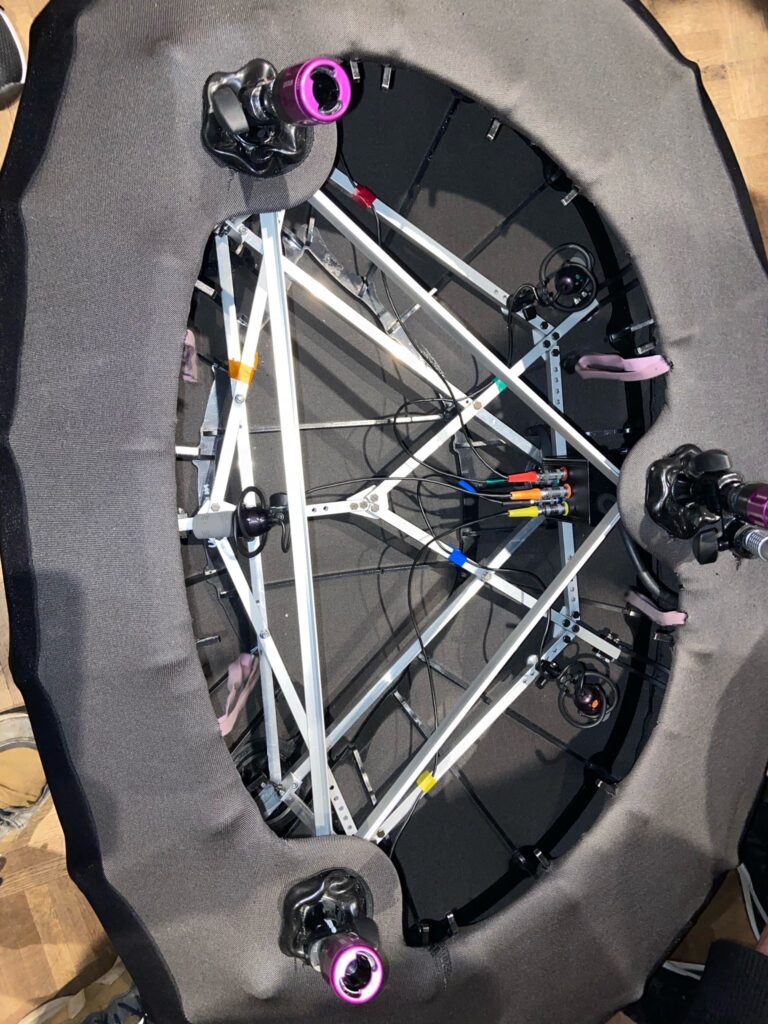
I arrived in Vienna on Sunday Morning, two days before the official seminar started, and began helping with the installation of the system alongside the team from Pan Acoustics, a German company specializing in professional audio solutions. The setup included multiple speakers, mostly connected via PoE++.
Throughout the day, I had several opportunities for in-depth conversations with Lasse Nipkow himself. These discussions were incredibly insightful and gave me a deeper understanding of the nuances and real-world challenges involved in creating immersive audio content. He also let us try some chocolate he brought from Switzerland – it was very delicious!
A key part of the system design included the placement of the two subwoofers, which were positioned to ensure even bass distribution across the listening area—crucial for supporting the 3D spatial illusion without overwhelming certain areas of the room. One subwoofer was placed in the front of the room, and one on the side. The combination of both subwoofers should ensure an even bass distribution.
Day 2: Measurement and Calibration Issues
Monday was dedicated to measuring and calibrating the system, but several issues became apparent during this process. In my opinion, the subwoofers were simply too small for the size of the room, resulting in a general lack of low-end energy. The bass was not only uneven in some areas—it was overall too weak to support the immersive sound field effectively.
The goal of calibrating the system on this second setup day was to create a neutral listening environment so that all presenters could play their demo material under consistent conditions. However, the system was so poorly calibrated that this goal wasn’t achieved. Most of the ceiling-mounted (height) speakers were barely audible, and the overall balance between the different channels lacked cohesion.
It also seemed likely that some mistakes were made during the measurement process itself—perhaps certain channels were misrouted or mislabeled, which could explain the unusual levels and inconsistent imaging.
As a result, each presenter ended up adjusting individual channel levels to suit their own material and preferences. This led to considerable inconsistencies in playback across presentations—some demos felt immersive and dynamic, while others sounded flat or unbalanced. It was a clear example of how crucial proper system tuning is when aiming for high-quality 3D audio experiences.
First seminar day – April 29
We met at 8 AM, had a coffee, and took the opportunity to chat with various manufacturers before the first lectures began at 10 AM.
The first day began with a deep dive into the psychological and technical fundamentals of spatial hearing, led by Lasse Nipkow himself. He demonstrated how immersive sound can create emotional reactions and detailed the principles of auditory perception in spatial contexts—explaining how our ears and brains collaborate to locate and interpret sound in a three-dimensional environment.
Then, Daniela Rieger introduced Dialog+, a Fraunhofer-based solution for making dialogues more intelligible using AI-assisted processing. This technology addresses a well-known problem in broadcasting: the difficulty many viewers have in understanding speech due to background noise and music. MPEG-H Dialog+ creates an alternative “Clear Speech” version by lowering background sounds and music from existing audio mixes. This version is available as an additional track in on-demand content, such as in the ARD Mediathek.
Dialog+ utilizes cutting-edge Deep Neural Networks (DNNs) to separate dialogue from other audio components. The system processes audio from real broadcasts, isolating the dialogue to create clearer, more accessible sound. It allows for personalization of the dialogue track, making it easier for viewers to understand speech in a variety of contexts, from documentaries to sports events.
Later in the day, Piotr Majdak and Katharina Pollack from the Austrian Academy of Sciences presented a session on how we perceive sound in space, explaining concepts such as HRTFs, ITDs/ILDs, and the role of early reflections in spatial hearing. Their session bridged the gap between scientific research and practical system design.
At 14:00 after lunch, Karlheinz Brandenburg, co-inventor of MP3 and founder of Brandenburg Labs, took the stage to discuss immersive headphone playback—an astonishing approach that makes the experience of listening over headphones almost indistinguishable from loudspeaker playback. His quote, “When I listen to sounds, our brain is a good pattern recognizer,” set the stage for a fascinating discussion on how our brains constantly compare the sounds we hear with stored expectations.
He presented various concepts:
Belly-voice effect (ventriloquist illusion)
McGurk effect (audio-visual fusion)
Room divergence/convergence (interaction of sound with space)
Learning and training (e.g., listening with different ears)
He argued that a plausible audio illusion requires a match between:
Expectations: What we anticipate hearing in the current environment.
Perceived sound: The actual auditory experience.
Several factors influence this, including:
Anatomy: The shape of the ear canal (HRTF).
Spatial cues: Reflections and room acoustics.
Visual cues: Sight can influence hearing.
Personal experience: Our brain’s prior knowledge.
Individualized HRTF: Recent studies have shown that personalized HRTF (tailored to an individual’s ear and head geometry) is not strictly necessary for realistic spatial audio. The brain can adapt to generic HRTF filters over time, though having a personalized measurement can enhance spatial accuracy, especially in headphone-based setups.
Brandenburg discussed how our brain’s ability to match sound patterns creates the illusion of immersive, spatial sound, and how visual and other sensory cues can enhance or disrupt that illusion.
One of the most practically engaging presentations followed: Tom Ammermann introduced his innovative Spatial Audio Designer Processor. This system, designed for professional use, allows real-time object-based mixing and supports a wide range of formats, from 5.1 and Dolby Atmos to custom 64-channel setups. Tom demonstrated how his system can be used in various contexts, from postproduction to live events, providing a highly flexible tool for immersive audio.
The day concluded with an evening listening session, where Tom, Lenni Damann, and Bene Ernst shared their own immersive productions. One of the highlights was the “Roomenizer” from Pinguin Ingenieurbüro, which let listeners experience real-time acoustic environments like cathedrals and concert halls, showing the power of spatial sound to enhance storytelling.
Day 2 – April 30
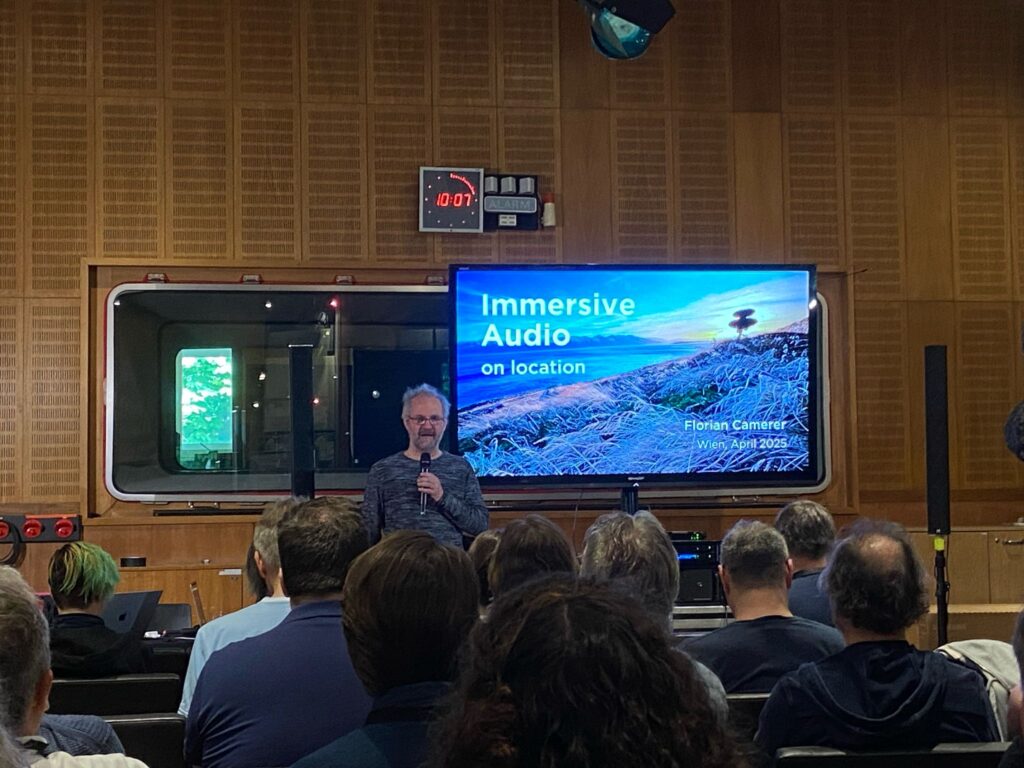
Florian Camerer presented his 9-channel microphone setup as a solution to the challenges of location-based sound recording for immersive audio. This setup addresses the limitations of traditional mono or stereo recordings by enabling more accurate capture of 3D sound.
Camerer’s system was designed to improve localization and spatial depth, utilizing microphone placement and wind shielding to ensure high-quality recordings in outdoor environments. His approach is particularly suited for capturing natural soundscapes in formats like AURO-3D and offers a more immersive listening experience by providing true spatial representation of the environment.
Later, Roger Baltensperger and Dietz Tinhof explored immersive music production, focusing on how spatial design can enhance emotional impact. Dietz Tinhof spoke openly about the current challenges in the production and perception of immersive audio. Two key issues give him, in his words, “a stomachache”: First, immersive content is often created for marketing purposes only or to benefit from higher payouts on platforms like Apple Music—not because of genuine artistic interest.
He recalled a conversation with Apple Music where they said there was a “quality problem.” His response was: “It’s not a quality problem, it’s a comprehension problem.” In his view, there is still a lack of understanding about what immersive audio can and should be. Too often, it’s still treated as an add-on to stereo, rather than its own creative medium.
He also criticized the widespread practice of charging based on the number of stems in a mix. This leads to worse results, he said, because if a label can choose to pay less, they will—forcing engineers to cut corners: “You get what you pay for.”
Tinhof passionately argued that immersive audio deserves to be seen as an independent art form. At the moment, though, the ecosystem is broken: Labels say they make no money, listeners don’t perceive the difference, and producers are stuck in the middle, trying their best without the proper recognition or infrastructure.
The final listening block included wellness-focused soundscapes and meditative music mixes, showing how spatial audio can be used for relaxation and therapeutic purposes.
Spotlight: Lenni Damann & Bene Ernst
The final session by Lenni Damann and Bene Ernst was a true highlight for me. They focused on the creative use of space in music production, emphasizing that 3D audio should serve the music, not the technology itself. Their works, including immersive mixes for artists like AMISTAT or Alexander Pielsticker, demonstrated how subtle movements and depth can transform simple compositions into emotionally immersive experiences.
Lenni and Bene’s philosophy is that “3D only makes sense if it serves the music.” This was evident in their work, where space became an emotional dimension, not just a technical tool. Their use of reverb zones, depth layering, and precise spatial movement turned a solo piano piece into a deeply immersive experience. They showcased how spatial dynamics can amplify the emotional power of music, making every sound more significant.
For AMISTAT, they worked on “Seasons,” a project where 3D audio wasn’t just used for technical innovation but to enhance the storytelling and emotions of the music. Their approach highlighted the power of “Spatial Dynamics” in music production—showing that the size of the mix should follow the story being told, not the other way around.
For Alexander Pielsticker, their immersive mixes of minimalist pieces, including solo piano works, were designed with “3D in mind.” They utilized modern grand piano recordings and extreme effects, allowing listeners to feel as though they were sitting on the piano bench alongside the artist.
Exhibition Area & Manufacturer Highlights
Throughout both days, the exhibition area was a hotspot of inspiration. Leading manufacturers like Neumann, Sennheiser, Brandenburg Labs, and others showcased their latest products, from spatial microphones and monitoring solutions to immersive production tools and head-tracking headphone systems. Being able to test these tools hands-on and engage with developers and engineers provided valuable insights into how these technologies can be integrated into real-world workflows.
Final Thoughts
One of the most important takeaways from Lasse Nipkow’s seminar was the reminder that 3D audio is not simply “surround sound with height channels.” Instead, it creates a true volumetric sound field—one that blends natural spatiality with precise localization. Lasse emphasized how this approach unlocks an entirely different level of immersive experience.
A particularly striking moment was his demonstration of the difference between real sources—sounds coming directly from a speaker—and phantom sources that exist between loudspeakers. Real sources offer sharper localization and a stronger presence, while phantom sources are more flexible in movement but often sound more diffuse.
Another key concept was the separation of localization and spatial envelopment. Accurate imaging relies on direct sound, whereas a convincing sense of space emerges from decorrelated signals—similar content distributed across multiple channels. This principle is at the heart of 3D audio’s immersive quality.
To illustrate these ideas, Lasse presented multi-channel organ recordings made in the Hofkirche Lucerne. Different organ registers were spatially distributed and individually mic’d—some directed from above, some from behind, and others straight ahead. This spatial strategy, combined with uncorrelated ambient material, resulted in a sonic image that felt rich, complete, and true to the complexity of the instrument.
Finally, Lasse underlined the urgent need for more education and training in the field of 3D audio—not only for sound engineers, but also for musicians and producers. It’s not just about technology, he said, but about developing a sensitivity to psychoacoustics and spatial composition. When these two elements—precise imaging and immersive space—come together, that’s when the magic happens.
After exploring the futuristic and hyper-stylized aesthetics of Electronic music, I’m taking a step in the opposite direction for my second genre experiment: Lofi. Known for its understated, nostalgic, and often deeply personal mood, Lofi presents an intriguing visual world that contrasts sharply with both K-Pop and the techno-futurism of Electronic.
Why Lofi?
Lofi music, short for “low fidelity”, originated from imperfections in sound recording, but over time, it has become synonymous with digital calm, emotional introspection, and a sense of soft detachment. Visually, Lofi has developed a recognizable aesthetic online: warm color palettes, grainy textures, analog-style overlays, animated or illustrated characters (thinking of the “lofi girl”), and settings that feel deeply personal, such as bedrooms, city windows at night, study desks.
This genre’s appeal lies in its intimacy and quietude. It’s not about spectacle or perfection, but rather about mood and tone. That makes it an exciting space to explore K-Pop through, especially given how heavily K-Pop relies on visual stimulation, dramatic styling, and polished image construction.
Lofi offers a space for gentleness, vulnerability, and emotional resonance. It will be interesting to see how this shifts not only the appearance of a K-Pop concept, but the emotional tone it performs.