Thesis Research #1 — What inspired me

Maximalism, as an aesthetic, attracted me because I see it as structured chaos, which provides an opportunity for deeper expression and study of complex themes. During 2025 and early 2026, the aesthetics of maximalism emerged as a dominant direction in design with a rich and expressive visual language.

I got the idea of working with and not against maksimalism during the Erasmus semester class “Creation and Conception” where I worked on an project on the topic of “Growth”, which inspired me to think about the issues of the growth of consumerism and excessive consumption. The consumerism in itself is excessive, overpowering and loud as is maximalism. But it is often presented in a minimalist and stuctured way, which is an opposite of its visual reality.

The topic of informed and conscientious consumption is current and relevant globally, and with the emergence of inflation, changing values ​​and uninformed financial habits of Croatian consumers, I believe that it is particularly relevant and necessary for local application.

I was inspired by existing solutions such as the Commons App, which is not adapted to the local market, but as I previously mentioned I believe that the core of consumerism is not communicated through minimalist and structured or easily readable visual language.

My vision is to create a visual language for communicating about problems of consumerism and excessive buying that is visually visually engaging, loud and „extra“ as well as maximalism is. But as well motivating and informative to prove that the aesthetics of maximalism and the use of diverse materials and sources can more effectively visually communicate the problem of impulsive and irresponsible buying in world of consumeristic practice.

For my project for class Creation and Conception, and with help of my professor and mentor Daniela Gruber, I designed series of posters and visualizations that represent consumerism and at the end produced the final poster.

Fast into my research for poster design, I realized the topic of consumerism in real life practice has much to do with persuading consumers to buy faster and more internet culture and dark patterns. Based on that I focused on internet culture, photography, ads, memes, stickers, icons, emoticons, apps and websites for Temu and AliExpress and other visuals that are associated with consumerist culture and internet culture (which is the source of many consumer habits). In my final poster I found and used real information, symbols and tags found on products from the cosmetics, fashion industry and food packaging and included then in design to contribute to a realistic rather than idealistic portrayal of consumerism.

That were the first steps of my research where I tested if my theory and known information to explore how maximalist aesthetics can used to communicate the topic of consumerism, impulsive buying and uninformed consumers. My further research will go more into explanations of consumerism, esthetics of maximalism and local problems created by consumeristic society in Croatia and world. Also finding relevant projects that support or dismiss my theory that maximalism can be used to communicate such topic.
#26 – Rebuilding the moment

I already played with the thought of including a statue or something “live” in the exhibition before, but I never knew what exactly. I kept thinking about my celery experiment. I could place one right in front of the entrance, or hide it somewhere in the space like a tiny secret for the people who actually pay attention.

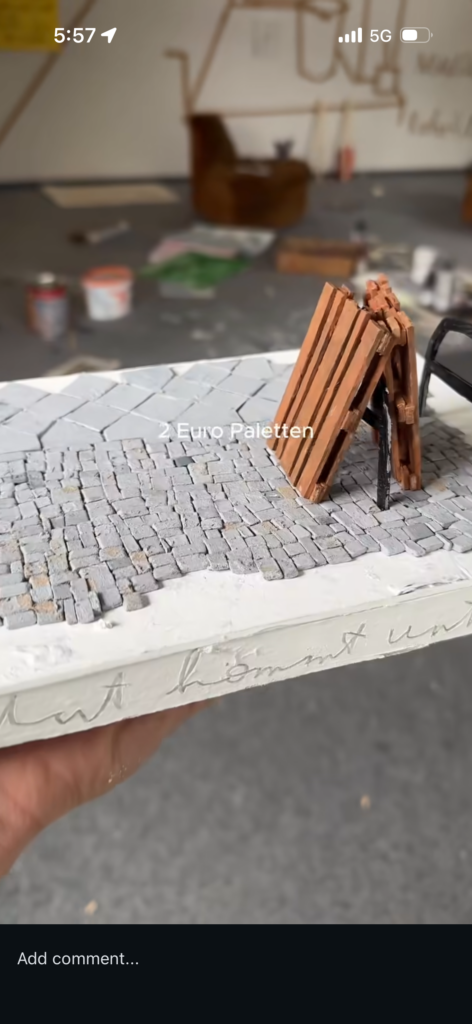
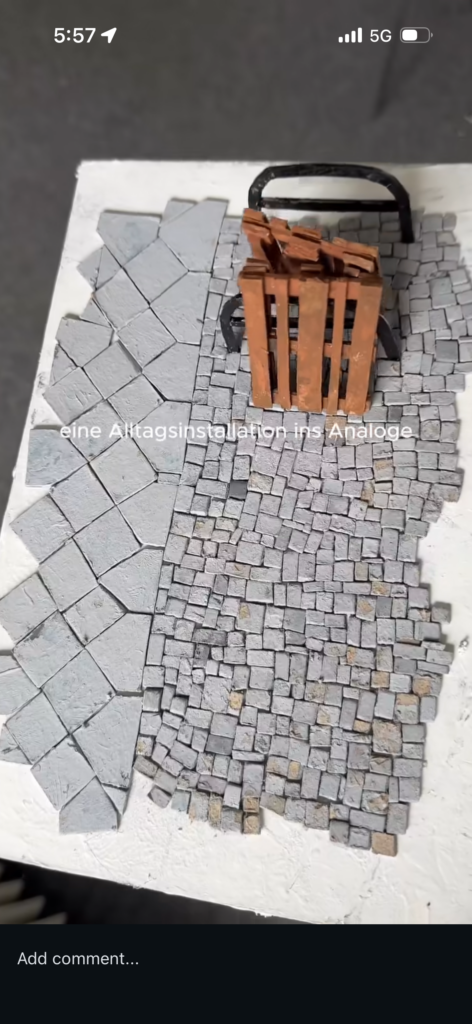
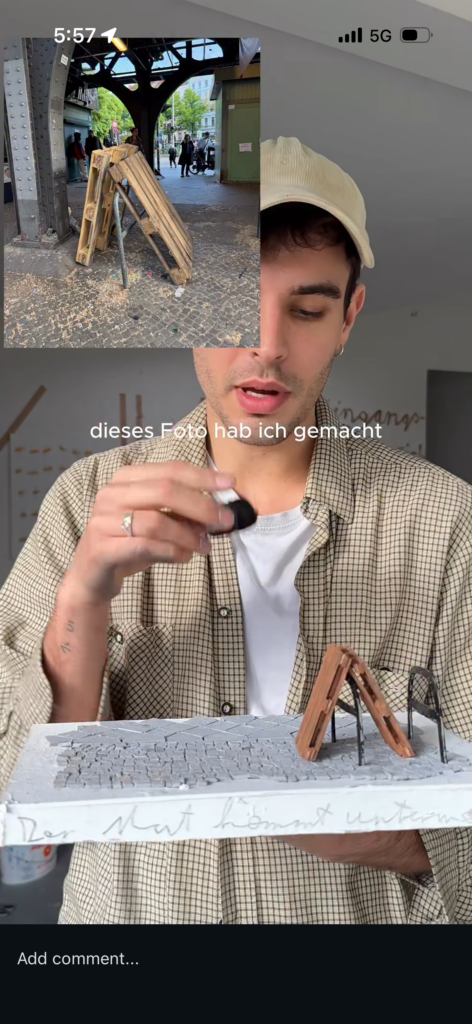
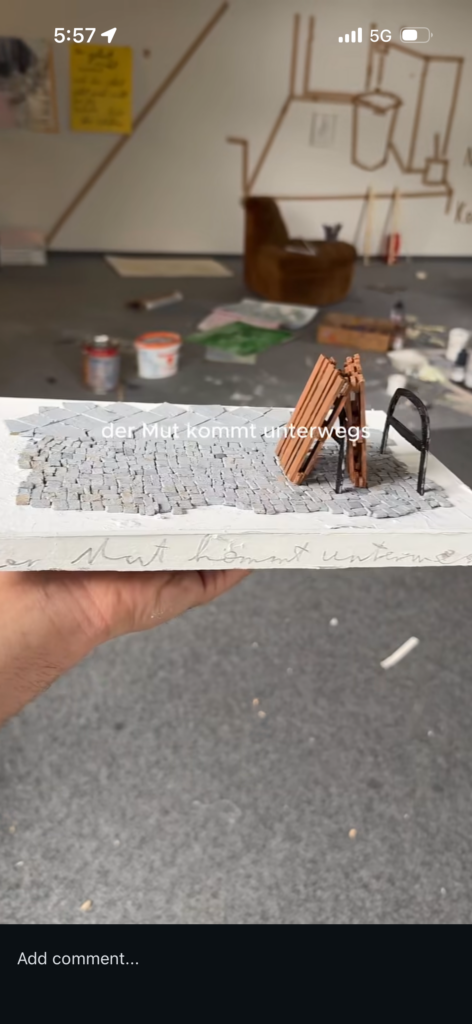
But this week I got inspired again by the KING Paulus Goerden. He had the brilliant idea to capture his everyday installations but not through a photograph. He actually REBUILT THEM IN MINIATURE VERSIONS.

And I have to say: this is genius.

Because it adds a whole new layer to the act of documenting. A photograph is still a translation, but it’s a very common one. Everyone takes photos. Everyone documents. Especially in the age of Instagram, photographing something “interesting” is almost the default reaction. It’s quick, it’s effortless, and it often stays on the surface.

Rebuilding an installation is different. It’s slower. It forces you to make decisions. You suddenly have to look at the scene like a designer, not just like a photographer. What exactly makes the arrangement work? Is it the proportions? The materials? The awkward tension between objects? The exact angle of something leaning? The fact that it looks accidental but somehow perfectly balanced?

I immediately noticed things I would normally overlook. For example: it’s not just “two palettes leaning somewhere.” It’s the surface underneath, the texture of the street, the way the metal barrier frames it, the little gap between the objects, and the fact that the whole thing looks like it could collapse at any second.

A reconstruction turns the installation into something you can’t just consume visually. You have to understand it structurally.

And it also shifts the question of authorship in a really interesting way. When I photograph an everyday installation, I’m still only the observer. I didn’t create it, I “just” framed it. But when I rebuild it, I’m suddenly much closer to becoming part of it. I’m recreating something that originally had no artist. I’m taking a random street moment and turning it into an object with intention.

Which feels slightly illegal. Oopsie

I also like the idea because it makes the exhibition more physical. Photography exhibitions can sometimes feel distant. But if there are small reconstructed installations in the space, the whole thing becomes more immersive. It could make people slow down. It could make them compare. It could make them question what’s “real” and what’s “recreated.”

So right now I’m seriously considering building a mini version myself. Like: the photograph shows the found moment, and the miniature shows the act of re-seeing it.

Because in the end, this thesis isn’t only about what is out there in the city. It’s also about what happens when I decide that something is worth noticing.

Paulus Goerden. “Ein Versuch es einzufangen” Instagram video, January 11, 2026. Screenshot. Accessed January 13, 2026. https://www.instagram.com/paulusgoerdon/

Let me know in the comments what you think of his interpretation of this everyday installation.

#25 – First thoughts planning the exhibition

Now that I have a few possible exhibition spaces in mind, I started thinking more seriously about what it would actually mean to present my photographs in a room. The more I read and plan, the more I realize how many decisions are involved and how strongly these decisions influence the meaning of the work.

Right now, I’m thinking more consciously about the curatorial idea behind the show. I don’t want it to become a random wall of images. If I exhibit my everyday installation photographs, I need to decide what story I’m actually telling: Is it about urban loneliness? About consumption? About visual coincidence? And I also need to think about the relationship between text and image. Do I want short captions? Longer explanations? Or no text at all, to keep the “found” feeling intact? Setting a clear theme and a guiding idea seems like the first real step into exhibition design.

Wissenschaftliche Sammlungen. Handreichung: Ausstellungen in der Lehre. Accessed December 10th, 2026. https://wissenschaftliche-sammlungen.de/files/3814/0023/0529/Handreichung_Ausstellungen_in_der_Lehre.pdf.

Another thing one shouldn’t underestimated is how much the room itself influences the reading. Visitors should be guided intuitively through the exhibition, even if there are no arrows. That includes the architecture of the space, the entry point, where people naturally pause, how light falls through windows, and what the room “suggests” as a path. With our Overlays exhibition I already got a bit of a feeling what is important while doing the floorplan.

Kemsies, Martina. Ausstellungen barrierefrei planen und gestalten. Landschaftsverband Rheinland (LVR). Accessed December 19th, 2026. https://www.lvr.de/media/wwwlvrde/kultur/berdasdezernat_1/publizieren_und_informieren/dokumente_44/15_1332_barrierefreiePDF_Kemsies_3.pdf.

When it comes to the hanging itself, I’m trying to stay practical. I like the idea of grouping photographs either thematically or through visual connections, because everyday installations work a lot through rhythm: similar shapes, similar object types, similar absurdity levels. I also researched that there are basic standards for hanging height (around eye level, roughly 155 cm). That sounds obvious, but I for example did not know the exact number. The more you know, right?

Museum Victoria. “Exhibition Basics.” Accessed December 16th, 2026. https://museumsvictoria.com.au/education/small-object-big-story/5-exhibition-basics/.

Text is another sensitive point. I know from my interviews and from my own experience that text can completely dominate the reading of an image. I don’t want the exhibition to become a lecture. So I’m currently leaning toward short, accessible texts that support the photographs without explaining them to death.

Museumskulturen. “10 Tipps für publikumsorientierte Ausstellungstexte.” October 15, 2022. https://www.museumskulturen.de/blog/2022/10/15/10-tipps-fr-publikumsorientierte-ausstellungstexte.

Lighting is also something I can’t ignore. Light changes everything. It can make photographs feel expensive, intimate, cold or dramatic. How I want to proceed with this I am not sure. Will find out during the process.

Kemsies, Martina. Ausstellungen barrierefrei planen und gestalten. Landschaftsverband Rheinland (LVR). Accessed December 19th, 2026. https://www.lvr.de/media/wwwlvrde/kultur/berdasdezernat_1/publizieren_und_informieren/dokumente_44/15_1332_barrierefreiePDF_Kemsies_3.pdf.

Finally, I keep coming back to the question of audience. One of the main themes of my thesis is how different people interpret everyday installations differently (insiders vs outsiders, design students vs random passersby). So it would be a missed opportunity if I designed an exhibition that only works for people who already speak “art language.” I want the texts to be understandable, and I want the exhibition to feel welcoming to everyone

Museumskulturen. “10 Tipps für publikumsorientierte Ausstellungstexte.” October 15, 2022. https://www.museumskulturen.de/blog/2022/10/15/10-tipps-fr-publikumsorientierte-ausstellungstexte.

Right now I’m still at the beginning of this process. But I already see how much exhibition planning connects back to my thesis topic. Because an exhibition is not just a place where photos hang. It becomes part of the work. It becomes the frame.

#24 – Spaces for Exhibition

Lately I’ve been thinking about where I could actually show it. Because as exciting as the idea of an exhibition sounds in theory, the reality is: space is not neutral. Space is a decision. It changes how photographs are read, how serious the work feels, and who even considers walking in. So this week I started researching possible exhibition spaces and what it would realistically cost budget-wise.

Rotor

The first space I contacted was Rotor (Volksgartenstraße 6a, 8020 Graz). I contacted them, but so far I haven’t received an answer. Still, Rotor feels like a very interesting option in Graz for my topic, because it sits right between art, city and public discourse. Even just reaching out already feels like a small step from “student project” into something more real.

ESC Medien Kunst Labor

A much more concrete option is the ESC Medien Kunst Labor (Bürgergasse 5, 8010 Graz). I already spoke with Reni there. The best part: she offered to give me the space for two days for free, which honestly feels like winning the lottery in exhibition terms. It’s a space that makes sense for my work because it is not overly polished, but still has a lot of character.

Galerie GRILL 

In the same street there is also Galerie GRILL (Bürgergasse 5, 8010 Graz). This one is still a question mark. From what I’ve seen, it looks very high-end and curated in a way that probably makes it completely unaffordable for a student project. But I still want to go there privately and ask, because even if the chance is small, I think it’s important to understand what different “levels” of exhibition spaces exist and how strongly the atmosphere of a space can already frame the work before anyone even sees a single photo.

Freiraum Ausstellungsraum

As i will move to Vienna in June 2026 I also considered doing my exhibition there. Of course I also take into account that I don’t have any contact there, which already brought me a save option in Graz (Esc with Reni).I found a space called Freiraum Ausstellungsraum (Gumpendorferstraße 23, 1060 Wien). Their pricing is actually very transparent: Monday to Wednesday, three days cost 450€. I like that because it makes the whole exhibition location very measurable. It’s not cheap, but it’s also not impossible. And having clear numbers helps a lot when I try to plan realistically, instead of just fantasizing about a perfect white cube.

vinzenzwien

Another Vienna option I recently found is vinzenzwien (Vinzenzgasse 24, 1180 Vienna). On Instagram they describe themselves as a “NEW ART AND CULTURE SPACE for exhibitions, workshops and readings.” I didn’t contact them yet, but I actually got this recommendation through a friend. It’s basically a “friends of friends of friends” situation. You never know when Vitamin B will help you hehe. I will give it a try!

If you have any other recommendations for exhibition spaces and also know someone who knows someone bla bla you know the game -> pleeeease hit me up

Dankii

#23 – Keyword Brainstorming

In the last blogpost I collected a list of AI tools that can support thesis research. But even the best tools are useless if the input is unclear. The quality of literature research depends heavily on the search terms you use. And because my topic sits between several disciplines, I can’t rely on one single keyword to find relevant sources.

So today I’m building a keyword landscape. The goal is simple: create a vocabulary for my thesis topic that works across different research databases and fields. Instead of searching only for “everyday installations,” I’m collecting neighboring terms that describe the same phenomena from different perspectives.

Here’s my growing keyword map:

Core topic words

  • everyday installations
  • accidental compositions
  • unintentional art / unintentional aesthetics
  • found arrangements
  • urban still life
  • mundane objects / everyday objects as art

Communication design / perception / meaning

  • visual communication
  • meaning-making / construction of meaning
  • semiotics (sign, signifier, signified)
  • visual literacy
  • attention / salience / noticing
  • framing / context effects
  • interpretation / audience reception

Space / public environment

  • public space
  • urban intervention
  • spatial storytelling
  • informal design
  • street culture / everyday urbanism
  • place-making

Photography / documentation

  • documentary photography
  • typology photography
  • photographic framing
  • archive / visual archive
  • cataloguing / classification systems

Institution / legitimacy

  • artworld theory
  • institutional critique
  • museum framing
  • authority signals / credibility cues
  • curation vs. discovery

Just building these clusters already helps to structure the topic more clearly. It also makes it easier to connect practical work (photography and observation) with theory (semiotics, perception, institutional framing).

The next step is combining these keywords into stronger search phrases, depending on what I need: theory, methodology, or case studies. 

Examples:

  • “semiotics everyday objects public space”
  • “context effects perception contemporary art”
  • “visual framing photography meaning-making”
  • “institutional critique Duchamp everyday object”

This keyword map is not a final list. It will grow over time as I read more and discover new terms. But it already functions as a working system. It gives my research a structure and makes literature search more targeted, instead of random.

#22 – AI Tools for Thesis

Now that we have cleared all doubts, we can start. But where?

The setup phase is the phase where we are all feeling the most lost during the whole process. We know kind of the topic we want to write about, but we don’t know where the f we should start looking for information.

Looking at my topic, I have been stuck for a long time in this space between art, design, urban studies, photography, sociology and “I swear this matters, please trust me.”

Before I start going deep into keywords and literature, I wanted to get an overview of something else first: 

AI tools.Because I knew ChatGPT exists, but I did not realize how many other tools are out there that can actually help during thesis research.

(BIG SHORT DISCLAIMER)
I’m very aware AI can make people lazy. So my rule is:
AI can help me find, compare and brainstorm, but it shall not do my thinking for me. If it gives me a claim, I verify it. If it summarizes a paper, I still read the paper.

Okay, let’s start.

I think the easiest way to think about AI tools is in categories: 

  • search
  • map
  • read
  • write
  • cite
  • analyze
  • create

This is the toolbox I’m building right now:

A) Literature discovery (search & find papers)

Elicit
Good for: jumping into a topic and quickly finding relevant papers, plus helping with screening/extraction.
How I’d use it: Start with queries like “context effects perception art public space” and let it propose other related papers.

Consensus
Good for: getting a research-backed overview quickly, with citations tied to papers (so you can trace everything).
How I’d use it: When I need a fast sense-check like: “Is there literature on how labels change perception?” Then I click through to the actual papers.

scite
Good for: checking how a paper is cited (supportive vs contrasting vs neutral).
How I’d use it: When I find a “key theory” paper, I can quickly see whether later work supports it or fights it.

B) Literature mapping

Connected Papers
Good for: visual graphs of related papers starting from one seed paper. Great when you have one perfect source.

ResearchRabbit
Good for: interactive maps + recommendations + tracking authors over time. It learns what you’re collecting and helps you expand it.

Litmaps
Good for: building and monitoring a literature map so you can see how research clusters connect and keep getting updates as new papers appear.

How I’d use these: Pick 2–3 “seed papers” (Duchamp/context theory, public space perception, photography framing), then map outward until patterns emerge. Once I see the clusters, I know what my literature chapter needs to cover.

C) Reference management + annotation

Zotero (+ plugins)
This was an obvious one, right?
Zotero is the base layer. Plugins can extend it (better workflows, translating, export setups, etc.).

How I’d use it:

  • store everything
  • tag papers by theme cluster
  • export citations cleanly when writing

D) Reading support (summaries)

This is where general AI chat tools can help carefully.

ChatGPT (file upload + analysis features depending on plan)
Helpful for: summarizing a paper you upload, extracting key arguments, turning messy notes into structure, generating keyword variations, comparing two theories.

My rule: I still read the original PDF, make my own notes and then compare with what it summarized. AI can be confidently wrong in a very convincing voice lol.

E) Transcription + interview workflow

Since I’m planning interviews, I need tools for:

  • recording
  • transcribing
  • coding themes

Even if I don’t choose a specific transcription tool yet, I know the pipeline:
audio → transcript → coding → quotes in thesis

AI becomes useful when it speeds up transcription and helps me find repeated themes but I still decide what counts as meaningful.

F) Writing + language polish

For writing support, I want tools that help with:

  • clarity
  • grammar

In case anyone of my student colleagues has another amazing AI tool please help a girl out and comment under my blogpost.

Lots of love and bussis
-Fiona

#21 – vamos

Entering the third semester things are getting real. I am scared of the fact that I have to start writing the thesis soon. This will be a big project that will accompany me for several months. But the biggest question I asked myself was if my topic can actually fulfil all the requirements to be passed as a master thesis of communication design. Of course the thesis should be a topic that one is very passionate about (this is the case for me yay). But is it too artsy?

I had several talks with people across different disciplines, different age groups and different experiences about this question and came to the following conclusion:

YES, IT IS COMMUNICATION DESIGN.

Heres why:

The more I think about it, the more obvious it becomes. My topic is not “just art”. It’s about how people read objects, about attention and their interpretation. And also about the thin line between something being seen as random trash or as something meaningful.

Not just posters

I know I know it’s a shocker but communication design is not just posters. (Gasp :O)

Its also logos and packaging 😛
No just kidding, communication design is about how meaning is created and understood in the world around us. How we    c o m m u n i c a t e through   d e s i g n. 

Reading the object

Everyday installations are basically unplanned visual messages. They appear in public spaces without someonces permission, without an explanation tag next to it and (very important) without an author. And still, people react to them. Or they don’t. Both is very interesting (to me).

Photography

A big part of my research is also photography. I do not only want to capture the moment, I also have to put thoughts into it and use it as my design tool. What do I want the viewer to see, what do I want them to see first? The moment I take a photo of an everyday installation, I am already framing it. I decide what is visible, what is cropped out, what is centered and what becomes the focus. It’s a form of communication. I am translating something temporary into an image that can be shared, archived and interpreted by other people.

Framing it

Another reason why this topic belongs in communication design is the way context works. In my experiments last semester, the same object was treated completely differently depending on where it was placed. In some spaces it was removed immediately, in others it stayed untouched. Sometimes it was invisible. Sometimes it looked suspicious. That means the object itself is not the main factor. The rules of the space are. And those rules are also a form of communication. Public space constantly tells us what belongs and what doesn’t.

So when I research everyday installations, I’m not researching “art”. I’m researching visual culture. I’m researching how people make decisions based on what they see. How they categorize things. How they judge meaning. How they react to something that breaks the normal order of a place.

In the end, my thesis connects to graphic design through:

  • visual communication (in public space & between photos and everyday objects)
  • Concept Development (Exhibition, Werkstück, Flyer for exhibition)
  • photography (& framing)
  • exhibition design (as a designed communication format)
  • attention, perception and interpretation (Perception Psychology, Gestalt Psychology)
  • experimental communication / experimental marketing / experimental design

So yes, I am still scared. But I am also sure that my topic fits. The challenge now is not proving that it belongs. The challenge is turning it into a structured project that I can actually write down and defend.

#21 Being a Freelance Illustrator

As I’ve been thinking about maybe working as a freelance illustrator one day, I thought it could be helpful and interesting to write down what I have to know and be aware of. I love drawing and creating visuals, but I also know that being freelance can be really hard and frustrating. It’s basically running your own small company.

It’s Not Just Drawing (Sadly)

The first thing I need to understand: freelance illustration is not only about being creative.

I would have to:

  • find my own clients
  • manage my time
  • handle money and taxes
  • organize contracts
  • promote myself

So it’s freedom, yes. But also a lot of responsibility.


Do I Need to Register Anything?

If I want to do this properly, I would need to register as self-employed. That usually means informing the tax office and getting a tax number. I’d also need to think about health insurance and maybe social security options for artists.

Taxes and Invoices

If I want to work as a freelancer, I would need to handle some basic tax and bookkeeping tasks (scary part):.

  1. Write proper invoices

Every project needs a correct invoice with all required information (my details, client details, tax number, description of the service, price, etc.). It’s important to nummerice them, it’s not allowed to change this number later!

2. Track income and expenses

I would need to document all the money I earn and all business-related costs, such as software, equipment, materials, or subscriptions.

3. Save receipts and documents

All invoices and receipts must be stored carefully in case the tax office asks for proof.

4. Set aside money for taxes

Since no employer deducts taxes for me, I would need to regularly save a percentage of my income for income tax (and possibly VAT).

Overall, it’s mostly about staying organized, keeping everything documented, and planning ahead financially so taxes don’t become a surprise (maybe it’s not as scary as I expected).

It’s all about the Money

This is something I really need to think about. At the beginning, I probably wouldn’t earn much. So I would need:

  • some savings (maybe 3–6 months of living costs)
  • or a part-time job
  • or very low monthly expenses

Because clients don’t just appear overnight. Building a name takes time. That’s why we came to…

How Would I Get Clients?

This is probably the biggest question. Some ideas:

  • Posting my work regularly on Instagram or other platforms
  • Sharing my process, not only finished images
  • Connecting with other creatives
  • Sending my portfolio to magazines or agencies

I think consistency would be more important than being perfect.

The Pricing

When I think about different pricing models as a future freelance illustrator, I would structure them clearly like this:

1. Hourly Rate

I charge for the exact time I work on a project. This is simple and transparent, especially at the beginning. However, it doesn’t always reflect the real value of the artwork and can limit my income as I become faster.

2. Project-Based Pricing

I offer one fixed price for the entire project. This usually includes concept, sketches, final artwork, and a defined number of revisions. It feels more professional and gives both me and the client clear expectations.

3. Usage-Based Pricing

On top of the creative work, I charge depending on how the illustration will be used — for example, social media, print, advertising, packaging, how long it will be used, and how large the audience is. The bigger the reach and the longer the usage, the higher the fee.

4. Package Pricing

For branding projects or long-term collaborations, I could offer bundled services (e.g., multiple illustrations for a set price). This creates structure and can make bigger projects more attractive for clients.

Ideally, I would combine project-based pricing with usage fees, so my work is valued not only by time spent but also by impact and visibility.

Summarising in the End: How would I start?

If I really decide to try this, I would probably:

  1. Build a strong portfolio.
  2. Save some money.
  3. Register as self-employed.
  4. Start small maybe alongside a part-time job.
  5. Slowly build an online presence.
  6. Learn about pricing and contracts.

People, who‘ve gone through

And at the end of this blogpost I want you to show a few examples of freelance illustrators. I love their work and maybe theirs is something that inspires you as well.

Julia Vanderbos

Julia van der Bos is a freelance illustrator originally from Russia, now based in Groningen in the Netherlands, who creates warm, inviting illustrations for diffrent projects, and works with clients worldwide.

Mrtina Illustrations (her illustrator Name, not a typing error)

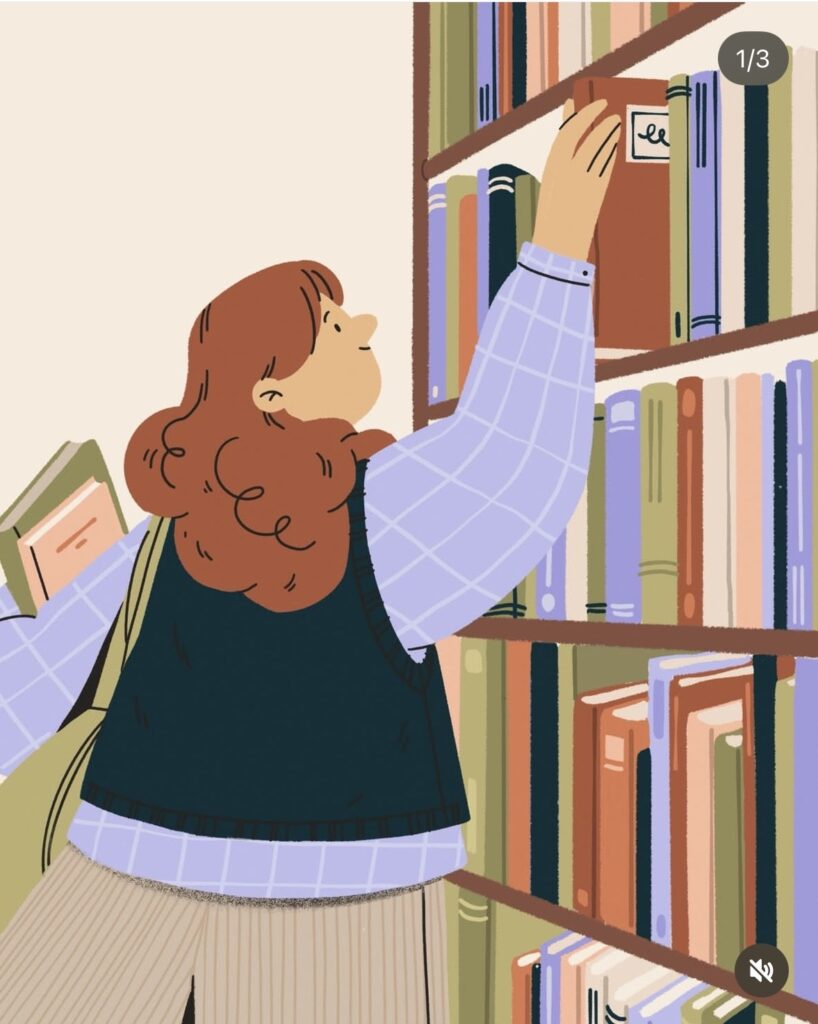
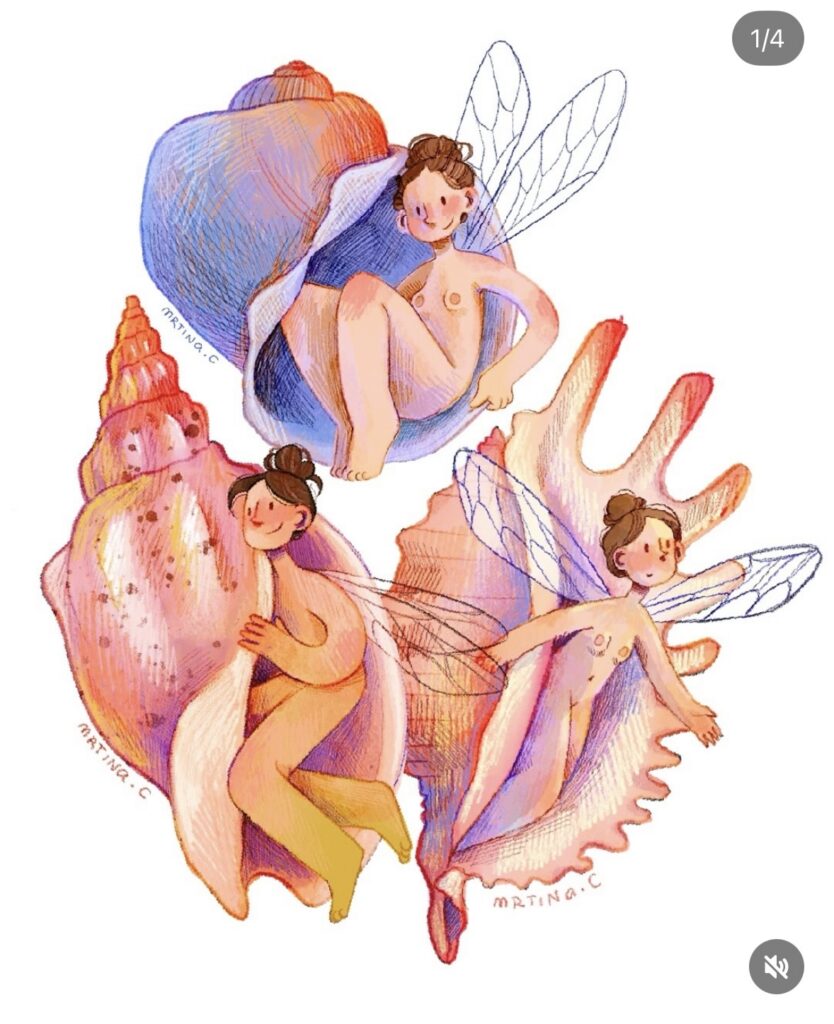
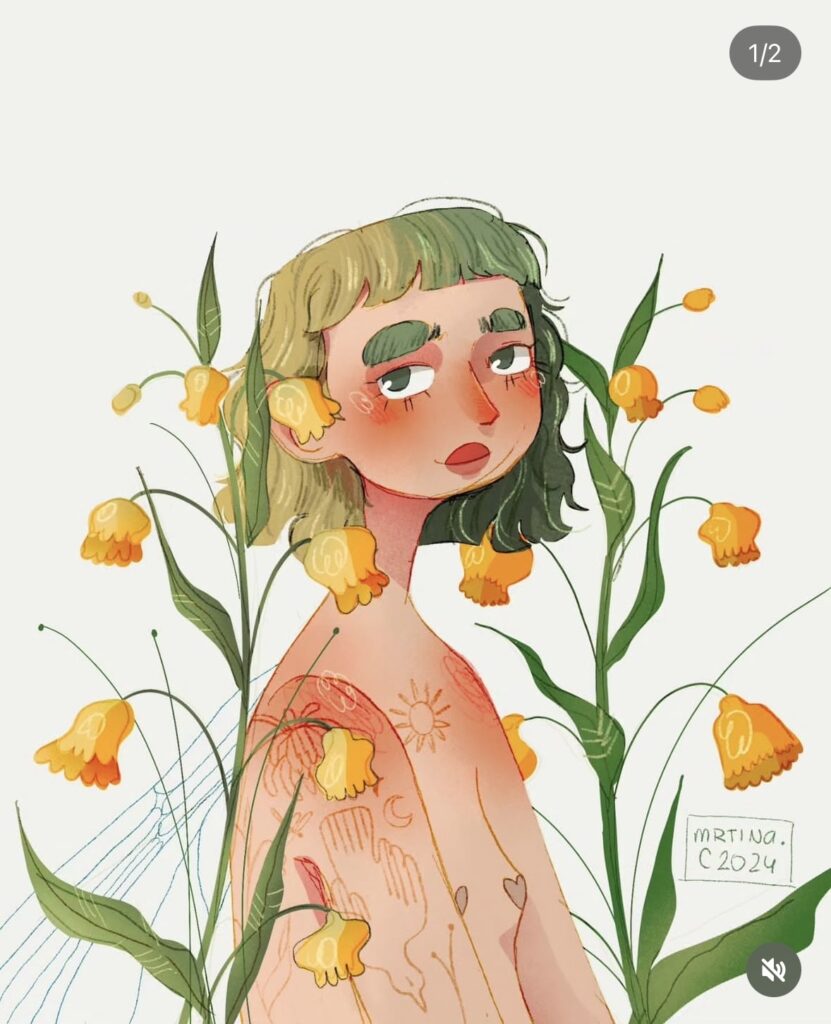
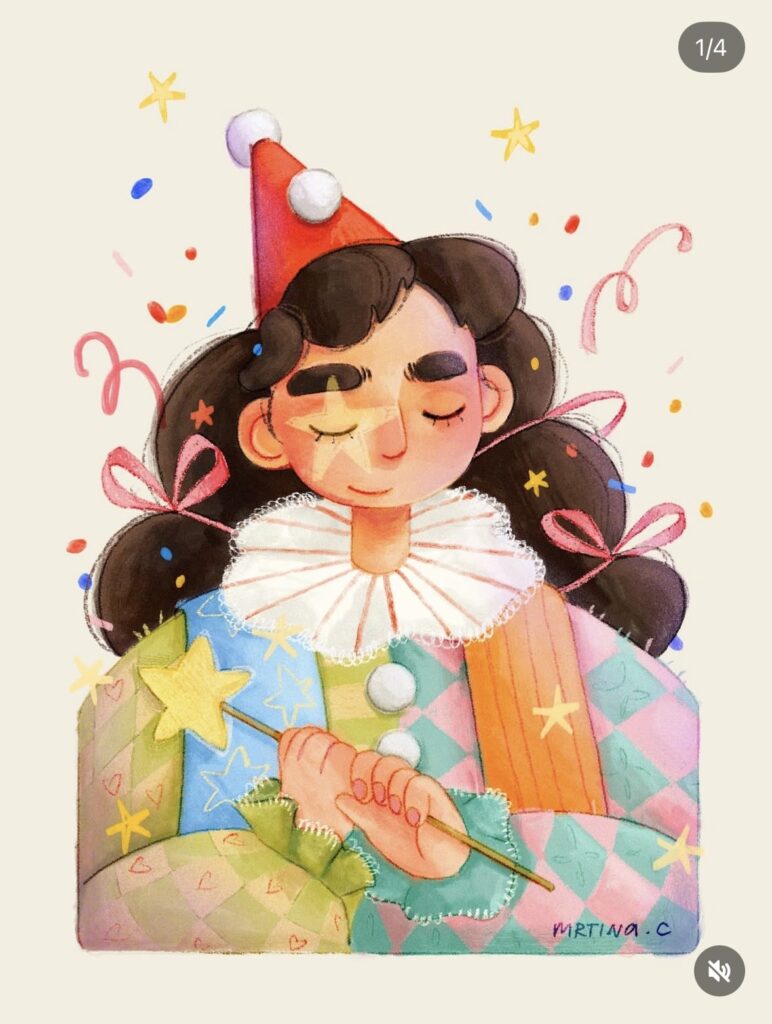
Martina is a Santa Fe (Argentinia) based illustrator who creates dreamy, character‑filled digital art, posts her creative process and finished pieces on Instagram, and sometimes takes requests or commissioned drawings from her followers (mainly active on instagram).