Impulse #8 – Getting Lost in the Library

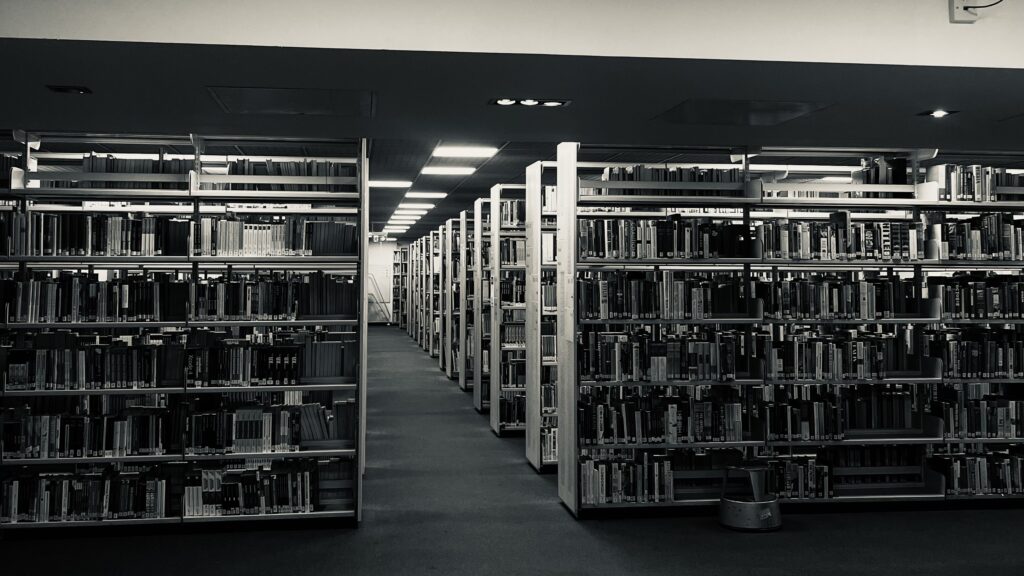
Throughout this research phase, I’ve spent a lot of time in libraries. Especially since coming to Kingston, visiting the library has become a regular part of my routine. This might be because of how big and comfortable the Kingston University library is, or simply because I feel motivated to make the most of my time here and use the facilities available to me. But I’ve noticed that the library has become more than just a place to work. It has become part of my research process itself.

I’ve always loved spending time in libraries and bookshops. As cheesy as it sounds, it really feels like entering a different world. There is something about being surrounded by books that makes knowledge feel physical and accessible. It creates a kind of quiet focus that is very different from being online. Even though I would argue that my social media feed is quite educational and inspiring, it doesn’t create the same depth of attention. Scrolling feels fast while being in a library feels slower and more intentional.

What became especially important during this phase was how I started collecting literature. Instead of using a structured or academic system, I began simply taking photos of the front and back of books that interested me and placing them into a Figma file. It’s probably the most unprofessional way of collecting literature for a thesis. But visually seeing the book covers alongside my thoughts made the process more engaging and personal. It didn’t feel like a boring literature research, it felt like building my own archive.
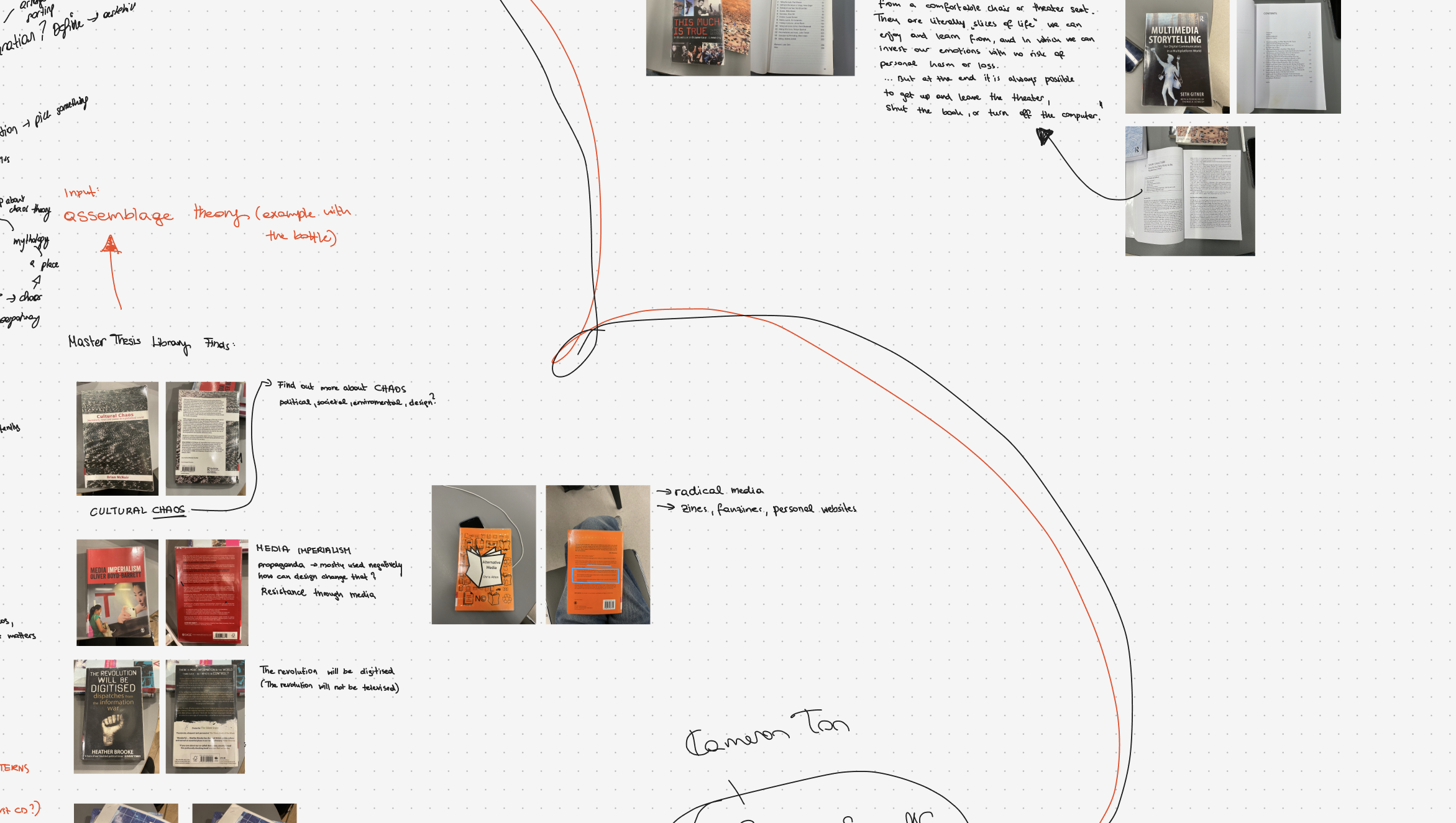
I didn’t even limit myself to design-related books. Most of my visits were to a different Kingston campus library and ended up in sections like psychology, politics, and cultural studies. I picked books purely based on intuition picking titles, colours, or topics that caught my attention, without worrying whether they were directly relevant to my thesis.

What surprised me was that even though these choices felt random, connections began to appear. Many of the books, in different ways, touched on similar themes: how people understand the world, how environments shape behaviour, how meaning is constructed, and how individuals exist within larger systems.

This experience also changed how I think about chaos in relation to research. At first, my approach felt disorganised. I wasn’t following a clear structure, and my collection of books came from different disciplines without an obvious order. But over time, patterns began to emerge. What initially felt like chaos started to form its own internal logic.

This impulse has influenced my research by helping me trust a more intuitive approach. Instead of forcing my thesis into a fixed direction too early, I’ve allowed myself to collect fragments, ideas, and references from different fields, wishing there was more time to just focus on this process. But unfortunately this phase of searching for a topic has to come to an end soon…
Links:
https://www.kingston.ac.uk/library/
https://www.bl.uk

Impulse #7 – ReThinking Podcast: The Truth About the Attention Crisis

For this impulse, I listened to the podcast ReThinking: The Truth About the Attention Crisis from the WorkLife with Adam Grant series, featuring historian Daniel Immerwahr. I kept thinking about it afterwards, especially because attention has slowly become an important part of how I understand my own research process.

I’ve often caught myself believing that my attention span is getting worse. It’s easy to blame phones, social media, or the constant availability of information. There is always something new to look at, something else to click on, and it becomes harder to stay with one thought for a longer period of time. I noticed this not only when working, but also when watching films, reading, or even visiting museums. My attention feels fragmented, constantly moving.

What interested me about this podcast was that it questioned this idea of the “attention crisis.” Instead of treating it as something entirely new, it suggested that people have worried about attention disappearing for a long time. This made me realise that attention is not just a personal ability that we either have or don’t have. It is something that is shaped by the environment we are in.

This connects strongly to experiences I’ve had recently. For example, as I mentioned in my previous blog entry: when I visited the Electric Cinema, I was able to watch a film with full attention, without distractions. The space itself allowed for that kind of focus. In contrast, when I visited the National Gallery, the large quantity of paintings made it harder to fully engage with individual works. It wasn’t because the paintings lacked meaning, but because my capacity to process them reached a limit.

This made me realise that attention is closely connected to structure and chaos. When there is too much information, everything starts to blur together. Nothing stands out anymore. But when there is enough space, attention can settle.

This idea feels very relevant to my thesis, where I am interested in chaos and how meaning is created within it. Chaos is not necessarily negative, but it can become overwhelming when there is no structure to navigate it. At the same time, too much structure can remove the unexpected moments that make things feel alive. Attention seems to exist somewhere in between these two states. It needs enough openness to allow discovery, but enough direction to allow focus.

The podcast made me reflect on attention not as something I need to “fix,” but as something that responds to context. It shifted my perspective from blaming myself for being distracted to observing the conditions that shape how I focus. This also changes how I think about creative direction. Directing attention is not about forcing control, but about creating environments where attention can naturally emerge.

For my research, this impulse reinforces the importance of atmosphere, structure, and context. It makes me more aware that meaning is not only created through content, but through how that content is experienced. Attention is not just an individual act, but something that is designed and influenced by the systems around us.

Links:
https://www.ted.com/podcasts/worklife
https://history.northwestern.edu/people/faculty/core-faculty/daniel-immerwahr.html

Impulse #6 – Electric Cinema: On Atmosphere and Attention

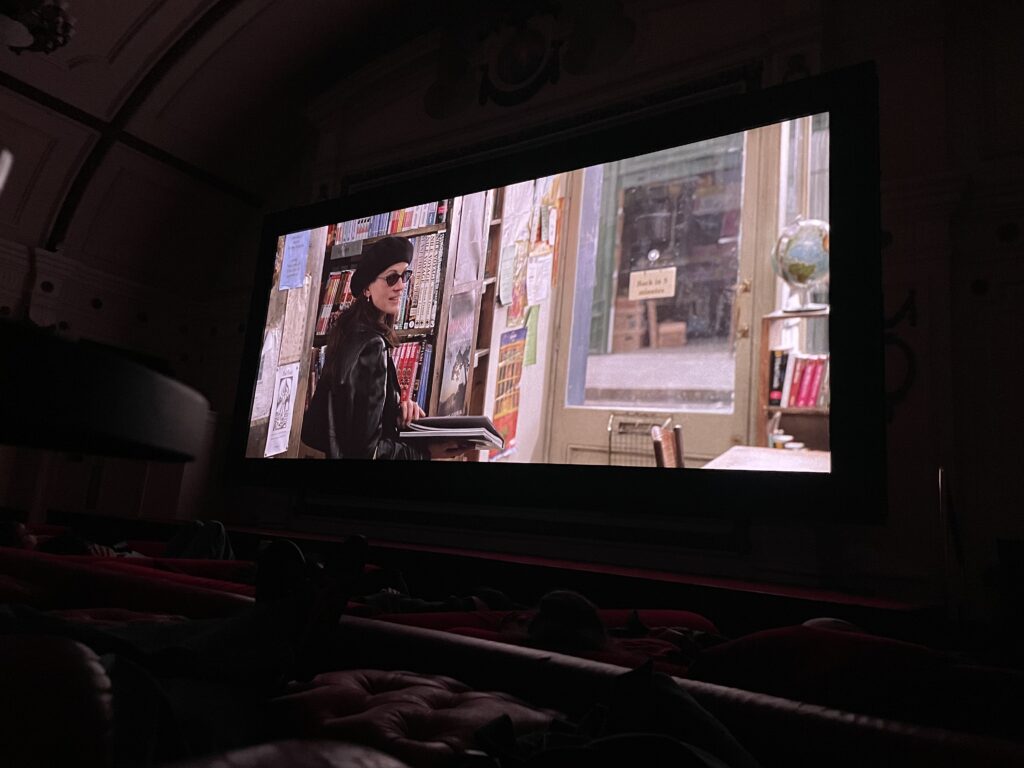
Last week, I went to the Electric Cinema in Notting Hill to watch Notting Hill. Which, on paper, sounds almost ridiculous. Watching a romcom I’ve already seen, in the exact neighbourhood where it’s set, didn’t feel like something that would count as “research.” It wasn’t a lecture, it wasn’t a book, and it definitely wasn’t productive in the traditional academic sense.

But it stayed with me.

I think what made it special wasn’t the film itself, but the atmosphere of the cinema. The Electric Cinema is one of the oldest cinemas in London, and it feels very different from watching something at home or on a laptop. You sit in these soft seats, there are small lamps next to you, people eat burgers and fries. It sounds like a small detail, but it made me realise how rarely I watch something with my full attention. No phone, no distractions, no multitasking. Just sitting there and watching.

I’ve loved Notting Hill for years, but I honestly can’t remember the last time I experienced a film like that by not just watching it, but really being present with it. The atmosphere allowed me to focus differently. It made me think about how much our surroundings shape the way we experience things.

What was also interesting was the contrast between the inside and outside. Notting Hill, especially around Portobello Road, feels very chaotic. It’s full of tourists, noise, and constant movement. But inside the cinema, there was this quiet fictional version of the same place. For two hours, you leave the real Notting Hill and enter a constructed one. And even though you know it’s fiction, it still feels real in its own way.

This made me think about my thesis and my interest in chaos. Outside, there is uncontrolled chaos, random, overwhelming, and hard to fully process. Inside the cinema, there is a different kind of structure. Everything is intentional. The story, the timing, the emotions are carefully directed. It’s not necessarily less real, but it’s organised in a way that allows you to engage with it more deeply.

I think working on a thesis is not only about reading books or sitting in libraries. It’s also about paying attention to experiences and noticing how context changes perception. The same film can feel completely different depending on where and how you watch it.

This visit reminded me that atmosphere, environment, and attention all play a role in how meaning is created. And maybe part of my research is learning to notice these moments more consciously.

Links:
https://www.electriccinema.co.uk/history/electric-cinema-portobello-history
https://www.imdb.com/de/title/tt0125439/

Impulse #5 – The Uses of Disorder by Richard Sennett

https://www.paulstewartdesign.co.uk/the-uses-of-disorder

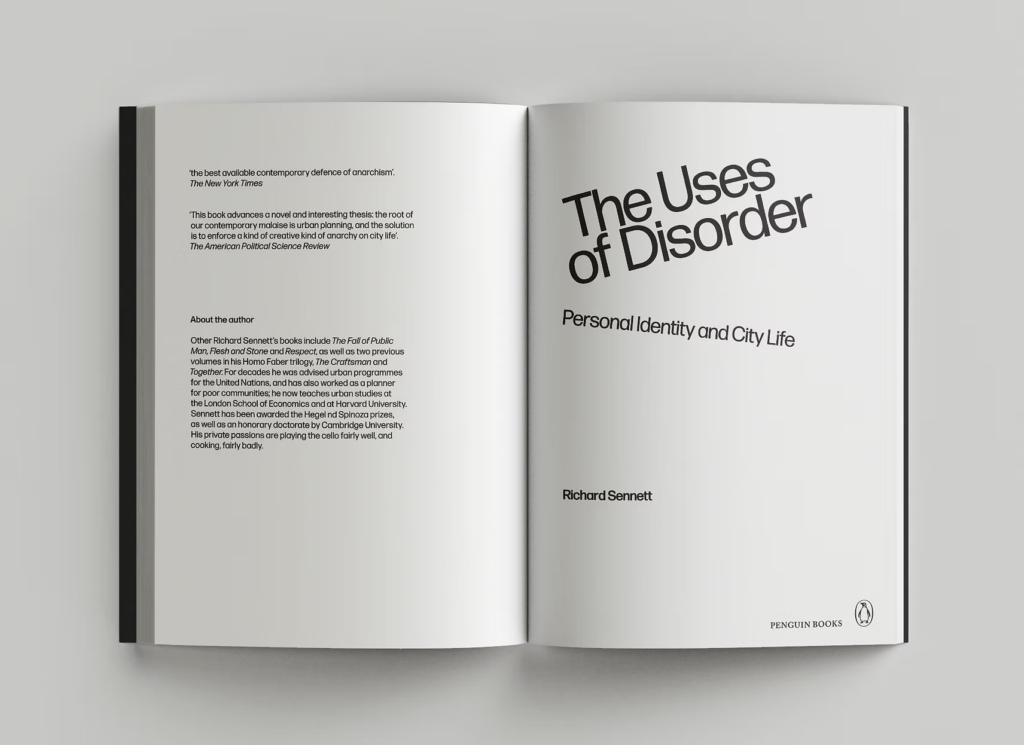
Lately I’ve been reading The Uses of Disorder by Richard Sennett, and even though I’m not finished yet, I already know it’s going to be important for how I shape my thesis. Mostly because my topic keeps circling around CHAOS not chaos as “everything is broken,” but chaos as something productive, alive, even necessary. And Sennett basically walks straight into that uncomfortable zone and says: maybe the problem isn’t disorder. Maybe the problem is how obsessed we are with getting rid of it.

The book was written as a critique of this dream of the perfectly planned, perfectly ordered city, the kind of place where everything is smooth and controlled and “safe,” but in a way that also flattens life. Sennett argues that overly ordered communities can become stagnant, because order can turn into avoidance: avoidance of difference, avoidance of conflict, avoidance of anything that might force you to grow.

What I find interesting is that he doesn’t talk about disorder like it’s a cute aesthetic. He’s not romanticising mess. He’s talking about it as something that can actually do work on a person. Like friction. Like a training ground. His point (at least how I’m understanding it so far) is that development doesn’t come from living in a bubble. It comes from being confronted with complexity, with other people, other values or other realities you can’t control.

One of the ideas that keeps sticking in my head is his critique of “purified” communities. Spaces built around sameness, where everything feels predictable. The way he frames it, these environments aren’t neutral. They’re a choice. And they’re often a choice made possible by privilege: if you have enough resources, you can design your life to avoid discomfort. You can separate yourself from anything messy. You can curate your surroundings until you barely have to deal with surprise.

And then I keep thinking… what does that mean for design?

Because design can easily become part of that “purifying” impulse. Even in the nicest, most well-intentioned way. We design systems to reduce uncertainty. We design environments to be seamless. We design experiences that remove friction. And sometimes that’s good but sometimes it feels like we’re also designing out the parts where people actually change.

Reading Sennett makes me ask: When does “making things easier” turn into making things less real? When does smoothing everything out become a way of avoiding growth?

This is where it starts connecting to my own obsession with chaos. Not because I want everything to be chaotic. But because I’m starting to see chaos as a condition for meaning. Like: if everything is too controlled, everything becomes the same. You stop noticing. You stop feeling. You stop having those moments where something interrupts you and you have to re-orient yourself.

Also, maybe this is the biggest thing the book is giving me right now: permission to not immediately “solve” chaos. To not treat disorder as a design failure. To treat it as information. As something you can work with instead of against.

I’m still in the middle of the book, so I don’t want to pretend I’m summarising it perfectly. But I can already tell it’s reshaping the way I think about cities, communities, and creative practice and honestly, it’s making me more suspicious of anything that looks too organized.

Links:
https://www.paulstewartdesign.co.uk/the-uses-of-disorder
https://www.versobooks.com/en-gb/products/2810-the-uses-of-disorder?srsltid=AfmBOoqcJ_Up1gbzIwcqjeYxPyC983siGmJnnOm5moLjHgr6Zbzdk7O0

Impulse #4 – Workshop @UAL

Recently, we had a workshop at the University of the Arts London with Ella, the Course Leader of the MA Design for Social Innovation and Sustainable Futures at London College of Communication. The workshop is part of a larger task for this semester: creating a future newspaper set in the year 2046. Each of us has to develop our own project that exists within this imagined future, while also working with a local community. It sounds simple at first, but the question behind it feels much bigger: how will the future look, and how do we position ourselves within it as designers?
I’ve noticed that thinking about the future makes me slightly uncomfortable. The future feels abstract, uncertain, and difficult to hold onto. I realised that I often find more comfort in looking at the past, in personal stories, cultural references, and existing memories. At first, I thought this might be a limitation. But Ella’s talk shifted my perspective.
One thing she said that stayed with me was: “Joy is radical.” In a time where so much of the future is discussed through crisis, climate change, political instability and uncertainty, choosing to focus on joy can itself become a form of resistance. It made me realise that future-oriented design doesn’t always have to come from fear or urgency. It can also come from care and hope.

Ella showed us several projects from her students, and one in particular stayed with me. It was created by an international student from South Korea, who asked the question: What if South Korea had never been colonised? She explored this question through deeply personal and visual methods. She rearranged photographs in her grandmother’s home, imagining how her family might have dressed or lived under different historical conditions. Through this process, she connected speculative thinking about the future with reflections on the past. What I found especially interesting was how this exploration eventually led her to something completely different: kimchi and sustainability. She created her own kimchi brand, using food waste from restaurants to imagine more sustainable production systems. I was fascinated by how a thesis that began with history and identity could evolve into something so tangible.

Decolonizing Sadaejuui in Korean History Through Speculative Letter from the Future – Rebecca Ghim

This project also reassured me on a personal level. It showed me that working with the past doesn’t mean you’re stuck there. The past can become a tool to imagine alternative futures. As someone who is interested in cultural memory and my own background, this approach felt very close to how I want to work.

Another moment during the workshop that stayed with me was when one of my classmates presented her idea that chocolate might no longer exist in the future due to climate change and resource scarcity. One suggestion I particularly loved was the idea to make people write letters and give them chocolate-flavoured stamps, allowing people to value it while we still have it.

Links:
https://read.followingthefootprints.com/p/the-check-out-20-theferm
https://madsisf.myblog.arts.ac.uk/2020/06/11/rebecca/
https://www.arts.ac.uk/colleges/london-college-of-communication/people/ella-britton

Impulse #3 – National Gallery London: On Seeing Too Much

I recently went to the National Gallery and wanted to write about my visit. At first, I didn’t really know how to connect it to my master’s thesis, or even what exactly I had learned from it. This time, I simply started writing down my thoughts and by the end, I realised that it’s possible to make a connection between almost everything.

One of the first things that still amazes me is that the National Gallery like so many important museums in London is free. You can just walk in, no ticket, no obligation, and suddenly you’re standing in front of some of the most famous paintings in the world. That alone already says something about access, value, and who art is for. There’s no barrier or expectation. You’re allowed to wander, to stay five minutes or five hours.

And five hours might actually be too much.

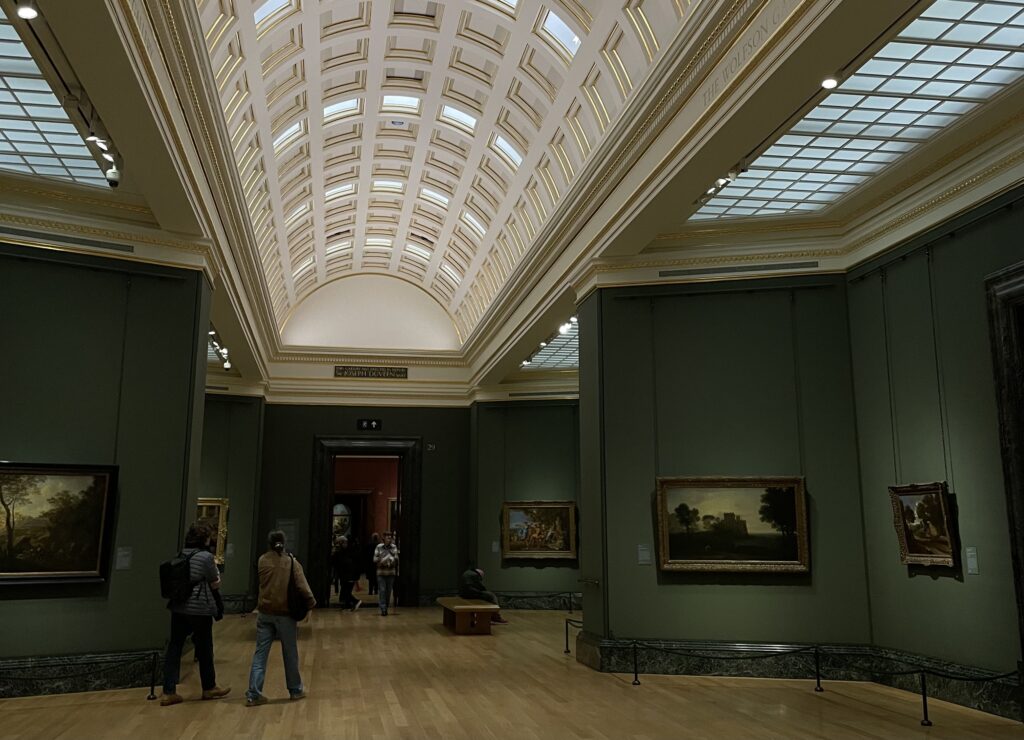
The gallery has so many rooms that after a while all the paintings started to blur together. This feels almost wrong to admit, because these are obviously some of the most important and celebrated artworks in history. Each painting, when looked at individually, carries such rich stories, political contexts, personal tragedies and fascinating details. Knowing the story behind a painting completely changes how you see it and how much it moves you.

I noticed this especially when I was looking for The Execution of Lady Jane Grey. I already knew her story, and I had been deeply moved by it before even seeing the painting in real life. Standing in front of it felt almost like meeting a celebrity you’ve admired for a long time. In that moment, the painting didn’t feel like “just another artwork on the wall.”

But those moments became rarer the longer I stayed.

After a while, the quantity of paintings started to work against them. Room after room everything slowly flowed into everything else. I started wondering if “too much” can actually make things lose their value. Not because they aren’t valuable, but because we, as viewers, reach a limit. It reminded me of how after scrolling on TikTok for two hours, everything starts to feel the same and not because the content is identical, but because our capacity to truly engage gets exhausted. And maybe this doesn’t only happen with digital media, maybe it happens in museums too.

There was also something about the way the paintings were displayed that made this feeling stronger. The lighting, for example. This might be controversial, but I really didn’t like how Van Gogh’s Sunflowers looked. The colours felt lifeless and I hate saying that, because it’s Van Gogh. But it made me realise how much context, presentation, and atmosphere shape our experience of art. Even the most powerful work can feel distant if the conditions around it don’t support it.

Walking through the gallery, I kept thinking about attention and how fragile it is, how easily it slips away. And maybe this is where the connection to my master’s thesis begins to form. I’m becoming more interested in how meaning is created, sustained, or lost depending on scale, quantity, and context. How can we design (physical or conceptual) to allow for slower and deeper engagement?

Links:
https://www.nationalgallery.org.uk/
https://www.hrp.org.uk/tower-of-london/history-and-stories/lady-jane-grey/
https://www.nationalgallery.org.uk/visiting/virtual-tours/google-virtual-tour

Impulse #2 – Lecture: Design Future Practices @Kingston University

For this Impulse blog entry, I wanted to share my insights from my lectures at Kingston University. After my first lecture, I felt so inspired that I went straight to the library and started doing research that would eventually lead me toward my master’s thesis topic.

On our first day, we got to hear about the career path of our lecturer, Cathy. She talked about moving through different creative and political spaces, from being part of a rebel music group to convincing students to create an alternative art school as a form of protest against London’s high tuition fees. The way she told these stories was incredibly engaging. With her comedic timing and honesty, it felt much more like sitting in the audience of a stand-up show than attending a university lecture. Of course, because it was my very first lecture in London and I was already buzzing with excitement about learning new things, I was probably way more impressed than everyone else. For the other students, it was likely just another rainy Thursday morning.

What I appreciated most about this lecture and the course in general is how seriously the university prepares students for their dissertation. This entire semester is dedicated to finding and shaping a topic, and they really take the time to guide us through that process. All the research we do is meant to lead toward a final project, supported by workshops that help us along the way. We work in groups, talk openly about our ideas, and constantly reflect on where we are and where we want to go.

One piece of advice Cathy keeps repeating really stuck with me: “Start with something small, you can always go bigger.” It’s exactly what I’ve been struggling with. I have a tendency to aim straight for big, complex problems that realistically require way more power, time, or resources than I currently have. Cathy explained that it’s often much more effective to start with something small and specific, and then slowly build on it. Over time, that small idea can grow, expand, and take on more layers. That’s what I’m trying to focus on now: collecting smaller ideas, letting them develop naturally, and then gradually adding more literature, references, and sources.

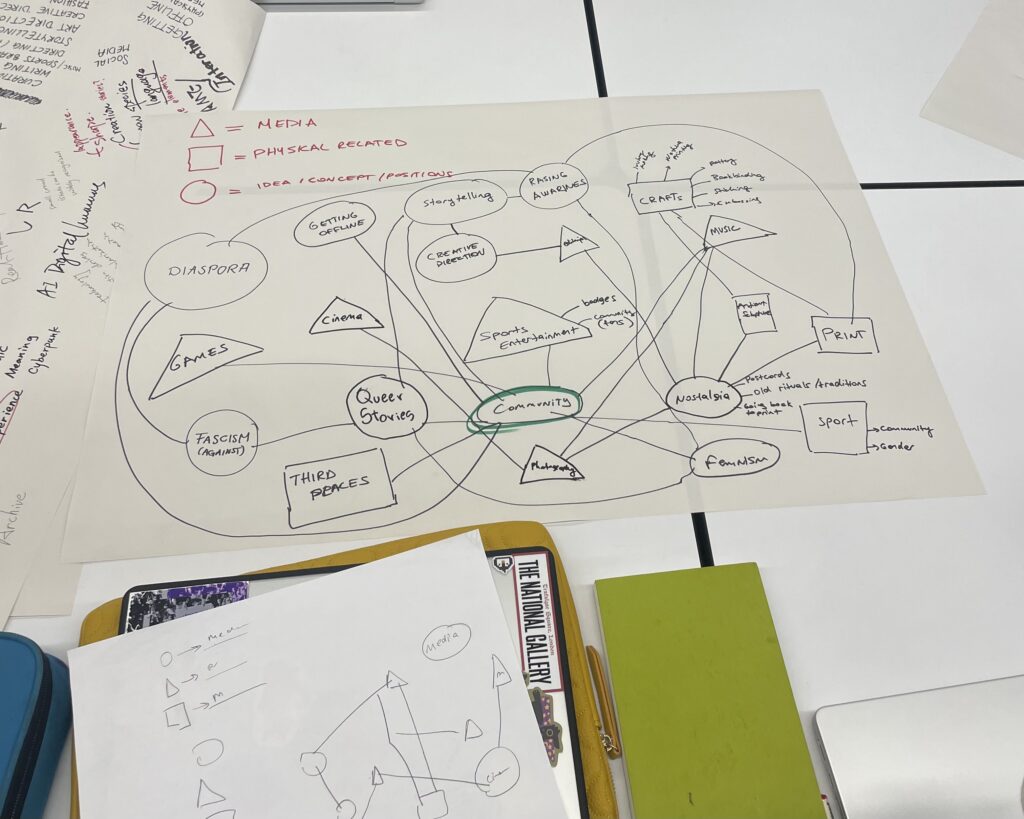
To help us through this process, Cathy divided us into three groups: Making Public, Making Situated Knowledge, and Making Meaning. Within these groups, we wrote down all of our interests and started mapping them together with the others. This simple exercise turned out to be surprisingly powerful. Seeing my thoughts laid out visually and alongside the ideas of others helped bring some structure to the chaos that had been floating around in my head. It made everything feel a little more tangible and manageable.

Links:
DE7608 intro Graphic Design – Future Practices Slides
https://docs.google.com/presentation/d/1SvQrDOy-4GwHipNV4sZ7klFm0ZUWH4DDy84T-SGMcjQ/edit?slide=id.p#slide=id.
Our Mindmaps:
https://padlet.com/qr-code/lhh5tuq2qwomtmav?source=image

Impulse #1 – Directors Roundtable

For my first Impulse blog entry, I wanted to start with something that has always been a big part of how I see and understand the world: film. Even though I study design, I’ve always felt drawn to cinema. Not just as entertainment, but as a way of thinking. Film is a combination of so many different disciplines: image, sound, timing, emotion, storytelling, and decision-making. Watching films, and especially listening to directors talk about their process, reminds me that creative direction exists everywhere, not just in design. It makes me realise how important it is to learn from other fields, because the questions are often the same. How do you create meaning? How do you guide attention? How do you stay true to an idea while navigating uncertainty?

I recently watched a Directors Roundtable with Todd Phillips, Martin Scorsese, Greta Gerwig, Noah Baumbach, Lulu Wang, Fernando Meirelles and it gave me a lot to think about. Not only about filmmaking, but about creative work in general.

One moment that stayed with me was when Martin Scorsese talked about The King of Comedy, which was called “flop of the year” when it was released. Today Scorsese is seen as one of the most important filmmakers of all time. It made me realise how success reshapes the way we look at people’s work. When someone becomes successful, we often forget the the failures and the moments where their work wasn’t understood. We see their career as something linear, even though it never was.

A story shared by the Brazilian director Fernando Meirelles stuck with me the most. When he was asked if he would consider moving to the US, he said: “I like to direct in Portuguese. I understand English, but I don’t feel English. If you say ‘mango tree’ in English, it’s just a tree. If you say ‘mangueira,’ it’s my mother, its scent, it’s so much.” This made me think about how language, context, and personal experience shape meaning. The same object can carry completely different emotional weight depending on how and where you encounter it. As someone interested in creative direction, this makes me reflect on how meaning is never fixed, it is always somehow shaped by cultural context.

Another idea that resonated with me was when they described production as an act of faith. Every day on set, you show up without knowing exactly what will happen. It might rain. Something might not work. The circumstances are rarely what you expected. You have to adapt constantly and make the best out of what is there. This feels very familiar to the creative process in general. You can prepare, research, and plan, but there will always be uncertainty. Instead of trying to control everything, you learn to respond, adjust, and trust the process.

Watching this conversation reminded me that creative direction is not about having complete control or certainty. It’s about observing closely and trusting that meaning will develop over time. It also reminded me that research is not always linear. Sometimes it starts with curiosity, with watching, listening, and collecting fragments. And only later do those fragments begin to connect.

In that sense, watching films and listening to the people who make them has become part of my research process. Not because it gives me clear answers, but because it helps me understand what it means to create something with intention.

Links:
https://www.youtube.com/watch?v=4iLtjMwkOlg&t=2471s
https://www.ebsco.com/research-starters/biography/fernando-meirelles
https://www.indiewire.com/news/general-news/martin-scorsese-audiences-hated-king-of-comedy-1234913652/

Kritische Bewertung einer Masterarbeit – WOOOOOOORRRRRMMMMMHHOOOLLLLLLLEEEEEEEEEEEEESSSSS

Autorin: Kimberly Duck
Titel: WOOOOORRMMHOOOLLEESS
Erscheinungsjahr: 2025
Hochschule: Rhode Island School of Design (RISD)
Master: Master of Fine Arts (MFA) – Graphic Design
Quelle: https://digitalcommons.risd.edu/masterstheses/1430

Die Masterarbeit WOOOOORRMMHOOOLLEESS von Kimberly Duck beschäftigt sich mit der Frage, wie digitale und physische Realitäten zunehmend ineinander übergehen und wie diese Übergänge: die „Wormholes“ als gestalterische und konzeptionelle Methode verstanden werden können. Die Autorin nutzt dabei den Begriff „Wormhole“ sowohl als Metapher als auch als Methodologie, um das Erleben von Zwischenräumen, Übergängen und Irritationen in digitalen Räumen zu erforschen. Das Werkstück ist die Arbeit selbst: eine experimentell gestaltete, visuell überladene, fast performative Publikation.

Gestaltungshöhe
Gestalterisch ist die Arbeit auf hohem Niveau. Sie ist mutig, auffällig und konsequent umgesetzt. Allerdings wirkt sie stellenweise überladen, vielleicht bewusst „freaky“, aber dadurch etwas unruhig. Trotzdem passt dieser Stil gut zur Idee der Arbeit und spiegelt das Konzept des „Wurmlochs“ formal wider.

Innovationsgrad
Das Thema ist originell und aktuell. „Wormholes“ als gestalterisches Prinzip zu sehen, ist ein spannender Ansatz, der das Denken über digitale Räume erweitert. Besonders interessant finde ich, dass sie Theorie, Popkultur und Design sehr frei miteinander verknüpft, aber dennoch einem roten Faden folgt.

Selbstständigkeit
Die Arbeit wirkt sehr eigenständig. Man merkt, dass sie nicht versucht, Erwartungen zu erfüllen, sondern ihren eigenen Zugang wählt. Der Ton, die Gestaltung und das Denken sind ganz klar ihre Handschrift.

Gliederung und Struktur
Die Struktur ist eher offen, weniger wie eine klassische wissenschaftliche Arbeit, mehr wie ein Essay oder ein künstlerisches Manifest. Das passt zum Thema, macht es aber manchmal schwer, einer klaren Argumentation zu folgen. Beim Lesen habe ich mir oftmals die Frage gestellt, ob diese Arbeit in einem österreichischen Kontext schon als zu experimentell angesehen werden würde, aber für eine Designhochschule wie RISD scheint es zu funktionieren. 

Kommunikationsgrad
Sprachlich ist die Arbeit sehr zugänglich und unterhaltsam. Sie schreibt fast erzählerisch, was die Aufmerksamkeit hält. Ich finde das angenehm zu lesen, auch wenn es wissenschaftlich vielleicht etwas zu locker ist. Trotzdem zeigt sie damit, dass man Theorie auch auf kreative Weise vermitteln kann.

Orthographie, Sorgfalt und Genauigkeit
Der Umfang wirkt passend, die Arbeit ist sorgfältig gestaltet. Sprachlich ist alles korrekt, aber sie legt mehr Wert auf Ausdruck und Rhythmus als auf formale Strenge, was in diesem Kontext in Ordnung ist.

Literatur
Die verwendeten Quellen sind vielfältig und passend zum Thema. Sie zitiert sowohl theoretische Texte als auch visuelle Referenzen, wodurch die Arbeit lebendig und gut verankert wirkt.

Abschließende Einschätzung
WOOOOORRMMHOOOLLEESS ist mutig, verspielt und sehr eigen. Manche gestalterischen Entscheidungen wirken etwas übertrieben, trotzdem bleibt die Arbeit sehr spannend. Für meine eigene Thesis nehme ich mit, dass es okay ist, eine persönliche Stimme zu haben und Gestaltung auch als Denkform einzusetzen, solange die Idee klar bleibt.

Diesen Satz fand ich besonders schön: „Our current reality is ruled by multitudes with varying frameworks, and the internet intensifies this exponentially. In the age of blurred lines, where the physical and the digital merge and exist in unison, I choose to be optimistically critical.“ Gerade diese Themen und Schnittpunkte finde ich selbst spannend, aber auch herausfordernd für meine eigene Themenwahl. Die Autorin hat es geschafft, ein sehr abstraktes und freies Thema präzise und greifbar zu formulieren. Auch wenn man sicher manches kritisch sehen kann, hat mir ihre Arbeit eine neue Perspektive eröffnet und gezeigt, wie vielfältig die Möglichkeiten in diesem Bereich eigentlich sind.

#10 To Be Continued…

Now that this phase of my research is coming to an end, the question becomes: how can all of this lead to something more tangible?

The answer, for now, is: I don’t know yet.

What I do know is that I want to keep working with fragments, randomness, and the unnoticed. I want to turn my growing archive of textures, messages, and spontaneous compositions into something. A publication? A zine? A projection? Maybe even a spatial installation? Something that feels more like a collection of evidence than a portfolio.

One idea I’ve been returning to is the “Randomness Manifesto”, a visual and written experiment that acts as both critique and celebration. Critique of overdesigned culture. Celebration of accidents, layers, and non-linear thinking. It might combine screenshots, photography, found type, short texts, print experiments. A design that reflects how we actually experience the world: not as clean grids, but as overlapping, constantly shifting impressions.

Another direction might explore design as documentation. Not designing something but noticing, framing, and amplifying what’s already there. A form of communication design that starts with observing instead of inventing.

Whatever it becomes, I know I want to stay close to the questions that guided me:
– What are we not noticing?
– What are we designing for?
– Can design help us reconnect not just with each other, but with what’s already in front of us?

Design doesn’t always need to answer. Sometimes it just needs to ask better questions. In a time when artificial intelligence can generate thousands of visuals in seconds, maybe the role of the designer is shifting. It’s no longer just about creating new things, it’s about curating, framing, and giving weight to what already exists. The designer becomes less of a maker, more of a connector. Someone who can read between the lines, trace meaning in chaos, and slow down the endless scroll of content to say: “Look closer, this matters.” In that sense, embracing the unfinished and the overlooked isn’t stepping away from design, it’s returning to its core purpose: helping people make sense of the world.