While researching Cognitive Load Theory, I confirmed again how strongly mental overload influences decision-making. I came across this page that explained it pretty well and also got little more information from wikipedia.
wikipedia:
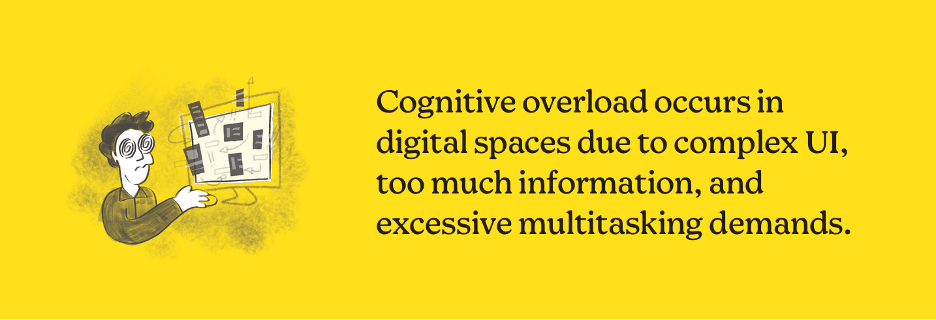
Cognitive load refers to the amount of mental effort a person needs to process information at a given moment. According to Cognitive Load Theory, when too much information is presented simultaneously, people feel overwhelmed, stressed, and less confident in their decisions. Instead of supporting users, the environment becomes exhausting.
In physical retail environments, cognitive load is often unintentionally high. Customers must process multiple layers of information at once:
product details, prices, sizes, spatial layout, lighting, background music, social interaction with staff, and sometimes even time pressure. For many users—especially introverted or socially sensitive individuals—this combination can quickly lead to discomfort and decision fatigue.
AR-based retail interfaces offer a way to reduce this mental overload rather than adding to it. Instead of requiring users to search, compare, and ask questions simultaneously, AR can and should present information in a structured and gradual way. Users receive only the information they need at a specific moment, such as visualising a product’s size, fit, or placement, without being exposed to unnecessary stimuli.
This approach shifts AR from being a novelty feature to a cognitive support tool. By filtering complexity and guiding attention, AR helps users focus on one decision at a time. This is particularly relevant for users who prefer calm, self-directed exploration and who may feel uncomfortable navigating crowded or socially demanding retail spaces.
From a UX perspective, this means that successful AR design should aim to lower cognitive load, not increase it through excessive animations, pop-ups, or interaction steps. Minimal interfaces, predictable interactions, and clear visual hierarchy become essential design principles.
For my master’s research, this insight reinforces a central idea:
AR in retail should be designed not for maximum stimulation, but for mental clarity, emotional comfort, and confident decision-making. Reducing cognitive load can ultimately lead to a more inclusive and humane shopping experience—one that respects different user needs and emotional thresholds.
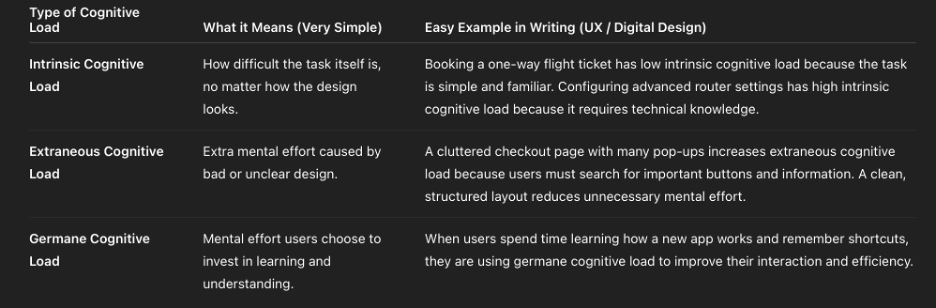
This image is the clear and short explanation of type of Cognitive Load based on wikipedia and Page: ( https://mailchimp.com)
When Design Thinks Too Much for the User
Sometimes digital products don’t fail because they are useless —
they fail because they ask users to think too much.
so as a summary: cognitive overload is when a person receives more information than their brain can comfortably process at one time. Instead of feeling supported, the user feels stressed, confused, or tired.
In digital design, this often looks very familiar:
too many buttons, too many messages, pop-ups everywhere, or long explanations that appear all at once. Even if every element is “useful,” together they can become overwhelming.
The problem is not intelligence.
The problem is mental capacity.
When users feel overloaded, they don’t explore more they just leave.
They stop reading, stop clicking, or postpone decisions.
Good design does not show everything at once.
It guides attention, reduces unnecessary choices, and respects how people actually think and feel.
This is especially important in areas like online shopping or AR-based experiences, where users already need to make decisions. If design adds extra pressure, it breaks trust instead of building it.
Sometimes, the best design decision is not adding a new feature —
but removing one.
So in my case:
AR Shopping Experience WITH cognitive load
- Many buttons floating in AR
- Bright colors and fast movement
- Too many instructions at once
WITHOUT cognitive load
- One action at a time
- Calm colors
- Short and clear instructions
Source (open & accessible):
Wikipedia – Cognitive Load Theory
https://en.wikipedia.org/wiki/Cognitive_load
(In the development of this blogpost, AI (ChatGPT) was used as a supportive writing and structuring tool. I provided the conceptual content, research direction, theoretical preferences, and methodological decisions, while the AI assisted in translating it to English, refining the wording, organising the material and generating coherent academic formulations based on my input. The AI did not produce research or arguments but helped transform my ideas into a clear and well-structured text draft.)
