
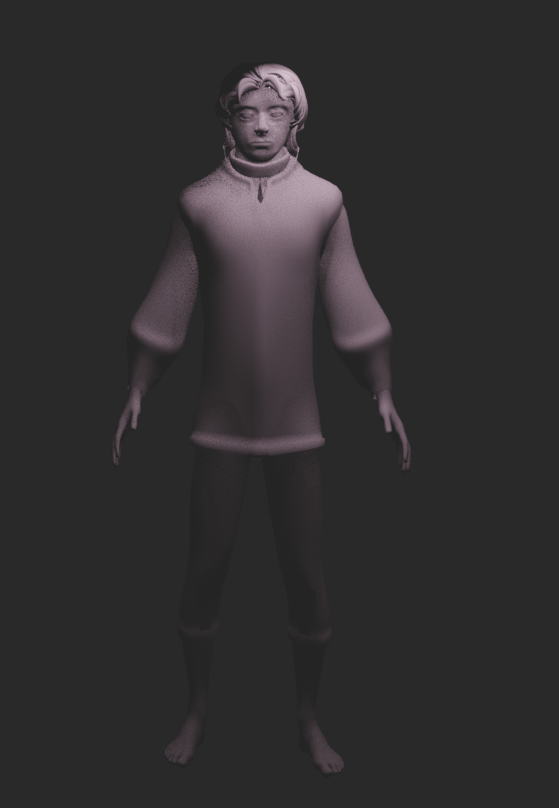
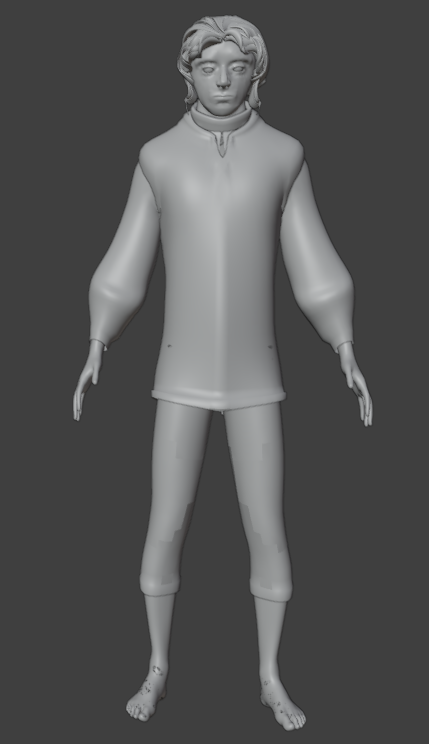
After completing the character’s head and hair, I turned my attention to modeling the clothing, which presented its own set of challenges. The reference artwork featured distinct garment shapes that needed to be translated into clean 3D geometry while maintaining proper drape and proportion. My initial attempts at creating the body mesh from scratch proved problematic, as the underlying topology lacked the necessary edge flow to support natural-looking clothing deformation. After several frustrating iterations, I made the pragmatic decision to use a pre-made base mesh from Blender’s asset library as my starting point. This provided a solid anatomical foundation with optimized topology, saving considerable time that would have otherwise been spent fixing fundamental flaws in my original mesh.
With the improved base mesh in place, I began creating the clothing by selectively extruding faces from the body geometry. This approach ensured the garments would follow the body’s contours naturally while maintaining consistent edge flow. For the jacket, I extruded from the torso and shoulders, carefully shaping the collar to match the reference. The pants were developed similarly, starting from the waistline and extending downward with proper consideration for how fabric would drape over the legs. By working this way, I preserved the clean topology of the base mesh while building out the clothing layers, which proved especially valuable when adding folds and wrinkles that needed to deform convincingly.
The extrusion method did require careful planning to avoid unnecessary geometry in areas that wouldn’t be visible, such as under the jacket or inside the collar. I frequently checked the mesh in both solid and wireframe views to maintain efficient polygon distribution. The process reinforced how crucial proper underlying topology is for any character model – whether for facial animation or clothing simulation – and how working from a quality base can elevate the entire project.
Looking back, this experience mirrored my earlier realization with head modeling: starting with proper fundamentals makes all subsequent work more effective. Just as the tutorial provided a structured approach to facial topology, using a professional base mesh gave me the solid foundation needed for quality clothing modeling. The completed outfit now fits the character’s proportions accurately and maintains clean geometry that will support future texturing and posing. This workflow – recognizing when to leverage existing resources rather than struggling through inferior custom solutions – has become an important part of my modeling process, saving time while producing better results.
