As an interaction design student, I’m always fascinated by how technology, form, and human experience intersect. Recently, I read the paper “Exploring Design Patterns for Spatial Instruments” by Enrique Tomás, Florian Goeschke, and Martin Kaltenbrunner—and it offered a fresh perspective on how sound can be more than just something we hear. It can be something we shape, move, and play with in space. The authors argue that spatialization tools—the systems and interfaces we use to place and move sound in 3D space—should be considered musical instruments in their own right.
What I liked as a designer
What stood out to me is how the authors focus on the user—how artists and performers find creative ways to control spatial sound, often by reusing or adapting existing tools. It reminded me that great design doesn’t always start from scratch.
I also loved the idea of music as space—that sound can actually shape how we feel in a space, not just exist within it. That concept feels very close to interaction design, where space, experience, and emotion often connect.
Things that could be improved
At times, the paper was very technical and hard to follow, especially the parts about synthesis techniques and mathematical descriptors. As someone without a lot of experience in this field, I found myself getting a bit lost sometimes. I would have loved more diagrams or simple examples to make some of those parts easier to understand.
Also, while the artistic examples are great, I wish there was more discussion about how these instruments could be made more accessible—both in terms of cost and learning curve. A lot of the setups seem very complex or custom-built, which makes it harder for newcomers to try them out.
Interesting Case Study
The most exciting example for me was Tangible Granular Spatialization. It’s a physical object you play with your hands, and the sounds you make are analyzed and broken into small pieces (sound grains). Each grain is sent to a different spot in 3D space based on its timbre. So when you change the texture of your touch, the sound doesn’t just change—it moves differently in space. That’s amazing to me. It turns sound design into a physical, spatial performance.
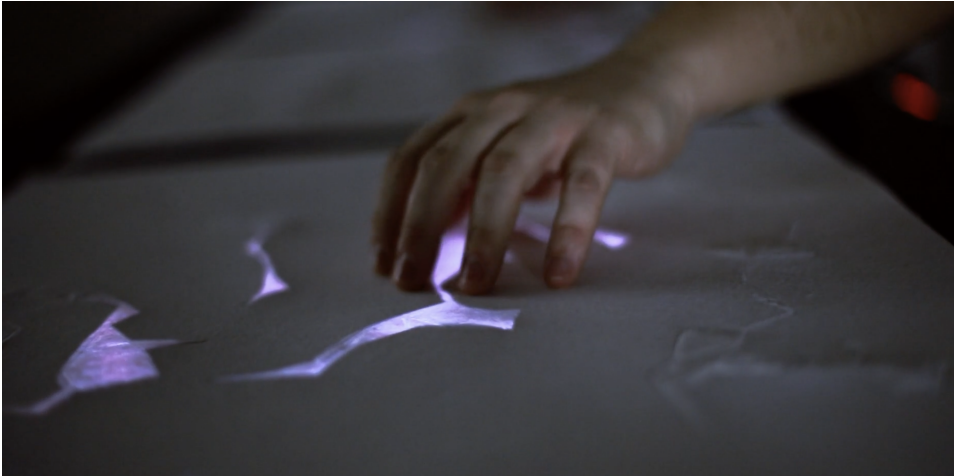
As a designer, it makes me ask:
What other objects could work like this? How can we make sound feel more tactile and intuitive? Can we design interactions where space and sound feel like one thing?
Final Thoughts
This paper reminded me that sound isn’t just something you hear. It can be something you move, something you sculpt, and something that can even shape your perception of a space. As a designer, that inspires me to think beyond screens and apps – and to consider how physical, spatial experiences can become creative tools too.
Source
https://nime.org/proceedings/2024/nime2024_19.pdf
