For the last few weeks, I’ve struggled a lot with idea generation for design & research this semester. As I had already researched the history and definitions of protest and feminist design in the first semester, I couldn’t quite figure out a way to explore protest without organizing a protest itself.
That’s when I started to think about subtle protest and, on the contrary, about subtle inequality that has found its way into our society and isn’t questioned too much in our day-to-day life.
An example would be:
Last week, I was on a fully booked train in Germany, sitting in the bike wagon. Right in front of me was a man sitting with his legs spread out to the sides. Next to him, on the left, sat a woman with her legs crossed, visibly uncomfortable with the situation. On the other side was a free seat—in the fully booked train. But nobody wanted to sit there because a man needed to take up space: the so-called “manspreading” (Merriam-Webster).
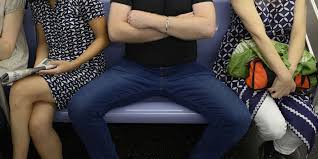
And I think a lot of women* can relate to this situation. It happens basically daily and is a subtle sign of how our society works. Men take up space, and women have to be happy with what’s left (Alonso, 2023).
Also, in that moment when I realized it, I tried to do the same—to sit in a way that takes up more space, shows confidence, and also kind of power. And when I did, it felt weird and unnecessary, and I had the feeling that the people around me gave me slightly weird looks when I put my arm on the rest of my chair and sat more with my legs apart.
For some reason, I could not even commit fully to it and only slightly sat more confidently, as it didn’t feel “right”—a feeling that a lot of women have when they are taking up too much space in a way. For too long, women have been conditioned to believe that confidence should be quiet, success should speak for itself, and self-promotion is just another word for arrogance (Saxena, 2025).
It is an internalized concept that comes from ingrained societal beliefs about gender roles and ensures that society continues to function as it is. Therefore, women* should be encouraged to refuse to shrink, take up space, and fight for a world where every girl grows up knowing her worth (Muselmann, 2025).
The Concept:
That’s when I got the idea for a small, animated poster series. The series will show little snippets or photographs of daily life situations like the one described above—but the other way around. Women taking up the space they should own. I want to explore whether it can feel natural, how people react to it, and whether it might even change how I behave in some way.
*In this blog post, I mostly refer to “women” when discussing experiences of inequality and everyday sexism. However, I want to clarify that I am specifically addressing the experiences of people who are read or perceived as female in public spaces. This includes not only cis women, but also many trans, nonbinary, and gender-nonconforming people who are treated according to societal expectations placed on femininity. These dynamics often affect individuals based on how they are externally perceived, regardless of their gender identity, and this post aims to speak to those shared experiences under patriarchal structures.
