Evaluating a Master Thesis: Ender Özerdem

Ender Özerdem’s 2012 master’s thesis, Evaluating the Suitability of Web 2.0 Technologies for Online Atlas Access Interfaces, explores how participatory web features such as recommendations, user comments, and blogs can enhance online atlas usability. Through a prototype simulating an Austrian online atlas and usability testing with 30 participants, the study empirically assesses user reactions to these interactive elements. The results show that Web 2.0 functions can meaningfully improve user engagement and navigation, demonstrating both practical innovation and sound methodological execution.

Overview

Author: Ender Özerdem
Title: Evaluating the Suitability of Web 2.0 Technologies for Online Atlas Access Interfaces
Institution: Vienna University of Technology, Institute of Geoinformation and Cartography
Supervisors: Univ.-Prof. Dr. Georg Gartner; Dipl.-Ing. Felix Ortag
Year: 2012
Length: ~80 pages + appendices
Artifact: an interactive prototype of an online atlas of Austria (implemented as a clickable PDF simulating web interfaces) used for usability testing with 30 participants.

Structure:

  1. Introduction
  2. Basics
  3. Map access methods
  4. Web 2.0
  5. Empirical evaluation
  6. Results
  7. Conclusions

Evaluation

Overall Presentation Quality

The thesis is well-formatted and consistently structured, following scientific conventions. Figures, tables, and lists are clear and properly captioned. The bilingual abstract (English + German) is concise and accurately summarizes the aims, methods, and findings. Minor typographical inconsistencies exist but do not impede comprehension. Overall presentation quality is very good.

Degree of Innovation

The work tackles the novel (for 2012) question of how Web 2.0 interactivity—recommendations, comments, tag clouds, blogs, RSS—might enrich online atlases. This was a forward-looking intersection between cartography and web usability. The idea of combining usability testing with interactive atlas prototypes represents a meaningful contribution, though not groundbreaking at a theoretical level. The innovation lies primarily in applied integration of Web 2.0 principles into geographic interfaces.

Independence

Özerdem designed and executed the empirical evaluation, built the prototype interface, and conducted the usability tests autonomously. The methodological and implementation details indicate independent planning and execution under supervision. The inclusion of custom interface variants and a participant survey supports this.

Organization and Structure

The work is logically organized. Each chapter builds upon the previous: theoretical groundwork → analysis of existing systems → introduction of new technologies → empirical test → interpretation. The flow from problem statement to results is coherent. However, minor redundancies appear in the literature review (e.g., extended quotations from definitions).

Communication

The writing style is formal, clear, and mostly fluent. Definitions and literature are carefully integrated, though sentence structure occasionally reflects non-native phrasing. Visual materials (figures and screenshots) effectively support comprehension. Technical terminology is correctly used throughout.

Scope

The chosen topic, evaluating Web 2.0 features within online atlas interfaces, is handled with appropriate breadth and depth for a master’s level. The work balances theoretical exposition and empirical application effectively. The 70+ page length is proportional to the scope.

Accuracy and Attention to Detail

The text demonstrates careful referencing and accurate terminology in cartography and web technology. Tables and figures are labeled consistently. Only minor formatting inconsistencies (e.g., spacing, capitalization) occur. The methodology is described in enough detail to be replicable.

Literature

The literature review is broad and relevant, covering both classic cartographic sources (Bollmann & Koch; Kraak & Ormeling) and Web 2.0 theory (O’Reilly, 2005; Gartner, 2009). While comprehensive for its time, it lacks more recent (post-2010) empirical studies on user-generated mapping—an understandable limitation given the publication date. Citation style is consistent.

The Prototype

The prototype developed by Ender Özerdem effectively demonstrates the integration of Web 2.0 features, such as recommendations, user comments, and tag clouds, into an online atlas interface. Although implemented as a clickable PDF rather than a live web application, it is clearly structured, visually coherent, and sufficiently interactive for usability testing. The documentation provides detailed explanations of interface variants, user tasks, and testing procedures, ensuring transparency and reproducibility. Overall, the prototype successfully translates the thesis’s theoretical ideas into a practical, testable form and meets the expected standards of a master’s-level artifact.

Conclusion

In conclusion, Ender Özerdem’s Evaluating the Suitability of Web 2.0 Technologies for Online Atlas Access Interfaces (2012) is a well-structured and methodically robust thesis that effectively combines theoretical research with empirical testing. Despite the prototype’s limited technical scope and a modest sample size, the work shows strong independence, clear documentation, and valuable insights into enhancing online atlas interfaces through participatory web features. Overall, it demonstrates solid academic competence and practical innovation, meriting a ~2, 2+ evaluation.

Powered by ChatGPT
2.5 Quick User Tests: Observations and Future Directions

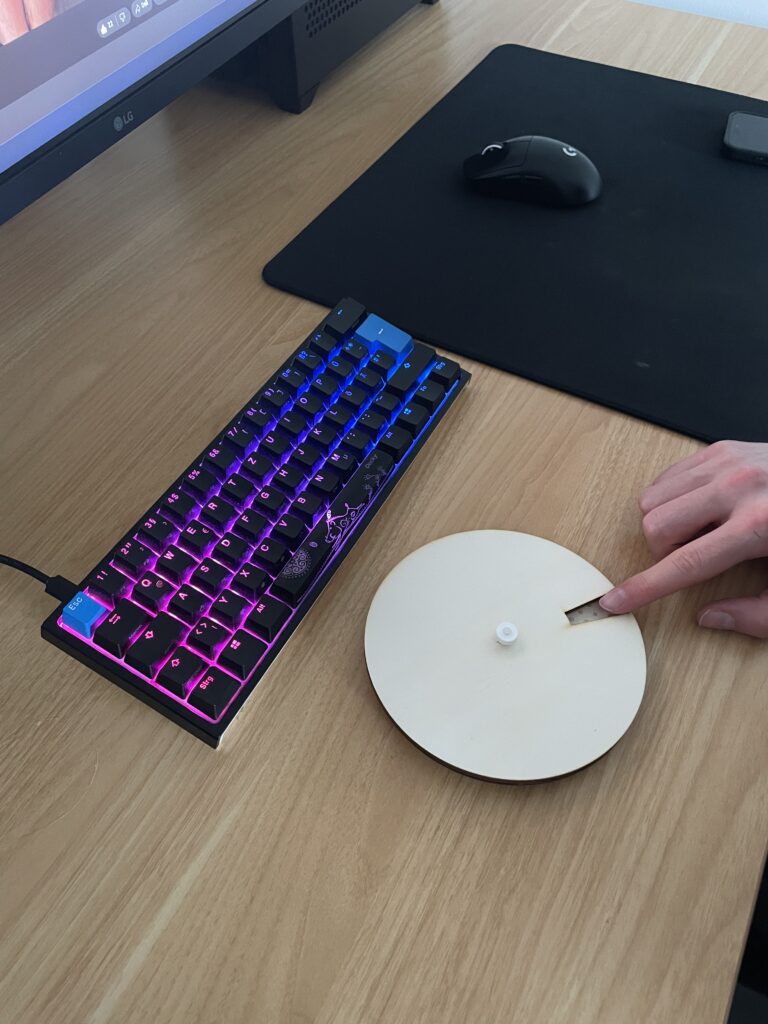
Over the past few days, I conducted three quick user tests to gain early feedback on my analog prototype – the breathing circle. Although the tests were informal and low-pressure, they offered helpful insights into how others interpret and interact with the object. I invited Žiga (26), Nika (24), and Črtomir (62) to try it out. Each session lasted around 5 minutes.

Test Setup

I placed the plywood breathing circle on a table and gave minimal instructions: “This is a tool for guided breathing. Feel free to explore it and describe what you think it’s doing or how you would use it.” I asked them to use the think aloud method, meaning they should voice their thoughts as they interact with the object: what they believe it is, what it might do, and how they feel using it.

The goal was to observe how people interacted with the object naturally, especially how they understood the engraved inhale–hold–exhale sections, the circular form, and the rotating movement of the top plate.

After each test, we spent some time discussing their experience and gathering suggestions for improvements and potential uses.

User 1: Žiga (26, software developer)

Žiga intuitively understood what the breathing circle was for. Without much hesitation, he picked it up, started turning the top plate, and said something like, “Ah, this is for breathing, right?” He immediately began mimicking the rhythm of inhale–hold–exhale as he turned the plate. He noted that the movement felt a bit stiff and suggested a smoother surface or finish to make the rotation feel more meditative and pleasant.

He also raised several ideas during our conversation afterward: “I’d use this during online meetings. I often catch myself scrolling or clicking random things without paying attention. Having this in my hand would keep my fingers busy and help me focus.”

He added that he would be more likely to use it if it were smaller and made of a more satisfying material, something smoother and less rough than bare plywood. He liked the idea of it being minimalistic and aesthetically pleasing: “If it looked like a clean, white decorative piece, I’d definitely keep it on my desk. It could be like a fidget toy for adults.”

Key takeaway: Žiga saw real use potential in focused work contexts and as a physical alternative to digital distractions. He emphasized the importance of both feel and aesthetics, suggesting that people might be more likely to use something that feels good in the hand and looks good in the environment.

User 2: Nika (24, pedagogy master’s student & HR assistant)

Nika was initially unsure how to interact with the breathing circle. She wondered aloud whether she should turn it only one way or back and forth. After some time exploring, she closed her eyes to focus more on the texture. She liked the tactile feel and suggested the engraved areas could be more pronounced so the different phases of the breathing cycle are easier to recognize by touch alone. Although she didn’t see herself using it frequently, she said she might carry a smaller version in her purse if it were about the size of a fidget spinner.

Drawing from her background working with children, she immediately thought about potential classroom uses, especially for kids with attention difficulties. “I see more and more kids who can’t calm down. Something like this could help them focus during class, they could use it with one hand while listening or drawing. If they focused on this, maybe they wouldn’t be so ‘naughty.’” She emphasized that a child-friendly design is important: sturdy, colorful, and available in different versions with language-appropriate text. She sees real potential for the breathing circle as a calming tool for kids.

“I really enjoy doing breathing exercises without screens. I never liked guided YouTube meditations. This feels more real.”

Key takeaway: Nika prefers meditating without any digital interfaces and enjoys practicing breathing exercises undistracted. She sees strong potential for the breathing circle to support children with attention and self-regulation challenges, especially in educational settings. Enhancing the tactile experience and making the design kid-friendly could open valuable new applications.

User 3: Črtomir (62, electrical engineer)

At first, Črtomir had some difficulty understanding the English words engraved on the breathing circle, but with his basic knowledge, he soon figured out the inhale–hold–exhale instructions. He said, “I wasn’t sure at first what these words meant, but I got it after a moment.”

He shared that he has never tried meditation before but could see this tool being useful for people who are stressed or those who always feel the need to hold something in their hands. He also agreed that the breathing circle could work well for children in school settings. When asked how he might use it, he said, “Maybe before bed or while watching TV, something to help you relax.”

Since he didn’t understand the concept right away, I explained a bit more about its purpose before we discussed further. Črtomir thought it was a smart and simple solution but suggested some digital enhancements, such as connecting to a phone to show heart rate. He recommended versions with instructions in different languages and a brief explanation on the device to help new users. He joked about the size, saying it should be made for bigger fingers too.

Key takeaway: Črtomir appreciated the simplicity of the breathing circle and its potential to help people manage stress or restlessness, even if they’re new to meditation. Clear instructions and multilingual options would improve accessibility, and some might value digital features for added feedback. Making the design inclusive for different hand sizes could also broaden its appeal.

What I Learned

  • Users value a smooth, satisfying rotational movement and a pleasant material feel.
  • Size matters: many suggested smaller, more portable versions.
  • Clear tactile differentiation for inhale–hold–exhale phases is important.
  • Different user groups have distinct needs: minimalistic and elegant for adults; sturdy, colorful, and kid-friendly for children.
  • Clear instructions or icons help users understand how to use the tool quickly.
  • Some users are interested in optional digital features but want to keep the core experience analog and distraction-free.

Next Iteration Ideas

  • Experiment with different materials and surface finishes to improve rotation smoothness and tactile satisfaction.
  • Develop smaller versions suitable for carrying in a purse or pocket.
  • Enhance tactile cues with deeper engraving or raised elements for easier recognition by touch.
  • Design variants tailored for children: durable, colorful, and with language-appropriate text.
  • Integrate subtle instructional text or simple icons on the device to aid understanding.
  • Explore potential optional digital integrations, like app connectivity, while maintaining a primarily analog experience.

What’s Next?

This initial round of testing provided valuable insights that will guide the next steps in refining the breathing circle. In my upcoming blog post, I’ll share a video showcasing this stage of the prototype in action and reflect on whether it’s meaningful to develop the concept further. Stay tuned to see how this simple analog tool might evolve into a practical aid for mindful breathing and focus.