We often measure the success of early learning tools in academic terms: Do they improve recognition? Do they support memory? But when testing the ABC Learning Cards, I also wanted to look at something less quantifiable but just as important: confidence.
For young children, learning is deeply emotional. It’s tied to curiosity, play, and, perhaps most critically, a sense of achievement. In this round of testing, I set out to explore a simple question: Do the cards help children feel proud of what they’re learning? Do they experience small “I got it!” moments that motivate them to keep going?
The Setup
This time, I worked with a group of four children (ages 4–6) across two short sessions, spaced a few days apart. In the first session, I introduced a small set of cards (10 total, including letters like A, B, D, E, S, and M) and ran a simple letter-sound matching activity. In the second session, I brought back the same cards to see if any of the children remembered them, and more importantly, how they responded to recognizing them.
The focus wasn’t on mastery, but on how the children reacted when they got something right or remembered something they had seen earlier.
Session One: First Tries, Shaky Starts
In the first session, some children were shy to answer. When I asked, “What sound does this letter make?” they looked at the picture instead. One guessed “dog” for the D card, but couldn’t say the letter. Another saw the M card and said, “Milk!” with excitement, but when I asked, “Do you know the letter?” she said, “I forget.”
This is normal for this stage of learning. The important part was what happened next.
As we worked through the cards together, with repetition, gestures, and exaggerated sounds, their comfort grew. They began making guesses more quickly and confidently. Even if they weren’t sure, they wanted to try. That shift, from hesitation to participation, was the first sign of growing confidence.
Session Two: “I Remember That One!”
When we returned for the second session, I casually laid out the same cards. One child pointed at the “S” card and said, “Sssss… that’s snake!” without prompting. Another picked up the “A” card and said, “Apple! And A!” This time, she remembered both the image and the letter.
One of the children who had been quiet in the first session now flipped through the cards out loud: “Dog. Milk. Banana.” Then he stopped at “B” and said, “That’s B. Like my name.” (His name was Ben.)
He looked up at me, smiled, and said, “I know that one!”
That moment said more than any correct answer ever could.
Confidence in Small Wins
None of the children “mastered” the alphabet in two sessions and that was never the goal. What I did see was the emergence of small wins:
A child remembering a letter after forgetting it the first time
A child willing to try, even if they weren’t sure
A child matching a sound to a picture without needing help
A child proudly showing a card to a peer and explaining it
These may seem minor, but they’re foundational. At this age, confidence builds from repeated exposure, encouragement, and positive reinforcement. The ABC cards worked not just as a teaching tool, but as a source of validation, a way for children to see that they are capable of learning something new.
And it wasn’t just about letters. Some children invented little rituals with the cards, clapping when they guessed correctly, handing cards to friends, or organizing them into “correct” and “almost” piles. These were their own systems for tracking success, and they brought visible pride.
Young children are naturally curious but they’re also naturally quick to switch focus. One of the key design considerations behind the ABC Learning Cards was whether they could hold a child’s attention long enough to make learning moments possible. In this test, I wanted to answer a simple, practical question: How long do children actually stay engaged with the cards?
Not in a structured lesson. Not with an adult leading them every step. But in an ordinary, relaxed setting with the cards available for use.
The Setup
For this session, I invited five children between the ages of 4 and 6 to explore the cards during a 30-minute free-play period. I introduced the cards with minimal instruction, just enough to explain what they were, and then sat back to observe.
I ran the test twice: once in a quiet, individual setup where children had access to the cards one-on-one, and once in a small group setting with some prompts and encouragement.
My goal was to measure:
How long children stayed focused when using the cards independently
Whether attention span improved with peer interaction or guidance
What types of play or activity held their interest the longest
What Happened
In the individual session, the average engagement time was around 8 to 12 minutes. Most children flipped through the cards, named the images, and commented on their favorites. Once they had explored 10 to 15 cards, their interest began to fade, and they moved on to something else.
Interestingly, they did not lose interest out of frustration or boredom, they simply reached a natural point of “I’ve seen enough for now.” Some returned later to look at the cards again, but they treated them more like a picture book, something to dip into briefly, not use continuously.
In the group setting, the results were different. When prompted with games (“Let’s all find an animal!” or “Who can find a card that starts with M?”), the children stayed focused for up to 20–25 minutes. The social element made a big difference. They laughed, guessed aloud, took turns, and cheered each other on. Some even invented small competitions, who could name more food cards, or who could find the “funniest” picture.
Group dynamics introduced variety and energy, which clearly extended attention. And yet, the moment the structure disappeared, interest dropped again quickly, showing that the way the cards are used is just as important as the cards themselves.
What Influenced Attention Span Most
A few clear factors stood out in both settings:
Visual engagement. Bright colors, familiar animals, and simple shapes helped hold focus. Cards like “Elephant” and “Giraffe” were handled more than once.
Personal relevance. Kids lingered longer on cards that matched letters in their name or reminded them of something at home. One child spent five minutes talking about the “D for Dog” card because it looked like her pet.
Peer interaction. Children feed off each other’s curiosity. The same card that was ignored in solo play became exciting when someone else got excited about it.
Observations and Takeaways
Solo attention spans average around 10 minutes. This is a perfectly normal range for this age group and a good benchmark for designing short learning bursts.
Group engagement lasts significantly longer. With simple prompts or peer involvement, attention nearly doubled.
Cards work best as a launchpad. The cards themselves aren’t entertainment, they’re a tool. What extends their use is interaction, structure, or narrative.
Revisiting is common. Some children walked away and came back multiple times. This suggests the cards have reusability, even if the child only stays a few minutes each time.
Design Implications
The takeaway from this test is less about changing the cards and more about how they’re presented. I’ll be developing a short “Quick Start” activity sheet for parents and educators that includes:
5-minute and 10-minute activity ideas
Simple group games
Low-prep sorting or matching tasks
Prompts for solo exploration (“Find the cards with animals you’ve seen before”)
This helps adapt the cards to different attention spans and contexts, which is essential when working with young learners.
One thing I’ve learned while observing children interact with the ABC Learning Cards is that sometimes the best “activities” are the ones I never planned. In this round of testing, I stepped back even further. I didn’t introduce a task or a sound or a letter. I simply put the full set of cards on the table and watched what the children did with them, on their own terms.
This session turned out to be one of the most revealing so far.
The Setup
Four children, ages 4 to 6, were invited to explore the cards during free play. I told them, “You can play with the cards however you want. There’s no wrong way.” I left the deck in a pile in the middle of the table, with nothing else provided, no pens, no extra props, no rules.
What They Did
First, the children flipped through the cards, calling out the pictures. This was expected. But then they started sorting.
One child made a pile of “animals.” Another collected “food.” A third made a “funny ones” pile—cards that had unusual or strange images to her, like the umbrella and the violin. Without being told to sort or categorize, they were organizing based on their own logic.
Then came the games.
One of the older children invented a “guessing game” where she held up a card and the others had to guess what was on it . She gave sound clues: “It makes with buh-buh.” Others shouted out, “Owl“! The right guess earned a cheer. The game got louder and more collaborative as it went on.
Another group built a “card train” by laying the cards out in a line across the floor. They connected them by themes (“snake goes next to zebra because they both live outside,” one said). There was no alphabet logic, just narrative play. But in this, I saw real engagement: they were practicing naming, sequencing, comparing, and verbalizing.
One child started assigning the cards to people in the room. “You’re G for giraffe. You’re A for apple.” It became a mini-roleplay scenario where each person got a card and had to “act it out” or make the matching sound. I joined in and was given “S for snake,” and had to look mean, apparently a snakes job.
Why This Matters
These invented games weren’t about correct answers. They weren’t about phonics or formal learning. But they were rich with literacy-relevant behaviors:
Naming and recalling vocabulary
Sound-based guessing and phonemic play
Storytelling and sequencing
Categorizing and classifying
Collaborative communication
When children invent their own structures, they show you how they understand the world and how they naturally want to play with it. The ABC Learning Cards, though designed with certain goals in mind, proved flexible enough to support this kind of free exploration.
That flexibility is powerful. It means the cards don’t have to be used “correctly” to be useful. If a child wants to build a zoo, act out animal sounds, or pretend the violin card is a flying spaceship, they’re still engaging with symbols and meanings, which is at the heart of early literacy.
Takeaways
Children are natural system-makers. Even with no rules, they create structure. That means tools like these cards don’t have to lead, they can follow.
Play is learning. The games they invented were often more cognitively rich than anything I could have planned.
Cards can serve different roles. They can be learning prompts, story props, characters, or even building blocks. That versatility increases their value in both home and classroom settings.
One of the subtler—but crucial—functions of the ABC Learning Cards is their ability to spark conversation. While they’re designed to support letter and sound recognition, that’s not all they can do. For many preschool-aged children, language development happens not through drills, but through talk—storytelling, asking questions, making observations, and connecting ideas.
For this round of testing, I wasn’t focused on whether children could name the letter or guess the word. Instead, I simply wanted to observe whether the cards acted as conversation starters. Could they create moments where a child shares a memory, asks a question, or invents a story?
The Setup
This session was intentionally informal. I sat with three children (ages 4 to 6) in a quiet playroom, with the full set of ABC Learning Cards laid out in front of us. I started flipping through the cards one by one, pausing on each and casually asking:
“What do you see here?” “What does that remind you of?” “Have you ever seen one of these?”
I didn’t push for answers. The idea was to see if the images would lead anywhere naturally.
What Happened
The results were better than I expected, not only did the cards lead to conversation, but the children talked more than I did for most of the session.
The animal cards, once again, opened the door to storytelling. The elephant card triggered a 10-minute story from one child about a trip to the zoo. She didn’t remember all the animals she saw, but she was confident she fed a giraffe and called the zebra “the one with pajamas.” When we reached the giraffe card, she beamed and said, “There! That’s him!”
The dog card led to a round of “Do you have a pet?” between the children. One said she had a dog named Max. Another said, “I don’t have one but I want a cat.” This turned into a conversation about what animals sleep on, what they eat, and whether cats like bananas (they agreed no).
The apple card led to a food discussion. One child said, “My grandma puts apples in the oven,” which led to a back-and-forth about apple pie, fruit snacks, and lunchbox favorites. Without any direction, the children began relating the image to their daily routines—snack time, groceries, helping in the kitchen.
Interestingly, even some of the less popular cards became conversational when handled together. The violin card, which previously hadn’t received much interest, became the center of attention when one child said, “That’s like the thing my cousin plays.” The group then mimicked playing instruments, humming and tapping on the floor.
What This Revealed
The most important thing I noticed was that conversation didn’t rely on knowing the letter or the word. The pictures worked on their own as social triggers. Children didn’t need to read to participate, they just needed something to respond to. And once they started, they often didn’t stop.
The cards seemed to serve as verbal scaffolding, giving children just enough visual structure to build their own stories, ideas, and questions around. And once a child started talking, the others often joined in. It became collaborative.
This kind of spontaneous language use is crucial. It supports:
Narrative development (telling what happened, or what might happen)
Social learning (listening, adding, agreeing, disagreeing)
Personal expression (sharing stories and emotions)
And importantly, it doesn’t feel like schoolwork. It feels like play.
What Helped
A few factors seemed to support the flow of conversation:
Open-ended questions. Not “What letter is this?” but “What do you think about this?” or “Have you ever seen this?”
Slower pacing. Giving time and space for children to make connections allowed ideas to come naturally.
Peer interaction. When children talked to each other (not just to me), they were more relaxed and expressive.
One subtle but important element: eye contact and gesture. Children often touched the cards while talking, or looked at me and each other for confirmation. The physical presence of the cards made the conversation feel grounded, not abstract.
Takeaways
This session confirmed that the ABC Learning Cards are more than academic tools, they’re conversation tools. They help children explore language socially and personally. Even without focusing on letters or phonics, the cards successfully encouraged:
Descriptive language (“It has a long neck like this!”)
Relational thinking (“I saw that animal in a book.”)
Memory recall (“We made apple pie last week.”)
Questioning (“Do all cats like fish?”)
These are essential building blocks for both literacy and communication. And they happen best in a space where there’s room to talk, imagine, and connect.
As we continue to test the ABC Learning Cards, I’ve started to notice that some cards get picked up over and over again, while others are left untouched. This observation led to a simple but useful question for the next test: Which cards are children most drawn to—and why?
This session was all about preference testing. I wasn’t focusing on letter recognition or sound associations this time. Instead, I wanted to observe which cards children chose to interact with when no instructions were given. What do they reach for first? What holds their attention the longest? And what, if anything, do they say about their choices?
The Setup
I arranged the full alphabet card set in a wide circle on the floor so all cards were visible. Then, I invited five children (ages 4 to 6) into the space and said, “Pick any card you like. You can look at as many as you want, and tell me which ones you like the most.”
There were no instructions beyond that. I wanted it to feel open, playful, and entirely led by the children’s instincts. After a few minutes, I asked follow-up questions like: “What do you like about that one?” “Do you know what it is?” “Do you want to find more like it?”
I recorded which cards were chosen first, which ones were picked multiple times, and which ones were ignored.
What Happened
Animal cards were clear favorites. The most frequently chosen cards were:
G for Giraffe
E for Elephant
C for Cat
D for Dog
Z for Zebra
Almost all of the children went straight for the animal images. When asked why, the answers were simple and consistent:
“I like animals.” “I saw that at the zoo!” “That’s a funny one with a long neck!” (about the giraffe)
One child even tried to arrange all the animal cards together in a group and called it “the zoo.” There was excitement, recognition, and storytelling around these cards. The children clearly related to animals—they had emotional and visual connections to them, often from books, toys, or past experiences.
Food cards came next. The most popular non-animal cards were:
A for Apple
B for Banana
M for Milk
O for Orange
These also sparked comments like:
“I eat that at home.” “That’s my juice!” “Apple is my favorite.”
The responses were more personal, tied to daily routines. Food cards had a slightly less enthusiastic reaction than animals, but they still felt familiar and accessible.
The least popular cards? Abstract or less familiar objects.
N for Net
Q for Quilt
U for Umbrella
V for Violin
These cards were barely touched. One child looked at the net card and said, “What’s that?” Another mistook the violin for a guitar. The umbrella card prompted one child to say, “I don’t like rain,” and walk away.
It’s not that the images were unclear, but these objects simply didn’t mean much to the children, at least not at first glance. Without a personal connection, they felt neutral or forgettable.
What This Tells Us
Children are more likely to engage with images that:
Represent things they see often (pets, food, favorite toys)
Have emotional or experiential meaning (zoo trips, snack time, picture books)
Are visually distinctive or “funny” (giraffe, snake, zebra)
This doesn’t mean less popular cards are useless, but it does suggest that certain images are more effective entry points for learning. These high-engagement cards are where we can introduce letters, sounds, and games most successfully. Once children are comfortable and interested, we can gradually incorporate the less exciting cards into the mix.
Design Implications
Based on this session, I’ll be re-evaluating the object selection for a few letters. Not every card has to be a hit but if a card consistently gets ignored, it may be worth replacing with something more relatable.
For example:
Quilt could become Queen, a concept many children already know from stories or costumes.
Violin might be swapped for Van, which appears more in children’s daily environments.
It’s also worth thinking about image design itself. Even with a good word choice, the way something is illustrated matters. An umbrella might become more appealing if it’s colorful or has a character holding it. A neutral object can become more engaging with a small creative twist.
Takeaways
This test reminded me that designing for children means designing for curiosity, not just curriculum. If a child doesn’t pick up a card, it’s not because they aren’t ready to learn the letter, it might just be that the image doesn’t speak to them. And when you find the right image? Suddenly, they want to hold it, talk about it, and learn more.
For this test session, I wanted to explore a more tactile aspect of learning, specifically, whether children would engage with tracing letters as a way of reinforcing what they see and hear on the ABC Learning Cards.
The cards are already designed to be highly visual, with bold, clean letterforms and simple, recognizable images. But children at this age (4 to 6) don’t just learn by looking, they learn by touching, doing, and moving. I wanted to see whether adding a tracing element would naturally deepen their attention and possibly help with letter recognition and memory.
The Setup
This time, I created enlarged, black-and-white printouts of ten selected cards, I laid out markers, crayons, and pencils at a small round table and invited four children to join the activity.
I asked the children to choose one letter card they liked, then find its matching tracing sheet. No one explained how to trace, the idea was to let them lead and observe how they interacted with the material.
What Happened
Almost immediately, the kids started tracing, some carefully, others a bit wildly. One girl picked the letter E and began slowly outlining it with a blue crayon, switching colors halfway through. Another boy chose “S” for snake and drew a full spiral around it before tracing the actual shape. A third child added drawings around the letters—cats, trees, a rainbow.
What struck me most was how engaged they were. For over 20 minutes, they kept tracing, coloring, decorating, and talking about the letters. It wasn’t always neat or focused, but it was deliberate. One child said, “I’m making the M like mountain,” as he drew peaks around the letter.
Interestingly, none of the children needed instruction. They all understood the basic idea of tracing without being told what to do. A few tried to copy the letter freehand next to the traced version, with varying results, but the intention was clear, they were trying to internalize the shape.
Observations
Tracing was intuitive. Every child naturally knew what to do and did it in their own style.
The act of tracing extended attention span. Children stayed at the table longer than during previous, non-tracing activities.
Creativity enhanced engagement. Many children added their own touches—coloring the letter, drawing objects around it, or matching it to personal experiences (“B is for Ben!”).
One of the most interesting moments came from a boy who had struggled to match sounds in the last session. While tracing the letter “D,” he said, “Duh… dog.” He had made the connection, not just by looking—but by doing.
While this activity clearly engaged the children, not all of them were focused on forming accurate letters. Some turned the letters into artistic elements or combined them with scribbles. And that’s okay, the goal wasn’t perfect handwriting. Still, for children who are ready for more structured practice, it may be helpful to add subtle guides (like directional arrows or dashed lines) in future versions.
Another challenge was attention drift after about 20–25 minutes. While that’s a generous window for this age group, it suggests that tracing works best as a short, focused part of a broader activity, not a standalone lesson.
Takeaways
This session confirmed what I suspected: children are eager to interact physically with letters, and tracing gives them a way to do that that’s both creative and developmentally meaningful.
One of the core goals of the ABC Learning Cards project is to help children begin forming letter-sound connections, the foundational link between a letter (like “B”) and the sound it represents (“buh”). In this test session, I focused specifically on this question: Can children match the beginning sound of a word to the correct image on the card, even if they don’t recognize the letter yet?
This test was different from the previous sessions. Instead of asking the children to name the image, I flipped the order. I gave them the letter sound first, and then asked them to find the picture card that matched that sound. It was a simple, low-pressure guessing game. I wasn’t testing reading or letter naming, just whether they could hear a sound and associate it with a familiar object or animal.
Instead, I said something like, “Let’s find the card that starts with the sound mmmmmm. Can you hear that? Mmmmm. What picture starts with that sound?”
At first, there was some hesitation. The children looked at the cards, some pointing at random images. But soon, I noticed a shift: when I exaggerated the sound (“sssss”) or mimicked the animal noise (“ssss like a snake!”), the children became more confident in guessing.
Overall, the results were promising. Even though most children couldn’t name the letters yet, they were starting to connect sounds to words, and then to the images. This reinforces the idea that phonemic awareness develops before formal reading or spelling skills and that image-led tools like these cards can help make that process concrete.
What Helped
There were a few things that made this test smoother:
Sound exaggeration. Stretching out the sound (“ssssss”) helped the kids isolate it.
Repetition. Saying the sound 2–3 times gave children enough time to process it.
Movement and mimicry. When I used gestures (wiggling fingers like a snake) or made the animal noise, they connected faster. These multisensory elements were especially helpful for the younger ones.
Small groups. Doing the activity with just a few children at a time allowed for focused, personal interaction.
The children didn’t yet understand that one letter makes only one sound, which is developmentally normal. For instance, when I asked for the “Ssss” card, one child pointed at two cards. They aren’t thinking about spelling or phonics rules yet, they’re going by instinct and recognition.
Takeaways
This test confirmed a few things for me:
The image is a bridge between the sound and the abstract letter. For early learners, this connection is fragile, but it can be built through repetition and play.
Sound matching is easier than letter matching at this stage. Many children could find a picture that “sounded right” even if they didn’t know the name of the letter at all.
Phonemic play works best when it’s multisensory. Movement, voice, and image together helped support understanding.
This was not a reading test—it was a sound test. And in that sense, the ABC cards served their purpose beautifully. They helped spark the first steps toward sound-letter association, which is a foundational skill for learning to read.
After the first round of testing the ABC Learning Cards in a preschool setting, I wanted to understand how they work in a more natural, everyday environment—the home. The aim of this test wasn’t to evaluate reading progress, but to simply observe how families use the cards, how children respond outside of the classroom, and whether the cards invite learning without pressure.
To do this, I gave a prototype card set to three families, each with one child aged between four and six. I explained the project briefly but gave no strict instructions—only that they should use the cards however felt natural during their normal day-to-day routine. I followed up with each family a few days later to ask about their experience.
Household #1 – The Play Table Approach
The first family used the cards during afternoon quiet time. The mother spread them out on the living room floor while the daughter was drawing nearby. According to her mother, the child was immediately interested, not in the letters, but in the pictures. She started picking them up and naming what she saw: “That’s a giraffe,” “That’s a feet,” “That’s a cat!”
Her mom didn’t interfere but watched. Later, when Emma asked what the big letters were, her mother said, “That’s the letter G. G is for Giraffe” The daughter then picked up another card and tried to guess the word by the picture, repeating the letter name after her mom said it aloud. They did this for about 15 minutes until Emma moved on to another activity.
What stood out in this case was that Noemi led the activity. Her engagement wasn’t forced, she was curious because the cards were visually inviting and because they were integrated into a calm, familiar space. Her mother noted that Noemi returned to the cards the next day and played with them by herself.
Household #2 – Structured Matching Game
In the second home, Jonathan (age 5) used the cards with his father, who turned the session into a game. First, he spread all cards on the table and asked Jonathan spell the letter. This was a bit too hard at first, so they adjusted the rules: The dad made the sounds like “Can you find the “C” Jonathan picked a picture card (e.g., the cat) and guessed what sound it started with. His dad then showed him a couple of letters to choose from. If Jonathan struggeled to match finding the spelled letter, his dad also gave him the hint of, which animal/object starts with the just announced letter.
This test showed that even without strong letter recognition, kids are beginning to develop phonemic awareness—the ability to connect sounds with starting letters. The cards helped support that process through images, speech, and guided choices.
Household #3 – Story Time Companion
The third family used the cards before bedtime, alongside story time. Olivia’s mom said she placed the cards next to her daughter’s bed and invited her to “pick three cards to talk about” after reading a book. Olivia picked the cat, the giraffe, and the leg, familiar things she likes.
Each night, they spent about ten minutes talking about the pictures, the words, and the letters. “I didn’t quiz her or correct her,” her mom told me. “If she said ‘E is for earphant,’ I just nodded and said, ‘Elephant, yes.’ The goal wasn’t to drill it into her, just to enjoy the words and images together.”
This approach was probably the most relaxed, but it still had value. Over a few nights, Olivia began recognizing and naming more of the letters without being asked. The repetition, combined with a calm environment, seemed to reinforce the associations gently.
Key Takeaways
Across the three homes, I saw very different approaches, but a few patterns stood out.
Images are the entry point. In all cases, the children engaged first with the illustrations. Recognition of the object came before any interest in the letter. This supports the choice to prioritize bold, familiar, image-led designs.
Sound comes before print. Even children who couldn’t name a letter could often guess its sound when prompted. This confirms that phonemic awareness develops earlier than letter naming—and that the cards can bridge the two.
Parent involvement shapes success. Whether structured or relaxed, parent presence made a big difference. The most progress happened when parents participated, rather than leaving children alone with the cards.
Flexibility matters. These cards aren’t a strict curriculum tool. They worked best when they could blend into routines: playtime, bedtime, or quiet time. For many families, too much structure would have been a turnoff.
The aim was simple: show the cards to a small group of children and ask them to guess what they saw in the image. I wanted to find out if the pictures on the cards were clear, age-appropriate, and easy to recognize, without needing to explain or guide too much.
The group consisted of 3 preschoolers, aged between four and six. We sat at a small table in a preschool setting, and I introduced the cards one by one. Each card shows one large letter and an image of an object or animal that begins with that letter. I didn’t mention the letter at first, I just asked, “What do you see on this card?” Sometimes I followed up with, “Do you know what it’s called?” or “What sound does it start with?”
The reactions were immediate and often enthusiastic. The giraffe card was recognized by everyone without hesitation. They shouted “giraffe!” almost in unison. The cat card was a hit too; they said “cat,” “kitty,” or just made meowing sounds.
Animal cards were especially successful. All the children knew the elephant and giraffe without help. One child even added, “That’s my favorite animal!” when the elephant card came up. Interestingly, one called the giraffe a “long-neck horse,” which wasn’t quite right, but showed that the image itself was being interpreted correctly even if the vocabulary wasn’t fully there.
Some images didn’t land as well. The ant house card caused confusion. One child guessed “mountain,” another said “insects”. Only one child eventually said “and house,” and even that seemed like a lucky guess. That image might need to be reconsidered. Something more visually distinct or more familiar.
The children also started trying to connect the image to a letter, even though most of them don’t know the alphabet yet. One child asked, “Cat starts with K?” It showed that they were curious about the relationship between letters and sounds, even if they weren’t getting it quite right yet. That’s actually a good sign, recognizing that letters link to words is one of the first steps in developing phonemic awareness.
One unexpected thing was how naturally some of them started making sounds. For example, they meowed for the cat and pretended to trumpet for the elephant. This could be something to build on—maybe incorporating sounds into the activities would make the cards even more engaging.
Another interesting observation: a few children traced the big letters on the cards with their fingers while naming the pictures. It was spontaneous, but very in line with the idea of multisensory learning. They weren’t copying letters on paper yet, but you could see the impulse to connect touch, sight, and sound.
Overall, the test gave me a lot to think about. The children responded best to cards that had familiar, concrete images, especially animals and common objects like fruit or toys. They were naturally drawn to the pictures and excited to name them. The letter recognition was limited, but that’s expected at this stage. What mattered most was that they were engaged, curious, and making connections between sounds, objects, and letters.
Below are the four participants whose heart-rate-variability traces we have explored. We deliberately chose them because they sit at clearly different points on the “health–illness” spectrum and therefore give us a compact but vivid physiological palette.
Subject 119 is our practical baseline. No cardiac findings, no anxiety-or-depression scores, no PTSD, no “Type-D” personality pattern. Anything we hear or see in this person’s HRV should approximate the dynamics of an uncomplicated, resilient autonomic system.
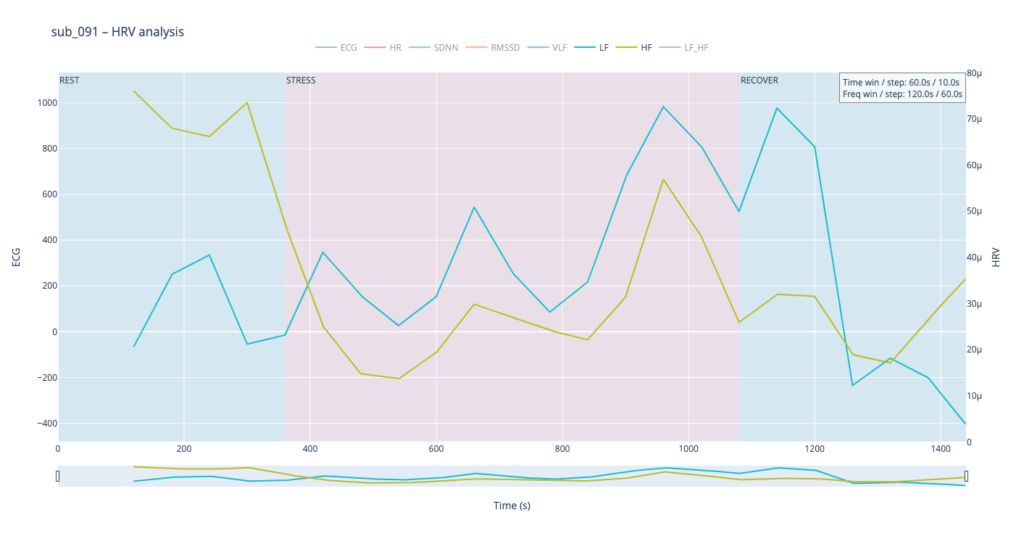
Subject 091 represents a “mind-only” disturbance. The heart itself is structurally sound, but the person carries the so-called Type-D trait (high negative affect, high social inhibition). This makes the autonomic system more reactive to worry or rumination even when the coronary vessels are normal.
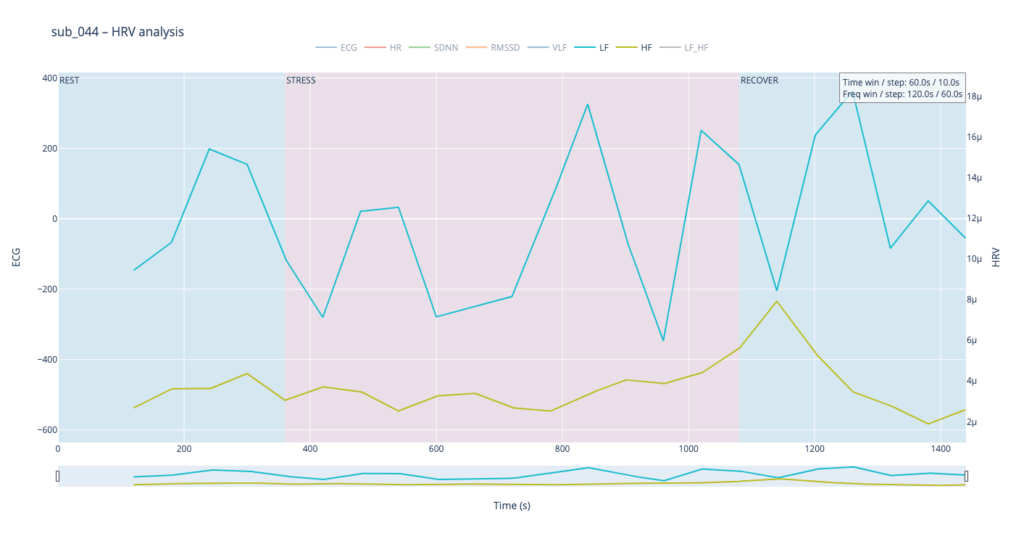
Subject 044 adds psychological trauma on top of mild, non-obstructive angina. Clinically this participant scores high on anxiety and meets full PTSD criteria. We therefore expect brisk sympathetic surges, slower vagal recovery and more noise in the LF/HF ratio—an autonomic pattern often seen in hyper-arousal states.
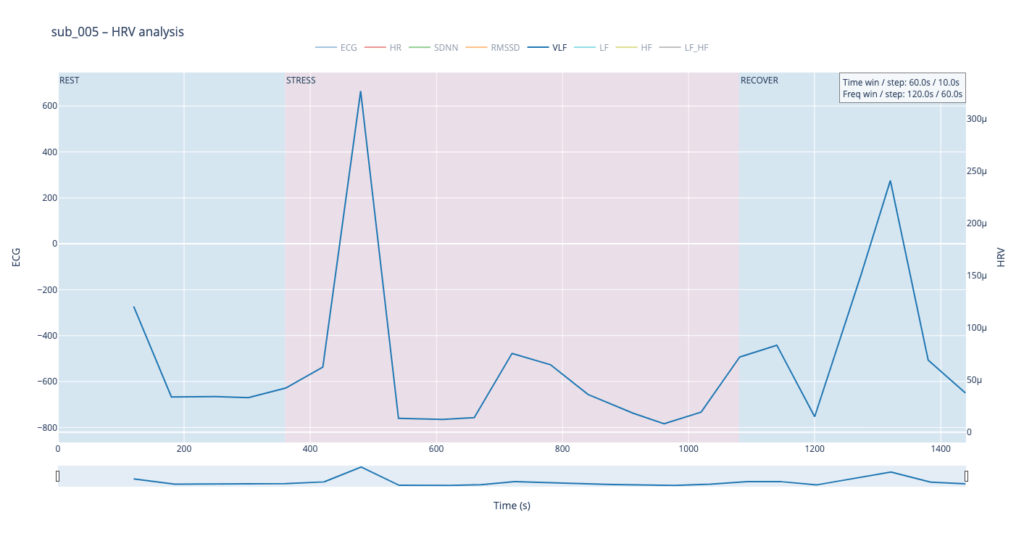
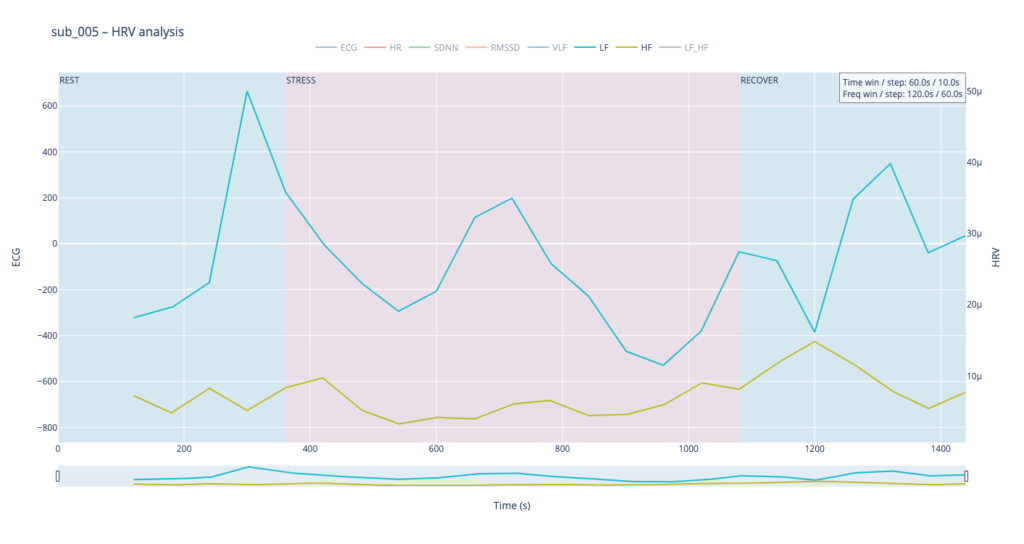
Subject 005 is the most medically burdened case: non-obstructive angina, endothelial dysfunction, stress-induced ischaemia, plus anxiety, depression, Type-D personality and PTSD. In short, both the mechanical pump and the emotional “software” are under strain, so variability measures are likely compressed and heart-rate plateaus may appear where a healthy person would fluctuate.
Using these four contrasting bodies as our “voices” lets us investigate how the same 6-min rest → 12-min exercise → 6-min recovery protocol is translated into four distinct autonomic narratives—information we will later map into equally distinct sonic textures.
HR
In general, each cardiovascular system answers physical load differently, depending on the baseline autonomic tone, fitness, psychological state, and comorbidities.
sub 115 – “healthy” The heart “ramps up” slowly. Pulse climbs in stair-like steps with brief dips between peaks—the body is constantly trying to regain homeostasis. After the exercise HR quickly falls almost to baseline. This is typical of a well-trained, adaptive cardiovascular system with a large functional reserve.
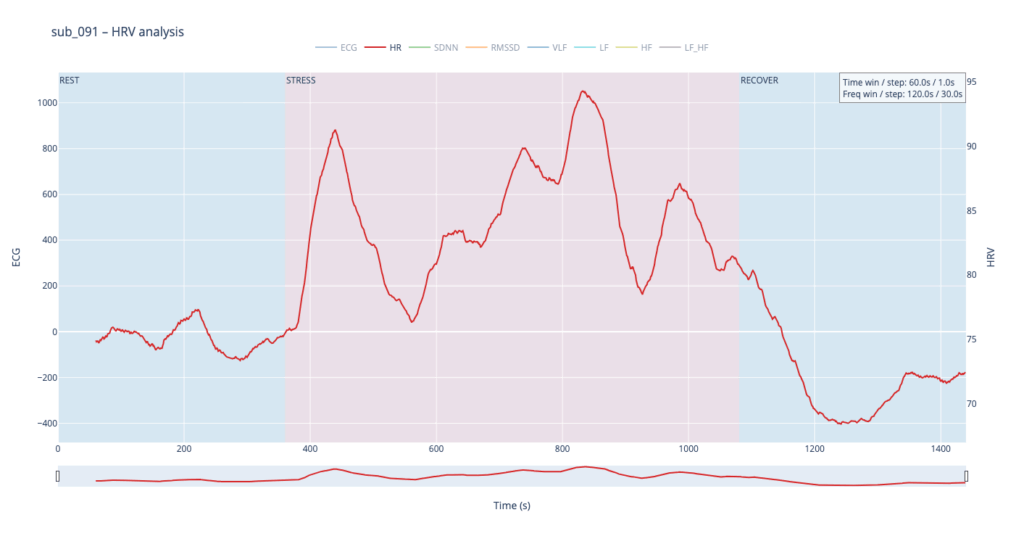
sub 091 – “mental / Type D” Resting HR is slightly above normal, yet overt anxiety is absent. The response is inertial: about a minute after load starts HR jumps from 75 → 91 bpm, then plummets to 76, followed by alternating short rises and falls. When the exercise stops, HR drops to 68 (below the initial value) and only then drifts back to ~75. Such a “swing” may reflect conflicting sympathetic vs. parasympathetic signals: outward calm while inner tension builds and discharges in bursts.
sub 044 – “PTSD” Even before load the heart is already in “fight-or-flight” mode (~83 bpm). The onset of exercise changes little, but at the third minute HR spikes to 98. It then declines stepwise yet remains high (89–97) even during recovery. The absence of a deep post-exercise dip shows that the parasympathetic “brake” hardly engages— the body struggles to shift into a resting state.
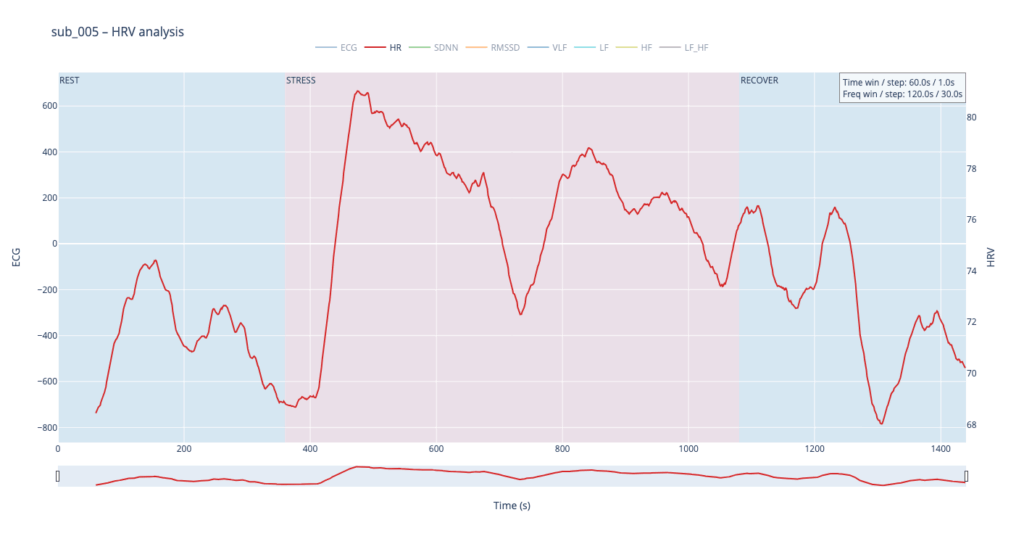
sub 005 – “sick / multiple pathologies” Baseline HR is 68. At the start of exercise it leaps to 80, after which it very slowly, step-by-step, drifts back toward normal and stays there until the end of the trial. The pattern resembles sub 044 but with lower background stress and slightly better recovery.
In healthy subjects the heart rate rises smoothly in step-like waves during effort and quickly settles back to baseline once the task stops, reflecting a well-balanced push-and-pull between sympathetic “accelerator” activity and parasympathetic (vagal) “brakes.” In patients with cardiac disease, PTSD or Type-D traits the resting rate is already elevated, the response to stress is sharper or more erratic, and the return to baseline is sluggish, showing a system locked in chronic “fight-or-flight” with weaker vagal damping.
Sound-design mapping:
Based on HR, I want to create drum patterns, where the lowest HR generates only kick, and then if HR rises, we can add more percusive elements.
SDNN
SDNN tracks how much the RR-intervals expand and shrink over time.
When the value climbs, the spacing between beats becomes more irregular—your heart is “dancing” around the mean to satisfy moment-to-moment demands.
When the value sinks, the intervals line up almost like a metronome—either the organism is in very deep rest or the rhythm is held in a tight sympathetic “clamp” and cannot flex.
Usually this parameter is calculated for 24 hours, but since we dont have such luxury, we stick to 2min time window
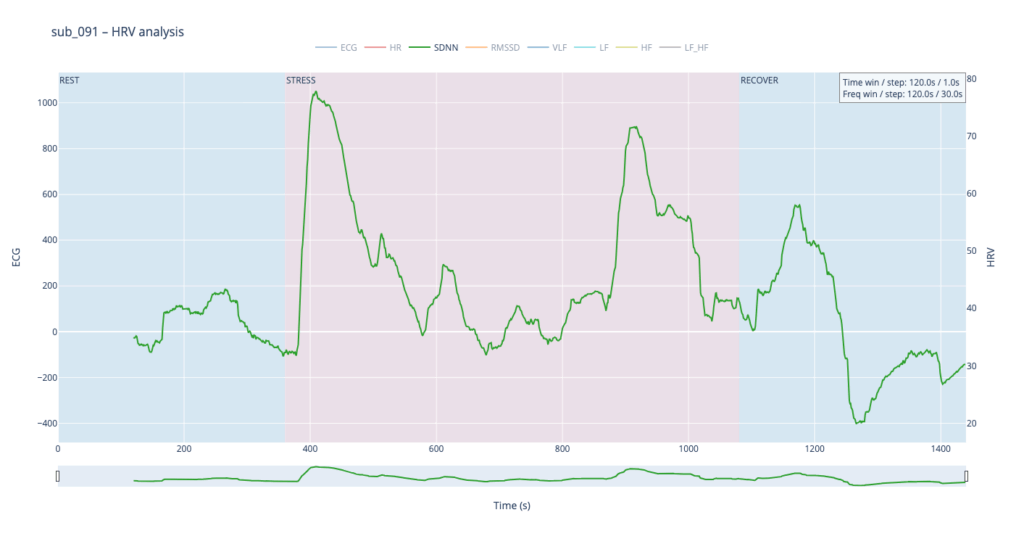
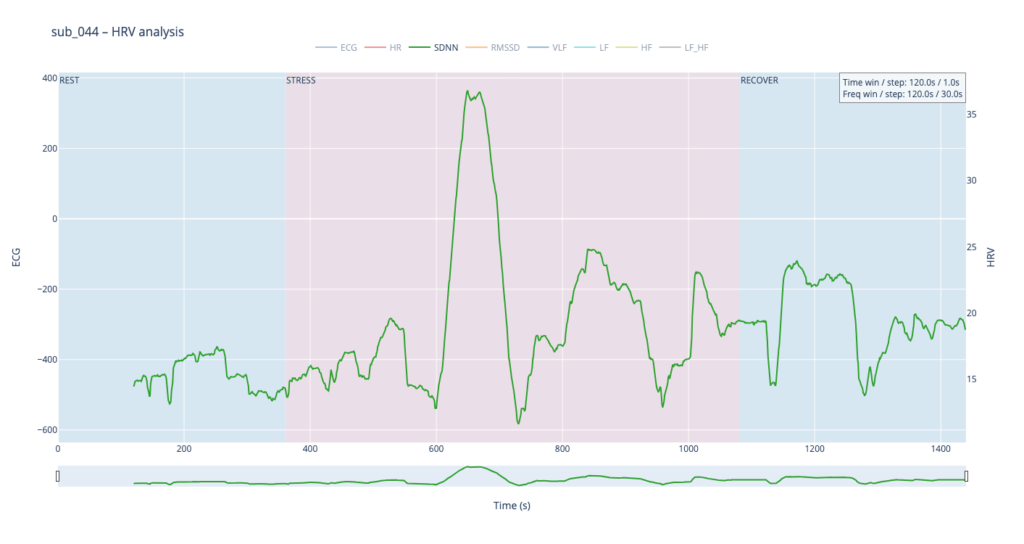
Looking at all four traces, the healthy control shows the widest SDNN swing and more frequent surges during the load phase. This wide dynamic range tells us the cardiac pacemaker is quick to loosen and tighten the rhythm, i.e. it adapts smoothly to the body’s changing needs. By contrast, the clinical subjects operate in a narrower corridor: their SDNN rarely strays far from baseline, signalling that the heart either remains compressed by chronic sympathetic tone or cannot recruit enough parasympathetic “slack” to respond fully.
For the sound-mapping layer, I’d like to add a short delay on the Drums track and control athe mount of feedback and reverb of echoes.
RMSSD
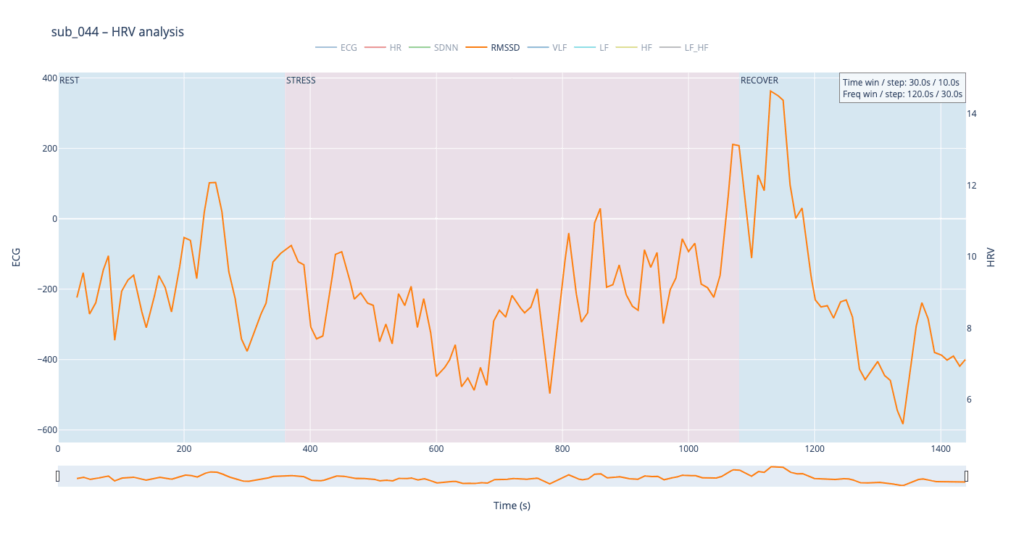
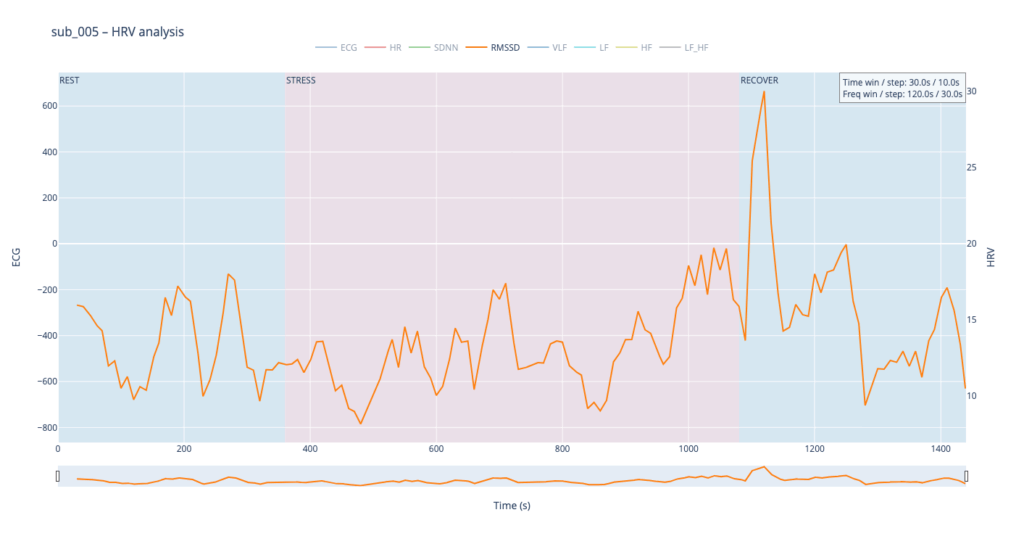
RMSSD is conceptually close to SDNN, but it is calculated as the square root of the mean of the squared differences between successive RR intervals. In essence, RMSSD captures beat-to-beat (“breath-by-breath”) variability, whereas SDNN reflects overall dispersion of intervals within the chosen window. Because of this local focus, we processed RMSSD in a shorter analysis window—30 seconds with a 10-second step—to obtain a curve that is smooth yet sensitive to rapid changes.
The comparative analysis reveals patterns similar to SDNN, with several noteworthy differences. First, in the clinical subjects, the RMSSD range is almost twice as narrow, indicating reduced high-frequency variability—the heart is working in a more “rigid” mode. Second, in both pathological cases, RMSSD rises noticeably toward the end of the protocol: once exercise stops, sharp spikes appear that are virtually absent in the healthy subject. This delayed surge suggests a late engagement of parasympathetic control—the body remains under sympathetic drive for a prolonged period and only during recovery tries to compensate, generating erratic, uneven intervals.
To highlight the heart’s “rigidity,” I plan to map RMSSD to the pitch shift of drums.
Spectral HRV analysis
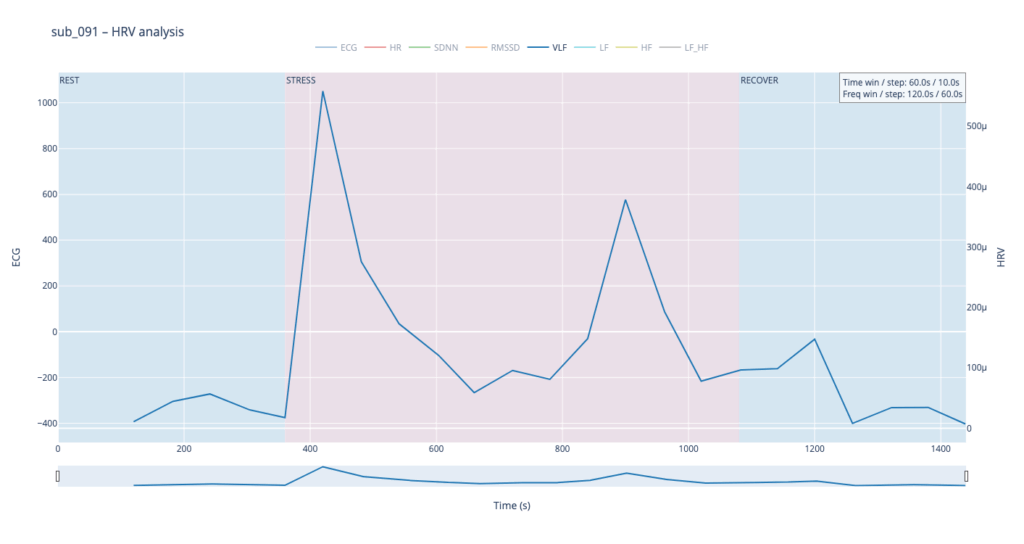
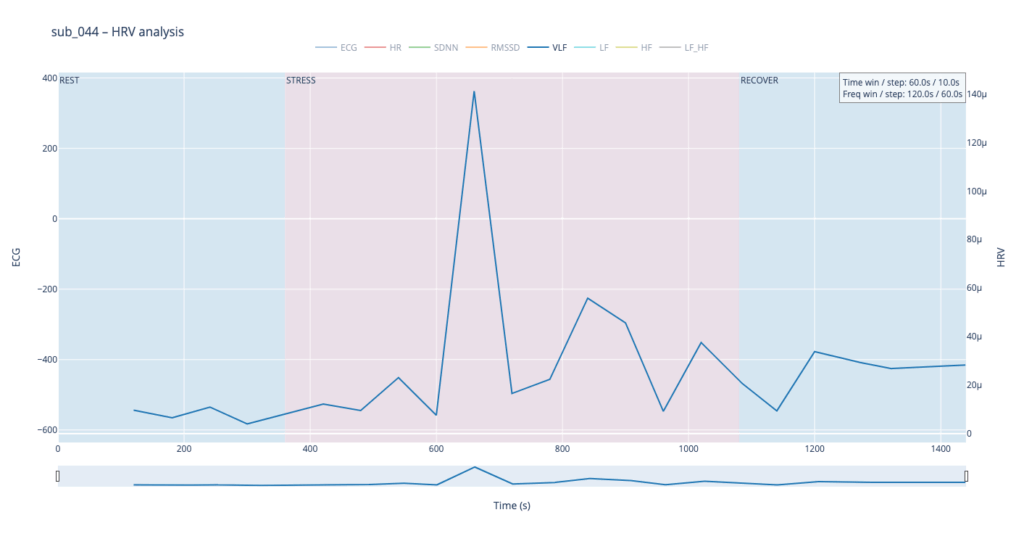
For spectral HRV analysis the gold-standard window is about five minutes, but in this project we need a compromise between scientific reliability and near-real-time responsiveness. We therefore use a 120-second window with a 60-second step.
VLF
Within such a short segment, the VLF band (0.003–0.04 Hz)—which is thought to reflect very slow regulatory processes such as hormonal release and thermoregulation—cannot be interpreted with the same statistical confidence as in traditional five-minute blocks. Even so, the plots still reveal that surges in VLF power tend to appear just before rises in heart-rate amplitude. In our context that timing may hint at micro-shifts in core temperature or other slow-acting homeostatic mechanisms that prime the cardiovascular system for the upcoming workload.
VLF → Sub-bass “body boil” layer We will map the slow-acting VLF band to a very low sub-bass drone in the first octave (≈ 30-60 Hz). As VLF power rises the pitch of this bass note is gently shifted upward by a few semitones and a subtle vibrato (slow LFO) is added. The result feels like liquid starting to simmer: higher VLF = hotter “water,” faster wobble, and a slightly higher fundamental. A pre-recorded low-frequency sample (e.g., pitched-down kettle rumble) can sit under the main mix; its playback pitch follows the same VLF curve to reinforce the sensation. When VLF falls, both pitch and vibrato relax, letting the bass settle back to its calm, foundational tone. This approach sonically frames VLF as the deep thermal undercurrent of the body.
LF & HF
Low-Frequency (LF, 0.04–0.15 Hz) and High-Frequency (HF, 0.15–0.40 Hz) power curves mirror the behavior we already saw with SDNN and RMSSD. That is perfectly logical: SDNN and LF both track activity of the sympathetic branch, which dominates under stress—heart rate accelerates, blood pressure rises, LF climbs. Conversely, HF and RMSSD follow the parasympathetic (“vagal”) branch: as the body relaxes, the heart slows, breathing deepens, and HF increases.
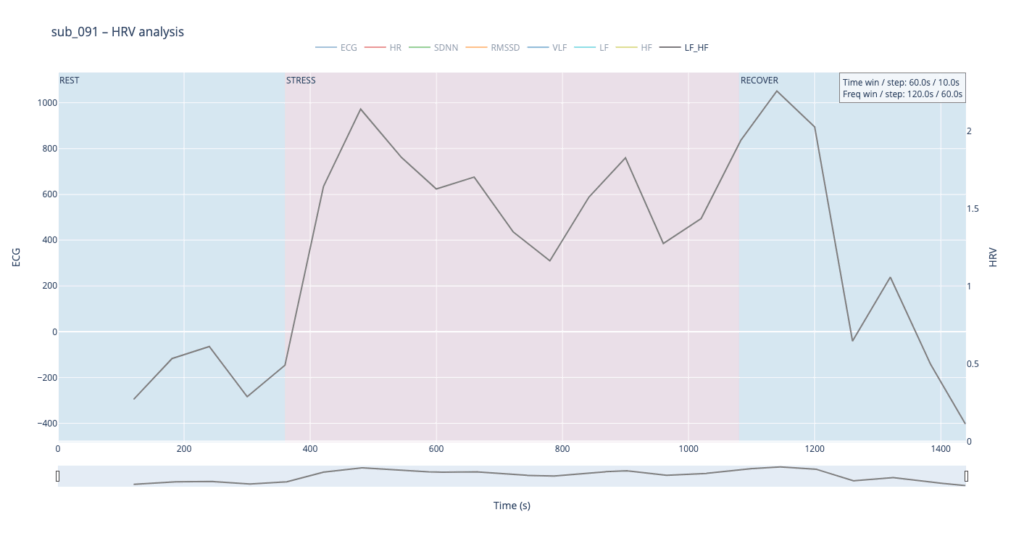
Patient 091 delivers a textbook illustration of that theory. At rest his HF overtops LF, but the moment exercise begins the autonomic balance flips—LF jumps above HF and keeps climbing, whereas HF rises more modestly and then drops back near the end, underscoring how hard it is for his system to settle.
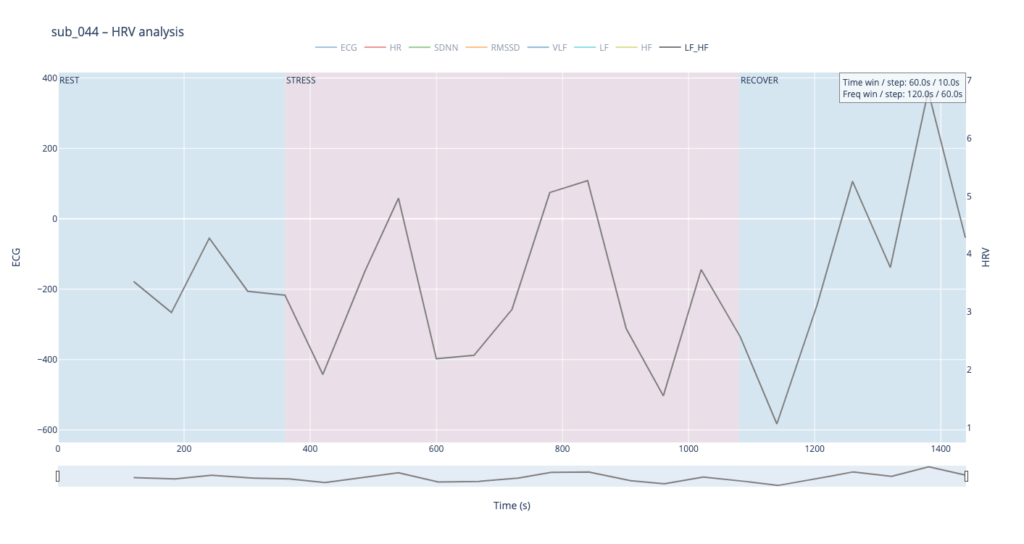
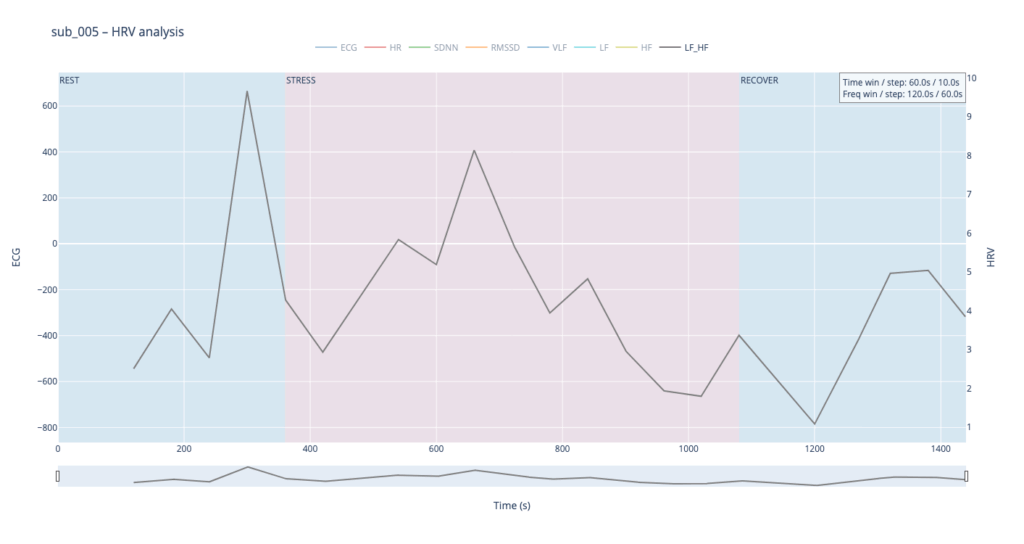
By contrast, our other symptomatic patients (044 and 005) show LF dominating HF throughout, signalling a chronically tense autonomic state.
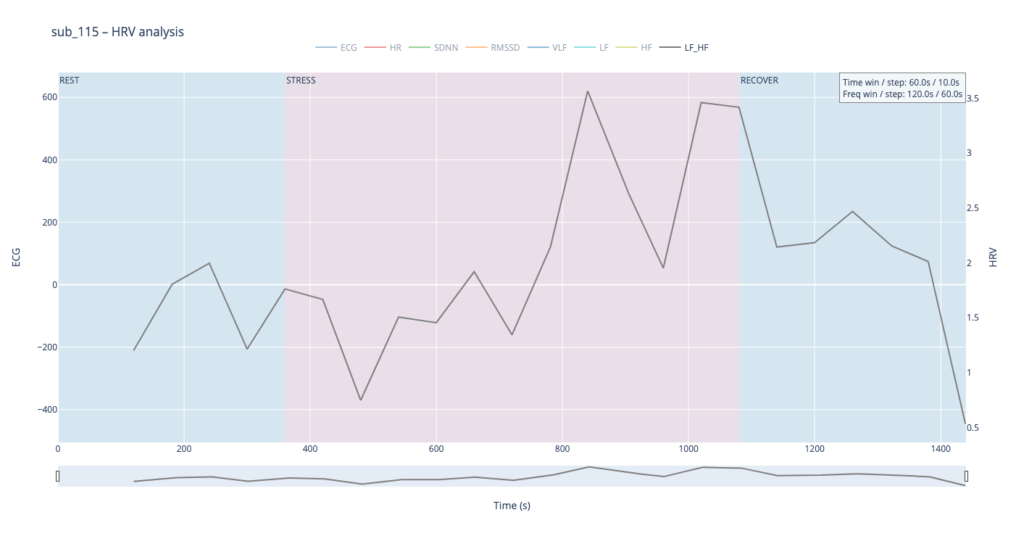
The healthy subject 115 starts with LF and HF almost equal; as effort mounts the gap widens in a smooth, orderly fashion.
Sonically, LF and HF make a natural complement to the VLF layer. We can map their absolute values to pitch in the second octave while using the LF/HF ratio to shape timbre—blending from a pure sine wave toward an edgier saw-like texture. When LF/HF is below 2, the sound stays near sine (calm, vagal tone); as the ratio exceeds 2, it becomes increasingly “saw-toothed,” evoking sympathetic arousal. Also, with this parameter, I would like to control the music scale from major to minor.
In practice, we see 115 and 091 resting in the neutral range and pushing upward only during exercise—the difference being that 115 ascends gradually, whereas 091 leaps. Both glide back to baseline once the task ends.
Patients 044 and 005, however, begin with ratios already high and jittering, telegraphing their persistent sympathetic load.
The next stage will be to develop an algorithm that converts these metrics into MIDI messages that can be mapped to parameters inside a DAW, or, alternatively, to build a SuperCollider or Pure Data patch implementing the same control scheme.