Semester Project – Doc Auto:Frei:Tag

The Idea

For this semester’s practical part of the course I decided to plan, film and edit a first, very short documentary-like video in preparation for my documentary project at the end of the Master’s. I want to analyse which steps have to be taken beforehand, how filming something like this might look like and what to keep in mind during the editing. Moreover, I wanted to streamline and optimise my filming setup as much as possible during this first “trial run”, given that I don’t know, how big of a crew I will have to support me for my final project. This means, seeing how much of the work I can do by myself and how to organise help for parts where I need it.
When trying to come up with a topic for the short documentary, I knew I wanted to focus on a group or organisation in Graz that inspires and interests me. This was when I remembered having been to 2 events in the past where people could come together, enjoy drinks and music, generally have a good time, and raise awareness of an important issue at the same time while listening to interesting speeches.

The Topic

Both of these events were held under the name “Auto:Frei:Tag”, which is exactly what the name suggests; an event on a Friday where one or multiple roads get blocked for car traffic and taken over by a small street-celebration. The organisation behind it supports individuals, shops or clubs wanting to organise their own car-free Fridays by providing posters, music, tables, chairs and much more. The idea of it all is to raise awareness to what our inner cities could potentially look like if they were not designed with mainly cars in mind. There is so much space in Graz’s inner city which could be used differently and organising events where this space is taken back, if just for one afternoon, shows how big the problem currently is and what a greener future might look like.

The First Steps

What I have done so far is reach out to the organisation, seeing if they would even be willing to collaborate with me for this project. I have also had a first meeting with some of the members, asking and answering questions about my plans and creating a rough framework as to what the final product might look like. I decided to keep the length of the video under 10min and to focus mostly on presenting what “Auto:Frei:Tag” even is and what they do, without going into too much detail on the issues behind it or trying to convince anyone to completely change their ways, as that would take up too much time in the video. This means that for my target group I have decided to focus mostly on young adults which already have a certain interest and awareness of sustainability topics and are open and willing to learn about new ways they can support certain causes and focus their energy and motivation.

Next Steps

During our meeting, I also got a lot of helpful input on possible sources for information on the topic and experts who might be interested in participating in my documentary. So for my next steps, I want to do some research on the topic of traffic politics in Graz as well as on some of the mentioned experts, as well as reach out to a few of them, asking whether they would be willing to give interviews on the topic.
I want to include interviews with one expert as well as one member of the organisation as well as interviews with visitors and participants of the Auto:Frei:Tag. Moreover, I want to film at one of the car-free Fridays. Due to the very loose organisational structure, these events are sometimes planned quite spontaneously and there is not one planned yet for this year. This means that for filming at an actual event I will still have to wait until I hear from them, but I can plan my shots beforehand as well as do research on the topic and plan and film interviews beforehand.
For my next blogposts I want to focus on researching the actual production process of a documentary film as well as do some research into the topic of my video in order to be able to ask the right questions.
2.1 Documentation & Reflection: Speed-Dating My Lo-Fi Prototype

Last semester, my research focused on how UX/UI design can make mental health apps more calming and accessible, and how AI can provide personalized, empathetic support. I explored micro-interactions, color psychology, and AI-driven emotional intelligence to understand what makes digital mental health tools effective.

This time, I wanted to explore physical, tangible interactions for well-being—something that doesn’t require a screen or notifications but still guides users toward emotional regulation.

The Three Prototypes

For this exercise, I created three lo-fi prototypes:

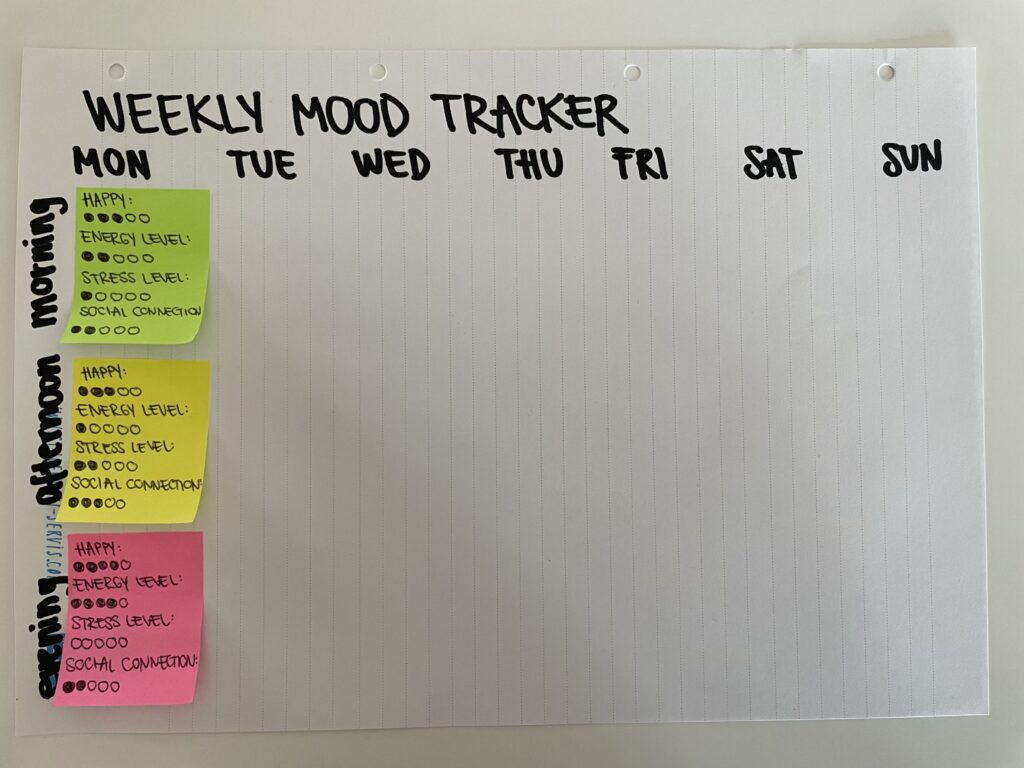
Weekly Mood Tracker: A simple, analog way to log emotions over the week using color-coded entries for easy reflection.

Self-Reflection Cards: A deck of prompts designed to encourage mindful self-exploration and emotional processing.

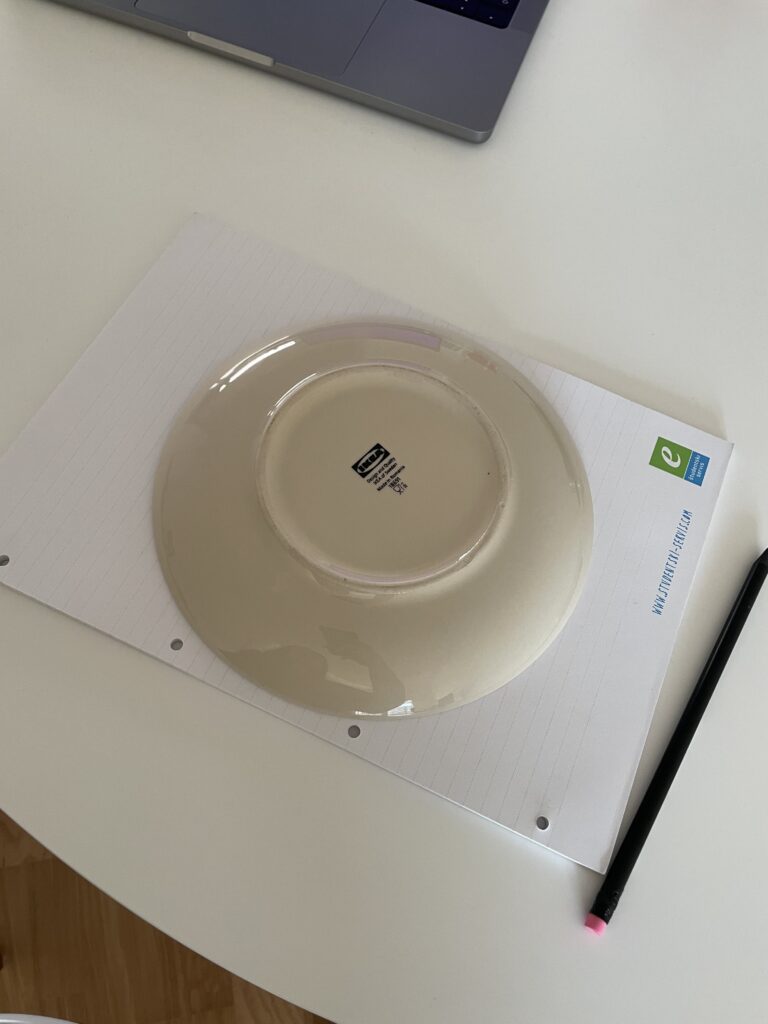
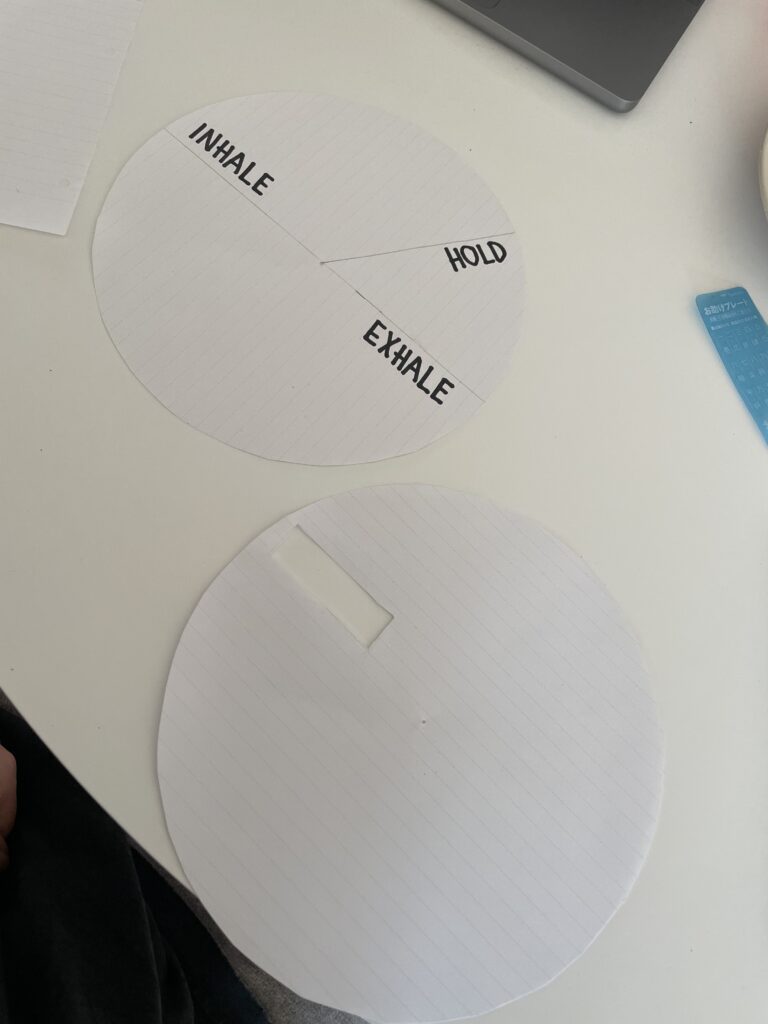
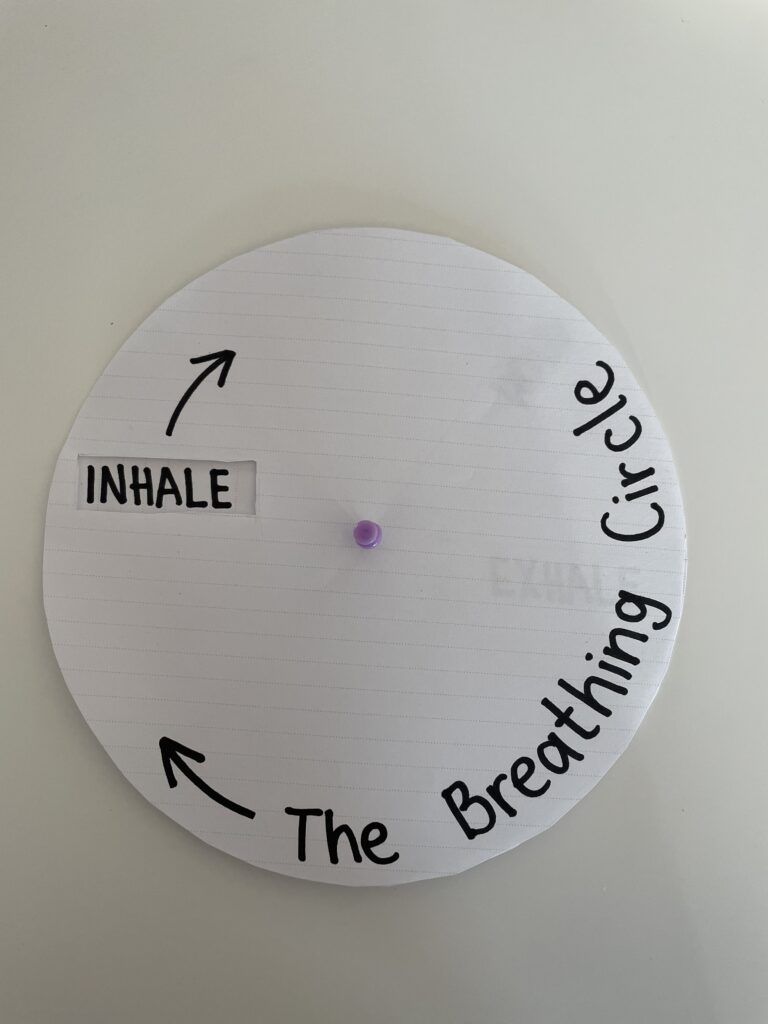
Breathing Circle: A guided breathing tool made of paper, where users rotate a circular element to synchronize their breath with a visual cue.

Choosing the Breathing Circle

While all three prototypes engage users in self-awareness and well-being, I chose to bring the breathing circle to class because it best embodies my research goal: designing interfaces that guide users toward calmness in a simple, intuitive way. Unlike mood trackers or reflection tools, the breathing circle introduces a hands-on, meditative experience that requires minimal effort—ideal for moments of stress.

Speed-Dating My Prototype

In class, we shared our prototypes in a Speed-Dating/Sharing session, presenting them to different classmates in quick succession. This was an exciting way to gather feedback and refine ideas. Some of the key insights from my classmates included:

  • Great for children in schools – One student noted that the breathing circle could be useful in classrooms, similar to a fidget gadget, helping children focus while also providing a calming mechanism.
  • Ideal for bedtime – Another student said they would love to use it before bed to relax, which sparked the idea of making the prototype more tactile with textures and even usable in the dark.
  • A minimalist, portable tool – Someone pointed out that, since it’s thin and can be small, it’s perfect for carrying on public transport or while traveling. Its minimalistic design keeps the focus solely on breathing, without distractions.
  • A sensory experience – A classmate suggested adding resistance to the movement (like a soft fabric hinge) to make turning it feel more grounding.

What is My Prototype Trying to Address?

The breathing circle is designed to address a key challenge in mental health support: how to create intuitive, low-effort tools for emotional regulation. Unlike mood-tracking apps or chat-based AI support, this tool is immediate and physical—it doesn’t require users to think, analyze, or type, just breathe. This prototype is particularly suited for:

  • Commuters and travelers – Its thin, compact design makes it easy to use on the go, whether on public transport, at an airport, or in a waiting room.
  • Children and adults needing focus – It can function as a calming fidget tool, helping with concentration in schools, workplaces, or even at home.
  • People looking for a screen-free relaxation method – No notifications, no distractions—just a simple, intuitive breathing guide.

Potential Features & Future Iterations

Based on the feedback, I’d love to explore:

  • Tactile Elements – Soft materials, textured surfaces, or raised patterns to enhance sensory engagement.
  • Glow-in-the-Dark or Low-Light Adaptation – So it can be used before bed without needing external light.
  • Personalization – Adjustable speed settings, so users can customize their breathing pace.
  • Elastic Resistance – Adding a slight resistance to the movement to make it more grounding and engaging.

If My Prototype Had a Dating Profile …

“Looking for a mindful moment? I’m a simple, no-fuss tool that helps you slow down and just breathe. I work best in quiet moments, whether you’re feeling stressed, anxious, or just need to unwind. Small, discreet, and always ready to help—swipe right for relaxation!”

Final Thoughts

This session reinforced how valuable it is to test even the simplest ideas. The breathing circle started as a basic paper prototype, but through conversation and iteration, it could evolve into something more immersive and widely useful. The feedback also reminded me that not all mental health tools need to be digital—sometimes, the most powerful solutions are the simplest, most tangible ones.

#2.01 Prototyping and Speed Dating

Recap from last semester

In my last ten blog posts I researched about loneliness and social isolation, focusing on how we as interaction designers can combat loneliness and how we can design for connection. I started by defining loneliness and social isolation, discussing how they are measured, and sharing statistics on who is most affected and their impact on mental and physical health. I then introduced the Theory of Third Places, and how important public spaces are for well-being and social connectedness. This led to an exploration of Human-Centered Design for public spaces and how interaction design can help shape these environments to encourage social interactions. Since a large part of our lives takes place online already, I want to take a more analog approach but still does not forego a digital aspect. This brought me to interactive installations and how they can strengthen social interactions in public spaces. I looked at how to design engaging interactive installations and key factors to consider ensuring people participate and connect with each other.


Prototyping

The first task in Design & Research 2 was to create three lo-fi prototypes, ideally linked to our Master thesis. To be honest, I am not sure if I want to continue with this topic for my Master Thesis, but for now my three prototypes are connected to it.


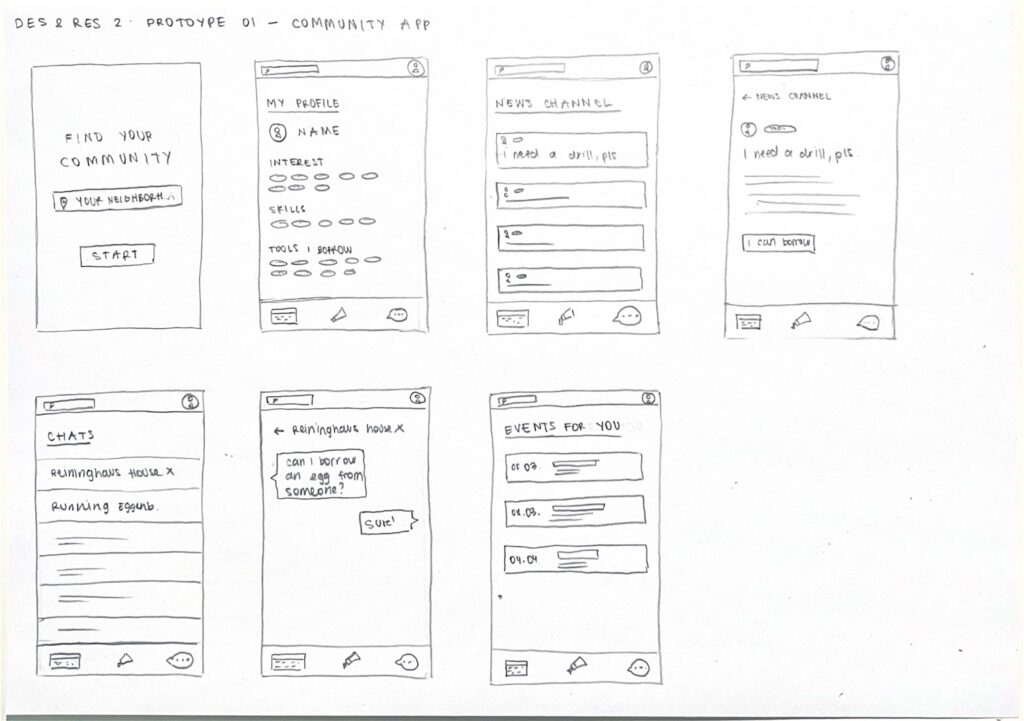
Prototype 01 – COMMUNITY APP

Although I wanted to take a more analog approach to the topic of loneliness, I wrote down all ideas that came to my mind and the first one was a community app. An app where you can connect with people in your neighborhood. You can find people with the same interests and hobbies, borrow tools you don’t own, arrange pet sitters while you are on vacation, get help with household repairs and discover local events.


Prototype 02 – SMART SOCIAL BENCH

A bench equipped with a small display that lights up when someone sits down, signaling an invitation for others to join. The display offers small conversation prompts such as “Tell me about your day” or “What’s your favorite song?” to encourage interaction. Additionally, a two-player mini games are included to further facilitate engagement and interaction.


Prototype 03 – INTERACTIVE INSTALLATION

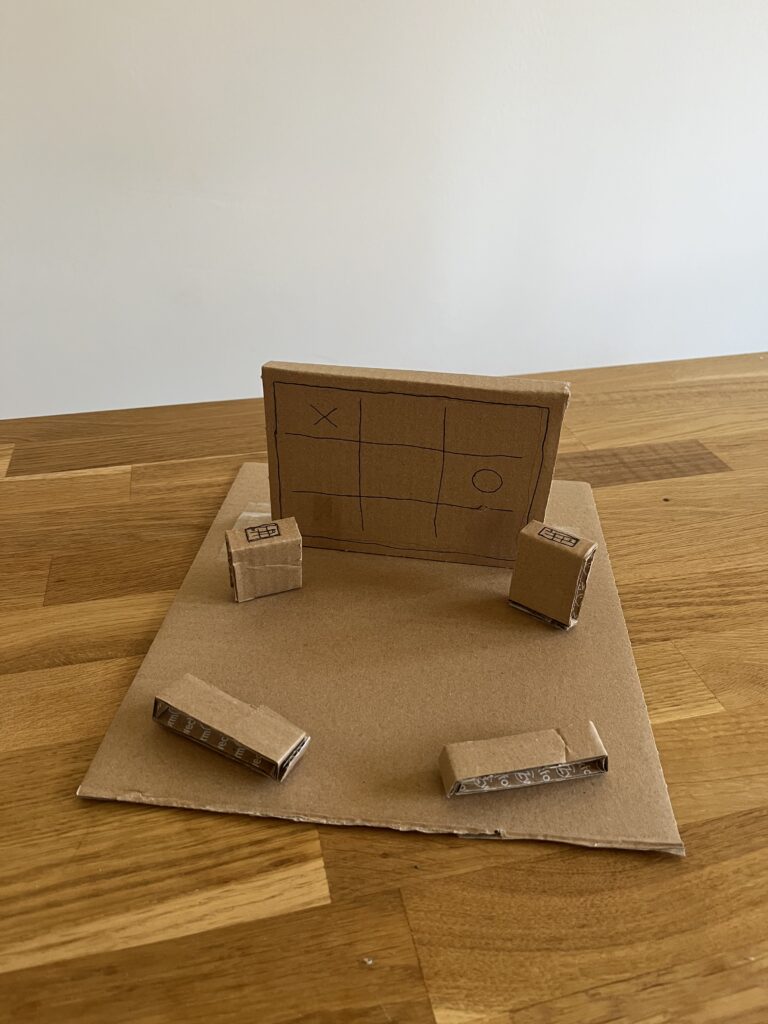
The last prototype is what I already thought about during the first semester – an interactive installation. A large screen installed in a public space, accompanied by two interactive tablets or screens that allow people to play mini games together, such as Tic-Tac-Toe for example. The setup is designed to encourage spontaneous social interactions among strangers or friends passing by. To make the space more inviting and inclusive, seating options are added nearby, providing a comfortable spot for people to watch the game, cheer on players, or even join in when a new round begins. This setup transforms the public space into a casual, engaging meeting point, fostering social connection through play and shared experiences.

Speed Dating

For the next class of Design & Research 2 we had to bring one of our prototypes. Since I already wrote about interactive installations, I brought my third prototype. We did a speed dating where we talked about our prototype with a different person every round to get more different insights, feedback and ideas. In the five rounds we got different task: guessing what the prototype was, suggesting additional features, describing it as if it is a dating profile, imagining a TED Talk about it, and reflecting about the most unexpected feedback.

Insights
  • Everyone I spoke with understood that my prototype is an interactive installation designed for two people to engage with each other.
  • One person suggested that instead of having a large screen with two control elements, I could use multiple small tables with built-in screens, allowing more people to interact rather than just two.
  • The description of the installation’s dating profile would be: Fun hanging out with.
  • Since I want to place the installation in a public space, I need to consider changing weather conditions and use waterproof materials. Additionally, the individual components should be securely built to prevent theft.

EP #4: The Future of Spatial Audio – Accessible, Crowdsourced, Real

The long-term vision of my project is simple:
– Record space.
– Upload it.
– Use it anywhere.

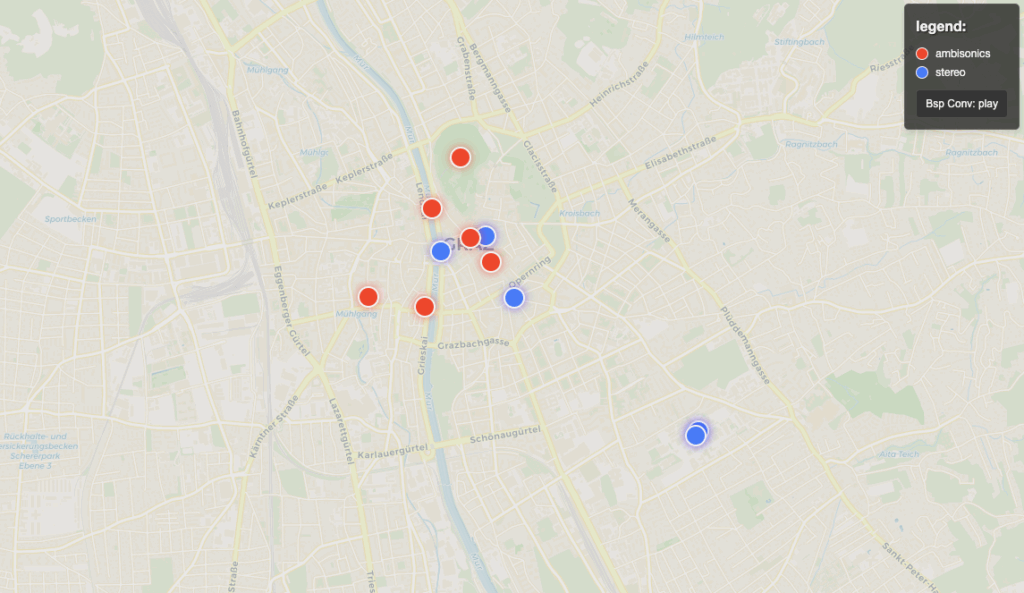
With enough participants, the Soundmap will become a searchable database of real-world acoustics – a kind of Google Street View for sound. Artists, researchers, and developers could then place sounds into acoustically true locations without ever going there.

Whether you want to preserve the sonic fingerprint of a historic building or make your VR app sound real, this approach makes spatial audio design more perceptual, democratic, and creative.

Just as photography changed how we see the world, acoustic photography could change how we hear it.

EP #3: Why Acoustics Matter – Designing Sound with Space

Most audio is designed in a vacuum – recorded dry and later drowned in artificial reverb. But what if we could design sound with real spaces in mind?

With my tool, I apply captured RIRs to original sounds, placing them into their authentic spatial context. A whisper in a cathedral, a guitar in a concrete stairwell, a voice in a silent forest – all can be recreated digitally and realistically.

This goes beyond fidelity – it’s about emotion, presence, and narrative. Sound design becomes site-specific. Just like film locations matter, so do acoustic locations.

Each space has a story to tell. I want to help sound designers listen to it.

EP #2: From Sweep to Space – How I Capture Room Impulse Responses

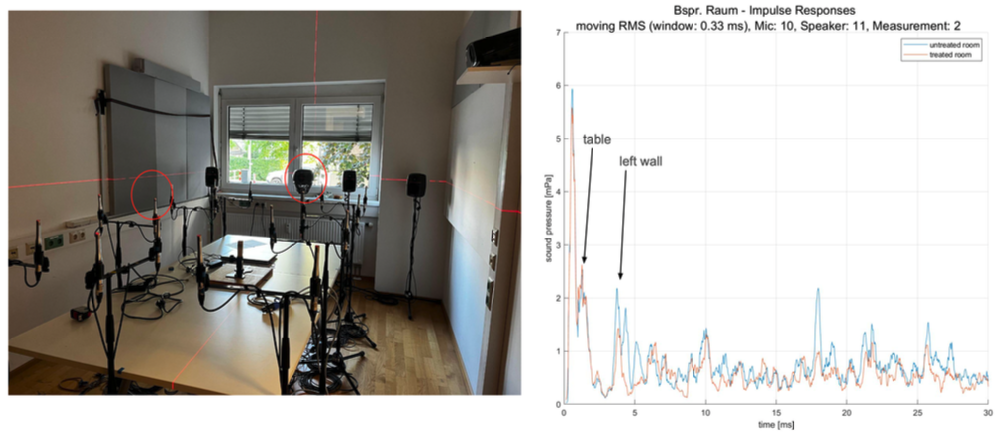
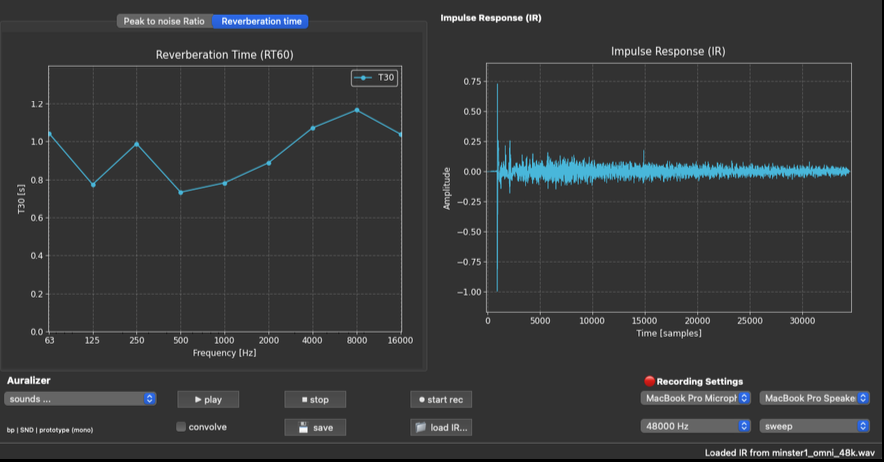
In my first prototype, I’m developing a mobile tool that turns a smartphone into an acoustic camera. Just clap your hands or play a short sweep tone – the reflections tell us everything about how sound travels in the space.

My app records these Room Impulse Responses in 360° using either basic stereo mics or, in the future, Ambisonics capsules. It then uploads the result, together with GPS coordinates, to a crowdsourced global Soundmap.

We’re not just mapping the world visually. We’re learning to map it acoustically.

This could democratize spatial audio for music, game audio, VR, and sound preservation.

Prototype Screenshot:

EP #1: Acoustic Photography – What If We Could Capture a Space?

Have you ever walked into a space and instantly felt its unique sound atmosphere?
Just like photographers capture the look of a space, we can now capture how a room sounds. My current research explores a concept I call acoustic photography – turning the complex echoes, reverberations and reflections of a room into a sonic “picture”.

Using a Impulse Response (IR) – an acoustic fingerprint of any environment – we can recreate its unique auditory qualities. With this, dry recordings can be placed into real acoustic environments using a method called convolution. The result? Audio that sounds like it was recorded in that space.

Interactivity in Music: How Listeners Become Part of the Performance

Music is often seen as a one-directional experience—composers create, performers interpret, and audiences listen. However, what if listeners could play a more active role in shaping the music they hear?

Movement as a Musical Element

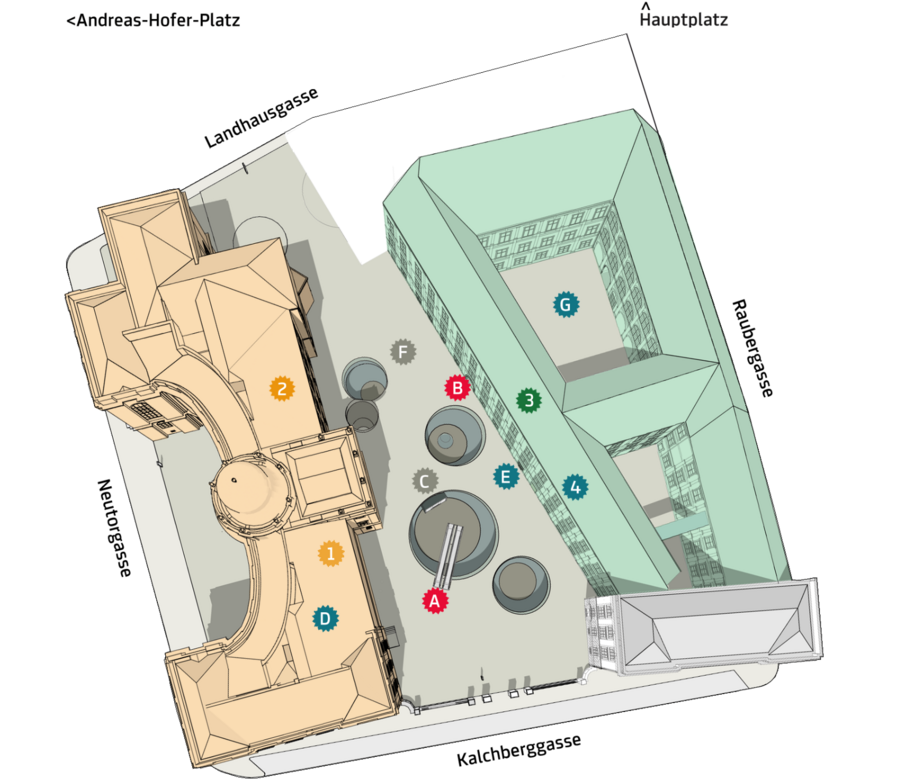
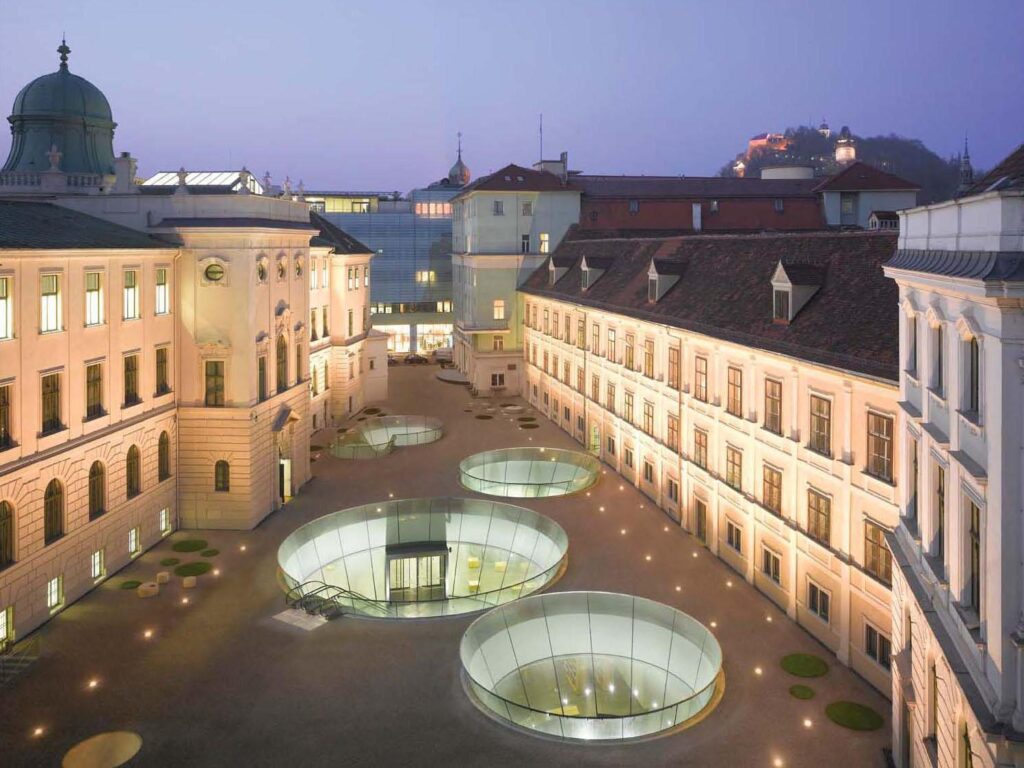
In conventional concerts, the audience remains stationary while sound moves towards them. In contrast, this project leverages the open public space of the Joanneum Quarter to allow the audience to move through different acoustic environments, making movement an essential part of the musical experience.

This already begins with the Joanneum Quarters being an open public space, people cross during there everyday-life. There is no literal gate-keeping, which allows people to enter end leave the place and therefore the musical piece, whenever they like or stumble upon it.

Further the architectural design of the Joanneum Quarter introduces natural delays and phasing shifts as sound waves bounce off its curved glass structures as well as from the surrounding walls. This means that a e.g. melody played in one location may sound different depending on where a listener is standing. And because of time delays the layering of melodies result differently at different locations. As audience members walk through the space, their perception of the music changes, creating a dynamic and personal auditory experience.

Creating immersion via interfaces

Beyond the organic interaction caused by movement, the project considers additional ways to involve audiences directly in the performance. One may be the installation of interfaces:

By incorporating technical solutions such as speaker controls or digital interfaces, visitors can influence the composition itself. Simple adjustments—such as modifying the volume of different speakers—allow participants to shape their own experience. A more complex approach could involve digital interfaces, such as iPads placed around the space, where participants can select different musical elements for each acoustic funnel, effectively curating their own version of the performance.

    Sources:
    “Joanneumsviertel,”accessed January 22, 2025, https://www.museum-joanneum.at/ihr-besuch/museen-standorte/joanneumsviertel.

    Sounds of the Joanneum Quarters

    Reimagining Concert Spaces: The Acoustic Landscape of Joanneum Quarter

    Music and spaces have always shared a deep and inextricable relationship. The way sound interacts with space transforms the listening experience. By playing with it consciously we are creating an immersive experience that goes beyond traditional concert settings. This is the core idea behind the “Sounds of the Joanneum Quarters Graz” project—an innovative approach to ambient music and concert formats that redefines how audiences engage with sound.

    The Vision: Transforming Public Spaces into Concert Venues

    The project explores how the spatial dynamics of the Joanneum Quarter in Graz can shape a unique musical experience. Unlike conventional concert halls with fixed seating and predictable acoustics, this public space presents a lively environment where sound can evolve organically. The goal is to break down barriers associated with classical concert settings by offering an open, interactive listening experience that invites both intentional audiences and casual passersby.

    Architectural Influence on Sound

    A key element of this project is the relationship between sound and architecture. The Joanneum Quarter is defined by its distinct conical funnels, made of curved glass with a silk-screen print that filters light. These architectural features create natural acoustic properties that influence how sound behaves within this space. By treating these funnels as integral instruments, the composition can interact with the environment rather than simply existing within it.

    There are two primary compositional approaches considered:

    1. Treating each funnel as an individual instrument, crafting site-specific musical material that resonates with the unique properties of each space.
    2. Creating soundscapes that work across all funnels, allowing listeners to move through the space and experience varied auditory perspectives.


    Sources:
    Nieto Sobejano, “Nieto Sobejano | Project | JOANNEUMSVIERTEL,” accessed January 19, 2025, https://nietosobejano.com/project.aspx?i=4&t=JOANNEUMSVIERTEL;