Level Up your Gains: Introduction

Gamification of Strength Training through Interactive Characters

Strength training has long been a staple of physical fitness, offering numerous benefits ranging from muscle growth to improved bone density. Yet, maintaining motivation and consistency in weightlifting or resistance exercises remains a challenge for many. While gamification has transformed areas like cardio and general fitness, it has yet to fully address the unique dynamics of strength training. This thesis seeks to explore how gamified elements, specifically through interactive characters, can be leveraged to make strength training not just effective, but genuinely engaging.

The Idea: A Virtual Companion for Progress

The core concept revolves around creating an app where users progress a virtual character—akin to a Tamagotchi—by completing strength training exercises. This character evolves or “levels up” in response to user efforts, offering a tangible and engaging representation of progress. By tying a user’s physical activities to the character’s development, the app introduces a compelling layer of emotional investment. Each completed set or increased weight becomes not just a personal achievement, but a meaningful step in the virtual companion’s journey.

This approach stands out in a market where most gamified fitness apps cater to cardio and conditioning. Fitocracy, for example, offers points and social leaderboards, while Zwift creates immersive cycling experiences. These platforms have proven the effectiveness of gamification but fall short of addressing the specific goals and mechanics of strength training. This thesis proposes to fill that gap by creating an experience tailored to lifters, where every rep contributes to the growth of their digital companion.

Research and Rationale

The motivational benefits of gamification are well-documented. Research highlights how incorporating game mechanics like competition, narrative, and rewards into fitness routines can enhance adherence. A study in the European Journal of Investigation in Health Psychology and Education found that gamified interventions helped individuals overcome exercise barriers by making activities more enjoyable. Despite this, the bulk of gamified solutions in fitness emphasize general physical activity or rehabilitation, leaving strength training underexplored.

Strength training, with its unique focus on progressive overload and structured routines, presents a distinct opportunity for gamification. Unlike cardio, which often relies on repetition and endurance, weightlifting requires incremental improvement and technical precision. These characteristics make it an ideal candidate for a game-inspired framework where users can see their progress reflected in both their physical capabilities and their virtual companion’s narrative.

Prototyping an Interactive Experience

The proposed app will include carefully designed feedback mechanisms to balance motivation with proper form and safety. The virtual character could evolve by gaining new abilities or defeating enemies as users achieve milestones, such as completing a personal best or mastering a new exercise. For instance, achieving a deadlift goal might unlock a “boss battle,” encouraging users to strive for consistent improvement. These mechanics will be accompanied by real-time feedback to ensure correct execution, helping users avoid injuries and maximize results.

The interplay between narrative and functionality is critical here. A compelling storyline tied to the character’s growth will not only keep users engaged but also create a sense of accomplishment that extends beyond the gym. This connection aims to shift the focus from viewing workouts as a chore to experiencing them as part of an interactive and rewarding journey.

Transforming Strength Training

By introducing gamified elements specifically designed for strength training, this project has the potential to redefine how people approach resistance exercises. The emotional and psychological investment in a virtual character offers a fresh perspective on fitness, turning a traditionally solitary activity into an engaging and interactive experience.

This thesis not only seeks to address a gap in the current landscape of fitness apps but also aspires to inspire further innovation in the gamification of physical health. Combining the science of strength training with the art of game design, the project lays the groundwork for a future where workouts are not only about results but also about enjoying the process.

Augmented- and Virtual Reality in Bouldering – Innovations and Case Studies

The integration of technology into sports has opened exciting possibilities, and AR and VR are transforming the world of bouldering. This blog post explores applications of AR and VR technologies, how they enhance performance, and ways how smaller climbing gyms can deliver interactive experiences similar to the MoonBoard, with little budget.


Current Applications of AR and VR in Bouldering

MoonBoard and Similar Systems
The MoonBoard is a standardized, interactive training wall equipped with an LED system controlled via an app. It connects climbers worldwide by offering identical routes regardless of location. The app features over 180,000 climbing problems, allowing users to track progress, compete globally, and refine their skills through structured training.

AR Guidance for Climbing
Augmented reality is used to project movement sequences or highlight optimal hold and foothold positions on climbing walls. Smart glasses, for instance, can show the best route in real-time, helping climbers—especially beginners—improve their technique and efficiency.

VR Simulations for Training
Companies like ClimLab are utilizing VR to create immersive training environments. These systems allow climbers to practice complex movements and scenarios, such as overhangs or challenging outdoor routes, within a safe virtual setting.


    How Technology Enhances Performance

    Data-Driven Training
    Wearables and sensor integration with AR/VR systems enable real-time analysis of movements, providing instant feedback on technique and performance. This data-driven approach helps climbers identify weaknesses and refine their skills effectively.

    Strength and Technique Improvement
    Tools like the MoonBoard and Tension Board use illuminated grips and data-backed training routines to build specific skills such as finger strength and endurance. These systems promote repetition and measurable progress, crucial for advanced climbing development.

    Gamification and Engagement
    AR/VR applications incorporate gamified elements, such as scoring for precise holds or timing challenges, to boost motivation. These features make training more engaging and enjoyable, encouraging climbers to push their limits.


      Creating a MoonBoard-Like Experience for Smaller Gyms

      Smaller gyms can leverage innovative, cost-effective technologies to replicate interactive training environments without significant investment:

      • Route Projection Systems: Affordable AR tools can project climbing routes onto walls, eliminating the need for physical LEDs.
      • Mobile Apps and Smart Holds: Bluetooth-enabled holds can be programmed to light up in specific patterns, offering flexibility and customization.
      • Localized Databases: A community-driven database of climbing problems fosters collaboration and provides tailored training opportunities.

      AR and VR are revolutionizing bouldering by enabling personalized training, fostering global connections, and making professional-grade tools like the MoonBoard more accessible. For smaller climbing gyms, creative solutions such as AR projections offer an exciting path to deliver interactive and motivational training experiences. As AR/VR technologies continue to advance, climbing may soon evolve into a hybrid reality, seamlessly blending the physical and digital worlds.

      02 The Bias Blindspot

      In my last blogpost, I linked a survey, which sadly no enough people answered, but what was it all about? I wanted to test something I read about while researching for my first blogpost: The bias blindspot. Explained simply this means, that we detect biases easier than in ourselves. Sadly not enough people took part, so I can’t make any assumptions on our study program. Still this is an important topic to talk about, this can pave the way for us to understand biases better and learn how to overcome their influence.

      What is the Bias Blindspot exactly?

      People are mostly unaware of their own biases, although they can easily detect them in the judgement of others. They tend to believe that they are less biased than their peers. There are many examples of this, that you will surely recognize, maybe you have already been in a similar situation before. If you ask physicians if gifts from pharmaceutical companies would influence their decision about what medicine they prescribe, most claim that they would not be influenced by this. If you turn the question around and ask if they think, other physicians would be influenced by gifts, most will agree. This disparity can occur in many different types of judgements or decisions. (cf. CMU)

      A study found that only one out of 661 adults said, that they were more biased than the average person, all other 660 were sure, that they are less biased than the average person. In addition most people have no idea, how biased they actually are but are sure people around them are more biased than themselves. There is a good reason to why this happens, since society teaches us from a young age, that being biased is bad, we don’t want to see ourselves as people, who do bad things.(cf. IxDF)

      The bias blindspot is a combination of two mental short cuts, the “introspection illusion” and “naive realism”. (cf. Scopelliti, Irene Scopelliti et. al.; pos. 1-2) The “introspection illusion”, says, that we tend to rely on our own thoughts and memories, when we think about whether we are biased or not. Although this introspection doesn’t reveal subconscious factors that are influencing us. (cf. Renascence) “Naive realism” describes, that we think we see the world how it is, without any distortion, although this is most likely not true. We underestimate the possibility that we are fooling ourselves. (cf. Medium a)

      What is the influence of a Bias Blindspot?

      The biggest problem of the bias is, if we operate within our blindspot, we are less likely to accept input from our peers and/or experts. In addition, we are less likely to benefit from education and training concerning our particular biases. (cf. IxDF) Not only that but we will underestimate the influence of our own biases, which can lead to skewed design decisions, that fail to cater to diverse user needs. Mitigating biases is essential to gain reliable insights into user behavior and preferences. (cf. Medium b)

      So this means for UX Design, this means, that if we fail to learn about flaws in our design, we can’t create an experience that truly caters to the users needs. We might even make mistakes over and over again.

      How can we overcome the Bias Blindspot?

      First things first, overcoming bias is hard and takes a lot of work and self reflection. To overcome the bias blindspot is to be aware that it exists and it influences a lot of our decisions. Then to truly overcome the bias blind spot, UX designers have to engage in self-reflection, constantly challenge assumptions, and foster an open and inclusive design process. (cf. IxDF, cf. Medium b)

      This is quite complex, and I want to give the topic of overcoming biases the room, that it deserves. There will be a follow up post about this topic.

      Thanks for reading through my blog! 
      Leave a comment, if you are interested in this topic and tell me what you want to read about next! ;P

      Fun Fact

      While writing this blogpost, I realized, that I thought to myself: “That could never happen to me.”, a second later, I realized, that this was exactly what was going on. So even if you are aware that something like this exists, you will fall into your own traps, over and over again.

      by me (using imgflip-MemeGenerator)

      Latest Trends in Automotive UX Design

      As the automotive industry experiences a digital transformation, user experience (UX) design is becoming a key factor in shaping the way drivers and passengers interact with vehicles. Modern vehicles are no longer just vehicles, but are transforming into connected, intelligent spaces that integrate seamlessly into our digital lives.

      Personalisation and integration of artificial intelligence

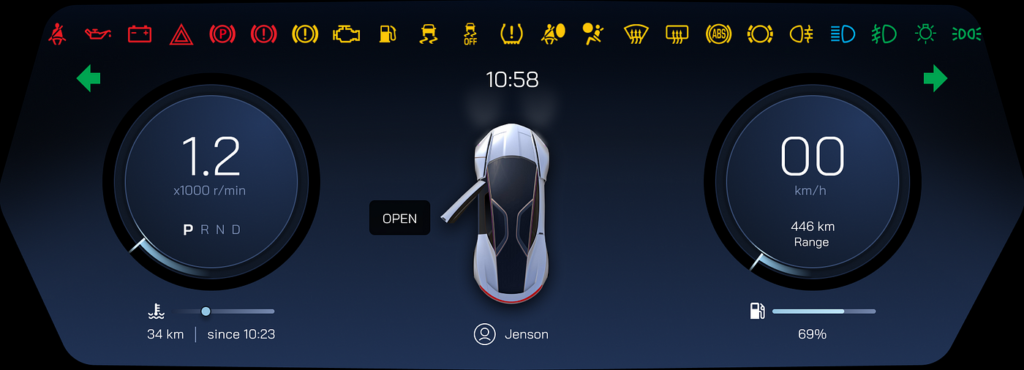
      One of the most significant UX trends in the automotive industry is the rise of personalisation, which is driven by artificial intelligence (AI) and machine learning. Vehicles are now adapting to individual user preferences and offering tailored experiences that enhance comfort and convenience. Everything from seat positioning and climate control to in-car entertainment and driving modes can be automatically adjusted based on user profiles. Predictive technologies are also becoming more prevalent, with systems suggesting routes, stops or even adjusting settings based on previous behaviour.

      (source: https://nix-united.com/blog/ai-in-automotive-a-new-edge-of-the-automotive-industry/)

      Augmented reality (AR) and immersive displays

      Augmented Reality (AR) is bringing a major innovation to vehicle interfaces by overlaying digital information onto the real world. AR heads-up displays (HUDs) project navigation instructions, safety alerts and vehicle diagnostics directly onto the windshield, allowing drivers to focus while receiving important information. This trend improves safety and convenience by providing real-time data without distracting the driver from driving.

      (source: https://iot-automotive.news/huawei-ar-hud-debuts-at-iaa-mobility-2021-delivering-a-new-driving-experience/)

      Voice assistants and natural language processing

      Voice assistants using advanced natural language processing (NLP) are becoming a central feature of the in-car experience. These systems allow drivers to control various functions – such as navigation, media playback or even air conditioning – hands-free through spoken commands. This trend not only improves safety by reducing distractions, but also makes interactions more intuitive. AI-powered voice assistants can also integrate into natural conversations, making driving more enjoyable.

      (source: https://www.theturnsignalblog.com/guidelines-for-designing-an-in-car-voice-assistant/)

      Entertainment and games in the car

      The concept of cars as entertainment centres is gaining popularity. With the rise of high-speed connectivity and advanced infotainment systems, passengers can now enjoy streaming services, multiplayer games and even immersive virtual reality experiences while driving. Some vehicles now feature large displays for backseat passengers or even integrate gaming platforms into the car’s ecosystem. This trend is turning long commutes or car journeys into immersive experiences for all passengers.

      (source: https://www.audi-mediacenter.com/en/press-releases/holorides-cutting-edge-in-car-entertainment-platform-launches-for-select-audi-models-15004)

      References:

      https://medium.com/@sreelakshmis.dilip/exploring-the-latest-trends-in-automotive-ux-a39ec4f9e95c

      https://medium.com/@yujdesigns23/steering-into-the-future-ux-trends-reshaping-the-automotive-sector-2b45d9d56fd7

      https://jobya.com/library/roles/kI6swA4r/vehicle_user_experience_researcher/articles/kI6swA4r_future_of_vehicle_UX

      https://digitalcreative.cn/blog/latest-automotive-hmi-design-trends

      UX/UI Challenges in Designing for Autonomous Vehicles

      The rise of autonomous vehicles has brought about a new era of user experience (UX) and user interface (UI) design in the automotive industry. As cars become smarter and more connected, the role of UX/UI designers is evolving to meet the demands of a future where vehicles drive themselves. This evolution presents both opportunities and challenges, particularly in how designers can create interfaces that are intuitive, safe and engaging for users who are no longer in full control of the vehicle.

      Balancing Automation and User Control

      One of the main challenges in designing autonomous vehicles is finding the right balance between automation and user control. Modern vehicles are already equipped with sensors, cameras and voice commands to help drivers with tasks such as parking or navigating traffic. However, once cars become fully autonomous, users will need to both trust the vehicle’s systems and feel that they have some control over them. This requires designing interfaces that clearly communicate the vehicle’s actions and intentions to the user.

      For example, when a car is about to change lanes or turn, the interface should provide clear visual or audible signals to inform the user. The challenge is to ensure that these notifications are not overwhelming or distracting, but still provide enough information to maintain confidence in the system.

      (source:https://dac.digital/the-future-of-autonomous-vehicles-and-autonomous-machines/)

      Managing Data Overload

      With autonomous vehicles generating huge amounts of data – from real-time traffic information to vehicle diagnostics – effectively managing this information is another key challenge for UX/UI designers. Modern cars have evolved into powerful computers on wheels that are capable of handling both internal and external data. Designers must create interfaces that present this data in an understandable way without overwhelming the user.

      This is particularly important for safety-related information. For example, if an obstacle is detected on the road ahead, the system must alert the user in a clear and well-timed way. At the same time, less important information such as entertainment options or air conditioning settings should be easily accessible but not distracting.

      (source:https://uxdesign.cc/data-overload-is-a-design-problem-bcdb76e3cd6c)

      Creating Emotional Connections Through Design

      In addition to functionality, car UX/UI design must also focus on creating emotional connections between users and their vehicles. Today’s customers expect their car’s interface to be visually appealing and reflect their personal style. This means designers must consider not only how the interface works, but also how it looks and feels.

      For example, customisable dashboards that allow users to choose colour schemes or display layouts can help create a more personalised driving experience. In addition, seamless integration with smartphones and other devices can strengthen this connection by allowing users to bring their digital experience into the car.

      Ensuring security and trust

      Safety remains a top concern in the design of autonomous vehicles. Advanced driver assistance systems (ADAS) such as adaptive cruise control and automatic parking help drivers get used to semi-autonomous functions. Fully autonomous vehicles, however, will require even more trust from users.

      Designers must ensure that interfaces are not only easy to use, but also reliable. For example, if an autonomous vehicle meets an unexpected situation – such as a crosswalk – the system must clearly and confidently communicate its response to avoid confusion or panic.

      (source:https://xorance.com/advancements-in-autonomous-vehicles-and-their-impact-on-transportation/)

      Literature:

      https://www.foundry.com/insights/design/smart-cars

      https://ordergroup.co/resources/article-business-and-technical/what-are-the-UX-and-Ul-challenges-in-the-automative-industry/

      https://blog.sasken.com/addressing-the-trends-and-challenges-in-designing-automotive-ux

      https://www.uxblog.com/user-experience-in-the-automotive-design-world/

      #02 Key factors influencing the energy and environmental impact of digitalisation.

      1. Growth of data centers and cloud computing

      Data centers are the base of the internet, powering everything from streaming platforms like Netflix to cloud services like Google Drive. These facilities require immense amounts of energy to store, process, and transmit data. According to the International Energy Agency (IEA), data centers account for 1% of global electricity demand, a figure expected to grow with the rise of cloud computing.

      Events like the COVID-19 pandemic accelerated cloud adoption, as companies and individuals transitioned to remote work, leading to an explosion in virtual meetings, file sharing, and cloud storage. For example, Microsoft reported a 775% increase in demand for cloud services in some regions during 2020. While major providers like Amazon Web Services (AWS) and Google are investing heavily in renewable energy, the rapid growth of cloud usage continues to challenge sustainability efforts.

      https://engineering.fb.com/wp-content/uploads/2018/05/data-center-shot.jpg

      2. Video streaming boom

      The increase in video streaming has become one of the largest contributors to online energy consumption. Services like Netflix, YouTube, and TikTok account for over 60% of internet traffic worldwide.

      The release of high-profile events—such as Netflix’s “Squid Game” debut in 2021—demonstrates the scale of the issue. During its first four weeks, the series was streamed for 1.65 billion hours, consuming massive amounts of energy in data processing and transmission. These statistics underline the need for platforms to optimize streaming technologies and encourage users to adopt sustainable viewing habits, such as lowering video resolution where possible.

      https://www.marca.com/en/lifestyle/tv-shows/2021/10/01/6157178546163f62728b45ae.html

      3. Expansion of internet-connected devices (IoT)

      The rise of Internet of Things (IoT) devices is a big deal. From smart speakers like Amazon Alexa to fitness trackers and smart thermostats, these gadgets are everywhere. By 2025, there could be 75 billion IoT devices worldwide, a massive jump from just 8 billion in 2017.

      This boom in connected devices means more electricity use and more e-waste. Each device needs rare earth metals, complex manufacturing, and constant power, all adding to the carbon footprint of our digital world. Plus, the rollout of 5G to keep these devices running smoothly has pushed energy demands even higher with the need for more infrastructure.

      4. Cryptocurrency mining

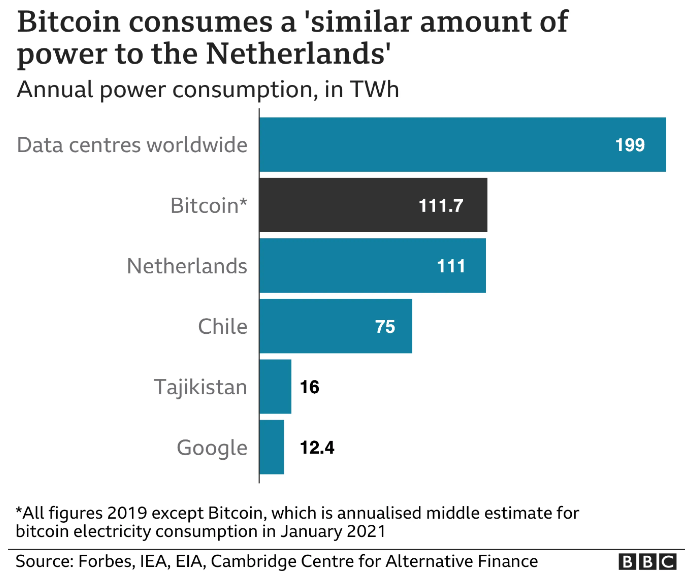
      Cryptocurrency mining, particularly Bitcoin, is one of the most energy-intensive activities in the digital space. Bitcoin mining alone consumes more electricity annually than entire countries like Argentina, with estimates placing its energy usage at 121.36 terawatt-hours (TWh). Fun fact – The Eiffel Tower uses about 7.8 GWh annually to light up and operate. With 121.36 TWh , you could power the Eiffel Tower for over 15,500 years.

      https://www.bbc.com/news/science-environment-56215787

      5. AI and ChatGPT

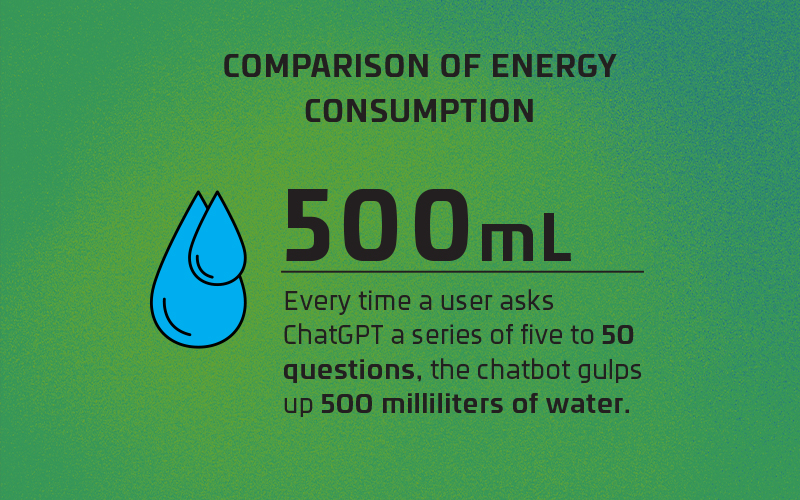
      AI systems like ChatGPT have a significant environmental footprint, driven by their high energy consumption. Each ChatGPT request uses about 2.9 watt-hours of electricity, which is ten times the energy required for a Google search (0.3 watt-hours). With 100 million weekly users sending around 15 prompts each, ChatGPT’s yearly energy use totals approximately 226.82 million watt-hours—enough to charge over 3 million electric vehicles or meet the energy needs of several small countries. Developing these AI models is also resource-intensive, training GPT-4 consumed more than 62 million kilowatt-hours, costing $8.2 million in electricity alone. These figures highlight the need for innovation in energy-efficient AI systems and a shift toward renewable energy sources. Balancing the rapid advancement of AI with environmental sustainability is becoming increasingly important.

      https://wired.me/science/energy/ai-vs-bitcoin-mining-energy/

      Resources:

      https://www.cloudzero.com/blog/tech-carbon-footprint

      https://www.fdmgroup.com/news-insights/environmental-impact-of-digitalisation

      https://wired.me/science/energy/ai-vs-bitcoin-mining-energy/

      https://www.researchgate.net/publication/358794471_Carbon_Footprint_of_The_Most_Popular_Social_Media_Platforms

      #01 The Hidden Cost: Does the energy footprint of digital/online spaces matter?

      When we think of the internet, we often imagine a clean, limitless, and weightless space. It’s easy to forget that every Google search, YouTube video, or Instagram scroll has a physical cost, one that’s measured in energy consumption and carbon emissions. Unlike the cars we drive or the factories we see, the internet’s energy footprint is invisible, which makes it all the more important to understand and address.

      Understanding the impact

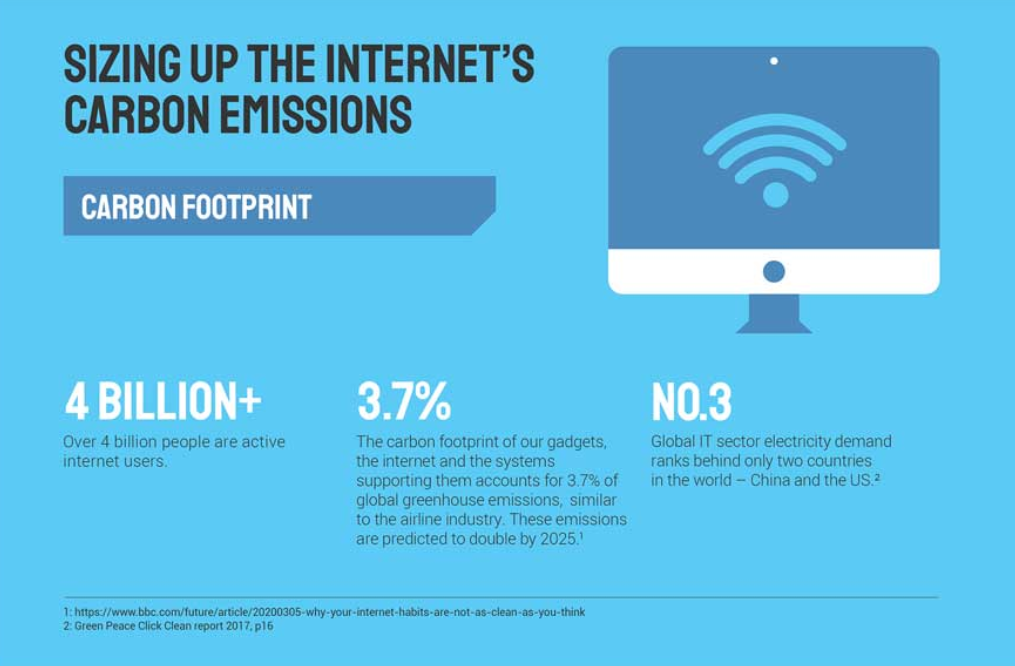
      Every online activity requires energy. For instance, streaming a standard-definition video for one hour generates approximately 36g of CO2, while high-definition streaming nearly doubles that to 86g of CO2. Multiply this by the millions of users streaming videos every second, and the environmental price becomes suprising. ClimateImpact’s infographic reveals that the internet’s carbon footprint is comparable to that of the airline industry—a sector notoriously known for its environmental impact.

      Beyond streaming, other seemingly trivial actions also contribute to this growing footprint. Sending an email with a large attachment, conducting a simple Google search, or saving files in cloud storage might feel inconsequential, but they all require energy-intensive processes that add up over time.

      The carbon footprint of the internet, Infographic

      The carbon footprint of the internet, Infographic

      Exposing the unnoticed energy footprint

      The challenge lies in the invisibility of the internet’s environmental impact. Unlike smog-filled skies or plastic-littered beaches, the energy footprint of digital spaces is hidden behind sleek user interfaces and seamless connectivity. This lack of visibility makes it harder to create a sense of urgency or inspire change.

      One potential solution, is the growing concept of “app sobriety.” This approach emphasizes the design of apps and websites that are lightweight, energy-efficient, and mindful of users’ time and data consumption. By optimizing digital products for efficiency, developers can significantly reduce the energy demands of everyday online activities. Application and website design can have a direct impact on reducing the ecological footprint of digital spaces, from simplifying user interfaces to minimizing background processes that consume unnecessary energy.

      Additionally, the debate between digital and paper-based communications is evolving. It’s not always clear whether digital is more environmentally friendly than paper. While digital platforms save resources like paper, they come with their own hidden energy costs in the form of data storage and the energy used to maintain vast digital infrastructures. The key is efficiency—both in how we design our digital systems and how we manage our data.

      https://www.inxsoftware.com/wp-content/uploads/2023/08/Blog-Image-Template-paper-vs-digital-1.webp

      Why Should We Care?

      As the internet continues to grow, so too does the environmental impact. The rapid expansion of cloud computing, the rise of video streaming, and the surge in online gaming and virtual meetings have all contributed to an increase in the demand for data storage and transmission. In fact, recent studies have shown that digital technologies are responsible for a significant portion of global carbon emissions. Therefore, it’s crucial to address these issues head-on and implement solutions that minimize the negative impact of our growing digital dependence.

      The internet is no longer just a tool for communication, it’s a complex ecosystem that supports everything from e-commerce and social media to education, healthcare, and entertainment. Yet, as we continue to rely on digital technologies, we must consider the toll these innovations take on our planet.

      How design could help to raise awareness of this issue?

      Design can play a transformative role in raising awareness of the hidden energy footprint of digital spaces by making the invisible visible and inspiring actionable change.

      Through visually compelling tools like infographics and real-time dashboards, it can translate abstract data into understandable insights. Eco-feedback embedded in interfaces, such as showing the carbon impact of streaming options, encourages greener choices. Gamification and educational prompts can nudge users toward sustainable habits without disrupting their experience. Minimalist, energy-efficient design styles not only reduce consumption but also serve as a blueprint for sustainable digital practices.

      Additionally, designers can collaborate on impactful awareness campaigns using social media and interactive exhibits to spotlight this often-overlooked issue. By blending education, creativity, and technology, design has the power to drive both awareness and behavioral shifts toward a more sustainable digital future.

      Researching the energy footprint of digital spaces comes also with several challenges.

      Data Availability and Accuracy

      Reliable and comprehensive data on the energy consumption of digital activities and infrastructure can be hard to find, as much of this information is proprietary or estimated.

      Complexity of Digital Ecosystems

      The interconnected nature of servers, devices, and networks makes it challenging to pinpoint the exact energy costs of specific actions, such as sending an email or streaming a video.

      Rapid Technological Changes

      The fast-paced evolution of technology means that data and findings can quickly become outdated, requiring ongoing monitoring and updates.

      Lack of Awareness or Priority

      Many companies and users, may not recognize the importance of addressing the internet’s energy footprint, which can limit access to resources or support for research.

      Comparative Analysis Difficulties

      Evaluating the environmental impact of digital solutions versus traditional methods (e.g., digital versus paper) often involves complex trade-offs and assumptions, making it hard to draw clear conclusions.

      In the upcoming blog posts, I will describe in more detail the selected problem and its possible solutions by design.

      Resources:

      https://www.readings.com.au/news/an-extract-from-the-dark-cloud#

      https://www.bbc.com/future/article/20200305-why-your-internet-habits-are-not-as-clean-as-you-think

      https://www.climateimpact.com/news-insights/insights/infographic-carbon-footprint-internet

      https://except.eco/knowledge/is-digital-more-environmentally-friendly-than-paper

      01 – Understanding Data Collection: What’s Tracked and Why It Matters

      Introduction: The Hidden World of Data Collection

      Every time you shop online, scroll social media, or use apps, you leave behind a trail of data. But what’s being collected, and why does it matter? In this post, we’ll break down the basics of data collection, why companies track you, and how ethical design can help make these processes more transparent.

      What Data Is Being Collected?

      The types of information collected about you often fall into two main categories:

      1. Personal Information:
        • Data you actively provide, like your name, email, or payment details.
        • Example: Signing up for a streaming service.
      2. Behavioral Data:
        • Your browsing habits, app usage, and even geolocation.
        • Example: An online store tracking your clicks to recommend products.

      How Is Your Data Collected?

      Cookies:

      • First-party cookies personalize experiences (e.g., saving your cart).
      • Third-party cookies track you across sites for advertising.

      Device Fingerprinting:

      • Websites identify your device through unique configurations like screen resolution or browser settings.

      Social Media Plugins:

      • Share buttons on websites let platforms like Facebook track your activity.

      Why Do Companies Collect This Data?

      While companies use data for personalization, advertising, and product development, this raises ethical concerns:

      • Lack of Transparency: Most users don’t understand what’s collected or how.
      • Security Risks: Data breaches can expose sensitive information.
      • Informed Consent: Legal jargon in terms of service often obscures what users are agreeing to.

      How can ethical design make data collection more transparent and user-friendly?

      For designers, creating transparent and user-friendly interfaces is critical to addressing privacy concerns. Ethical design not only builds trust but also aligns with global privacy laws like GDPR and CCPA.

      Challenges and Motivation

      Challenges:

      • Understanding complex data flows between companies.
      • Educating users who lack technical knowledge.
      • Encouraging companies to adopt ethical practices.

      Motivation: My frustrations with unclear privacy settings inspire me to design solutions that prioritize user control and clarity.

      Next steps could include:

      • Prototyping solutions for clearer data collection practices.
      • Analyzing current privacy tools and consent mechanisms.
      • Conducting user interviews to understand behaviors and perceptions.

      In the next post, I will dive deeper into what a Digital Footprint is.

      Cheers!

      Automotive UX: Understanding the Fundamentals

      The automotive industry is going through a transformation driven by technological advances and changing user expectations. As vehicles become increasingly connected, autonomous and electric, the role of user experience (UX) design becomes essential in creating a safe, intuitive and enjoyable driving experience.

      (source: https://www.linkedin.com/pulse/driving-success-critical-importance-ux-design-gerard-chaustow/)

      User-Centered Design: Drivers come first.

      The basis of automotive UX is user-centred design – an approach that prioritises the needs, behaviours and preferences of drivers and passengers.

      Unlike traditional vehicles, where mechanical performance was at the centre of the focus, modern cars are increasingly defined by their digital interfaces and features. Designers need to make sure that all interactions with the vehicle – whether it’s setting the climate controls or navigating the infotainment system – are intuitive and seamless.

      To achieve this, designers carry out a wide research on how users interact with vehicles in different contexts. This includes understanding how drivers perceive information while driving, how they interact with touchscreens or voice commands, and how they handle distractions. The goal is to minimise cognitive load so that drivers can focus on what’s most important: safe driving.

      (source: https://www.ramotion.com/blog/automotive-ux-design/)

      Safety as a Fundamental Principle

      Safety is a fundamental consideration when designing UX in the automotive industry. With the development of advanced driver assistance systems (ADAS) such as lane keeping assist or automatic emergency braking, it is essential that these systems are reliable and easy to use. Poorly designed interfaces can lead to confusion or even accidents if drivers misinterpret warnings or have difficulty operating safety features.

      A key aspect of safety-focused UX is information hierarchy – making sure critical information is displayed clearly and at the right time. For example, speed limits or collision warnings should be visible on dashboards or head-up displays (HUDs), while less urgent information can be hidden in secondary menus. In addition, haptic feedback (such as steering wheel vibration) can provide non-visual signals to alert drivers without overwhelming them with too much visual information.

      (source: https://medium.com/design-bootcamp/what-product-designers-should-know-about-vehicle-warning-system-design-1a0f91e0b632)

      The Role of Connectivity and Infotainment

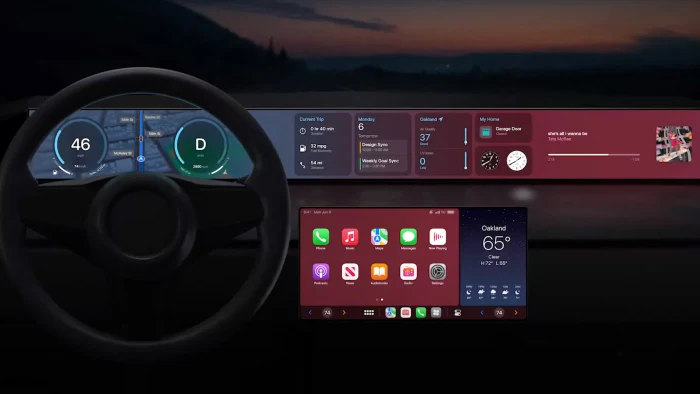
      Modern vehicles are no longer standalone machines, but part of a wider ecosystem of connected devices. From smartphone integration to real-time traffic information updates, connectivity has become an essential part of the automotive UX. Infotainment systems now offer a wide range of features such as Apple CarPlay, Android Auto, voice assistants such as Amazon Alexa, and even streaming services. With these added features, however, comes the challenge of making sure they don’t distract drivers from the driving experience. Designers must strike a balance between offering a wide range of features and keeping the controls simple. Voice control has become a popular solution for limiting screen interaction while driving, allowing users to make phone calls or change music hands-free.

      (source: https://www.autoblog.com/features/apple-carplay-next-generation-data)

      References:

      https://www.uxpin.com/studio/blog/automotive-ux/

      https://www.ramotion.com/blog/automotive-ux-design/

      https://makolab.com/insights/user-experience-design-for-in-car-systems

      https://ordergroup.co/resources/article-business-and-technical/what-are-the-UX-and-Ul-challenges-in-the-automative-industry/

      Designing for short attention spans by reducing cognitive load in UI/UX Design

      In a world where users attention spans are becoming increasingly shorter, the question arises:
      How can designers create digital experiences that thrive in this new age of the attention economy?
      Modern platforms like TikTok and Instagram Reels have fostered a culture where content must engage users within seconds. This shift not only changes how people consume media but also how they interact with digital products.

      My Personal Motivation

      I chose this topic because it is not only timely but also a crucial phenomenon shaping the future of UI/UX design. Understanding how to design for evolving user behaviors is not just about keeping up with trends, it’s about creating experiences that are inclusive, engaging and user-friendly. On a personal level, I’ve always been intrigued by the intersection of psychology and design. How do visual and interactive elements influence what we focus on? How can we use design to reduce frustration and enhance usability? These are questions that fuel my curiosity and drive my research. In this blog, I will explore (for now, I’ll see where this topic takes me) the challenges and opportunities posed by shortened attention spans and discuss smart design strategies that can deliver optimal user experiences.


      Why This Topic Is More Relevant Than Ever

      The relevance of designing for shortened attention spans has never been greater. As digital consumption habits evolve, designers are facing unprecedented challenges and opportunities. Here’s why this topic matters today:

      Modern Digital Behaviors: As users attention spans are impacted by fast-paced platforms (TikTok, Instagram), they bring these expectations to every app or website they interact with. UI/UX design needs to adapt to keep users engaged without overwhelming them.

      Optimizing User Performance: Reducing cognitive load helps users focus on key tasks, leading to better performance, conversions, and overall satisfaction.

      The Rise of Short-Form Content

      Platforms like TikTok, Instagram Reels, and YouTube Shorts have redefined how users consume media. According to a report by Statista (2023), TikTok users spend an average of 95 minutes per day on the app, often scrolling through hundreds of short videos. This trend has created an expectation for quick, engaging interactions across all digital platforms.
      Users now demand:

      • Immediate gratification
      • Minimal friction in navigation
      • Engaging visuals that deliver value in seconds

      Cognitive Overload in the Digital Age

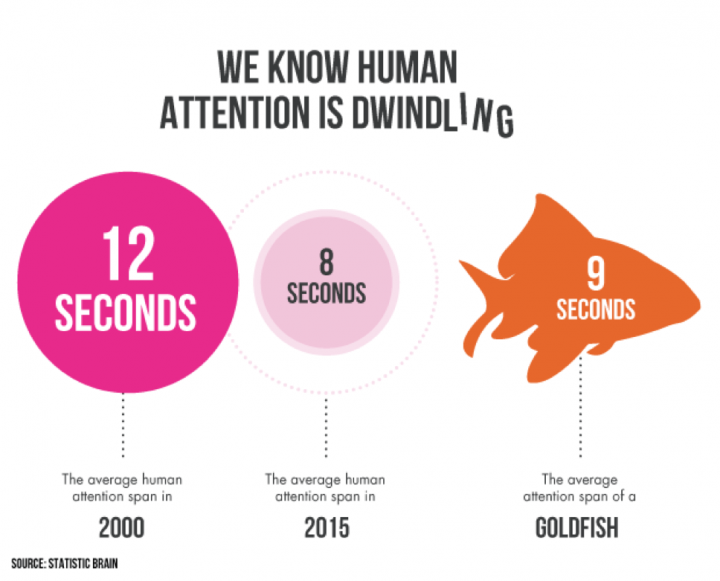
      The constant exposure to digital stimuli has a measurable effect on our cognitive capacities. Studies, such as one conducted by Microsoft (2015), suggest that the average human attention span has dropped from 12 seconds in 2000 to 8 seconds in 2015. This number is likely even lower today due to the rise of short-form content platforms.

      For designers, this means that traditional, text-heavy or overly complex interfaces are losing effectiveness. The challenge is to simplify interactions without sacrificing functionality or depth.

      Economic Impact

      Shortened attention spans have direct implications for businesses:

      • E-commerce Conversion Rates: According to a Baymard Institute Report (2023), nearly 70% of online shopping carts are abandoned, often due to overwhelming or confusing interfaces.
      • Ad Revenue: Digital ads are now designed to capture attention within the first few seconds as users skip or scroll past them if they don’t immediately engage

      Designers who fail to address these shifts risk losing users, revenue and relevance in competitive markets.

      The Shift in Learning and Education

      Attention spans are also affecting how people learn and process information. The rise of microlearning platforms like Duolingo or Blinkist reflects the need for bite-sized, focused content that aligns with modern user behaviors. Designing for shorter attention spans isn’t just about entertainment, it’s about enabling users to achieve their goals more effectively.

      The Attention Economy

      The concept of the attention economy – where attention is treated as a finite resource has become a central topic in UI/UX design. Every app, website and platform is competing for user attention, often at the expense of user well-being. The challenge is to design ethically, balancing engagement with cognitive health. When discussing “user well-being” I plan to dedicate an entire blog post to exploring the ethical implications and the darker side of digital products and platforms that exploit attention in harmful ways. This includes practices like Netflix Kids use of gamification to encourage binge-watching by rewarding children with patches for every movie they complete, highlighting how attention can be manipulated through design. But stay tuned for this one.

      Why Designers Must Act Now

      Addressing these issues isn’t optional, it’s a necessity. Designers must:

      1. Adapt to Changing Behaviors: Interfaces must align with the fast-paced consumption habits of today’s users.
      2. Reduce Cognitive Load: Simplified designs help users focus on key tasks and avoid frustration.
      3. Ensure Ethical Design Practices: Designers have a responsibility to create experiences that are engaging but not exploitative.


      If this topic sparks your interest, join me on this journey as we delve deeper into the nuances of attention spans and design in the upcoming blog posts.

      Literature:

      Statista (2023)
      https://www.statista.com/topics/8309/tiktok-marketing/#topicOverview

      Microsoft Attention Span Study (2015)
      chrome-extension://efaidnbmnnnibpcajpcglclefindmkaj/https://sherpapg.com/wp-content/uploads/2017/12/MAS.pdf

      Baymard Institute Report (2023)
      https://baymard.com/research/checkout-usability

      Interesting talk about Designing for Short Attention Spans by Victor Yocco (UX Burlington 2019)
      https://www.youtube.com/watch?v=6WBS6YYMAcE