During the preparation of the installation, I decided to extend the project with a visual layer that supports and reinforces the sound. The visual component was conceived as a minimal, data-driven system that mirrors the same physiological dynamics shaping the audio, rather than functioning as an independent narrative. For this purpose, I used TouchDesigner, where I created a relatively simple visual patch controlled by HRV-derived parameters. Instead of implementing real-time data streaming, I reused the MIDI files generated during the sound design stage. These MIDI signals were imported into TouchDesigner, normalized from the MIDI range (0–127) to values between 0 and 1, and used to drive visual modulation.
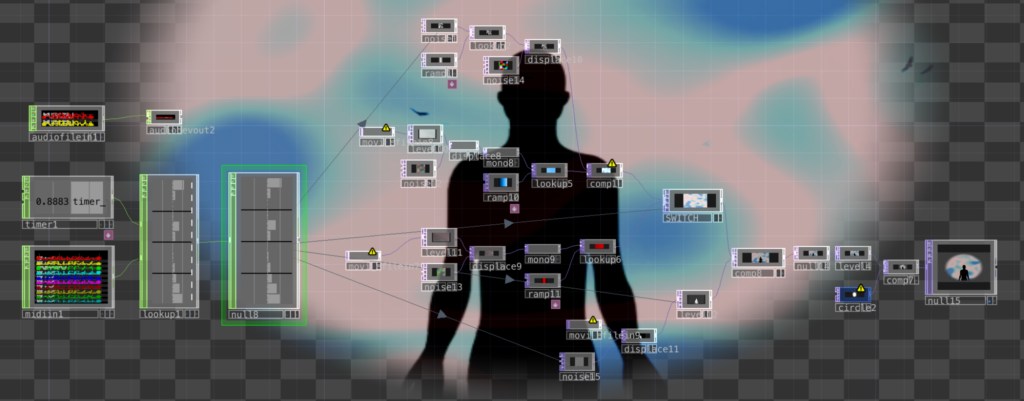
TouchDesigner patch for HRV-driven visual modulation.
The patch is structured around two parallel visual layers based on the same source footage: a video of the sky with birds flying through the frame. Each video layer undergoes a similar processing chain, including the addition of procedural noise, displacement, conversion to monochrome, and subsequent color mapping.
As in the sound design, the two visual layers differ primarily in their color treatment. One layer is tinted in cool blue tones, while the other is dominated by red hues. Switching between these layers is controlled by the LF/HF ratio, which acts as a high-level indicator of autonomic balance. When the LF/HF value increases, corresponding to a stressed physiological state, the red-toned layer becomes dominant.
In addition to color changes, the patch applies displacement effects that are also influenced by HR. During moments of increased stress, the displacement intensity rises, causing the image to warp and fragment more strongly.
A human silhouette is layered on top of the background video. Under calm conditions, the silhouette remains stable and clearly defined. As stress increases, the silhouette becomes progressively distorted through displacement and noise-based modulation. This distortion visually emphasizes bodily tension and loss of internal stability, reinforcing the embodied dimension of the work.
