Following the initial experiments, ECG and GSR recordings were conducted consistently over a period of five weeks during the weekly civil defense siren tests on Saturdays. Each recording session typically began between 11:30 and 11:40, allowing sufficient time to later remove several minutes of motion-related noise caused by movement, setup, and settling into a stable posture for recording.
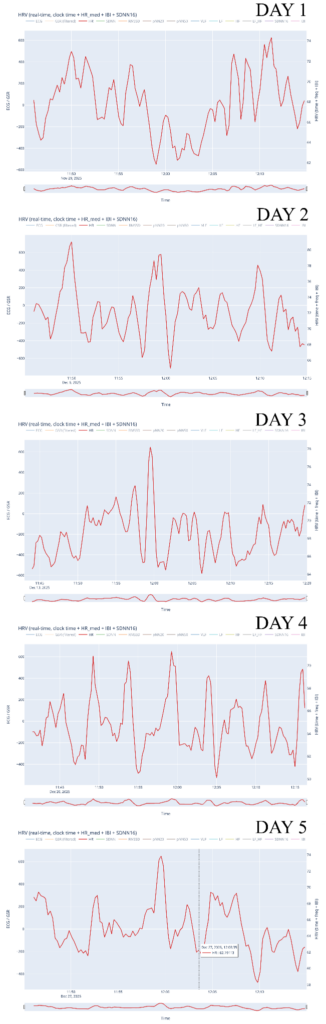
It is important to note that I generally follow a late chronotype (“night owl”) sleep pattern and tend to wake up relatively late, especially on weekends. As a result, during most Saturday siren tests I was still in bed. Rather than attempting to alter this routine, I deliberately chose to maintain it in order to preserve ecological validity. All recordings were therefore conducted in bed, under a blanket, in a resting position consistent with a typical weekend morning. Although these Saturdays were dedicated to working on the project, the physical and contextual conditions were intentionally kept as close as possible to a habitual state.
I usually woke up around 11:00, completed the necessary preparations, and often attempted to set up the recording equipment on Friday evening to reduce time pressure. After attaching the ECG electrodes, I returned to bed and waited for the siren, keeping the window slightly open to ensure that the sound was clearly audible. For analysis, each recording was trimmed to retain approximately 15 minutes before and 15 minutes after the siren onset. The resulting segments were then processed using the established analysis pipeline.
Contrary to the initial hypothesis, the results of these repeated recordings did not show a consistent or clearly separable heart rate response before and after the siren. In particular, heart rate values were often already elevated at the beginning of the recording, prior to the siren onset. A plausible explanation for this pattern is the experimental context itself. On the nights preceding the recordings, I frequently went to bed late and woke up insufficiently rested. In addition, there was often time pressure in the morning to complete setup before the siren at 11:45. As a result, a heightened physiological arousal state was likely present already at the start of the experiment.
In several sessions (notably days 3 and 5), heart rate began to rise even before the siren, suggesting an anticipatory stress response associated with waiting for the event rather than reacting to the sound itself.
The LF/HF ratio provided slightly clearer indications of stress-related changes, although with considerable variability. On the first recording day, LF/HF showed a pronounced increase after the siren. On the second day, however, the behavior of this metric differed substantially. During days 3, 4, and 5, a tendency toward increased LF/HF after the siren was often observable, but in several cases the increase began before the siren, again suggesting a pre-existing stress state of the autonomic nervous system.
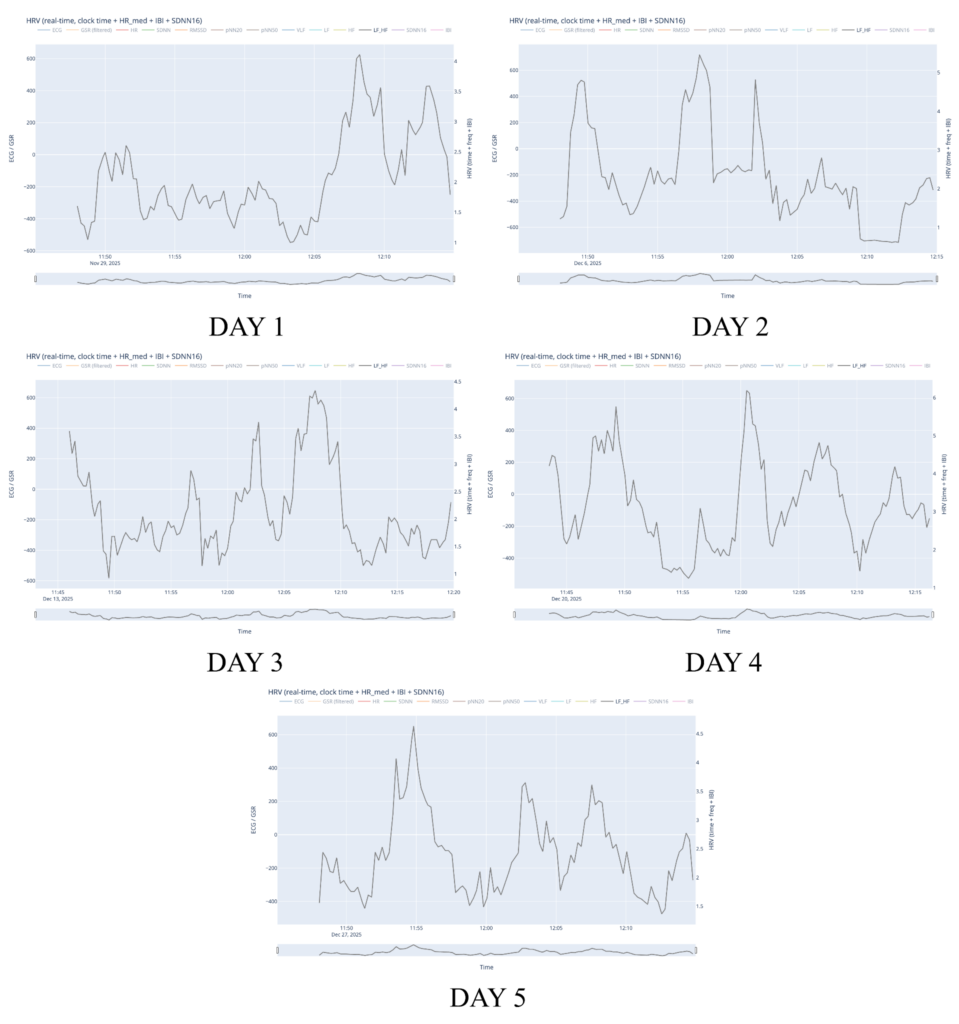
LF/HF from five weekly siren test sessions.
The only parameter that behaved consistently across sessions was the GSR signal. Each time the siren sounded, a sharp drop in GSR values was observed. However, for reasons that remain unclear, the sensor did not function correctly during the final two recording sessions. The recorded GSR data from these sessions did not reflect plausible physiological responses and were therefore considered unreliable. As a result, GSR could not be used further as a parameter for sound mapping.
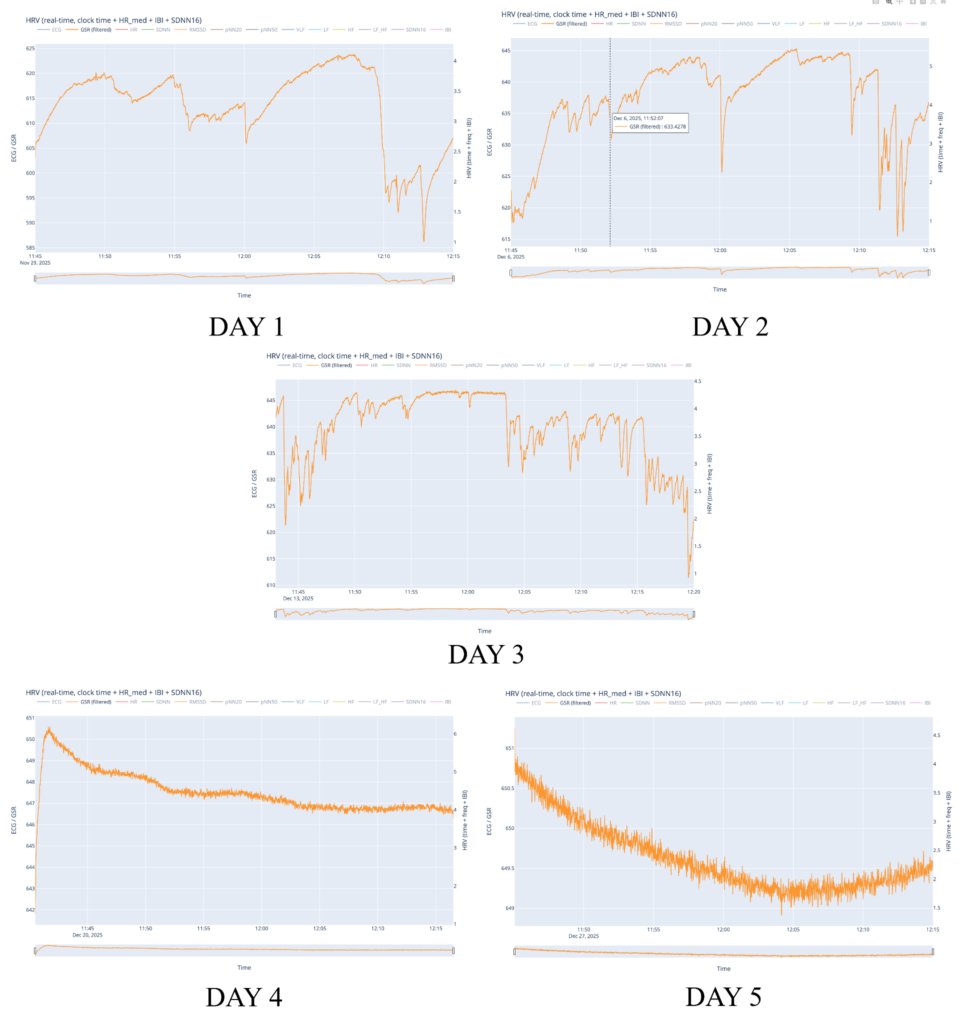
GSR from five weekly siren test sessions.
Rather than discarding these recordings as unreliable, I chose to accept the limitations and realities of the experimental conditions. The longitudinal dataset is therefore approached not as a controlled physiological study, but as a form of embodied, self-reflexive investigation. The recordings capture a body shaped by multiple interacting factors—sleep, anticipation, routine, and personal history—and reflect the complexity of measuring stress responses in real-life contexts rather than laboratory environments.
