After applying the HRV-to-CC conversion script, five MIDI files were generated—one for each recording day. A deliberate decision was made to normalize MIDI CC values (0–127) separately for each day rather than across the entire dataset. This approach emphasizes intra-day dynamics and allows relative physiological changes within a single session to be expressed more clearly through sound, rather than flattening them through global normalization.
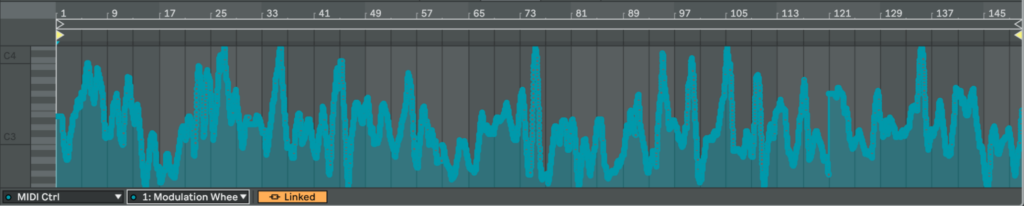
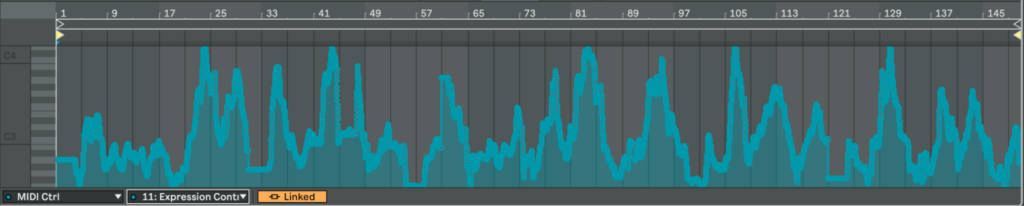
MIDI CC automation derived from HR (CC1) and LF/HF (CC11).
In the conversion stage, specific MIDI CC numbers were preassigned to selected physiological parameters. Heart rate (HR) was mapped to MIDI CC 1 (Mod Wheel), and the LF/HF ratio was mapped to MIDI CC 11 (Expression). This choice was primarily practical: in Ableton Live, both CC 1 and CC 11 can be freely accessed and remapped using the Expression Control device, allowing flexible routing to multiple sound parameters without additional MIDI processing.
The core sound texture was constructed using a combination of Granulator II, Auto Pan (used in tremolo mode), Auto Filter, and Utility. Expression Control devices were used to distribute incoming MIDI CC data to multiple plugin parameters simultaneously.
The LF/HF ratio was used as a proxy for autonomic balance and stress level and was mapped to parameters that strongly affect spectral content and internal motion of the sound: Granulator II → Position, Grain Size, Variation
Auto Filter → Frequency, Resonance
Heart rate (HR) was mapped to parameters associated with rhythmic modulation, spatial perception, and perceived intensity:
Auto Pan → Amount, Frequency
Granulator II → Shape
Utility → Stereo Width
Together, these mappings translate physiological arousal into changes in movement, brightness, density, and spatial spread of the sound texture.
In parallel, a second, identical processing chain was created using the same plugin structure but a different sound source and an inverted mapping strategy. The two granular layers were combined inside an Instrument Rack, preceded by an additional Expression Control device.
Overview of the mapping between HRV parameters, MIDI CC signals, and audio processing parameters.
The two sound sources used were:
Layer 1: an airy pad sample with subtle vinyl noise and bird sounds
Layer 2: a field recording of an air-raid siren from Kyiv
The LF/HF ratio was additionally mapped to the Chain Selector of the Instrument Rack, enabling a continuous crossfade between the two layers:
Low LF/HF values → dominance of the pad and bird sounds
High LF/HF values → dominance of the siren texture
As a result, the overall sound gradually shifts toward a siren-like timbre during periods of elevated physiological stress, and toward a softer, atmospheric texture during calmer states. Rather than triggering discrete sound events, this approach produces a continuously evolving audio texture that reflects internal physiological dynamics over time.
