Meta Quest Headsets vs Smartphones in Retail AR:

When comparing AR on smartphones with VR headsets such as Meta Quest, the discussion should not only focus on immersion, but also on practical use in real retail environments.

Defining the technologies briefly

  • Smartphone-based AR (Augmented Reality) means digital elements are added to the real world through a phone screen. The user stays fully aware of their surroundings.
  • VR (Virtual Reality) uses head-mounted displays that fully replace the real environment with a virtual one.

While VR offers stronger immersion, this strength also creates operational challenges in retail.

Hardware management and constant care in stores

One major difference between smartphones and VR headsets is device ownership and responsibility.

Smartphones are personal devices. Customers bring their own phones, meaning:

  • no shared hardware
  • no setup by staff
  • no maintenance by the store
  • no hygiene management

VR headsets, on the other hand, are shared devices in retail settings. This means they require:

  • staff supervision
  • setup assistance
  • regular cleaning and sanitization
  • technical troubleshooting

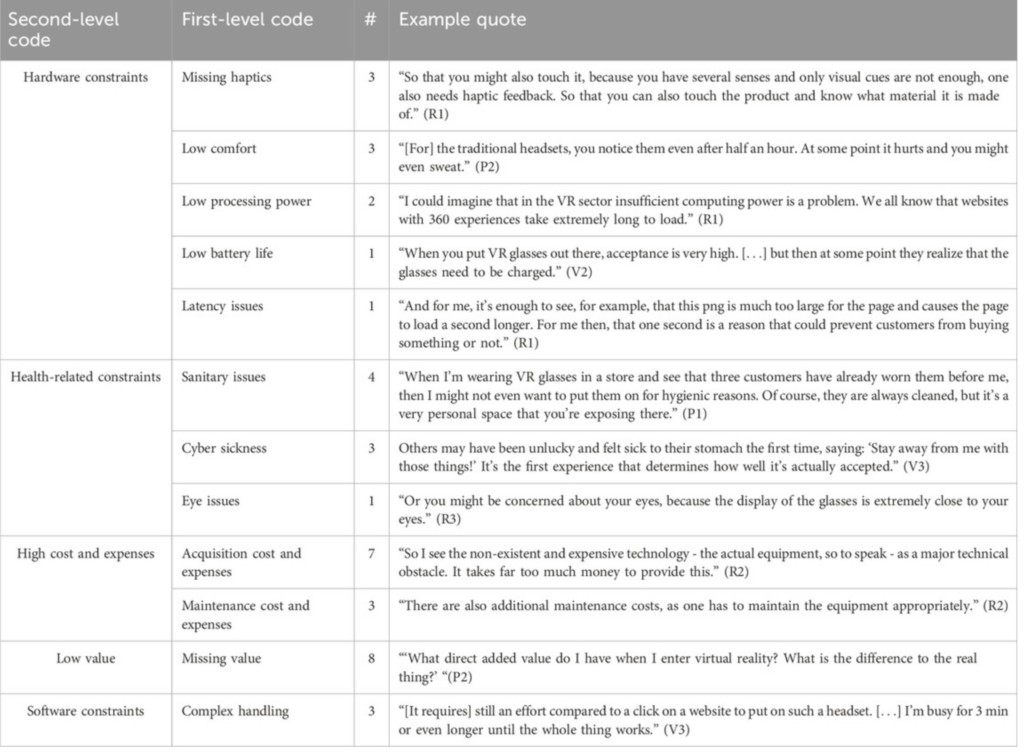
Retail research on VR adoption highlights operational complexity and maintenance effort as key barriers to implementing VR experiences in stores. Studies reviewing VR use in retail environments point out that head-mounted displays require additional resources and management, which makes them harder to integrate into everyday shopping situations.
(Source: Frontiers in Virtual Reality, 2025 – VR adoption barriers)
 https://www.frontiersin.org/journals/virtual-reality/articles/10.3389/frvir.2025.1721321/full

Throughput and waiting time: one user vs many users

Another critical issue is throughput, meaning how many people can use a system at the same time.

  • Smartphone AR allows many users simultaneously, because everyone uses their own device.
  • VR headsets allow only one user at a time per headset.

In busy retail environments, this creates waiting times, which research in consumer behavior shows can reduce satisfaction and willingness to engage. Even highly engaging experiences lose value if customers have to wait, ask for assistance, or interrupt their shopping flow.

low-effort, fast-access solutions are more likely to be adopted than complex systems that slow down the shopping process.

Security and loss prevention as a realistic concern

Another practical issue is security.

VR headsets are:

  • expensive
  • portable
  • visually attractive

In open retail environments, this means they often need:

  • constant supervision
  • fixed stations
  • anti-theft measures

This adds another layer of operational effort. Smartphones avoid this issue entirely because the store does not provide the hardware. From a retail management perspective, this significantly lowers risk and responsibility.

Why smartphones fit everyday retail better

Research on mobile AR in retail shows that smartphones work well because they:

  • integrate into existing shopping behavior
  • require no additional learning or equipment
  • allow users to start and stop instantly
  • support short, spontaneous interactions

 ease of use and familiarity strongly influence acceptance and engagement in retail contexts.

Conclusion: immersion vs reality

VR headsets like Meta Quest are powerful tools for guided experiences, events, or brand storytelling. However, in everyday retail environments, they introduce challenges related to:

  • hardware care
  • waiting times
  • staff involvement
  • security and maintenance

Smartphone-based AR avoids these issues by using devices people already own. This makes it more scalable, safer, and better aligned with real shopping behavior.

For these reasons, smartphone AR currently represents a more realistic and responsible solution for retail experiences focused on comfort, accessibility, and smooth user flow.

In public store environments, VR users must often remain in fixed positions for safety, while wearing highly visible head-mounted displays. Studies show that this increases self-consciousness and feelings of being observed or judged by others, making VR less suitable for casual, everyday shopping experiences. As a result, VR is often better suited to private or controlled environments than open retail spaces.

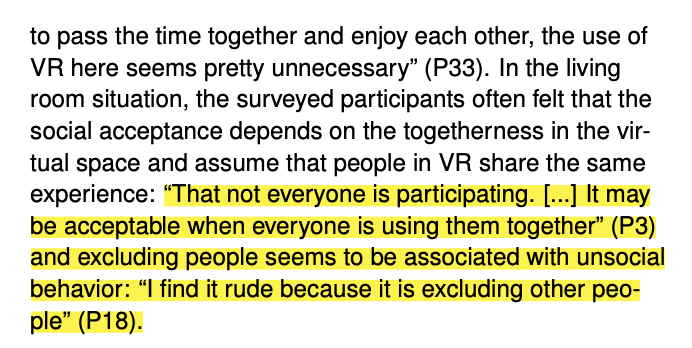
I particularly appreciate the approach taken by Schwind et al. (2018), as the authors do not only theorize about social acceptance, but empirically investigate how people actually feel when using VR glasses in public spaces—and how the surrounding public reacts to this use. By testing VR glasses in different everyday contexts, the study shows that while VR use is more accepted in private or socially isolated situations (such as at home or on a train), acceptance decreases significantly in public environments where social interaction is expected. This finding is especially relevant for retail contexts, as the high level of immersion provided by VR glasses also makes the user more visible and socially exposed, which can increase self-consciousness and discomfort.

Virtual Reality on the Go? A Study on Social Acceptance of VR Glasseshttps://www.researchgate.net/publication/327256690_Virtual_reality_on_the_go_a_study_on_social_acceptance_of_VR_glasses

(In the development of this blogpost, AI (ChatGPT) was used as a supportive writing and structuring tool. I provided the conceptual content, research direction, theoretical preferences, and methodological decisions, while the AI assisted in translating it to English, refining the wording, organising the material and generating coherent academic formulations based on my input. The AI did not produce research or arguments but helped transform my ideas into a clear and well-structured text draft.)
One on One Sessions – Impulse #7

Yesterday, I got to talk to two people, to get some feedback on my masters thesis. Ursula Lagger during the “Proseminar Master’s Thesis” class and Martin Kaltenbrunner during the “Final Crit” session. These discussions have changed, what I will/ want to du during the creation of my masters thesis.

For better understanding let me outline my thesis shortly. My thesis aims to explore and create a clear path for designers who want to contribute their skills to the world of open-source software. The initial plan was to research existing barriers and create a practical “workpiece” to demonstrate a viable contribution method. However, thanks to the input from my professors, the focus and form of that workpiece will change.

The first major insight came during my “Proseminar Master’s Thesis” class with Ursula Lagger. I was heavily focused on the parallels between open-source maintainers and my experience in social volunteering (in my scout group), looking at it through the lens of social science. She pointed out that while this comparison is interesting, it was pulling my thesis away from my actual field of study. How do people interact with the project and the code? How do they communicate and document their process? How do designers get involved? It was a sort of sobering clarification. I realised the core connection to interaction design was secondary and I will change my focus.

The second, and more disruptive, piece of feedback came from Martin Kaltenbrunner during my “Final Crit.” My plan was to create an open-source Figma plugin as a workpiece, to outline the whole process of the creation, maintenance and distribution of an Open Source project. He challenged this directly, arguing that building a plugin for a proprietary, closed-source tool like Figma is more of a simulation of open source rather than a genuine contribution to it. He made me question whether a project can be truly “open” if it’s fundamentally tied to a closed ecosystem.

I will probably move away from the Figma plugin idea. Instead, focus on contributing to an existing, truly open-source project. For example could address an UX issue I found in the Pi-hole project. This new approach feels more authentic and will serve as a much stronger, more “translatable” case study for the final outcome of my thesis: the guideline for other designers. This actually was a third, unifying piece of feedback from them. They suggested that the most valuable result would be a practical, reusable guideline for designers. The idea is to create a “manifesto” of sorts on how to get started and contribute to open source, something that goes beyond my personal project and can empower others.

The biggest shift in perspective probably came through Ursula Lagger, which revealed a blindspot in my own thinking. What are negative sides of Open Source Software? How could giving work away for free to be used by anyone change ones reputation? what impact could OS have on the day to day work of designers? In my next and final blog post, I plan to dive into this blindspot and investigate the other side of the open-source coin.

Ai was used to formulate this blogpost (Gemini + WisprFlow)

Impulse #8 – Trust the process, I guess?

This final impulse isn’t really about one single event but more about my next steps and some reminders for myself, that hopefully help me shape my thesis, since I am kind of lost at the moment.

Instead of moving forward with my thesis I find myself circling, questioning and mostly doubting my current direction. It feels uncomfortable, but maybe this phase is necessary for the whole process, since everyone always says “the journey is the reward”. Up until now I tried to define what my thesis should be, what the outcome should look like and what form it should take, and how can I justify or measure it. I realized the more and harder I tried to answer all of these questions the more pressured I felt. Also, I realized that defining the workpiece kind of in the beginning, blocked me even more because I felt like I already defined a way and I can’t move away from it. Rationally, I know that I can always change the direction, but somehow, I still feel stuck at the moment.

Since I am not 100% happy with my current direction, my next step is a step back. I think I need to go back to a more open and exploratory phase. The process doesn’t need to be linear, and I want to allow myself to also move sidewards not only forwards. I want to explore different topics, topics that I truly care about. But I want to explore them without immediately trying to turn them into a solution asking myself if this would be a good thesis. I want to ask myself more open questions: What excites me? What makes me curious? What topics do I come back to? I think this next phase should be less about creating and more about researching through reading, watching, observing and experimenting and see what resonates with me. I want to spend time writing down thoughts, questions, references or any ideas that come to my mind, without the pressure of turning it into a concept right away.

I need to remind myself that I don’t need to have all the answers right away. For someone who loves to have a clear goal and all the steps that lead me to reach this goal, this feels very unnatural and hard, but maybe this is exactly what I need right now. I need to trust the process and accept uncertainty as part of it. Additionally, going back doesn’t mean going back to zero. The impulses from the past weeks aren’t wasted, they formed a good foundation I can build on if I want to. Now that I finished all my courses, I finally have more time and mental space to really take a step back and sit with some ideas longer, sketch, reflect and finding out what I really want to do. Maybe I just need to narrow down my current idea or maybe I need to go into a completely different direction, but anyways I think my goal right now is to be curious, to explore, to ask questions instead of searching for the perfect thesis.

AI was used to check spelling and grammar.

Installing a PiHole (Homelabbing_3) – Impulse #6

In my last homelabbing post, I talked about getting my server set up with Docker and hosting my first applications. A logical next step on my list was to tackle network-wide ad-blocking. As I hinted before, the time finally came to set up a PiHole. I was excited to improve my own network but also to get my hands on a piece of open-source software that is widely loved.

For those unfamiliar, PiHole works differently than an add blocking browser extension. Instead of scanning websites for ad-like code, it operates as a DNS sinkhole. In simple terms, when any device on your network tries to contact a server known for serving ads, the PiHole intercepts that request and sends back an empty response, so the ad never even loads. The biggest advantage? It works for everything on your network, your laptop, your phone, and even your Smart TV, where ad-blockers are often non-existent.

The setup process itself was a great hands-on experience. I used a tiny Raspberry Pi Zero that I got from my brother for christmas, flashed the operating system to an SD card, enabled SSH for remote access, and plugged it into my router. From there, running the single install command and watching it work its magic was incredibly satisfying. A few configuration changes on my router to direct all DNS traffic through the Pi, and it was up and running, protecting me from ads. ;D

Impact for my Masters Thesis

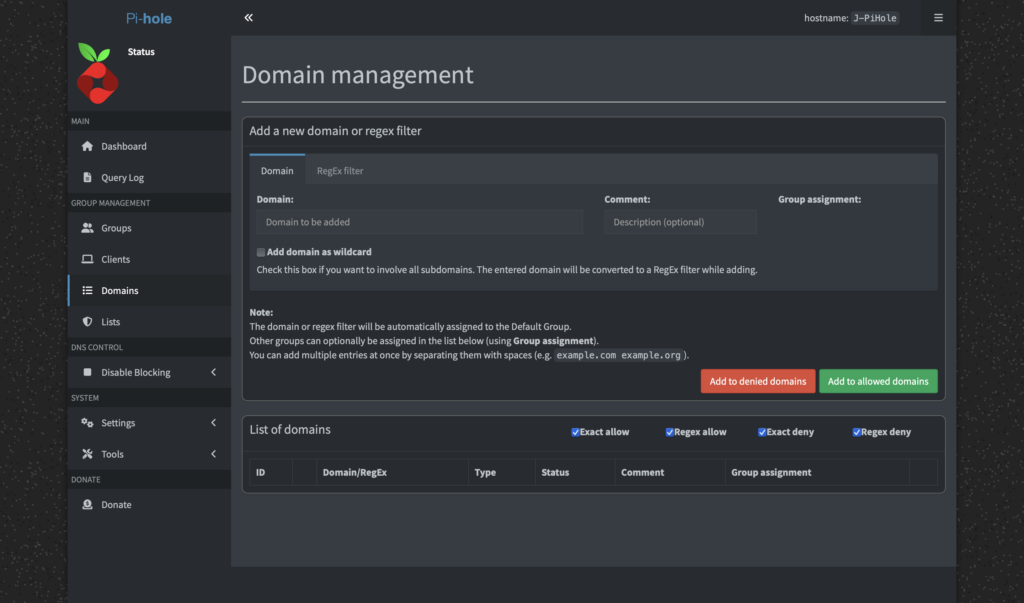
This is where this little project became a huge impulse for my thesis. While exploring the PiHole’s web dashboard, I stumbled upon a perfect, real-world UX issue. To block a domain, you add it to a blocklist. To allow one, you add it to an “allow list.” On the dashboard, the button to add a domain to the allow list is green.

As a designer, green signifies a positive action, like adding something while red signals a negative action, like deleting something. More than once, I found myself accidentally clicking the green “Allow” button when my actual intention was to block a domain. It’s a classic UX problem where the visual signifier conflicts with the user’s intent. For a developer, a green button for “allow” might make perfect sense, it’s the “good” list. But for a user managing blocklists, it creates confusion.

This was a firsthand example of a barrier a designer could help lower. I immediately thought, “This is open source, I should be able to fix this!” I wanted to change the button color, maybe add an icon, or just improve the layout. But then I hit another wall: the documentation on how to change interface elements wasn’t straightforward for a non-developer. I literally had no idea, where to start.

This entire experience perfectly encapsulates the core of my thesis. It’s not just about finding UX issues, but about the entire process: identifying a problem, understanding the contribution workflow, and finding the right documentation. My simple home lab project has given me a tangible case study, a real problem to solve, and a clear path to explore for my “Designer’s Guide to Open Source.” It’s the first step in moving from theory to a real, practical contribution.

Accompanying Links

Pi-hole official website – https://pi-hole.net/

Raspberry Pi Zero – https://www.raspberrypi.com/products/raspberry-pi-zero/

Ai was used to formulate this blogpost (Gemini + WisprFlow)

Interviewing an AKH Psychiatrist for My Master’s Thesis:

The interview was conducted on January 17, 2026

Medical Perspectives on Sensory Overload, AR, and Emotional Comfort in Retail

My focus in this case lies particularly on people who experience shopping as stressful or overwhelming, such as introverted individuals, people with social anxiety, and users on the autism spectrum.

To support my design research with a medical perspective, I conducted a qualitative expert interview with Dr. Sofia Kuhn, a psychiatrist working in the clinical context of AKH Wien.

About her:

Dr. Sofia Kuhn is a medical doctor working in the field of psychiatry, with clinical experience in the context of child and adolescent mental health. She is affiliated with AKH Wien, one of Austria’s largest university hospitals, which is closely connected to the Medical University of Vienna.

Her professional work focuses on the diagnosis and treatment of psychiatric and developmental conditions, including autism spectrum conditions, anxiety-related disorders, and social difficulties in children and adolescents. Through her clinical practice, she works closely with patients and families who face challenges related to sensory sensitivity, emotional regulation, and social interaction.

Due to her medical background and daily clinical experience, Dr. Kuhn brings a psychiatric and therapeutic perspective to questions of environmental stress, sensory overload, and behavioral responses. This makes her expertise particularly relevant for research at the intersection of mental health, user experience, and design, especially when exploring how digital or immersive tools may influence comfort, stress, and participation in everyday environments.

The aim of this interview was to gain insight into how sensory environments are experienced from a psychiatric point of view—and how design decisions may support, but also potentially challenge, mental wellbeing.

Reaching the interview: more complex than expected

Arranging this interview was already part of the research process. I initially contacted AKH Vienna via email, explaining my academic background and research topic. Due to institutional structures, several emails were required before an appropriate specialist could be assigned. I also went there personally to support the process.

After Dr. Kuhn was assigned, I sent a short written presentation of my thesis topic together with several versions of interview questions. She asked to see the questions in advance and selected the ones she felt were most relevant and realistic to answer within the given time. I agreed to this approach, as it respects both clinical workload and qualitative research ethics.

Interview setting, consent, and technical limitations

The interview was conducted via Zoom and recorded as audio and screen video, with explicit consent given at the beginning of the conversation. I clearly stated that the interview was being documented for academic purposes.

Originally, the interview was planned for 10 minutes only. Despite this strict limitation, we managed to slightly extend the conversation beyond the original 10-minute limit, especially toward the end, when the discussion became more reflective.

For transcription, I used AmberScript. Due to the limitations of the free version, only 10 minutes of audio could be transcribed. The transcript therefore contains minor grammatical inaccuracies and repetitions. However, for qualitative thematic analysis, this is acceptable, as the focus lies on meaning and content rather than linguistic perfection. I asked for permission to record it and use it in the future.


Selected interview questions (original wording)

Dr. Kuhn selected and answered the following questions during the interview. The wording below is documented in its original form, as prepared and shared with the interviewee in advance:

  1. Before we start, could you briefly tell us about your medical background and your current position?
  2. It is well known that visual sensitivity is common in children on the autism spectrum. In your opinion, can autistic children benefit from predictable and visually simple screen interfaces rather than complex or highly animated ones?
  3. In your experience, can controlling brightness, color intensity, and visual clutter on screens help reduce stress or anxiety in autistic children?
  4. What aspects of shopping environments—such as visual stimuli, unpredictability, mirrors, or fitting rooms—you think can be especially overwhelming for autistic, introverted and people with social anxiety?
  5. Could screen-based AR guidance, such as step-by-step instructions or visual navigation, help people feel more in control during shopping experiences?
  6. Does this mean that digital or AR-based try-ons on phones or tablets could reduce sensory overload compared to physical try-ons in stores?
  7. From a psychiatric perspective, what visual design principles should designers consider when developing screen-based tools or AR applications for autistic children?
  8. What main problems or challenges do you see with this concept in practice and how accessible do you think this concept is for different groups of people?
  9. In Austria, do you see a growing need for sensory-friendly digital solutions in everyday environments such as retail, public services, or education?

These questions structured the entire conversation

key moments from the interview (quoted)

One of the most valuable outcomes of this interview was the unexpected depth of medical reflection, especially given the strict 10-minute time limit. Several statements by Dr. Sofia Kuhn stood out.

1. Shopping environments as cumulative sensory stressors

When asked which aspects of shopping environments can be overwhelming, Dr. Kuhn clearly described shopping as a multi-layered sensory challenge, especially for autistic children and their families:

“Shopping can be particularly difficult for autistic children and their parents. Retail environments are often overwhelming and tiring, as children are required to process multiple sensory stimuli at the same time, including bright lights, loud sounds, crowded spaces, and visually intense product displays.” 

She further emphasized that overload is not limited to one space, but builds up through constant transitions:

“Frequent transitions, for example moving from one store to another, being exposed to street noise and entering new environments, can further heighten sensory overload and make the experience especially challenging.”…

Why this is important:
This confirms that sensory overload in retail is cumulative, not isolated. From a design perspective, this means AR should aim to reduce overall mental effort, not just improve one single interaction.


2. AR guidance as a tool for stress reduction and focus

When discussing screen-based AR guidance, Dr. Kuhn highlighted its potential to improve concentration and reduce stress—if designed carefully:

“I think it could be helpful by reducing stress and increasing concentration. Such tools may help children focus better on their actions.” 

She directly linked this to visual design choices:

“The use of soft colors and gentle animations could make the experience more comfortable and enjoyable for such children.” 

Why this is important:
This statement validates key design principles for my AR prototype from a psychiatric perspective, not just a UX one.


3. Simplicity and visual restraint in design

When asked which visual design principles should guide AR tools for autistic children, Dr. Kuhn gave a very clear answer:

“Visual design should remain uncluttered and include only the elements and symbols that are essential for the given context. Color should be selected very thoughtfully and kept at a moderate intensity.” 

She also stressed the importance of motion control:

“Animations, if used, should be subtle and smooth, avoiding sharp or sudden movements. Overall, the design should be intuitive and easy for children to understand.” 

When I asked directly whether simpler design is better, her response was unambiguous:

“Yes. Of course.” 

Why this is important:
This supports the idea that “less is better” is not a stylistic trend, but a mental health requirement for certain user groups.


4. Digital try-ons as a way to avoid stressful physical experiences

Regarding AR-based try-ons, Dr. Kuhn confirmed their potential benefit:

“Yes, they certainly could. Digital trials may help avoid some of the stressful sensory experiences associated with physical fitting rooms.” 

Why this is important:
This quote directly supports the relevance of AR try-ons as a stress-reducing alternative, not merely as a technological novelty.

5. The most critical insight: when innovation can become harmful

The most unexpected and influential part of the interview emerged when discussing limitations and risks. Dr. Kuhn emphasized that innovation is never universally positive:

“Every innovation has both positive and negative aspects. Not everyone will benefit from such innovations.” 

She explained that for certain psychiatric conditions, reduced interaction can conflict with therapeutic goals:

“For a person with social phobia, Asperger’s syndrome, depression, or other disorders, avoiding social interactions is part of the condition. Such innovative technologies may even reduce direct contact with anxiety, which is especially necessary in exposure-based psychotherapy.”

She stated this very clearly:

“This is not the goal of therapy. The goal is for the person to be able to communicate.” inteview 10 min at end verion t…

Why this is important:
This insight fundamentally changed my thinking. It introduced an ethical boundary for AR design: reducing stress must not mean reinforcing avoidance.


6. AR as encouragement, not replacement

Toward the end of the interview, Dr. Kuhn clarified how such technologies can still be useful when applied responsibly:

“An easier form of communication may help people decide to go to a shop, knowing that they will only need minimal interaction. This can be beneficial at a certain stage, as a form of encouragement.” 

However, she immediately added a clear limitation:

“This is beneficial only up to a certain stage. At later stages, we would expect a stronger therapeutic effect.” 

She concluded with a statement that strongly frames my design responsibility:

“It’s essential that such innovative approaches are introduced with great care. These advancements should not reduce real-world communication or lead to social isolation. Sensory-friendly technology should support interaction with the outside world, not replace it.” inteview 10 min at end verion t…

Summary: Key insights from the interview

Understand AR not as a tool to remove social interaction, but as a supportive layer that reduces stress while still allowing real-world engagement.

From a psychiatric perspective, shopping environments were described as highly demanding sensory spaces, especially for autistic and sensitive individuals. Sensory overload results from the combination of bright lights, noise, crowds, visual clutter, and frequent transitions between environments, making shopping exhausting rather than neutral.

Dr. Kuhn emphasized that predictable, visually simple, and uncluttered interfaces—using moderate colors and gentle animations—can help reduce stress and improve concentration. This confirms that visual simplicity is a psychological necessity, not just an aesthetic choice.

She also confirmed that digital or AR-based try-ons can reduce sensory overload compared to physical fitting rooms by avoiding confined spaces, mirrors, and time pressure.

At the same time, the interview highlighted a critical limitation: for certain psychiatric conditions, reducing social interaction too much can reinforce avoidance behavior. Therefore, sensory-friendly technologies should support gradual participation, not eliminate communication entirely.

Overall, the interview strengthened the medical and ethical foundation of my thesis and directly informed the design principles of my AR prototype, reinforcing the idea that AR should support interaction with the outside world rather than replace it.

(In the development of this blogpost, AI (ChatGPT) was used as a supportive writing and structuring tool. I provided the conceptual content, research direction, theoretical preferences, and methodological decisions, while the AI assisted in translating it to English, refining the wording, organising the material and generating coherent academic formulations based on my input. The AI did not produce research or arguments but helped transform my ideas into a clear and well-structured text draft.)
Impulse #7 – Talk, Talk, Talk

As written in my last blog post, unfortunately I feel kind of lost and stuck about my master’s thesis at the moment. However, this week I had three different talks about my master thesis, which helped me a bit to gather my thoughts.

My struggles right now

The main topic of my thesis is the impact of productivity and perfection pressure on creative work nowadays. The reasons why I am unsure about the topic are that [a] creativity is a very broad and sometimes hard-to-grasp topic, [b] there are already quite a lot of theses about creativity, and it might be hard to create a strong and unique selling point and [c] I am worried about whether there is a scientific way to really measure creativity. Especially in my case where I want people to interact with the creative webspace and then reflect on their emotional response afterwards and this feels rather vague right now. To prove or disapprove a thesis it is of course important to be able to measure something.

In addition, there is also the realization that I don’t want to create something only digital.

Final Crit with Horst Hörtner

Horst Hörtner is expert in human computer interaction and managing director of the Ars Electronica Futurelab which is known as one of the most important institutions in interaction design on the edges of digital media, design, art, science, industry, society.

The talk was not just about the master thesis itself, but in general about us, our projects and skills and where we want to head in the future. I told him about my master’s thesis idea and about the struggles I am currently facing. He also agreed that in my case only building something digital, which should help creatives in a time of creative blocks, might not be the best solution. We talked a bit more about my general research interests, such as mental health, social issues, feminism and tangible interfaces. He said this is already a good starting point and even though I feel unsure about my thesis right now they resonate with my current topic.

He gave me the advice to deeply dive into topics I am genuinely interested in and to think about what visions I have for my future self, this will help me find a clearer direction. Additionally, he said that, even though he knows it is hard, it is important to engage with the theme, see where the research leads me, and then, in the best-case scenario, a workpiece will emerge from this process.

Final Crit with Martin Kaltenbrunner

Mr. Kaltenbrunner is professor at the Institute of Media Studies / Interface Culture at the University of Art and Design in Linz, head of the Tangible Music Lab, expert in human computer interaction and co-inventor of the Reactivision framework.

Mr. Kaltenbrunner gave me valuable feedback on both my approach and the overall direction of my thesis. I explained my idea of creating a digital, interactive playground as a counter act to productivity culture in creative environments. The webspace intended to support creatives during times of creative blocks. He pointed out that, despite the playful intention, it still would function as a tool designed to increase productivity, since its goal is to generate more creativity. To be honest I never thought about it this way, but he was right. This underlying logic contradicts with what I actually want to explore and question in my thesis.

He told me about the exhibition Unuselessness – The Useful Useless they did at University of Arts and Design Linz. The exhibition explored the contradiction between art and usefulness and the growing expectation that art, design and technology always must be useful or efficient. While researching for the exhibition, they came across Chindogu – the Japanese art of “useless inventions”. He advised me to read up on this topic and narrow down my topic as it currently seems a bit too broad.

https://www.kunstuni-linz.at/archiv/detail/unuselessness-the-useful-useless

Talk with Ursula Lagger

Yesterday I also had a conversation with Ursula Lagger about my master’s thesis and my exposé. She advised me to create a pro-and-contra list if I feel unsure about my topic and to write down everything that comes to my mind about it. When I told her that I might want to explore different topics, she encouraged me to think about the graduation itself and what I want to present to my family, something I feel proud and happy about it, as this might help me to find a topic I truly want to write about.

These three conversations all gave me different perspectives, insights and impulses to move forward. Even though it feels frustrating to realize that I might need/want to rethink or even start over, the conversations felt encouraging.

AI was used to check spelling and grammar.

Impulse #6 – Overlays Exhibition

It’s crazy that our Overlays Exhibition has already been over since Tuesday, but since then I’ve had some time to review the whole process and the exhibition itself.

I was part of the speaker team, so in addition to planning and implementing my own projects that were exhibited as well as the Portfolio Machine, we also had to coordinate the entire exhibition itself and keep track of the organization. That was often not easy and involved a lot of stress and long nights. But I think the effort and stress paid off, because it was a successful exhibition with a lot of positive feedback. I learned so much about teamwork, project management and exhibition design, and I am sure this will help me in my future career. During this whole process I also realized that organizing exhibitions is something I really enjoy. However, most importunately this whole exhibition and its process gave me some new impulses and directions for what I want to do in my master’s thesis.

I was part of three projects that were exhibited: The Poisonous Twin (game), BÖRG (interactive projection mapping) and the Portfolio Machine. Looking back at these projects, I realized all of them had a strong haptic interface and where not just another only screen-based experience. And I think this is the main reason why I enjoyed working on them so much. I’m a crafty person and I like to work with my hands and that is exactly what we did in all of these three projects: from cutting, painting, building a mountain out of Styrofoam and then cover it with papier-mâché, building little mushrooms out of fimo, soldering, printing cd covers to 3D-printing our cd player for the Portfolio Machine. The combination of working analog and digital is what I enjoy the most, especially in a time where we are staring at our screens too much anyways. And I think not every idea needs to live exclusively on one.

My initial idea for my master’s thesis was to create a digital webspace/creative playground for low-pressure and non-goal-oriented creativity. However, after experiencing my projects in a physical exhibition, I realized that creating just another webspace/digital environment might not be exactly what I want to do. Or at least it should not be the only part of my workpiece. I am interested in finding a way to combine digital and analog elements for my project, because I think it is quite nice to hold something physical in your hands after working on a project for such long time.

Even though this might take me back few steps in my thesis process, it is important to me to rethink my workpiece and approach. Right now, I feel kind of unhappy and unsure about my idea and project. And I guess already starting with this feeling might not be the best starting point for my master’s thesis. My next step is a step back; to brainstorm again about the direction of my thesis. I think it is necessary now because I want to be excited and confident about my master’s thesis.

AI was used to check spelling and grammar.

LS3 #5 Werbung bleibt so in Erinnerung

Sprachlich krasse Werbungen! Let’s gooo

Reime sind eines der wertvollsten Stilmittel in der Werbung, das habe ich ja schon im letzten Blogpost etwas angeschnitten. Warum ist das eigentlich so?  

Rhyme as Reason Effekt

Reime sind nicht nur witzig oder dumm oder poetisch, sie haben bestimmte Wirkungen, unterschiedlich natürlich basierend auf dem Kontext, ob sprachlich oder visuell und wie sie dargestellt bzw. rübergebracht werden.

Der rhyme-as-reason Effekt ist ein „cognitive bias“, bestätigt diese Wirkung und besagt, dass der Wahrheitsgehalt einer Aussage von Menschen eher als qualitativ hochwertig und glaubhaft beurteilt werden, wenn die Grundlage der ästhetischen Qualität gegeben ist (Tofighbakhsh & McGlone, 2000). Daher werden diese oft in der Werbung verwendet; Menschen glauben der Aussage mehr, sie erinnern sich stärker daran und werden so besser beeinflusst (Rhyme, 2025).

Der Effekt basiert auf einer Studie von 2000, in welcher Wissenschaftler die Teilnehmenden verschiedene Aphorismen mit gleicher semantischer Bedeutung dargelegt bekamen, manche gereimt und andere nicht. Die Teilnehmenden sollten dann die Richtigkeit der verschiedenen aussagen beurteilen. Die Ergebnisse zeigten klar, dass die gereimten Aussagen kontinuierlich als korrekter beurteilt wurden (Tofighbakhsh & McGlone, 2000).

Bekannte Werbeslogans

Wenn ich selbst so darüber nachdenke, welche Werbeslogans ich kenne, fallen mir zu aller erst folgende ein:

  • Haribo macht Kinder froh, und Erwachsene ebenso
  • Carglass repariert, Carglass tauscht aus
  • Willst du viel, spül mit Pril
  • Bei Technikfragen Tech-Nick fragen

Diese und noch viel mehr Slogans sind teilweise schon sehr alt und trotzdem bleiben sie im Kopf hängen. Der erste Teil von “Haribo macht Kinder froh” stammt aus z.B. den 1930ern (ca. 1935) von Gründer Hans Riegel sen., der Zusatz “…und Erwachsene ebenso” wurde 1962 ergänzt, um die Zielgruppe zu erweitern (Haribo, 2026). Carglass besitzt seinen Slogan seit 2009 und hat durch den bekannten Radio SingSang dazu eine ganze Memewelle geschaffen (Dowideit, 2012).

Sixt als Beispiel für Provokation und Wortwitz

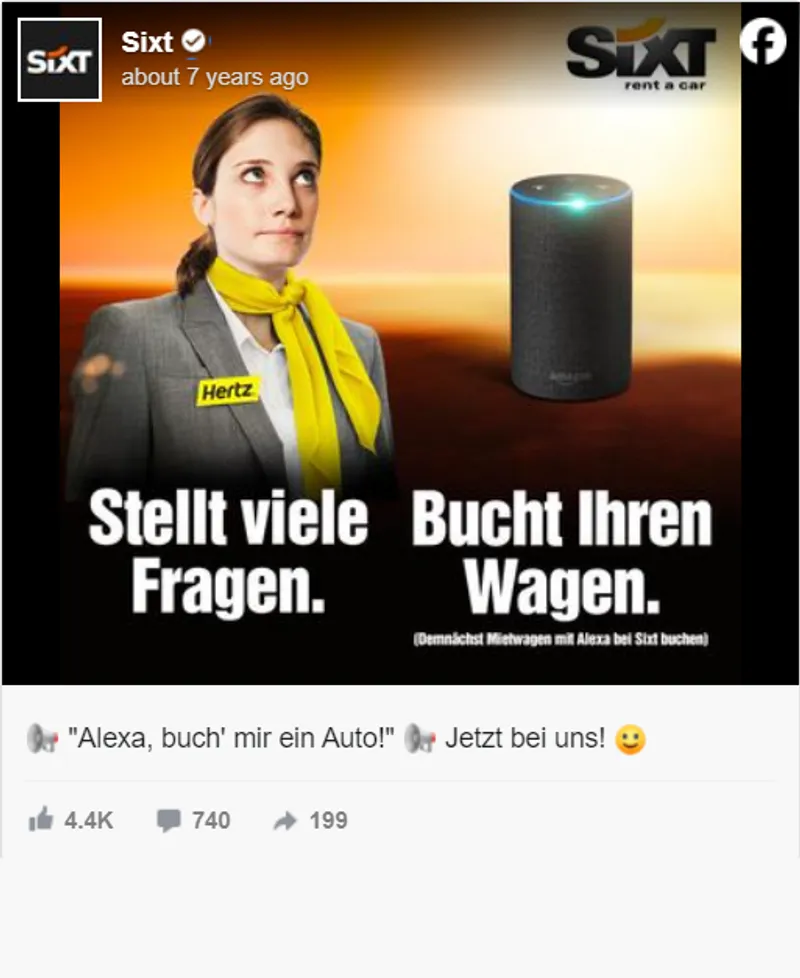
Ein Beispiel, welches ich hier einmal hervorheben möchte ist Sixt, die Autovermietung.

Sixt selbst sagt über sich: “Die SIXT Autovermietung ist bekannt und berüchtigt für ihre ausgefallene und humorvolle Werbung – und das in jeder Spielart. Von gigantischen Flughafeninstallationen über aufsehenerregende Printanzeigen bis hin zu markanten Online-Werbungen sorgt SIXT regelmäßig über alle Kanäle hinweg für großes Staunen” (Sixt, 2021).

Sixt ist immer vorne dabei, was aktuelle politische oder soziale Neuigkeiten angeht und nutzt diese aus um exakt dort provokant anzusetzen und es für ihre Werbung zu nutzen. So erreichen sie eine besonders grße Zielgruppe, egal ob diese das Thema unterstützden oder nicht, da es sowieso ins Lächerliche gezogen wird (Mühlberg, 2025).

Literaturverzeichnis

Dowideit, A. (2012, July 11). Steinschlagschaden: Die Angst vor dem teuren „Krracks“. DIE WELT; WELT. https://www.welt.de/wirtschaft/article108264548/Steinschlagschaden-Die-Angst-vor-dem-teuren-Krracks.html

Haribo. (2026). HARIBO Geschichte – Der Süßwarenkonzern seit 1920. HARIBO. https://www.haribo.com/de-at/ueber-uns/geschichte

McGlone, M. S., & Tofighbakhsh, J. (2000). Birds of a Feather Flock Conjointly (?): Rhyme as Reason in Aphorisms. Psychological Science, 11(5), 424–428. https://doi.org/10.1111/1467-9280.00282

Mühlberg, M. (2025, July 30). Sixt und die Meme-Kultur: Wie viel bringt provokante Online-Werbung? Absatzwirtschaft. https://www.absatzwirtschaft.de/sixt-und-die-meme-kultur-wie-viel-bringt-provokante-online-werbung-274302/

Rhyme. (2025). Rhyme As Reason Effect. Newristics. https://newristics.com/heuristics-biases/rhyme-as-reason-effect

Sixt. (2021). SIXT Werbung | Motive & Kampagnen. Sixt.de. https://www.sixt.de/mietwagenleitfaden/werbung/

IMPULSE #7 – A Talk & A Book

After defining my thesis topic as Narrative UX & Interactive Web Storytelling, I wanted to engage more directly with designers who explicitly connect storytelling and design. One impulse that felt especially relevant was watching Ellen Lupton’s talk Storytelling and Visual Design. After the talk, I spent a few hours browsing through her book Design is Storytelling, skimming through it and reading the parts that drew me in the most.

The Talk: Storytelling and Visual Design

What stayed with me most from Lupton’s talk was her idea of the journey as the interface. She described interfaces as narrative paths, using the example of a weight loss app. The user is on one long journey toward a goal, while within that journey there are many smaller daily journeys, such as logging progress or receiving feedback. Each interaction becomes a small narrative moment within a larger story.

Lupton also explained how even very small design elements can tell stories. Interface icons, transitions, and micro-interactions function as short narrative cues that guide users and shape expectations. Another key idea was her explanation of mazes versus labyrinths. A maze is designed to confuse, while a labyrinth has one guided path. She used IKEA as an example of a labyrinth: a long, structured journey where the visitor moves through different stages and succeeds at the end (often rewarded with a hot dog). This made me think about how well-designed interfaces should guide users through information rather than overwhelm them.

The Book: Design is Storytelling

The book expands on many of the ideas introduced in the talk and frames storytelling as a practical design tool rather than something purely narrative or fictional. Lupton argues that all design communicates a message, whether it is political, social, or cultural, and that storytelling provides a structure for how those messages are experienced. Instead of focusing on linear stories, she presents storytelling as a way of shaping meaning through interaction, sequencing, and context.

A key part of the book is Lupton’s framework of Action, Emotion, and Sensation, which she uses to describe how people move through designed experiences. Action focuses on paths and decisions, similar to the idea of users navigating a guided journey. Emotion centers on empathy and human-centered design methods, such as personas and experiences, while Sensation looks at how users perceive and react to visual and interactive cues. Together, these layers helped me better understand how narrative structure and interaction design overlap.

Another idea that stood out was her explanation of how storytelling adds value by providing context. Lupton uses examples like coffee culture to show how experience can transform a simple product into something more meaningful. This made it clear that storytelling in design is often subtle and embedded in atmosphere, flow, and expectations rather than explicitly told. For my thesis, this reinforced the idea that Narrative UX is less about telling a story to users and more about guiding them through one in a way that feels intentional and coherent.

Why This Was an Impulse for My Research

This impulse helped me clarify how storytelling principles apply directly to interaction design. Lupton’s talk introduced the idea of interfaces as guided journeys, while her book provided language and structure for thinking about narrative in design. For my thesis on Narrative UX & Interactive Web Storytelling, this reinforced the idea that interfaces do not simply present content, but guide users through experiences. Seeing design as a form of storytelling helped me think more intentionally about how users move through digital spaces and how meaning is constructed through interaction.

Stuff Worth Clicking A.K.A. Accompanying Links

Disclaimer: This blog post was written with the help of AI for better grammar and correct spelling.

Impulse #8 Design, Ethics and a lot more to think about

Over the past days and weeks, I had the opportunity to talk with several people whose perspectives strongly influenced the direction of my master’s thesis: Anika Kronberger, Martin Kaltenbrunner, Ursula Lagger, and expecially Horst Hörtner.
Although these conversations were very different in tone and focus, one shared insight gradually became clear: my thesis is not primarily about design decisions or visual outcomes. At its core, it is about ethics.

During my talk with Horst Hörtner, one sentence in particular stayed with me:


“Freedom is not the absence of rules, but the absence of oppression.”


This statement fundamentally changed how I think about my project. Until then, I often approached freedom in digital spaces as something that emerges when rules are removed. However, this idea reframes freedom as something more complex. Rules can exist without limiting freedom, as long as they are not oppressive. This immediately raised deeper questions for my thesis: Who defines these rules? Who enforces them? And can systems designed by humans ever truly be neutral?

Through further discussions with Anika Kronberger and Martin Kaltenbrunner, these questions became even more concrete. We talked about interfaces not just as tools, but as systems that structure behavior. Every interface sets boundaries, even when it appears open or playful. This led to an important doubt: Is a website really the right medium for my project?
While a website is accessible and familiar, it might already carry too many expectations and conventions. Other possibilities came up, such as a browser add-on, a plugin for Google Maps or Google Earth, or interventions that sit closer to existing infrastructures. These alternatives could make rules and control more visible, rather than hiding them behind a neutral-looking interface.

My conversation with Ursula Lagger further reinforced this shift in thinking. We discussed the responsibility of designers and how design decisions always reflect certain values, even when they are framed as purely functional or technical. This made me realize that my artefact should not aim to provide answers or solutions, but rather to expose tensions: freedom versus control, participation versus regulation, action versus permission.

At this stage, I am not fully certain what form my final artefact will take, and I am learning to accept this uncertainty as part of the process. What is clear, however, is that I need to engage more deeply with ethical questions. I want to talk to more people, especially from different backgrounds, to better understand how morality, power, and responsibility intersect with design. Broadening this perspective feels necessary before committing to a specific medium or implementation.

Right now, my outlook is open but focused. I know that my thesis will deal with freedom under rules and with the role design plays in shaping what is allowed, visible, or possible. This shift from form to ethics feels challenging, but also motivating. I am excited to see where these conversations will lead next — and I am genuinely stoked to continue this journey.