When comparing AR on smartphones with VR headsets such as Meta Quest, the discussion should not only focus on immersion, but also on practical use in real retail environments.
Defining the technologies briefly
- Smartphone-based AR (Augmented Reality) means digital elements are added to the real world through a phone screen. The user stays fully aware of their surroundings.
- VR (Virtual Reality) uses head-mounted displays that fully replace the real environment with a virtual one.
While VR offers stronger immersion, this strength also creates operational challenges in retail.
Hardware management and constant care in stores
One major difference between smartphones and VR headsets is device ownership and responsibility.
Smartphones are personal devices. Customers bring their own phones, meaning:
- no shared hardware
- no setup by staff
- no maintenance by the store
- no hygiene management
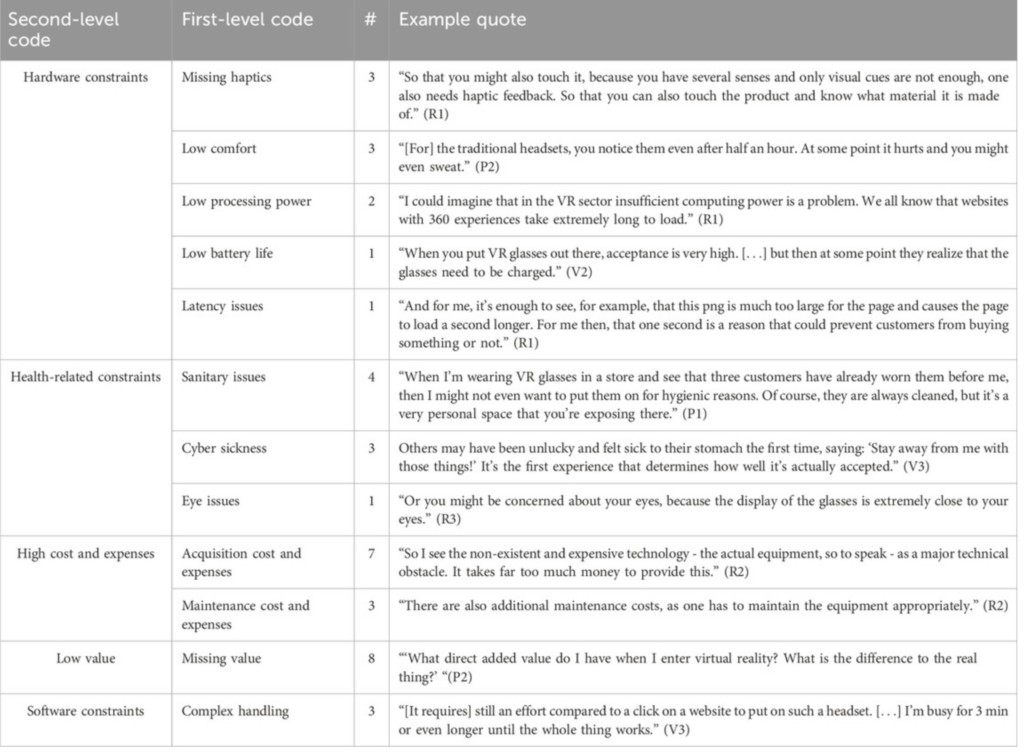
VR headsets, on the other hand, are shared devices in retail settings. This means they require:
- staff supervision
- setup assistance
- regular cleaning and sanitization
- technical troubleshooting
Retail research on VR adoption highlights operational complexity and maintenance effort as key barriers to implementing VR experiences in stores. Studies reviewing VR use in retail environments point out that head-mounted displays require additional resources and management, which makes them harder to integrate into everyday shopping situations.
(Source: Frontiers in Virtual Reality, 2025 – VR adoption barriers)
https://www.frontiersin.org/journals/virtual-reality/articles/10.3389/frvir.2025.1721321/full
Throughput and waiting time: one user vs many users
Another critical issue is throughput, meaning how many people can use a system at the same time.
- Smartphone AR allows many users simultaneously, because everyone uses their own device.
- VR headsets allow only one user at a time per headset.
In busy retail environments, this creates waiting times, which research in consumer behavior shows can reduce satisfaction and willingness to engage. Even highly engaging experiences lose value if customers have to wait, ask for assistance, or interrupt their shopping flow.
low-effort, fast-access solutions are more likely to be adopted than complex systems that slow down the shopping process.
Security and loss prevention as a realistic concern
Another practical issue is security.
VR headsets are:
- expensive
- portable
- visually attractive
In open retail environments, this means they often need:
- constant supervision
- fixed stations
- anti-theft measures
This adds another layer of operational effort. Smartphones avoid this issue entirely because the store does not provide the hardware. From a retail management perspective, this significantly lowers risk and responsibility.
Why smartphones fit everyday retail better
Research on mobile AR in retail shows that smartphones work well because they:
- integrate into existing shopping behavior
- require no additional learning or equipment
- allow users to start and stop instantly
- support short, spontaneous interactions
ease of use and familiarity strongly influence acceptance and engagement in retail contexts.
Conclusion: immersion vs reality
VR headsets like Meta Quest are powerful tools for guided experiences, events, or brand storytelling. However, in everyday retail environments, they introduce challenges related to:
- hardware care
- waiting times
- staff involvement
- security and maintenance
Smartphone-based AR avoids these issues by using devices people already own. This makes it more scalable, safer, and better aligned with real shopping behavior.
For these reasons, smartphone AR currently represents a more realistic and responsible solution for retail experiences focused on comfort, accessibility, and smooth user flow.
In public store environments, VR users must often remain in fixed positions for safety, while wearing highly visible head-mounted displays. Studies show that this increases self-consciousness and feelings of being observed or judged by others, making VR less suitable for casual, everyday shopping experiences. As a result, VR is often better suited to private or controlled environments than open retail spaces.
I particularly appreciate the approach taken by Schwind et al. (2018), as the authors do not only theorize about social acceptance, but empirically investigate how people actually feel when using VR glasses in public spaces—and how the surrounding public reacts to this use. By testing VR glasses in different everyday contexts, the study shows that while VR use is more accepted in private or socially isolated situations (such as at home or on a train), acceptance decreases significantly in public environments where social interaction is expected. This finding is especially relevant for retail contexts, as the high level of immersion provided by VR glasses also makes the user more visible and socially exposed, which can increase self-consciousness and discomfort.
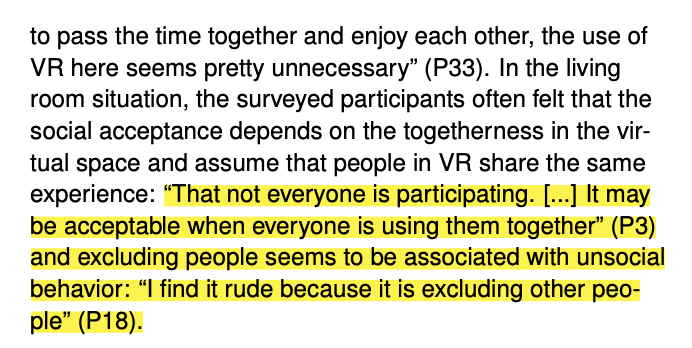
Virtual Reality on the Go? A Study on Social Acceptance of VR Glasseshttps://www.researchgate.net/publication/327256690_Virtual_reality_on_the_go_a_study_on_social_acceptance_of_VR_glasses
(In the development of this blogpost, AI (ChatGPT) was used as a supportive writing and structuring tool. I provided the conceptual content, research direction, theoretical preferences, and methodological decisions, while the AI assisted in translating it to English, refining the wording, organising the material and generating coherent academic formulations based on my input. The AI did not produce research or arguments but helped transform my ideas into a clear and well-structured text draft.)
