Introduction
In today’s digital world, websites are an essential part of communication and branding, yet their environmental impact is often overlooked. Every webpage consumes energy, through data centers, user devices, and data transmission. This entry explores how we can measure and reduce the carbon footprint of websites through simple optimizations.
Practical Exercise: Testing Website Carbon Footprints
Step 1: Measuring CO₂ Emissions of Websites
To understand the environmental impact of different website designs, I analyzed three websites using the Website Carbon Calculator:
- Wikipedia (https://www.wikipedia.org/) – A text-heavy, minimalistic site.
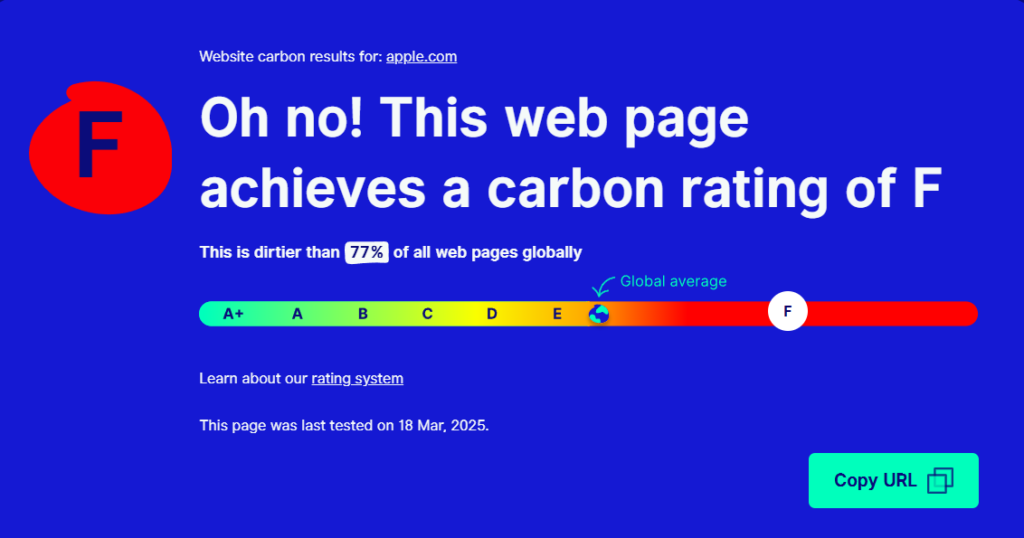
- Apple (https://www.apple.com/) – A high-design, image-rich site with animations.
- H&M Online Shop (https://www.hm.com/) – A dynamic e-commerce platform with extensive tracking and interactivity.
Initial Findings:
- Wikipedia: ~0.02g CO₂ per visit – highly efficient due to minimal design.

- Apple: ~0.54g CO₂ per visit – significant energy use due to high-resolution visuals.
- H&M: ~1.5g CO₂ per visit – the highest footprint, likely due to third-party tracking, interactive elements, and large product images.

These numbers reflect the per-visit emissions, meaning that on a global scale, these websites generate tons of CO₂ per year, depending on their traffic.
Step 2: Estimating the Impact of Optimizations (Using Apple.com as an Example)
To see how much a website’s footprint could be reduced, I modeled potential optimizations for Apple’s homepage.
Before Optimization (Apple.com Homepage)
- Page size: 5.1 MB
- Estimated CO₂ per visit: 0.54g CO₂
- Annual emissions estimate (1M daily visits): ~197 tons of CO₂
Possible Optimizations & Estimated Impact:
| Optimization | Estimated Size Reduction | New CO₂ per Visit | Potential Annual Savings |
| Image Compression (WebP instead of PNG/JPEG) | ~30% reduction | 0.42g CO₂ | ~43 tons saved |
| Lazy Loading & Caching | ~10% reduction | 0.38g CO₂ | ~19 tons saved |
| Reducing Animations & Tracking Scripts | ~20% reduction | 0.30g CO₂ | ~79 tons saved |
After Optimization (Theoretical Best Case)
- New page size: ~3 MB
- New estimated CO₂ per visit: ~0.30g CO₂
- Annual emissions estimate (1M daily visits): ~109 tons of CO₂ (a ~45% reduction!)
These calculations demonstrate how even basic changes, like compressing images and reducing animations, could make a website significantly more sustainable.
Key Learnings & Takeaways
Web design choices have a measurable environmental impact.
Simple optimizations can cut CO₂ emissions almost in half.
Sustainable design isn’t just about print, digital design matters as well.
Resources
- Website Carbon Calculator: https://www.websitecarbon.com/
