
What is the research topic / central research question?
Research Topic:
The cultural and commercial significance of luxury brand collaborations in shaping design trends and consumer perceptions from the 1980s to today.
In the world of luxury, collaborations between major brands have become an essential strategy for stimulating innovation, broadening their customer base and raising their profile. These partnerships create a unique synergy, combining the prestige of different houses to offer exclusive products.
Central Research Question:
How do brand collaborations influence design aesthetics, consumer behavior, and brand strategy, and how have these dynamics evolved?
Why is it relevant to designers / what are the ‘problems to solve’?
While the concept of the brand collaboration isn’t new, the pace at which both luxury and general consumer brands are rolling out collaborations is accelerating.
Synergy between luxury brands from disparate verticals offers a powerful solution to the challenge of capturing consumer engagement, particularly as the consumer attention span shrinks, market saturation is at an all-time high and instant gratification reigns supreme. In fact, today, collaborations aren’t just a trend; they are a strategic imperative in a competitive marketplace.
Collaborations are a requisite for any (luxury) brand looking to offer its existing customer base new moments of discovery, interest and intrigue while also strategically expanding into new audience verticals.
Relevance to Designers:
- Cultural Impact of Design: Collaborations between luxury brands and unexpected partners (e.g., artists, mainstream brands, or celebrities) redefine what is considered “luxury” and expand the boundaries of design language.
- Maintaining Brand Identity: Designers must find the balance between innovation and preserving a brand’s core identity. This is especially challenging when two distinct creative visions merge.
- Accessibility vs. Exclusivity: How can brands create accessible, aspirational collections without diluting their luxury status? Designers play a crucial role in achieving this balance.
- Sustainability: The rise of limited-edition collections raises questions about overproduction, fast fashion, and long-term cultural value.
Problems to Solve:
- How can luxury brands stay relevant in a world increasingly driven by Gen Z and millennial values, such as inclusivity and sustainability?
- What makes a collaboration successful both visually and commercially? Examples like Gucci x North Face succeed, while ventures like Target x Neiman Marcus fail.
- How do cultural, technological, and generational shifts shape the nature of collaborations?
3. My motivation & interest
Luxury brand collaborations offer a fascinating lens to study the intersection of design, culture, and commerce. They often reflect the zeitgeist of a specific era—whether it’s the graffiti-inspired Louis Vuitton x Stephen Sprouse collection of the early 2000s or the contemporary blending of high fashion and streetwear. Personally, this topic resonates because it showcases how creativity can transcend traditional boundaries while posing new challenges for modern designers.
This research highlights the power of collaboration to reinvent iconic brands and define new cultural narratives. It’s also intriguing to explore how these collaborations influence design aesthetics across industries and inspire broader creative movements.
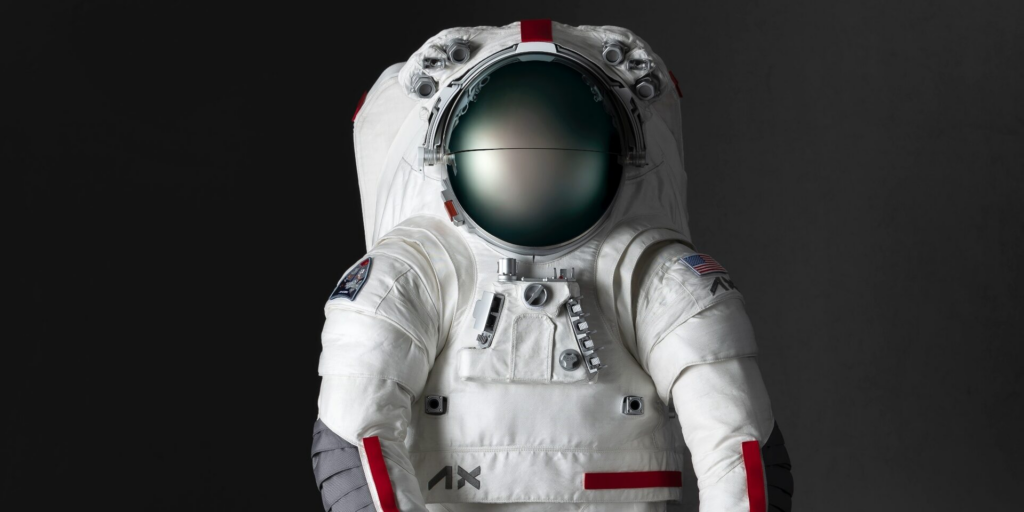

Research Results
- Design Evolution:
- The 1980s: Luxury brands focused on exclusivity and craftsmanship, with less emphasis on collaborations. Design was largely driven by opulence and classicism.
- Today: Luxury brands embrace collaborations to stay culturally relevant, often blending nostalgia with modernity to appeal to younger audiences.
- Consumer Behavior:
- Collaborations significantly impact purchasing decisions, particularly among Gen Z and millennials.
- Authenticity and uniqueness are critical factors in determining the success of a collaboration.
- Aesthetic Trends:
- High-low collaborations (e.g., H&M x Karl Lagerfeld) have introduced luxury aesthetics to mainstream audiences.
- Unexpected pairings (e.g., Dior x Technogym) challenge traditional notions of luxury while expanding brand narratives.
- Commercial Value:
- Successful collaborations drive significant revenue increases and long-term brand loyalty.
Research Methods: Comparative analysis of iconic collaborations
Best practice examples / state of the art

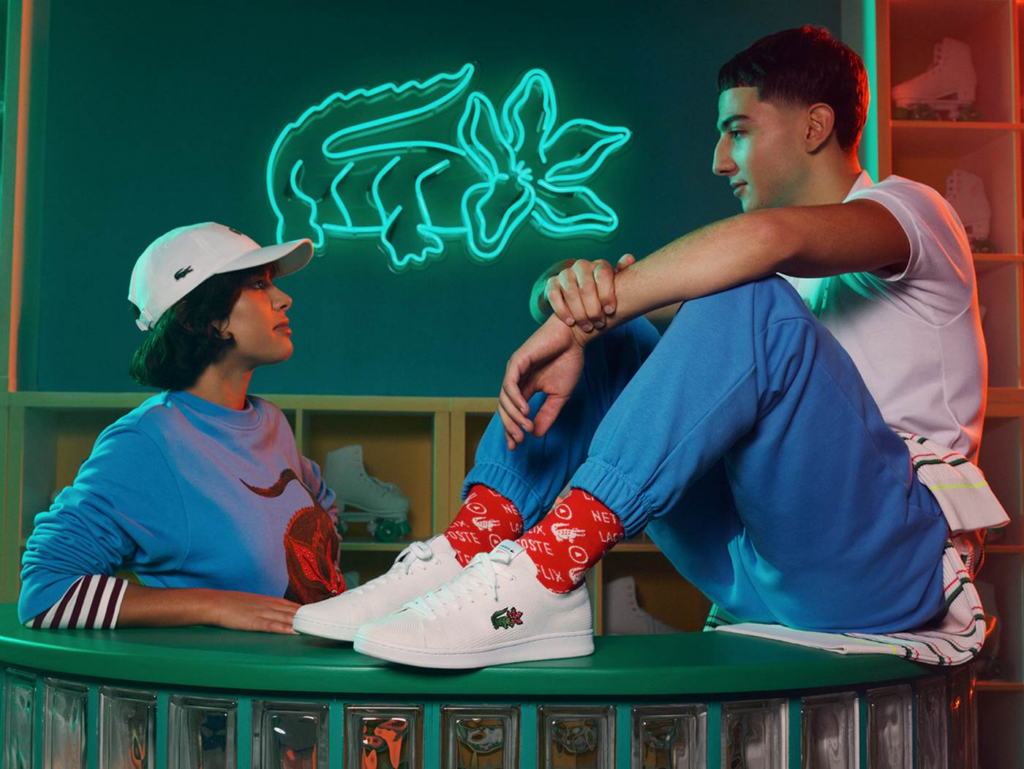
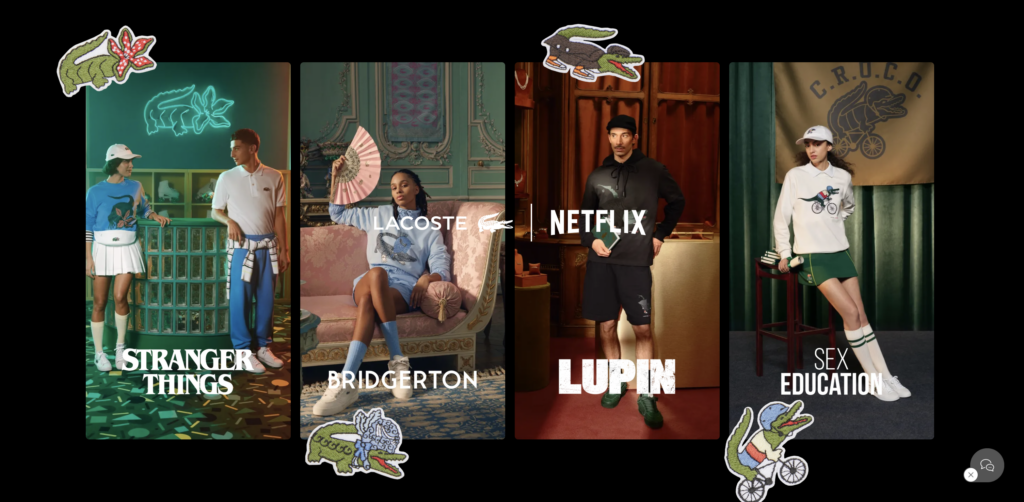
Stranger things is an 80s inspired Netflix series, which is now available as merch from Lacoste. Combining nostalgia, luxury and mainstream media all in one campaign. And they did not stop there: Bridgerton, Sex Education, Lupin, Shadow and Bone, Elite, La Casa de Papel, The Witcher were all incorporated in collections of Lacoste.
1980s Collaborations:
- Karl Lagerfeld x Chanel (1980s): Lagerfeld’s transformative influence on Chanel laid the foundation for modern luxury collaborations.
Modern Collaborations:
- Luxury Brand x Luxury Brand:
- Fendi x Versace (“Fendace”): A successful reinterpretation of each other’s aesthetics, showcasing how luxury brands can cross-pollinate.
- Luxury Brand x Celebrity:
- Louis Vuitton x Kanye West: A groundbreaking sneaker collaboration that combined luxury with streetwear.
- Luxury Brand x Surprise Partner:
- Gucci x North Face: A marriage of outdoor practicality and high fashion, appealing to the rising trend of luxury athleisure. A separate logo was designed for the joint collection, combining The North Face’s graphic logo, which is inspired by a mountain, with the green-red-green weave of the GUCCI house.

Vision & next steps
My Vision is to understand the cultural, aesthetic, and commercial dynamics of luxury collaborations. This could include conceptualizing and executing mockup collaborations, ensuring they resonate both visually and culturally. Or I aim to present my research as an own design merge, that inspires creatives and viewers to think differently about a given topic and put it into another context.
For this I would have to conduct consumer sentiment surveys and polls regarding collaboration campaigns.
- Explore the Intersection of Nostalgia and Innovation:
- Investigate how collaborations use nostalgia (e.g., 1980s influences) to attract modern audiences.
- Examine how digital tools like AR and CGI expand the storytelling possibilities
- Study the Role of Cultural Context:
- Analyze how collaborations reflect societal values, such as inclusivity, sustainability, and technological innovation.
- Case Study Development:
- Conduct in-depth case studies of successful and failed collaborations to identify best practices and pitfalls.
- Analysis of commercial performance metrics for high-profile collaborations.
- Interviews with design and branding professionals.


Further research questions
Which industies or topics could I target? Interior, Cars, Digital Sector, Music, Games Politics, …?
Resources
- https://www.supdeluxe.com/en/collaboration-marque-de-luxe
- https://luxe.croud.com/en-gb/insights/the-history-and-effectiveness-of-luxury-brand-collaborations/
- https://www.luxurydaily.com/the-future-of-successful-luxury-brand-collaborations/
- https://www.sothebysinstitute.com/how-to-series/luxury-branding
- https://www.gucci.com/de/de/st/stories/article/the-north-face-gucci-campaign?srsltid=AfmBOooCLzXwRhdsp_48EbIvgA2V2Mfd3FpCdNYNdmvTT4l8fn89Kt92
- https://www.mcarthurglen.com/de/outlets/at/designer-outlet-parndorf/news/not-published-whats-on-pages/Lacoste-x-Netflix/
- https://www.lacoste.com/de/netflix.html#/
- https://www.nzz.ch/panorama/prada-fliegt-mit-der-nasa-zum-mond-auch-andere-edelmarken-sind-ins-geschaeft-mit-der-raumfahrt-eingestiegen-ld.1853458
- https://www.ingenieur.de/technik/fachbereiche/raumfahrt/diese-neue-raumanzuege-werden-menschen-auf-dem-mond-tragen/
- https://www.spiegel.de/panorama/nasa-mission-astronauten-tragen-weltraumanzug-von-prada-a-096db732-7e05-4702-bc27-f25be9414650
- https://www.axiomspace.com/release/prada-axiom-suit
- https://www.prada.com/at/de/pradasphere/special-projects/2024/prada-axiom.html
