Early on in my research I came across the document “eHealth-Strategie Österreich” created by the Ministry of Social Affairs (Sozialministerium) published in June 2024.
The digitalization of healthcare in Austria was significantly accelerated by the pandemic. For the first time, there were large-scale online appointment bookings and teleconsultations, the hotline 1450 was expanded, and the e-prescription has now become established. To further advance digitalization, the federal government, states, and social insurance will provide an additional 51 million euros annually as part of the healthcare reform. The “eHealth Strategy Austria” defines the focus areas and priorities for implementation in the coming years.
This document presents Austria’s eHealth strategy for 2024–2030, aiming to digitally transform its healthcare system. It outlines strategic and operational goals, including improved digital access, telehealth services, infrastructure development, and data utilisation. The strategy emphasises patient-centric care, incorporates a participatory stakeholder process, and addresses challenges like digital literacy and data governance. Implementation plans and monitoring frameworks are detailed, with a commitment to regular updates. International best practices and the European Health Data Space are also considered.
The Austrian eHealth strategy aims to define a shared vision for eHealth and digitalisation in the health and care sector in Austria, with a focus on further development. The strategy seeks to contribute to the maintenance and restoration of health through the appropriate use of digitalisation. It addresses various target groups, including citizens, patients, healthcare providers, and those involved in research and system management.
Eight strategic goals, each with specific measures are designed to achieve the objectives of the strategy:
- Enabling digital access to the healthcare system. This involves ensuring all citizens and healthcare providers have access to the public health telematics infrastructure (GTI) and that digital services are integrated across all levels of care, while maintaining analogue options.
- Creating telehealth prevention and care solutions. This aims to develop a network of telehealth services to improve patient care and enhance collaboration among healthcare providers, with clear legal and organisational frameworks.
- Further developing the public health telematics infrastructure (Gesundheitstelematik-Infrastruktur GTI). The goal is to establish a robust and convergent infrastructure to support digitalisation in the health and care sectors. This includes ensuring the GTI’s operation, updating its architecture, and expanding its connectivity to all relevant healthcare providers.
- Providing central eHealth services/components. This involves offering essential services and components to support participation in the public GTI, utilizing the existing e-government infrastructure.
- Establishing registers relevant to healthcare and governance. This focuses on having a defined set of registers for health data, both statutory and virtual, which are essential for improving care quality, patient safety and system management.
- Strengthening the secondary use of health data. The strategy aims to create a secure platform for the secondary use of health data in research and system management, ensuring compliance with data protection standards and the European Health Data Space (EHDS).
- Making innovation accessible. This involves creating a structured approach to innovation within the public health system, setting up transparent processes for introducing external innovations, and ensuring that innovative projects receive sufficient support and funding.
- Strengthening digital skills. The strategy seeks to ensure that both patients and healthcare providers have the necessary digital skills, with readily available training and support.
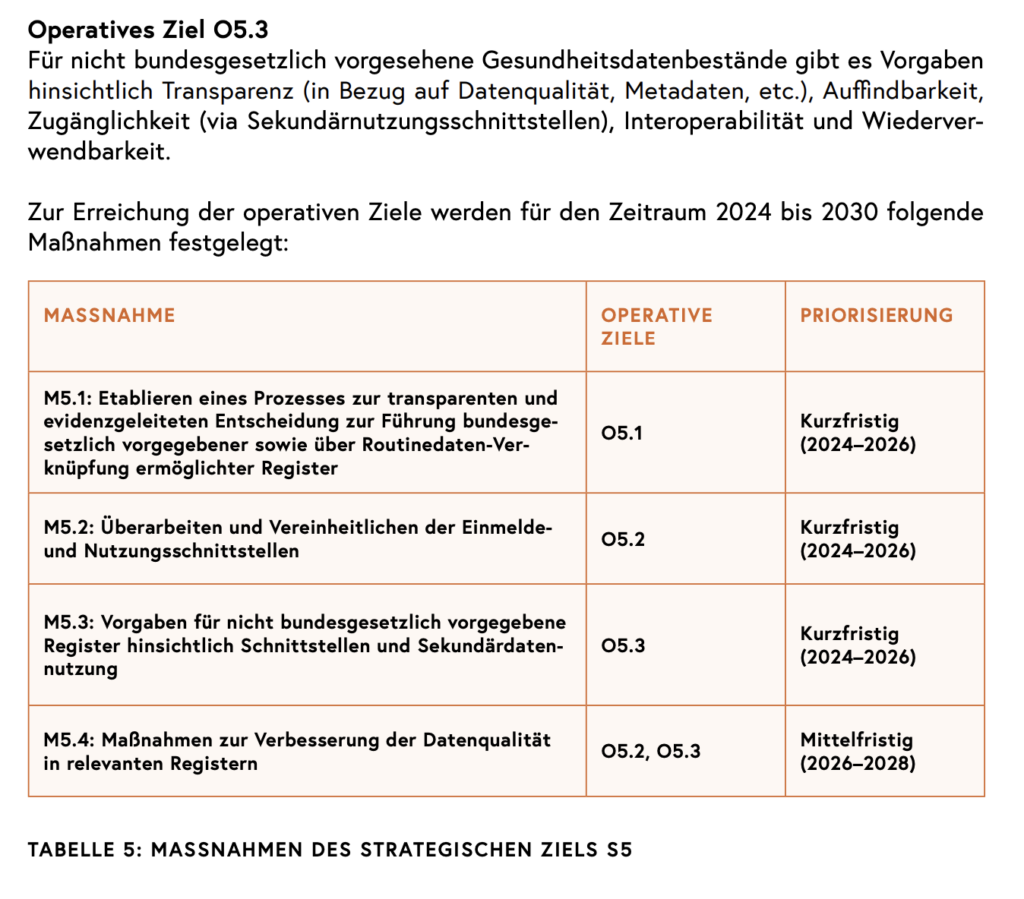
Each goal is then broken down into operational goals and specific measures. The following screenshot shows what this looks like for the 5th goal “Establishing registers relevant to healthcare and governance“.
By actively engaging users in the design and testing phases, the Austrian eHealth strategy aims to create digital health solutions that are both effective and accepted by the public. The paper states that the development process must be user-centred and participatory, involving potential users in the design process.
The strategy is designed to be a living document, and will be updated every five years, aligning with financial equalisation periods. It is also intended to align with the health reform of 2023, the Federal Target-Based Governance Contract of 2024 and the “digital before outpatient before inpatient” (digital vor ambulant vor stationär) principle. The eHealth strategy is designed to be a collaborative effort that involves all relevant stakeholders and aims to create a patient-centred digital health system.
References
BMSGPK (2024): eHealth-Strategie
Österreich. v1.0 im Juni 2024. Bundesministerium für Soziales, Gesundheit,
Pflege und Konsumentenschutz, Wien
https://www.sozialministerium.at/Themen/Gesundheit/eHealth/eHealth-in-Oesterreich.html
