Product X: Image Extender

Extending the System from Image Interpretation to Image Synthesis

This update marked a conceptual shift in the system’s scope: until now, images functioned purely as inputs, sources of visual information to be analyzed, interpreted, and mapped onto sound. With this iteration, I expanded the system to also support image generation, enabling users not only to upload visual material but to synthesize it directly within the same creative loop.

The goal was not to bolt on image generation as a novelty feature, but to integrate it in a way that respects the system’s broader design philosophy: user intent first, semantic coherence second, and automation as a supportive, not dominant, layer.

Architectural Separation: Reasoning vs. Rendering

A key early decision was to separate prompt reasoning from image rendering. Rather than sending raw user input directly to the image model, I introduced a two-stage pipeline:

  1. Prompt Interpretation & Enrichment (GPT-4.1)
    Responsible for understanding vague or underspecified user prompts and rewriting them into a semantically complete, realistic scene description.
  2. Image Synthesis (gpt-image-1 → DALL-E 2/3)
    Dedicated purely to rendering the final image from the enriched prompt. Through implementation, I discovered that while the original spec referenced gpt-image-1, OpenAI’s actual models are DALL-E 2 (60% cheaper, faster, but less detailed) and DALL-E 3 (higher quality but more expensive).

This separation mirrors the system’s audio architecture, where semantic interpretation and signal processing are deliberately decoupled. GPT-4.1 acts as a semantic mediator, while the image model remains a deterministic renderer.
The Response Format Learning Curve

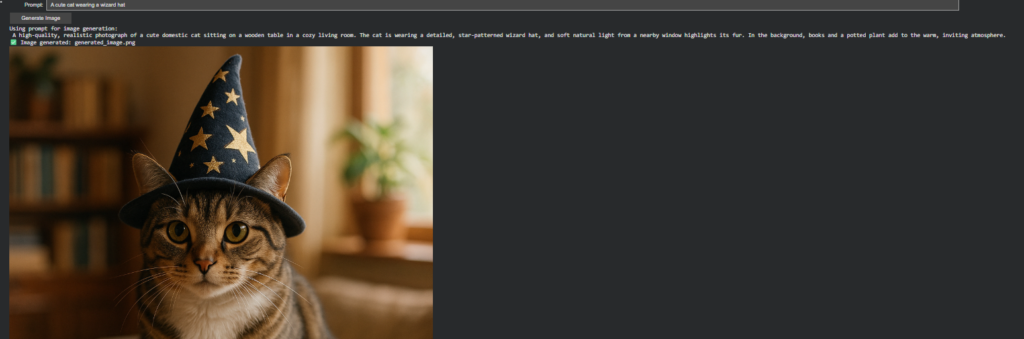
During implementation, I encountered a subtle but important API nuance that forced a deeper understanding of the system’s data flow: DALL-E models return URLs by default, not base64 data. The initial implementation failed with a confusing “NoneType” error because I was trying to decode a base64 field that didn’t exist.

The fix was elegantly simple, adding response_format=”b64_json” to the API call—but the debugging process revealed something more fundamental about API design: different services have different default behaviors, and understanding those defaults is crucial for robust system integration.

This also led to implementing proper fallback logic: if base64 isn’t available, the system gracefully falls back to downloading from the image URL, ensuring reliability across different OpenAI model versions and configurations.

Interactive Workflow Integration with Toggle Architecture

To maintain consistency with the existing interactive toolset while adding flexibility, I implemented a mode-toggle architecture:

  • Upload Mode: Traditional file upload with drag-and-drop support
  • Generate Mode: Text-to-image synthesis with prompt enrichment
  • State Preservation: The system maintains a single IMAGE_FILE variable that can be overwritten by either mode, ensuring seamless transitions between workflows

The interface exposes this through clean toggle buttons, showing only the relevant UI for each mode. This reduces cognitive load while preserving full functionality, a principle I’ve maintained throughout the system’s evolution.

Cost-Aware Design with Caching and Model Selection

Image synthesis presents unique cost challenges compared to text generation or audio processing. I implemented several cost-mitigation strategies learned through experimentation:

  1. Resolution Control: Defaulting to 1024×1024  or 512×512 (for DALL-E 2)
  2. Quality Parameter Awareness: Only DALL-E 3 supports quality=”standard” vs “hd”—using the wrong parameter with DALL-E 2 causes API errors

The cost considerations weren’t just about saving money—they were about enabling iteration. When artists can generate dozens of variations without financial anxiety, they explore more freely. The system defaults to the cheapest viable path, with quality controls available but not forced.
Prompt Realism as a Soft Constraint

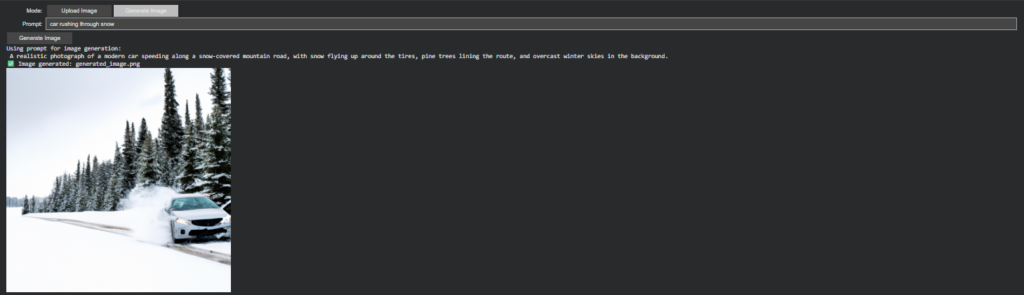
Rather than enforcing hard validation rules (e.g., predefined lists of places or objects), I chose to treat realism as a soft constraint enforced by language, not logic.

User prompts are passed through a prompt-enrichment step where GPT-4.1 is instructed to:

  • Reframe the input as a photographic scene
  • Ensure the presence of spatial context (location, environment)
  • Ground the description in physical objects and lighting
  • Explicitly avoid illustrated, cartoon, or painterly styles

This approach preserves creative freedom while ensuring that the downstream image generation remains visually coherent and photo-realistic. Importantly, the system does not reject user input—it interprets it.

Design Philosophy: Generation as a First-Class Input

What this update ultimately enabled is a shift in how the system can be used:

  • Images are no longer just analyzed artifacts
  • They can now be constructed, refined, and immediately fed into downstream processes (visual analysis, audio mapping, spatial inference)

This closes a loop that previously required external tools. The system now supports a full cycle: imagine → generate → interpret → sonify.

Crucially, the same principle that guided earlier updates still applies: automation should amplify intent, not replace it. Image generation here is not about producing spectacle, but about giving users a controlled, semantically grounded way to define the visual worlds their soundscapes respond to.

The implementation journeyfrom API quirks to cost optimization to user experience design, reinforced that even “simple” features require deep consideration when integrating into a complex creative system. Each new capability should feel like it was always there, waiting to be discovered.
Product IX: Image Extender

Moving Beyond Dry Audio to Spatially Intelligent Soundscapes

My primary objective for this update was to bridge a critical perceptual gap in the system: while the previous iterations successfully mapped visual information to sonic elements with precise panning and temporal placement, the resulting audio mix remained perceptually “dry” and disconnected from the image’s implied acoustic environment. This update introduces adaptive reverberation, not as a cosmetic effect, but as a semantically grounded spatialization layer that transforms discrete sound objects into a coherent, immersive acoustic scene.

System Architecture

The existing interactive DAW interface, with its per-track volume controls, sound replacement engine, and user feedback mechanisms, was extended with a comprehensive spatial audio processing module. This module interprets the reverb parameters derived from image analysis (room detection, size estimation, material damping, and spatial width) and provides interactive control over their application.

Global Parameter State & Data Flow Integration

A crucial architectural challenge was maintaining separation between the raw audio mix (user-adjustable volume levels) and the reverb-processed version. I implemented a dual-state system with:

  • current_mix_raw: The continuously updated sum of all audio tracks with current volume slider adjustments.
  • current_mix_with_reverb: A cached, processed version with reverberation applied, recalculated only when reverb parameters change or volume sliders are adjusted with reverb enabled.

This separation preserves processing efficiency while maintaining real-time responsiveness. The system automatically pulls reverb parameters (room_sizedampingwet_levelwidth) from the image analysis block when available, providing image-informed defaults while allowing full manual override.

Pedalboard-Based Reverb Engine

I integrated the pedalboard audio processing library to implement professional-grade reverberation. The engine operates through a transparent conversion chain:

  1. Format ConversionAudioSegment objects (from pydub) are converted to NumPy arrays normalized to the [-1, 1] range
  2. Pedalboard Processing: A Reverb effect instance applies parameters with real-time adjustable controls
  3. Format Restoration: Processed audio is converted back to AudioSegment while preserving sample rate and channel configuration

The implementation supports both mono and stereo processing chains, maintaining compatibility with the existing panning system.

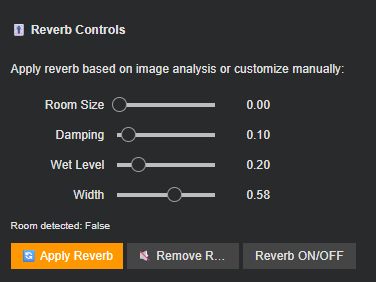
Interactive Reverb Control Interface

A dedicated control panel was added to the DAW interface, featuring:

  • Parameter Sliders: Four continuous controls for room size, damping, wet/dry mix, and stereo width, pre-populated with image-derived values when available
  • Toggle System: Three distinct interaction modes:
    1. “🔄 Apply Reverb”: Manual application with current settings
    2. “🔇 Remove Reverb”: Return to dry mix
    3. “Reverb ON/OFF Toggle”: Single-click switching between states
  • Contextual Feedback: Display of image-based room detection status (indoor/outdoor)

Seamless Playback Integration

The playback system was redesigned to dynamically switch between dry and wet mixes:

  • Intelligent Routing: The play_mix() function automatically selects current_mix_with_reverb or current_mix_raw based on the reverb_enabled flag
  • State-Aware Processing: When volume sliders are adjusted with reverb enabled, the system automatically reapplies reverberation to the updated mix, maintaining perceptual consistency
  • Export Differentiation: Final mixes are exported with _with_reverb or _raw suffixes, providing clear version control

Design Philosophy: Transparency Over Automation

This phase reinforced a critical design principle: spatial effects should enhance rather than obscure the user’s creative decisions. Several automation approaches were considered and rejected:

  • Automatic Reverb Application: While the system could automatically apply image-derived reverb, I preserved manual activation to maintain user agency
  • Dynamic Parameter Adjustment: Real-time modification of reverb parameters during playback was technically feasible but introduced perceptual confusion
  • Per-Track Reverb: Individual reverberation for each sound object would create acoustic chaos rather than coherent space

The decision was made to implement reverb as a master bus effect, applied consistently to the entire mix after individual track processing. This approach creates a unified acoustic space that respects the visual scene’s implied environment while preserving the clarity of individual sound elements.

Technical Challenges & Solutions

State Synchronization

The most significant challenge was maintaining synchronization between the constantly updating volume-adjusted mix and the computationally expensive reverb processing. The solution was a conditional caching system: reverb is only recalculated when parameters change or when volume adjustments occur with reverb active.

Format Compatibility

Bridging the pydub-based mixing system with pedalboard‘s NumPy-based processing required careful attention to sample format conversion, channel configuration, and normalization. The implementation maintains bit-perfect round-trip conversion.

Product VI: Image Extender

Intelligent Balancing – progress of automated mixing

This development phase introduces a sophisticated dual-layer audio processing system that addresses both proactive and reactive sound masking, creating mixes that are not only visually faithful but also acoustically optimal. Where previous systems focused on semantic accuracy and visual hierarchy, we now ensure perceptual clarity and natural soundscape balance through scientific audio principles.

The Challenge: High-Energy Sounds Dominating the Mix

During testing, we identified a critical issue: certain sounds with naturally high spectral energy (motorcycles, engines, impacts) would dominate the audio mix despite appropriate importance-based volume scaling. Even with our masking analysis and EQ correction, these sounds created an unbalanced listening experience where the mix felt “crowded” by certain elements.

Dual-Layer Solution Architecture

Layer 1: Proactive Energy-Based Gain Reduction

This new function analyzes each sound’s spectral energy across Bark bands (psychoacoustic frequency scale) and applies additional gain reduction to naturally loud sounds. The system:

  1. Measures average and peak energy across 24 Bark bands
  2. Calculates perceived loudness based on spectral distribution
  3. Applies up to -6dB additional reduction to high-energy sounds
  4. Modulates reduction based on visual importance (high importance = less reduction)

Example Application:

  • Motorcycle sound: -4.5dB additional reduction (high energy in 1-4kHz range)
  • Bird chirp: -1.5dB additional reduction (lower overall energy)
  • Both with same visual importance, but motorcycle receives more gain reduction

Layer 2: Reactive Masking EQ (Enhanced)

Improved Feature: Time-domain masking analysis now works with consistent positioning

We fixed a critical bug where sound positions were being randomized twice, causing:

  • Overlap analysis using different positions than final placement
  • EQ corrections applied to wrong temporal segments
  • Inconsistent final mix compared to analysis predictions

Solution: Position consistency through saved_positions system:

  • Initial random placement saved after calculation
  • Same positions used for both masking analysis and final timeline
  • Transparent debugging output showing exact positions used

Key Advancements

  1. Proactive Problem Prevention: Energy analysis occurs before mixing, preventing issues rather than fixing them
  2. Preserved Sound Quality: Moderate gain reduction + moderate EQ = better than extreme EQ alone
  3. Phase Relationship Protection: Gain reduction doesn’t affect phase like large EQ cuts do
  4. Mono Compatibility: Less aggressive processing improves mono downmix results
  5. Transparent Debugging: Complete logging shows every decision from energy analysis to final placement

Integration with Existing System

The new energy-based system integrates seamlessly with our established pipeline:

text

Sound Download → Energy Analysis → Gain Reduction → Importance Normalization

→ Timeline Placement → Masking EQ (if needed) → Final Mix

This represents an evolution from reactive correction to intelligent anticipation, creating audio mixes that are both visually faithful and acoustically balanced. The system now understands not just what sounds should be present, but how they should coexist in the acoustic space, resulting in professional-quality soundscapes that feel natural and well-balanced to the human ear.

Product IV: Image Extender

Semantic Sound Validation & Ensuring Acoustic Relevance Through AI-Powered Verification

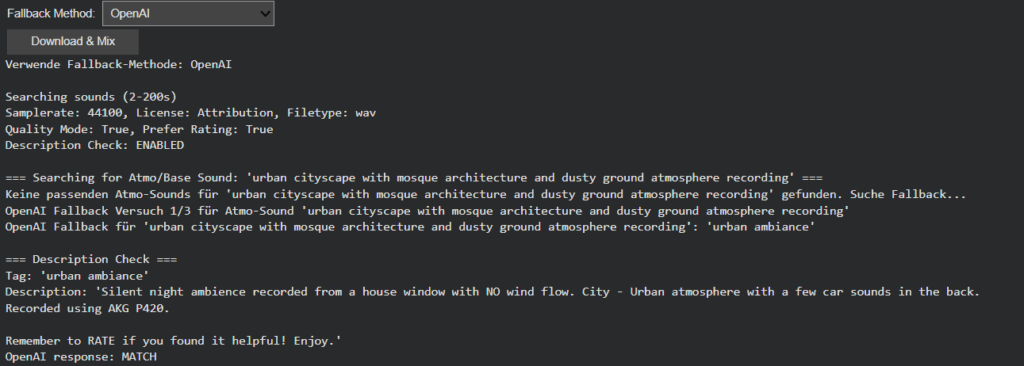
Building upon the intelligent fallback systems developed in Phase III, this week’s development addressed a more subtle yet critical challenge in audio generation: ensuring that retrieved sounds semantically match their visual counterparts. While the fallback system successfully handled missing sounds, I discovered that even when sounds were technically available, they didn’t always represent the intended objects accurately. This phase introduces a sophisticated description verification layer and flexible filtering system that transforms sound retrieval from a mechanical matching process to a semantically intelligent selection.

The newly implemented description verification system addresses this through OpenAI-powered semantic analysis. Each retrieved sound’s description is now evaluated against the original visual tag to determine if it represents the actual object or just references it contextually. This ensures that when Image Extender layers “car” sounds into a mix, they’re authentic engine recordings rather than musical tributes.

Intelligent Filter Architecture: Balancing Precision and Flexibility

Recognizing that overly restrictive filtering could eliminate viable sounds, we redesigned the filtering system with adaptive “any” options across all parameters. The Bit-Depth filter got removed because it resulted in search errors which is also mentioned in the documentation of the freesound.org api.

Scene-Aware Audio Composition: Atmo Sounds as Acoustic Foundation

A significant architectural improvement involves intelligent base track selection. The system now distinguishes between foreground objects and background atmosphere:

  • Scene & Location Analysis: Object detection extracts environmental context (e.g., “forest atmo,” “urban street,” “beach waves”)
  • Atmo-First Composition: Background sounds are prioritized as the foundational layer
  • Stereo Preservation: Atmo/ambience sounds retain their stereo imaging for immersive soundscapes
  • Object Layering: Foreground sounds are positioned spatially based on visual detection coordinates

This creates mixes where environmental sounds form a coherent base while individual objects occupy their proper spatial positions, resulting in professionally layered audio compositions.

Dual-Mode Object Detection with Scene Understanding

OpenAI GPT-4.1 Vision: Provides comprehensive scene analysis including:

  • Object identification with spatial positioning
  • Environmental context extraction
  • Mood and atmosphere assessment
  • Structured semantic output for precise sound matching

MediaPipe EfficientDet: Offers lightweight, real-time object detection:

  • Fast local processing without API dependencies
  • Basic object recognition with positional data
  • Fallback when cloud services are unavailable

Wildcard-Enhanced Semantic Search: Beyond Exact Matching

Multi-Stage Fallback with Verification Limits

The fallback system evolved into a sophisticated multi-stage process:

  1. Atmo Sound Prioritization: Scene_and_location tags are searched first as base layer
  2. Object Search: query with user-configured filters
  3. Description Verification: AI-powered semantic validation of each result
  4. Quality Tiering: Progressive relaxation of rating and download thresholds
  5. Pagination Support: Multiple result pages when initial matches fail verification
  6. Controlled Fallback: Limited OpenAI tag regeneration with automatic timeout

This structured approach prevents infinite loops while maximizing the chances of finding appropriate sounds. The system now intelligently gives up after reasonable attempts, preventing computational waste while maintaining output quality.

Toward Contextually Intelligent Audio Generation

This week’s enhancements represent a significant leap from simple sound retrieval to contextually intelligent audio selection. The combination of semantic verification, adaptive filtering and scene-aware composition creates a system that doesn’t just find sounds, it finds the right sounds and arranges them intelligently.

Product I: Image Extender

OpenAI API Image Analyzer – Structured Vision Testing and Model Insights

Adaptive Visual Understanding Framework
In this development phase, the focus was placed on building a robust evaluation framework for OpenAI’s multimodal models (GPT-4.1 and GPT-4.1-mini). The primary goal: systematically testing image interpretation, object detection, and contextual scene recognition while maintaining controlled cost efficiency and analytical depth.

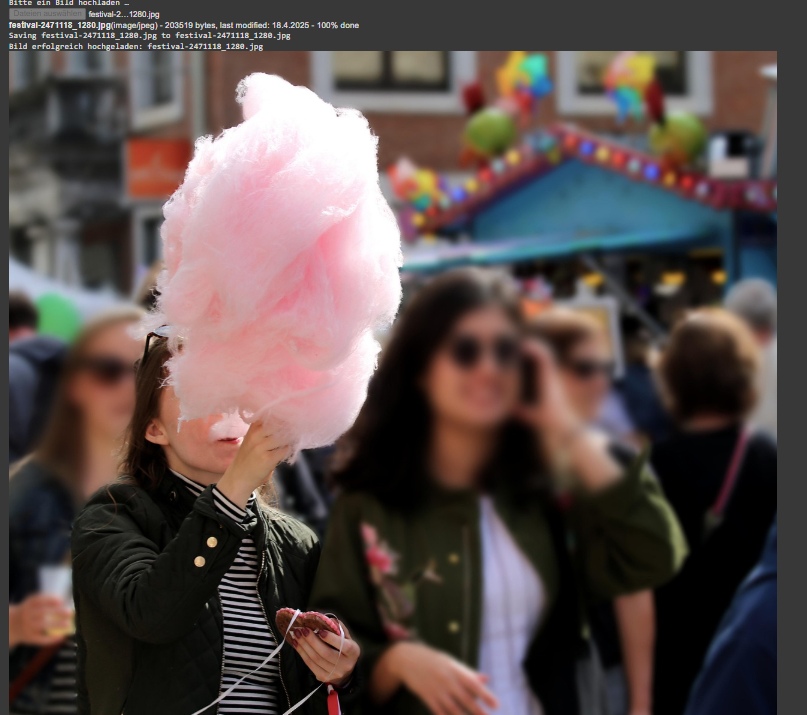
upload of image (image source: https://www.trumau.at/)
  1. Combined Request Architecture
    Unlike traditional multi-call pipelines, the new setup consolidates image and text interpretation into a single API request. This streamlined design prevents token overhead and ensures synchronized contextual understanding between categories. Each inference returns a structured Python dictionary containing three distinct analytical branches:
    • Objects – Recognizable entities such as animals, items, or people
    • Scene and Location Estimation – Environment, lighting, and potential geographic cues
    • Mood and Composition – Aesthetic interpretation, visual tone, and framing principles

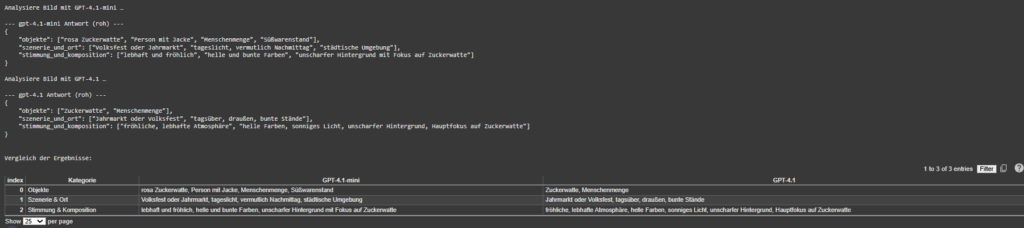
For each uploaded image, the analyzer prints three distinct lists per modelside by side. This offers a straightforward way to assess interpretive differences without complex metrics. In practice, GPT-4.1 tends to deliver slightly more nuanced emotional and compositional insights, while GPT-4.1-mini prioritizes concise, high-confidence object recognition.

results of the image object analysis and model comparison

Through the unified format, post-processing can directly populate separate lists or database tables for subsequent benchmarking, minimizing parsing latency and data inconsistencies.

  1. Robust Output Parsing
    Because model responses occasionally include Markdown code blocks (e.g., python {…}), the parsing logic was redesigned with a multi-layered interpreter using regex sanitation and dual parsing strategies (AST > JSON > fallback). This guarantees that even irregularly formatted outputs are safely converted into structured datasets without manual intervention. The system thus sustains analytical integrity under diverse prompt conditions.
  2. Model Benchmarking: GPT-4.1-mini vs. GPT-4.1
    The benchmark test compared inference precision, descriptive richness, and token efficiency between the two models. While GPT-4.1 demonstrates deeper contextual inference and subtler mood detection, GPT-4.1-mini achieves near-equivalent recognition accuracy at approximately one-tenth of the cost per request. For large-scale experiments (e.g., datasets exceeding 10,000 images), GPT-4.1-mini provides the optimal balance between granularity and economic viability.
  3. Token Management and Budget Simulation
    A real-time token tracker revealed an average consumption of ~1,780 tokens per image request. Given GPT-4.1-mini’s rate of $0.003 / 1k tokens, a one-dollar operational budget supports roughly 187 full image analyses. This insight forms the baseline for scalable experimentation and budget-controlled automation workflows in cloud-based vision analytics.

The next development phase will integrate this OpenAI-driven visual analysis directly into the Image Extender environment. This integration marks the transition from isolated model testing toward a unified generative framework.