Product XI: Image Extender

From Notebook Prototype to Local, Exhibitable Software

This iteration was less about adding new conceptual capabilities and more about solidifying the system as an actual, deployable artifact. The core task was migrating the image extender from its experimental form into a standalone local application. What sounds like a technical refactor turned out to be a decisive shift in how the system is meant to exist, be used, and be encountered.

Until now, the notebook environment functioned as a kind of protected laboratory. It encouraged rapid iteration, verbose configuration, and exploratory branching. Moving out of that space meant confronting a different question: what does this system look like when it stops being a research sketch and starts behaving like software?

The transition from Colab-style execution to a locally running script forced a re-evaluation of assumptions that notebooks quietly hide:

  • Implicit state becomes explicit
  • Execution order must be deterministic
  • Errors can no longer be “scrolled past”
  • Configuration must be intentional, not convenient

Porting the logic meant flattening the notebook’s narrative structure into a single, readable execution flow. Cells that once assumed context had to be restructured into functions, initialization stages, and clearly defined entry points. This wasn’t just cleanup, it was an architectural clarification.

In the notebook, ambiguity is tolerated. In running software, it accumulates as friction.

Reduction as Design: Cutting Options to Increase Clarity

One of the more deliberate changes during this phase was a reduction in exposed settings. The notebook version allowed extensive tweaking, model switches, resolution variants, prompt behaviors, fallback paths, all useful during development, but overwhelming in a public-facing context.

For the exhibition version, optionality became noise.

Instead of presenting the system as a configurable toolkit, I reframed it as a guided instrument. Core behaviors remain intact, but the number of visible parameters was intentionally constrained. This aligns with a recurring principle in the project: flexibility should live inside the system, not on its surface.

Adapting for Exhibition: Y2K as Interface Language

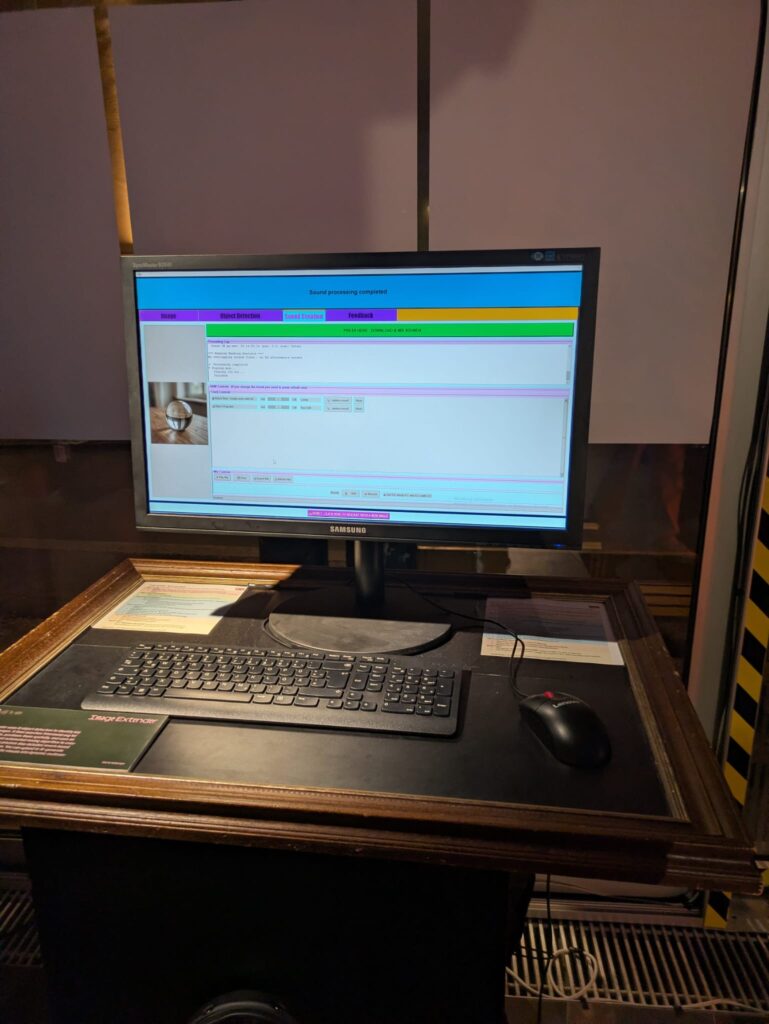
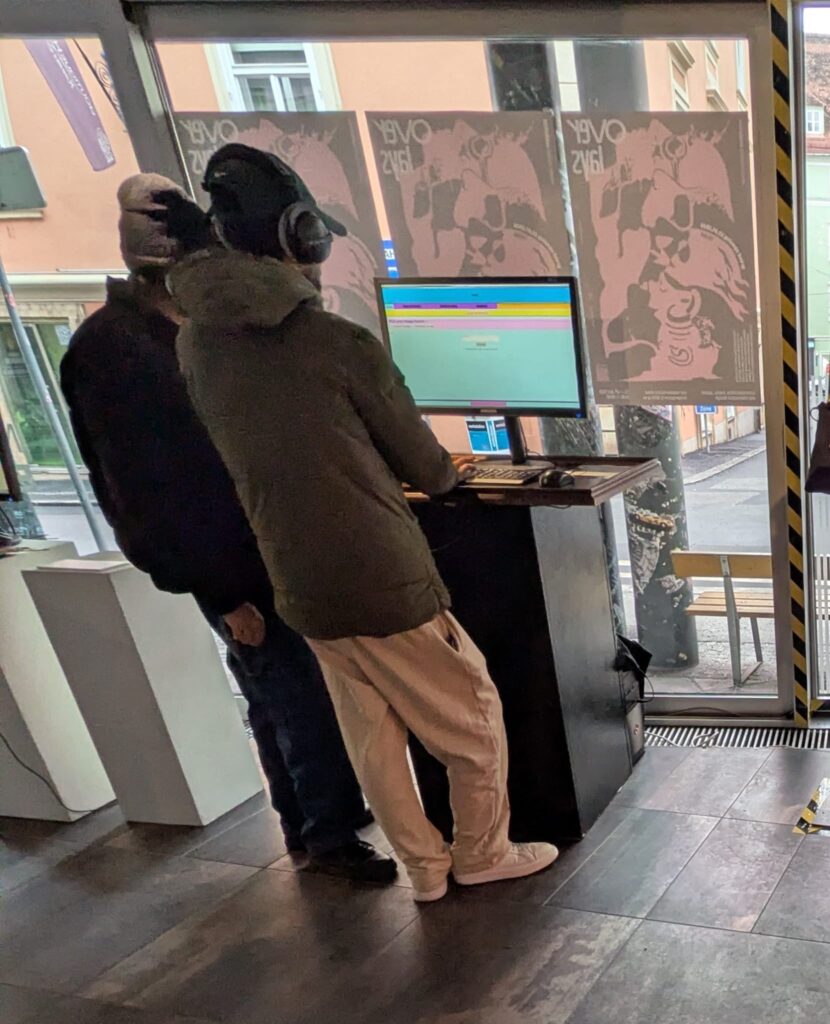
Alongside the structural changes, the interface was visually adapted to match the exhibition context. The decision to lean into a Y2K-inspired color palette wasn’t purely aesthetic; it functioned as a form of contextual grounding.

The visual layer needed to communicate that this is not a neutral utility, but a situated artifact. The Y2K styling introduced:

  • High-contrast synthetic colors
  • Clear visual hierarchy
  • A subtle nod to early digital optimism and machinic playfulness

Rather than competing with the system’s conceptual weight, the styling makes its artificiality explicit.
Stability Over Novelty

Another quiet but important shift was prioritizing stability over feature expansion. The migration process exposed several edge cases that were easy to ignore in a notebook but unacceptable in a live context: silent failures, unclear loading states, brittle dependencies.

Addressing these didn’t add visible functionality, but they fundamentally changed how trustworthy the system feels. In an exhibition setting, reliability is part of the experience. A system that hesitates or crashes invites interpretation for the wrong reasons.

Here, robustness became a form of authorship.

Reframing the System’s Status

By the end of this iteration, the most significant change wasn’t technical, it was ontological. The system is no longer best described as “a notebook that does something interesting.” It is now a runnable, bounded piece of software, designed to be encountered without explanation.

This transition marks a subtle but important moment in the project’s lifecycle:

  • From private exploration to public behavior
  • From configurable experiment to opinionated instrument
  • From development environment to exhibited system

The constraints introduced in this phase don’t limit future growth, they define a stable core from which growth can happen meaningfully.

If earlier updates were about expanding the system’s conceptual reach, this one was about giving it a body.

Product V: Image Extender

Dynamic Audio Balancing Through Visual Importance Mapping

This development phase introduces sophisticated volume control based on visual importance analysis, creating audio mixes that dynamically reflect the compositional hierarchy of the original image. Where previous systems ensured semantic accuracy, we now ensure proportional acoustic representation.

The core advancement lies in importance-based volume scaling. Each detected object’s importance value (0-1 scale from visual analysis) now directly determines its loudness level within a configurable range (-30 dBFS to -20 dBFS). Visually dominant elements receive higher volume placement, while background objects maintain subtle presence.

Key enhancements include:

– Linear importance-to-volume mapping creating natural acoustic hierarchies

– Fixed atmo sound levels (-30 dBFS) ensuring consistent background presence

– Image context integration in sound validation for improved semantic matching

– Transparent decision logging showing importance values and calculated loudness targets

The system now distinguishes between foreground emphasis and background ambiance, producing mixes where a visually central “car” (importance 0.9) sounds appropriately prominent compared to a distant “tree” (importance 0.2), while “urban street atmo” provides unwavering environmental foundation.

This represents a significant evolution from flat audio layering to dynamically balanced soundscapes that respect visual composition through intelligent volume distribution.

Product III: Image Extender

Intelligent Sound Fallback Systems – Enhancing Audio Generation with AI-Powered Semantic Recovery

After refining Image Extender’s sound layering and spectral processing engine, this week’s development shifted focus to one of the system’s most practical yet creatively crucial challenges: ensuring that the generation process never fails silently. In previous iterations, when a detected visual object had no directly corresponding sound file in the Freesound database, the result was often an incomplete or muted soundscape. The goal of this phase was to build an intelligent fallback architecture—one capable of preserving meaning and continuity even in the absence of perfect data.

Closing the Gap Between Visual Recognition and Audio Availability

During testing, it became clear that visual recognition is often more detailed and specific than what current sound libraries can support. Object detection models might identify entities like “Golden Retriever,” “Ceramic Cup,” or “Lighthouse,” but audio datasets tend to contain more general or differently labeled entries. This mismatch created a semantic gap between what the system understands and what it can express acoustically.

The newly introduced fallback framework bridges this gap, allowing Image Extender to adapt gracefully. Instead of stopping when a sound is missing, the system now follows a set of intelligent recovery paths that preserve the intent and tone of the visual analysis while maintaining creative consistency. The result is a more resilient, contextually aware sonic generation process—one that doesn’t just survive missing data, but thrives within it.

Dual Strategy: Structured Hierarchies and AI-Powered Adaptation

Two complementary fallback strategies were introduced this week: one grounded in structured logic, and another driven by semantic intelligence.

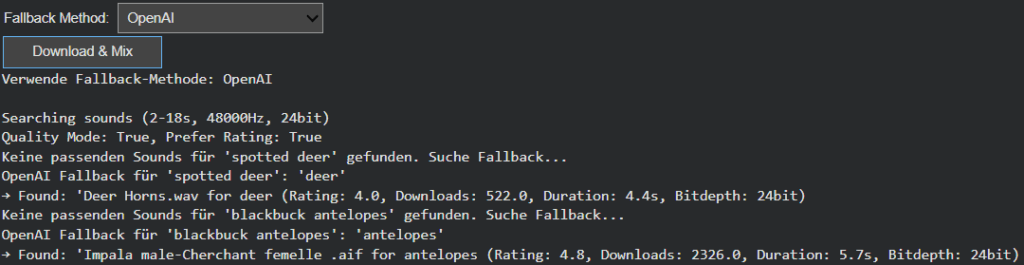
The CSV-based fallback system builds on the ontology work from the previous phase. Using the tag_hierarchy.csv file, each sound tag is part of a parent–child chain, creating predictable fallback paths. For example, if “tiger” fails, the system ascends to “jungle,” and then “nature.” This rule-based approach guarantees reliability and zero additional computational cost, making it ideal for large-scale batch operations or offline workflows.

In contrast, the AI-powered semantic fallback uses GPT-based reasoning to dynamically generate alternative tags. When the CSV offers no viable route, the model proposes conceptually similar or thematically related categories. A specific bird species might lead to the broader concept of “bird sounds,” or an abstract object like “smartphone” could redirect to “digital notification” or “button click.” This layer of intelligence brings flexibility to unfamiliar or novel recognition results, extending the system’s creative reach beyond its predefined hierarchies.

User-Controlled Adaptation

Recognizing that different projects require different balances between cost, control, and creativity, the fallback mode is now user-configurable. Through a simple dropdown menu, users can switch between CSV Mode and AI Mode.

  • CSV Mode favors consistency, predictability, and cost-efficiency—perfect for common, well-defined categories.
  • AI Mode prioritizes adaptability and creative expansion, ideal for complex visual inputs or unique scenes.

This configurability not only empowers users but also represents a deeper design philosophy: that AI systems should be tools for choice, not fixed solutions.

Toward Adaptive and Resilient Multimodal Systems

This week’s progress marks a pivotal evolution from static, database-bound sound generation to a hybrid model that merges structured logic with adaptive intelligence. The dual fallback system doesn’t just fill gaps, it embodies the philosophy of resilient multimodal AI, where structure and adaptability coexist in balance.

The CSV hierarchy ensures reliability, grounding the system in defined categories, while the AI layer provides flexibility and creativity, ensuring the output remains expressive even when the data isn’t. Together, they form a powerful, future-proof foundation for Image Extender’s ongoing mission: transforming visual perception into sound not as a mechanical translation, but as a living, interpretive process.

Product II: Image Extender

Dual-Model Vision Interface – OpenAI × Gemini Integration for Adaptive Image Understanding

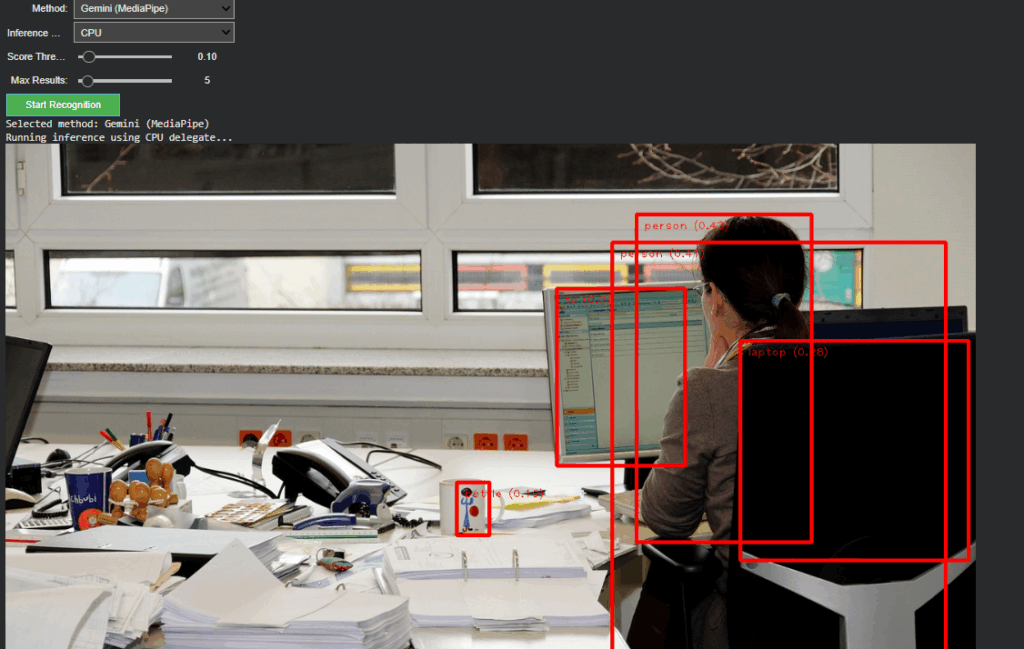
Following the foundational phase of last week, where the OpenAI API Image Analyzer established a structured evaluation framework for multimodal image analysis, the project has now reached a significant new milestone. The second release integrates both OpenAI’s GPT-4.1-based vision models and Google’s Gemini (MediaPipe) inference pipeline into a unified, adaptive system inside the Image Extender environment.

Unified Recognition Interface

In The current version, the recognition logic has been completely refactored to support runtime model switching.
A dropdown-based control in Google Colab enables instant selection between:

  • Gemini (MediaPipe) – for efficient, on-device object detection and panning estimation
  • OpenAI (GPT-4.1 / GPT-4.1-mini) – for high-level semantic and compositional interpretation

Non-relevant parameters such as score threshold or delegate type dynamically hide when OpenAI mode is active, keeping the interface clean and focused. Switching back to Gemini restores all MediaPipe-related controls.
This creates a smooth dual-inference workflow where both engines can operate independently yet share the same image context and visualization logic.

Architecture Overview

The system is divided into two self-contained modules:

  1. Image Upload Block – handles external image input and maintains a global IMAGE_FILE reference for both inference paths.
  2. Recognition Block – manages model selection, executes inference, parses structured outputs, and handles visualization.

This modular split keeps the code reusable, reduces side effects between branches, and simplifies later expansion toward GUI-based or cloud-integrated applications.

OpenAI Integration

The OpenAI branch extends directly from Last week but now operates within the full environment.
It converts uploaded images into Base64 and sends a multimodal request to gpt-4.1 or gpt-4.1-mini.
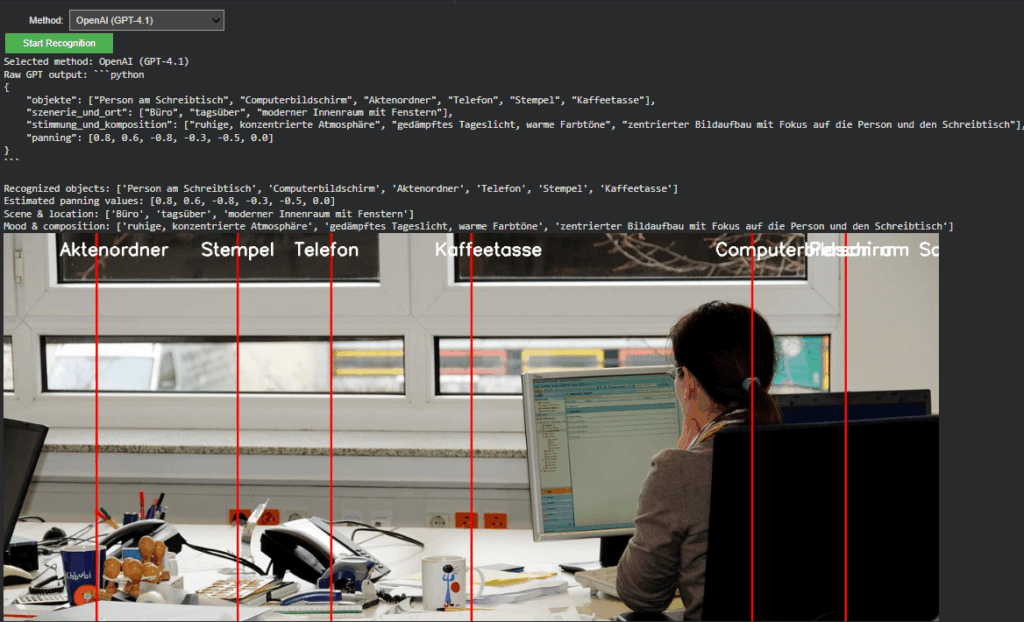
The model returns a structured Python dictionary, typically using the following schema:

{

    “objects”: […],

    “scene_and_location”: […],

    “mood_and_composition”: […],

    “panning”: […]

}

A multi-stage parser (AST → JSON → fallback) ensures robustness even when GPT responses contain formatting artifacts.

Prompt Refinement

During development, testing revealed that the English prompt version initially returned empty dictionaries.
Investigation showed that overly strict phrasing (“exclusively as a Python dictionary”) caused the model to suppress uncertain outputs.
By softening this instruction to allow “reasonable guesses” and explicitly forbidding empty fields, the API responses became consistent and semantically rich.

Debugging the Visualization

A subtle logic bug was discovered in the visualization layer:
The post-processing code still referenced German dictionary keys (“objekte”, “szenerie_und_ort”, “stimmung_und_komposition”) from Last week.
Since the new English prompt returned English keys (“objects”, “scene_and_location”, etc.), these lookups produced empty lists, which in turn broke the overlay rendering loop.
After harmonizing key references to support both language variants, the visualization resumed normal operation.

Cross-Model Visualization and Validation

A unified visualization layer now overlays results from either model directly onto the source image.
In OpenAI mode, the “panning” values from GPT’s response are projected as vertical lines with object labels.
This provides immediate visual confirmation that the model’s spatial reasoning aligns with the actual object layout, an important diagnostic step for evaluating AI-based perception accuracy.

Outcome and Next Steps

The project now represents a dual-model visual intelligence system, capable of using symbolic AI interpretation (OpenAI) and local pixel-based detection (Gemini).

Next steps

The upcoming development cycle will focus on connecting the openAI API layer directly with the Image Extender’s audio search and fallback system.

Product I: Image Extender

OpenAI API Image Analyzer – Structured Vision Testing and Model Insights

Adaptive Visual Understanding Framework
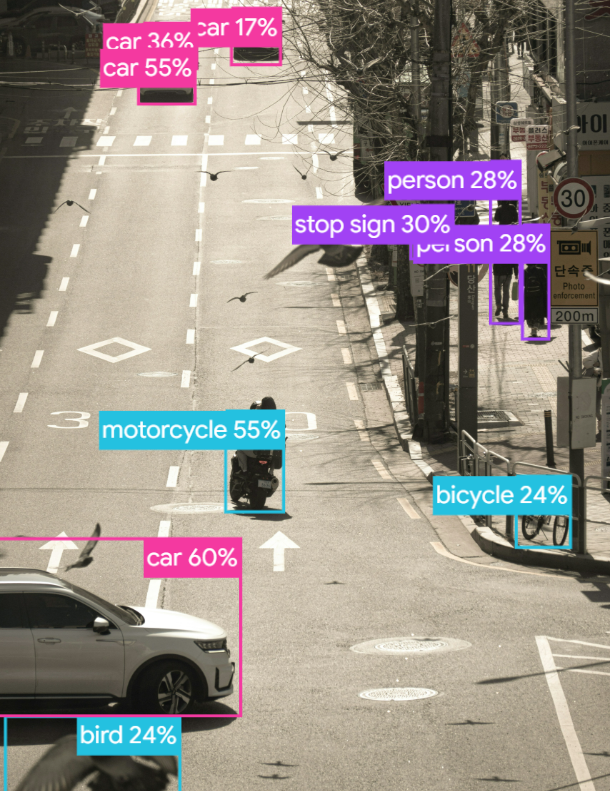
In this development phase, the focus was placed on building a robust evaluation framework for OpenAI’s multimodal models (GPT-4.1 and GPT-4.1-mini). The primary goal: systematically testing image interpretation, object detection, and contextual scene recognition while maintaining controlled cost efficiency and analytical depth.

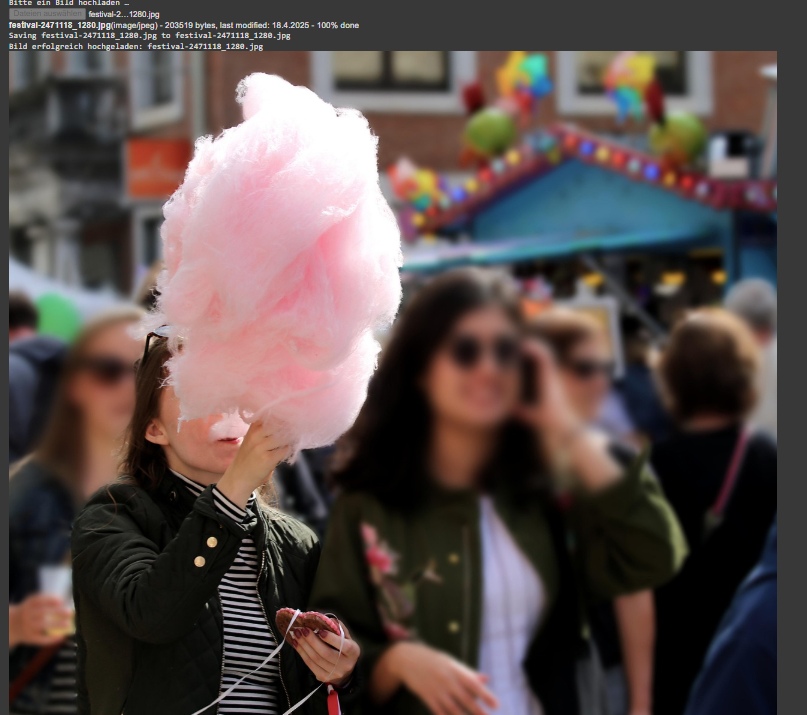
upload of image (image source: https://www.trumau.at/)
  1. Combined Request Architecture
    Unlike traditional multi-call pipelines, the new setup consolidates image and text interpretation into a single API request. This streamlined design prevents token overhead and ensures synchronized contextual understanding between categories. Each inference returns a structured Python dictionary containing three distinct analytical branches:
    • Objects – Recognizable entities such as animals, items, or people
    • Scene and Location Estimation – Environment, lighting, and potential geographic cues
    • Mood and Composition – Aesthetic interpretation, visual tone, and framing principles

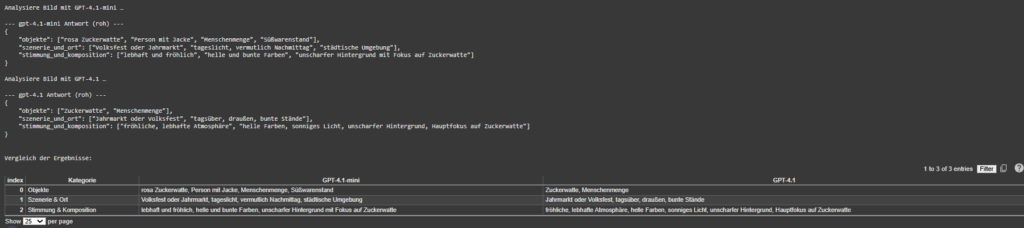
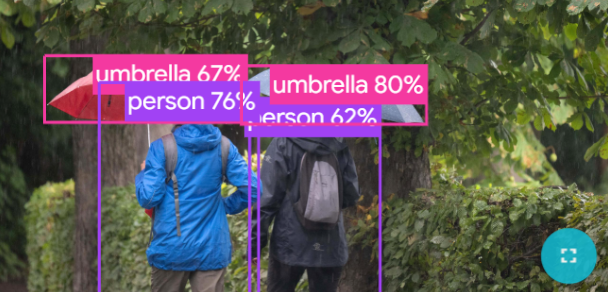
For each uploaded image, the analyzer prints three distinct lists per modelside by side. This offers a straightforward way to assess interpretive differences without complex metrics. In practice, GPT-4.1 tends to deliver slightly more nuanced emotional and compositional insights, while GPT-4.1-mini prioritizes concise, high-confidence object recognition.

results of the image object analysis and model comparison

Through the unified format, post-processing can directly populate separate lists or database tables for subsequent benchmarking, minimizing parsing latency and data inconsistencies.

  1. Robust Output Parsing
    Because model responses occasionally include Markdown code blocks (e.g., python {…}), the parsing logic was redesigned with a multi-layered interpreter using regex sanitation and dual parsing strategies (AST > JSON > fallback). This guarantees that even irregularly formatted outputs are safely converted into structured datasets without manual intervention. The system thus sustains analytical integrity under diverse prompt conditions.
  2. Model Benchmarking: GPT-4.1-mini vs. GPT-4.1
    The benchmark test compared inference precision, descriptive richness, and token efficiency between the two models. While GPT-4.1 demonstrates deeper contextual inference and subtler mood detection, GPT-4.1-mini achieves near-equivalent recognition accuracy at approximately one-tenth of the cost per request. For large-scale experiments (e.g., datasets exceeding 10,000 images), GPT-4.1-mini provides the optimal balance between granularity and economic viability.
  3. Token Management and Budget Simulation
    A real-time token tracker revealed an average consumption of ~1,780 tokens per image request. Given GPT-4.1-mini’s rate of $0.003 / 1k tokens, a one-dollar operational budget supports roughly 187 full image analyses. This insight forms the baseline for scalable experimentation and budget-controlled automation workflows in cloud-based vision analytics.

The next development phase will integrate this OpenAI-driven visual analysis directly into the Image Extender environment. This integration marks the transition from isolated model testing toward a unified generative framework.

Prototyping I: Image Extender – Image sonification tool for immersive perception of sounds from images and new creation possibilities

Shift of intention of the project due to time plan:

By narrowing down the topic to ensure the feasibility of this project the focus or main purpose of the project will be the artistic approach. The tool will still combine the use of direct image to audio translation and the translation via sonification into a more abstract form. The main use cases will be generating unique audio samples for creative applications, such as sound design for interactive installations, brand audio identities, or matching image soundscapes and the possibility to be a versatile instrument for experimental media artists and display tool for image information.

By further research on different possibilities of sonification of image data and development of the sonification language itself the translation and display purpose is going to get more clear within the following weeks.

Testing of Google Gemini API for AI Object and Image Recognition:

The first testing of the Google Gemini Api started well. There are different models for dedicated object recognition and image recognition itself which can be combined to analyze pictures in terms of objects and partly scenery. These models (SSD, EfficientNET,…) create similar results but not always the same. It might be an option to make it selectable for the user (so that in a failure case a different model can be tried and may give better results). The scenery recognition itself tends to be a problem. It may be a possibility to try out different apis.

The data we get from this AI model is a tag for the recognized objects or image content and a percentage of the probability.

The next steps for the direct translation of it into realistic sound representations will be to test the possibility of using the api of freesound.org to search directly and automated for the recognized object tags and load matching audio files. These search calls also need to filter by copyright type of the sounds and a choosing rule / algorithm needs to be created.

Research on sonification of images / video material and different approaches:

The world of image sonification is rich with diverse techniques, each offering unique ways to transform visual data into auditory experiences. The world of image sonification is rich with diverse techniques, each offering unique ways to map visual data into auditory experiences. One of the most straightforward methods is raster scanning, introduced by Yeo and Berger. This technique maps the brightness values of grayscale image pixels directly to audio samples, creating a one-to-one correspondence between visual and auditory data. By scanning an image line by line, from top to bottom, the system generates a sound that reflects the texture and patterns of the image. For example, a smooth gradient might produce a steady tone, while a highly textured image could result in a more complex, evolving soundscape. The process is fully reversible, allowing for both image sonification and sound visualization, making it a versatile tool for artists and researchers alike. This method is particularly effective for sonifying image textures and exploring the auditory representation of visual filters, such as “patchwork” or “grain” effects.(Yeo and Berger, 2006)

Principle raster scanning (Yeo and Berger, 2006)

In contrast, Audible Panorama (Huang et al. 2019) automates sound mapping for 360° panorama images used in virtual reality (VR). It detects objects using computer vision, estimates their depth, and assigns spatialized audio from a database. For example, a car might trigger engine sounds, while a person generates footsteps, creating an immersive auditory experience that enhances VR realism. A user study confirmed that spatial audio significantly improves the sense of presence. It contains a interesting concept regarding to choosing a random audio file from a sound library to avoid producing similar or same results. Also it mentions the aspect of postprocessing the audios which also would be a relevant aspect for the image extender project.

principle audible panorama (Huang et al. 2019)

Another approach, HindSight (Schoop, Smith, and Hartmann 2018), focuses on real-time object detection and sonification in 360° video. Using a head-mounted camera and neural networks, it detects objects like cars and pedestrians, then sonifies their position and danger level through bone conduction headphones. Beeps increase in tempo and pan to indicate proximity and direction, providing real-time safety alerts for cyclists.

Finally, Sonic Panoramas (Kabisch, Kuester, and Penny 2005) takes an interactive approach, allowing users to navigate landscape images while generating sound based on their position. Edge detection extracts features like mountains or forests, mapping them to dynamic soundscapes. For instance, a mountain ridge might produce a resonant tone, while a forest creates layered, chaotic sounds, blending visual and auditory art. It also mentions different approaches for sonification itself. For example the idea of using micro (timbre, pitch and melody) and macro level (rhythm and form) mapping.

principle sonic panoramas (Kabisch, Kuester, and Penny 2005)

Each of these methods—raster scanningAudible PanoramaHindSight, and Sonic Panoramas—demonstrates the versatility of sonification as a tool for transforming visual data into sound and lead keeping these different approaches in mind for developing my own sonification language or mapping method. It also leads to further research by checking some useful references they used in their work for a deeper understanding of sonification and extending the possibilities.

References

Huang, Haikun, Michael Solah, Dingzeyu Li, and Lap-Fai Yu. 2019. “Audible Panorama: Automatic Spatial Audio Generation for Panorama Imagery.” In Proceedings of the 2019 CHI Conference on Human Factors in Computing Systems, 1–11. Glasgow, Scotland: ACM. https://doi.org/10.1145/3290605.3300851.

Kabisch, Eric, Falko Kuester, and Simon Penny. 2005. “Sonic Panoramas: Experiments with Interactive Landscape Image Sonification.” In Proceedings of the 2005 International Conference on Artificial Reality and Telexistence (ICAT), 156–163. Christchurch, New Zealand: HIT Lab NZ.

Schoop, Eldon, James Smith, and Bjoern Hartmann. 2018. “HindSight: Enhancing Spatial Awareness by Sonifying Detected Objects in Real-Time 360-Degree Video.” In Proceedings of the 2018 CHI Conference on Human Factors in Computing Systems, 1–12. Montreal, QC, Canada: ACM. https://doi.org/10.1145/3173574.3173717.

Yeo, Woon Seung, and Jonathan Berger. 2006. “Application of Raster Scanning Method to Image Sonification, Sound Visualization, Sound Analysis and Synthesis.” In Proceedings of the 9th International Conference on Digital Audio Effects (DAFx-06), 311–316. Montreal, Canada: DAFx.