Product VIII: Image Extender

Iterative Workflow and Feedback Mechanism

The primary objective for this update was to architect a paradigm shift from a linear generative pipeline to a nonlinear, interactive sound design environment

System Architecture & Implementation of Interactive Components

The existing pipeline, comprising image analysis (object detection, semantic tagging), importance-weighted sound search, audio processing (equalization, normalization, panoramic distribution based on visual coordinates), and temporal randomization was extended with a state-preserving session layer and an interactive control interface, implemented within the collab notebook ecosystem.

Data Structure & State Management
A critical prerequisite for interactivity was the preservation of all intermediate audio objects and their associated metadata. The system was refactored to maintain a global, mutable data structure, a list of processed_track objects. Each object encapsulates:

  • The raw audio waveform (as a NumPy array).
  • Semantic source tag (e.g., “car,” “rain”).
  • Track type (ambience base or foreground object).
  • Temporal onset and duration within the mix.
  • Panning coefficient (derived from image x-coordinate).
  • Initial target loudness (LUFS, derived from object importance scaling).

Dynamic Mixing Console Interface
A GUI panel was generated post-sonification, featuring the following interactive widgets for each processed_track:

  • Per-Track Gain Sliders: Linear potentiometers (range 0.0 to 2.0) controlling amplitude multiplication. Adjustment triggers an immediate recalculation of the output sum via a create_current_mix() function, which performs a weighted summation of all tracks based on the current slider states.
  • Play/Stop Controls: Buttons invoking a non-blocking, threaded audio playback engine (using IPython.display.Audio and threading), allowing for real-time auditioning without interface latency.

On-Demand Sound Replacement Engine
The most significant functional addition is the per-track “Search & Replace” capability. Each track’s GUI includes a dedicated search button (🔍). Its event handler executes the following algorithm:

  1. Tag Identification: Retrieves the original semantic tag from the target processed_track.
  2. Targeted Audio Retrieval: Calls a modified search_new_sound_for_tag(tag, exclude_id_list) function. This function re-executes the original search logic, including query formulation, Freesound API calls, descriptor validation (e.g., excluding excessively long or short files), and fallback strategies—while maintaining a session-specific exclusion list to avoid re-selecting previously used sounds.
  3. Consistent Processing: The newly retrieved audio file undergoes an identical processing chain as in the initial pipeline: target loudness normalization (to the original track’s LUFS target), application of the same panning coefficient, and insertion at the identical temporal position.
  4. State Update & Mix Regeneration: The new audio data replaces the old waveform in the processed_track object. The create_current_mix() function is invoked, seamlessly integrating the new sonic element while preserving all other user adjustments (e.g., volume levels of other tracks).

Integrated Feedback & Evaluation Module
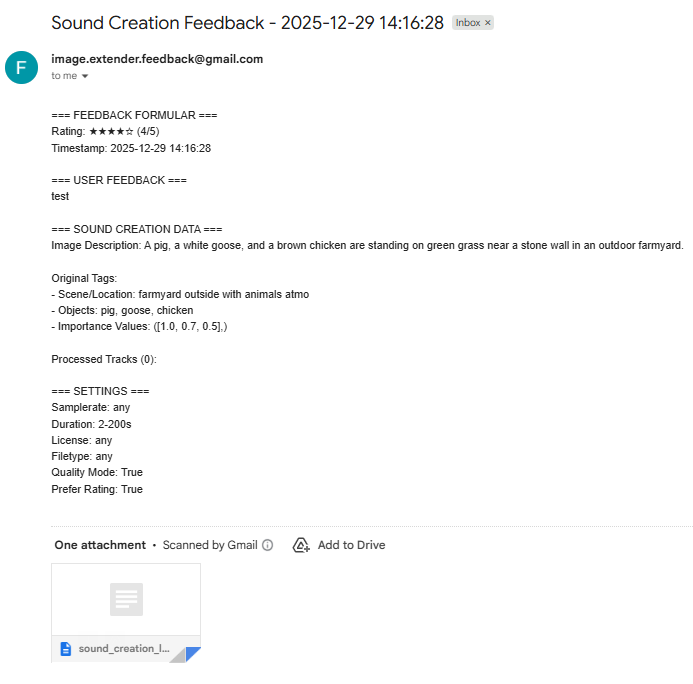
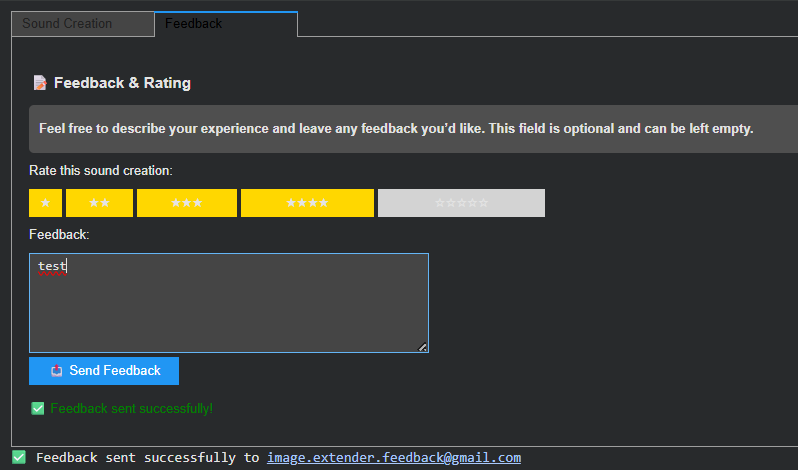
To formalize user evaluation and gather data for continuous system improvement, a structured feedback panel was integrated adjacent to the mixing controls. This panel captures:

  • A subjective 5-point Likert scale rating.
  • Unstructured textual feedback.
  • Automated attachment of complete session metadata (input image description, derived tags, importance values, processing parameters, and the final processed_track list).
    This design explicitly closes the feedback loop, treating each user interaction as a potential training or validation datum for future algorithmic refinements.
  • Automated sending of the feedback via email
Product IV: Image Extender

Semantic Sound Validation & Ensuring Acoustic Relevance Through AI-Powered Verification

Building upon the intelligent fallback systems developed in Phase III, this week’s development addressed a more subtle yet critical challenge in audio generation: ensuring that retrieved sounds semantically match their visual counterparts. While the fallback system successfully handled missing sounds, I discovered that even when sounds were technically available, they didn’t always represent the intended objects accurately. This phase introduces a sophisticated description verification layer and flexible filtering system that transforms sound retrieval from a mechanical matching process to a semantically intelligent selection.

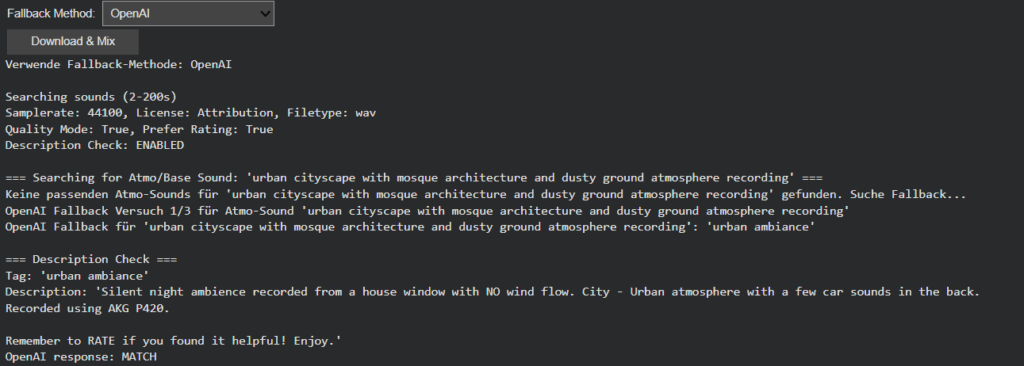
The newly implemented description verification system addresses this through OpenAI-powered semantic analysis. Each retrieved sound’s description is now evaluated against the original visual tag to determine if it represents the actual object or just references it contextually. This ensures that when Image Extender layers “car” sounds into a mix, they’re authentic engine recordings rather than musical tributes.

Intelligent Filter Architecture: Balancing Precision and Flexibility

Recognizing that overly restrictive filtering could eliminate viable sounds, we redesigned the filtering system with adaptive “any” options across all parameters. The Bit-Depth filter got removed because it resulted in search errors which is also mentioned in the documentation of the freesound.org api.

Scene-Aware Audio Composition: Atmo Sounds as Acoustic Foundation

A significant architectural improvement involves intelligent base track selection. The system now distinguishes between foreground objects and background atmosphere:

  • Scene & Location Analysis: Object detection extracts environmental context (e.g., “forest atmo,” “urban street,” “beach waves”)
  • Atmo-First Composition: Background sounds are prioritized as the foundational layer
  • Stereo Preservation: Atmo/ambience sounds retain their stereo imaging for immersive soundscapes
  • Object Layering: Foreground sounds are positioned spatially based on visual detection coordinates

This creates mixes where environmental sounds form a coherent base while individual objects occupy their proper spatial positions, resulting in professionally layered audio compositions.

Dual-Mode Object Detection with Scene Understanding

OpenAI GPT-4.1 Vision: Provides comprehensive scene analysis including:

  • Object identification with spatial positioning
  • Environmental context extraction
  • Mood and atmosphere assessment
  • Structured semantic output for precise sound matching

MediaPipe EfficientDet: Offers lightweight, real-time object detection:

  • Fast local processing without API dependencies
  • Basic object recognition with positional data
  • Fallback when cloud services are unavailable

Wildcard-Enhanced Semantic Search: Beyond Exact Matching

Multi-Stage Fallback with Verification Limits

The fallback system evolved into a sophisticated multi-stage process:

  1. Atmo Sound Prioritization: Scene_and_location tags are searched first as base layer
  2. Object Search: query with user-configured filters
  3. Description Verification: AI-powered semantic validation of each result
  4. Quality Tiering: Progressive relaxation of rating and download thresholds
  5. Pagination Support: Multiple result pages when initial matches fail verification
  6. Controlled Fallback: Limited OpenAI tag regeneration with automatic timeout

This structured approach prevents infinite loops while maximizing the chances of finding appropriate sounds. The system now intelligently gives up after reasonable attempts, preventing computational waste while maintaining output quality.

Toward Contextually Intelligent Audio Generation

This week’s enhancements represent a significant leap from simple sound retrieval to contextually intelligent audio selection. The combination of semantic verification, adaptive filtering and scene-aware composition creates a system that doesn’t just find sounds, it finds the right sounds and arranges them intelligently.