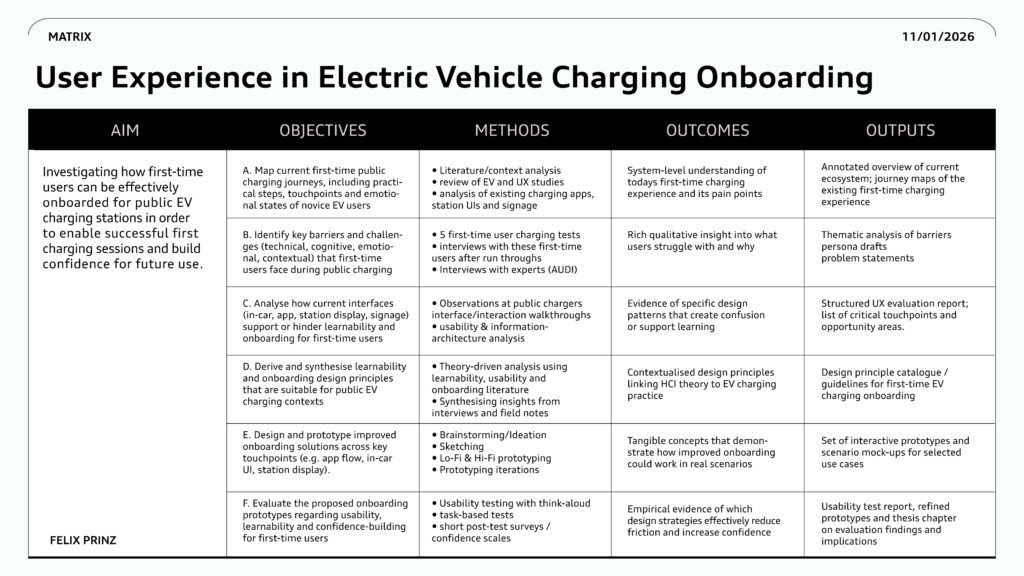
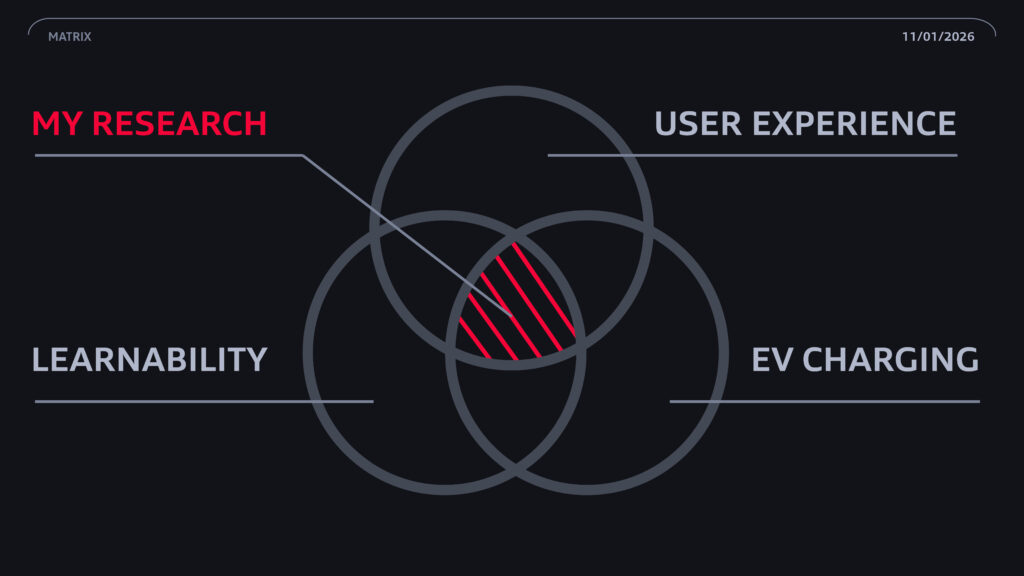
This master project explores how first‑time users can charge an electric car at public charging stations in a simple and confident way. I focus on the Audi UI and look at the whole journey: finding a charger in the app, using the in‑car system and interacting with the charger on site. With interviews, observations and usability tests, I study where people get stuck, feel stressed or unsure. The matrix in the image shows how my aims, objectives, methods and expected outcomes connect and guide the design of better onboarding experiences.
Research Question: How can first-time users be effectively onboarded for
public electric vehicle charging stations to ensure successful completion of their initial charging session and build confidence for future use?
To answer the central research question a mixed-methods approach combining literature review, qualitative user research and onboarding design evaluation is employed. This approach is justified because effective onboarding requires understanding: (1) what barriers first-time users face during initial public charging encounters, (2) which onboarding interventions reduce these barriers and (3) whether designed solutions actually build user confidence for repeated use. Single-method investigation cannot adequately address this complexity.
This thesis is grounded in an interpretivist, user-centered research paradigm, assuming that first-time charging experiences cannot be understood only through technical performance metrics but must be interpreted through users perceptions, emotions and interpretive processes. The work therefore draws primarily on qualitative HCI theory, learnability models and onboarding research that explain how people approach unfamiliar systems and how confidence develops through interaction.
Albert, Bill, and Tom Tullis. Measuring the User Experience: Collecting, Analyzing, and Presenting Usability Metrics. 2nd ed. Morgan Kaufmann, 2013.
Aichinger, Wolfgang, Nadine Appelhans, Julian Gerlach, Jürgen Gies, Stefanie Hanke, Anne Klein-Hitpass, and Thomas Warnecke. „Elektromobilität in der kommunalen Umsetzung – Kommunale Strategien und planerische Instrumente.“ Technical Report. Deutsches Institut für Urbanistik (DIFU), 2015. https://starterset-elektromobilität.de/sites/default/files/Dokumente/Elektromobilitaet_in_der_kommunalen_Umsetzung.pdf.
Bevan, Nigel, and Michelle Macleod. „Usability Measurement in Context.“ Behaviour and Information Technology 13, no. 2 (1994): 132–145. https://www.academia.edu/1962544/Usability_measurement_in_context
Beringer, D. B., and J. G. Peterson. „Underlying Behavioral Parameters of the Operation of Touch-Input Devices: Biases, Models, and Feedback.“ Human Factors 27, no. 4 (1985): 445–458.
Bundesverband Elektromobilität Österreich (BEÖE), „Neuzulassungen E-Autos (BEV) in Österreich,“ accessed December 2, 2025, https://www.beoe.at/neuzulassungen/
Choi, B. R., W. P. Lee, and D. J. Won. „Optimal Charging Strategy Based on Model Predictive Control in Electric Vehicle Parking Lots Considering Voltage Stability.“ Energies 11, no. 7 (2018): 1812. https://doi.org/10.3390/en11071812.
Davis, Fred D. „Perceived Usefulness, Perceived Ease of Use, and User Acceptance of Information Technology.“ MIS Quarterly 13, no. 3 (1989): 319–340. https://doi.org/10.2307/249008.
Designability and Motability. Accessible EV Charging: Scoping and Discovery Report. United Kingdom, 2021.
eCharge4Drivers Consortium. eCharge4Drivers D1.2: A Priori Users‘ Concerns and Expectations Relevant to EV Charging. Project Report, Version 1.0 FINAL, 2023.
Figenbaum, Erik, et al. “Empirical Analysis of the User Needs and the Business Models in the
Norwegian Charging Infrastructure Ecosystem.” World Electr. Veh. J. 13, no. 10 (2022)
Grossman, Tovi, George Fitzmaurice, and Ramtin Attar. “A Survey of Software Learnability: Metrics, Methodologies, and Guidelines.” In CHI ’09 Extended Abstracts on Human Factors in Computing Systems, 649–658. New York: ACM, 2009.
Guo, Jianfeng, Binbin Xu, Qi Cao, Siyao Liu, Fu Gu, and Xuemei Zhang. „Unveiling the Bidirectional Link Between Electric Vehicle Sales and Charging Infrastructure: Evidence from 95 Cities in China.“ iScience 27, no. 3 (2024). https://doi.org/10.1016/j.isci.2024.111245.
Han, Tye. „Learnability and EV: Improving First-Time Electric Vehicle User Experience of Learning on Electrification Functions.“ Master‘s thesis, Södertörn University, 2023.
Hardman, Scott, Alan Jenn, Gil Tal, Jonn Axsen, George Beard, Nicolo Daina, Erik Figenbaum, et al. „A Review of Consumer Preferences of and Interactions with Electric Vehicle Charging Infrastructure.“ Transportation Research Part D: Transport and Environment 62 (2018) https://doi.org/10.1016/j.trd.2018.04.002.
ISO 9241-11:2018. Ergonomics of Human-System Interaction – Part 11: Usability: Definitions and Concepts. International Organization for Standardization.
Krug, Steve. Don‘t Make Me Think, Revisited: A Common Sense Approach to Web & Mobile Usability. New Riders, 2014.
Lee, Dong-Yeon, Melanie H. McDermott, Benjamin K. Sovacool, and Raphael Isaac. „Toward Just and Equitable Mobility: Socioeconomic and Perceptual Barriers for Electric Vehicles and Charging Infrastructure in the United States.“ Energy and Climate Change 5 (2024). https://doi.org/10.1016/j.egycc.2024.100146.
Linja-aho, Merja. Learnability Assessment of Complex ICT Systems: Iterative Design-Validation Cycle. Doctoral dissertation, University of Oulu, 2006.
Ma, Jun, and Qinrui Yang. „Research on User Satisfaction of Charging Infrastructure.“ IOP Conference Series: Earth and Environmental Science 440 (2020). https://doi.org/10.1088/1755-1315/440/3/032078.
Nielsen, Jakob. Designing Web Usability: The Practice of Simplicity. New Riders Publishing, 2000.
Norman, Don. The Design of Everyday Things: Revised and Expanded Edition. Basic Books, 2013.
Ries, Eric. The Lean Startup: How Modern Entrepreneurs Use Continuous Innovation to Create Radically Successful Businesses. Crown Business, 2011.
Rubin, Jeffrey, and Dana Chisnell. Handbook of Usability Testing: How to Plan, Design, and Conduct Effective Usability Testing. 2nd ed. Wiley Publishing, 2008.
Story, Molly Follette, James L. Mueller, and Ronald L. Mace. The Universal Design File: Designing for People of All Ages and Abilities. The Center for Universal Design, 1998.
Tullis, Tom S., and Jacqueline N. Stetson. „A Comparison of Questionnaires for Assessing Website Usability.“ In Proceedings of the Usability Professionals Association Conference, 1–12. Minneapolis: Usability Professionals Association, 2004.
UDG Consortium. Universal Design Guidelines for Electric Vehicle Charging Infrastructure. Policy and Design Report. Ireland/European, 2024.
Venkatesh, V., and F. D. Davis. „A Theoretical Extension of the Technology Acceptance Model: Four Longitudinal Field Studies.“ Management Science 46, no. 2 (2000): 186–204.
Wang, Hengsong, Qi Huang, Changhua Zhang, and Aihua Xia. „A Novel Approach for the Layout of Electric Vehicle Charging Station.“ In Proceedings of the 2010 International Conference on Apperceiving Computing and Intelligence Analysis (ICACIA), 64–70. IEEE, 2010. https://doi.org/10.1109/ICACIA.2010.5743443.
Wang, Yingwei, and Chuan-Ren Wang. „Locating Passenger Vehicle Refueling Stations.“ Transportation Research Part E: Logistics and Transportation Review 46, no. 5 (2010): 791–801. https://doi.org/10.1016/j.tre.2010.02.007.
Yang, Mengqi, and Boqiang Lin. „The Development of Consumer Preferences for Electric Vehicle Charging Infrastructure in China: Evidence from a Questionnaire Survey with a Four-Year Interval.“ Energy 307 (2024): 132671. https://doi.org/10.1016/j.energy.2024.132671.
Zheng, Jian, Xingang Wang, Ke Men, and Yonghua Song. „Aggregation Model-Based Optimization for Electric Vehicle Charging Strategy.“ IEEE Transactions on Smart Grid 4, no. 2 (2013): 1058–1066. https://doi.org/10.1109/TSG.2013.2244904.
