Key Takeaways:
- Abstraction is a tool to create distance and provoke curiosity.
- Pixelation transforms objects into texture, letting viewers reinterpret them.
- Playing with legibility can make a message more open, not less clear.
In another project, I designed three posters for a fictional museum and explored abstraction by pixelating classical sculptures and paintings. The idea was to break the image down until it became more about texture and rhythm than content. I wanted to see how far I could push visual distortion while still communicating “art.”
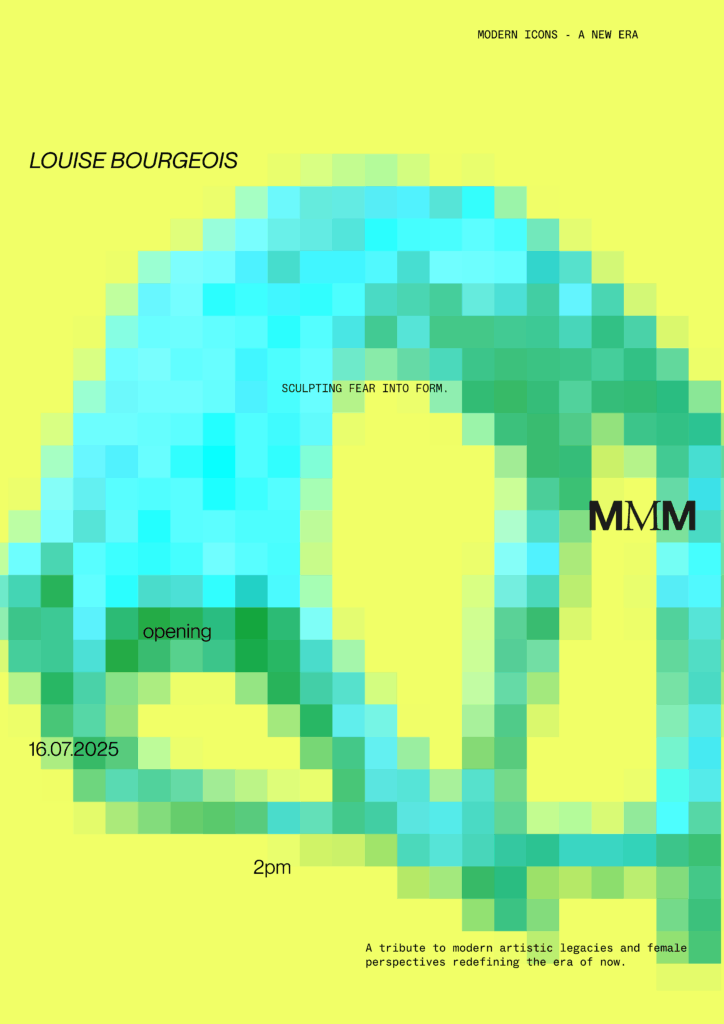
This technique of pixelation or glitching became a sort of visual experiment in interruption: how can you disturb an expected image and create curiosity instead? For my thesis, this connects to the idea of interrupting the expected aesthetic of motorsport. What happens when you pixelate a racing helmet or glitch a car silhouette? Can this be a tool for showing that design isn’t neutral, but always coded? It was a way of thinking about how visual identity can distort or transform meaning. In motorsport, visuals are often super crisp and literal. You see cars, sponsors, drivers, flags. But what if abstraction could help recode the aesthetics of speed and power?
I see this as a potential method for my thesis: using abstraction and distortion as design strategies to deconstruct typical racing imagery. Maybe I’ll develop a poster series or animation that glitches traditional symbols such as a trophy, a helmet, or a car to comment on their cultural weight. Continuing this experiment, I’d like to try physical distortion (like scanning and rescanning) to explore how “fuzzy” the image of motorsport can become.
