Recently, I had the chance to take part in an open studio session at Druckzeug in Graz (a space dedicated to analog print techniques – i guess everybody knows it). These open workshops take place roughly once a month, and I joined with two friends from Communication Design. Together, we tried something completely new (at least for me): setting metal type by hand and printing it using letterpress.
It was my very first time working with movable type, and I have to say: it was a fascinating, hands-on experience that felt like stepping into another era of design.
How Does Letterpress Actually Work?
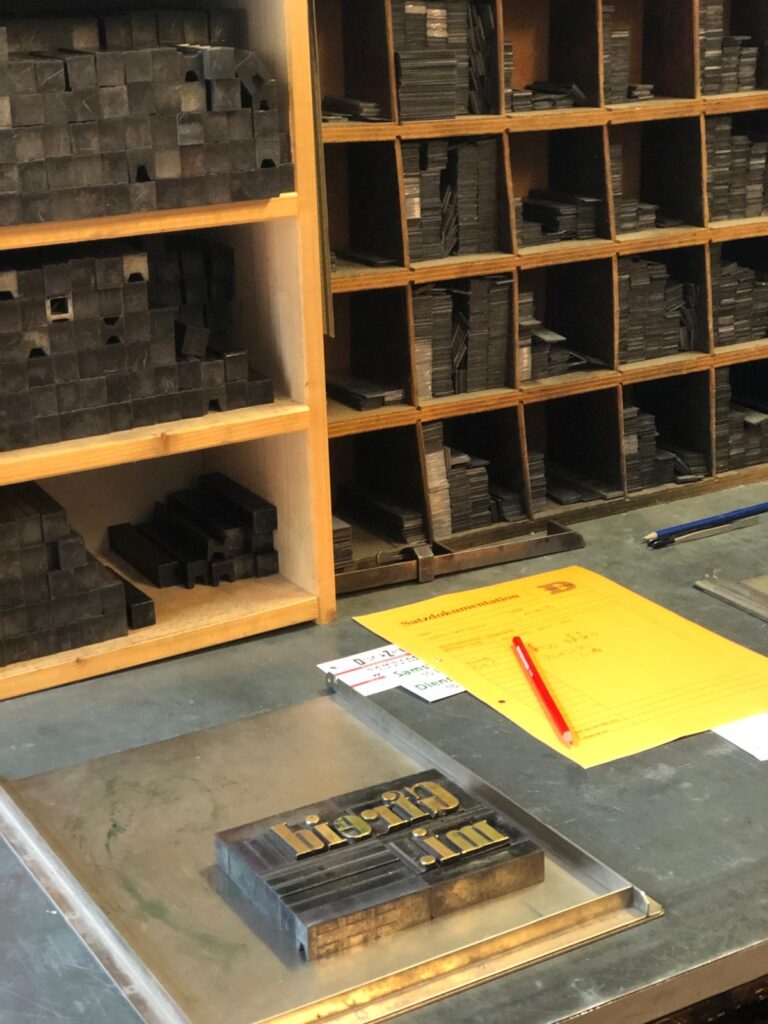
With traditional letterpress printing, each individual letter (called a type or letterform) is selected from a collection of lead blocks and set mirror-inverted into a metal frame called a composing stick. You build your text letter by letter (kind of like heavy-duty Scrabble) to form words and lines.
But it’s not just about picking letters. Since they don’t hold themselves in place, you also have to fill all the empty spaces between words and around the layout using lead spacers and furniture blocks. Once the composition is complete and perfectly aligned, everything is tightly locked into place using a chase (metal frame) and quoins (tightening devices), so nothing moves during printing.
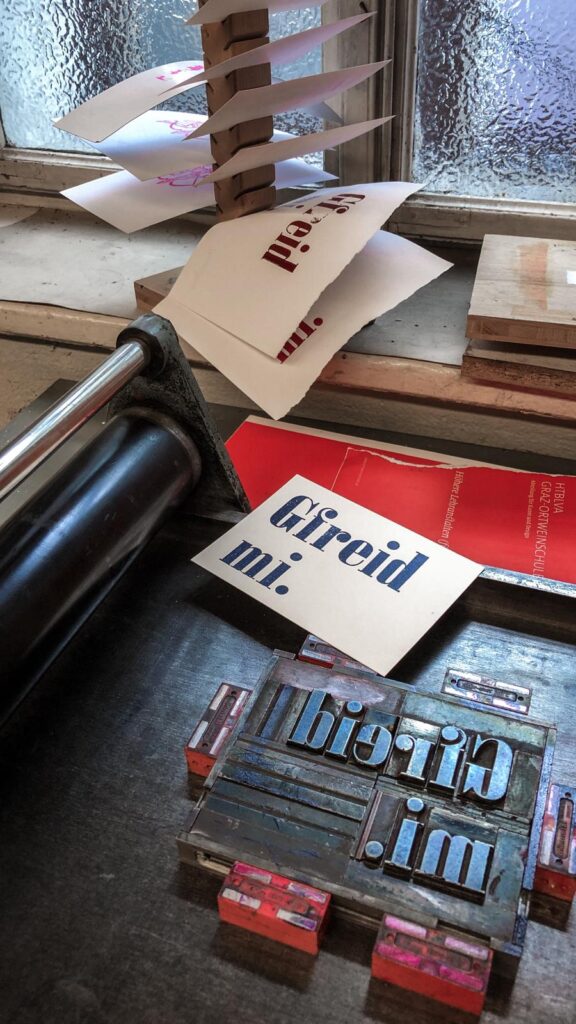
Then it’s time to ink the type and print by placing it in a press, rolling on the ink, and pressing the paper onto the form. The result: a tactile print with real depth.
Let’s print
For my first try, I chose the Bavarian word “Gfreit mi”, which roughly means “I’m happy” or “That makes me glad.” Surprisingly, the process wasn’t as difficult as I’d expected but it was definitely very time-consuming. Every little gap needs to be filled carefully, and everything has to be placed just right. But that’s also what makes it so satisfying.
Working with the physical type, taking time to set each line, and finally seeing it printed, it gave me a whole new appreciation for the craft and history of printing.
Reflection
This experiment at Druckzeug was a beautiful experience, a dive into the world of analog typography and a nice break from our digital routines. It’s inspiring to see these old techniques still being taught and practiced, and how much joy and creativity they can bring.
“Gfreit mi” – that pretty much sums it up.
