Introduction
Typography plays a central role in digital and print design, but it’s not just about aesthetics. Fonts can influence load times, data usage, and even printing efficiency. This entry explores whether certain fonts are more sustainable than others, both in terms of web performance and resource consumption in print.
Practical Test: Font Choices & Sustainability
Step 1: Set Up Different Font Types
I created a simple HTML page using different font types, including:
- System fonts (e.g., Arial, Georgia, Helvetica)
- Google Fonts (e.g., Roboto, Lato, Montserrat)
- Custom web fonts loaded via
@font-face - Eco-friendly print fonts like Ecofont
This allowed me to measure load time differences for digital use and ink usage for print scenarios.
Step 2: Measure Digital Performance
Using Lighthouse and WebPageTest, I tested the page with different font combinations. Key findings:
- System fonts loaded the fastest and required no external requests, resulting in lower page weight.
- Google Fonts slowed down load time slightly due to external fetching.
- Custom fonts had the highest environmental impact, especially when served without optimization (e.g., not subsetted or compressed).
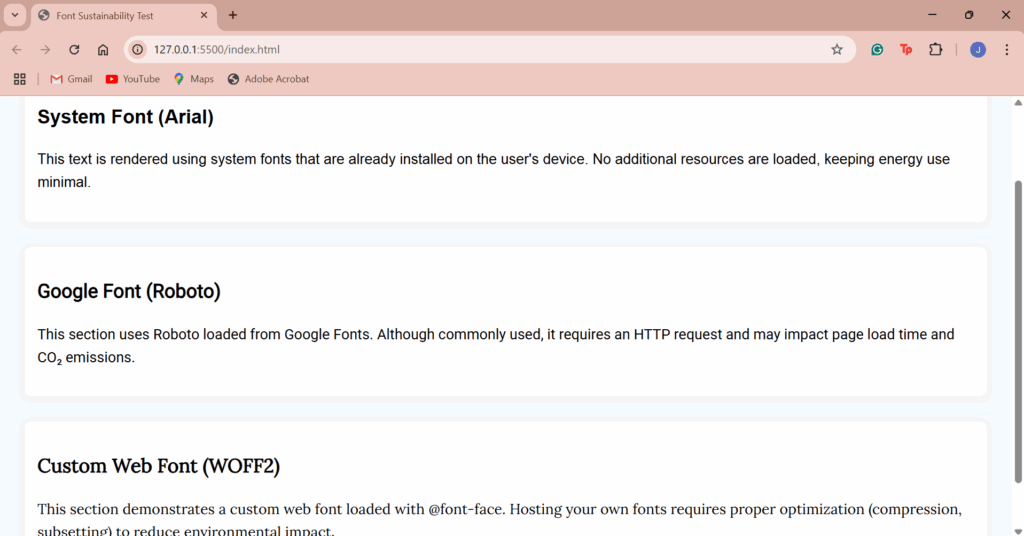
Result: Switching from custom or Google fonts to system fonts saved up to 100–300 KB per page load, depending on font size and styles used.
Step 3: Print Efficiency
For print testing, I compared a basic document printed in:
- Arial (standard sans-serif)
- Ecofont Vera Sans
- Times New Roman
With Ecofont, small perforations in the letters reduced ink usage by up to 20%, while maintaining readability.
Conclusion
Typography may seem like a minor design decision, but it can have a real environmental impact. In digital environments, using system fonts can significantly reduce file size and loading energy. In print, using ink-saving fonts like Ecofont leads to measurable reductions in material usage.
These are low-effort changes that don’t compromise design quality and they scale well across large projects.
Key Takeaways
- Use system fonts for faster and lighter web performance.
- Optimize custom fonts with subsetting and compression (e.g., WOFF2 format).
- Try Ecofont for print materials to save ink and reduce environmental impact.
- Avoid loading multiple font weights or families if not necessary.
Tools Used
- Lighthouse
- WebPageTest
- Ecofont
- Google Fonts loading via
<link>and@import
