The primary objective for this update was to architect a paradigm shift from a linear generative pipeline to a nonlinear, interactive sound design environment
System Architecture & Implementation of Interactive Components
The existing pipeline, comprising image analysis (object detection, semantic tagging), importance-weighted sound search, audio processing (equalization, normalization, panoramic distribution based on visual coordinates), and temporal randomization was extended with a state-preserving session layer and an interactive control interface, implemented within the collab notebook ecosystem.
Data Structure & State Management A critical prerequisite for interactivity was the preservation of all intermediate audio objects and their associated metadata. The system was refactored to maintain a global, mutable data structure, a list of processed_track objects. Each object encapsulates:
The raw audio waveform (as a NumPy array).
Semantic source tag (e.g., “car,” “rain”).
Track type (ambience base or foreground object).
Temporal onset and duration within the mix.
Panning coefficient (derived from image x-coordinate).
Initial target loudness (LUFS, derived from object importance scaling).
Dynamic Mixing Console Interface A GUI panel was generated post-sonification, featuring the following interactive widgets for each processed_track:
Per-Track Gain Sliders: Linear potentiometers (range 0.0 to 2.0) controlling amplitude multiplication. Adjustment triggers an immediate recalculation of the output sum via a create_current_mix() function, which performs a weighted summation of all tracks based on the current slider states.
Play/Stop Controls: Buttons invoking a non-blocking, threaded audio playback engine (using IPython.display.Audio and threading), allowing for real-time auditioning without interface latency.
On-Demand Sound Replacement Engine The most significant functional addition is the per-track “Search & Replace” capability. Each track’s GUI includes a dedicated search button (🔍). Its event handler executes the following algorithm:
Tag Identification: Retrieves the original semantic tag from the target processed_track.
Targeted Audio Retrieval: Calls a modified search_new_sound_for_tag(tag, exclude_id_list) function. This function re-executes the original search logic, including query formulation, Freesound API calls, descriptor validation (e.g., excluding excessively long or short files), and fallback strategies—while maintaining a session-specific exclusion list to avoid re-selecting previously used sounds.
Consistent Processing: The newly retrieved audio file undergoes an identical processing chain as in the initial pipeline: target loudness normalization (to the original track’s LUFS target), application of the same panning coefficient, and insertion at the identical temporal position.
State Update & Mix Regeneration: The new audio data replaces the old waveform in the processed_track object. The create_current_mix() function is invoked, seamlessly integrating the new sonic element while preserving all other user adjustments (e.g., volume levels of other tracks).
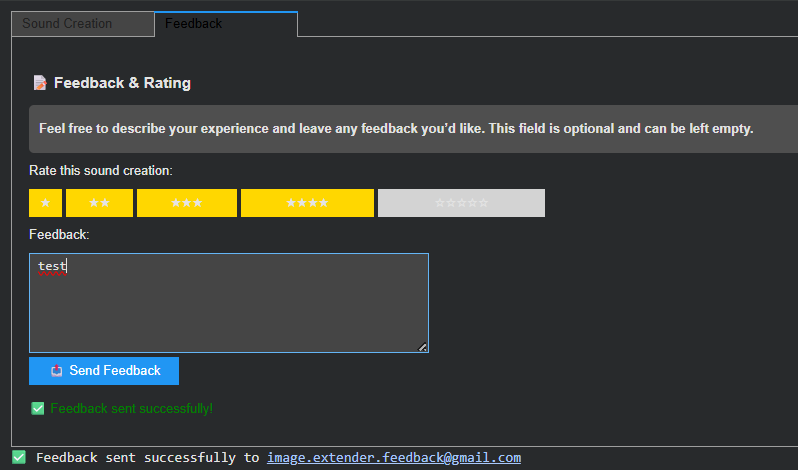
Integrated Feedback & Evaluation Module To formalize user evaluation and gather data for continuous system improvement, a structured feedback panel was integrated adjacent to the mixing controls. This panel captures:
A subjective 5-point Likert scale rating.
Unstructured textual feedback.
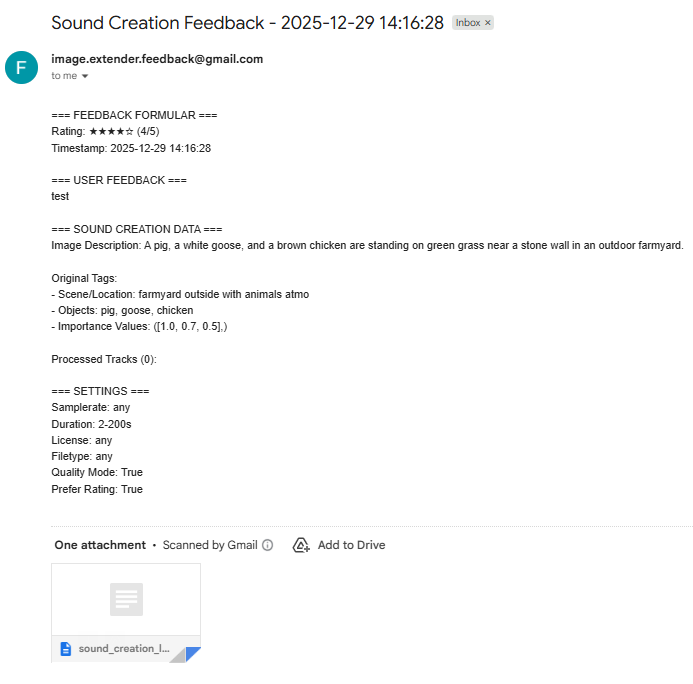
Automated attachment of complete session metadata (input image description, derived tags, importance values, processing parameters, and the final processed_track list). This design explicitly closes the feedback loop, treating each user interaction as a potential training or validation datum for future algorithmic refinements.
I recently had the opportunity to visit the Tolkien exhibition in Trieste. The exhibition was dedicated to the life and work of J. R. R. Tolkien and showcased not only his literary world, but also the huge cultural impact his stories have had to this day. I was particularly impressed by three large walls that were completely covered with bookshelves. They contained numerous editions of The Lord of the Rings and The Hobbit from all over the world in a wide variety of formats and designs. (It would be interesting to look at the book covers from different countries and analyze the background and cultural influences on the illustrations.)
At the end of the exhibition, there were also many illustrations by artists and fans who were inspired by Tolkien’s stories. These works ranged from classic drawings to modern interpretations and impressively showed how differently the same world can be visualized.
And again Books
All of this reminded me of a bookshelf at my parents house. For years, it has held several illustrated books dealing with conceptual art and illustrations for the Lord of the Rings and Hobbit films (of course Harry Potter as well). Now, during the Christmas holidays, while I am back at my parents’ house, I went to this shelf and took another look at the books.
One book in particular caught my attention: “The Hobbit: The Desolation of Smaug Chronicles – Concept Art and Design,” published by Hobbit Press. The first edition was published in London in 2013. The main author is Daniel Falconer, supplemented by forewords and texts by other authors and contributors who were directly involved in the film production.
Concept Art at Middle-earth
Conceptual art plays a central role, especially in film adaptations of books. As already mentioned in the blog post about the Harry Potter exhibition in London, conceptual art forms the visual bridge between text and film and helps to translate abstract descriptions, moods, and places into specific images. This work is particularly sensitive and challenging when it comes to a literary source such as The Hobbit, which many readers already associate with their own inner images.
In the case of The Hobbit films, the screenwriters provided numerous ideas that were strongly based on the book. At the same time, The Lord of the Rings already provided existing locations, characters, and visual rules that had to be followed. This made it all the more important to develop the new locations that play a major role in The Hobbit for the first time including Mirkwood (Düsterwald), Esgaroth the lake-town (Seestadt), and Erebor, the Lonely Mountain.
Weta Workshop, which also co-published this book, played a central role in this process. Weta Workshop is a New Zealand special effects company founded in 1987 and based in Wellington. It provides services for film productions, including design drafts, makeup effects, props, creatures, puppets, miniatures, models, and large sculptures. The company also produces merchandising items. For The Hobbit trilogy, Weta Workshop was instrumental in the visual development of characters, costumes, environments, and fantastical creatures, working closely with the director, screenwriters, and other creative departments.
Back to the Book
The illustrated book is structured along the sections of the film and shows the concept art for specific scenes, locations, characters, costumes, and mythical creatures. At the time of publication, many of the artists involved had already been working on The Hobbit trilogy for four to five years. Every day brought new challenges, as concept designer Alan Lee describes in the book’s introduction.
“The book shows only a relatively small part of the enormous amount of work that went into the visualization and production of The Hobbit: The Desolation of Smaug,” says Lee.
The creation of Beorn
The first section of the book is about Beorn’s house. Beorn is a man who can transform himself into a bear. According to the author, this character posed a particular challenge, as he had to be portrayed convincingly in both human and animal form, visually credible but at the same time consistent with Tolkien’s description and the existing imagery of Middle-earth.
I am particulary interested in how artists create fantasy characters, especially those with an ambiguous or hard-to-define personality. Having read the book as well, I can imagine that Boern was one of the most difficult figures to design, because its never entirly clear wheater he is good or bad. His bear form in particular needed to appear frightening and monstrous.
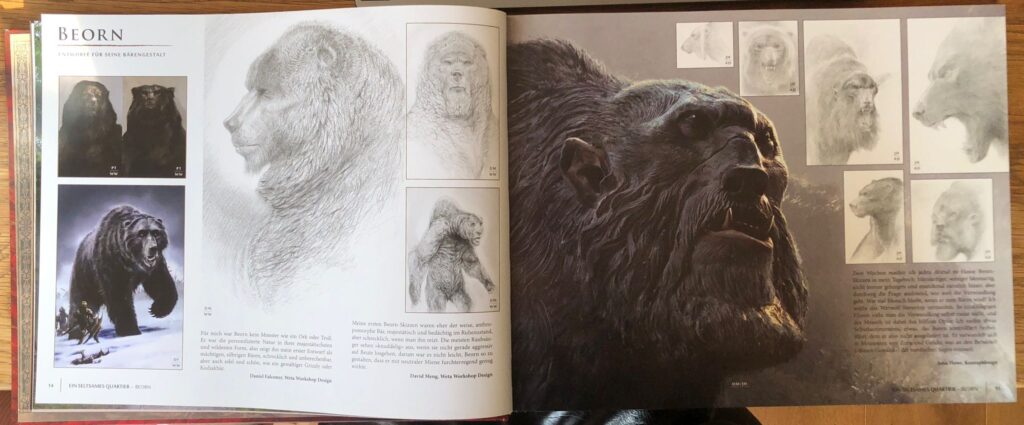
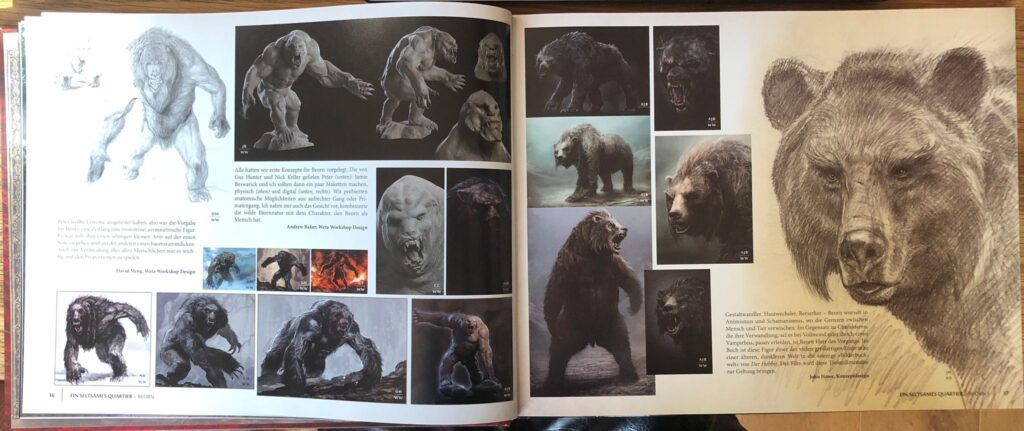
The many pictures in the book are showing how difficult is was, and how many attempts they needed to finding a clear direction. I think its always really calming when you see that talanted artist like the one who contributed here in the films are also struggeling sometimes. Its interesting to see how it works on big sets like this. Many artists work on the same subject at once, each starting with a different vision, and then gradually discussing, refining, and combining these ideas.
John Howe mentoined that for two weeks he made a scribble of boern on his diary every evening. Each day he tried a new approach. Some of these drawings can be seen on the right side of the upper image. For me, this highlights how important it is to keep going, to think differently, and to have the courage to experiment and try things out.
After large number of artworks had been created and presented to the Weta Workshop, the team began developing 3D Modells and exploring anatomical possibilities. Their aim was to push the design in a bit more brutal and extreme direction, which can be seen on the left page of the lower image. In the end, all these ideas come together, resulting in the creation of a truly unforgettable character.
The Elevnking’s Hall
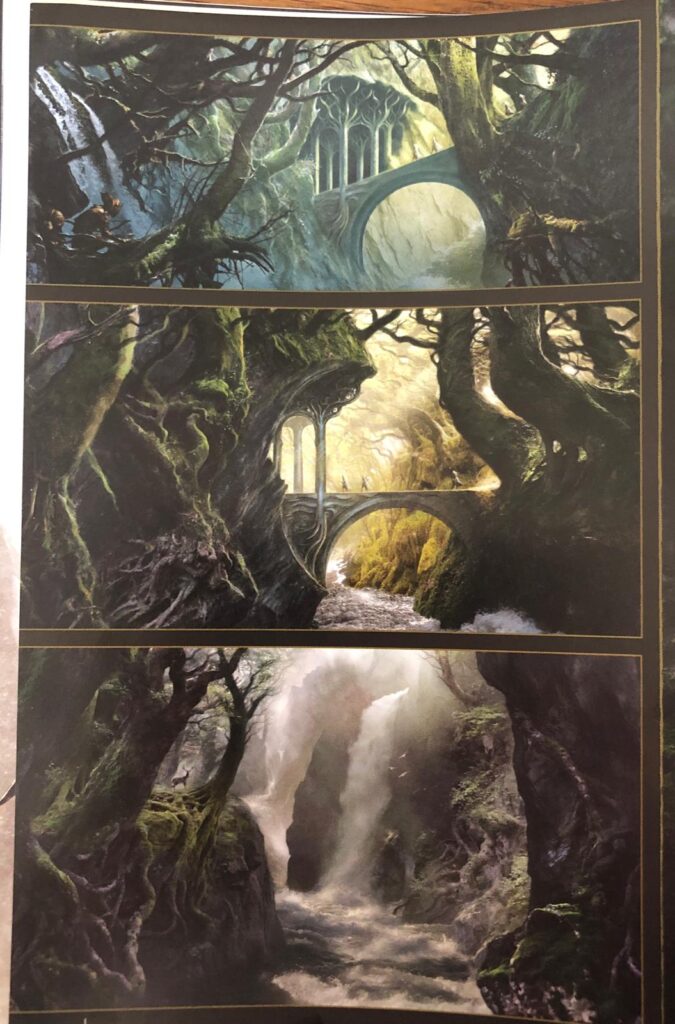
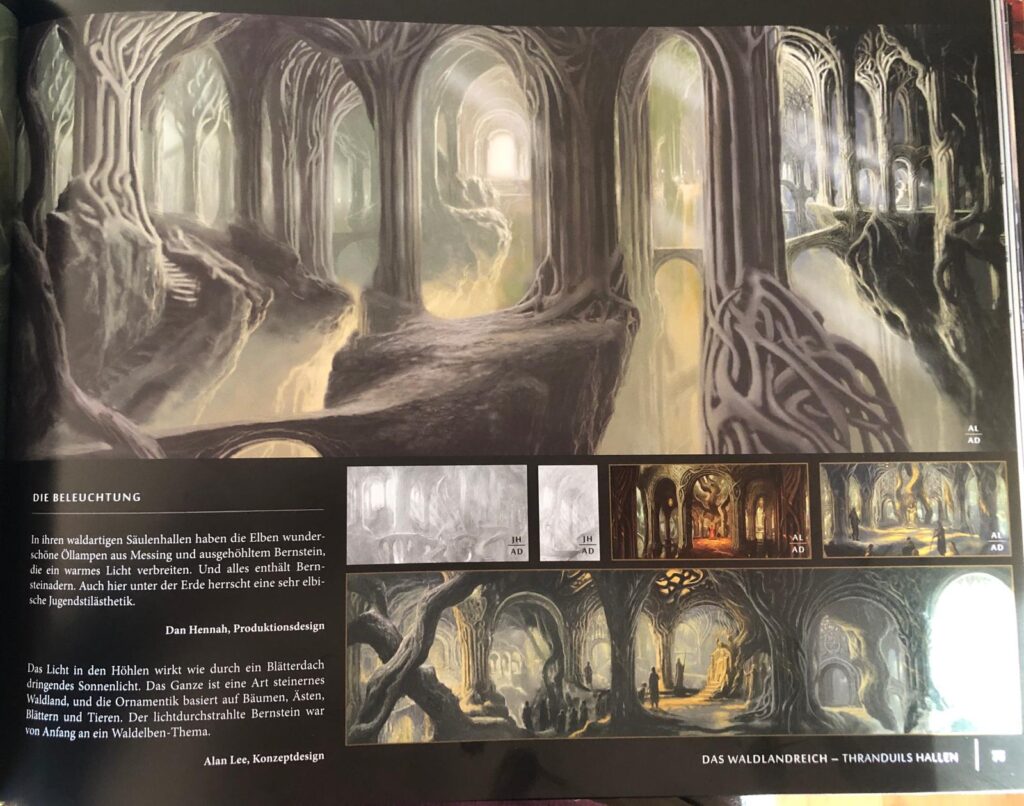
Besides character design, I can imagine designing settings almost as difficult, maybe even more so. Because, as mentioned in the book, you have to think about so many things like light setting, perspective and the story behind it. Across eleven pages, the book shows how the Elvenkings Hall and the Throne room were created. These are two of my favorite locations in the movie because they combine a sense of magic with a darker atmosphere. According to the Conceptartists, one one the Challanges was to continue the Mirkwood but in a more magic way. They wanted to build an entire cave system out of trees that looks very natural.
In the images above you can see a few of the artworks they did. Another important thing in the creation was the deepth the rooms should have. Gus Hunter, one of the designers at Weta Workshop, worked with many columns, trees, and roots to shape the space. When thinking about the lighting of the hall, he came up with the idea of using stalactites in which the elves could place oil lamps. In addition, he used water reflections to help illuminate the entire setting.
To come to an End
Overall, it is incredibly interesting to see how these different departments and artists work together to bring such complex worlds to life. What I have written about here is only a very small glimpse into the book, which itself is just one part of a much larger series documenting the creative process behind The Hobbit. Once again, it highlights how essential concept art and strong visual storytelling are for building believable and immersive worlds. This topic is especially important for my future academic work, as it directly connects to my interest in the visualization of storytelling and in creative development processes more broadly both of which I eventually plan to explore further in my master’s thesis.
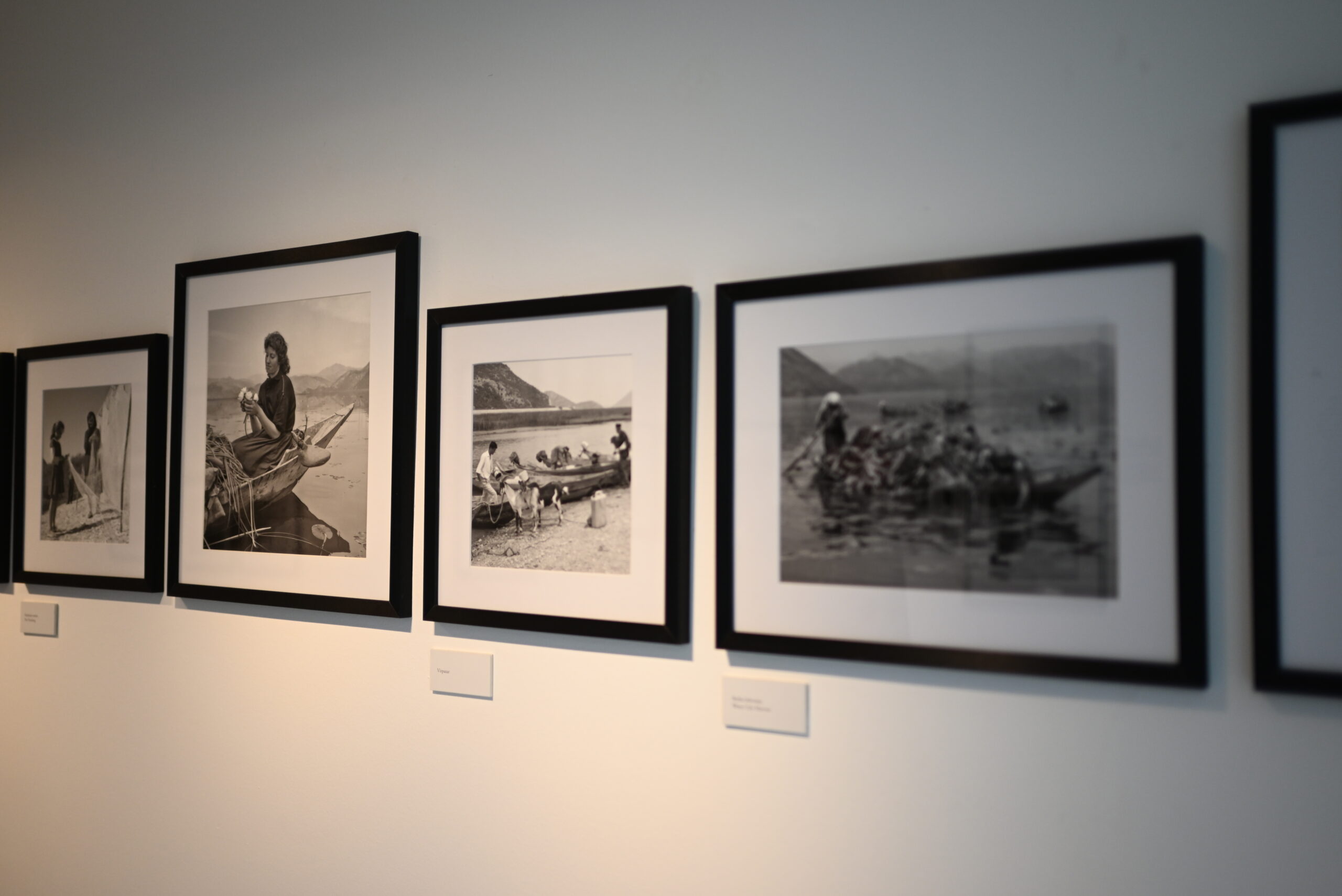
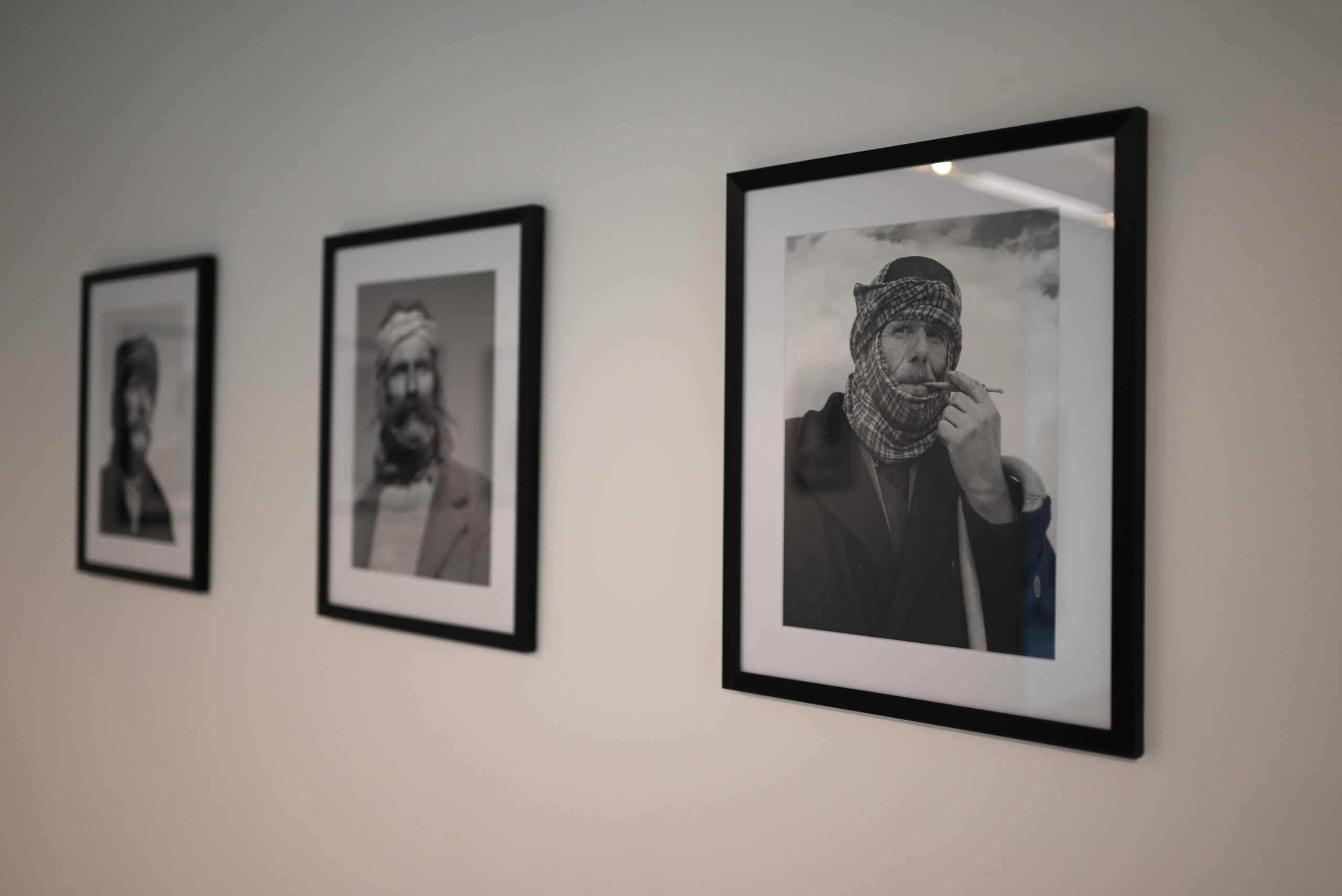
Visiting the photography exhibition of Milorad (Milan) Pešić in Cetinje felt less like attending a cultural event and more like stepping into a collective family album. As a girl born and raised in Montenegro, I did not walk into that space as a neutral observer. I walked in carrying memories, inherited stories, and a deep emotional connection to the landscapes and faces that Pešić captured through his camera.
Cetinje itself already carries a special weight for me. Old royal capital has a quiet dignity, a sense of endurance that mirrors the Montenegrin spirit. Seeing Pešić’s photographs displayed there felt right — as if the city and the images were speaking the same language. From the very first photograph, I felt recognition. Not just recognition of places, but of emotions. These were not distant historical documents. These were scenes I felt I had lived, even when they belonged to a time before I was born.
What moved me most was how familiar everything felt. The faces in Pešić’s portraits reminded me of my grandparents, my neighbors. The men — strong, reserved, shaped by the land — carried expressions I have seen my entire life. There is something uniquely Montenegrin in the way people stand, look, and exist in space, and Pešić captured that without exaggeration or romanticism.
As a woman, I found myself paying special attention to the images of women in the photographs. They are rarely posed or idealized. Instead, they appear real — working, waiting, carrying burdens both physical and emotional. Their strength is quiet, almost understated, yet undeniable. Looking at them, I felt a deep respect and a sense of continuity. These women are the reason our traditions survived. They held families together, preserved customs, and endured silence when words were not allowed.
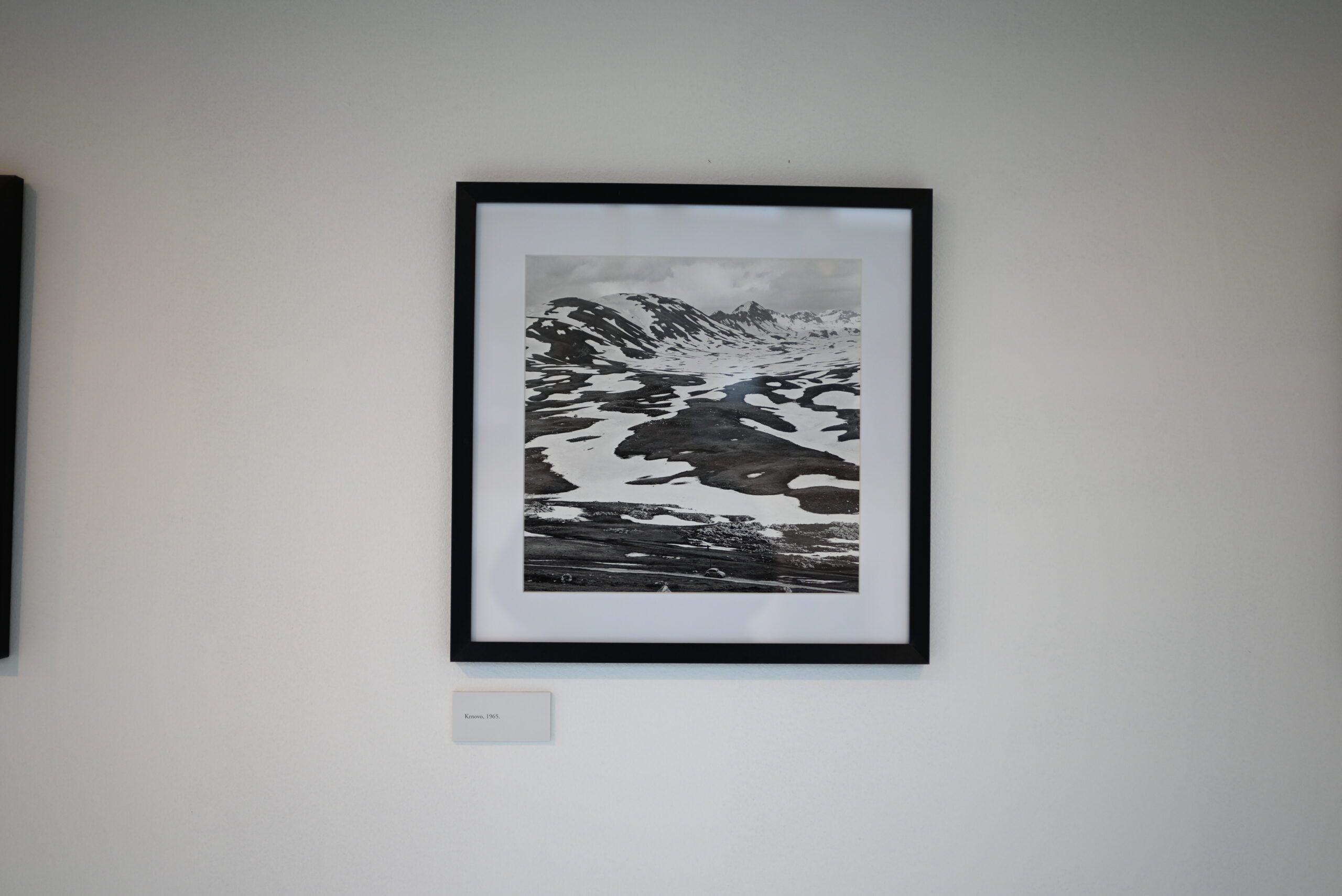
The landscapes, too, stirred something deeply personal. Montenegro is a country of extremes — harsh mountains, calm seas, isolated villages, and narrow streets filled with history. Pešić’s photographs do not simply show these places; they remember them. The mountains feel heavy with time, the villages feel intimate and vulnerable, as if they could disappear if not preserved through images like these. Standing in front of those photographs, I felt gratitude that someone cared enough to document our world before it changed forever.
What makes this exhibition especially powerful is its honesty. Pešić did not try to beautify poverty or dramatize hardship. He simply observed. And in doing so, he allowed dignity to emerge naturally. His work reminded me that our history is not only written in books or political events, but in ordinary lives — in daily routines, in work, in silence, in perseverance.
Leaving the exhibition, I felt both proud and emotional. Proud of where I come from, and emotional because so much of what I saw belongs to a Montenegro that is slowly fading. Yet thanks to photographers like Pešić, it is not lost. It lives on — not as nostalgia, but as testimony.
This exhibition was not just about photography. For me, it was about identity. About seeing ourselves clearly, without filters, and accepting both the beauty and the hardship that shaped us. As a Montenegrin woman, I left with a renewed sense of connection — to my past, my people, and my place in this long, quiet story we call home.
Klanglicht 2026 war für mich ein richtig angenehmer Startpunkt für meine Recherche. Es war zwar erst mein zweites Klanglicht, aber diesmal bin ich ganz anders hineingegangen. Ich habe mir bewusst Zeit genommen und versucht, nicht nur zu konsumieren oder „schön zu finden“, sondern genauer zu beobachten, wie Licht, Sound und Raum eigentlich Emotionen erzeugen. Genau das ist ja auch der Kern meiner Arbeit: Erinnerungen spürbar machen – nicht nur zeigen oder erklären, sondern fühlbar werden lassen.
Was mich bei Klanglicht besonders fasziniert hat, war diese Mischung aus Staunen, Ruhe und gleichzeitig einem totalen Überwältigtsein. Man bewegt sich durch die Stadt, die man eigentlich gut kennt, und plötzlich wirken Straßen, Plätze und Gebäude komplett anders. Vertraute Orte verlieren kurz ihre Alltäglichkeit und bekommen etwas Fremdes, fast Zeitloses. Das hat mich stark daran erinnert, dass Erinnerungen nie fix oder abgeschlossen sind. Sie verändern sich ständig – je nachdem, aus welchem Blickwinkel man schaut, in welcher Stimmung man ist oder welche Atmosphäre gerade entsteht.
Viele Installationen haben genau dieses Gefühl verstärkt. Sie haben nichts „erzählt“ im klassischen Sinn, sondern eher Räume geöffnet, in denen man selbst etwas gespürt hat. Ich hatte oft das Gefühl, dass nicht das einzelne Werk im Vordergrund stand, sondern das Zusammenspiel aus Licht, Klang, Architektur und den Menschen, die sich darin bewegen. Dadurch wurde mir klar, wie sehr Erinnerung auch etwas Situatives ist – etwas, das im Moment entsteht und nicht einfach abrufbar ist wie eine Datei.
Ein Moment, der mir besonders hängen geblieben ist, war eine Projektion, die wie schwebende Lichtpartikel gewirkt hat, begleitet von einem extrem minimalistischen Sound. Es war nichts Lautes, nichts Dramatisches. Viele Leute standen einfach still da, teilweise minutenlang. Niemand hat geredet, niemand hat gefilmt. Das Ganze hatte etwas sehr Intimes, obwohl man von fremden Menschen umgeben war. Es war fast wie ein kollektives „In-sich-Hineinhorchen“. Genau solche Zustände finde ich extrem spannend, wenn es um neue Formen der Erinnerung an Verstorbene geht: Situationen, die automatisch entschleunigen, ohne dabei traurig oder kitschig zu wirken.
Mir wurde bei Klanglicht auch sehr bewusst, wie stark multisensorische Gestaltung Emotionen beeinflussen kann. Licht kann warm oder kühl wirken, Geborgenheit erzeugen oder Distanz schaffen. Klang kann Nähe herstellen oder einen Raum aufspannen, der fast leer wirkt. Und zusammen können Licht und Sound eine Stimmung erzeugen, die ganz ohne Worte auskommt. Das ist für mein Thema besonders relevant, weil klassische Trauer- und Erinnerungskommunikation oft sehr sprach- und bildlastig ist. Man erklärt, beschreibt, zeigt Fotos. Vielleicht müsste man Erinnerungen viel stärker erleben lassen, statt sie zu erklären oder zu archivieren.
Das Festival hat mir außerdem gezeigt, dass Emotionen nicht nur im Inneren einer Person entstehen, sondern stark vom Raum und von anderen Menschen beeinflusst werden. Die Stimmung zwischen den Besucher*innen, das gemeinsame Schweigen, das langsame Gehen – all das trägt zur Erfahrung bei. Erinnerung ist damit nichts rein Privates, sondern etwas, das auch kollektiv entstehen kann, ohne laut oder aufdringlich zu sein.
Was ich vom Festival konkret mitnehme: -Erinnern kann interaktiv sein, ohne dass man aktiv etwas bedienen oder steuern muss – manchmal reicht schon Bewegung, Licht und Atmosphäre. -Emotionen entstehen oft im Raum zwischen Menschen, nicht nur in ihnen selbst. -Erinnerungsdesign könnte viel stärker mit Raum, Stimmung und Zeit arbeiten, statt sich nur auf Objekte, Texte oder Bilder zu konzentrieren.
Klanglicht war für mich damit weniger ein Event und mehr eine Art Denkraum – und ein sehr stimmiger Einstieg in meine weitere Recherche.
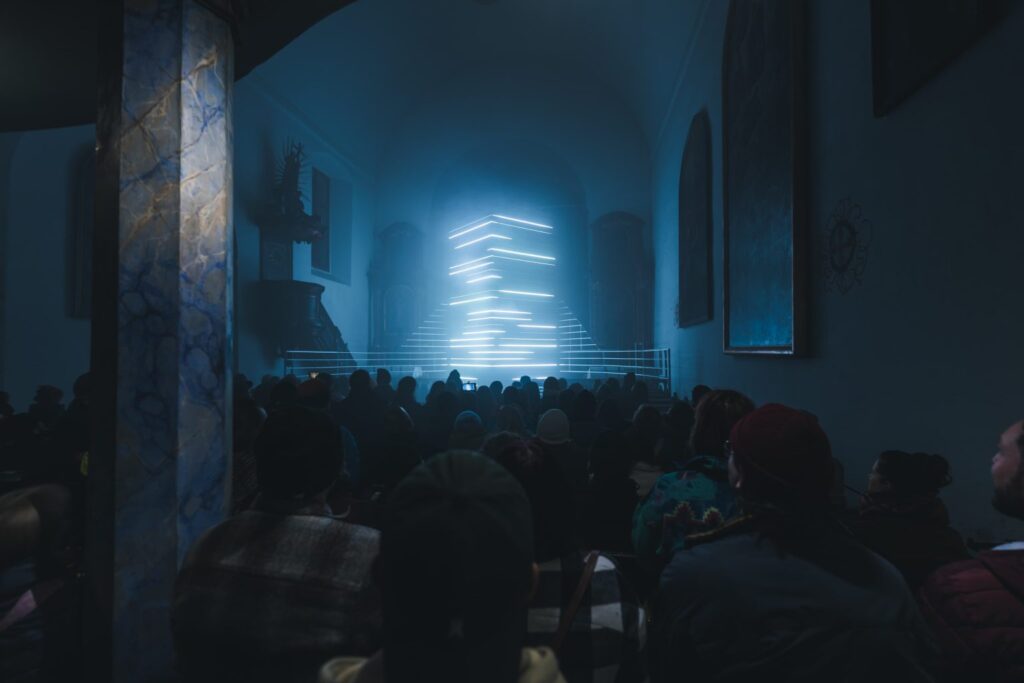
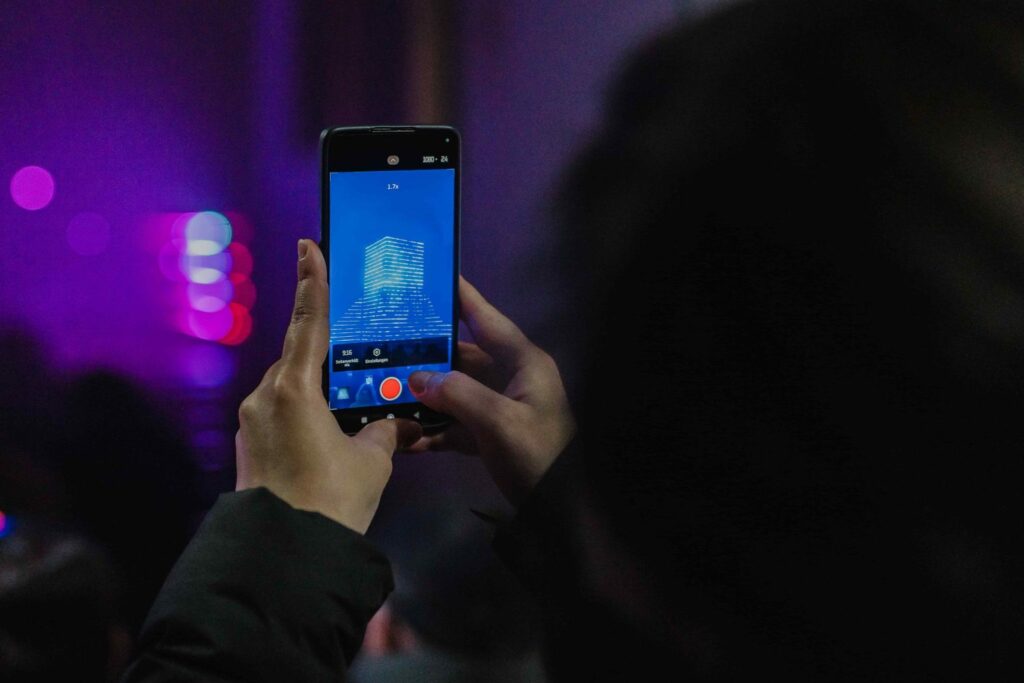
During Klanglicht, I didn’t only get inspiration from other installations that were spread around Graz, but especially from the one I was working on myself. Being part of the project “Vertigo” changed the way I experienced the festival, because I wasn’t only visiting the installations, but actively working on one of them. Our installation took place in a church, where we built a huge tower made out of LED panels. Visitors were invited to sit down and watch minute-long animated shows. Each group created a seamless animation combined with sound, guiding the visitors through a topic. Even though all animations were very different, they were connected through the same structure and space.
My role in the project was as a media student, so I was part of the animation team. I searched for different ways to show the storyline and to use sound together with visuals by working with shapes and videos. A big part of the process was trying things out, failing, and then testing everything again directly on the final installation. Timing was very relevant, because the sound and the animation only worked well together when they were perfectly aligned. Even small changes in rhythm could completely change the effect. Within my group, we focused on the topic of urbanisation. We wanted to show, not just with our visuals but also with the sound, that more and more urbanisation is taking away from nature and with that also from us. We worked a lot with colors and rhythm to show the different parts of our animation. The city was shown as cold, hard, and very bright, using colors that were almost neon. This was meant to represent a new, superficial world and was supported by loud construction sounds. Nature, on the other hand, was calmer and a bit warmer. This contrast helped to clearly distinguish between the two parts within our storyline.
We also worked with building and destroying elements within the animation. At one point, a tower was built up and then destroyed again. The impact of this moment was made stronger through sound. Sometimes we also used black screens or short pauses, which helped to create an emotional impact and made the moment feel more intense. I also found it very inspiring to see what the other groups had done. One group showed the topic of love only by using colors and shapes that once moved in sync and then slowly left each other again. This project showed me what power simple shapes can have and how different the effect can be depending on movement, timing, and surface.
The installation would not have worked the same way on a normal screen. The LED panels, their vertical construction, and especially the space of the church had a big influence on how everything was perceived. The space also had a strong effect on the sound, making the whole installation feel more immersive. This project really inspired me and also influenced how I think about my master’s thesis. I loved that the work was abstract, but still very specific in the way it showed a storyline so clearly. It made me realize that it’s possible to tell a strong story without being literal, just by working with shapes, rhythm, color, sound, and timing.
AI is no longer limited to creating images. Today, it is also possible to animate illustrations. Short videos, subtle motion, and atmospheric loops can be generated from a image or prombt. Since I had never animated illustrations with AI before, I decided to try it out and see how it works in practice. i knew that its possible to create illustrateded animation videosfrom the scratch, but I am intrested in using already existing illustrations and animating them. I heared it works best for minimalistic, subtle animations. That’s why I chose my illustration, which I’ve used once before. I think it has the potential to be pretty good. This blog post is an exploration and an experiment with AI and based on the previous post.
Why I Wanted to Try AI Animation
As an illustrator, animation has always felt like a separate skill set. Traditional animation takes time, planning, and technical knowledge. AI promises a faster and more accessible way to bring illustrations to life, even without animation experience. Sometimes even small animations enhance an illustrations more, especially for soocial media.
Over all I was curious to find out:
how much control I actually have
how natural the movements look
whether AI animation feels like a useful tool or just a visual effect
which Generator is the best
How AI Animation Works (as a user)
Most AI animation tools work with an image-to-video approach. You upload a finished illustration and describe how it should move. The AI then creates a short animated clip based on your image and text prompt. Typical movements include flowing smoke, water, light, or subtle object motion. These animations are usually short and loopable, making them suitable for social media, websites, or mood visuals.
Let’s Start Animating
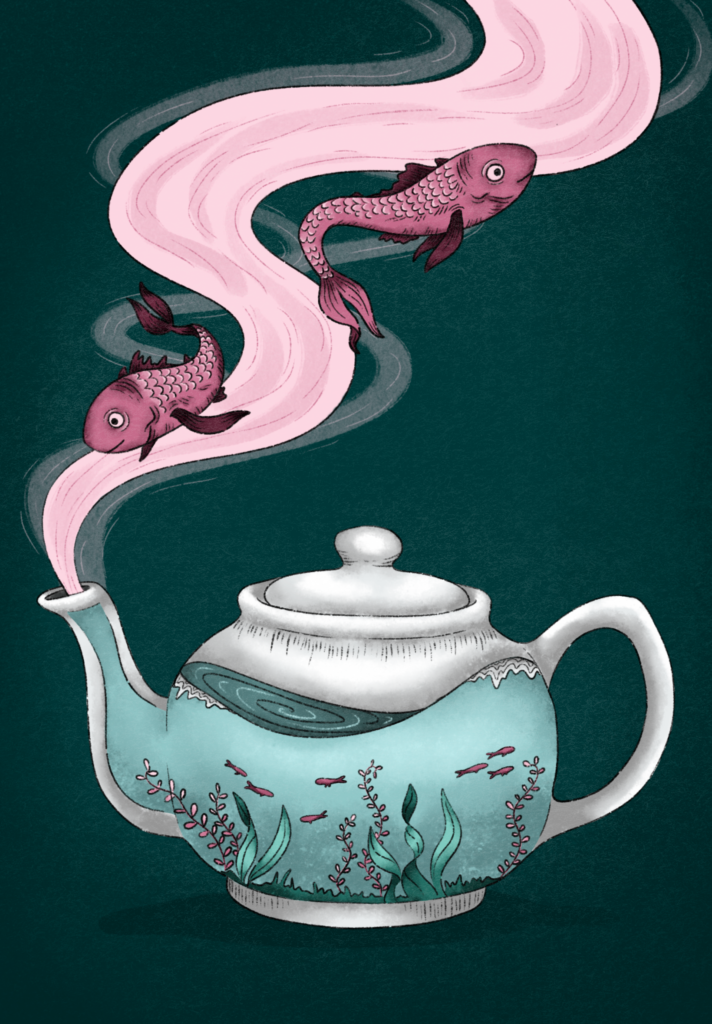
For my first tests, I decided to focus on tools that are commonly used (and free) for image-to-video animations. I let Chat GPT write the prombt for my imagined animation. Here how it turned out and the picture an want to use, which you may already know from my previous article:
Soft, slow animation. The pink smoke gently flows out of the teapot spout and moves upward in a smooth curve. The fish inside the smoke slowly swim forward. Calm, dreamy motion, no camera movement, subtle loop.
It was not easy to find Generators that are completly free. I just can just Firefly because I have an Adobe Subscription but there exclusive material as well. The good thing on Firefly is, that you can choose between a lof of diffrent models. Most websites require you to purchase credits, but there are some models where you have a few credits available in the free plan as Leonardo Ai or Stable Diffusion. However, I assume that you will achieve the best results with paid models.
Firefly Veo 2: You just can create 9:16 or 16:9 which is very limiting, just the fishes are moving, even though one of the fishi sis turning weird, I like the flowy and slow motions
Stable Diffusion: I tried Stable Diffusion for the first time and I have to admit I am very happy with this result, the movements of the fish are really realistic and I like how the smoke is slightly moving in the background, it looks very magical
Firefly Ray 3 HDR: I like how the smoke is slowly moving upwards and how the fish are floating around it, I dont get why the camera is mocing upwards cause there is no information about it in the prombt but I kinda like it, what’s really strange are the colors and how gray and dark they’ve become.
Firefly Pika 2.2: Really dont know whats going on there
Leonardo AI: I had high hopes on that generator but it turned out a bit weird, i like how the smoke is flowing, but everything is moving way too fast
Firefly Veo 2
Stable Diffusion
Firefly Ray 3 HDR
Firefly Pika 2.2
Leonardo AI
I think the best result so far came from Stable Diffusion. That’s why I wanted to refine the prompt and make it more precise, to see if I could achieve an even better result, even though I already really like how it turned out. Here’s what I got.
Unfortunately, I couldn’t manage to keep the fish inside the frame. Aside from that, I really like the movements inside the teapot, especially the gentle water motion and the way the small fish swim. If it were possible to combine these movements with the version shown above, that would be my ideal result.
Final Thoughts
Animating static illustrations with AI is something I find really interesting. Compared to fully creating illustrations with AI, I like this approach because it lets you add motion to existing artwork and create cool results very quickly. You don’t need any After Effects skills, and traditional animation usually takes a lot of time.
Especially for social media or small animated pieces, AI animation is a great option. You can get something moving without a complex workflow. It could also be interesting to animate individual layers separately and then combine them, which might lead to even better and more controlled results. Prompting is still challenging, especially when you have a very specific idea in mind, but overall it’s an exciting and accessible way to experiment with animation.
Before the break I met with Birgit to talk about my master’s thesis. I had a rough idea what I want to do for my thesis since end of November, but nothing really concrete yet. To be honest I also had some doubts about the topic every other day if this is really what I want to do. I thought a lot about the topic and the project, brainstormed, researched but somehow, I circled around the same project ideas over and over again. While this is probably a normal part of the process, I still felt stuck. So, the meeting with Birgit came at a very good time for me, since I wanted to move forward with my idea and get more concrete.
One thing that felt quite clear to me already was the general direction for my thesis. I want to design something that embraces low-pressure creativity, fun, a bit of uselessness, and something whimsical. I feel like we are missing all of these sometimes during our everyday life as creatives. I see this as a counter to the productivity- and hustle-culture we are currently live in. It feels like everything needs to be useful, perfect and efficient. With my thesis I want to explore the opposite: creating a space where people can simply enjoy the act of creating without goals, pressure and expectations.
However, my intention felt clear, I struggle with what the creative space/playground could be. What should be on the website? What do people do there? How does it look like? After pitching her my idea she gave me a historical context I didn’t think of yet. She told me about a the time where the internet was full of so-called “useless” or one-purpose websites, especially during the time of Flash websites. These sites didn’t try to solve a problem or be efficient; they simply existed for fun, surprise and a little confuse.
One example she showed me was the, back in the days very famous, Hamster Dance Website (http://www.hamsterdance.org/hamsterdance/). The website doesn’t really do any useful it is basically just a loop of animations of a hamster with music (unfortunately the sound somehow doesn’t work, but the version Birgit showed me had sound). There is no goal, it doesn’t lead to anything and there is no productivity value and yet it is very joyful and funny. This reminded me that the internet hasn’t always been about optimization, metrics and productivity. It was playful, strange and delightfully pointless. So, I am going to take a deeper look at the history of websites and what was already out there.
Another aspect Birgit told me I should consider is the time factor. She suggested that the webspace or the content of it should not be available all the time. Instead of it being constantly available, it should be available only temporarily, for example 24 hours, before disappearing or changing into something else. That is the same concept as BeReal follows, people can take a snapshot of what they are doing now, once every 24 hours. This limitation creates presence and urgency, but without the pressure to be perfect. This temporal aspect could reinforce the idea of low-pressure creativity: you show up, you play, you create and then it’s gone. You create just in the moment, there is no way to iterate, optimize or monetize.
Even though I still don’t have an exact idea of what the webspace should be like, the talk with Birgit gave me new insights and impulses for the next steps.
AI was used to check spelling and grammar and better clarity.
Artificial Intelligence is currently one of the most discussed and controversial topics in the creative industry. Especially for illustrators, AI raises many questions, fears, and also curiosity. Some see it as a threat, others as a useful tool. Instead of taking a clear position right away, I decided to test AI illustration tools myself and see what they can (and cannot) do. The goal of this article is to explore it through a practical experiment and see what models are the best for illustrations.
Between Fear and Opportunity
I have already written a blogpost on this topic. However, for the purpose of completeness, I would like to reiterate the most important points here. AI in illustration comes with many concerns, and these concerns are valid.
On the negative side, many AI tools are trained on artworks without the consent of the original artists, which raises ethical concerns. Many illustrators fear job loss or that their work will lose value. AI also tends to copy existing styles without truly understanding their meaning.
On the positive side, AI can be useful when used carefully. It allows fast idea generation, quick experiments, and can support inspiration and composition during the creative process.
This mix of risks and possibilities is why AI remains such a challenging topic in illustration.
The Experiment: Recreating My Illustration with AI
For this experiment, I used one of my own illustrations, which I created manually in Procreate. This illustration served as the reference and starting point. The idea was to see:
how close the AI results come to my original illustration
how well the style, colors, and mood are translated
where AI performs well and where it clearly fails
From my experiences using AI Genereators, its easier to let AI write the Prombt for the gererated picture instead of write it by myself. So I gave Chat GPT my Illustration and asked him to describe this illustration in form, color an style for an AI Generator Prombt.
This is how it turned out:
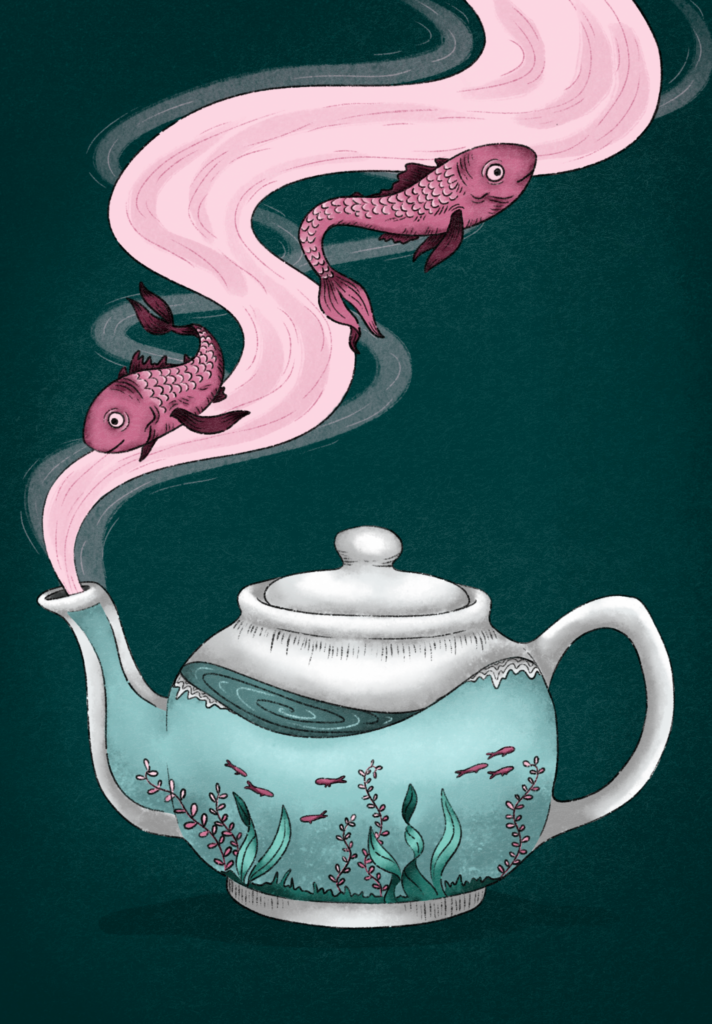
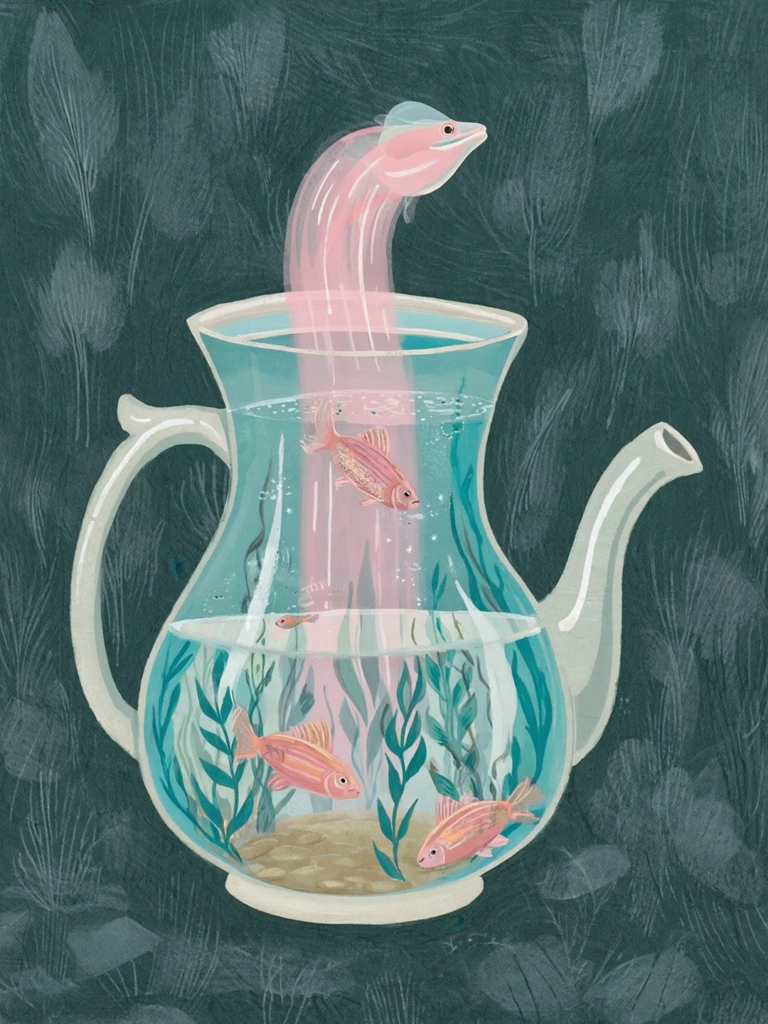
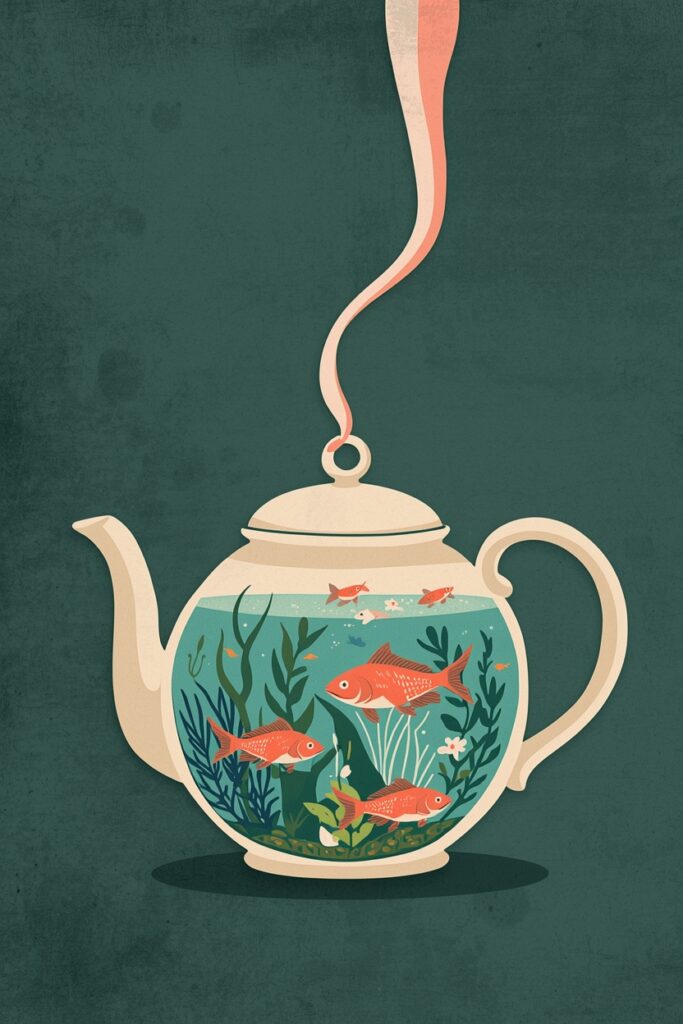
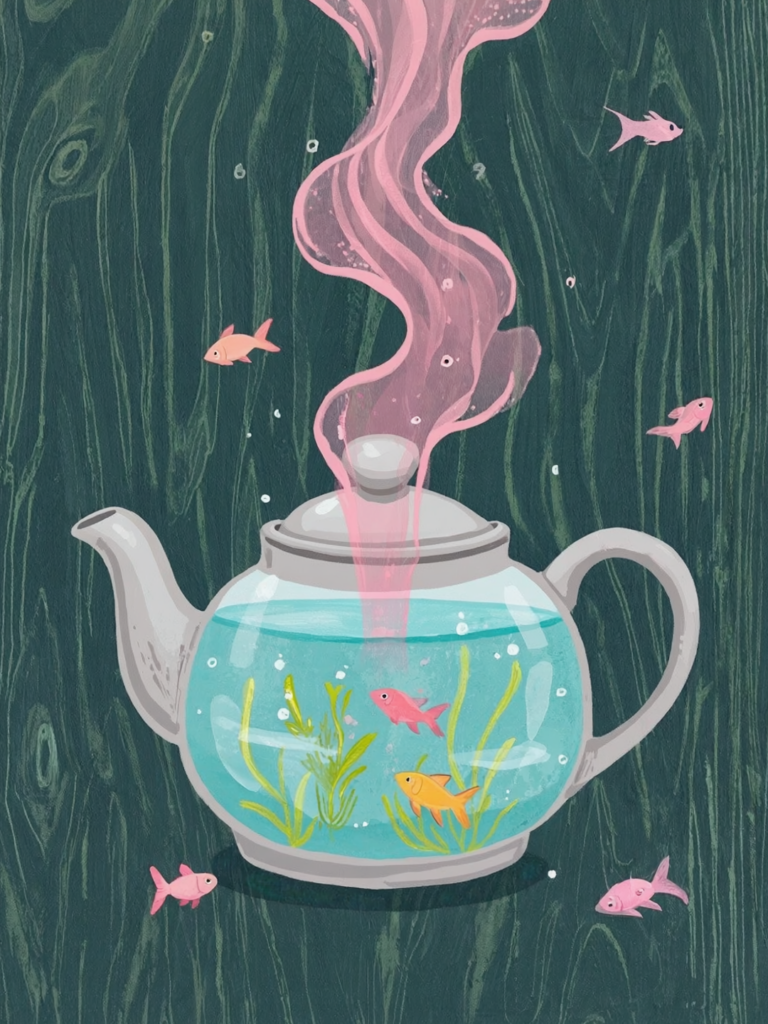
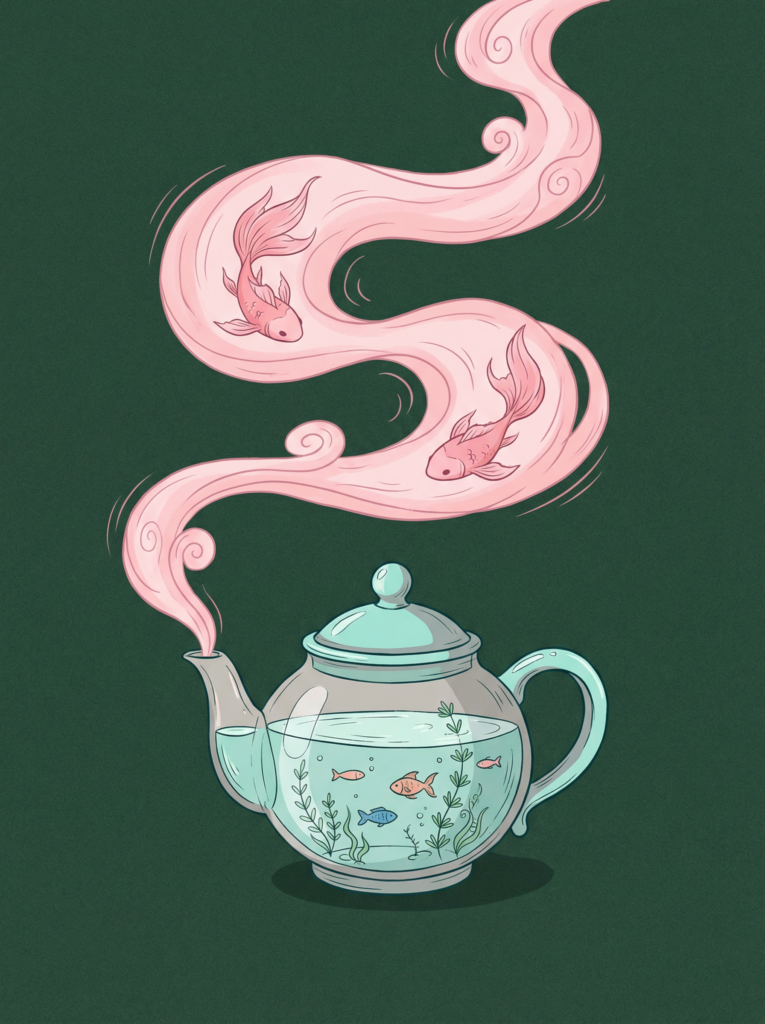
A surreal hand-drawn illustration of a ceramic teapot filled with water like a small aquarium. Inside the teapot, tiny fish and aquatic plants are floating gently. From the spout of the teapot, a soft pink stream flows into the air, and two larger pink fish are swimming within this flowing stream. Dark green textured background, soft pastel color palette with turquoise, pink, and muted grey tones. Whimsical, poetic atmosphere, clean linework, subtle grain texture, storybook illustration style, calm and dreamy mood.
Let’s start the AI Competition
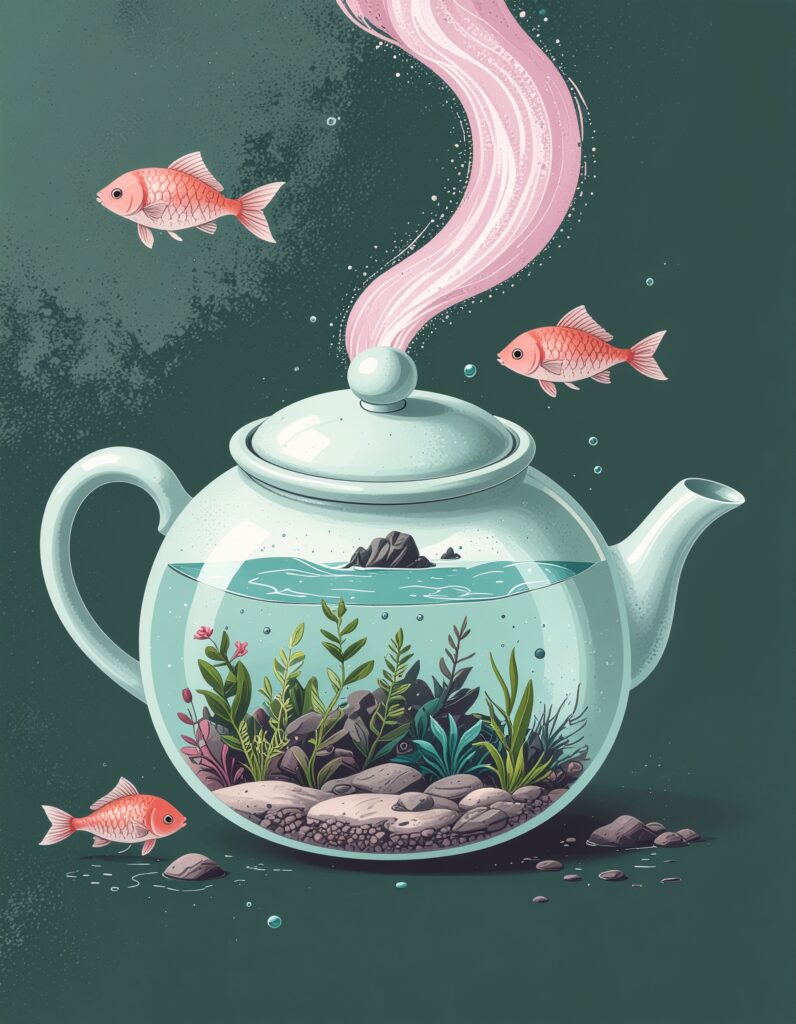
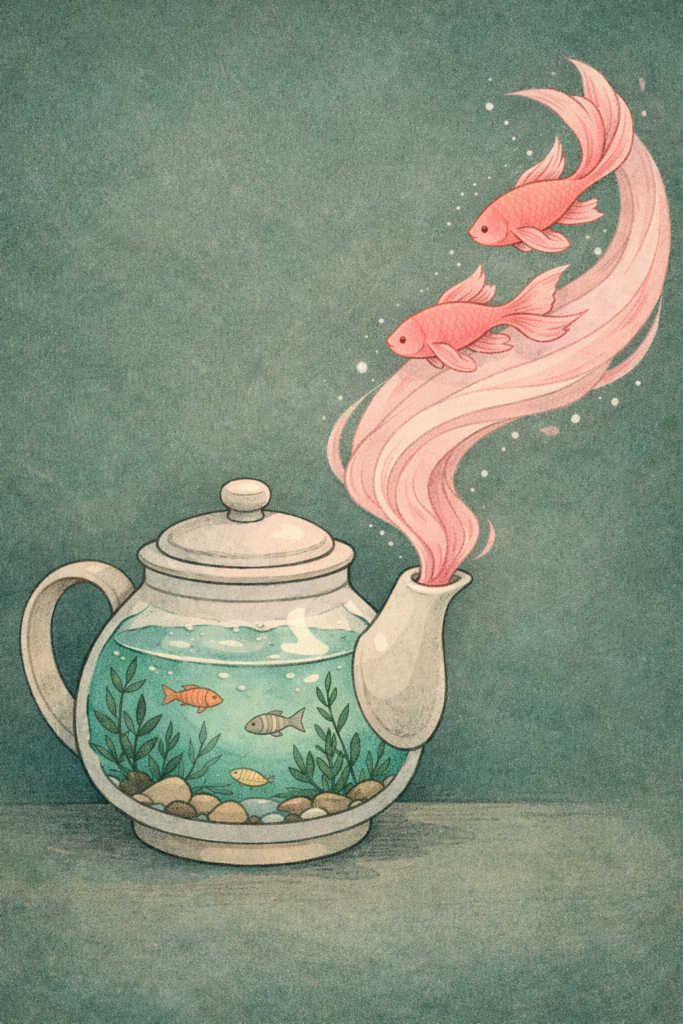
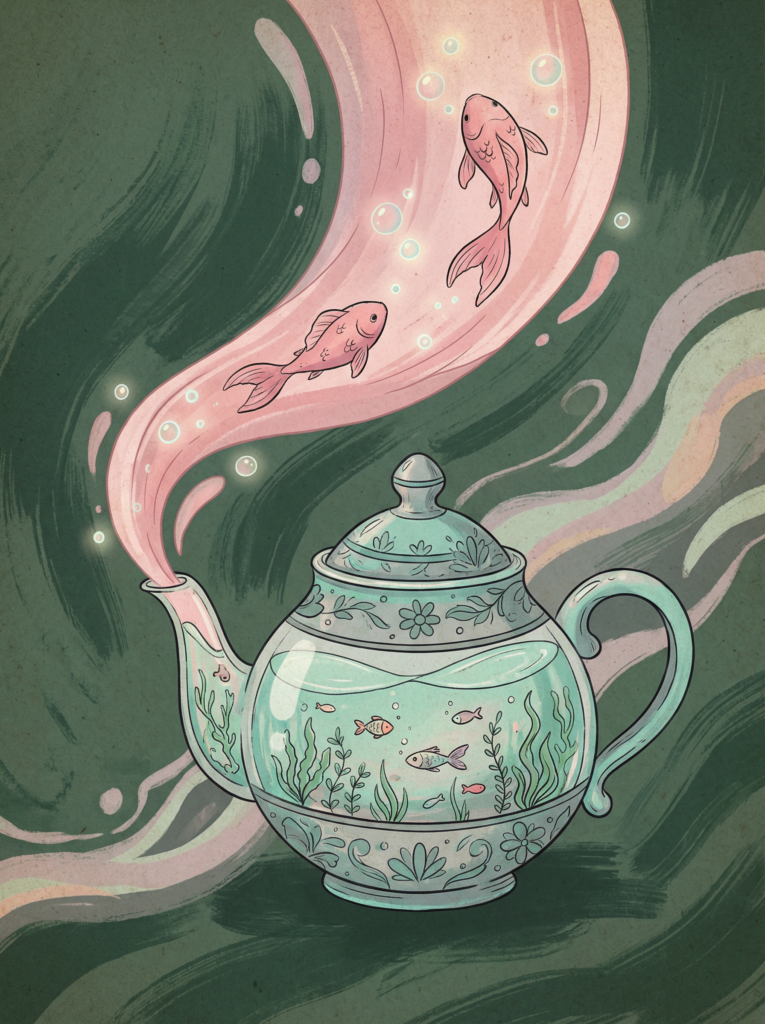
For this experiment, I tested several popular AI image generator models mainly from Firefly. Here are the results and my opinion on it:
Firefly Image 4 Ultra: it dosen’t make sense at all, the style is quite mixed up (3d and 2d elements), don’t understand the stain in the backgorund, at least the teapot looks quite nice with the aquarium in it
Chat GPT Iamge 1.5: I think thats one of the best results when it comes to similarity, the style is illustrative and handmade, it actually make sense, but I don’t like the layout it seems kind of lost and random, the fishis are nice
Gemini 3 with Nano Banana Pro: This modell is usually one of my favorites, I like the artsy style, I think its the best result in gerneral which you could actually use for something (or work further on that), It’s all kind of random and not exactly like the prombt but the style fits pretty well
Flux 1.1 Ultra Raw: The only thing I like here is the bold and graphic style, without the fish in the air and the tiny smoke-thingy it could look nice
Runway Gen-4 Image: What the hell is happing here?! But to be honest if there were no weird eel-ghost there, I would choose that as the winner picture. I really like the style, it looks very editoral-ish and artsy, even though its the most diffrent compared to the original one
Leonardo AI: I tried this website for the first time as I read it should work well for illustrations, turns out: not really. I think its together with the Firefly Ultra its my least favorite, the style is kind of nice (maybe for posters) but it dosen’t make sense
Firefly Image 4 Ultra
Chat GPT Image 1.5
Gemini 3 with Nano Banana Pro
Flux 1.1 Ultra Raw
Runway Gen-4 Image
Leonardo AI
I thought this experimetn was really fun, but I am not completley happy with it at this point. So I decided to take my favorite model and work on the gererated picture until I am happy with the result. Since I really liked the Style of the Runway Gen-4 Image Generator I chose to go with that one, even though the compostions is hilarious. But I see the most potentiol here to get a nice and artsy result.
But after half an hour promting by myself and chat gpt, the picture below was the best result I could get. So I gave Runway up again and switch to my usual favorite Nano Banana again.
Runway
Nano Banana
I tried hard to create a nice result, but the one from Nano Banana was the best I could get. Its kinda nice, but the artsy and handdrawn style is totally missing. It always seems easier than it is to prombt something nice, but actually its pretty hard and time consuming. Probably I could get a better result than this, but I dont wanted to waste so much time (and of course energy) to create those images. And I think thats the whole point: It’s kind of fun to prombt something until it doesn’t work out the way we want or it dosen’t match our expectations. It was interesting and fun to create these images and see how differently each generator works, but it was not as enjoyable as painting the illustration myself. In the end all the created images are looking like AI images. I can’t say exactly why – maybe the too clean lines, the over perfectionsim or the plain textures – but you can see it in all of them. They have no soul and no personality. I don’t want to be an AI-hater, because I am sure that we all have to use it in the future, but with real art at least for me it can’t compete and won’t ever.
I am sure that for some tasks or areas, it makes sense, especially if it doesn’t matter much which illustrations are used. It can save a lot of time and produce beautiful results. Perhaps there are also ways to combine analog illustration and AI, which would certainly be interesting to test. But all in all, I believe and hope that human illustration and art will always remain an important and irreplaceable part of our lives.
Because Art without soul is like a book without words.
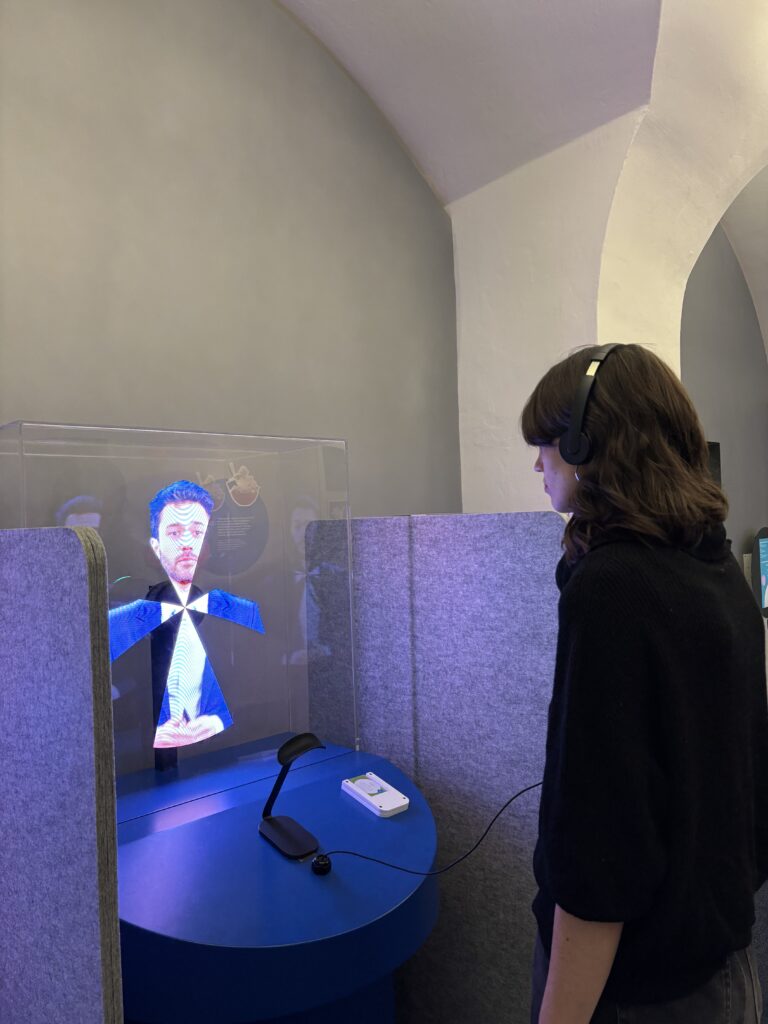
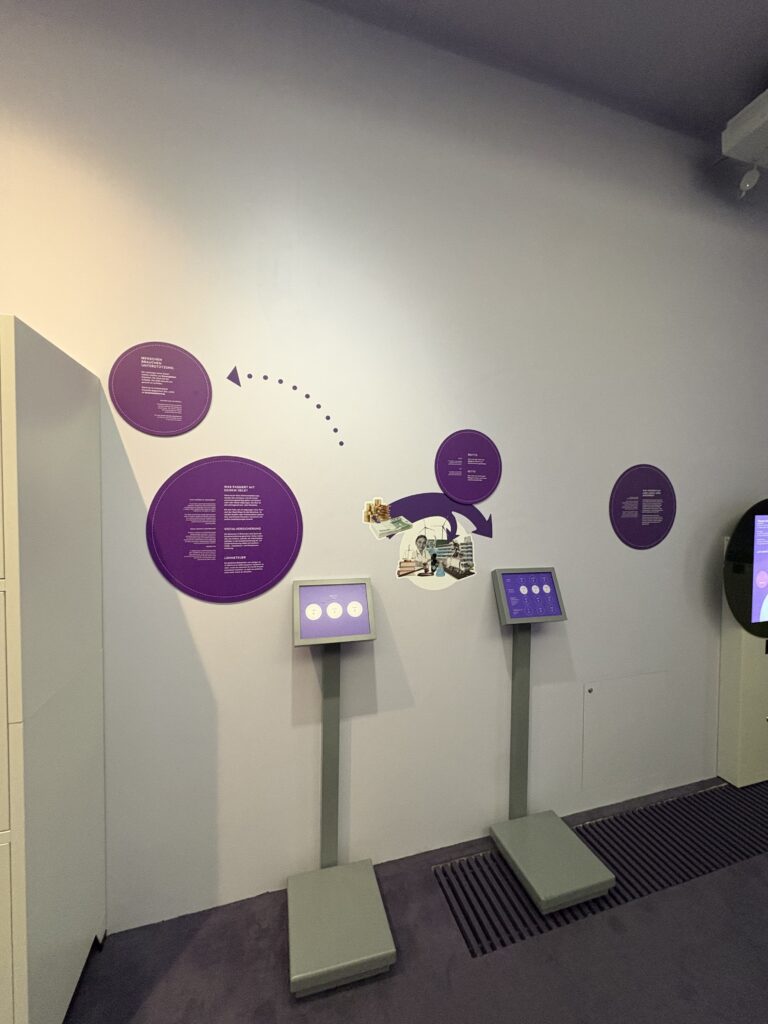
Recently, I visited the CoSA – Center of Science Activities – museum in Graz, and it honestly surprised me in a very good way. I’ve been to a lot of museums before, mostly the kind where you walk through quiet rooms, read wall texts, and carefully don’t touch anything. Here CoSA felt completely different, but was also designed to be very different from a regular museum visit. It was playful, interactive, and at the same time still dealt with serious and important topics. That combination made the whole experience feel much more accessible and memorable for me and inspired me to now write about it. What stood out immediately was how much the museum invites you to participate and interact. That is what I lives of. Almost everything is interactive. You are encouraged to touch things, try them out and make decisions. Instead of just consuming information, you become part of the exhibition. It felt less like “learning facts” and more like discovering things through the experience you get while walking thought the exhibition itself. I noticed that this made it much easier to stay focused and curious while moving through the space.
One part of the exhibition that really stuck with me and was a fun way to interact, was a system where you could collect points. Depending on how you interacted with certain stations, you would gain or lose points. What I found interesting was not the points themselves, but how differently people reacted to them. Some visitors were immediately motivated by the system. They tried to maximize their score, compared results, and took the tasks very seriously. Others didn’t care at all. They ignored the points, focused on the content, or even found the system a bit annoying. Seeing this made me think about motivation in general. The same mechanic can feel exciting to one person and completely meaningless to another. That’s something we often forget when designing exhibitions or interactive spaces.
Whithin this museum I also realised what made it different then most other experiences. The space almost encourages you to behave more like a child again: to be curious, playful, and less afraid of doing something wrong. CoSA creates an environment where interaction feels allowed and even expected, which lowers that barrier a lot. Another thing I really appreciated was that the museum was simply fun to go through. It didn’t feel like a task or something I had to concentrate really hard on. Instead, I was able to walk through the exhibition easily, guided by my personal interest in ceratin topics or things rather than obligation. And still, important topics were communicated in a clear and understandable way. That balance between fun and content is something that’s actually very hard to achieve. This also made me think a lot about the exhibition we are planning for January, where works from the past year will be shown. Designing an exhibition like that is a challenge in itself: different topics, different formats, different levels of interaction. CoSA showed me that there is no single “right” way to design an exhibition space. Museums can be playful, interactive, and still meaningful in their own ways.
How Color and Form Shape Emotion in Editorial Illustration
Editorial illustrations are pictures that go with articles in magazines, books or online. They help people feel the story, not just read it. The way an illustrator uses colors and shapes can change how the viewer feels about the idea before they even read the words. As I want to do something with Editorial Illustration or Design in my Master Thesis, I decided to dive a bit deeper in this topic again.
Why Color Matters
Color is one of the first things we notice in an image. Colors can change our mood and make us feel something without thinking too hard. For example:
Red can make an illustration feel energetic, urgent, or strong.
Blue can feel calm, quiet, or thoughtful.
Yellow feels happy, bright, and full of energy.
This works because our brains connect colors with feelings, often without us planning it. A red element might make a viewer feel alert immediately, while a blue background can make a story feel peaceful. Illustrators use these color feelings on purpose. For example, an editorial illustration about climate change might use mostly blues and greens to make the reader feel calm and connected to nature. A political cartoon about protest might use bold reds and blacks to show intensity and movement. In this picture you see the typical color meanings. It significant to consider this while creaitng something for a certain information and emotion.
How Shapes and Forms Affect Mood
Color isn’t the whole story. The shapes and forms the illustrator uses also give the viewer emotional clues.
Soft, round shapes often feel friendly and gentle.
Sharp, pointed shapes feel tense or active.
Large open spaces can feel calm or lonely, while crowded shapes can feel busy or chaotic.
The way elements are arranged on the page (called composition) also matters. A centered figure can feel stable or important, while a tilted composition can create tension or movement.
Golden Cosmos: Colorful, Playful, and Thoughtful
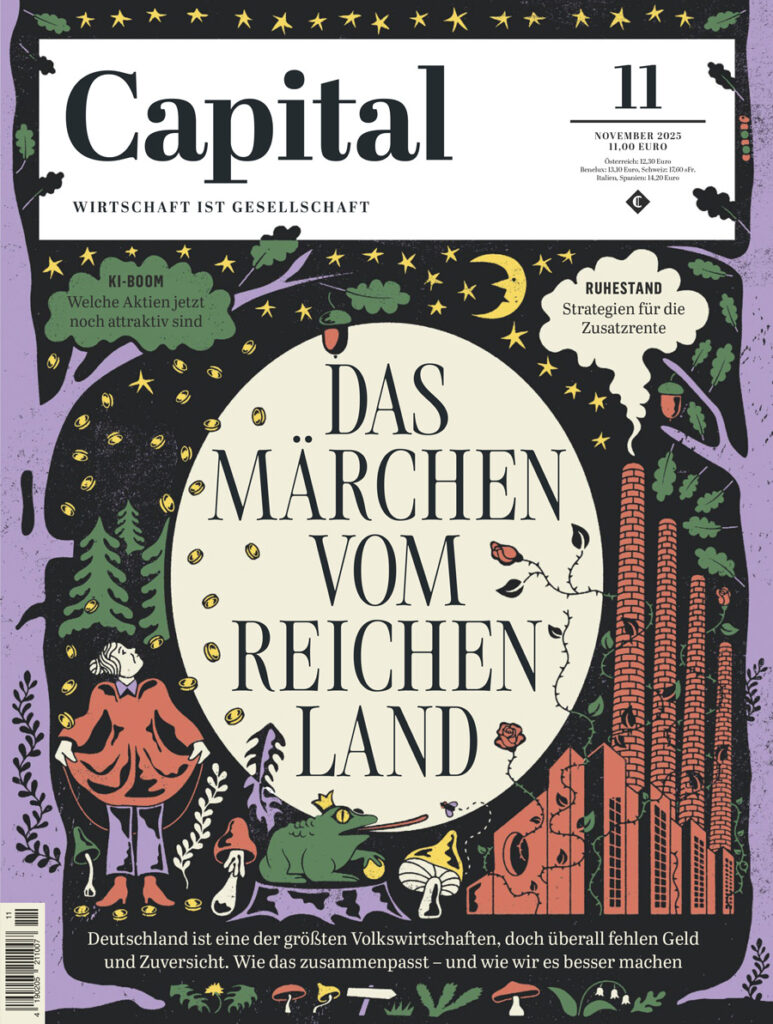
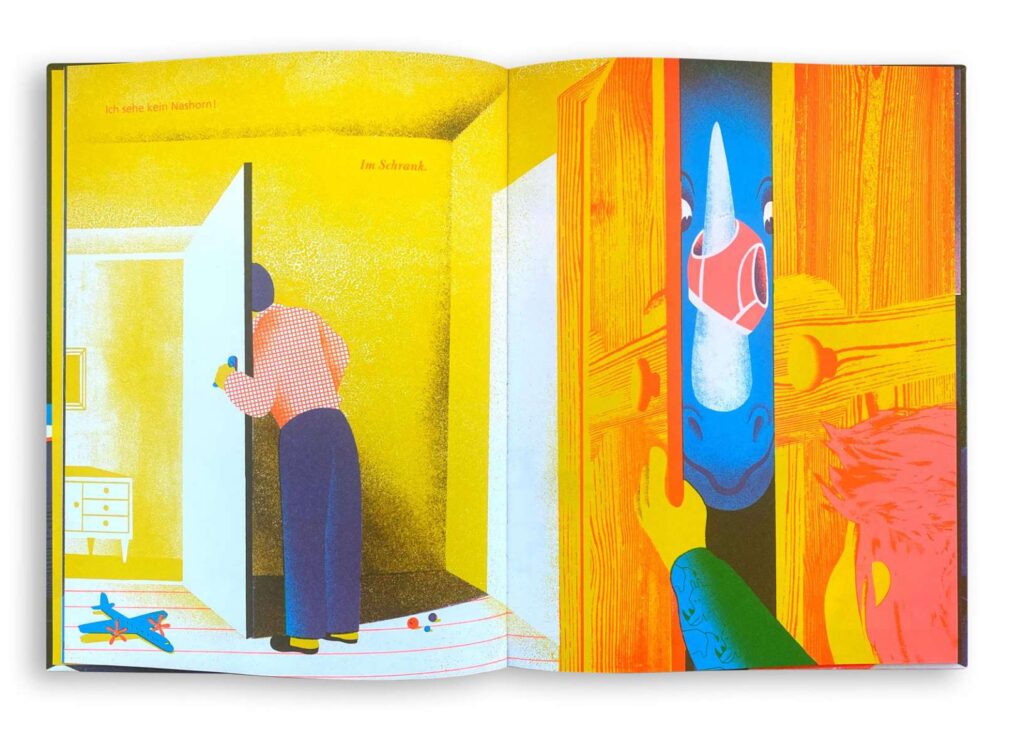
One of the best real-world examples of how color and form influence emotion in editorial illustration is the Berlin-based duo Golden Cosmos (illustrators Doris Freigofas and Daniel Dolz). I saw their website and thougt they are doing really really nice work. They are working for major international publications like The New York Times, The New Yorker, Die Zeit, and Bloomberg. Their style is instantly recognizable because they use bright, contrasting spot colors, simple shapes, and a screen-print-like aesthetic that feels both bold and warm.
How Their Work Uses Color and Shape
Bold palettes: Golden Cosmos often limits their illustrations to a few strong colors which create a feeling of energy and focus. In editorial contexts, this helps draw readers in and gives a visual intensity that matches serious topics.
Simple but expressive forms: Their people and objects are usually drawn in flattened shapes with playful proportions. This makes spaces feel open and engaging, not heavy or literal, and lets readers connect emotionally before reading the text.
Narrative scenes: Instead of just illustrating a literal idea from the article, they often build scenes with small stories inside them which makes the illustrations feel like visual essays themselves.
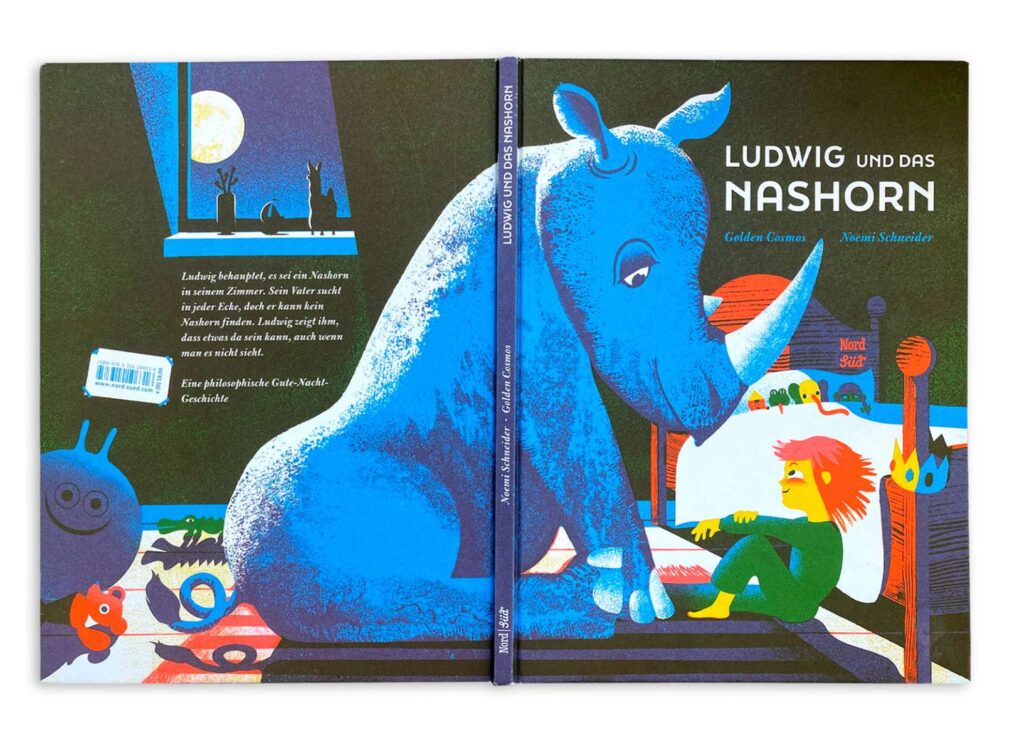
In their picture book work (like Ludwig and the Rhinoceros) the duo gained awards for color and spatial design, showing that color and composition are central to their emotional storytelling whether in editorial work or book illustration. I thought comapred to usual childrenbooks, it is really diffrent in how they using colors and shapes.
Another Example: Kirsten Ulve
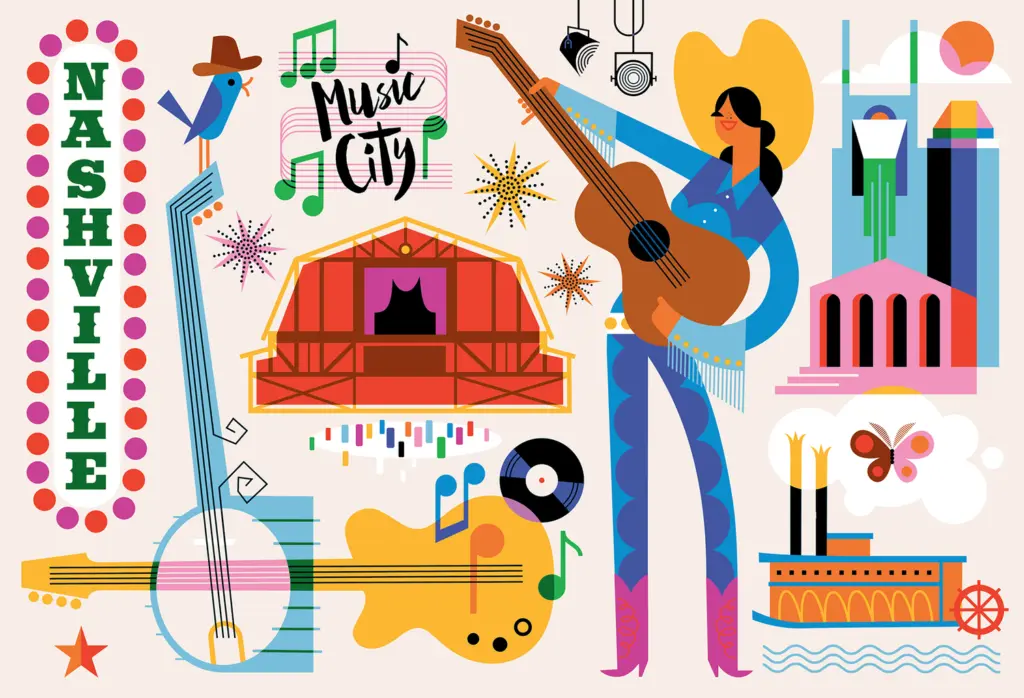
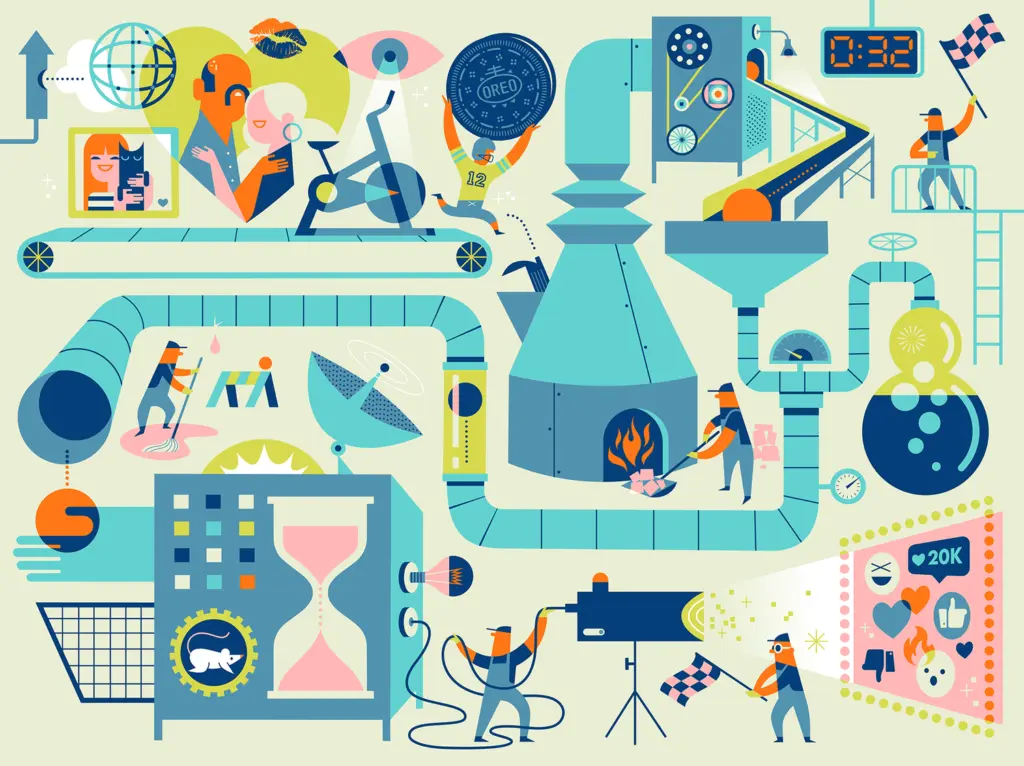
A second great example of emotional editorial illustration comes from Kirsten Ulve, an American graphic artist known for her vibrant editorial and caricature work. Ulve’s illustrations appear in publications such as The New York Times, Vogue Japan, Los Angeles Times and Entertainment Weekly.
What Makes Ulve’s Work Emotionally Effective
Expressive color: Ulve often chooses bold and saturated colors that draw attention and give a lively energy to the topics. For example, using strong reds and blues in political caricatures gives urgency and emotional punch to commentary about public figures.
Character and exaggeration: Her caricatures use shapes and proportions that exaggerate personality traits, making the emotional impact of the subject immediately clear. A reader can sense mood (whether satire, tension, or humour) before reading a word.
Collage and texture elements: In addition to flat color, Ulve sometimes combines visual textures and patterns that heighten emotional contrast, like rough patterns behind calm figures to show underlying conflict.
Ulve’s strong and confident use of form helps editorial stories about politics, culture, and society feel alive and very human, which keeps readers visually engaged and emotionally connected.
Why Color and Form Matter in Editorial Illustration
Whether it’s Golden Cosmos’ bright screen-print shapes or Kirsten Ulve’s expressive caricatures or editorial illustration uses visual language to communicate emotion. Here’s why it matters:
Color Sets the Mood
Color creates emotional cues instantly. Bright, high-contrast colors can feel urgent or joyful, while muted or limited palettes can feel calm, serious, or reflective. Color can signal the right emotional tone even before someone starts reading.
Shape and Composition Guide Understanding
Shapes and layout help guide the reader’s eye. Organic, flowing shapes can feel natural and warm. Straight lines or geometric forms can feel structured and formal. How space is organized around figures or objects shapes the viewer’s emotional response to the idea being illustrated.
Emotion First, Narrative Second
Illustrations that influence emotion don’t just show facts, they embody a feeling. This is especially effective in editorial contexts where the illustration sets the tone for the article and stays in the reader’s memory long after they’ve moved on.
Conclusion
Color and form are more than stylistic tools, they are emotional languages in illustration. When illustrators choose color palettes thoughtfully and shape forms with intentional emotional impact, they give editorial stories a deeper voice and connection. Golden Cosmos and Kirsten Ulve are great examples of how strong visual design can turn words into feeling. For me personally its very helpful and inpirational to compare such examples as Golden Cosmos or Kirsten Ulve and just look at their work.