How Motion created meaning 

A square slowly growing or a rectangle slipping across the screen seemed too minimal to create anything emotional. But the more I read about the effect moving shapes have on our preception the more I realise that motion itself can carry a kind of langueage. It doesn’t need details. It needs rhythm, timing and space. The viewers then fill the rest. I noticed this most clearly when I wanted Rhytmus 21. Nothing dramatic really happens in the film however the black and white shapes feel strangely confident in how they move (Richter, 1921). A shape that is growing feels like pressure and a shape shrinking feels like realse in a sort of way. Its not a narrative but it can create a flow that is easy to follow. It shows that timing has a purpose as it creats structure in the whole experience. 

Around the same time I was reading a psychology paper that explored how people react to abstract motion. This study shoes that viewers look for strucutre even when visuals are extremly simple (Bloom & Veres, 1999). There is no need for faces or objexts or any sort of representational content. As soon as movement has rhythm or direction, our brain starts to organise it. This helped me to understand why Richters film feels so intentional even though nothing is “doing” anything. The viewers mind gives the motion sense just because the timing fits together. Here I also learned that direction of motion matters. Forward motion feels way more natural. Reversed motion feels off and it breaks the sense of progression. That alone showed me how sensitive we are to timing and order, even in minimal animations. This also might explain why a loop can feel smooth in one version and confusing in another even fi the shapes are identical. 

I came across another study which then again changed my understanding of moving shapes. The study here focused on how small, more abstract motions can create emotional impressions without them needing any kind of character (Bartram & Nakatani, 2010). Here it surprised me that even very little motion has a big effect and can feel very expressive. A soft drift can feel more calm whereas a quick movment or jitter can make it feel more tense. In a way it makes a lot of sense but these are still just objects moving around randomly. Even movements that are barely visible can change how we read an animation. This outcomes also connects very well back to Richer’s film as the shapes there are extremely simple, yet they already carry athomsphere and feeling just through how they move. Reading this also made me think differently about how to animate. I sometimes do assume that there is a ceratin need for details however here the opposite seems to be true. Even small changes in acceleration or smoothness can change how the viewer expereinces the whole piece. 

Following that I also looked into other design research papers that examined how physical structures influence the movement of shapes. Here the study focused more on mechanical models, but the findings can still apply well to abstract animations (Harrison et al., 2015). Here the authors explained that motion depends on the relationships between parts. Some changes in the structure can change the experience completely. Motion worked only when the relationships between the shapes stayed in balance. If one angle or distance changed too much, the flow of the movement broke and suddenly looked irregular or unstable. This shows that abstract motion follows a kind of internal logic. When timing and spacing support that logic, the movement feels smooth and coherent. When they don’t, the viewer notices it immediately, even if the shapes themselves remain simple. It highlights how sensitive motion is to structural consistency, and how much the quality of a movement depends on the conditions that allow it to unfold naturally.

All of this showed again that motion can have a big impact on the shapes’ perception. The shapes themselves are simple, but their relationships, timing, and rhythm create structure, flow, and atmosphere. Motion can communicate emotions even when nothing represents anything.

Bibliography:

Bartram, L., & Nakatani, A. (2010). What makes motion meaningful? Affective properties of abstract motion. 2010 Fourth Pacific-Rim Symposium on Image and Video Technology, 468–474. https://doi.org/10.1109/PSIVT.2010.85

Bloom, P., & Veres, C. (1999). The perceived intentionality of groups. Cognition71(1), B1–B9.

Harrison, L., Earl, C., & Eckert, C. (2015). Exploratory making: Shape, structure and motion. Design Studies.41, 51–78.

Richter, H. (Director). (1921). Rhythmus 21 [Video]. https://www.youtube.com/watch?v=R_kceafWtbE&list=RDR_kceafWtbE&start_radio=1

Impuls 6: The Possession of Hannah Grace

In meiner zweiten Filmanalyse dreht sich alles um den Horrorfilm The Possession of Hannah Grace, den ich bis dato selbst noch nicht gesehen hatte, aber aus gutem Grund ausgewählt habe. Er war zum Zeitpunkt der Veröffentlichung 2018 nämlich der erste Feature Film der in voller Länge auf einer spiegellosen Sony Kamera, der A7SII, gedreht wurde. Also genau das was ich vor habe.

Generelle Überlegungen

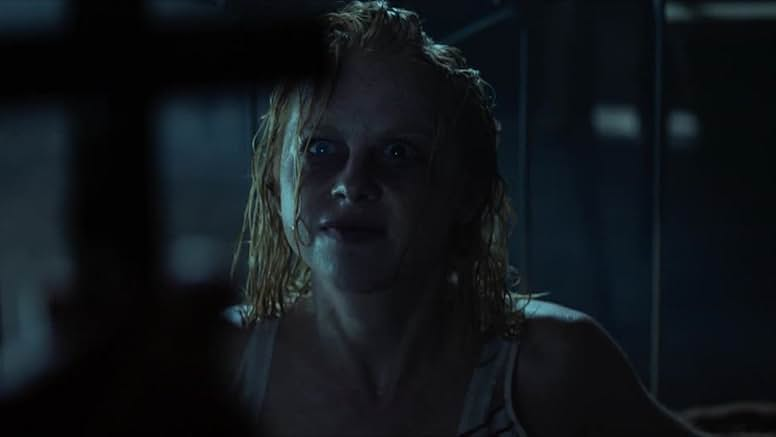
Der gesamte Film spielt in einer Leichenhalle und ist dementsprechend durchgehend Low-Key geleuchtet. Laut dem 1st AC, war dies auch exakt das was das menschliche Auge am Dreh gesehen haben soll. Heißt: Die Dunkelheit wurde nicht durch das Runterziehen der Schatten in der Post erzeugt, sondern das Set war wirklich so dunkel. Laut ihm wurde fast alles auf ISO 3200 geshootet, was eben diese Vorgehensweise ermöglicht hat. Zusätzlich, so hat man es im BTS gesehen, wurde anscheinend etwas gemacht, was ich so als Ratschlag noch in keinem Video gefunden habe: Irgendwie hatte es nämlich den Anschein, dass manche Szenen wirklich von den Practicals geleuchtet wurden. Auch wenn die Practicals, jetzt in diesem Fall keine klassischen Tischlampen hinten am Schreibtisch, sondern fette Neonröhren an der Decke waren, hat mich das doch sehr verwundert. Der (aus meiner Sicht) damit induzierte Effekt war natürlich, dass das Licht automatisch viel toppiger kam, und tiefe Schatten unter den Augen erzeugte. Als Beweis dafür, was ich damit meine, hier zwei Screenshots aus dem BTS des Films. In beiden Fällen kann ich eigentlich nur eine Lichtquelle ausmachen. Im Falle der Spiegelszene wahrscheinlich ein Tube-Light über dem Spiegel, und im Gang die Practicals an der Decke.

Frame 1-3: Die Heldin

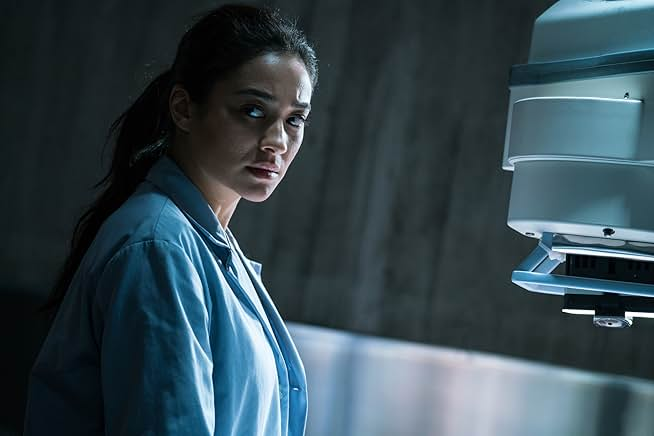
Der erste Frame ist ein klassischer Shot im Film. Noch (oder gerade) geht keine Bedrohung von der halbtoten besessenen Leiche im Kasten aus, und die Hauptdarstellerin macht einfach ihren Job als Nachtarbeiterin in der Leichenhalle. Jedoch wird sogar schon hier mit einem extrem starken Kontrastverhältnis im Gesicht und mit extrem hartem Licht gearbeitet. In diesem Fall wird das Key-Light von der nebenstehenden Gerätschaft samt ihrem beleuchteten Arbeitsplatz motiviert, der mit Neon-Röhren ausgestattet ist, wie man in anderen Einstellungen sehen kann. So dunkel wie die Fill-Seite ist, dürfte kaum aus dem Frame draußen wohl eine fette Flag mit negative Fill gestanden sein, um das Gesicht so kontrastig hinzubekommen.

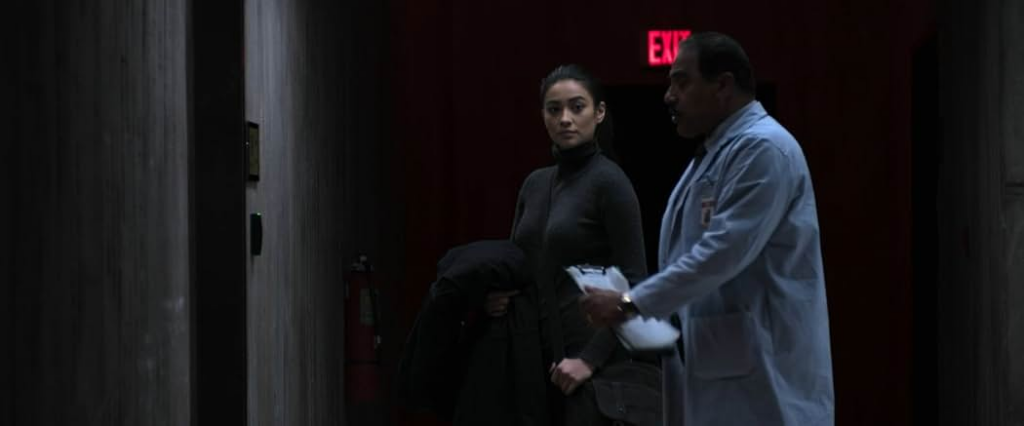
Im zweiten Frame ist sie bei der Einführung in ihren neuen Job zu sehen. Wie in der Einleitung beschrieben, sehr toppig geleuchtet, womöglich sogar wirklich mit den Deckenlampen am Set. Auch hier finde ich die Schatten im Gesicht, diesmal unter den Augen, sehr prominent. Besonders gut gefällt mir aber, wie ihr Chef in dem Licht herausgearbeitet wird. Anscheinend (zumindest soll es so den Eindruck machen) steht er direkt zwischen zwei Neonröhren. Die kameranahe gibt ihm Licht auf die Schulter, die ferne noch weiter hinten auf die Brust, sein Kopf inzwischen ist fast unbeleuchtet. Ich könnte mir vorstellen, dass sie dafür einfach die Practicals (sofern es mit diesen geleuchtet ist) mit schwarzem Stoff innen abgeklebt haben, um zu verhindern, dass sie streuen. Dadurch entsteht dann diese schöne Separation und der hohe Kontrast.

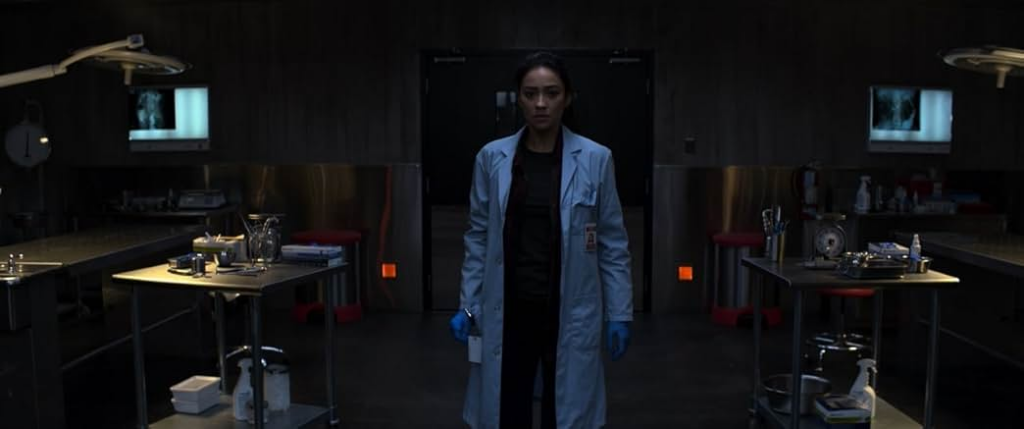
Im dritten und letzten Frame der Heldin wird es schon spannender, denn sie hört die ersten Geräusche und geht diesen auf den Grund. Was auffällig ist: Ab hier werden die Kontraste auf ihr eigentlich immer geringer, da sie als gesamtes immer dunkler wird. Wie vorher kommt das Licht sehr toppig, aber viel schwächer als vorher, was dafür spricht, dass die Practicals vermutlich Tubes sind, die das Team frei in ihrer Helligkeit kontrollieren konnte.

Besonders gut gefallen mir hier die Kontraste um sie herum. Die einzelnen Tische und Arbeitsflächen, die Bildschirme, die roten Knöpfe hinter ihr etc.. In diese Einstellung hätte man wirklich kaum mehr Lichttupfer einfügen können, ohne das es gestellt wirkt, immer schön mit der Separierung, dass zumindest kurz dazwischen schwarz ist. Außerdem ist nicht nur ein Kontrast zwischen hell und dunkel, sondern auch warm und kalt gegeben, da sie eindeutig kühler daherkommt, als die Tischlampen seitlich.

Frames 4-6: Die Besessene

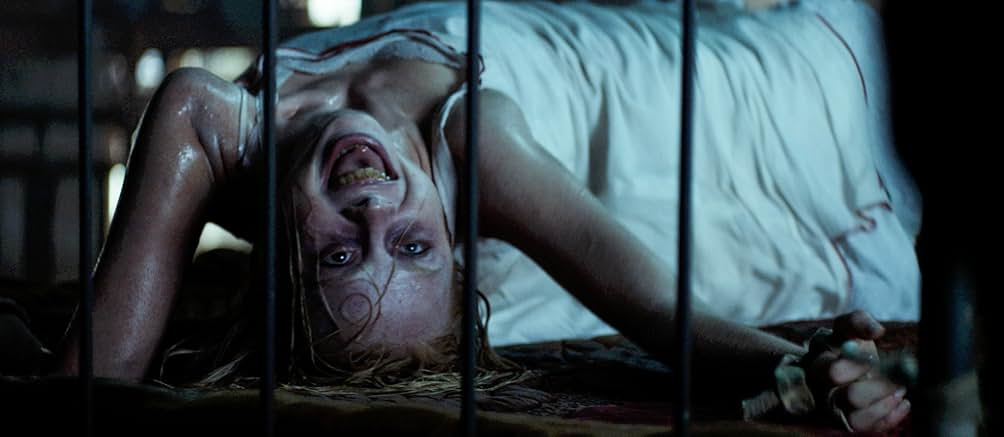
Im ersten Frame ist die Anfangsszene zu sehen, in der der ursprüngliche Exorzismus am Mädchen scheitert. Für mich hier am auffälligsten ist die Farbe des Lichts, denn ihr weißes Gewand scheint eigentlich fast schon türkis, so kalt ist das Licht, das sie für diesen Shot gewählt haben. Das erzeugt natürlich auch auf der Haut extrem unnatürliche Töne, die einem das Gefühl vermitteln, dass hier etwas ganz und gar nicht passt. Verwunderlich finde ich die in diesem Fall recht gleichmäßige Ausleuchtung ihres Gesichts. Vielleicht war hier das Ziel, soviel von der Verrücktheit in ihren Augen mitzunehmen wie möglich.

Dieses fast schon türkise Licht zieht sich auch weiter durch ihre Darstellungen. Im Fall des zweiten Frames aber im Winkel mehr wie ich es eigentlich erwarten würde, nämlich sehr seitlich, mit starkem Kontrast zur Fill Seite. Auch sehr interessant: Das Backlight, das ihre Schultern und Haare vom Hintergrund abhebt. Dieses kommt nämlich aus einer sehr ähnlichen Richtung wie das Key – kann aber meiner Meinung nach nicht das gleiche sein, da sich das physikalisch nicht ganz ausgehen würde. Dadurch erreichen die Filmemacher aber natürlich einen recht interessanten Effekt: Sie können verhindern, dass die Darstellerin im dunklen Hintergrund absäuft, ohne irgendwie die Helligkeit der Fill-Seite angreifen zu müssen, und können diese ganz dunkel lassen.

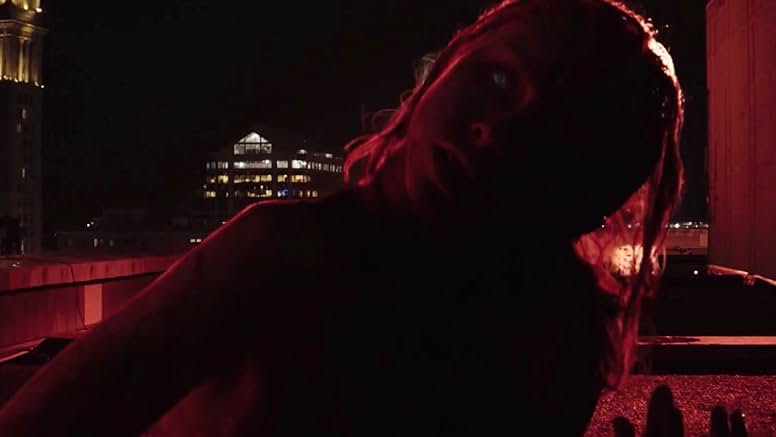
Im letzten Frame ist dann die Kacke wirklich am Dampfen, denn der Dämon fordert in diesem Moment sein (glaube ich) drittes Opfer. Und drastischer geht es eigentlich auch kaum. Abgesehen davon, dass der Charakter eigentlich völlig absäuft und fast komplett dunkel daherkommt, ist die gesamte Umgebung in der signalstärksten aller Farben geleuchtet und das Spitzlicht an ihren Haaren macht mit dem Sensor der Kamera sowieso was es will. Also eigentlich gibts im gesamten Frame nur die drei RGB Values für schwarz, weiß und rot, mehr ist nicht.

James Turrell. Räume des Lichts, Räume der Wahrnehmung

“My desire is to set up a situation to which I take you and let you see. It becomes your experience.” – James Turrell

Installation view with James Turrell
All Clear (2024), from the series
Ganzfeld (1976-)
Artwork @ James Turrell. Photo: Thomas Lannes
https://gagosian.com/exhibitions/2024/james-turrell-at-one/

James Turrell gehört zu den bedeutendsten Lichtkünstlern der Gegenwart. Sein Werk umfasst über fünf Jahrzehnte und bewegt sich an der Schwelle zwischen Kunst, Architektur, Wahrnehmungspsychologie und spirituellen Räumen. Turrells Arbeiten sind keine Objekte im klassischen Sinne, sondern Rahmenbedingungen, in denen Licht selbst zur Erfahrung wird.

1. Licht als Material und als Ort

Aus dem Art21-Interview wird deutlich, wie radikal Turrell Licht versteht. Er sagt:

“Generally, we use light. We don’t really pay much attention to the light itself. That’s my interest. This fascination with light and how we come to light.”

Turrell wendet den Blick weg vom „Beleuchteten“ hin zum „Licht selbst“. In einer Zeit, in der Licht meist als funktionales Werkzeug erscheint, zur Illumination, zur Orientierung oder zur Inszenierung, schafft er Situationen, in denen Licht als stoffliche Präsenz erfahrbar wird.

Turrell ist in der Quäker-Tradition aufgewachsen, wo Licht eine spirituelle Metapher darstellt („inner light“). Die Stille, das Sitzen, das Schauen und das Hinwenden zum Licht sind in dieser Tradition zentrale Praktiken.

Die Verbindung zu seinen Skyspaces und Meeting Houses wird hier deutlich: Die Räume erinnern an Andachtsräume, ohne sakral zu sein. Sie aktivieren die Aufmerksamkeit, die innere Ruhe und die Wahrnehmung des Materials Licht, als etwas, das den Raum formt, aber auch die eigene innere Wahrnehmung.

2. Roden Crater – Architektur des Himmels

Eines seiner monumentalsten Projekte ist Roden Crater, ein erloschener Vulkan im US-Bundesstaat Arizona, den Turrell seit den 1970er Jahren zu einem Gesamtkunstwerk transformiert.

Turrell beschreibt den Krater als einen Ort, an dem „der Kosmos herabgeholt“ wird:

  • Licht der Sonne, acht Minuten alt,
  • Sternenlicht, älter als das Sonnensystem,
  • Mondphasen und kosmische Ereignisse wie der 18,6-Jahres-Zyklus des lunaren Stillstands.

Durch Öffnungen, Tunnel, Kammern und geologische Eingriffe wird Licht in hochpräziser Form in die Architektur gelenkt. So entsteht eine Situation, in der die Besucher:innen nicht mehr auf den Himmel schauen, sondern sich im Himmel wiederfinden.

„You realize its closeness… you discover that you’re in the atmosphere, not separated from the sky at night… you feel one with the universe.”

Diese Wahrnehmungsverschiebung ist zentral für Turrells Werk:
Der Betrachter soll nicht „sehen“, sondern erfahren, wie Licht Raum erzeugt und wie Raum Wahrnehmung verändert.

3. Das Berliner Skyspace – Licht als sakrale Präsenz

Turrells Installation im Dorotheenstädtischen Friedhof in Berlin ist ein weiteres Beispiel dafür, wie er Licht als architektonische Kraft einsetzt. Die Kapelle, 2015 eröffnet, arbeitet mit wechselnden Lichtprogrammen, die die weiße Innenarchitektur transformieren.

Der Raum wird nicht beleuchtet, er atmet.
Farbtöne gleiten über Wände, schärfen und verwischen Konturen, öffnen und schließen den Raum. Die Besucher:innen nehmen nicht einen „Lichteffekt“ wahr, sondern eine Atmosphäre, die sie selbst einschließt und verändert.

Diese Arbeit knüpft direkt an Turrells Skyspaces an, die u. a. in Lech am Arlberg und weltweit installiert sind. Die Skyspaces sind halboffene architektonische Räume, in denen ein quadratischer oder elliptischer Deckenausschnitt den Himmel als „lebendige Leinwand“ zeigt.

Turrells Grundidee:
Nicht der Himmel verändert sich, wir verändern uns, indem wir ihn bewusst betrachten.

4. Wahrnehmung statt Abbildung: Das Betreten des Kunstwerks

“A lot of people come to art and they look at it… They don’t actually enter the realm that the artist was involved in.”

Turrell fordert, dass Wahrnehmung nicht passiv bleibt. Seine Kunst muss nicht „interpretiert“ werden, sie muss betreten werden.
Das Publikum wird Teil der Arbeit, indem es im Licht sitzt, die Dauer erfährt, sich öffnet für minimale Veränderungen, die in ihrer Langsamkeit fast meditativen Charakter besitzen.

Das steht im starken Gegensatz zu einer Kunstrezeption, die von schnellen Impulsen, Fotografie und digitaler Reproduzierbarkeit geprägt ist.
Bei Turrell hingegen braucht Licht Zeit.
Raum braucht Zeit.
Wahrnehmung braucht Zeit.

Diese Haltung erinnert an die Tradition sakraler Architektur:
Kirchen, Moscheen, Tempel und Höhlen sind Räume der Langsamkeit, der Lichtsensibilisierung, des Übergangs vom Außen ins Innen.

Turrell greift diese Idee auf, entfernt aber narrative und religiöse Inhalte, und legt den Fokus auf die reine Erfahrung des Lichtes.

5. Relevanz für meine eigene künstlerische Forschung

Turrells Werk ist für meine Masterarbeit aus mehreren Gründen hochrelevant:

1. Licht als primäres Material

Auch meine Arbeit befasst sich mit Lichtprojektionen und Mapping-Techniken, die nicht als dekorative Effekte verstanden werden sollen, sondern als räumliche Eingriffe.

2. Architektur & Wahrnehmung

Wie Turrell testen auch Videomapping, Hologramme und immersive Installationen die Frage:
Wie verändert Licht den Raum, und wie verändert Raum die Wahrnehmung des Lichtes?

3. Sakrale Räume & Transzendenz

Turrells Werk operiert häufig zwischen Spiritualität und Wahrnehmung, ohne religiös zu sein, ein Modell, das sich gut mit meinen Überlegungen zur Nutzung sakraler Orte (Kirchen, Kapellen) für Lichtkunst verknüpfen lässt.

4. Atmosphärenbildung

Die Art, wie Turrell Licht als „Atmosphäre“ versteht, ist für meine Projektplanung (z. B. Hologramm, Nebelprojektion, sakrale Lichtinterventionen) äußerst inspirierend.

5. Das Eintauchen in das Werk

Turrell fordert nicht das „Anschauen“, sondern das Erleben des Kunstwerks.
Dieser Ansatz deckt sich mit meiner eigenen Ambition, nicht nur visuelle Bilder, sondern immersive Momente zu schaffen.

Schlussgedanke

James Turrell erschafft keine Bilder, sondern Situationen, in denen wir uns selbst im Licht begegnen.
Seine Räume sind zugleich archaisch und futuristisch, wissenschaftlich und spirituell, minimalistisch.

Literaturverzeichnis (Chicago Author–Date)

Art21. 2001. Exploring James Turrell’s Roden Crater and Quaker Meeting House. Video, 13:35. PBS / Art21.
https://www.youtube.com/watch?v=6TGzvDamBZQ

Champ Magazine. 2023. “Roden Crater – James Turrell’s Sky Observatory.” Champ Magazine.
https://champ-magazine.com/art/roden-crater/

Häusler Contemporary. 2015. “James Turrell – Kapelle Dorotheenstädtischer Friedhof.” Häusler Contemporary Gallery.
https://haeusler-contemporary.com/james-turrell-dorotheenstaedtischer-friedhof

Skyspace Lech. 2023. “James Turrell – Biography and Skyspace Lech.” Skyspace Lech Official Site.
https://www.skyspacelech.com/about/james-turell/


Hinweis zur Verwendung von KI-Tools

Zur sprachlichen Optimierung und Strukturierung wurde ein KI-gestütztes Schreibwerkzeug (ChatGPT, OpenAI, 2025) verwendet. Inhaltliche Reflexion basiert auf eigener Analyse.

Product VI: Image Extender

Intelligent Balancing – progress of automated mixing

This development phase introduces a sophisticated dual-layer audio processing system that addresses both proactive and reactive sound masking, creating mixes that are not only visually faithful but also acoustically optimal. Where previous systems focused on semantic accuracy and visual hierarchy, we now ensure perceptual clarity and natural soundscape balance through scientific audio principles.

The Challenge: High-Energy Sounds Dominating the Mix

During testing, we identified a critical issue: certain sounds with naturally high spectral energy (motorcycles, engines, impacts) would dominate the audio mix despite appropriate importance-based volume scaling. Even with our masking analysis and EQ correction, these sounds created an unbalanced listening experience where the mix felt “crowded” by certain elements.

Dual-Layer Solution Architecture

Layer 1: Proactive Energy-Based Gain Reduction

This new function analyzes each sound’s spectral energy across Bark bands (psychoacoustic frequency scale) and applies additional gain reduction to naturally loud sounds. The system:

  1. Measures average and peak energy across 24 Bark bands
  2. Calculates perceived loudness based on spectral distribution
  3. Applies up to -6dB additional reduction to high-energy sounds
  4. Modulates reduction based on visual importance (high importance = less reduction)

Example Application:

  • Motorcycle sound: -4.5dB additional reduction (high energy in 1-4kHz range)
  • Bird chirp: -1.5dB additional reduction (lower overall energy)
  • Both with same visual importance, but motorcycle receives more gain reduction

Layer 2: Reactive Masking EQ (Enhanced)

Improved Feature: Time-domain masking analysis now works with consistent positioning

We fixed a critical bug where sound positions were being randomized twice, causing:

  • Overlap analysis using different positions than final placement
  • EQ corrections applied to wrong temporal segments
  • Inconsistent final mix compared to analysis predictions

Solution: Position consistency through saved_positions system:

  • Initial random placement saved after calculation
  • Same positions used for both masking analysis and final timeline
  • Transparent debugging output showing exact positions used

Key Advancements

  1. Proactive Problem Prevention: Energy analysis occurs before mixing, preventing issues rather than fixing them
  2. Preserved Sound Quality: Moderate gain reduction + moderate EQ = better than extreme EQ alone
  3. Phase Relationship Protection: Gain reduction doesn’t affect phase like large EQ cuts do
  4. Mono Compatibility: Less aggressive processing improves mono downmix results
  5. Transparent Debugging: Complete logging shows every decision from energy analysis to final placement

Integration with Existing System

The new energy-based system integrates seamlessly with our established pipeline:

text

Sound Download → Energy Analysis → Gain Reduction → Importance Normalization

→ Timeline Placement → Masking EQ (if needed) → Final Mix

This represents an evolution from reactive correction to intelligent anticipation, creating audio mixes that are both visually faithful and acoustically balanced. The system now understands not just what sounds should be present, but how they should coexist in the acoustic space, resulting in professional-quality soundscapes that feel natural and well-balanced to the human ear.

5. IMPULS: Diablo IV – Licht, Schatten und moderne Mythologie

Während meiner spielerischen Beschäftigung mit Diablo IV fiel mir auf, wie stark dieses Werk nicht nur narrativ, sondern insbesondere ästhetisch und atmosphärisch mit Licht, Schatten, sakralen Räumen und mythologischen Motiven arbeitet. Viele dieser Themen überschneiden sich mit jenen, die ich im Rahmen meiner Masterarbeit untersuche: Licht als Träger von Bedeutung, Atmosphäre als räumliche Qualität, sowie die Transformation von Räumen durch visuelle Interventionen.

Diese Nähe zwischen digitaler Spielwelt und realen Licht-/Rauminstallationen war Anlass für diesen Impulse-Blog.

1. Mythologische Grundstruktur – stark gekürzt, aber thematisch relevant

Der Kern von Diablo beruht nicht auf bildgetreuen religiösen Übernahmen, sondern auf einer ästhetischen und dramaturgischen Transformation christlich-jüdischer Mythen. Blizzard entlehnt Namen und Archetypen – Engel, Dämonen, Lilith, apokalyptische Motive –, formt daraus aber ein eigene mythologische Welt, in der Licht und Dunkelheit keine moralischen Gegensätze, sondern atmosphärische Kräfte darstellen.

Für meine Forschung ist genau dieser Aspekt relevant:

Licht wird nicht moralisch gelesen, sondern räumlich, emotional und symbolisch wirksam.

Damit teilt Diablo ein Konzept, das auch in sakralen Räumen zentral ist: Licht erzeugt Bedeutung.

2. Atmosphärenbildung: Licht, Schatten & sakrale Ästhetik

Besonders faszinierend ist die Lichtdramaturgie in Diablo IV. Das Spiel verwendet:

  • volumetrisches Licht in nebeligen Räumen,
  • harte Spotlight-Akzente in Kathedralen,
  • gedämpfte Leuchtflächen in Ruinen,
  • extrem starke Hell-Dunkel-Kontraste,
  • farbpsychologisch aufgeladene Räume (Rot = Verderben, Blau = Magie, Gold = Heiligkeit).

Blizzard hat bewusst eine “European Dark Art Direction” gewählt (Art Director: John Mueller), die sich an barocken, gotischen und romantischen Malereitraditionen orientiert. Die offizielle Entwicklerpublikation Unter dem Lack: Die Grafik von Diablo IV (Blizzard 2023) beschreibt detailliert, wie volumetrisches Licht gezielt eingesetzt wird, um Raumtiefen, Materialitäten und Stimmung zu formen.Damit zeigt Diablo, wie digitale Räume über Lichtführung emotional und narrativ aufgeladen werden – ein Prinzip, das unmittelbar in meine eigene Praxis der Projektionen und Lichtinstallationen übertragbar ist.

3. Concept Art und Leveldesign: Die visuelle Grundlage der Welt

Im Zuge meiner Recherche stieß ich auf eine Reihe von Referenzen, die den Herstellungsprozess der Diablo-Ästhetik sehr gut dokumentieren. Diese sind nicht nur für Game Studies interessant, sondern auch für meine visuelle Forschung zu Licht, Raum und Atmosphäre.

Relevante Quellen:

The Art of Diablo(Gerli 2019)
Ein umfassendes Artbook mit Concept Art zu Architektur, Landschaft, Kultstätten und Lichtstimmungen.

• Blizzard-Artikel: „The real-life inspiration for Diablo IV art“
Hier erklären die Entwickler, wie klassische Malerei (Géricault, Caravaggio, mittelalterliche Ikonografie) in das Leveldesign eingeflossen ist.

Unter dem Lack: Die Grafik von Diablo IV(Blizzard 2023)
Technische Analyse zu Rendering, volumetrischem Licht, Oberflächen und Shadern.

• Room8 Studio – „Artwork for Diablo IV“ (2023)
Making-of zu Environment Art, Konzeptentwicklung, Lichtsetzung und Materialoberflächen.

• ArtStation-Galerien
Hier veröffentlichen Blizzard Artists ihre frühen Skizzen, Lichtstudien und atmosphärischen Farbtests.

Diablo IV – Erkenntnisse

A. Licht als emotionales Narrativ

Sowohl in sakralen Räumen als auch im digitalen Raum ist Licht ein dramaturgisches Werkzeug, kein neutraler Beleuchtungsfaktor.

B. Transformation durch atmosphärische Kontraste

Was Diablo übertrieben inszeniert (Nebel, Spotlights, Farbdramaturgie), geschieht in Kirchen subtiler – aber folgt oft denselben Prinzipien:

  • Fokussierung,
  • Bedeutungsschichtung,
  • räumliche Öffnung oder Kompression.

C. Räume erzählen durch Schatten genauso wie durch Licht

Schatten wird zum aktiven gestalterischen Element.

D. Digitale Mythologien & sakrale Wahrnehmungsräume

Diablo zeigt, dass moderne Medien nicht nur unterhalten, sondern religiöse Bilderwelten transformieren.
Diese Transformation ist ein wertvoller gedanklicher Hintergrund für meine Arbeit an Sakralprojektionen und an der Erforschung künstlichen Lichts in heiligen Räumen.


Hinweis zur Verwendung von KI-Tools

Zur sprachlichen Optimierung und für Verbesserungsvorschläge hinsichtlich Rechtschreibung, Grammatik und Ausdruck wurde ein KI-gestütztes Schreibwerkzeug (ChatGPT, OpenAI, 2025) verwendet.

Masterarbeit-Thema und Überlegungen im Detail

Beim schreiben meines Expose’s habe ich mich intensiver mit den Aspekten auseinander gesetzt die ich in der Masterarbeit behandeln möchte und möchte diese in einer etwas ausführlicheren (und deutschen) Version hier im Blog teilen.

Arbeitstitel: Beyond Characters: Alternative Narrative Strategien im Motion Design
Untertitel:
„Character – Warum Marken- und Erklärvideos neue narrative Strategien brauchen“ 

1. Problem (Starting Point, Problem Description)

Character-basierte Erzählweisen dominieren das Motion Design in der Branche, besonders im Bereich der Markenkommunikation und Erklärvideos kleiner und mittelständischer Unternehmen – und das obwohl es zunehmend komplexere, abstraktere oder systembasierte Kommunikationsziele werden. Dennoch fordern viele Unternehmen weiterhin klassische Erklärfilme und Videos mit Figuren, Maskottchen und Co. Video-Content wird dort häufig entweder als Realfilm oder als Character-basiertes Erklärformat gedacht. Dadurch wissen viele Kund:innen nicht, dass Markenbotschaften auch durch eine starke Motion Identity, durch Motion Graphics, Typografie oder abstrakte visuelle Systeme vermittelt werden können, die ganz ohne Figuren oder „Maskottchen“ auskommen.
Vielen mittelständischen Unternehmen fehlt meinem Ansatz zufolge das Wissen über versch. Ansätze für animierte Markenkommunikation und „Character basierte Erzählweisen“ sind oft das einzige dass sie sich vorstellen können.

Diese eingeschränkte Vorstellung erzeugt mehrere praktische Probleme: Videos, die ihr Publikum nicht wirklich erreichen, dramaturgisch schwache oder vorhersehbare Erzählstrukturen, generische visuelle Ästhetiken (z. B. austauschbare Flat-2D- oder trendige Character-Stile) sowie eine deutliche Reduktion der wahrgenommenen Möglichkeiten von Animation im Branding. In manchen Fällen wird Animation als Medium sogar komplett ausgeschlossen, weil Charaktere als unpassend zur Marke wahrgenommen werden – obwohl eine non-character-basierte Lösung ideal wäre.

Ob meine Vermutung stimmt und was die tatsächlichen Gründe dafür sind, warum Unternehmen so häufig auf Character Animation setzen, wird im Rahmen dieser Arbeit weiter erforscht. Gewohnheit, mangelndes Wissen über alternative Motion-Ansätze oder Trends könnten eben mögliche Faktoren sein. Ein zentraler Teil dieser Arbeit ist daher, diese Entscheidungslogiken besser zu verstehen, die Probleme charakterbasierter Ansätze zu untersuchen und herauszufinden, in welchen Fällen non-character Strategien passendere und effektivere Alternativen bieten.

2. Stand der Forschung

Themenbereiche die ich hier recherchieren möchte sind folgende:

  • historische Nutzung von Charakteren in Werbung & Animation
  • psychologische Begründungen (Anthropomorphismus, Identifikation)
  • Marketing-Mechanismen (Brand Recall, Emotionalisierung)
  • kritische Perspektiven (z. B. „Mascot Fatigue“, Kritik an generischen 3D/Flat-Stilen)
  • Forschung zu non-character Storytelling, Motion Grammar, Form-based Narratives

Es existiert umfangreiche Forschung zu visuellem Storytelling, Wahrnehmung und Animation allgemein. Autor:innen aus verschiedenen Disziplinen untersuchen, wie visuelle Formen interpretiert werden, wie Bildsequenzen Bedeutung erzeugen und welche Rolle Software und digitale Medien in der heutigen visuellen Kommunikation spielen. Zu der einen oder anderen Quelle kommt im Laufe der nächsten Wochen bestimmt noch ein Blogpost.

Psychologische und kognitive Studien zeigen, dass Menschen selbst einfachen bewegten Formen Intentionalität und Emotion zuschreiben – narrative und emotionale Wirkung ist also keinesfalls auf Figuren beschränkt. Forschung im Bereich Branding und Motion Identity wiederum beleuchtet, wie Bewegung als Teil einer visuellen Markenidentität funktionieren kann.

Dennoch gibt es Forschungslücken, die ich behandeln will

  • Eine systematische Analyse, wann Character-basierte Narrative in Branding- und Erklärvideo-Kontexten schwach oder kontraproduktiv sind.
  • Bestehende Literatur vergleicht Character-basierte Narrationen kaum direkt mit non-character Systemen wie typografischer, formbasierter oder rhythmischer Kommunikation.
  • Konzepte wie „Motion Grammar“ und formbasiertes Storytelling werden selten praxisnah operationalisiert und kaum im Branding-Kontext getestet.

Diese Arbeit knüpft an die vorhandene Forschung an, setzt jedoch einen klaren Fokus auf alternative narrative Strukturen im non-character Motion Design und untersucht deren Potenziale sowie deren Grenzen im direkten Vergleich zu Character-basierten Ansätzen.

Autor:innen und Papers die ich bisher gefunden habe oder die ich noch genauer recherchieren werde:

Arnheim, R. (1974). Art and visual perception: A psychology of the creative eye. University of California Press.

Blazer, L. (2020). Animated storytelling: Simple steps for creating animation and motion graphics (2nd ed.). Peachpit Press. https://permalink.obvsg.at/AC16663659

Kim, J., & Lee, S. (2021). Motion as identity: Exploring dynamic branding in digital media. In Proceedings of the 6th International Conference on Arts, Design and Contemporary Education (ICADCE 2020) (pp. 678–683). Atlantis Press. https://doi.org/10.2991/assehr.k.210106.132

Manovich, L. (2013). Software takes command: Extending the language of new media. Bloomsbury. https://search-fhj.obvsg.at/permalink/f/1a6sh9s/FHJ_alma5114293650004526

Sweet, F. (1999). Frog: Form follows emotion. Thames and Hudson. https://permalink.obvsg.at/AC03426968

Heider and Simmel (1944) animation
+ The perceived intentionality of groups: Author: Paul Bloom Csaba Veres
https://doi.org/10.1016/S0010-0277(99)00014-1

Weitere: 

  1. Scott McCloud (Visual Narration)
  2. Donald Norman (Emotional Design)
  3. Barbara Tversky (Cognition / Diagrammatical Thinking)
  4. Motion Design Theory (Lupton, Betancourt etc.)


3. Forschungsfrage

Hauptfrage:
Wie können Marken- und Erklärvideos im Motion Design mithilfe non-character narrativer Strategien klarer, wirksamer und markenspezifischer kommunizieren als mit klassischen Character-basierten Animationen?

„Unterfragen”:

  • In welchen historischen und praktischen Kontexten wurde Character-basierte Animation dominant?
  • In welchen Anwendungsfällen zeigt diese Erzählform heute Schwächen (z. B. Redundanz, „Character Fatigue“, fehlender Markenfit)?
  • Welche alternativen narrativen Strukturen existieren im non-character Motion Design und wie lassen sie sich systematisch beschreiben?
  • Wie wirkt dieselbe Botschaft, wenn sie einmal charakterbasiert und einmal non-character erzählt wird – hinsichtlich Klarheit, Engagement und Markenpassung?
  • Welche Rolle spielen Erwartungen, Gewohnheiten und Trendwahrnehmungen von Kund:innen bei der Bevorzugung von Character Animation?

Ich möchte „the rise of character animation“ und „wann/wo/wie character Animation gut eingesetzt funktioniert“ anreißen, aber Fokus darauf legen, raus zu finden „Welche Schwäche Character Animation” hat und vor allem „alternative Strukturen“ zu finden (Forschung zu non-character Storytelling, Motion Grammar, Form-based Narratives) und hier herausfinden welche Ansätze wann/wie/wo gut funktionieren.


4. Hypothese / Zielsetzung

Gedanken: Ich weiß bereits, dass es Bereiche gibt in denen Character-basierte Erzählstrukturen immer noch super funktionieren. Ich will für jene Fälle Alternativen finden, in denen Charcater-Animation schwach ist und hier die Wirksamkeit non-character testen. Am Ende will ich zumindest ein Video in dem Non-character-Animation ein Produkt/service/… zeigt/bewirbt/… und ev. mit einem Character Gegenbeispiel arbeiten.

Hypothese:
Obwohl Character-basiertes Storytelling historisch und psychologisch stark verankert ist, ist es nicht in allen Fällen die wirkungsvollste narrative Methode für zeitgenössische Markenkommunikation und Erklärvideos. In vielen Szenarien können non-character Strategien – basierend auf Typografie, Form, Rhythmus, Motion Systemen und abstrakten visuellen Metaphern – klarer, flexibler und markenspezifischer kommunizieren.

Ziele:

  • Identifikation von Fällen, in denen Character Animation narrativ oder ästhetisch schwach ist.
  • Erforschung und Systematisierung alternativer non-character narrativer Strategien (z. B. Motion Grammar, formbasiertes Storytelling, systembasierte Kommunikation).
  • Produktion eines animierten Vergleichspaars:
    1. characterbasierte Version
    2. non-character Motion-Graphics-Version derselben Botschaft
  • (Optional) Vergleichende Untersuchung der Wahrnehmung beider Varianten durch Testpersonen.
  • Entwicklung eines praxisorientierten Frameworks bzw. Tools zur Kommunikation dieser Ergebnisse gegenüber Kund:innen.


5. Theoriebezug

Die Arbeit stützt sich auf folgende theoretische Ansätze:

  • Narratologie & visuelles Storytelling
  • Motion Grammar / Bewegung als Bedeutungsträger
  • Gestaltprinzipien & kognitive Visualisierungsforschung
  • Brand Identity, Dynamic Branding & Motion Identity
  • Anthropomorphismus & Intentionalität (selektiv, zur Kontextualisierung)

Die eigene Position ist design-theoretisch mit stark praktischer Ausrichtung: Character Animation ist ein wertvolles Werkzeug, aber derzeit überrepräsentiert. Die Arbeit plädiert für ein erweitertes Verständnis von Storytelling im Motion Design, in dem non-character Systeme als gleichwertige – und oft überlegene – Optionen anerkannt werden.


6. Methode

Die Arbeit nutzt einen Mixed-Methods-Ansatz aus Theorie, Analyse und Praxis:

  1. Literaturrecherche
  2. Fallstudien & Vergleichsanalyse (Character vs. Non-Character)
  3. Experteninterviews (Motion Designer:innen, Brand Strategists)
  4. Design-Experiment – zwei Versionen derselben Botschaft
  5. (Optional) User Testing zu Klarheit, Engagement, Emotion und Markenfit
  6. Synthese & Framework-Entwicklung

Im Detail:

1.  Literature review

  •  Systematic review of literature on visual storytelling, animation, motion design, motion grammar, perception and brand identity
  • Identification of existing models that relate motion and narrative structure to communication goals.

2.  Case studies / analytical comparison

  • Selection of existing brand and explainer videos that use character-based storytelling.
  • Selection (or identification) of non-character motion design examples (typography-driven, form-based, system/identity-based).
  • Qualitative analysis focusing on clarity of message, aesthetic specificity, narrative structure and perceived brand fit.

3.  Expert interviews

  • Semi-structured interviews with motion designers, creative directors or brand strategists.
  • Topics: reasons for choosing character vs. non-character approaches, perceived strengths and weaknesses, client expectations and real-world constraints.
  • Evaluation via thematic coding and synthesis of recurring patterns.

4.  Design experiment / practice-based research

  • Concept development for a short explainer or brand-related message (e.g. introducing a service or product).
  • Creation of two animated versions:
    a) a character-based narrative solution,
    b) a non-character motion graphics solution (e.g. using typography, forms, rhythm, motion systems and abstract metaphor).
  • Potentially also further non-character variations (e.g. typography-only, form-only), depending on scope.
  • ALTERNATIVE: Ase an existing character-based narrative and translate it to a non-character motion graphics solution

5.  (Optional) User testing / evaluation

  • Recruitment of test participants from relevant or mixed target groups.
  • Presentation of the different video versions under comparable conditions.
  • Data collection via questionnaires and/or short interviews focusing on:
    • perceived clarity and understanding of the message
    • attention and engagement
    • emotional response
    • perceived fit with a hypothetical or existing brand
    • Qualitative and, where applicable, simple quantitative evaluation (e.g. rating scales).

6.  Synthesis and framework development

  • Integration of insights from literature, case analysis, expert interviews and user testing.
  • Formulation of a set of principles or a framework describing when and how non-character narrative strategies are particularly effective.
  • Translation of these findings into a practical “tool” or guideline that can be used in discussions with clients. 


7. Material

Vorhandene Materialien:

  • Fachliteratur
  • Beispiele aus Brand- und Erklärvideo-Praxis
  • Animationssoftware
  • potenzielle Interviewpartner:innen

Noch zu erheben:

  • Fallstudien-Korpus
  • Material zu Motion Identity & Motion Grammar
  • Teilnehmer:innen für Tests
  • Interview- & Testdaten


8. Idee für das Workpiece

Geplant ist eine Serie experimenteller Animationen:

  • eine charakterbasierte Version
  • eine oder mehrere non-character Versionen derselben Botschaft
  • optional: Übersetzung eines bestehenden Character-Videos in eine abstrakte Motion-Lösung

Das Workpiece dient sowohl der Untersuchung als auch als späteres Tool für Kund:innen.

9. Vorläufiger Aufbau

1.     Introduction
Background, motivation and relevance of the topic, Research gap and objectivesStructure of the thesis

2.     Problem and context: Character dominance in motion design

– Character-based explainer films and brand videos
– Client expectations and common industry practices
– Initial observations from practice

3.     Historical and theoretical foundations

– Short history of characters in animation and advertising
– Psychological foundations: anthropomorphism, identification, perceived intentionality
– Basics of visual storytelling and narrative in design

4.     Brand communication, motion identity and design systems

– Brand identity basics
– Dynamic branding and motion identity
– Motion as a component of visual brand systems

5.     Limits and weaknesses of character-based narratives in contemporary contexts

– Aesthetic redundancy and “character fatigue”
– Generic styles (e.g. flat 2D, corporate mascot trends)
– Mismatches between character styles and brand identity
– Cases where animation is not used because characters are perceived as unsuitable

6.     Alternative narrative systems in non-character storytelling
(Should be the central and detailed chapter… still unsure what exact content will be)

–      Concept of non-character communication in motion design
–      Motion grammar: timing, rhythm, transitions and system behaviour as meaning
–      Typographic storytelling and kinetic typography
–      Form-based and abstract narratives (shape, composition, colour, scale, rhythm)
–      System-based and grid-based motion identities
–      Emotional expression through form and movement without figurative characters‘
–      …
–      Synthesis: a preliminary framework of non-character narrative strategies

7.     Methodology

– Research design and rationale
– Literature review approach
– Case study selection and analytical criteria
– Expert interviews (design, sample, procedure)
– Design experiment and user testing (setup, indicators, limitations)

8.      Analysis and results

– Insights from case studies
– Summary of expert interviews
– Results of user testing (character vs. non-character versions)

9.      Development and discussion of the framework / tool

– Integration of findings into a practical model
– Description of the experimental workpiece
– Implications for practice and client communication

10.  Conclusion and outlook

Summary of key findings, Limitations of the study, Outlook for future research and practice in motion design. 
IMPULSE #4: World Usability Congress 2025

Spending two days at the World Usability Congress in Graz made me focus on UX aspect of my thesis. The talks I followed were mostly about UX KPIs, usability testing and accessibility, and I kept translating everything into my own topic: AR and IoT in retail. Instead of just thinking about how my future system could look, I started to think in a much more concrete way about how to measure it, test it and make sure it works for real people, not only in prototypes.

KPIs – Learning To Define What “Better” Means

One of the clearest lessons was how seriously UX teams treat KPIs. In my notes I wrote that valuable improvements are often only 10 to 15 percent per quarter, and that this is already considered success. That sounds small, but the important part is that these improvements are defined and measured. The typical UX KPIs that kept coming up were conversion rate, task completion time, System Usability Scale score, Net Promoter Score and error rate.

For my thesis this means I cannot just write “AR wayfinding will improve the shopping experience”. I need to specify what that improvement looks like. For example: people find a product faster, they ask staff for help less often, they feel more confident about their choices. The practical action I took from the congress is: for each feature I design, I will write down one or two concrete metrics and how I would measure them in a real store test. That turns my concepts into something that can be evaluated instead of just admired.

Accessibility As A Built In Check, Not An Extra

The accessibility track was also directly relevant. In my notes I wrote down a “quick checklist” that one speaker shared: check page layout and content, contrast and colours, zoom, alerts and error messages, images and icons, videos, no flashing animation and audio only content. It is simple, but exactly because it is simple it is realistic to apply often.

For my AR and IoT ideas, this becomes a routine step. Whenever I sketch a screen or overlay, I can quickly run through that checklist. Also thinking how my work could also have an impact on the accessibility for the end users. Are colours readable on top of a busy store background. Can text be enlarged. Is there a non visual way to access key information. Combined with talks about accessibility on a corporate level and inclusive design for neurodivergent people, it pushed me to treat accessibility as a default requirement. The concrete action is to document accessibility considerations in my thesis for every main feature, instead of adding a separate chapter at the end.

What I Take Back Into My Thesis

After World Usability Congress, my AR and IoT retail project feels less like a collection of futuristic ideas and more like something that could be developed and tested step by step. The congress gave me three practical habits. First, always define UX KPIs before I design a solution, so “better” is not vague. Second, run an accessibility quick check on every main screen or interaction and think about different types of users from the start.

This fits nicely with my other blog reflections. The museum visit gave me ideas about where AR and IoT could be applied. The festival made me think about wayfinding and smart environments. World Usability Congress added the missing layer: methods to prove that these ideas actually help people and do not silently exclude anyone.

Links
Official conference homepage
World Usability Congress – Home World Usability Congress

2025 agenda with talks and speakers
World Usability Congress 2025 – Agenda World Usability Congress
AI Disclaimer
This blog post was polished with the assistance of AI.

IMPULSE #3: Meta Connect 2025 AR Moving From Headsets To Everyday Life

Watching Meta Connect 2025 felt like seeing my thesis topic walk on stage. The focus was not on big VR helmets anymore but on glasses that look close to normal and are meant to be worn in everyday life. The main highlight was the new Meta Ray-Ban Display, a pair of smart glasses with a small full color display in one lens and a lot of AI power built in. They are controlled with a neural wristband that reads tiny finger movements, so you can click or scroll with almost invisible gestures.

When starting this topic I have theorized how technology going to look and have had my hopes and assumptions. A few years ago AR meant heavy hardware that you would never wear into a supermarket or furniture store. Now the vision is a pair of sunglasses that weigh about as much as regular glasses, can show simple overlays in your field of view and are designed to be worn on the street, in a shop or on the couch. The technology is still expensive and early, but watching the keynote made it very clear that the direction is: smaller, lighter, more normal looking, and more tightly connected with AI.

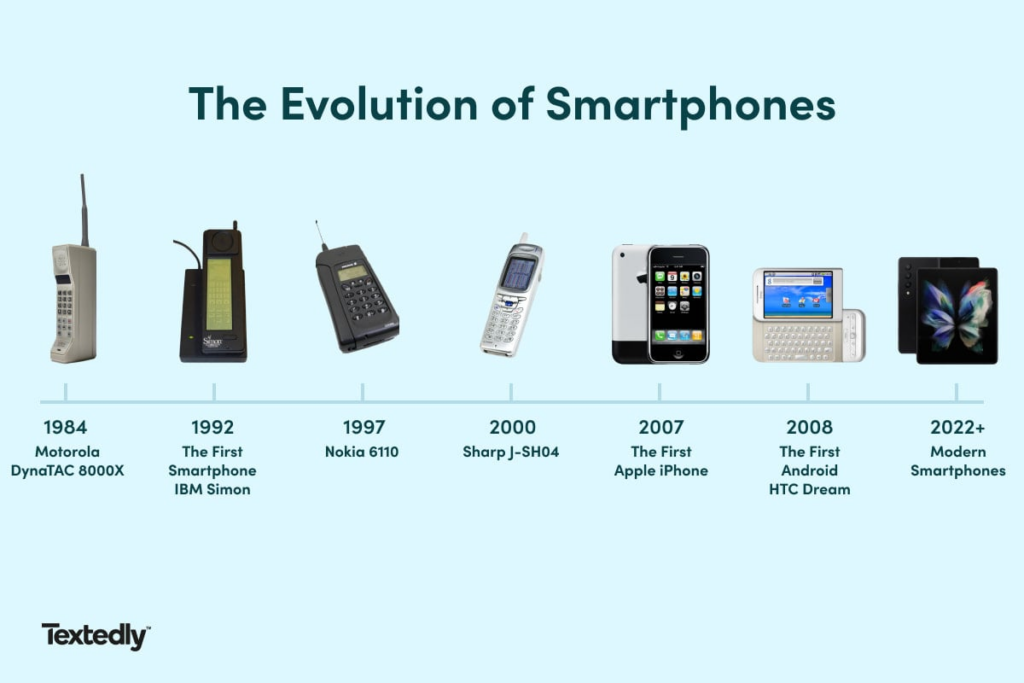
It could be compared to evolution of the phones and technology in general how our everyday devices moved from being heavy and bulky to light and portable and also with having speculations such as it’s not needed we can come to vision that everyday said we do not need phones because we have laptops but technology advances and we find new ways where we interact with the world.

What I Learned About AR From The Event

The first learning is about form factor. The Ray-Ban Display does not try to turn your whole field of view into a digital world. It uses a compact display area to show only what is necessary: navigation hints, messages, short answers from Meta AI or the title of a song that is playing. Instead of replacing reality, it adds a thin layer on top of it.

The second learning is about interaction. The neural wristband is a good reminder that people do not want to wave their arms in public to control AR. In real environments like a festival, a museum or a supermarket, subtle gestures or simple taps are much more realistic.

The third learning is the merge of AI and AR. The glasses are clearly designed as AI first devices. They can answer questions, translate speech, caption what you hear and see, and then present this information visually inside the lens.

Technology Getting Smaller And More Accessible

Another strong theme in Meta Connect is how quickly the hardware is trying to become socially acceptable. Earlier devices were clearly gadgets. These glasses try to be fashion first, tech second. They look like familiar Ray-Ban frames instead of a prototype. The same is true for battery life and comfort. The promise is that you can wear them for several hours without feeling like you are in a lab experiment.

Why Meta Connect Matters For My Thesis

Meta Connect 2025 confirmed that my scenarios for AR in retail are not just science fiction. The building blocks are emerging in real products: lightweight glasses, AI assistants, subtle input methods and simple overlays instead of full virtual worlds. For my master’s thesis this is both motivating and grounding. It tells me that the interesting design work is no longer about asking if AR will be possible in stores, but about shaping how it should behave so that it actually helps people shop, learn and navigate without stealing the spotlight.

Technology should become smaller, calmer and closer to everyday objects, so it can quietly support what people already want to do in physical spaces. Not to replace those spaces, but to make moving through them a little clearer, smarter and more human.

Links

Official Meta recap of the Connect 2025 keynote (Ray-Ban Display, Neural Band etc.)
Meta Connect 2025 – AI Glasses And Ray-Ban Display Meta

Meta product page for Ray-Ban Meta smart glasses (for specs and positioning)
Ray-Ban Meta Smart Glasses – Meta Meta

General info / news listing around Meta smart glasses and AI wearables
Meta – Newsroom / Ray-Ban Meta Announcements

AI Disclaimer
This blog post was polished with the assistance of AI.

IMPULSE #2: A Night of Techno Losing Yourself And Finding Your Way Experience

The night I saw Charlotte de Witte at Signal Festival was pure overload. Heavy bass, dense crowd, strobing lights, smoke, multiple bars and stages, lockers, queues, a constant flow of people in every direction. As an experience it was amazing, I am a designer and one thing I love to do and always do is to see how I can optimize the whole event and how I can apply it to my thesis because I am also a workaholic.

Observations: Immersion Versus Orientation

One of my strongest observations was how different immersion and orientation felt. Immersion was perfect. When I was in front of the main stage, I did not need any interface. The sound and visuals were enough. Orientation was a different story. Moving away from the stage meant guessing, especially if you got drunk a bit. Where is the nearest bar that is not overcrowded. Which corridor leads to the toilets. How do I get back to my locker without opening the venue map again and again. The more time passed, the more people were intoxicated, and the weaker everyone’s internal navigation became.

At some point I lost my friends in the crowd and we had the usual routine: messages that did not go through, vague descriptions like “I am near the left bar” that are useless in a dark hall, and the classic feeling of spending twenty minutes trying to reconnect. When you are sober this is still slightly annoying. Once you are drunk, it becomes hard work.

Understanding: How AR And IoT Could Be A Soft Safety Net

This is where I started to imagine an IoT based guidance system with AR as the interface. Where IoT beacons or other positioning technology could be distributed across the venue. Every bar, locker zone, toilet block and entrance could have its own tiny digital footprint. If visitors opt in, AR glasses could use this network to understand three basic things in real time: where they are, where their friends are, and where key services are located.

In practice, that could look very simple. An AR arrow could hover in my view and gently lead me to my locker, even if I barely remember which area I used. A small indicator could show me which direction my friends are in and roughly how far and also notify in case my friends need help as sometimes you can face safety issues other people approaching and annoying. If I want a drink, the system could show the nearest bar plus tell where I can go to smoke. If there is an emergency or I need to leave quickly, the AR layer could highlight the closest safe exit instead of forcing me to rely on my memory in a confused state.

Main Concept: Festivals As Prototypes For Smart Guidance

The main concept that came out of Signal Festival for me is the idea of a soft, ambient guidance system built on AR and IoT. The festival does not need more screens. It needs invisible structure that supports people at the right moment. A network of small, low power devices in the space can give the system awareness of positions and states. Which will elevate user experience nd AR then becomes a thin, context aware layer on top of that awareness. It answers very simple questions: where am I, where is what I need, and how do I get back.

This is closely related to my retail research. A music festival is like an extreme version of a shopping mall. Both are large, noisy, crowded environments where people try to reach specific goals while managing limited energy and attention. If a guidance system can help a drunk visitor find the right bar, locker or friend in a dark venue, it can certainly help a tired shopper find the right aisle or click and collect point in a busy store.

Links
Event page for Signal Festival Weekend 2 at Pyramide
Signal Festival – PYRAMIDE TAKEOVER WE2 (O-Klub) O-Klub

Techno event listing with headliners and description
Signal Festival Pyramide WE2 – Event Overview technomusicworld.com

Local article about Signal Festival in the glass pyramid
Signal Festival in der Pyramide Vösendorf – Heute.at

AI Disclaimer
This blog post was polished with the assistance of AI.

IMPULSE #1 Kunsthistorisches Museum Wien: Analog Space, Digital Ideas

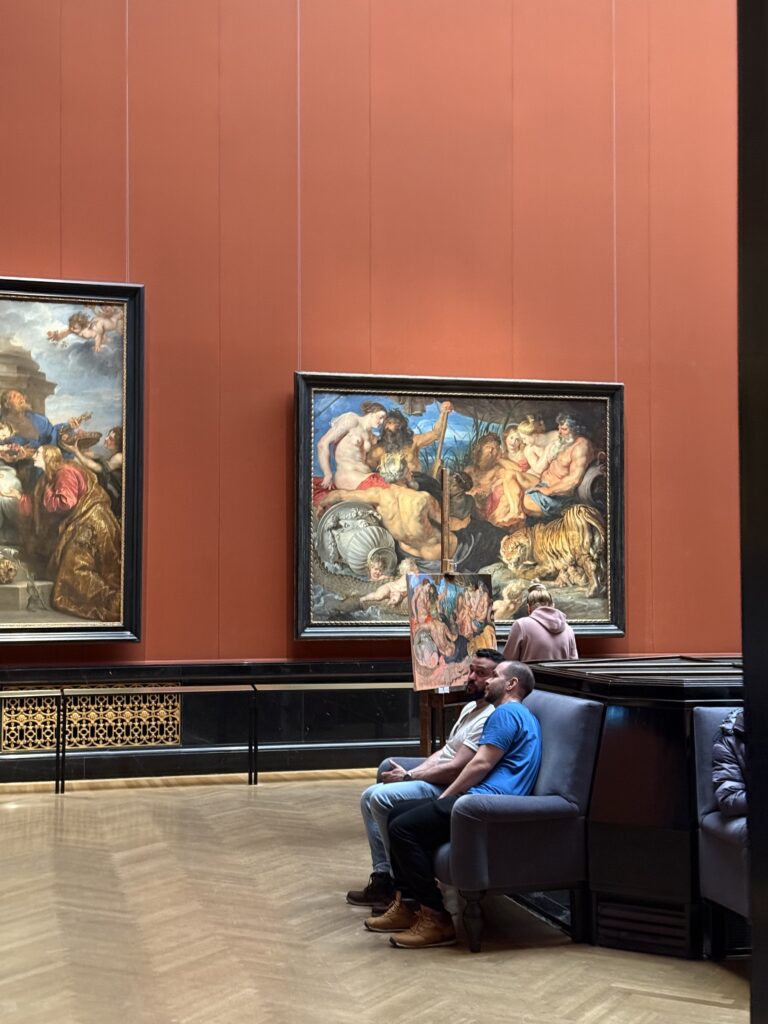
Visiting the Kunsthistorisches Museum Wien felt almost the opposite of my thesis topic. It’s a very “analog” space: heavy architecture, old masters, quiet rooms, and almost no visible technology. Apart from the optional audio guide device, there are no screens, no projections, no interactive installations. You move from room to room, read the small wall texts and simply look.

That contrast is exactly what made the visit so valuable for me as an interaction design student. I wasn’t impressed by high-tech features. I was impressed by how much potential there is for technology to quietly support the experience without taking attention away from the art itself. The museum became a kind of mental sandbox where I could imagine how AR and IoT might be implemented in a very delicate context: history, culture, and learning.

Observations: A Classical Museum with a Small Digital Layer

My main observation was how traditional the user journey still is. You enter, pick a wing, and mostly navigate by room numbers, map and intuition. The only digital touchpoint I used was the handheld audio guide. Even that already shows the basics of what I work with in my thesis: an extra information layer on top of the physical space. You enter a painting number, press play, and suddenly you get context, story and meaning instead of just title, date and artist.

But the interaction is linear and passive. You always get the same story, no matter who you are, how much you already know, or what caught your eye. There is no way for the system to “notice” that you are fascinated by one detail and want to go deeper, or that you are in a hurry and only want a short summary. It made me see very clearly where today’s museum tech stops and where AR and IoT could start.

Understanding: Technology Should Support the Artwork, Not Compete with It

Standing in front of paintings, I tried to imagine AR in the room. The danger is obvious: if we fill the space with too many digital elements, the painting becomes a background for the interface. That’s exactly what I do not want, and it connects strongly to my thesis: technology must serve the human and the content, not distract from it.

So my understanding is that any AR or IoT system in a museum like this would have to be extremely calm, subtle and respectful. The artwork stays the main actor. AR is just a transparent layer that appears only when the visitor asks for it. IoT devices like small beacons near the frame could be completely invisible, only there to let the system know where you are and what you’re looking at. The goal is not to “modernise” the museum for its own sake, but to deepen the connection between visitor and artwork.

Main Concept: A Future AR & IoT Guidance Layer for Museums

The main concept that came out of this visit is to treat the museum as a potential case study for the same principles I explore in smart retail: guided navigation, contextual information, and personalised journeys, all powered by AR and IoT.

I imagined wearing AR glasses instead of holding an audio guide. When I look at a painting for more than a few seconds, a small icon could appear next to it in my field of view. If I confirm, the system overlays very minimal hints: a highlight around a specific detail, a short caption, or the option to see a brief animation explaining the story behind the scene. If I want more, I can dig deeper maybe see a reconstruction of how the painting originally looked, or how it was restored. If I don’t, nothing changes; I just keep looking with my own eyes.

The same system could also redesign the wayfinding experience. Instead of a fixed predefined tour, AR could show me a route that matches my interests and time: “Show me five highlights from the Renaissance in 45 minutes,” or “Guide me only to works that relate to mythology.” IoT sensors in rooms could provide live information about crowding, so the path avoids the most packed galleries and keeps the experience more relaxed.

What mattered most for me in this museum visit was not what technology was already installed, but the mental exercise of placing my thesis ideas into this setting. It helped me see that the principles I am developing for AR and IoT could have wider use case from the intended one and give a perspective for a retail subtle guidance, context-aware information, and respect for the physical environment also make sense in a cultural space.

Links

Official museum site
Kunsthistorisches Museum Wien – Official Website KHM.at

Visitor overview and highlights in English
Kunsthistorisches Museum – Overview & Highlights (visitingvienna.com) Visiting Vienna

Background and history of the building
Kunsthistorisches Museum Wien – Wikipedia

AI Disclaimer
This blog post was polished with the assistance of AI.