RESEARCH #1 – Feeling Lost

At the beginning of the semester, I felt completely lost when thinking about my thesis. Not in the sense that I had no interests, but almost the opposite. I had too many ideas, too many directions, and none of them felt stable enough to commit to. Every time I thought I had found something, I would question it again. It felt like everything was possible, which strangely made it harder to begin.

Looking back, I realise that I expected myself to start with clarity. I thought I needed to know exactly what my thesis would be about before allowing myself to explore it. But this expectation made it difficult to move forward. Instead of helping me, it made me feel stuck.

During lectures, workshops, and conversations, I saw how open the process actually is. There is no single correct starting point. Research is not about immediately knowing, but about gradually finding direction through exposure and reflection.

What I understand now is that feeling lost was not a failure of the process, but the beginning of it. It forced me to question my assumptions and stay open. Instead of following a predefined path, I had to start paying attention to what genuinely interested me.

This uncertainty also made me more aware of the themes that kept reappearing in my thinking, such as chaos, attention, atmosphere, and meaning. At the time, these ideas felt random but over time I started seeing relationships between them.

This phase taught me that not knowing is not something to avoid, but something to work with. It creates space for ideas to develop more naturally, without forcing them too early into fixed forms.

Impulse #8 – Getting Lost in the Library

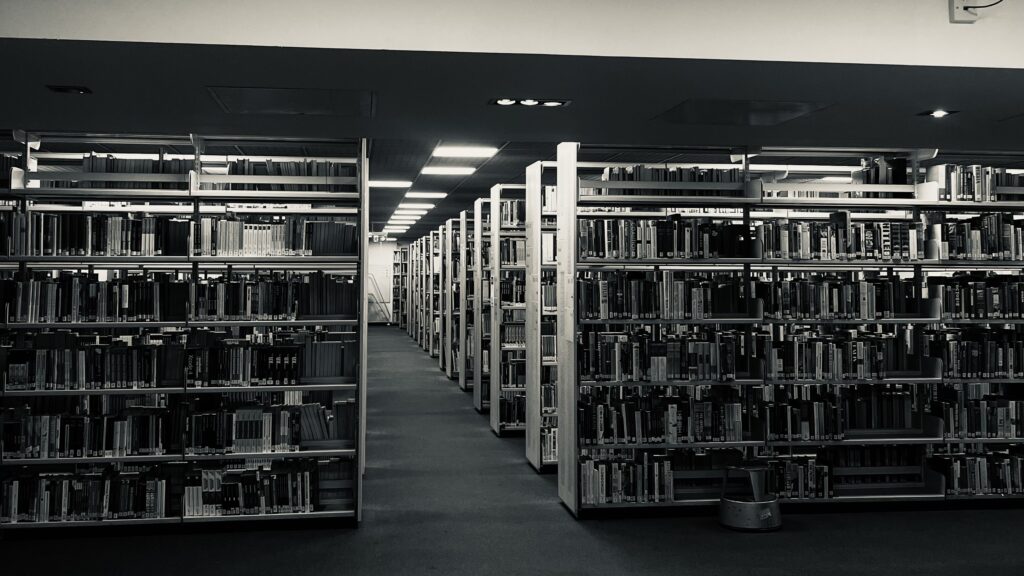
Throughout this research phase, I’ve spent a lot of time in libraries. Especially since coming to Kingston, visiting the library has become a regular part of my routine. This might be because of how big and comfortable the Kingston University library is, or simply because I feel motivated to make the most of my time here and use the facilities available to me. But I’ve noticed that the library has become more than just a place to work. It has become part of my research process itself.

I’ve always loved spending time in libraries and bookshops. As cheesy as it sounds, it really feels like entering a different world. There is something about being surrounded by books that makes knowledge feel physical and accessible. It creates a kind of quiet focus that is very different from being online. Even though I would argue that my social media feed is quite educational and inspiring, it doesn’t create the same depth of attention. Scrolling feels fast while being in a library feels slower and more intentional.

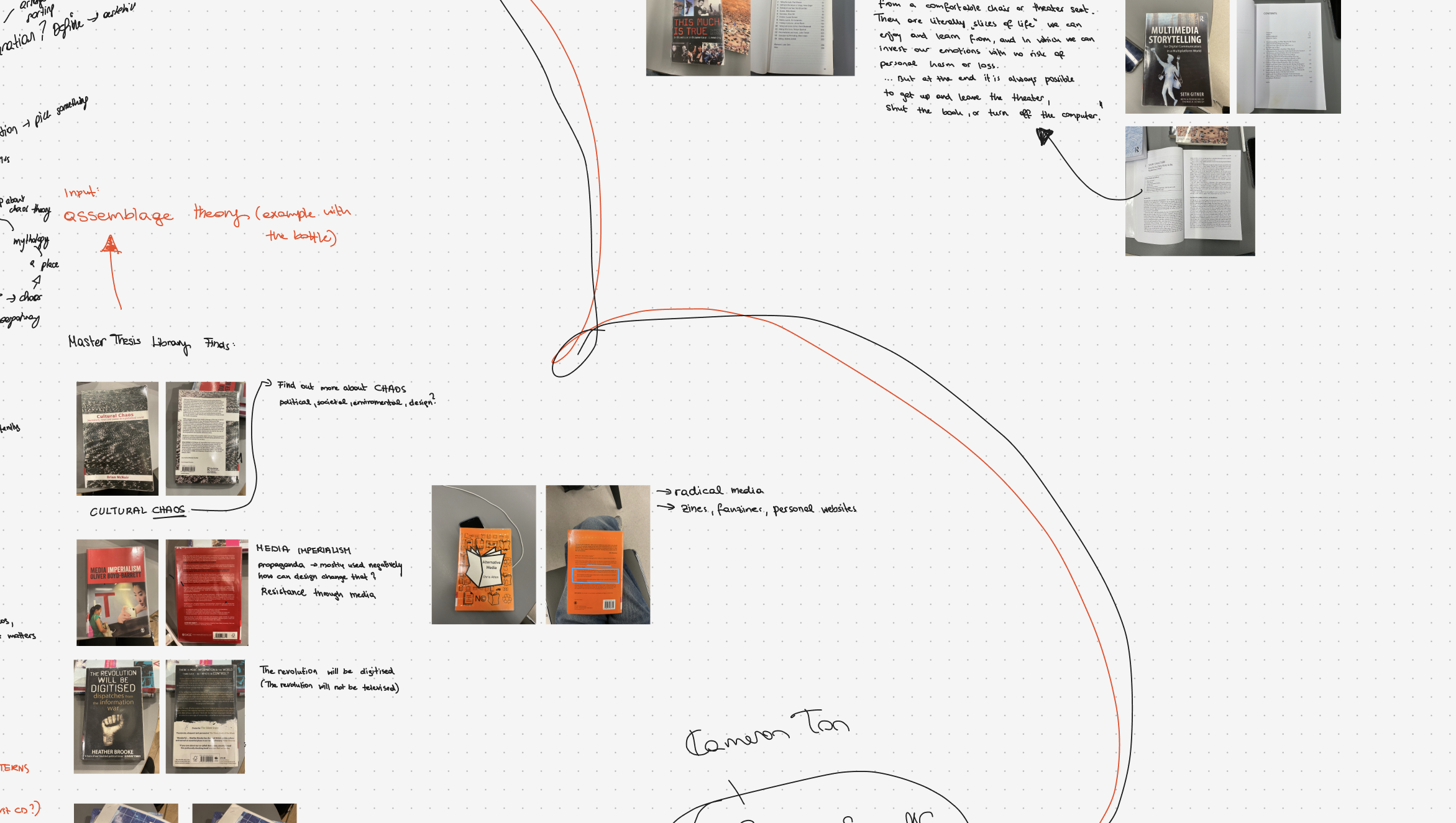
What became especially important during this phase was how I started collecting literature. Instead of using a structured or academic system, I began simply taking photos of the front and back of books that interested me and placing them into a Figma file. It’s probably the most unprofessional way of collecting literature for a thesis. But visually seeing the book covers alongside my thoughts made the process more engaging and personal. It didn’t feel like a boring literature research, it felt like building my own archive.

I didn’t even limit myself to design-related books. Most of my visits were to a different Kingston campus library and ended up in sections like psychology, politics, and cultural studies. I picked books purely based on intuition picking titles, colours, or topics that caught my attention, without worrying whether they were directly relevant to my thesis.

What surprised me was that even though these choices felt random, connections began to appear. Many of the books, in different ways, touched on similar themes: how people understand the world, how environments shape behaviour, how meaning is constructed, and how individuals exist within larger systems.

This experience also changed how I think about chaos in relation to research. At first, my approach felt disorganised. I wasn’t following a clear structure, and my collection of books came from different disciplines without an obvious order. But over time, patterns began to emerge. What initially felt like chaos started to form its own internal logic.

This impulse has influenced my research by helping me trust a more intuitive approach. Instead of forcing my thesis into a fixed direction too early, I’ve allowed myself to collect fragments, ideas, and references from different fields, wishing there was more time to just focus on this process. But unfortunately this phase of searching for a topic has to come to an end soon…

Links:
https://www.kingston.ac.uk/library/
https://www.bl.uk

Impulse #7 – ReThinking Podcast: The Truth About the Attention Crisis

For this impulse, I listened to the podcast ReThinking: The Truth About the Attention Crisis from the WorkLife with Adam Grant series, featuring historian Daniel Immerwahr. I kept thinking about it afterwards, especially because attention has slowly become an important part of how I understand my own research process.

I’ve often caught myself believing that my attention span is getting worse. It’s easy to blame phones, social media, or the constant availability of information. There is always something new to look at, something else to click on, and it becomes harder to stay with one thought for a longer period of time. I noticed this not only when working, but also when watching films, reading, or even visiting museums. My attention feels fragmented, constantly moving.

What interested me about this podcast was that it questioned this idea of the “attention crisis.” Instead of treating it as something entirely new, it suggested that people have worried about attention disappearing for a long time. This made me realise that attention is not just a personal ability that we either have or don’t have. It is something that is shaped by the environment we are in.

This connects strongly to experiences I’ve had recently. For example, as I mentioned in my previous blog entry: when I visited the Electric Cinema, I was able to watch a film with full attention, without distractions. The space itself allowed for that kind of focus. In contrast, when I visited the National Gallery, the large quantity of paintings made it harder to fully engage with individual works. It wasn’t because the paintings lacked meaning, but because my capacity to process them reached a limit.

This made me realise that attention is closely connected to structure and chaos. When there is too much information, everything starts to blur together. Nothing stands out anymore. But when there is enough space, attention can settle.

This idea feels very relevant to my thesis, where I am interested in chaos and how meaning is created within it. Chaos is not necessarily negative, but it can become overwhelming when there is no structure to navigate it. At the same time, too much structure can remove the unexpected moments that make things feel alive. Attention seems to exist somewhere in between these two states. It needs enough openness to allow discovery, but enough direction to allow focus.

The podcast made me reflect on attention not as something I need to “fix,” but as something that responds to context. It shifted my perspective from blaming myself for being distracted to observing the conditions that shape how I focus. This also changes how I think about creative direction. Directing attention is not about forcing control, but about creating environments where attention can naturally emerge.

For my research, this impulse reinforces the importance of atmosphere, structure, and context. It makes me more aware that meaning is not only created through content, but through how that content is experienced. Attention is not just an individual act, but something that is designed and influenced by the systems around us.

Links:
https://www.ted.com/podcasts/worklife
https://history.northwestern.edu/people/faculty/core-faculty/daniel-immerwahr.html

Thesis Research 11: Zusammenfassung

Wenn ich auf meine bisherigen Research-Blogposts zurückblicke, sehe ich keine lineare Entwicklung, sondern ein Feld aus Gedanken, Impulsen, Begegnungen und Fragen. Ich habe mich mit politischer Gestaltung beschäftigt, mit Typografie, mit Lesbarkeit und Macht, mit Raum, Wahrnehmung und Intervention. Ich habe über Wut nachgedacht, über Haltung, über Perspektive. Und zuletzt intensiv über Tod, Trauer und Sprachlosigkeit. Nicht jedes Thema war gleich stark. Nicht jede Idee war gleich tragfähig. Aber jede hat etwas freigelegt.

Von Anfang an war mir klar, dass meine Masterarbeit politisch sein soll. Nicht im parteipolitischen Sinne, sondern im Sinne einer Haltung. Friedrich von Borries schreibt in Weltentwerfen. Eine politische Designtheorie, dass Design politisch ist, weil es in die Welt interveniert (vgl. von Borries, 2024, S. 30), und dass alles, was gestaltet ist, entwirft und unterwirft (vgl. ebd., S. 9f.). Dieser Gedanke hat sich wie ein roter Faden durch meine Research-Phase gezogen. Gestaltung ist nie neutral. Sie schafft Realitäten, rahmt Wahrnehmung und positioniert sich zu bestehenden Ordnungen.

In den letzten Blogposts haben sich zwei Themen besonders verdichtet: Wut und Tod. Zwei scheinbar unterschiedliche Felder, die sich jedoch in einem Punkt berühren. Beide sind starke, existenzielle Erfahrungen. Beide werden gesellschaftlich oft verdrängt, privatisiert oder normiert. Beide erzeugen Sprachlosigkeit.

Beim Thema Wut ging es um die Frage, ob Gestaltung Emotion darstellen oder aus Emotion entstehen kann. Ob „aus Wut Gestaltung wird“ und was das für eine gestalterische Haltung bedeutet. Beim Thema Tod und Abschied ging es weniger um Ausdruck als um Schweigen. Um die irritierende Erfahrung, dass etwas so Alltägliches wie Sterben gesellschaftlich kaum besprochen wird. Aus persönlicher Erfahrung weiß ich, wie merkwürdig diese Stummheit sein kann und das sie isoliert.

Der Satz „Der Tod ist real“ ist aus dieser Auseinandersetzung entstanden. Er wirkt banal und gleichzeitig radikal. Vielleicht weil er eine Tatsache ausspricht, die wir kollektiv oft umgehen.

Wenn ich meine Research-Beiträge insgesamt betrachte, wird deutlich, dass es mir weniger um einzelne Themen geht als um eine übergeordnete Frage: Wie kann Gestaltung Räume öffnen. Für Emotion. Für Perspektive. Für Gespräch. Für das, was gesellschaftlich schwer sagbar ist.

Wut, Tod, Lesbarkeit, politische Haltung sind Themen, welche um Sichtbarkeit und Zugang kreisen. Um Macht. Um das Verhältnis zwischen Gestaltung und Wirklichkeit.

Für den nächsten Schritt bedeutet das für mich vor allem eines: Zuspitzung. Ich muss entscheiden, ob ich mich thematisch fokussiere, etwa auf Tod und Sprachlosigkeit oder ob ich eine übergeordnete Fragestellung entwickle, die existenzielle Emotionen als Ausgangspunkt nimmt. Parallel dazu möchte ich beginnen, praktisch zu denken. Erste Gespräche führen. Stimmen sammeln. Formale Experimente wagen. Testen, wie sich Offenheit, Nähe oder Konfrontation gestalterisch anfühlen.

Die bisherige Research-Phase war kein Finden einer Antwort beziehungweise eines finalen Themas, sondern ein Schärfen meiner Haltung und Ideen. Die Kirmes im Kopf ist etwas weniger durcheinander, weil ich nun einige Themenansätze herausgearbeitet habe, die ich gerne weiter verfolgen möchte.

Impulse #6 – Electric Cinema: On Atmosphere and Attention

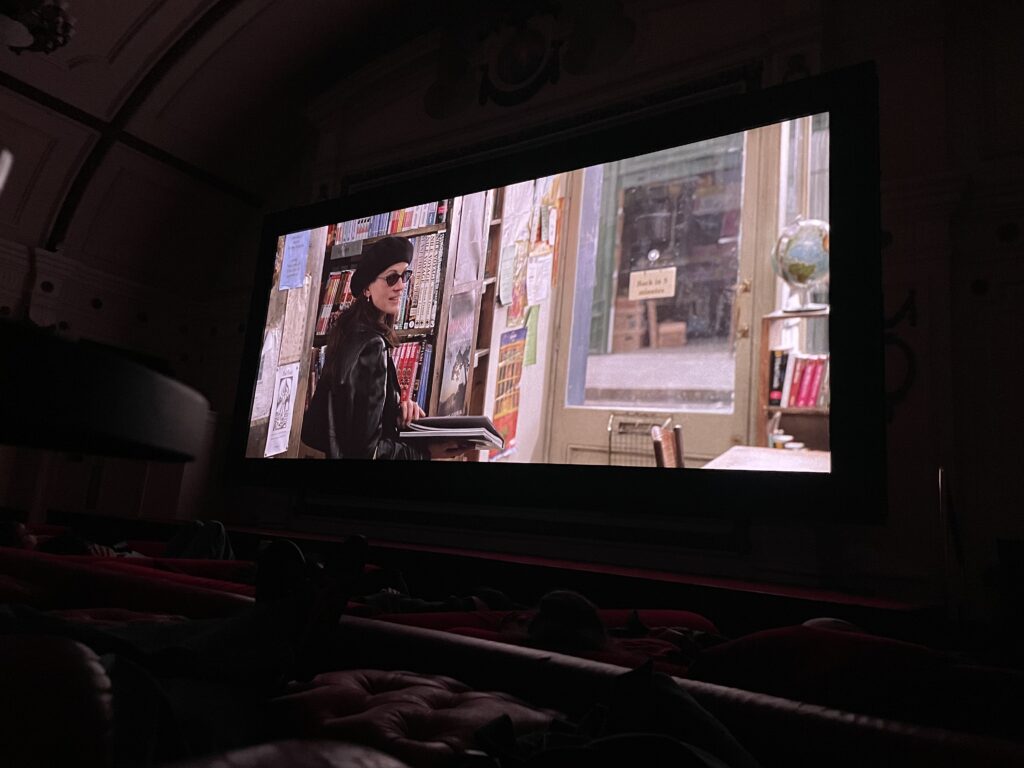
Last week, I went to the Electric Cinema in Notting Hill to watch Notting Hill. Which, on paper, sounds almost ridiculous. Watching a romcom I’ve already seen, in the exact neighbourhood where it’s set, didn’t feel like something that would count as “research.” It wasn’t a lecture, it wasn’t a book, and it definitely wasn’t productive in the traditional academic sense.

But it stayed with me.

I think what made it special wasn’t the film itself, but the atmosphere of the cinema. The Electric Cinema is one of the oldest cinemas in London, and it feels very different from watching something at home or on a laptop. You sit in these soft seats, there are small lamps next to you, people eat burgers and fries. It sounds like a small detail, but it made me realise how rarely I watch something with my full attention. No phone, no distractions, no multitasking. Just sitting there and watching.

I’ve loved Notting Hill for years, but I honestly can’t remember the last time I experienced a film like that by not just watching it, but really being present with it. The atmosphere allowed me to focus differently. It made me think about how much our surroundings shape the way we experience things.

What was also interesting was the contrast between the inside and outside. Notting Hill, especially around Portobello Road, feels very chaotic. It’s full of tourists, noise, and constant movement. But inside the cinema, there was this quiet fictional version of the same place. For two hours, you leave the real Notting Hill and enter a constructed one. And even though you know it’s fiction, it still feels real in its own way.

This made me think about my thesis and my interest in chaos. Outside, there is uncontrolled chaos, random, overwhelming, and hard to fully process. Inside the cinema, there is a different kind of structure. Everything is intentional. The story, the timing, the emotions are carefully directed. It’s not necessarily less real, but it’s organised in a way that allows you to engage with it more deeply.

I think working on a thesis is not only about reading books or sitting in libraries. It’s also about paying attention to experiences and noticing how context changes perception. The same film can feel completely different depending on where and how you watch it.

This visit reminded me that atmosphere, environment, and attention all play a role in how meaning is created. And maybe part of my research is learning to notice these moments more consciously.

Links:
https://www.electriccinema.co.uk/history/electric-cinema-portobello-history
https://www.imdb.com/de/title/tt0125439/

Thesis Research 10: Kann Design Schweigeräume öffnen?

Neben dem Thema Wut beschäftigt mich zunehmend ein anderes Feld, das ebenso existenziell ist und gleichzeitig gesellschaftlich auffallend leise behandelt wird: Tod und Abschied. Ich finde dieses Thema besonders interessant, weil es in gewisser Weise ein Tabuthema ist, obwohl es das Alltäglichste überhaupt ist. Jeden Tag sterben Menschen. Jeden Tag werden Menschen geboren. Jede Person wird im Laufe ihres Lebens unweigerlich mit dem Tod konfrontiert, sei es durch den Verlust von Angehörigen, Freundinnen oder Freunden, oder irgendwann durch den Gedanken an den eigenen Tod. Und trotzdem fällt es uns schwer, darüber zu sprechen.

Aus eigener Erfahrung weiß ich, wie irritierend diese Schweigsamkeit sein kann. Als ich selbst einen Verlust erlebt habe, hat mich weniger die Trauer anderer irritiert als ihre Unsicherheit. Die Stummheit. Das Ausweichen. Das Gefühl, dass niemand weiß, wie man das Thema ansprechen darf. Diese Sprachlosigkeit hat mich gestört. Nicht, weil ich perfekte Worte erwartet hätte, sondern weil ich gemerkt habe, wie sehr das Thema Tod aus dem öffentlichen Gespräch ausgeschlossen ist.

Natürlich ist Trauer schmerzhaft. Natürlich ist Abschied schwer. Aber warum fällt es uns so schwer, darüber offen zu sprechen, wenn es doch eine Erfahrung ist, die jede und jeder teilt.

Vielleicht liegt genau darin ein Kern des Problems. Der Tod ist real, aber er wird aus dem öffentlichen Raum verdrängt. Er findet im Privaten statt. In Krankenhäusern, Hospizen, Familien. Und wenn er eintritt, fehlt vielen die Sprache.

Ein Satz von Chimamanda Ngozi Adichie begleitet mich in diesem Zusammenhang besonders:
„Trauer ist das Glück, geliebt zu haben.“

Dieser Gedanke verschiebt den Blick auf Trauer radikal. Trauer ist hier nicht nur Schmerz, sondern Ausdruck von Verbundenheit. Auch die Aussage von Eva Maria Thümling, „Trauer und Glück können koexistieren“, öffnet einen ähnlichen Raum. Trauer wird nicht als reiner Ausnahmezustand verstanden, sondern als Teil des Lebens, als etwas, das neben anderen Gefühlen existieren darf.

Im Podcast 50 über 50 spricht Stephanie Hielscher mit Leonie Jung über Tod, Verlust und Endlichkeit. Schon in der Einleitung wird deutlich, dass Tod und Trauer Themen sind, die uns ein Leben lang begleiten, über die aber kaum gesprochen wird. Ähnlich offen spricht Guido Maria Kretschmer im Format Deep und Deutlich über den Verlust seiner Eltern. Auch Joëlle berichtet dort sehr ehrlich über den Tod ihrer beiden Mütter. Diese Gespräche zeigen, dass Offenheit möglich ist. Dass Sprache entlasten kann. Dass das Teilen von Erfahrungen Verbindung schafft.

Und genau hier formt sich für mich ein weiterer Gedanke. Vielleicht geht es weniger darum, den Tod neu zu interpretieren, sondern ihn schlicht auszusprechen. Nicht symbolisch. Nicht metaphorisch. Sondern klar. Der Tod ist real.

Dieser Satz wirkt auf den ersten Blick banal. Und gerade darin liegt seine Kraft. Vielleicht tun wir gesellschaftlich oft so, als wäre er es nicht. Als könnte Schweigen ihn kleiner machen. Als würde Unsichtbarkeit ihn weniger endgültig erscheinen lassen. Doch er ist real. Jeden Tag. Für irgendjemanden.

Wenn Gestaltung, wie Friedrich von Borries schreibt, politisch ist, weil sie „in die Welt interveniert“ (von Borries, Weltentwerfen. Eine politische Designtheorie, 2024, S. 30), und wenn „alles, was gestaltet ist, entwirft und unterwirft“ (ebd., S. 9f.), dann wäre eine gestalterische Arbeit mit dieser klaren Setzung bereits ein Eingriff. Eine Intervention gegen die gesellschaftliche Stummheit. Keine Provokation im Sinne eines Schocks, sondern eine ruhige, konsequente Benennung.

Mich interessiert weniger, den Tod selbst darzustellen, als die Sprachlosigkeit rund um ihn zu thematisieren. Das Unbehagen. Die Unsicherheit. Die Angst, etwas Falsches zu sagen. Und gleichzeitig die Sehnsucht nach Austausch. Vielleicht geht es darum, Räume zu schaffen, in denen Menschen nicht perfekt reagieren müssen, sondern ehrlich.

Wut und Trauer haben für mich weiterhin eine Parallele. Beide sind starke, existenzielle Emotionen. Beide werden gesellschaftlich häufig privatisiert. Beide verlangen Raum. Beide sind zutiefst menschlich.

Im Moment weiß ich noch nicht, ob Tod und Abschied mein finales Thema sein werden. Aber ich merke sehr deutlich, dass mich der Gedanke nicht loslässt, Gestaltung als Einladung zum Gespräch zu denken. Vielleicht geht es weniger um ein einzelnes Thema, sondern um die Frage, wie Design Schweigeräume öffnen kann.

Links:
https://www.fischerverlage.de/buch/chimamanda-ngozi-adichie-trauer-ist-das-glueck-geliebt-zu-haben-9783596710164
https://www.instagram.com/p/DUplWGMDNfE/?img_index=8
https://open.spotify.com/episode/6WNHnZOAcZ9OKdnUU1Qljv
https://www.ardmediathek.de/video/deep-und-deutlich/der-verlust-meiner-eltern-oder-guido-maria-kretschmer-im-talk/ndr/Y3JpZDovL25kci5kZS8zYjY0NGQ0Ni02NzIyLTQxZTQtYWQ2Yy02NDAwMWQxOTExNGM
https://www.ardmediathek.de/video/deep-und-deutlich/ich-habe-zwei-mal-meine-mutter-verloren-oder-joelle-im-talk/ndr/Y3JpZDovL25kci5kZS9mMzkwMzE2NC1mYzRiLTRhMmQtYmZhZC0xZWE2MTdiMWQ5MmE
Impulse #5 – The Uses of Disorder by Richard Sennett

https://www.paulstewartdesign.co.uk/the-uses-of-disorder

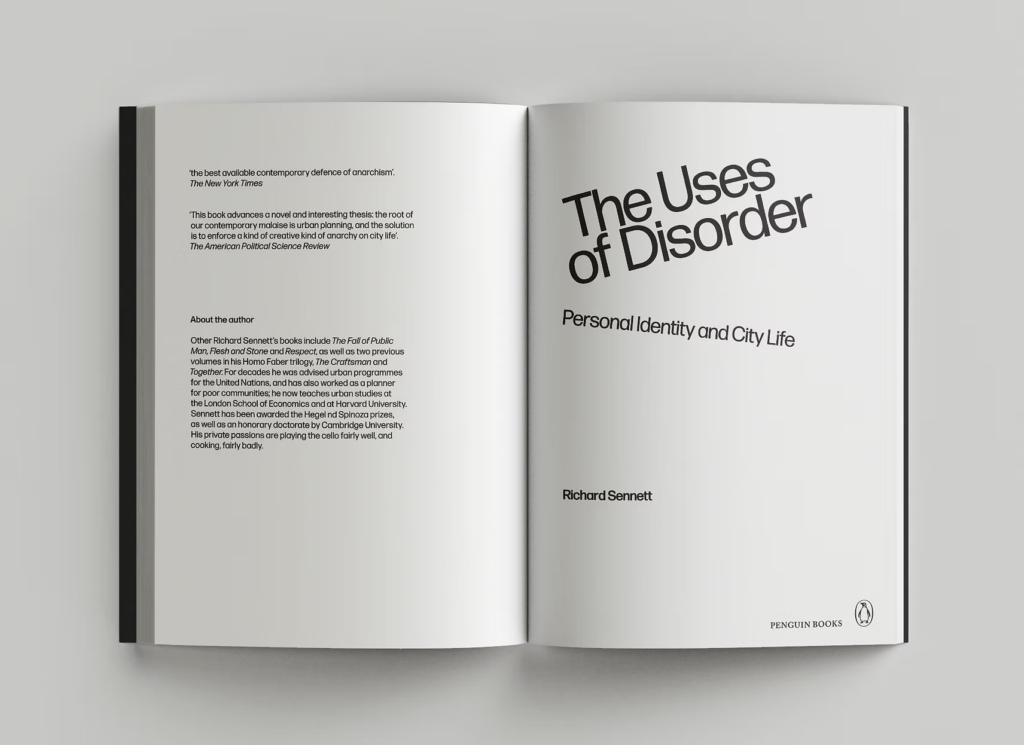
Lately I’ve been reading The Uses of Disorder by Richard Sennett, and even though I’m not finished yet, I already know it’s going to be important for how I shape my thesis. Mostly because my topic keeps circling around CHAOS not chaos as “everything is broken,” but chaos as something productive, alive, even necessary. And Sennett basically walks straight into that uncomfortable zone and says: maybe the problem isn’t disorder. Maybe the problem is how obsessed we are with getting rid of it.

The book was written as a critique of this dream of the perfectly planned, perfectly ordered city, the kind of place where everything is smooth and controlled and “safe,” but in a way that also flattens life. Sennett argues that overly ordered communities can become stagnant, because order can turn into avoidance: avoidance of difference, avoidance of conflict, avoidance of anything that might force you to grow.

What I find interesting is that he doesn’t talk about disorder like it’s a cute aesthetic. He’s not romanticising mess. He’s talking about it as something that can actually do work on a person. Like friction. Like a training ground. His point (at least how I’m understanding it so far) is that development doesn’t come from living in a bubble. It comes from being confronted with complexity, with other people, other values or other realities you can’t control.

One of the ideas that keeps sticking in my head is his critique of “purified” communities. Spaces built around sameness, where everything feels predictable. The way he frames it, these environments aren’t neutral. They’re a choice. And they’re often a choice made possible by privilege: if you have enough resources, you can design your life to avoid discomfort. You can separate yourself from anything messy. You can curate your surroundings until you barely have to deal with surprise.

And then I keep thinking… what does that mean for design?

Because design can easily become part of that “purifying” impulse. Even in the nicest, most well-intentioned way. We design systems to reduce uncertainty. We design environments to be seamless. We design experiences that remove friction. And sometimes that’s good but sometimes it feels like we’re also designing out the parts where people actually change.

Reading Sennett makes me ask: When does “making things easier” turn into making things less real? When does smoothing everything out become a way of avoiding growth?

This is where it starts connecting to my own obsession with chaos. Not because I want everything to be chaotic. But because I’m starting to see chaos as a condition for meaning. Like: if everything is too controlled, everything becomes the same. You stop noticing. You stop feeling. You stop having those moments where something interrupts you and you have to re-orient yourself.

Also, maybe this is the biggest thing the book is giving me right now: permission to not immediately “solve” chaos. To not treat disorder as a design failure. To treat it as information. As something you can work with instead of against.

I’m still in the middle of the book, so I don’t want to pretend I’m summarising it perfectly. But I can already tell it’s reshaping the way I think about cities, communities, and creative practice and honestly, it’s making me more suspicious of anything that looks too organized.

Links:
https://www.paulstewartdesign.co.uk/the-uses-of-disorder
https://www.versobooks.com/en-gb/products/2810-the-uses-of-disorder?srsltid=AfmBOoqcJ_Up1gbzIwcqjeYxPyC983siGmJnnOm5moLjHgr6Zbzdk7O0

Research #9 The “Drive to Survive” Effect

We can’t talk about modern motorsport without talking about the “Drive to Survive” effect. The Netflix Series didn’t just bring in more fans but it also changed the demographic of the fans. For the first time, we have a massive, young, and increasingly female audience that cares as much about the drama, the personalities, and the vibe as they do about the technical specs.

#27 – Platform as Context

After being inspired by Paulus Goerden again (and again), I finally did something I should have done much earlier: I stopped only saving posts and started looking at his Instagram account as a whole system. Not just what he posts, but how he builds meaning around everyday installations through format, repetition and framing.

I already wrote a deeper version of this as an Impulse blogpost, but I wanted to keep a short version here as well because it connects directly to my own thesis process.
What I noticed is that his account is not simply documentation. It’s structured. He repeats a few formats over and over again, and that is exactly why it works so well. The most obvious one is the classic: showing a found everyday installation. But then he expands it with other layers: reconstruction (miniature versions), street interviews, and meta-posts where he includes hate comments or reactions from followers. The installations stay anonymous, but the context around them keeps changing.

This is important for my thesis because it proves something I keep coming back to: the object itself is rarely the main point. The frame is. On Instagram, the frame can be a caption, a voiceover, a title, a hate comment screenshot, or a conversation with a stranger. And suddenly the same pile of boxes becomes either trash, minimalism, or a joke — depending on what kind of frame is offered.

For me, the biggest takeaway is that I shouldn’t think of my work as “just photos” either. The documentation, the text, the exhibition space, the order of images, the titles, even the reactions from other people, all of that is part of the final communication.
Paulus’ work is a good reminder that everyday installations don’t need a museum to become readable. But they do need a structure. And building that structure is basically communication design.