AUGMENTING SHOPPING REALITIES: STUDIES ON AUGMENTED REALITY (AR) IN RETAIL: Review

Thesis: Augmenting Shopping Realities: Studies on Augmented Reality (AR) in Retail

Author: Camen Teh

Degree/Institution/Date: PhD, University of Nottingham, February 2023.

How is the artifact documented?

There are basically two “work pieces.” First, the hierarchical value map from Study 1, which connects AR attributes, consequences, and values. It’s documented with an implication matrix, centrality and abstractness indices, and a final map; you can see which items ranked most important, like product evaluation, amplified product information, and product knowledge. 

Second, the web-based AR product presentation was used in the field experiment. The design varies the visual style (cartoonised vs realistic) and whether simple control buttons are present. When students scan a code on the product, one of the versions plays. The figures make the manipulations and trigger flow clear. 

Where and how can it be accessed?

I discovered the research while I was scrolling through research of various universities on HCI and AR technology, and stumbled upon this research. So research is accessible at the university of nottingham web-page. I was not able to find it on other platforms.

Do theory and implementation align?

Yes. Study 1 shows that shoppers care about information that builds knowledge and supports evaluation; Study 2 then tries concrete design moves (visual style + simple controls) that could nudge curiosity and controllability, and checks whether that helps people make sense of a “weird” product and move toward buying. The pipeline is coherent.

Is the documentation clear and comprehensible?

Yes. The thesis shows step-by-step procedures, visuals for manipulations, and full instrument lists; reliability/validity and manipulation checks are reported, enabling reproducibility and critique.  

Does the artifact meet master’s level quality standards?

This is a PHD research. Nevertheless, Research constitutes substantive work pieces with clear research aims, implementation details, and evaluation, meeting and in places exceeding typical master’s expectations. The absence of a public build/repo is a practical limitation rather than a quality flaw.  


Systematic Evaluation (CMS Criteria)

  • Overall presentation quality: Clean structure, figures and tables used purposefully. Reads polished.
  • Degree of innovation: Neat combo: means-end mapping of retail AR, then a live store test of visual style and simple controls. The finding that a stylized look can help sense-making for unfamiliar products is genuinely interesting.
  • Independence: The author builds or modifies stimuli, runs a campus-store experiment with random assignment, and reports checks and stats. Feels hands-on.
      
  • Organization and structure: The thesis is easy to follow: it opens with an introduction and an overarching AR literature review, then presents Study 1, a short bridge chapter that links Study 1 to Study 2, and a full chapter on the field experiment, before closing with implications and limitations. The table of contents and chapter headers make this flow clear.  
  • Communication: The author explains the manipulations plainly and even shows them with simple figures, and the measurement section reports reliability and validity in a straightforward way. 
  • Scope: Study 1 goes deep with 45 interviews, which is plenty to build the value map, and Study 2 is sizable for a field setting with 197 student participants. It tracks both purchase intention and an objective purchase measure via pre-orders, so the behavioral side isn’t just hypothetical.
        
  • Accuracy and attention to detail: The author explains what was tested and shows that the setup worked as intended. Most of the questionnaires feel solid, and while one of them is a bit shaky, it doesn’t break the study. Overall, the write-up is careful, tidy, and easy to follow.
  • Literature: The work includes a focused AR-in-retail review in Appendix A with a transparent selection funnel that narrows to 53 journal papers, and the measurements used in the experiment are adapted from prior validated scales and documented in the item tables. It reads grounded rather than hand-wavy.  

Overall Assessment (strengths & weaknesses)

Overall, this is a well put together thesis that treats AR in retail as a tool for better decisions rather than a flashy add-on. It moves cleanly from ideas to practice: first mapping what shoppers actually need from AR, then testing simple design choices in a real store. The write-up is clear, the artifacts are documented inside the thesis, and the practical message is easy to use: give people decision & useful information, let them control the presentation a little, and don’t assume photorealism is always the best choice for unfamiliar products.

There are a few issues. The live AR build isn’t shared as a public demo, and the field test sits in a single, student-heavy setting, so we should be careful about claiming it works everywhere. Still, the work is coherent, transparent, and genuinely helpful for anyone designing AR in shops. For a PHD, it comfortably meets the standard and, in places, goes beyond it.
BLOGPOST 1 – Review: Designing a Title Sequence for Gabriel García Márquez’s “One Hundred Years of Solitude”

ACKERL Blog 

Nach längerer Suche nach einer passenden Arbeit habe ich mich letztlich für diese Master-Thesis entschieden – auch wenn sie thematisch nicht direkt an mein eigenes Vorhaben anschließt. Trotzdem war es spannend zu sehen, wie sich jemand wissenschaftlich mit Animation und einer literarischen Vorlage auseinandersetzt…

Titel: Designing a Title Sequence for Gabriel García Márquez’s “One Hundred Years of Solitude”

Autorin: María Paz Muñoz Balharry

Abschluss: Master of Fine Arts in Digital Arts

Institution: DigiPen Institute of Technology, Redmond (USA)

Erscheinungsjahr: Juli 2019

Betreuung: Pamela Mathues

Zugänglich über: https://www.digipen.edu/academics/graduate-degrees/mfa-in-digital-arts/thesis-work

Wie wird das Artefakt in der Arbeit dokumentiert? 

Der eigentliche Titelvorspann ist in der Arbeit nicht zugänglich – es gibt nur Screenshots und Prozessdokumentationen. Auch online ließ sich kein schnell zugängliches Video finden und selbst wenn müsst es trotzdem im PDF hinterlegt sein.
Die Arbeit selbst beschreibt den Entstehungsprozess ausführlich: mit Skizzen, Moodboards und Erläuterungen zu gestalterischen Entscheidungen. Der kreative Prozess wird so also gut nachvollziehbar, auch wenn das fertige Ergebnis in dem Online zugänglichen PDF fehlt.

Wo und wie ist es zugänglich?

Das finale Video selbst ist also weder im PDF enthalten noch über die angegebenen Quellen zugänglich Auch über eine Internetrecherche war keine öffentliche Version des Films zugänglich.

Stimmen theoretische Argumentation und praktische Umsetzung überein?

Theorie und Praxis gehen hier in den meisten Kapiteln gemeinsam einher. Die Autorin trennt ihre Arbeit nicht konkret in einen theoretischen und einen praktischen Teil, sondern reflektiert ihre Recherchen/Analysen und  Entscheidungen kontinuierlich im Prozess und dokumentiert da dann auch ihren Projektstand. Dadurch wirkt die Arbeit nicht wie Forschung sondern mehr wie die Dokumentation des Entwicklungsprozess.

Ist die Dokumentation klar und nachvollziehbar? 

Ja, die Kapitel sind sehr verständlich und nachvollziehbar aufgeteilt. Die Arbeit ist logisch und klar in die versch. Kapitel gegliedert, alles ist leicht lesbar und logisch (aufeinander) aufgebaut. Jede Phase – von der ersten Idee bis zur finalen Umsetzung – wird nachvollziehbar beschrieben und dokumentiert. Positiv finde ich auch: Verworfene Ideen und Alternativen werden notiert und begründet, z.B. warum sie bestimmte Stile nicht verwenden konnte (bsp. fehlendes Skillset/würden den Rahmen sprengen/…) Das macht den kreativen Prozess sehr transparent.

Entspricht die Qualität des Artefakts dem Niveau einer Masterarbeit?

Basierend darauf, dass ich den finalen Film nicht sehen konnte und nur Screenshots und den Prozess in der Erstellung beurteilen kann finde ich, dass etwas an information fehlt, um die Frage zu beantworten. Dennoch lässt sich sagen: Die Qualität des Filmes wirkt künstlerisch hochwertig und gut recherchiert, vor allem illustrativ sehr gut gelöst und man erkennt das die Autorin dahingehend Fachlich-Kompetent ist. Stil, Szenen und Co. wurden immer basierend auf Recherche/Analysen gewählt, es wurde genau abgewogen und es wurden Entscheidungen basierend auf theoretischem Input getroffen – alle as spricht für eine gute Qualität

(Bewertungskriterien des CMS-Programms:)

Gesamteindruck – Standard und Qualität der gesamten Arbeit

Inhaltlich hätte ich mir an manchen Stellen etwas mehr theoretische Tiefe gewünscht. Die Autorin beschreibt ihre Recherche zwar, geht aber selten in analytische oder wissenschaftliche Tiefe. Quellen von z.B. Interviews werden eher beiläufig im Text erwähnt, fast immer ohne genaue Nachweise oder Fußnoten.
Trotzdem ist eigentlich immer spürbar, dass sie intensiv recherchiert hat – etwa durch Literaturanalysen (am Anfang), Stilrecherchen (im Prozess) und Gespräche mit Fachleuten. Ihr Entscheidungsprozess basiert auf Reflexion und Vergleich, nicht nur auf Intuition, aber es fehlt an Dokumentation davon. Es fehlt der wissenschaftliche Zugang und das wissenschaftliche Arbeiten.

Also Positiv: Die Arbeit ist klar strukturiert, verständlich und methodisch nachvollziehbar.
Negativ: Wissenschaftliche Tiefe und Dokumentation der Recherche/Umfragen lückenhaft
Insgesamt: Pprofessionellen Eindruck, auch wenn in theoretischer Tiefe eher begrenzt. Schwerpunkt liegt deutlich auf dem gestalterischen Prozess.

Innovationsgrad – Originalität und Beitrag zum Forschungsfeld

Ich habe mich ein bisschen informiert um mich richtig auszudrücken und würde daher sagen, die Arbeit verfolgt keinen „explizit wissenschaftlichen Forschungsansatz“, sondern einen … „künstlerisch-praktischen.“ Persönlich finde ich das für eine Masterarbeit eher weniger angemessen, es sollte doch schon zumindest ansatzweise wissenschaftlich/forschungs-relevant sein.

Die Arbeit hat einen klaren künstlerischen Charakter und zielt wenig auf neue Forschungserkenntnisse ab – vielmehr auf die persönliche Entwicklung der Autorin. Also die Erkenntnisse der Arbeit dienen in erster Linie der Autorin selbst, weniger einer wissenschaftlichen Gemeinschaft. (Ähnlich bei meiner eigenen Bachelorarbeit, wobei sich dort deutlich(er) und intensivere Forschungsarbeit im Theoretischen Bereich finden ließ, wenn auch nicht zum Design-Thema sondern zum Thema des Films.)
Hier sind es eher persönliche Einsichten in den gestalterischen Prozess und der Forschungsanteil bleibt überschaubar.

Eigenständigkeit – Grad der Originalität und Unabhängigkeit der Arbeit

Das Projekt basiert auf einer bestehenden literarischen Vorlage, was den thematischen Rahmen vorgibt. Die Originalität liegt eher in der individuellen visuellen Umsetzung und im ästhetischen Stil, der entwickelt wurde (basierend auf der Recherche etc.) weniger aber in theoretischen Erkenntnissen.

Aufbau und Struktur – Logische Kohärenz und Klarheit

Die Arbeit ist sehr gut gegliedert. Der Aufbau folgt dem Gestaltungsprozess chronologisch und ist logisch nachvollziehbar. Theorie und Praxis werden organisch miteinander verknüpft.
Die formale Gestaltung (Layout, Bildmaterial, Kapitelstruktur) wirkt nicht sonderlich beachtet.

Kommunikation – Verständlichkeit, Stil und Präsentationsqualität

Sprache, Stil und Aufbau sind insgesamt sehr klar und zugänglich. Fachbegriffe werden nur sparsam verwendet, was die Arbeit gut lesbar macht – auch für Leser:innen ohne tiefes Vorwissen. Gleichzeitig wirkt sie dadurch stellenweise etwas oberflächlich und weniger akademisch geprägt.

Umfang – Angemessenheit von Länge und Tiefe in Bezug auf das Thema 

Der Umfang ist okay, da die wichtigen Themen behandelt werden. Dennoch scheint es etwas kurz. Inhaltlich wäre mehr theoretische Tiefe gut, um die Arbeit wissenschaftlicher zu machen… 

Literatur und Quellen

Die Literaturliste ist recht kurz. Zitate und Interviews werden nicht immer vollständig belegt.  Einige Quellen, insbesondere Interviews oder persönliche Kontakte, sind im Text zwar erwähnt, werden jedoch nicht nachgewiesen und hinterlegt, nichtmal Fußnoten, was mich sehr verwundert.
Gerade für eine Masterarbeit wäre hier etwas Qualität bei der Quellenarbeit wünschenswert gewesen.

Fazit

Insgesamt ist die Arbeit als Beispiel für eine künstlerisch orientierte Masterarbeit im Bereich Digital Arts…okay. Positiv ist, dass sie gut dokumentierte Gestaltungsprozesse, klare Strukturen und nachvollziehbare Reflexionen beinhaltet.
Weniger überzeugend ist die theoretische Tiefe und die wissenschaftliche Fundierung, was mich sehr stört. Vor allem auch die lückenhafte Quellenarbeit führt form mich dazu, dass ich der Arbeit Qualität abspreche.

Als gestalterische Arbeit ist sie also solide und ästhetisch super ansprechend, als Forschungsarbeit bleibt sie aber eher „im beschreibenden Bereich“ und erarbeitet nicht wirklich neue Erkenntnisse.
Für mich kann ich daraus rausnehmen, wie man kreative Prozesse dokumentieren und begründen kann.

(AI Note:
I read in the AI Guideline FH JOANNEUM that „For the use of “everyday aids” for example, automatic formatting, grammar or spell checks, which are integrated into many word processing programs, no separate “labeling” is required.“ I am unsure of grammar/spell correction by tools like Chatgpt are included here too.
Therefore I want to add: ChatGPT-4 was used for grammar and spelling. All insights are based on my Notes, the Thesis-PDF was never uploaded to ChatGPT; I take full responsibility for the selection of the AI technology/technologies and have independently reviewed and validated all generated results.)

Product I: Image Extender

OpenAI API Image Analyzer – Structured Vision Testing and Model Insights

Adaptive Visual Understanding Framework
In this development phase, the focus was placed on building a robust evaluation framework for OpenAI’s multimodal models (GPT-4.1 and GPT-4.1-mini). The primary goal: systematically testing image interpretation, object detection, and contextual scene recognition while maintaining controlled cost efficiency and analytical depth.

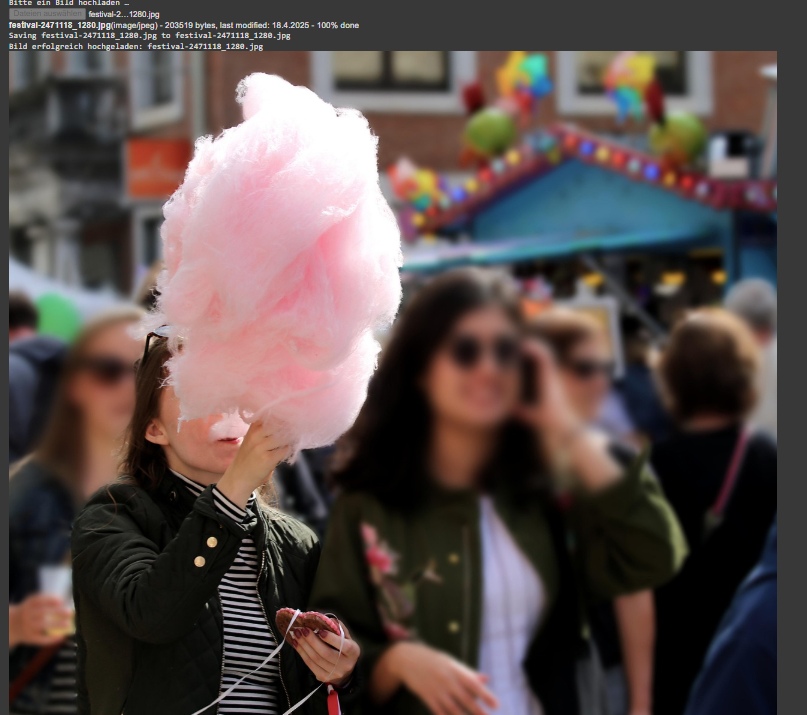
upload of image (image source: https://www.trumau.at/)
  1. Combined Request Architecture
    Unlike traditional multi-call pipelines, the new setup consolidates image and text interpretation into a single API request. This streamlined design prevents token overhead and ensures synchronized contextual understanding between categories. Each inference returns a structured Python dictionary containing three distinct analytical branches:
    • Objects – Recognizable entities such as animals, items, or people
    • Scene and Location Estimation – Environment, lighting, and potential geographic cues
    • Mood and Composition – Aesthetic interpretation, visual tone, and framing principles

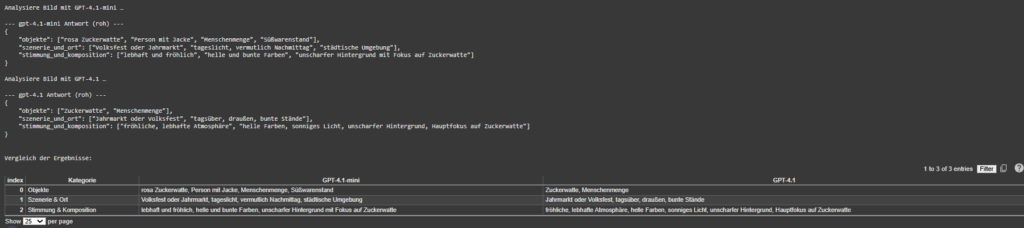
For each uploaded image, the analyzer prints three distinct lists per modelside by side. This offers a straightforward way to assess interpretive differences without complex metrics. In practice, GPT-4.1 tends to deliver slightly more nuanced emotional and compositional insights, while GPT-4.1-mini prioritizes concise, high-confidence object recognition.

results of the image object analysis and model comparison

Through the unified format, post-processing can directly populate separate lists or database tables for subsequent benchmarking, minimizing parsing latency and data inconsistencies.

  1. Robust Output Parsing
    Because model responses occasionally include Markdown code blocks (e.g., python {…}), the parsing logic was redesigned with a multi-layered interpreter using regex sanitation and dual parsing strategies (AST > JSON > fallback). This guarantees that even irregularly formatted outputs are safely converted into structured datasets without manual intervention. The system thus sustains analytical integrity under diverse prompt conditions.
  2. Model Benchmarking: GPT-4.1-mini vs. GPT-4.1
    The benchmark test compared inference precision, descriptive richness, and token efficiency between the two models. While GPT-4.1 demonstrates deeper contextual inference and subtler mood detection, GPT-4.1-mini achieves near-equivalent recognition accuracy at approximately one-tenth of the cost per request. For large-scale experiments (e.g., datasets exceeding 10,000 images), GPT-4.1-mini provides the optimal balance between granularity and economic viability.
  3. Token Management and Budget Simulation
    A real-time token tracker revealed an average consumption of ~1,780 tokens per image request. Given GPT-4.1-mini’s rate of $0.003 / 1k tokens, a one-dollar operational budget supports roughly 187 full image analyses. This insight forms the baseline for scalable experimentation and budget-controlled automation workflows in cloud-based vision analytics.

The next development phase will integrate this OpenAI-driven visual analysis directly into the Image Extender environment. This integration marks the transition from isolated model testing toward a unified generative framework.

Proseminar Task III

Title: Design System as a Service

Author: Qianfei Gu

University: Aalto University, School of Arts, Design and Architecture 

Year: 2021

Link to thesis: https://aaltodoc.aalto.fi/items/dd9f4b4b-f9f7-4f46-90d5-3d8db8ae0040

This thesis examines the evolution and current offerings of design systems in various organizations, highlighting their role in creating better digital products through reusable designs and guidelines. The thesis includes case study of the ABB CommonUX Design System, using qualitative and quantitative data gathered from user and creator interviews. Findings suggest that the complexity of an organization’s product portfolio and its design maturity significantly influence the services offered by design systems.

Overall presentation quality (Grade: 1)

    This thesis used a clear structure that was easy to follow. The reader is guided from surface-level general information to in depth and practical research. 

    Degree of innovation (Grade: 1)

    By conducting their own research the author proved a high grade of innovation. All findings and 

    Independence (Grade: 1)

    The author showed their independence clearly by referencing literature but also working together with the ABB CommonUX Team. By conducting clearly structured interviews and making 

    Organization and structure (2)

    In general the thesis was clearly structured. The page numbers were not noted in the table of contents. Especially for people that want to browse the thesis (like me) this was unfortunate. Having the table of figures and images at the start of the thesis irritated me. 

    Communication (1)

    The author used professional language, simple and effective structure, tables and figures when appropriate. 

    Scope (Grade 1)

    The work ranges over 150 pages. This is suitable when considering the spaced out formatting of the thesis. All research questions are answered in depth throughout the thesis and summarized accurately in the summary.

    Accuracy and attention to detail (Grade: 2)

    Tables and figures are labeled consistently. Unfortunately there are some page numbers missing.

    Literature (Grade: 1)

    The choses literature offers a broad spectrum from print to online media both very recent (from the time the thesis was published) to classic renowned relevant works from the start of service design.  

    No AI was used to write this text.

    Evaluating a Master Thesis: Ender Özerdem

    Ender Özerdem’s 2012 master’s thesis, Evaluating the Suitability of Web 2.0 Technologies for Online Atlas Access Interfaces, explores how participatory web features such as recommendations, user comments, and blogs can enhance online atlas usability. Through a prototype simulating an Austrian online atlas and usability testing with 30 participants, the study empirically assesses user reactions to these interactive elements. The results show that Web 2.0 functions can meaningfully improve user engagement and navigation, demonstrating both practical innovation and sound methodological execution.

    Overview

    Author: Ender Özerdem
    Title: Evaluating the Suitability of Web 2.0 Technologies for Online Atlas Access Interfaces
    Institution: Vienna University of Technology, Institute of Geoinformation and Cartography
    Supervisors: Univ.-Prof. Dr. Georg Gartner; Dipl.-Ing. Felix Ortag
    Year: 2012
    Length: ~80 pages + appendices
    Artifact: an interactive prototype of an online atlas of Austria (implemented as a clickable PDF simulating web interfaces) used for usability testing with 30 participants.

    Structure:

    1. Introduction
    2. Basics
    3. Map access methods
    4. Web 2.0
    5. Empirical evaluation
    6. Results
    7. Conclusions

    Evaluation

    Overall Presentation Quality

    The thesis is well-formatted and consistently structured, following scientific conventions. Figures, tables, and lists are clear and properly captioned. The bilingual abstract (English + German) is concise and accurately summarizes the aims, methods, and findings. Minor typographical inconsistencies exist but do not impede comprehension. Overall presentation quality is very good.

    Degree of Innovation

    The work tackles the novel (for 2012) question of how Web 2.0 interactivity—recommendations, comments, tag clouds, blogs, RSS—might enrich online atlases. This was a forward-looking intersection between cartography and web usability. The idea of combining usability testing with interactive atlas prototypes represents a meaningful contribution, though not groundbreaking at a theoretical level. The innovation lies primarily in applied integration of Web 2.0 principles into geographic interfaces.

    Independence

    Özerdem designed and executed the empirical evaluation, built the prototype interface, and conducted the usability tests autonomously. The methodological and implementation details indicate independent planning and execution under supervision. The inclusion of custom interface variants and a participant survey supports this.

    Organization and Structure

    The work is logically organized. Each chapter builds upon the previous: theoretical groundwork → analysis of existing systems → introduction of new technologies → empirical test → interpretation. The flow from problem statement to results is coherent. However, minor redundancies appear in the literature review (e.g., extended quotations from definitions).

    Communication

    The writing style is formal, clear, and mostly fluent. Definitions and literature are carefully integrated, though sentence structure occasionally reflects non-native phrasing. Visual materials (figures and screenshots) effectively support comprehension. Technical terminology is correctly used throughout.

    Scope

    The chosen topic, evaluating Web 2.0 features within online atlas interfaces, is handled with appropriate breadth and depth for a master’s level. The work balances theoretical exposition and empirical application effectively. The 70+ page length is proportional to the scope.

    Accuracy and Attention to Detail

    The text demonstrates careful referencing and accurate terminology in cartography and web technology. Tables and figures are labeled consistently. Only minor formatting inconsistencies (e.g., spacing, capitalization) occur. The methodology is described in enough detail to be replicable.

    Literature

    The literature review is broad and relevant, covering both classic cartographic sources (Bollmann & Koch; Kraak & Ormeling) and Web 2.0 theory (O’Reilly, 2005; Gartner, 2009). While comprehensive for its time, it lacks more recent (post-2010) empirical studies on user-generated mapping—an understandable limitation given the publication date. Citation style is consistent.

    The Prototype

    The prototype developed by Ender Özerdem effectively demonstrates the integration of Web 2.0 features, such as recommendations, user comments, and tag clouds, into an online atlas interface. Although implemented as a clickable PDF rather than a live web application, it is clearly structured, visually coherent, and sufficiently interactive for usability testing. The documentation provides detailed explanations of interface variants, user tasks, and testing procedures, ensuring transparency and reproducibility. Overall, the prototype successfully translates the thesis’s theoretical ideas into a practical, testable form and meets the expected standards of a master’s-level artifact.

    Conclusion

    In conclusion, Ender Özerdem’s Evaluating the Suitability of Web 2.0 Technologies for Online Atlas Access Interfaces (2012) is a well-structured and methodically robust thesis that effectively combines theoretical research with empirical testing. Despite the prototype’s limited technical scope and a modest sample size, the work shows strong independence, clear documentation, and valuable insights into enhancing online atlas interfaces through participatory web features. Overall, it demonstrates solid academic competence and practical innovation, meriting a ~2, 2+ evaluation.

    Powered by ChatGPT

    Proseminar Task III: Analysing a Master’s Thesis

    The thesis that I am analysing is titled “Exploring games to foster empathy” by Alice Blot (2017), which investigates empathy in games and explores how to create a game that fosters empathy.

    Production of the Artifact
    The thesis presents two interactive artifacts. The first is a mystery-style escape room for two players, where the goal is not to escape but to uncover and understand the personal stories of the characters. The second is a single-player interactive narrative that combines elements of LARP and escape rooms, allowing the player to take on a character role and progress through a story that unfolds both within and beyond the physical space. These artifacts are well documented in a dedicated chapter through written descriptions and photographs that explain the development and playtesting process. Although the prototypes themselves can only be partially accessed in the appendix, the documentation provides enough clarity for readers to grasp the concepts without needing additional context. The theoretical framework is clearly connected to the practical work, showing a consistent progression from concept to implementation. User scenarios and testing outcomes are presented in a direct and understandable way. While the artifacts effectively reflect the thesis’s main goal of exploring empathy through interactive design, the overall theoretical discussion remains somewhat limited. The concept of empathy, being complex and abstract, is not examined in great depth, which slightly weakens the level of academic criticality expected at the master’s level.

    Overall Presentation Quality
    The thesis is cohesive in structure and includes visuals that support understanding. However, minor inconsistencies, such as the informal tone in certain parts of the practical chapters, slightly reduce the level of professionalism expected at the master’s level.

    Degree of Innovation
    The topics explored in the thesis have been examined previously, but the combination of LARP elements with an escape room format to investigate empathy is original and engaging.

    Independence
    The author demonstrates autonomy in the design process. This is particularly evident in the iterative development of the prototypes, where changes were made based on feedback from playtesting participants.

    Organization and Structure
    The chapters are logically ordered and easy to follow. However, placing the design process and analysis earlier in the thesis might have created a clearer connection between the theoretical foundation and the artifact development.

    Communication
    The writing is understandable, but some sections would benefit from a more professional tone. Certain parts of the practical documentation contain redundancy or missing punctuation, which affects overall clarity.

    Scope
    The thesis maintains a balance between theoretical discussion and practical exploration. While the scope of both components is appropriate for a master’s project, certain theoretical sections would benefit from greater analytical depth, especially given the abstract nature of empathy as a research topic.

    Accuracy and Attention to Detail
    Attention to formal writing conventions, such as grammar, punctuation, and formatting, could be improved. There are sections with redundant phrasing and missing punctuation. These minor inaccuracies do not hinder understanding but affect the academic precision expected in a final thesis document.

    Literature
    The literature review includes relevant and somewhat recent sources for the time of publication. Although not comprehensive, it provides a useful foundation. The author also introduces her own set of parameters for empathy-driven game design, which shows initiative and original thinking.

    Overall Assessment

    Strengths

    • Innovative combination of narrative and spatial interaction to foster empathy.
    • Clear documentation of prototypes and design decisions.
    • Strong independence shown in the iterative design process.

    Weaknesses

    • The theoretical depth is limited, especially considering the abstract nature of empathy.
    • Some sections lack academic tone and precision.
    • The accessibility of the artifact is partial and relies heavily on interpretation.

    Conclusion
    Overall, this thesis offers an interesting and original contribution to the intersection of game design and emotional engagement. While it could benefit from deeper theoretical analysis and more critical discussion of empathy as a concept, the work is valuable for its creative approach and its emphasis on player experience as a medium for emotional understanding. It opens up important questions about how intangible concepts like empathy can be embedded into gameplay, not through winning conditions, but through storytelling, embodiment, and reflection.

    Proseminar Task: Analysing a Master’s Thesis

    Autorin: Armita Arvani

    Titel: Gefahrenpotentiale von Ladestationen im Öffentlichen Raum

    Erscheinungsjahr: Wien, 11.Sep 2022

    Hochschule: FH Technikum Wien

    Master: Master of Science in Engineering

    Quelle: search.obvsg.at/primo-explore/fulldisplay?docid=OBV_alma71577075630003331&context=L&vid=OBV&lang=de_DE&search_scope=OBV_HS&adaptor=Local Search Engine&isFrbr=true&tab=hs-tab&query=any,contains,”EV Charging” AND “Design”&offset=0


    I chose this master thesis because it helps me understand the problems with public EV charging stations. The work explains what dangers people face, like bad weather or mistakes when charging. It also shows what can happen if the technology is not safe, for example computer attacks. I am interested in how first-time users can learn about safe and easy charging.

    For my own research, I want to know how user experience can make charging simple and comfortable. This thesis gives me ideas about what people need to feel safe and what city planners should think about when designing stations.

    Gestaltungshöhe

    The has a clear and logical structure. The first part gives a good overview of the topic and explains the background with careful research and useful literature. After that, the thesis moves on to interviews and qualitative research, which makes the work practical and realistic. I noticed several writing mistakes and incomplete sentences, for example on page 46 where a sentence about expert interviews is not finished. Still, the author connects the theory with practice in a good way and always explains the reasons for each research step. Even though there are some language problems, the thesis is strong in showing new ideas and gives good insight on how EV charging stations can get better for everyone in the future.

    Innovationsgrad

    The thesis brings several new ideas to the field of public EV charging stations. It focuses on the risks and dangers of charging stations in cities—this is a topic that is not often covered in other research, as most studies look more at technical charging details or grid integration. By analyzing not only technical risks but also including cyber attacks, vandalism, and user safety, the thesis gives a full and modern view on current and future problems.

    The thesiss is valuable for the field because it asks important questions about safety and public acceptance and helps others understand what needs to be improved for EV charging in cities.

    Selbstständigkeit

    The thesis shows clear signs of independent work by the author. The approach is original because the author combines existing research with own interviews and qualitative analysis, giving a fresh view on the topic. The thinking is logical and focused, with the author consistently explaining why each part is important for understanding the risks of public EV charging stations. Even though some language mistakes appear, the work reflects the author’s own understanding and perspective rather than just repeating others. Overall, the thesis demonstrates good self-reliance and a clear, structured way of thinking.

    Gliederung und Struktur

    The structure of the thesis generally follows a logical order, which fits the topic and research questions well. It starts with a literature review and background information, which sets the stage for the later parts. Then it moves to interviews and qualitative research to collect original data. However some transitions between chapters could be smoother and a clearer summary at the end of each section would improve readability and help the reader connect the parts better. Also, occasional language mistakes and unfinished sentences disrupt the flow and make some sections harder to follow. Overall, the structure suits the research but could benefit from better coherence and polishing for full clarity.

    Kommunikationsgrad

    The Author communicates the topic most clearly, but there are some small problems with expression and flow that affect overall understanding. The language is generally precise and uses appropriate technical terms and also some informationsgraphics but occasional grammatical errors and unfinished sentences reduce the reading flow.

    Umfang der Arbeit

    The length of the thesis is mostly appropriate for the topic and provides a balanced view of different aspects. However, it could focus more specifically on answering the research question in detail, as some points are only listed without full exploration or conclusion. Overall, it fits well but would benefit from deeper analysis on key questions

    Orthographie, Sorgfalt und Genauigkeit

    The thesis contains some spelling and grammatical errors, which show that the language was not always carefully checked. The writing is not always precise or formal enough for a scientific work, and this reduces the overall professionalism and accuracy. However, these mistakes do not completely block understanding.

    Literatur

    The thesis uses a good mix of sources, including relevant books, scientific articles, and industry reports, not only internet websites. The literature is mostly current and covers important topics to support the research. However, some newer publications could be added to strengthen the up-to-date nature of the work. Overall, the sources seem sufficient and well chosen for the research focus, showing a solid and comprehensive bibliographic foundation.

    Final thoughts

    It provides important insights into the risks and safety challenges of public EV charging stations which is very usful for my own research on user experience and onboarding. The combination of theoretical background and practical interviews creates a solid basis, even though the work could be improved in language and deeper focus on the research question. From this thesis I take the understanding that safety and clear communication are the key to designing better charging station that are easy and safe.

    Personal Rating

    Armita Arvani did a good amount of work for the thesis but worked a bit superficially. I really liked her choice of experts for the interviews and she made an effort to find people very relevant to the field. She connected theory well with empirical research to find solutions, but I think the answers to the research questions could have been deeper. Also, the thesis lacked pictures/illustrations/graphics that could help understand the topics and the answer to the forschungsfrage better. I would have liked to see some data or numbers, so a bit of quantitative approach would have been good too. The language could be better. Overall, I would rate this work as a minus 2.

    Proseminar Task: Analysing a Master’s Thesis

    The master’s thesis with the title “Overtourism destination: Finding the positive message in overtourism DMOs social media” (Limbu, 2022), which was published in 2022 by Dil Kumar Limbu at the Faculty of Social Sciences and Business Studies at the University of Eastern Finland, analyses how destination marketing organisations (DMOs) deal with the issue of overtourism in their social media marketing, especially on Facebook. 
    The thesis makes a qualitative analysis of two different DMO Facebook accounts; Visit Reykjavik and I Amsterdam, over the course of a year.

    Unfortunately, the thesis was not created alongside a workpiece, which could have been used to dive deeper into the topic. Generally, I would have hoped to find a more design-heavy thesis on the topic, but did not succeed unfortunately, which is why this analysis focuses more on how the scientific background and analysis of media content could look.

    Overall presentation quality

    Scientifically, the thesis fulfils a fairly high standard with a well-reasoned methodology and a thorough overview of the most important scientific backgrounds as well as a comprehensive presentation of the current knowledge pool. All this information is presented in a well-structured manner that is easy to follow. 

    Degree of innovation

    While part of the thesis was used to sum up and explain existing ideas and terms in marketing and tourism, the main core of Limbu’s work could be considered innovative, for connecting the topics social media marketing and overtourism as well as for deducting an independent in-depth analysis of Facebook posts. 

    Independence

    This also speaks for the student’s independence, seeing as the research conducted has not been done in this way before, meaning a completely new and independent analysis structure had to be developed. 

    Organization and structure

    The thesis is structured into an introduction, explaining the background, objective and approach of the study, a main part where different terms and ideas around marketing, social media in tourism and over-tourism are explained, then a methodology part talking more about the conducted analysis and an in-depth discussion of the results as well as a conclusion, summarising the whole thesis and taking a look into the future. 

    Communication

    Overall, the thesis is well structured, however, concerning the quality of the written text I found the language to be a bit lacking at times, with some sentences being either grammatically wrong or too vague to properly grasp the conveyed idea. This sometimes made it difficult to follow the point made and was generally detrimental to the effectiveness of the communication. 

    Scope

    For each of the chapters, an appropriate and balanced number of pages was allocated, leading to the feeling that the thesis had an appropriate length and scope for the treated topic. With a page number of around 50, the scope also seems appropriate for a master’s thesis. 

    Accuracy and attention to detail

    As I have mentioned before, the attention to detail was focused more on the scientific work and the discussed results, and less so on the linguistic finetuning of the text. While the scientific content is arguably very important, it is unfortunate when the style of the written text distracts from the actual content instead of properly supporting the scientific results. 

    Literature

    The thesis includes an 8 page long, comprehensive literature list, which to the best of my knowledge includes a well-balanced mixture of articles, books and various webpages. While I have not checked each and every one of these sources, the ones I looked up all seemed to be of appropriate quality and credibility for usage in a master’s thesis. 

    Conclusion

    The thesis I chose to evaluate was unfortunately not written in the field of media, which is why there was no workpiece to analyse and the overall style and focus of the work might not have been what will be expected from our theses. Nonetheless, I found it interesting to see how another student from another field has approached and analysed the topic of media and overtourism, or at least part of it. The scientific work in the thesis seems to be sound and very thoroughly conducted, leading to newly synthesised information. However, one of the weak points of the thesis for me was the linguistic style and some of the errors made, which impeded the reading flow whilst analysing the thesis. Nonetheless, the thesis certainly fulfils a high scientific standard and provides valuable information on the topic. 

    Literature

    Limbu, D. K. (2022). Overtourism destination: Finding the positive message in overtourism DMOs social media.

    Evaluation Academic theses

    Autor: Marius Lessiak 
    Titel: Interaktionsdesign in Webapplikationen 
    Jahr: 2007 
    Institution: Technische Universität Wien, Fakultät für Informatik 
    Betreuung: Ao. Univ.-Prof. Dr. Gerald Steinhardt, Univ.-Ass. Dipl.-Ing. Dr. Hilda Tellioglu 
    Typ: Diplomarbeit 

    Zugänglichkeit: Original in der Hauptbibliothek der TU Wien 

    Oder 

    https://repositum.tuwien.at/bitstream/20.500.12708/14588/2/Lessiak%20Marius%20-%202007%20-%20Interaktionsdesign%20in%20Webapplikationen.pdf

    Struktur: 

    1. Einleitung 
    1. Usability 
    1. Interface & Interaktion 
    1. Entwicklung des Interaktionsmodells 
    1. Implementierung 
    1. Evaluierung 
    1. Zusammenfassung & Ausblick 

    Artefakt: 

    Die Arbeit enthält ein eigenständig entwickeltes Interaktionsmodell für Webapplikationen, das mithilfe aktueller Webtechnologien (AJAX, DOM, JavaScript) in einer funktionierenden Anwendung („Zeitspur“) umgesetzt und technisch evaluiert wurde. 

    1. Overall Presentation Quality 

    Die Arbeit ist klar gegliedert, sauber formatiert und sprachlich konsistent. Tabellen, Abbildungen sowie Diagramme werden sorgfältig eingesetzt und mit Quellen belegt. Grundsätzlich eine gute wissenschaftliche Aufbereitung, wenn auch mit älterem Layout-Standard. 

    2. Degree of Innovation 

    Wenn meine Recherche richtig ist, war zum Zeitpunkt der Verfassung (2007) AJAX ein relativ neues Paradigma. Die Verbindung von Interaction Design Principles mit der technischen Realisierung einer Webapplikation ist innovativ und interdisziplinär gedacht. Eine Arbeit die einen hohen Innovationsgrad durch theoretisch fundierte Modellbildung und experimentelle Umsetzung aufweist.  

    3. Independence 

    Marius Lessiak zeigt deutlich Eigenständigkeit in der Entwicklung des Interaktionsmodells und seiner technischen Umsetzung. Die Arbeit geht über eine reine Literaturstudie hinaus und verbindet Theorie mit einem realen Prototyp. 

    4. Organization and Structure 

    Die Arbeit folgt einer klaren, nachvollziehbaren Logik: Von den theoretischen Grundlagen über Usability und HCI bis zur Entwicklung und Evaluation. Querverbindungen zwischen Theorie und Praxis sind deutlich erkennbar, wenn auch stellenweise etwas textlastig. 

    5. Communication 

    Sprache und Stil sind präzise und sachlich, mit hohem wissenschaftlichem Anspruch. Englischsprachige Fachliteratur wird korrekt eingebunden. Die Formulierungen sind klar, teilweise etwas technisch-nüchtern. 

    6. Scope 

    Die Arbeit bewegt sich in einem angemessenen Umfang (~65 Seiten Text + Visualisierungen). Sie deckt sowohl theoretische Tiefe (HCI, Design Patterns) als auch praktische Breite (AJAX, DOM) ab. 

    7. Accuracy and Attention to Detail 

    Quellen sind sorgfältig zitiert, Fachbegriffe korrekt verwendet, Diagramme (UML, Hypertext-Strukturmodelle etc.) präzise ausgeführt. 

    8. Literature 

    Die Literaturbasis umfasst zentrale Arbeiten aus der HCI-Forschung (Cooper, Shneiderman, Beaudouin-Lafon) und relevante technische Quellen (AJAX, DOM, W3C). Für 2007 ist der Stand aktuell und wissenschaftlich solide. 

    Beurteilung des Artefakts 

    Dokumentation: 

    Das Artefakt („Zeitspur“) ist detailliert beschrieben, mit Diagrammen. Die Dokumentation erlaubt ein gutes Verständnis der Funktionsweise. 

    Zugänglichkeit: 

    Das System war als funktionsfähige Webapplikation umgesetzt, die Interaktionsprinzipien konkret veranschaulicht. Zugang erfolgt theoretisch über TU Wien-Bibliothek (kein Link zu Live-System). 

    Theorie–Praxis-Verknüpfung: 

    Sehr stark. Das entwickelte Modell wird nicht nur theoretisch erläutert, sondern praktisch umgesetzt und technisch evaluiert. 

    Qualität des Artefakts: 

    Für mich wirkt es sehr anspruchvoll, sowohl technisch als auch gestalterisch niveauvoll für den damaligen Stand. 

    Gesamturteil 

    Stärken: 

    • Exzellente theoretische Fundierung (Verbindung HCI ↔ Webtechnologie) 
    • Eigenständiges Interaktionsmodell 
    • Klare, logische Struktur 
    • Fundierte Evaluation 
    • Solide wissenschaftliche Sprache 

    Schwächen: 

    • Begrenzte empirische Evaluation (Fokus auf technische, nicht auf Nutzerstudien) 
    • Text teilweise zu detailverliebt in technische Aspekte 
    • Gestaltung/Visualität des Artefakts könnte stärker diskutiert werden 

    Marius Lessiak liefert eine inhaltlich und methodisch überzeugende Diplomarbeit, die den Stand der Webentwicklung Anfang der 2000er-Jahre reflektiert und ihn mit HCI-Theorien verbindet. Das Werk zeigt, wie Interaktionsdesign strategisch und technisch zusammengedacht werden kann. Ein Beitrag, aus dem man heute noch methodisch relevantes Wissen beziehen kann. 

    Evaluation of a Master’s thesis

    Autor: Matthias Müller, BSc
    Titel: Applying Service Design on Free Open Source Software (FOSS)
    Erscheinungsjahr: 2017
    Hochschule: Graz University of Technology
    Master: Software Development and Business Management
    Quelle: https://repository.tugraz.at/publications/yq1qq-qwe76

    This master’s thesis takes a closer look at how open-source software projects actually work. While open-source tools are built “by users, for users” and have changed the tech world in many ways, their success often depends on more than good code. The author uses service design methods to explore the Austrian open source project “Catrobat”, mapping everyone involved, their roles, and how they work together. The goal is to find out what helps or holds back open-source projects and how better collaboration and understanding can lead to more innovation long-term success.

    Presentation quality 

    Overall, the master’s is well made, the layout is simple yet fitting, since the layout itself probably wasn’t part of the scope. Simple paragraphs, some graphics and pictures, highlighted quotes, nothing special, although you could find some gaps in the text due to the full justification. Long, bloated sentences and swollen language make the text difficult to read. But the arguments made follow a logically form, from explaining the open-source context to applying service design tools.

    Degree of innovation & independence

    What stood out to me is how service design is connected to the world of open-source software, since any design practices are usually hard to be implemented into open source projects. The work shows a high level of independence, especially in how the author adapts existing design tools to fit the unique dynamics of Catrobat. Although making assumptions for the whole world of open source might be a bit farfetched, since open source projects can be very different, not only in size but number of users, supporters or funders, distribution channels and much more. Meaning this is a great case study but doesn’t really contribute to making the open source more design friendly.

    Organization and structure 

    The thesis is well structures, although sometimes hard to understand. The author is very thorough, service design & Catrobat are both very well defined and explained. Before using a service design tool, the author explains the reason for using it first, explains the process, shows the results and their conclusion in the end. The flow of the work seems natural, and additionally the usage of graphics and pictures, as well as bullet points really help to clarify.

    Communication 

    Like I have said before, the language is hard to understand, or in other words very academic. However, this might just be due to my background being in design and not more science driven studies, like computer science or information technology. In the eyes of a student of the technical university of Graz, the tone might be common.

    Scope 

    The topic is handled with an appropriate level of detail overall, although personally I would have pot emphasis on different topics, as the author did. Catrobat is explained in a lot of detail, while user research or testing of proposed improvements fell short, although those are key elements of servicer design.

    Accuracy and attention to detail 

    Citations are well made, if they are taken word by word, they are visually different from the rest of the text. Footnotes as well as inline citations are flawless and all figures are accurately described. I also couldn’t find any grammar or spelling mistakes, luckily writing software like microsoft word gets better at catching those mistakes.

    Literature 

    The literature review is solid, with relevant sources from design, service research, and technology studies. It combines classic design theory with more recent publications about open collaboration. The references are well integrated and show that the author understands the academic conversation around the topic

    My personal reason to pick out a master’s thesis like this one was to get a better grasp on open source in general, since I want to write my thesis about the same topic, although with a different scope. I used this exercise to get more insight into the opinions of non designers working on open source software. But as I pointed out, grasping the topic and the conclusion was hard, due to me not being able to understand and comprehend the way sentences were written.

    Disclaimer:
    This blog post was supported by AI (ChatGPT) to help with structuring and phrasing.