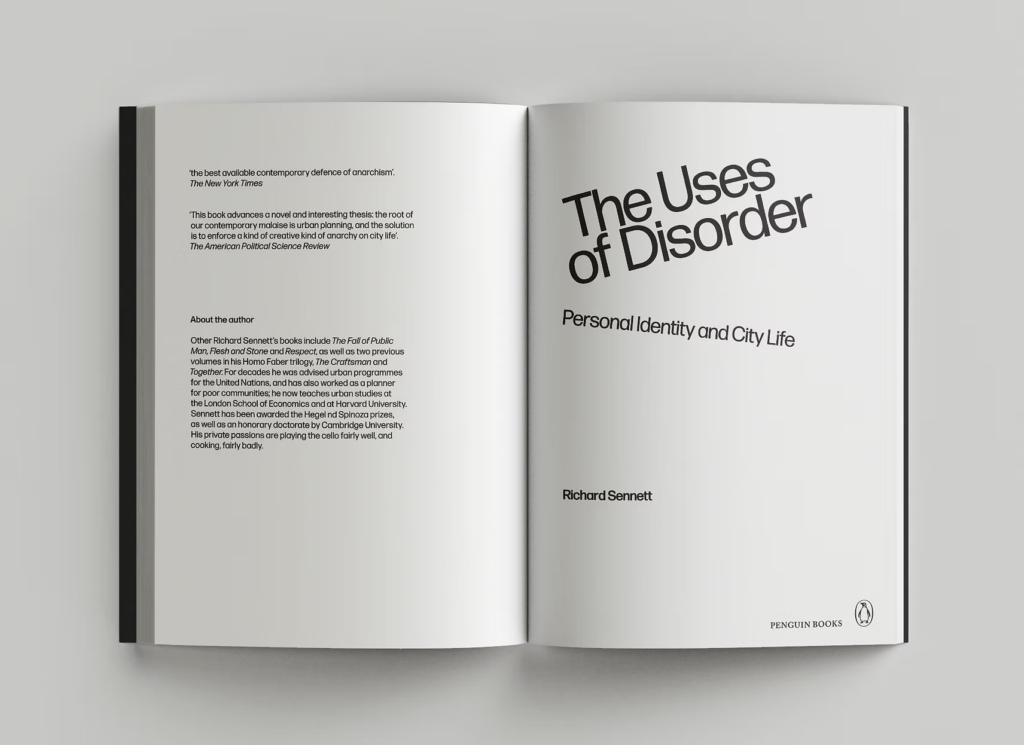
Lately I’ve been reading The Uses of Disorder by Richard Sennett, and even though I’m not finished yet, I already know it’s going to be important for how I shape my thesis. Mostly because my topic keeps circling around CHAOS not chaos as “everything is broken,” but chaos as something productive, alive, even necessary. And Sennett basically walks straight into that uncomfortable zone and says: maybe the problem isn’t disorder. Maybe the problem is how obsessed we are with getting rid of it.
The book was written as a critique of this dream of the perfectly planned, perfectly ordered city, the kind of place where everything is smooth and controlled and “safe,” but in a way that also flattens life. Sennett argues that overly ordered communities can become stagnant, because order can turn into avoidance: avoidance of difference, avoidance of conflict, avoidance of anything that might force you to grow.
What I find interesting is that he doesn’t talk about disorder like it’s a cute aesthetic. He’s not romanticising mess. He’s talking about it as something that can actually do work on a person. Like friction. Like a training ground. His point (at least how I’m understanding it so far) is that development doesn’t come from living in a bubble. It comes from being confronted with complexity, with other people, other values or other realities you can’t control.
One of the ideas that keeps sticking in my head is his critique of “purified” communities. Spaces built around sameness, where everything feels predictable. The way he frames it, these environments aren’t neutral. They’re a choice. And they’re often a choice made possible by privilege: if you have enough resources, you can design your life to avoid discomfort. You can separate yourself from anything messy. You can curate your surroundings until you barely have to deal with surprise.
And then I keep thinking… what does that mean for design?
Because design can easily become part of that “purifying” impulse. Even in the nicest, most well-intentioned way. We design systems to reduce uncertainty. We design environments to be seamless. We design experiences that remove friction. And sometimes that’s good but sometimes it feels like we’re also designing out the parts where people actually change.
Reading Sennett makes me ask: When does “making things easier” turn into making things less real? When does smoothing everything out become a way of avoiding growth?
This is where it starts connecting to my own obsession with chaos. Not because I want everything to be chaotic. But because I’m starting to see chaos as a condition for meaning. Like: if everything is too controlled, everything becomes the same. You stop noticing. You stop feeling. You stop having those moments where something interrupts you and you have to re-orient yourself.
Also, maybe this is the biggest thing the book is giving me right now: permission to not immediately “solve” chaos. To not treat disorder as a design failure. To treat it as information. As something you can work with instead of against.
I’m still in the middle of the book, so I don’t want to pretend I’m summarising it perfectly. But I can already tell it’s reshaping the way I think about cities, communities, and creative practice and honestly, it’s making me more suspicious of anything that looks too organized.
Links:
https://www.paulstewartdesign.co.uk/the-uses-of-disorder
https://www.versobooks.com/en-gb/products/2810-the-uses-of-disorder?srsltid=AfmBOoqcJ_Up1gbzIwcqjeYxPyC983siGmJnnOm5moLjHgr6Zbzdk7O0
