#9 The Role of the Audience within an Installation

In installation art, the physical presence of the viewer is not optional but it is essential. Ilya Kabakov famously stated that “the main actor in the total installation is the viewer; they are the center toward which everything is directed.” This focus on the viewer, however, often leads to a paradox: instead of being placed at a privileged point, the viewer is physically decentered. There is no single, ideal position from which the work can be fully understood. Meaning emerges only through movement within the space (Bishop, 2005). Another key aspect of installation art is duration. While a painting often suggests an instant or timeless moment, an installation requires time. The viewer must walk through it, pause, return, and explore. In this sense, installation art shares qualities with theater or film, yet differs in one crucial way: the visitor remains autonomous. They choose their own path, pace, and length of engagement (Zhihan Ren, 2025).

Contemporary museums increasingly respond to these demands with dynamic exhibition design. Static white walls are replaced by flexible and mobile elements that can adapt to movement and interaction. A notable example is the exhibition Homo Ludens where visitors were able to change the spatial setup themselves using mobile devices. Architecture becomes a “living” part of the experience, something that reacts and evolves through human presence.

Technological developments have further expanded these possibilities. Hereby immersive exhibitions today often use:

  • High-resolution projection mapping, allowing images to be projected precisely onto irregular surfaces such as columns or curved walls, making architecture appear fluid or unstable (Johnson, 2025a)
  • Spatial sound systems, with multiple speakers creating soundscapes that move around the visitor and envelop them acoustically (Johnson, 2025a)
  • Haptic feedback, such as vibrating floors or handheld controllers, which add a tactile layer to perception (Johnson, 2025a)

These technologies are not meant as pure spectacle. Their goal is to intensify emotional and sensory engagement and to encourage visitors to reflect on their own perception and their relationship to the surrounding world.

Richard Serra and Time as Matter

Richard Serra’s monumental installation The Matter of Time (2005) in the Guggenheim Museum Bilbao is one of the most radical explorations of space, time, and bodily experience. Installed in the 130-meter-long, column-free gallery, the work consists of eight massive Cor-Ten steel sculptures that activate the entire space (Johnson, 2025b).

Rather than presenting individual objects, Serra creates an environment that unfolds through movement. The viewer becomes the subject, and meaning is produced through walking.
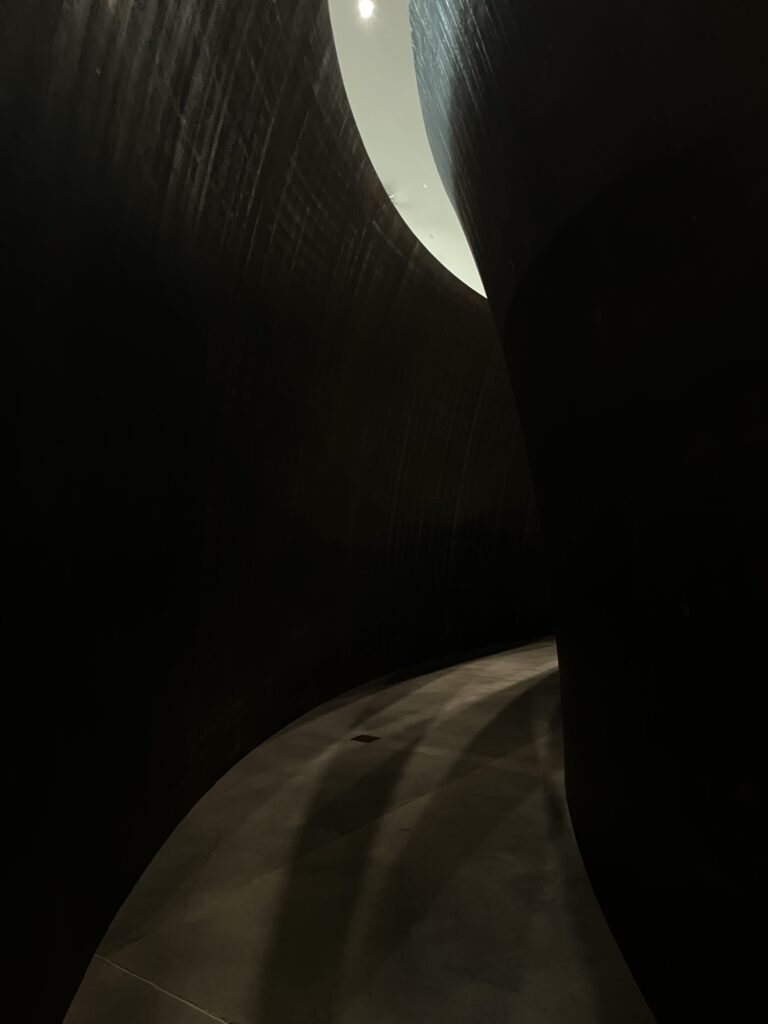
  • Physical disorientation: The tilted and curved steel walls create a constant sense of imbalance. Scale and orientation shift continuously, challenging spatial perception.
  • Proprioceptive awareness: Moving through narrow passages makes visitors more aware of their own bodies, their breathing, rhythm, and physical limits. The acoustics of the steel amplify footsteps and ambient sounds, intensifying feelings of isolation or compression.
  • Time as material: The title emphasizes that time itself is sculptural. Each form leads to the next, subtly altering the visitor’s orientation in relation to the museum architecture.

Serra’s approach is influenced by his study of Japanese Zen gardens, which he understood as spatial fields that can only be experienced through movement. In Bilbao, Frank Gehry’s architecture functions as a resonant shell around the sculptures, creating a quiet, almost meditative space where perception slows down.

Olafur Eliasson and Perceiving Perception

Olafur Eliasson places the viewer at the absolute center of his work. His installations often function as tools that invite visitors to step back and reflect on their own actions and sensory processes. Eliasson frequently works with natural elements such as light, fog, water, and ice to heighten sensory awareness. Blurring subject and object: In Your Imploded View (2001), a polished aluminum sphere reflects the surrounding space but distorts it so strongly that viewers see themselves from unfamiliar perspectives. The artwork no longer dominates; instead, a dialogue emerges between observer and object (Malone, 2007).

  • Individual experience: Eliasson’s frequent use of the word “Your” in his titles emphasizes that meaning is personal and shaped by memory, expectation, and physical position.
  • Collective awareness: At the same time, these highly subjective experiences make visitors aware of others sharing the space. Being surrounded by fog or light creates temporary communities and encourages reflection on social responsibility.

A clear example is Beauty, where a rainbow appears through light and fine mist. The rainbow is only visible from a specific angle and exists solely in the act of seeing. Here, the viewer does not just observe the image but actively produces it through their position in space.

Installation art shifts the focus away from the artwork as an isolated object and toward experience as a process. Movement, time, and bodily presence are not secondary effects but core components of meaning. Whether through massive steel structures or fragile light phenomena, these works demand active participation and awareness. Rather than offering clear messages, they create situations in which perception itself becomes unstable, and it is precisely within this instability that reflection begins.

Bibliography

Bishop, C. (2005). Installation Art. Tate Publishing. https://www.scribd.com/document/463827422/Installation-Art-Claire-Bishop-pdf

Johnson, F. (2025a, September). Immersive Art Museum: A Deep Dive into Digital Experiences, Future Trends, and Visitor Engagement. Wonderful Museums. https://www.wonderfulmuseums.com/museum/immersive-art-museum/

Johnson, F. (2025b, November). Richard Serra Guggenheim Museum Bilbao: Exploring the Monumental Steel Sculptures Within Frank Gehry’s Architectural Masterpiece. Wonderful Museums. https://www.wonderfulmuseums.com/museum/richard-serra-guggenheim-museum-bilbao/

Malone, M. (2007, December). Ólafur Eliasson, Your Imploded View, 2001. Mildred Lane Kemper Art Museum. https://www.kemperartmuseum.wustl.edu/learn/learning-resources/eliasson-olafur-your-imploded-view-2001/type/essays

Zhihan Ren. (2025). When the Black Box Meets the White Cube: Spatial Shifts and Postdramatic Aesthetics in Performance Art. ResearchGate. https://www.researchgate.net/publication/392611552_When_the_black_box_meets_the_white_cube_spatial_shifts_and_postdramatic_aesthetics_in_performance_art

#8 Experiencing Installation Art

Over the past decades, contemporary art has shifted away from purely object-based works towards more spatial and experiential forms. Installation art plays a key role in this development. Instead of presenting an artwork as an isolated object, installation art places the viewer directly within the work (Bishop, 2005). The viewer is no longer a distant observer, but an active and physically present part of the artwork. This shift changes how meaning is created. Experience is no longer limited to visual perception, but includes space, movement, and time. Walking through an installation, staying within it, or changing position all influence how the work is perceived by the visitor. Meaning therefore comes through presence and duration rather than through visual observation alone (Lennon, 2025). 

The main difference between traditional object-based art and installation art lies in how the viewer is addressed and how physical space is used. Classical artworks such as paintings or sculptures function as closed objects that are observed from a distance. The viewer remains outside the work and engages with it mainly through vision. Sculptures often emphasize control over material such as marble, bronze, or wood. They are usually placed on pedestals, which separate them from the everyday space of the viewer and maintain a clear distance between artwork and audience (Bishop, 2005). In installation art, space itself becomes an active part of the work. A room filled with colored light is no longer just a container for art, but the artwork itself. The work exists as a unified whole in which objects, spatial proportions, light, and sound are closely connected. This shift from object-based aesthetics to situational experience fundamentally changes perception. The viewer is no longer a detached observer, but a physically present subject whose senses are engaged beyond sight, including sound, touch, and spatial awareness (Kadari Art Gallery, n.d.).

In her critical history of installation art, Claire Bishop describes four main modes of experience. Each of them shows a different understanding of the viewer and their role within the artwork.

Phenomenological experience

This mode is based on the philosophy of Maurice Merleau-Ponty and focuses on the lived body as the main site of perception. The viewer is not an analytical observer, but an active participant who experiences the work through movement, presence, and bodily awareness. The boundary between subject and object becomes less clear (Mildred Lane Kemper Art Museum, n.d.).

Psychological experience

Drawing on psychoanalytic ideas by Sigmund Freud, some installations aim to disturb the viewer’s sense of stability or address deeper psychological layers. Concepts such as the uncanny or unconscious impulses are used to create emotional tension or discomfort (Bishop, 2005). 

Political activation

In this mode, audience participation is understood as a tool for social and political engagement. The active involvement of the viewer is seen as an alternative to the passive consumption encouraged by mass media such as television or film.

Decentering of the subject

This approach challenges the idea of a single, fixed viewpoint. The viewer is confronted with multiple perspectives, which undermines hierarchical models of vision, such as those established by Renaissance perspective (Bishop, 2005).

Among these modes, the phenomenological perspective is especially important. It focuses on the awareness of one’s own body, movement, and position in space. This bodily awareness plays a key role in how installation art is experienced. Studies show that when viewers are physically involved and aware of their presence, the emotional impact of the artwork becomes much stronger.

The development of installation art is closely linked to a critique of the traditional exhibition space known as the “White Cube.” This model, described by Brian O’Doherty, refers to modern gallery spaces with white walls, neutral lighting, and little reference to the outside world (Zhihan Ren, 2025). The goal of the White Cube is to present artworks as timeless and objective, as if they exist outside of history, place, or social context. In this setting, architecture is not a neutral background. It functions as an invisible frame that shapes how viewers engage with the artwork. Installation art challenges this framework. Instead of being confined to a single object, the work extends into the surrounding space. Walls, floors, and the viewer’s position become part of the artwork itself. As a result, viewers are forced to constantly question where to stand and how to move within the space.

In contrast, the “Black Box” offers a highly controlled environment that originates from theatre and cinema. Here, darkness, light, sound, and movement are carefully directed to guide attention and emotion. In contemporary practice, these two models increasingly overlap and form what is often described as a “Grey Zone.” This hybrid space appears when performative works enter museum contexts or when media installations combine the openness of the White Cube with the controlled atmosphere of the Black Box.

Within this Grey Zone, the viewer often becomes an incidental performer. Their movement through the space is no longer random, but part of the overall structure of the work. The experience emerges through presence, movement, and interaction with the spatial setting.

To conclude installation art fundamentally changes the relationship between artwork, space, and viewer. Instead of observing from a distance, the viewer becomes an active part of the work through movement, presence, and sensory engagement. By involving the body and multiple senses, installation art shifts perception from visual observation to spatial and embodied experience. Overall, installation art positions the viewer not as a passive observer, but as a participant whose presence is essential to the work itself.

Bibliography: 

Bishop, C. (2005). Installation Art. Tate Publishing. https://www.scribd.com/document/463827422/Installation-Art-Claire-Bishop-pdf

Kadari Art Gallery. (n.d.). Exploring the Boundaries: Installation Art vs Traditional Sculpture. Retrieved https://kadariartgallery.com/blogs/news/exploring-the-boundaries-installation-art-vs-traditional-sculpture

Lennon, B. (2025). How contemporary installation art uses space, site and scale to create a phenomenological experience for viewers [Master’s thesis, Institute of Art, Design + Technology]. https://hdl.handle.net/10779/iadt.30601340.v1

Mildred Lane Kemper Art Museum. (n.d.). Olafur Eliasson: Your Imploded View (2001). Retrieved https://www.kemperartmuseum.wustl.edu/learn/learning-resources/eliasson-olafur-your-imploded-view-2001/type/essays

Zhihan Ren. (2025). When the Black Box Meets the White Cube: Spatial Shifts and Postdramatic Aesthetics in Performance Art. ResearchGate. https://www.researchgate.net/publication/392611552_When_the_black_box_meets_the_white_cube_spatial_shifts_and_postdramatic_aesthetics_in_performance_art