Impulse #7: The Manual for My Hörtner-Inspired Pivot

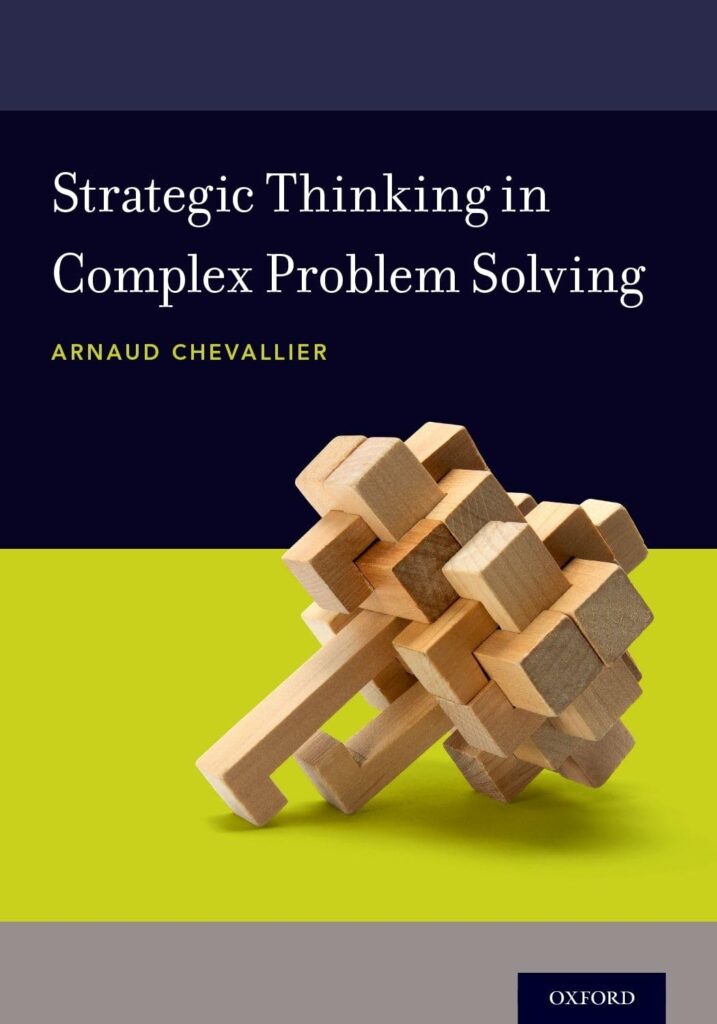
It’s funny how things come full circle. After my transformative talk with Horst Hörtner about strategically tackling my Master’s thesis, I immediately went looking for resources to solidify that new way of thinking. Lo and behold, a book I’d previously added to my maybe later-list suddenly shot to the top: Strategic Thinking in Complex Problem Solving by Arnaud Chevallier. Diving into it now, it feels less like a new read and more like a detailed instruction manual for the approach Horst outlined.

From Vague Notion to Strategic Framework

My biggest takeaway from Horst was the concept of moving beyond just liking a topic or disliking a problem, and instead using those intuitions as strategic starting points. Chevallier’s book is essentially the blueprint for that process. It doesn’t just tell you to think strategically, it shows you how.

The core connection lies in how Chevallier tackles problem framing. Before I spoke with Horst, my approach was probably typical: identify a broad area, then try to force a research question into it. Now, with Horst’s guidance and Chevallier’s detailed steps, I’m learning to:

  1. Deconstruct: Break down the big, messy problem (like ocean plastic) into its fundamental components.
  2. Analyze: Identify the specific lever points where my current knowledge can actually make an impact.
  3. Synthesize: Reassemble these components into a clear, actionable research question.

It’s a methodical process that directly addresses the collect and form strategy Horst talked about, helping me organize those scattered thoughts into a logical attack plan.

The Power of Issue Mapping

One of the most impactful tools in Chevallier’s book for me has been Issue Mapping. This technique directly mirrors Horst’s advice to look at both what fascinates me and what I want to change. Instead of just holding these ideas in my head, Issue Mapping forces me to visually lay out:

  • The main question/problem: What exactly am I trying to solve?
  • The sub-questions: What smaller questions need to be answered to address the main one?
  • The hypotheses: What are my initial educated guesses or potential solutions?

This is exactly what I needed after those stressful weeks. It transforms the overwhelming feeling of a complex problem into a structured, navigable diagram. It’s like building a custom roadmap, where each turn represents a sub-problem, and each destination is a potential research outcome.

Aligning Knowledge with Leverage

The most practical part of Chevallier’s book is the focus on leverage. Horst challenged me to use my current knowledge. The framework helps me map my skills (like web development, prototyping, or systems design) against the sub-questions in my logic tree.

If I find a sub-question that is both a high-impact friction point and perfectly aligns with my technical portfolio, that’s the sweet spot for my thesis. It takes the guesswork out of the pivot. I’m no longer choosing a topic because it sounds cool. I’m choosing it because the logic tree proves it’s the most effective use of my skills to solve a problem I actually care about.
Impulse #1: Affective Computing, Rosalind W. Picard

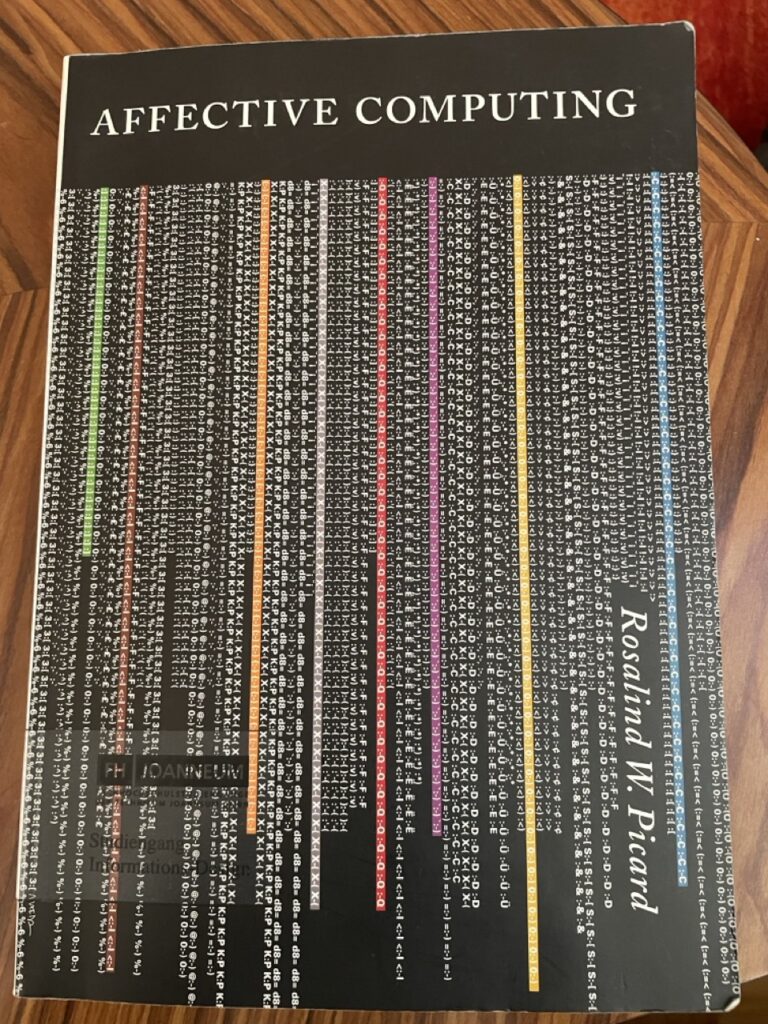
The work Affective Computing by Rosalind W. Picard from the year 2000 proposes a fundamental paradigm shift in computer science, challenging the traditional view that intelligent machines must operate only on logic and rationality. Picard’s work provides a comprehensive framework for the design of computational systems that relate to, arise from, or influence human emotions.

In Interaction Design we want interfaces that are easy to use and look good. We spend our time while working on projects thinking about usability, efficiency and aesthetics. For us in design, this means a functional interface isn’t enough anymore. If a system doesn’t register that a user is confused or frustrated, it’s not truly successful. Picard essentially launched a new field dedicated to building technology that can sense, interpret, and respond to human emotional states.

Adaptive Interfaces enhanced by Computer Vision Systems

A central connection between affective computing and my work in emotion detection for computer vision lies in the development of adaptive user interfaces. Picard emphasizes that computers often ignore users’ frustration or confusion, continuing to operate rigidly without awareness of emotional signals. By equipping systems with the ability to recognize facial expressions, stress indicators, or declining engagement, interfaces can dynamically adjust elements such as difficulty level, information density, feedback style, or interaction pacing. This emotional awareness transforms an interface from a static tool into an intelligent communication partner that responds supportively to users’ needs. In learning environments, for example, a tutor system could detect when a student becomes overwhelmed and automatically provide hints or slow down the content. In safety-critical settings, such as driver monitoring, emotion recognition can alert systems when attention or alertness drops. Thus, integrating affect recognition directly contributes to more human-centered, flexible, and effective interfaces, aligning with Picard’s vision of computers that interact with intelligence and sensitivity toward humans.

Computer Vision in UX-Testing

Computer vision–based emotion recognition can significantly enhance UX testing by providing objective insights into users’ emotional responses during interaction. Rather than relying solely on post-task questionnaires or self-reporting, facial expression analysis and behavioral monitoring enable systems to detect in real time when a user experiences frustration, confusion, satisfaction, or engagement. Picard highlights that current computers are affect-blind, unable to notice when users express negative emotions toward the system, and therefore cannot adjust their behavior accordingly. Integrating affective sensing into UX evaluation allows designers to pinpoint problematic interface moments, identify cognitive overload, and validate usability improvements based on measurable affective reactions.

In summary, the intersection of affective computing, computer vision, and adaptive interfaces offers a protential research path for my master thesis. By enabling systems to detect emotional reactions through facial expressions and behavioral cues, UX testing can become more insightful and responsive, leading to interface designs that better support the users needs. Building on Picard’s foundational ideas of emotional intelligence in computing, my research could contribute to developing affect-aware evaluation tools that automatically identify usability breakdowns and adapt interactions in real time.