LS3 #9 Typooo

Bisher zwar noch nicht meine Lieblingsbeschäftigung, aber wenn ich mich mit Sprache und Schrift auseinandersetzen möchte, ist Typografie ein nicht ganz unwichtiger Teil davon. Vielleicht sogar der Wichtigste, weil es beides miteinander verknüpft.

Back to the Basics

Wieso ist es wichtig, verschiedene Schriften zu nutzen? Irgendwie ja auch logisch, aber was ist da der Hintergrund?

Die Gestaltung und Anordnung von Schrift anhand von Merkmalen wie Schriftart, Schriftgröße, Zeilenabstand, Satzzeichen, Zeichenabstand, Textausrichtung … wird als “Typografie” bezeichnet (Leitner, 2024). Mithilfe von diesen (und noch viel mehr) Elementen wird die Darstellung der Schrift je nach Kontext angepasst. Weil Schriften sind im Grunde genommen auch nur Formen und Formen hinterlassen unterschiedliche Wirkungen.

Typografie strukturiert Informationen, schafft Hierarchien und lenkt den Blick. Sie entscheidet darüber, was zuerst wahrgenommen wird, wie schnell etwas gelesen werden kann und ob ein Text zugänglich oder anstrengend wirkt. Damit beeinflusst sie nicht nur die Lesbarkeit, sondern auch das Verständnis von Inhalten.

Gleichzeitig transportieren Schriften immer Stimmungen und kulturelle Bedeutungen. Eine Serifenschrift kann traditionell oder seriös wirken, eine serifenlose modern oder technisch, eine handschriftliche persönlich oder informell. Typografie ist daher nie neutral: Sie rahmt den Inhalt und prägt, wie eine Botschaft interpretiert wird.

Die Gestaltung der Schrift sollte demnach eine Information gut lesbar, aesthetisch ansprechend und im Kontext stehen gestaltet werden, es gibt aber natürlich keine Regeln denen befolgt werden muss (Leitner, 2024).

Typography & Poetry

Hier mal wieder eine kleine Zusammenfassung eines Buches, was ich passend und spannend zum Thema finde.

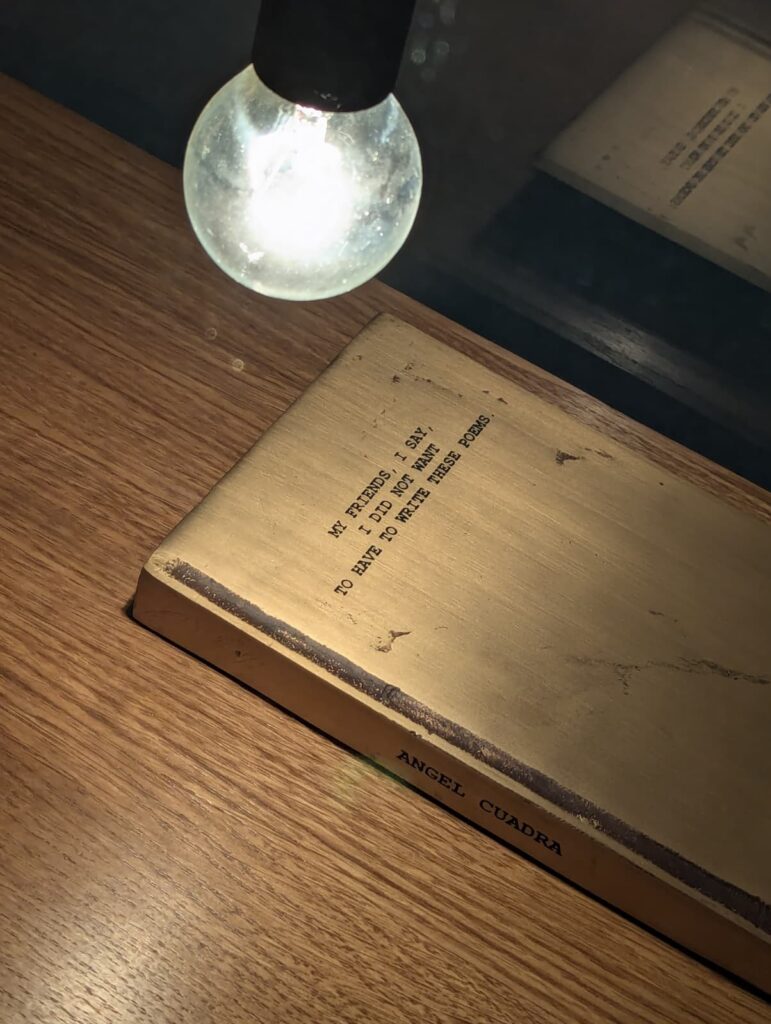
“Typography is kept at the treshold of verse” (Matore, 2023).

In dem Buch the graphics of verse experimental typography in twentieth century poetry beschäftigt sich Daniel Matore damit, wie Poetry durch Print zu einer visuellen Erfahrung wurde und wie die unterschiedliche Nutzung von Typografie dies im Beszug auf Aspekte wie Layout, Sound und Struktur beeinflusst hat (Matore, 2023). Außerdem wird hier argumentiert, dass Typografie zu Beginn des Druckes sehr konservativ ausgerichtet war. Es ging hierbei mehr um die Funktionalität des Textes und der Leitsatz “Gute Typografie fällt nicht auf” ist Gang und Gebe. Laut Morison (1967), bewegt sich Typografie mit der Geschwindigkeit des konservativsten Lesers. Auch die modernen Bewegungen im 20. Jahrhhundert wie Bauhaus oder Tschichold sehen Typografie eher als funktional und rational an. Es wird als Werkzeug der Informationsübertragung genutzt und designed.

Das Buch stellt dies dann einiger Dichter gegenüber, welche ohne Typografieasubildung in den Druck iherer Poesie geworfen wurden. Da natürlich kein Verständnis von Regeln vorhanden war, konnte hier viel freier und vielleicht auch kreativer mit der Gestaltung umgegangen werden – Resultat sind zerbrochene Syntax, Störung der Lesbarkeit, visuelle Anordnung von Wörtern oder variable Abstände. Typographie nimmt also als Gestaltungsmittel Form an und ist Teil der Kunst und des Gedichts. Das Schriftbild ist ein wichtiger Teil davon, wie das Gedicht aufgenommen wird.

Matore kritisiert hier also die funktionale Typografie und zeigt auf, dass es gerade für Literatur, Poesie und “künstlerische” Texte keine messbare Funktion gibt (Matore, 2023).

LS3 #8 Sweeter than Honey

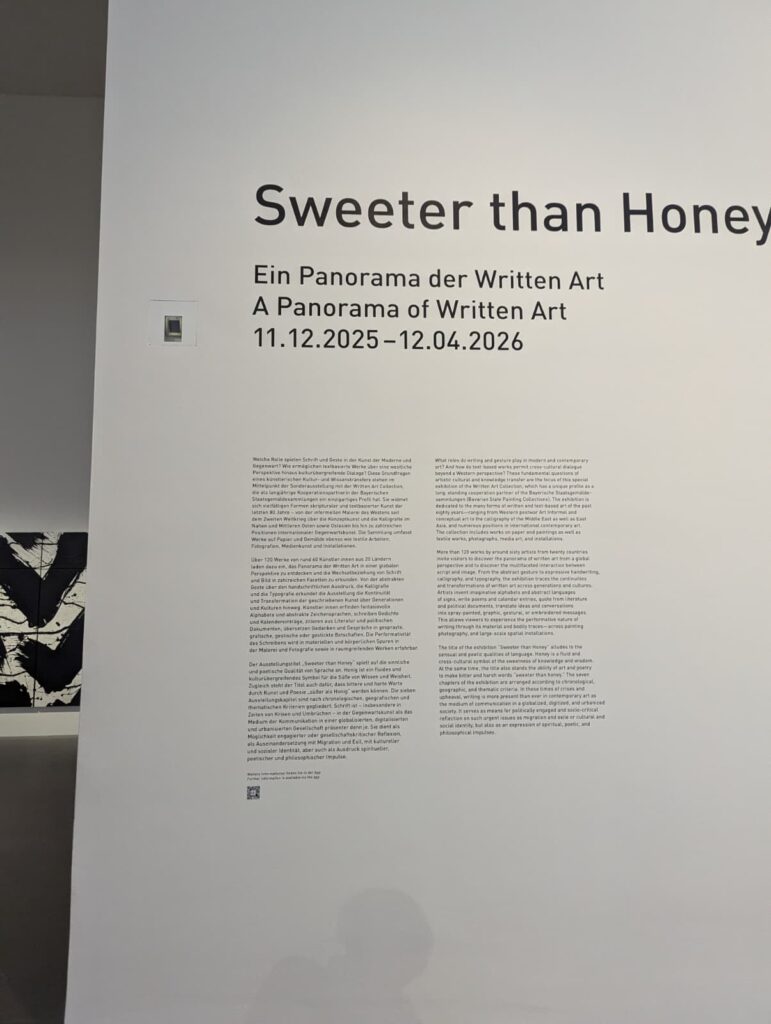
Ich war jetzt am Wochenende in München eine Freundin besuchen. Wir sind dann in der Ausstellung “Sweeter than Honey – Ein Panorama der Written Art” in der Pinakothek der Moderne gewesen. Ich habe meine Impuls Beiträge alle schon durch, deswegen nutze ich das hier jetzt einmal als Inspiration für meine Masterarbeit und als normalen Blogpost.

In der Ausstellung geht es um verschiedene Aspekte zwischen Schrift, Bild und Geste in der modernen Kunst und zeigt eine Sammlung verschiedener Werke von ca. 60 Künstler:innen aus verschiedenen Ländern um eine globale Perspektive zu schaffen. Die zwei wesentlichen Fragen, die hierbei gestellt werden, sind:

Welche Rolle spielen Schrift und Geste in der Kunst der Moderne und Gegenwart?

Wie ermöglichen textbasierte Werke über eine westliche Perspektive hinaus kulturübrgreifende Dialoge?

Spannend finde ich auch die Interpretation des Titels. “Sweeter than Honey” also Süßer als Honig kann als Symbol für die Süße von Wissen und Weisheit stehen, aber eben auch aufzeigen, dass harte Realität auch durch Kunst und schöne Worte “süß” werden kann. Diesen Ansatz fand ich spannend, da ich die Theamtik eventuell auch in meiner Masterarbeit aufgreifen möchte. Wie kann Wortspiel und Taktik verwendet werden, um etwas eventuell aus dem Kontext heraus darzustellen oder anders wirken zu lassen und wie ist das messbar?

In der Ausstellung wurden unter anderem auch einige arabische und persische Werke präsentiert. Da ich die Sprache nicht kann bzw. bisher auch wenig Berührungspunkte damit hatte, fand ich es auch hier sehr interessant die Beschreibungen der Werke zu lesen und zu verstehen. Dort wurde erklärt, dass Buchstaben eben nicht nur neutrale Träger von sprachlichen inhalten ist, sondern auch die Erscheinungsform bzw Art der Darstellung eine wichtige Bedeutung trägt oder tragen kann. text funktioniert hier also als Text so wie als Bild. Oft werden Schriftzüge mit floralen oder geometrischen Ornamenten verknüpft und fungieren so auch als darstellendes Bild trotz eigentlich nützlicher Funktion.

Ein anderes für mich inspirierendes Werk der Ausstellung ist der “Room with all existing words”. Mark Manders hat als Projekt eine Zeitung erschaffen, welche mit korrekter Grammatik jedes Wort des englischen Dictionaries einmal nennt (Zeiten vor AI lol). Ich finde das Projekt irgendwie so simpel und wirkürlich, was es gleichzeitig so interessant macht. Ich hab kaum etwas verstanden, wenn ich mir mal einen Absatz durchgelesen habe, sodass ich mich direkt gefreut hab, wenn mal ein Wort kam, was ich verstanden hab. Und es hat mir irgendwie wieder gezeigt, was man eigentlich alles mit Wörtern und Sprache machen kann.

Literaturverzeichnis

Pinakothek der Moderne. (09.02.2025). Sweeter than Honey [Exhibition]. Munich, Germany. 

TR #8 The AIDS Crisis and Queer Representation in the Balkans

The AIDS crisis shaped queer communities globally, but in the Balkans it overlapped with war, sanctions, and political chaos.

Healthcare systems were collapsing. Information was limited. Stigma was intense.

Photography from this period sometimes carries that weight. You see fragility. Hospital visits. Activist posters. Intimate portraits that feel almost like quiet memorials.

But you also see solidarity.

Friends caring for each other. Community meetings. Protest signs demanding visibility and support.

The camera becomes both witness and activist.

AIDS photography isn’t just about illness. It’s about care networks. About refusing to let people disappear quietly.

In a region already overwhelmed by conflict, queer suffering could easily be ignored. But these images insist on attention.

They ask us to look — and not look away.

Impuls #8 Llum Barcelona

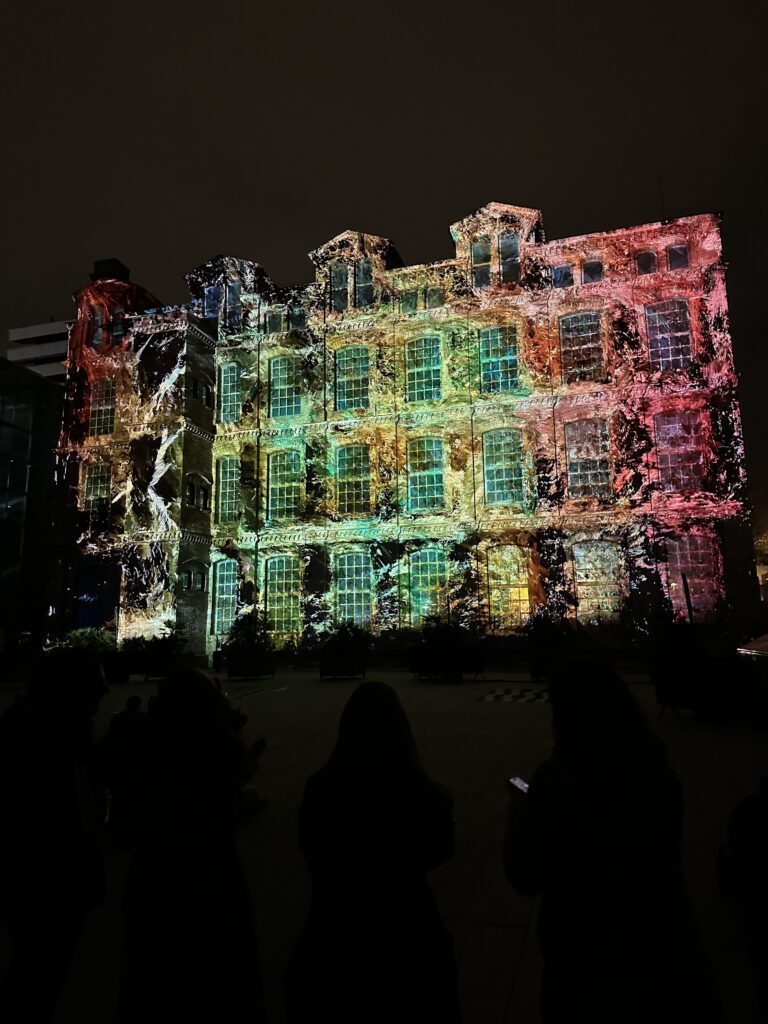
I traveled to Barcelona to see the Llum Festival (among other things). I was curious about it and the art. Even though the festival is mainly focused on media art and light installations, I still found a lot of inspiration there. It showed me new ways of thinking about space, atmosphere, and how art can change the feeling of a city at night.

The Llum Festival is an annual light and media art festival that takes place in Barcelona, mainly in the Poblenou area. For a few nights, streets, buildings, and public spaces are transformed by light installations, projections, and digital artworks created by artists, designers, and architecture schools. Many of the works play with technology, movement, sound, and interaction. It’s very similar to Klanglicht in Graz.

In this article, I want to capture the moments and installations that stayed with me the most. These were the pieces that caught my attention, sparked ideas, or simply made me stop and look for a little longer.

The Rhythmen of the Ocean

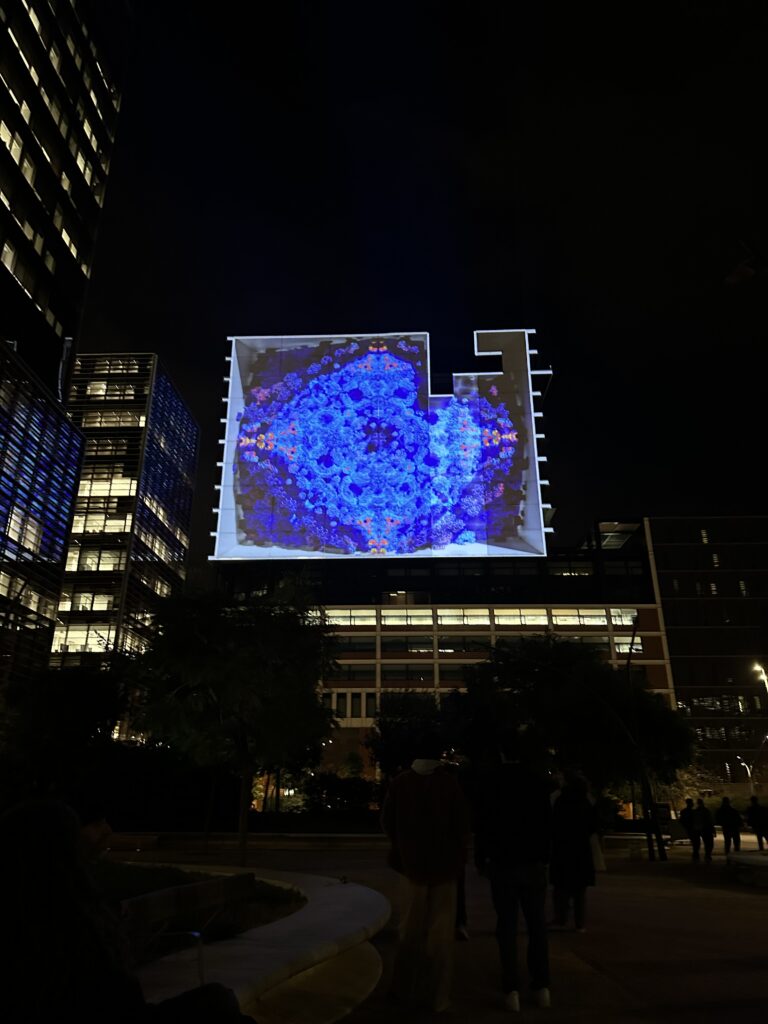
One of my absolute favorite installations at the Llum Festival was “The Rhythm of the Ocean” by the visual studio Desilence, paired with music by composer Suzanne Ciani. This piece stood out immediately because it used a big open space in a powerful way, making the message feel immersive and meaningful. I really liked the flowing visuals and sound that moved like waves around you, it was very magical. It felt like you were inside the ocean and reminded me of Atlantis.

What I liked most was that the installation wasn’t only visually impressive, but also meaningful. Toward the end, text was projected that explained how much waste ends up in the ocean every day and how this pollution affects our environment. By using such a big surface and clear text at the end, the artists made sure the message couldn’t be ignored. For me, this combination of scale, movement, and environmental awareness is what made this installation one of my favorites at the festival.

Mantra Intervention

Another installation I really enjoyed was “Mantra Intervention” by the creative duo STUDIO MO:YA (designers Roland Mariacher and Werner Huber) presented as part of the Llum Festival’s main programme. And you might remember their names, because Moya is based in Graz and also participated at Klanglicht. And to be honest, they were definitely one of the best installations at the festival.

It was an interactive and generative piece that immediately drew me in because it let visitors participate with the art. At one screen, people could change the colours themselves, and brightly rectangles would pulse and lighten up to the rhythm of the music. What made it especially fascinating was watching how the piece constantly recalculated and evolved in real time, so no two moments looked the same, it was always shifting. This mix of interaction, generative visuals, and live rhythm made Mantra Intervention one of the most memorable parts of my visit. 

Bulla

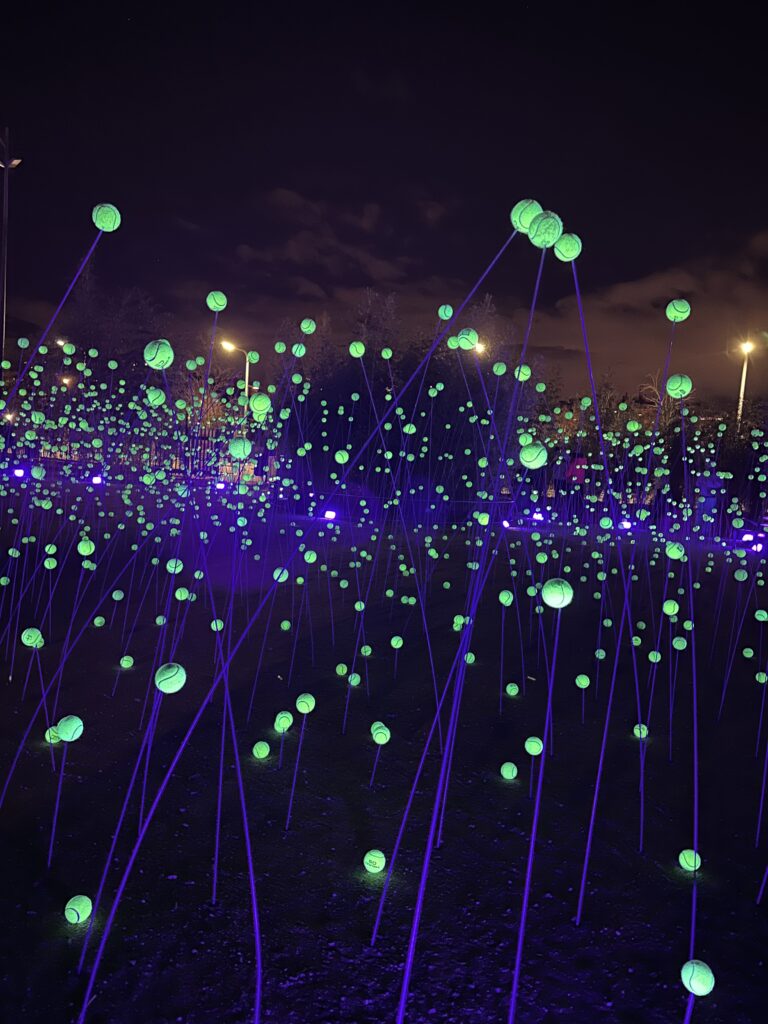
Another installation that I really liked was “Bulla” by Lola Solanilla. This piece was set up in the Àgora Berta Cáceres in Parc de les Glòries (next to Off- Area if you remember). Walking into it felt almost like stepping into a mystical, magical world. The work was made up of almost 4,000 luminous spheres (Golfballs on rods) suspended over a large area, creating a soft, dreamlike landscape of light that you could walk around. 

What I liked most about “Bulla” was the vibe it had this unreal, almost enchanted atmosphere that made the space feel a bit mysterious. The play of light and shadows, and how the spheres floated above the ground, made it feel like you were in some kind of glowing cosmic field.

The whispering Mountains

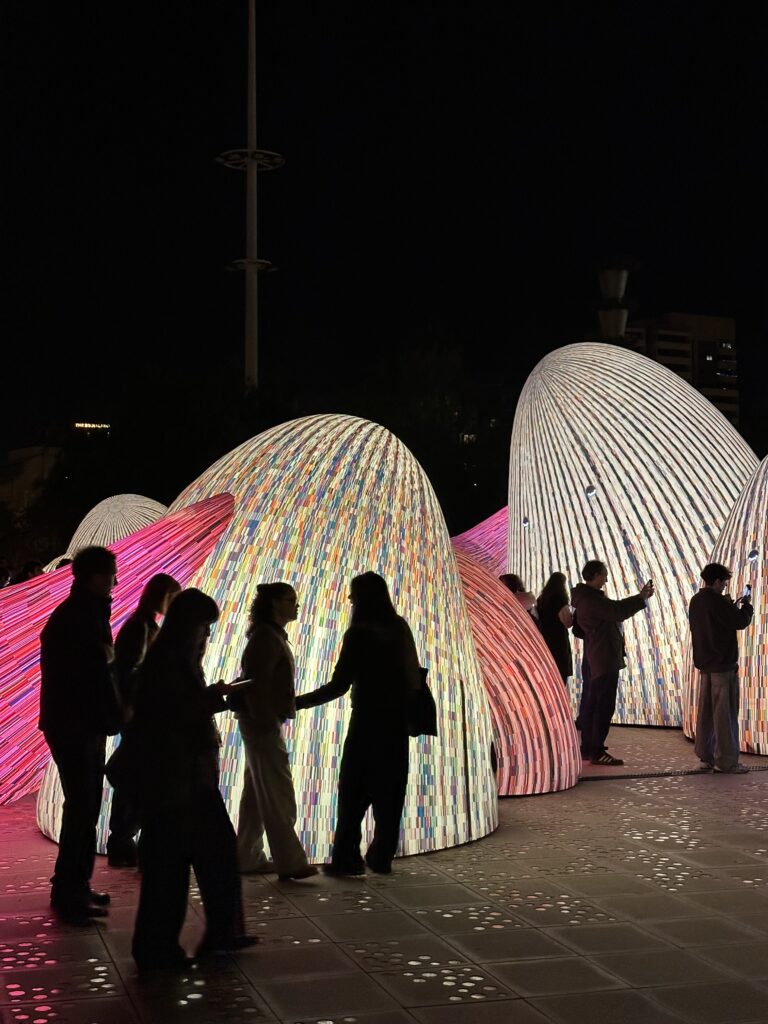
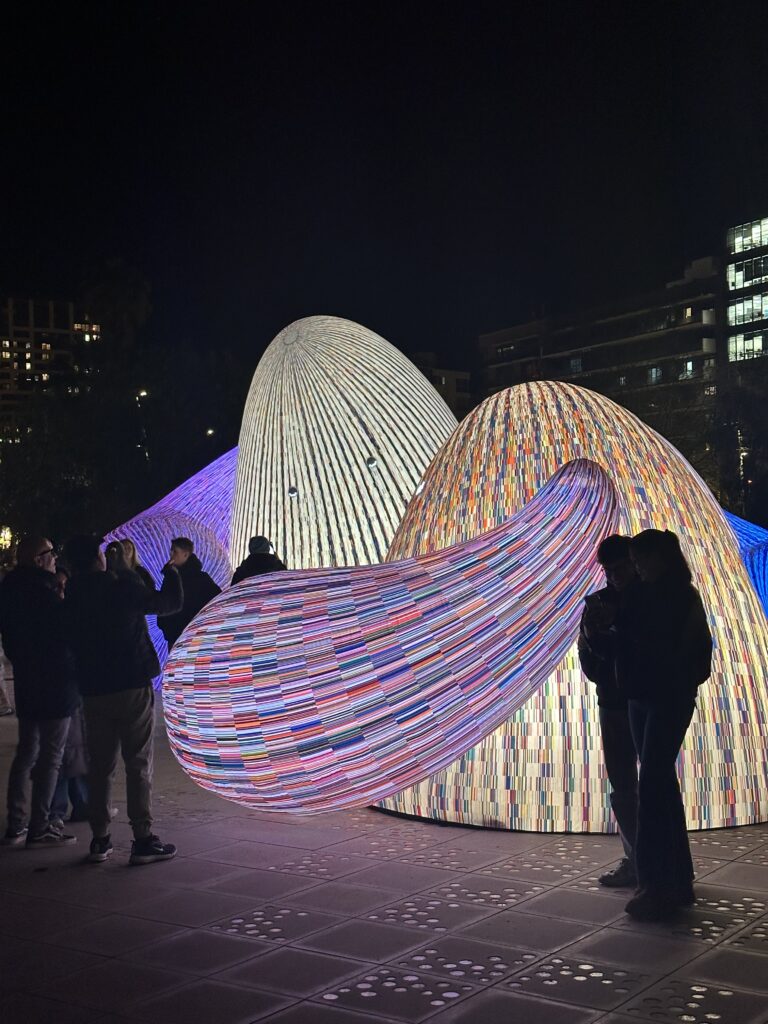
Another piece I really liked at the Llum Festival was “The Whispering Mountains” by ENESS. This installation used inflatable sculptures spread out in the Parc del Centre del Poblenou, and the whole vibe felt really cool and magical. Walking among and through these soft, glowing shapes gave the space a kind of playful, other‑worldly feeling. 

I especially enjoyed this installation because it felt alive, the shapes and light looked almost like friendly creatures with eyes blinking and subtle movements that gave them emotion. This cute, expressive quality made the artwork feel personal and engaging, not just a static display of light. For me, that artistic approach was one of the reasons “The Whispering Mountains” stood out as one of the best installations at the festival.

Final Thoughts

Overall, I found the Llum Festival very beautiful and interesting. Even as a Communication Designer, it was a great source of input and inspiration. The professional installations were impressive and really cool. But to be honest, compared with Klanglicht, I had expected a bit more from Barcelona. (After all, it’s a huge city with a strong design background). While there were some truly amazing pieces, there were also many installations by students that sometimes felt rushed or not fully thought out (not just student installation felt like this). I also noticed that some works might have been even more striking if it had been darker overall, but the city itself is already quite brightly lit at night, which limited the effect in some areas.

Still, despite these small points, I’m really glad I went. All in all, it was a very beautiful and inspiring experience, and it gave me plenty to think about and reflect on creatively.

TR #7 Lesbian Visibility and Invisibility in 90s Photography

Lesbian representation often gets erased — especially in post-socialist contexts. Gay male imagery was sometimes more visible, even if still marginalized. But lesbians? Even more hidden.

So when we find photographs of lesbian couples, friends, activists — they feel precious.

Many images are subtle. Two women sitting close. Hands almost touching. A look that lingers a bit too long. There’s often ambiguity.

And maybe that ambiguity was intentional.

In a hostile environment, subtlety can be protective. You don’t always need spectacle to be queer. Sometimes queerness lives in small gestures.

But invisibility also hurts. When there are fewer images, it becomes harder to build historical narratives. That’s why these photographs matter so much. They fill gaps.

They remind us that lesbian lives existed, loved, organized, created.

Even when the archive is small, it speaks loudly.

TR #6 Gay Men, War, and the Camera

Post-socialist masculinity in the Balkans was intense. Nationalist propaganda glorified soldiers, strength, aggression. The ideal man was tough, patriotic, heterosexual. So where did that leave gay men?

Queer photography complicates this image. You see men who are soft, intimate, playful. Men holding each other. Men posing in ways that challenge militarized masculinity.

That contrast is powerful.

Some photographs feel almost tender in a political way. Two men touching gently in a society obsessed with hardness? That’s radical.

At the same time, not all queer men rejected masculinity. Some played with it. Leather aesthetics. Hyper-masculine poses. It wasn’t always about softness — sometimes it was about reclaiming masculinity on different terms.

Photography becomes a space to experiment.

In a time when the state was defining what a “real man” should be, queer images said: actually, masculinity can look like this too.

And that’s a huge statement. <3

TR #5 Nightclubs, Basements, and Safe Spaces

A lot of queer photography from this period doesn’t happen in public squares. It happens in basements. In small clubs. In dimly lit apartments.

Safe spaces weren’t trendy buzzwords back then. They were necessary.

Nightclubs became temporary utopias. For a few hours, you could dance, flirt, perform, experiment. Outside, the city might be tense, nationalist, violent. Inside, there was music and sweat and freedom.

The camera loved these spaces.

Flash photography in dark rooms creates dramatic contrasts. Glitter reflects light. Faces glow in the darkness. There’s something almost cinematic about it.

These spaces weren’t perfect. They were fragile. Raids could happen. Gossip could spread. But they allowed queer communities to exist physically together.

And photography turned those moments into memory.

When you look at those images today, you’re not just seeing people dancing. You’re seeing survival. You’re seeing community being built in real time.

Those basements were more than party spots. They were laboratories of identity. And the camera was always there, quietly documenting.

TR #4 Visibility vs. Vulnerability

Visibility sounds like a good thing, right? We always say representation matters. But in the 1990s Balkans, being visible as queer could be dangerous.

So what does it mean to pose for a photograph in that context?

Every image carries risk. If a photo circulates publicly, it could expose someone to violence, rejection, or job loss. But at the same time, invisibility erases you completely.

That tension — visibility versus vulnerability — lives inside these photographs.

Some images feel bold. Direct eye contact. Strong posture. Almost confrontational. Others feel softer, more hesitant. You can sometimes sense the awareness of danger.

But that’s what makes them powerful.

The queer body becomes both fragile and defiant at the same time. And photography amplifies that duality. The body is framed, lit, frozen — but it also looks back.

There’s something deeply intimate about being photographed by someone who understands you. Many of these images were taken within the community. That changes the dynamic completely. It’s not voyeurism. It’s collaboration.

Visibility in post-socialist Yugoslavia wasn’t just about pride. It was about negotiating safety. Deciding when to appear. When to hide. When to trust the lens.

And somehow, those photographs still radiate courage.

TR #3 Susan Sontag and the Politics of L00king

Susan Sontag once wrote that to photograph is to appropriate. And honestly? That line hits differently when you think about queer bodies in post-socialist Yugoslavia.

Photography isn’t neutral. It never was.

Who gets photographed? Who is visible? Who controls the image? Those questions matter, especially in societies where queer people were pushed to the margins. In the 1990s Balkans, mainstream media rarely showed queer life — unless it was framed as scandal or deviance.

So when queer photographers documented their own communities, something shifted.

Sontag talks about how photographs shape reality rather than just reflect it. That’s exactly what happened here. The act of photographing queer people in nightclubs, apartments, protests — it wasn’t passive documentation. It was political.

The camera became a tool of survival.

But Sontag also warns us: looking can be a form of power. So we have to ask — who is behind the camera? Is it a queer insider? Or an outsider exoticizing?

In post-socialist contexts, this tension becomes even sharper. Western media often portrayed the Balkans as violent, backward, hyper-masculine. Queer photography disrupts that narrative. It complicates it. It says: yes, there is nationalism and war — but there is also softness, intimacy, glitter, and chosen family.

Photography doesn’t just show reality. It builds archives. And archives shape history.

Sontag helps us see that every image of a queer body in that time wasn’t accidental. It was loaded.

Looking is political. Being seen is political. And choosing how to be seen? That might be the most radical act of all.

TR #2 Drag Queens in the great Yugo

When people think about drag culture, they usually imagine glitter, RuPaul, big stages, maybe New York or Berlin. But what about Belgrade in the 1990s? Or Zagreb? Or Ljubljana right after socialism collapsed?

Drag in post-socialist Yugoslavia wasn’t just about performance. It wasn’t just about entertainment. It was survival. It was rebellion. And honestly? It was art in its rawest form.

The 1990s in the Balkans were chaotic. Yugoslavia dissolved. Wars broke out. Nationalism intensified. Public spaces became hyper-masculine, militarized, and deeply conservative. The idea of “proper” gender roles became even stricter. Men were supposed to be soldiers. Women were supposed to be mothers. And anyone outside that binary? Invisible — or worse.

So imagine doing drag in that environment.

Photography becomes incredibly important here. Because even when performances were underground — happening in clubs, private apartments, hidden parties — the camera captured proof. Not just proof that it happened, but proof that queer joy existed in the middle of violence and political collapse.

There’s something powerful about seeing a drag queen posing confidently in a space that politically didn’t want her to exist. The photograph freezes that moment. It says: “We were here.”

And what I find fascinating is how these photos often mix vulnerability and strength. You’ll see exaggerated femininity — wigs, dramatic makeup, heels — but also tension. Sometimes the background reveals peeling walls, dim lighting, makeshift stages. These weren’t polished Western drag scenes. They were improvised, local, specific.

Drag became a way to exaggerate gender so much that it exposed how fake gender already is. In a society obsessed with “real men” and “real women,” drag said: okay, let’s push that to the extreme. Let’s make it theatrical. Let’s make it absurd.

And photography amplified that message.

Because once something is photographed, it becomes harder to erase. Even if mainstream media ignored queer lives, these images circulated — sometimes privately, sometimes in alternative magazines, sometimes later in exhibitions. They created a visual memory.

What also strikes me is the intimacy of some of these photos. Not all drag photography from that era is about spectacle. Some images show performers backstage, removing makeup, smoking, laughing, looking tired. Those photos feel almost more radical. They show the human behind the persona.

In post-socialist societies, where identity was already being renegotiated (national identity, political identity, cultural identity), drag added another layer. It questioned gender at the exact moment when everything else was also unstable.

And maybe that’s why it feels so powerful.

Drag in post-socialist Yugoslavia wasn’t imported culture. It wasn’t imitation. It grew from local conditions — war, censorship, underground art scenes, economic crisis. It carried that tension in its aesthetics.

The camera didn’t just document drag. It collaborated with it.

The pose, the gaze, the defiance — they were all intensified by knowing the image might survive longer than the night itself.

Looking at these photographs today feels emotional. They’re not just pretty or edgy. They’re historical documents. They show that queerness didn’t suddenly “arrive” in the Balkans in the 2000s. It was always there. It was just pushed to the margins.

And honestly? That makes those glittery, defiant faces even more iconic.