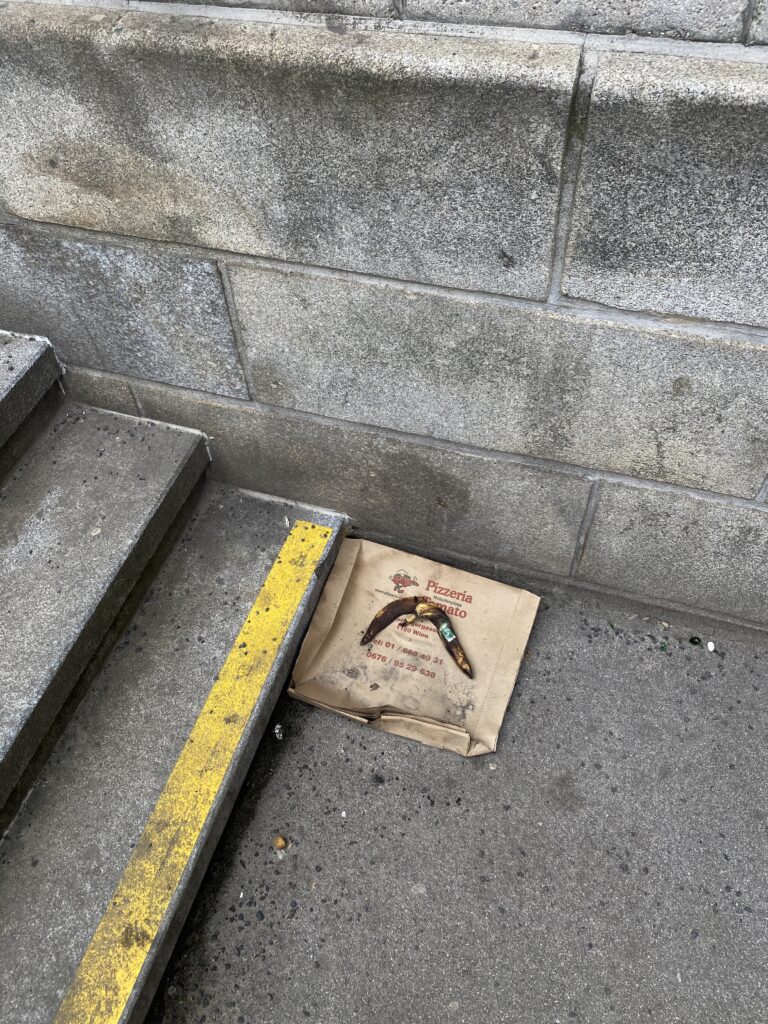
As I continue documenting these small scenes, these frozen moments of unplanned composition, I’m realizing how much they mirror the act of photography itself: a moment held in place, briefly meaningful, before it disappears. Some installations I find are funny. Some feel tragic. Some are just confusing. But all of them whisper something, even if I don’t always know what.
Here are two recent finds. Both from the same day in Graz, one in the morning on my way to university, and one in the evening, just outside my apartment.
Observation 1:
Graz – near university
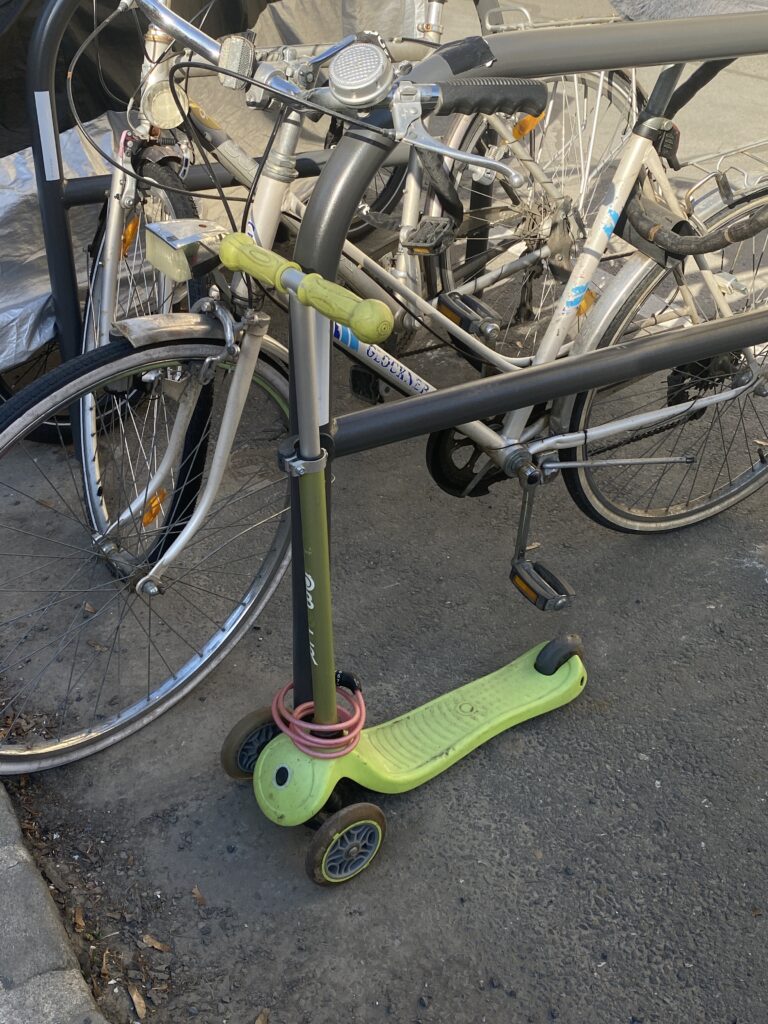
A small child’s scooter, lime green, plastic, low to the ground. It’s locked with a heavy-duty adult bike lock to a thick black metal railing, surrounded by full-sized bicycles. At first glance, it’s funny. Almost absurd. Who’s going to steal a toddler’s scooter? Is it really necessary to protect it like a prized vehicle? But then I paused, and the image changed.
There’s a tension here. Between play and control.
The scooter is a symbol of freedom, of chaotic childhood energy. Something designed to move, to glide, to roll fast and fall hard. But here, it’s immobilized, chained to the structure of grown-up life surrounded by gears, spokes, regulations. It’s being treated like a real object, forced into the system of locks and fears. On one hand, the lock says “I care about this.” But on the other, it says “You can’t go anywhere.” Is this about safety or control? It’s like the scooter knows it was meant to move, and now it waits. A toy, arrested in motion. Childhood, on hold. Or maybe I’m projecting. Maybe it’s just locked up so a kid doesn’t scream about their missing scooter. That’s the thing about these moments: they leave just enough room for you to wonder.
Observation 2:
Graz – evening, outside my apartment
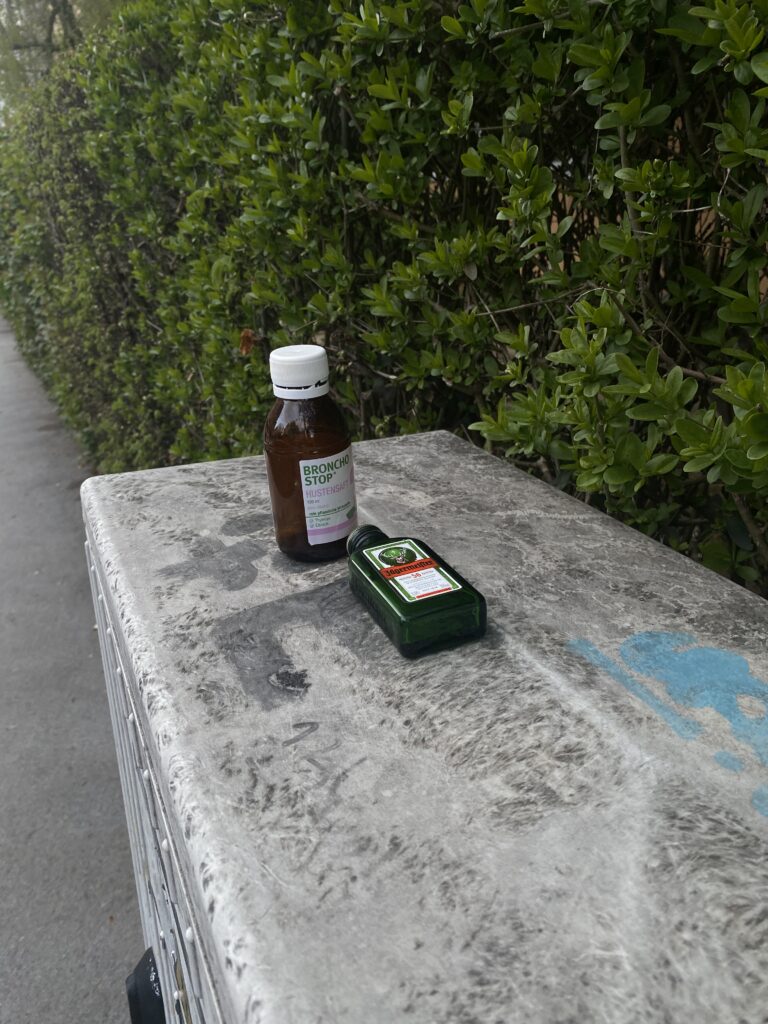
Two bottles on a scratched-up electricity box on a sidewalk. One Bronchostop, a cough syrup. The other Jägermeister, a dark herbal liqueur that’s usually anything but medicinal. The arrangement is almost too good. So perfectly misplaced that it feels staged. Was it a coincidence? Or a statement?
It’s one of my favorite finds so far because it’s so loaded with contradiction and yet it’s silent. It doesn’t explain itself. But the metaphors are loud. There’s something incredibly human about these two bottles standing next to each other. One is meant to heal, the other to numb. One comes from the pharmacy, the other from the bar. But both get poured into your body when something doesn’t feel right.
It made me wonder:
Was this someone trying to take care of themselves, but giving up halfway through the effort?
Or someone who mixed both on purpose, convinced that health and hedonism don’t have to cancel each other out?
Maybe the Jäger came after the Bronchostop. Maybe it came before. Maybe they belonged to two different people, and this is just the city making art while no one’s watching. But there’s also a strange sense of sadness here. Like someone meant to fix something, but didn’t get there. The bottles feel abandoned, like forgotten decisions.